

Scope Of
Training
Course Co-ordinator:
Dr. Neetu Kushwaha
Topic to be Covered:
2
⦁ Shadowing Training
⦁ Management Development Programs
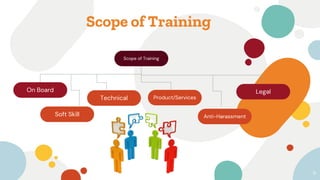
⦁ Scope of Training:
 On Board
 Soft Skills
 Technical
 Product/Services
 Anti-Harassment
 Legal
Shadowing Training
Job shadowing is a type of on-the-job
training that allows an interested
employee to follow and closely observe
another employee performing the role.
This type of learning is usually used to
onboard new employees into an
organization or into a new role. Job
shadowing may also be used as a learning
opportunity for interns or students to
gain an understanding of the role
requirements and the job tasks.
3
4
Management Development Programs
 Development is different from training. While training improves skills of a
person in the present job, development improves his skills in future jobs.
 Development enables a person to assume jobs of higher skill, competence
and responsibility.
 Development is the "long-term training designed to increase an employee's
job effectiveness and to develop his or her ability to assume greater job
responsibilities“.
 Development prepares people to assume jobs with higher responsibilities in
the future
 Training is, thus, related to the current job that a person is performing.
Development improves his ability to perform present and future jobs with
greater competence and skill.
 Training increases the skill while development shapes attitude.
 Development is a step further than training
5
Need for Development
 Improves knowledge, skills and attitudes of
a person and makes him effective on the job.
 It prepares a person to assume jobs with
higher skills and competence.
 It leads to individual growth and
organizational effectiveness.
 It identifies creativity and potential for
innovation and makes people competent to
hold jobs that require special talents
 It promotes career development, managerial
and communication skills of people.
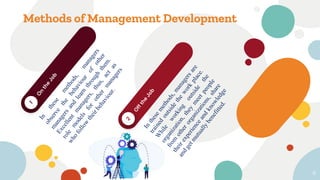
Methods of Management Development
6
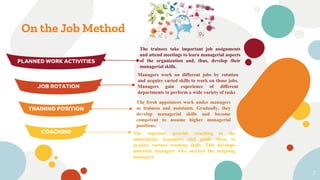
On the Job Method
7
PLANNED WORK ACTIVITIES
TRAINING POSITION
JOB ROTATION
COACHING The superiors provide coaching to the
subordinate managers and guide them to
acquire various working skills. This develops
potential managers who succeed the outgoing
managers
Managers work on different jobs by rotation
and acquire varied skills to work on those jobs.
Managers gain experience of different
departments to perform a wide variety of tasks
The fresh appointees work under managers
as trainees and assistants. Gradually, they
develop managerial skills and become
competent to assume higher managerial
positions.
The trainees take important job assignments
and attend meetings to learn managerial aspects
of the organization and, thus, develop their
managerial skills.
8
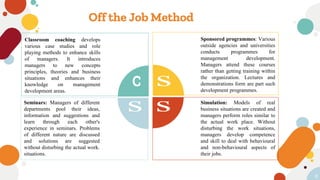
Off the Job Method
Classroom coaching develops
various case studies and role
playing methods to enhance skills
of managers. It introduces
managers to new concepts
principles, theories and business
situations and enhances their
knowledge on management
development areas.
Sponsored programmes: Various
outside agencies and universities
conducts programmes for
management development.
Managers attend these courses
rather than getting training within
the organization. Lectures and
demonstrations form are part such
development programmes.
Seminars: Managers of different
departments pool their ideas,
information and suggestions and
learn through each other's
experience in seminars. Problems
of different nature are discussed
and solutions are suggested
without disturbing the actual work.
situations.
Simulation: Models of real
business situations are created and
managers perform roles similar to
the actual work place. Without
disturbing the work situations,
managers develop competence
and skill to deal with behavioural
and non-behavioural aspects of
their jobs.
Scope of Training
9
Scope of Training
Legal
On Board
Soft Skill
Technical Product/Services
Anti-Harassment
10
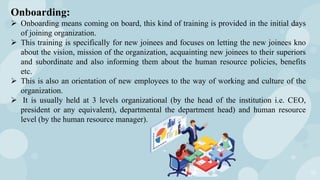
Onboarding:
 Onboarding means coming on board, this kind of training is provided in the initial days
of joining organization.
 This training is specifically for new joinees and focuses on letting the new joinees kno
about the vision, mission of the organization, acquainting new joinees to their superiors
and subordinate and also informing them about the human resource policies, benefits
etc.
 This is also an orientation of new employees to the way of working and culture of the
organization.
 It is usually held at 3 levels organizational (by the head of the institution i.e. CEO,
president or any equivalent), departmental the department head) and human resource
level (by the human resource manager).
11
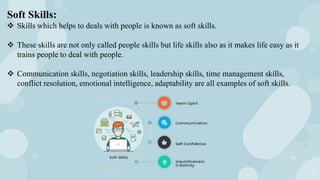
Soft Skills:
 Skills which helps to deals with people is known as soft skills.
 These skills are not only called people skills but life skills also as it makes life easy as it
trains people to deal with people.
 Communication skills, negotiation skills, leadership skills, time management skills,
conflict resolution, emotional intelligence, adaptability are all examples of soft skills.
12
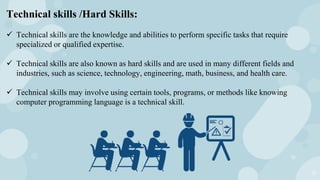
Technical skills /Hard Skills:
 Technical skills are the knowledge and abilities to perform specific tasks that require
specialized or qualified expertise.
 Technical skills are also known as hard skills and are used in many different fields and
industries, such as science, technology, engineering, math, business, and health care.
 Technical skills may involve using certain tools, programs, or methods like knowing
computer programming language is a technical skill.
13
Product and Service:
 Some job profiles require training on product and services, like banking officials are given
training on products and services for instance when a new systematic investment plan
introduced by a bank, the banking officials are training about the SIP (its features,
advantages, comparison with other sips, process to invest in the sip.
Legal:
 Employees should also be informed of the legal issues and aftermath of these kinds of
challenges. The legal aspects/ aftermath related to such issues should be introduced in the
training programs so that employees are aware about the repercussions of such a behavior.
14
Anti-Harassment:
 As workforce diversity has become very important due to the diverse workforce
(male, females transgender, specially abled, single (divorced/ widowed parent) people
from different regions, religions, countries etc.), many companies have introduced
anti-harassment policies.
 An anti-harassment policy aims to address and prevent antagonistic situations that
violate the dignity of employees. It pertains to single or repeated incidents of
intimidation, humiliation, degradation, bullying, or other undesirable verbal, non-
verbal, or physical conduct toward one person or a group of people. Therefore,
regular training for Anti-Harassment should be conducted by the organization.
15

Scope of Training.pptx

  • 1.
  • 2.
    Topic to beCovered: 2 ⦁ Shadowing Training ⦁ Management Development Programs ⦁ Scope of Training:  On Board  Soft Skills  Technical  Product/Services  Anti-Harassment  Legal
  • 3.
    Shadowing Training Job shadowingis a type of on-the-job training that allows an interested employee to follow and closely observe another employee performing the role. This type of learning is usually used to onboard new employees into an organization or into a new role. Job shadowing may also be used as a learning opportunity for interns or students to gain an understanding of the role requirements and the job tasks. 3
  • 4.
    4 Management Development Programs Development is different from training. While training improves skills of a person in the present job, development improves his skills in future jobs.  Development enables a person to assume jobs of higher skill, competence and responsibility.  Development is the "long-term training designed to increase an employee's job effectiveness and to develop his or her ability to assume greater job responsibilities“.  Development prepares people to assume jobs with higher responsibilities in the future  Training is, thus, related to the current job that a person is performing. Development improves his ability to perform present and future jobs with greater competence and skill.  Training increases the skill while development shapes attitude.  Development is a step further than training
  • 5.
    5 Need for Development Improves knowledge, skills and attitudes of a person and makes him effective on the job.  It prepares a person to assume jobs with higher skills and competence.  It leads to individual growth and organizational effectiveness.  It identifies creativity and potential for innovation and makes people competent to hold jobs that require special talents  It promotes career development, managerial and communication skills of people.
  • 6.
    Methods of ManagementDevelopment 6
  • 7.
    On the JobMethod 7 PLANNED WORK ACTIVITIES TRAINING POSITION JOB ROTATION COACHING The superiors provide coaching to the subordinate managers and guide them to acquire various working skills. This develops potential managers who succeed the outgoing managers Managers work on different jobs by rotation and acquire varied skills to work on those jobs. Managers gain experience of different departments to perform a wide variety of tasks The fresh appointees work under managers as trainees and assistants. Gradually, they develop managerial skills and become competent to assume higher managerial positions. The trainees take important job assignments and attend meetings to learn managerial aspects of the organization and, thus, develop their managerial skills.
  • 8.
    8 Off the JobMethod Classroom coaching develops various case studies and role playing methods to enhance skills of managers. It introduces managers to new concepts principles, theories and business situations and enhances their knowledge on management development areas. Sponsored programmes: Various outside agencies and universities conducts programmes for management development. Managers attend these courses rather than getting training within the organization. Lectures and demonstrations form are part such development programmes. Seminars: Managers of different departments pool their ideas, information and suggestions and learn through each other's experience in seminars. Problems of different nature are discussed and solutions are suggested without disturbing the actual work. situations. Simulation: Models of real business situations are created and managers perform roles similar to the actual work place. Without disturbing the work situations, managers develop competence and skill to deal with behavioural and non-behavioural aspects of their jobs.
  • 9.
    Scope of Training 9 Scopeof Training Legal On Board Soft Skill Technical Product/Services Anti-Harassment
  • 10.
    10 Onboarding:  Onboarding meanscoming on board, this kind of training is provided in the initial days of joining organization.  This training is specifically for new joinees and focuses on letting the new joinees kno about the vision, mission of the organization, acquainting new joinees to their superiors and subordinate and also informing them about the human resource policies, benefits etc.  This is also an orientation of new employees to the way of working and culture of the organization.  It is usually held at 3 levels organizational (by the head of the institution i.e. CEO, president or any equivalent), departmental the department head) and human resource level (by the human resource manager).
  • 11.
    11 Soft Skills:  Skillswhich helps to deals with people is known as soft skills.  These skills are not only called people skills but life skills also as it makes life easy as it trains people to deal with people.  Communication skills, negotiation skills, leadership skills, time management skills, conflict resolution, emotional intelligence, adaptability are all examples of soft skills.
  • 12.
    12 Technical skills /HardSkills:  Technical skills are the knowledge and abilities to perform specific tasks that require specialized or qualified expertise.  Technical skills are also known as hard skills and are used in many different fields and industries, such as science, technology, engineering, math, business, and health care.  Technical skills may involve using certain tools, programs, or methods like knowing computer programming language is a technical skill.
  • 13.
    13 Product and Service: Some job profiles require training on product and services, like banking officials are given training on products and services for instance when a new systematic investment plan introduced by a bank, the banking officials are training about the SIP (its features, advantages, comparison with other sips, process to invest in the sip. Legal:  Employees should also be informed of the legal issues and aftermath of these kinds of challenges. The legal aspects/ aftermath related to such issues should be introduced in the training programs so that employees are aware about the repercussions of such a behavior.
  • 14.
    14 Anti-Harassment:  As workforcediversity has become very important due to the diverse workforce (male, females transgender, specially abled, single (divorced/ widowed parent) people from different regions, religions, countries etc.), many companies have introduced anti-harassment policies.  An anti-harassment policy aims to address and prevent antagonistic situations that violate the dignity of employees. It pertains to single or repeated incidents of intimidation, humiliation, degradation, bullying, or other undesirable verbal, non- verbal, or physical conduct toward one person or a group of people. Therefore, regular training for Anti-Harassment should be conducted by the organization.
  • 15.