Formative
Assessment
Centre régionale des métiers d’éducation et
de formation- CRMEF Inezgane, Morocco
Laura Greenstein’s book
Presented by:
Dalal Mourbit
Soumia Taki
Supervised by:
Mr. Ayad Chraa
Department of English
Module: Testing & Assessment
Outline
2
 Introduction
 Essential principles of formative assessment
 Using formative assessment
- Formative Assessment Prior to Instruction.
- Formative Assessment during Instruction.
- Formative Assessment after Instruction.
3
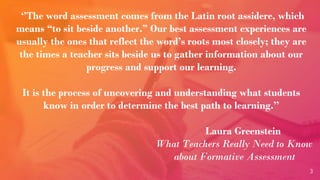
‘’The word assessment comes from the Latin root assidere, which
means “to sit beside another.” Our best assessment experiences are
usually the ones that reflect the word’s roots most closely; they are
the times a teacher sits beside us to gather information about our
progress and support our learning.
It is the process of uncovering and understanding what students
know in order to determine the best path to learning.’’
Laura Greenstein
What Teachers Really Need to Know
about Formative Assessment
4
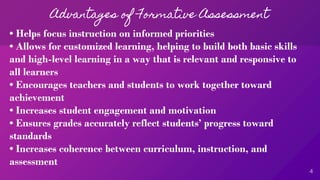
Advantages of Formative Assessment
• Helps focus instruction on informed priorities
• Allows for customized learning, helping to build both basic skills
and high-level learning in a way that is relevant and responsive to
all learners
• Encourages teachers and students to work together toward
achievement
• Increases student engagement and motivation
• Ensures grades accurately reflect students’ progress toward
standards
• Increases coherence between curriculum, instruction, and
assessment
5
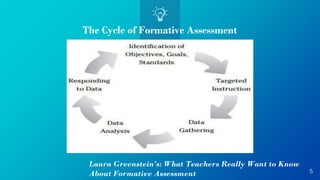
Laura Greenstein’s: What Teachers Really Want to Know
About Formative Assessment
The Cycle of Formative Assessment
6
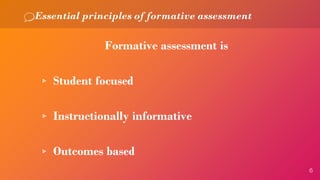
Formative assessment is
▹ Student focused
▹ Instructionally informative
▹ Outcomes based
Essential principles of formative assessment
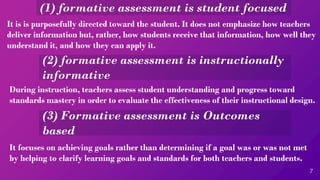
(1) formative assessment is student focused
7
It is is purposefully directed toward the student. It does not emphasize how teachers
deliver information but, rather, how students receive that information, how well they
understand it, and how they can apply it.
(2) formative assessment is instructionally
informative
During instruction, teachers assess student understanding and progress toward
standards mastery in order to evaluate the effectiveness of their instructional design.
(3) Formative assessment is Outcomes
based
It focuses on achieving goals rather than determining if a goal was or was not met
by helping to clarify learning goals and standards for both teachers and students.
8
Using Formative Assessment
9
▹ Teachers need information to make accurate
diagnoses and prescriptions for learning.
▹ Finding out what students know before
beginning instruction allows teachers to
focus teaching on what students haven’t yet
learned, avoiding redundancy.
▹ Pre-assessment results can also guide
teachers in determining the level of challenge
and difficulty each student needs and what
the final individual learning targets should
be.
Formative Assessment Prior to Instruction
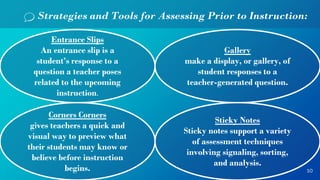
Corners Corners
gives teachers a quick and
visual way to preview what
their students may know or
believe before instruction
begins.
Entrance Slips
An entrance slip is a
student’s response to a
question a teacher poses
related to the upcoming
instruction.
Gallery
make a display, or gallery, of
student responses to a
teacher-generated question.
10
Strategies and Tools for Assessing Prior to Instruction:
Sticky Notes
Sticky notes support a variety
of assessment techniques
involving signaling, sorting,
and analysis.
11
Formative Assessment during Instruction:
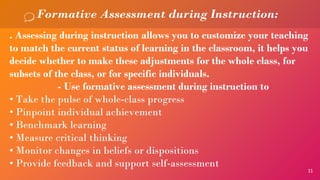
. Assessing during instruction allows you to customize your teaching
to match the current status of learning in the classroom, it helps you
decide whether to make these adjustments for the whole class, for
subsets of the class, or for specific individuals.
- Use formative assessment during instruction to
• Take the pulse of whole-class progress
• Pinpoint individual achievement
• Benchmark learning
• Measure critical thinking
• Monitor changes in beliefs or dispositions
• Provide feedback and support self-assessment
12
Tools and Strategies for Assessing During
Instruction
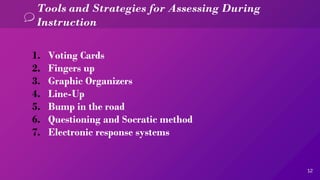
1. Voting Cards
2. Fingers up
3. Graphic Organizers
4. Line-Up
5. Bump in the road
6. Questioning and Socratic method
7. Electronic response systems
13
Formative Assessment after Instruction:
Use formative assessment after instruction to
• Identify remaining gaps in students’ knowledge, skills, or
understanding
• Determine the selection of final customized interventions
• Gain insight into the learning that has occurred
• Provide opportunities for thoughtful reflection
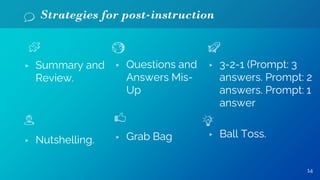
Strategies for post-instruction
14
▹ Summary and
Review.
▹ Nutshelling.
▹ 3-2-1 (Prompt: 3
answers. Prompt: 2
answers. Prompt: 1
answer
▹ Ball Toss.
▹ Questions and
Answers Mis-
Up
▹ Grab Bag
15
References:
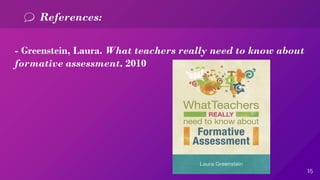
- Greenstein, Laura. What teachers really need to know about
formative assessment. 2010
thanks!
ANY QUESTIONS?
You can find us at:
dalalmourbit@gmail.com or
soumia.taki93@gmail.com
16

Formative Assessment - Laura Greenstein's book

  • 1.
    Formative Assessment Centre régionale desmétiers d’éducation et de formation- CRMEF Inezgane, Morocco Laura Greenstein’s book Presented by: Dalal Mourbit Soumia Taki Supervised by: Mr. Ayad Chraa Department of English Module: Testing & Assessment
  • 2.
    Outline 2  Introduction  Essentialprinciples of formative assessment  Using formative assessment - Formative Assessment Prior to Instruction. - Formative Assessment during Instruction. - Formative Assessment after Instruction.
  • 3.
    3 ‘’The word assessmentcomes from the Latin root assidere, which means “to sit beside another.” Our best assessment experiences are usually the ones that reflect the word’s roots most closely; they are the times a teacher sits beside us to gather information about our progress and support our learning. It is the process of uncovering and understanding what students know in order to determine the best path to learning.’’ Laura Greenstein What Teachers Really Need to Know about Formative Assessment
  • 4.
    4 Advantages of FormativeAssessment • Helps focus instruction on informed priorities • Allows for customized learning, helping to build both basic skills and high-level learning in a way that is relevant and responsive to all learners • Encourages teachers and students to work together toward achievement • Increases student engagement and motivation • Ensures grades accurately reflect students’ progress toward standards • Increases coherence between curriculum, instruction, and assessment
  • 5.
    5 Laura Greenstein’s: WhatTeachers Really Want to Know About Formative Assessment The Cycle of Formative Assessment
  • 6.
    6 Formative assessment is ▹Student focused ▹ Instructionally informative ▹ Outcomes based Essential principles of formative assessment
  • 7.
    (1) formative assessmentis student focused 7 It is is purposefully directed toward the student. It does not emphasize how teachers deliver information but, rather, how students receive that information, how well they understand it, and how they can apply it. (2) formative assessment is instructionally informative During instruction, teachers assess student understanding and progress toward standards mastery in order to evaluate the effectiveness of their instructional design. (3) Formative assessment is Outcomes based It focuses on achieving goals rather than determining if a goal was or was not met by helping to clarify learning goals and standards for both teachers and students.
  • 8.
  • 9.
    9 ▹ Teachers needinformation to make accurate diagnoses and prescriptions for learning. ▹ Finding out what students know before beginning instruction allows teachers to focus teaching on what students haven’t yet learned, avoiding redundancy. ▹ Pre-assessment results can also guide teachers in determining the level of challenge and difficulty each student needs and what the final individual learning targets should be. Formative Assessment Prior to Instruction
  • 10.
    Corners Corners gives teachersa quick and visual way to preview what their students may know or believe before instruction begins. Entrance Slips An entrance slip is a student’s response to a question a teacher poses related to the upcoming instruction. Gallery make a display, or gallery, of student responses to a teacher-generated question. 10 Strategies and Tools for Assessing Prior to Instruction: Sticky Notes Sticky notes support a variety of assessment techniques involving signaling, sorting, and analysis.
  • 11.
    11 Formative Assessment duringInstruction: . Assessing during instruction allows you to customize your teaching to match the current status of learning in the classroom, it helps you decide whether to make these adjustments for the whole class, for subsets of the class, or for specific individuals. - Use formative assessment during instruction to • Take the pulse of whole-class progress • Pinpoint individual achievement • Benchmark learning • Measure critical thinking • Monitor changes in beliefs or dispositions • Provide feedback and support self-assessment
  • 12.
    12 Tools and Strategiesfor Assessing During Instruction 1. Voting Cards 2. Fingers up 3. Graphic Organizers 4. Line-Up 5. Bump in the road 6. Questioning and Socratic method 7. Electronic response systems
  • 13.
    13 Formative Assessment afterInstruction: Use formative assessment after instruction to • Identify remaining gaps in students’ knowledge, skills, or understanding • Determine the selection of final customized interventions • Gain insight into the learning that has occurred • Provide opportunities for thoughtful reflection
  • 14.
    Strategies for post-instruction 14 ▹Summary and Review. ▹ Nutshelling. ▹ 3-2-1 (Prompt: 3 answers. Prompt: 2 answers. Prompt: 1 answer ▹ Ball Toss. ▹ Questions and Answers Mis- Up ▹ Grab Bag
  • 15.
    15 References: - Greenstein, Laura.What teachers really need to know about formative assessment. 2010
  • 16.
    thanks! ANY QUESTIONS? You canfind us at: dalalmourbit@gmail.com or soumia.taki93@gmail.com 16