Formation of print
Contents

• Formation of print
   – Colour formation
   – Halftone formation
   – Screening and detail rendering
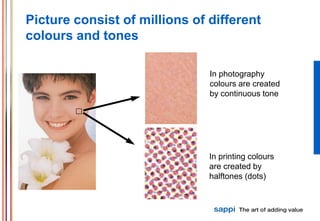
Picture consist of millions of different
colours and tones

                               In photography
                               colours are created
                               by continuous tone


                               In printing colours
                               are created by
                               halftones (dots)
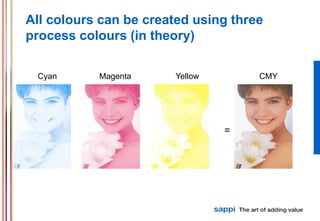
All colours can be created using three
process colours (in theory)

 Cyan      Magenta     Yellow        CMY


                                =
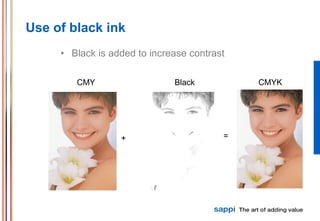
Use of black ink
     • Black is added to increase contrast

        CMY                   Black          CMYK


                  +                      =
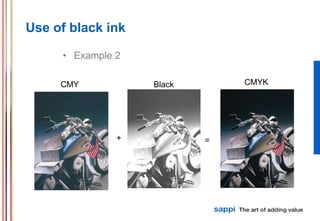
Use of black ink

     • Example 2

     CMY           Black       CMYK


               +           =
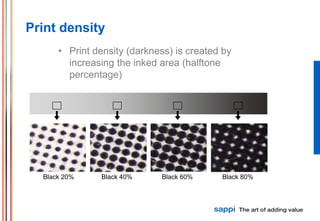
Print density
      • Print density (darkness) is created by
        increasing the inked area (halftone
        percentage)


  Black 20%    Black 40%     Black 60%     Black 80%
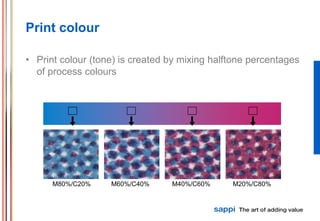
Print colour

• Print colour (tone) is created by mixing halftone percentages
  of process colours


      M80%/C20%    M60%/C40%     M40%/C60%     M20%/C80%
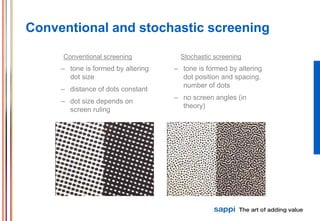
Conventional and stochastic screening

     Conventional screening           Stochastic screening
     – tone is formed by altering   – tone is formed by altering
       dot size                       dot position and spacing,
                                      number of dots
     – distance of dots constant
                                    – no screen angles (in
     – dot size depends on
                                      theory)
       screen ruling
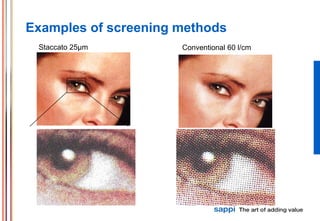
Examples of screening methods
 Staccato 25µm        Conventional 60 l/cm
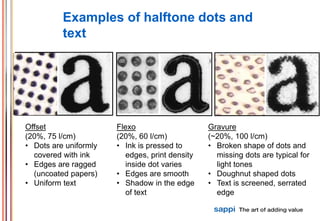
Examples of halftone dots and
          text


Offset                 Flexo                     Gravure
(20%, 75 l/cm)         (20%, 60 l/cm)            (~20%, 100 l/cm)
• Dots are uniformly   • Ink is pressed to       • Broken shape of dots and
  covered with ink        edges, print density     missing dots are typical for
• Edges are ragged        inside dot varies        light tones
  (uncoated papers)    • Edges are smooth        • Doughnut shaped dots
• Uniform text         • Shadow in the edge      • Text is screened, serrated
                          of text                  edge
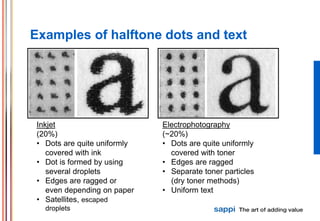
Examples of halftone dots and text


 Inkjet                       Electrophotography
 (20%)                        (~20%)
 • Dots are quite uniformly   • Dots are quite uniformly
    covered with ink            covered with toner
 • Dot is formed by using     • Edges are ragged
    several droplets          • Separate toner particles
 • Edges are ragged or          (dry toner methods)
    even depending on paper   • Uniform text
 • Satellites, escaped
   droplets
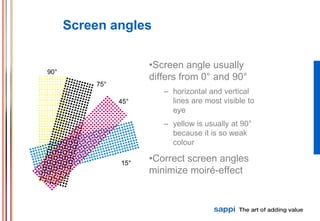
Screen angles

                      •Screen angle usually
90°
                      differs from 0° and 90°
          75°
                         – horizontal and vertical
                45°        lines are most visible to
                           eye
                         – yellow is usually at 90°
                           because it is so weak
                           colour

                15°
                      •Correct screen angles
                      minimize moiré-effect
Moiré and Rosette patterns

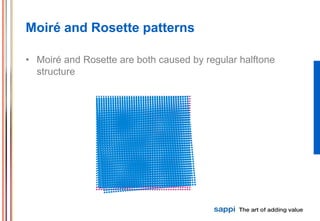
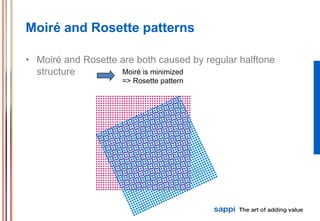
• Moiré and Rosette are both caused by regular halftone
  structure
Moiré and Rosette patterns

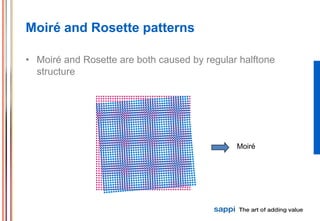
• Moiré and Rosette are both caused by regular halftone
  structure


                                              Moiré
Moiré and Rosette patterns

• Moiré and Rosette are both caused by regular halftone
  structure
Moiré and Rosette patterns

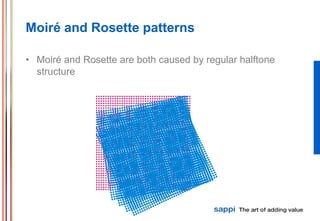
• Moiré and Rosette are both caused by regular halftone
  structure         Moiré is minimized
                     => Rosette pattern
Screen ruling vs. detail rendering
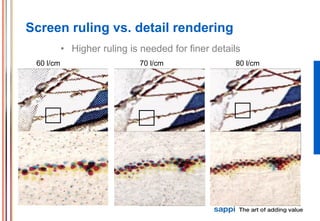
           • Higher ruling is needed for finer details
 60 l/cm                     70 l/cm                80 l/cm
Screen ruling

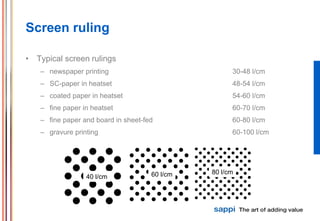
• Typical screen rulings
   – newspaper printing                              30-48 l/cm
   – SC-paper in heatset                             48-54 l/cm
   – coated paper in heatset                         54-60 l/cm
   – fine paper in heatset                           60-70 l/cm
   – fine paper and board in sheet-fed               60-80 l/cm
   – gravure printing                                60-100 l/cm


                                     60 l/cm   80 l/cm
                 40 l/cm
Examples


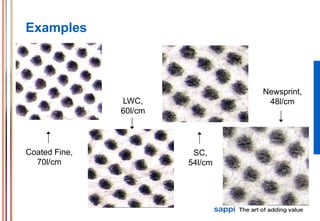
                                 Newsprint,
               LWC,               48l/cm
               60l/cm


Coated Fine,             SC,
  70l/cm                54l/cm

Formation of Print

  • 1.
  • 2.
    Contents • Formation ofprint – Colour formation – Halftone formation – Screening and detail rendering
  • 3.
    Picture consist ofmillions of different colours and tones In photography colours are created by continuous tone In printing colours are created by halftones (dots)
  • 4.
    All colours canbe created using three process colours (in theory) Cyan Magenta Yellow CMY =
  • 5.
    Use of blackink • Black is added to increase contrast CMY Black CMYK + =
  • 6.
    Use of blackink • Example 2 CMY Black CMYK + =
  • 7.
    Print density • Print density (darkness) is created by increasing the inked area (halftone percentage) Black 20% Black 40% Black 60% Black 80%
  • 8.
    Print colour • Printcolour (tone) is created by mixing halftone percentages of process colours M80%/C20% M60%/C40% M40%/C60% M20%/C80%
  • 9.
    Conventional and stochasticscreening Conventional screening Stochastic screening – tone is formed by altering – tone is formed by altering dot size dot position and spacing, number of dots – distance of dots constant – no screen angles (in – dot size depends on theory) screen ruling
  • 10.
    Examples of screeningmethods Staccato 25µm Conventional 60 l/cm
  • 11.
    Examples of halftonedots and text Offset Flexo Gravure (20%, 75 l/cm) (20%, 60 l/cm) (~20%, 100 l/cm) • Dots are uniformly • Ink is pressed to • Broken shape of dots and covered with ink edges, print density missing dots are typical for • Edges are ragged inside dot varies light tones (uncoated papers) • Edges are smooth • Doughnut shaped dots • Uniform text • Shadow in the edge • Text is screened, serrated of text edge
  • 12.
    Examples of halftonedots and text Inkjet Electrophotography (20%) (~20%) • Dots are quite uniformly • Dots are quite uniformly covered with ink covered with toner • Dot is formed by using • Edges are ragged several droplets • Separate toner particles • Edges are ragged or (dry toner methods) even depending on paper • Uniform text • Satellites, escaped droplets
  • 13.
    Screen angles •Screen angle usually 90° differs from 0° and 90° 75° – horizontal and vertical 45° lines are most visible to eye – yellow is usually at 90° because it is so weak colour 15° •Correct screen angles minimize moiré-effect
  • 14.
    Moiré and Rosettepatterns • Moiré and Rosette are both caused by regular halftone structure
  • 15.
    Moiré and Rosettepatterns • Moiré and Rosette are both caused by regular halftone structure Moiré
  • 16.
    Moiré and Rosettepatterns • Moiré and Rosette are both caused by regular halftone structure
  • 17.
    Moiré and Rosettepatterns • Moiré and Rosette are both caused by regular halftone structure Moiré is minimized => Rosette pattern
  • 18.
    Screen ruling vs.detail rendering • Higher ruling is needed for finer details 60 l/cm 70 l/cm 80 l/cm
  • 19.
    Screen ruling • Typicalscreen rulings – newspaper printing 30-48 l/cm – SC-paper in heatset 48-54 l/cm – coated paper in heatset 54-60 l/cm – fine paper in heatset 60-70 l/cm – fine paper and board in sheet-fed 60-80 l/cm – gravure printing 60-100 l/cm 60 l/cm 80 l/cm 40 l/cm
  • 20.
    Examples Newsprint, LWC, 48l/cm 60l/cm Coated Fine, SC, 70l/cm 54l/cm