Player Styles Agon Games of competition & conflict Alea Games of chance & “fate” Mimicry Games of simulation & copying Ilinx Games of vertigo & reckless abandon.
Project Goal Define aim of the project to experience a value they don’t normally feel through experience the world, build a better world Tailor your values to balance relationships Allow players to explore, express, and then exchange with one another Encouraging values in daily life Empowering relaxation that allows reflection on value Experiential, differing short games focusing n 3-4 values Tolerance - working on otehr values - going to other places in the world, make friends, experience different cultural values Experience love & peace in engaging way that leads to greater awareness Appreciate values as more than words but as a force of change Experience is best way to learn values.
Project Goal To experience a value they don’t normally feel Through experience the world, build a better world Tailor your values to balance relationships Allow players to explore, express, and then exchange with one another Encouraging values in daily life Empowering relaxation that allows reflection on value Experiential, differing short games focusing n 3-4 values Tolerance - working on otehr values - going to other places in the world, make friends, experience different cultural values Experience love & peace in engaging way that leads to greater awareness Appreciate values as more than words but as a force of change Experience is best way to learn values.
Who is the Player? What is their Role? What are they going to do? Who is playing the game - age, gender, location? Who is the player trying to be? Critical for representational & realistic games. In single game may have multiple roles/multiple modes. Ex. football–manager, coach, player. In a role , as an avatar:  A single character or object that represents the play Player’s actions are limited to location Omnipresence Player can act in many or all places in the world Chess
Who is the Player? What is Goal? Player: 13-24, middle ages 18-25 or 13-17? Goal: Taking a value going deeper into experience of value, doing something out in real life.  Inspire to action. Move emotionally, reflect in real life. Internal connection within selves. Group progression. Player: middle ages - 18-25 but appealing to olders. Goal: Tolerance.  Experience world, goal-making friends buy being differing characters. Goal 2: world - use values from OmCafe type experience to build environment building - values have consequences. Player: cross-generational 13-25. Goal: Enlightment, building a better world,  gaining a concrete result. Feel value, enter make choices in action, then create world - being fleshed out like an art piece. I do this action, this is the result. Layers of world that is built. Message becomes more subtle. (Social Game - Restaurant City - FB reflection). Player: 13-18, appeals to adults like Pixar. Goal: To experience a goal they don’t usually feel.   Avatar fantasy world with different kingdoms, characters on journey. Create unity. Kingdoms are values. Master elements sequentially. Discipline way to discovering values.
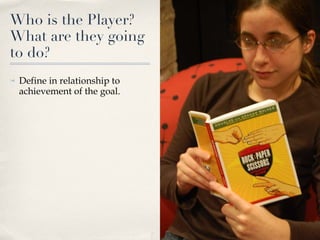
Who is the Player? What are they going to do? Define in relationship to achievement of the goal.
Conflict or Challenge Physical Challenges  Speed and reaction time (twitch games) Accuracy and precision (steering and shooting)  Timing  and rhythm (dance games) Learning special moves (fighting games) Races – achieving something first Logical challenges (puzzles) Should be based on an underlying goal Time Trial-and-error solution is a sign of bad design Exploration Challenges Locked doors and traps Mazes and illogical spaces
Conflict or Challenge (continued) Conflict Strategy, tactics, and logistics - logistics (food for armies) is rarely used Survival and reduction of enemy forces Defending vulnerable items or units Stealth Economic Challenges  Accumulating wealth or points  Efficient Manufacturing  Achieving balance or stability in a system Caring for living things within a system Conceptual Challenges Understanding something new Deduction, observation, interpretation Detective games offer conceptual challenges
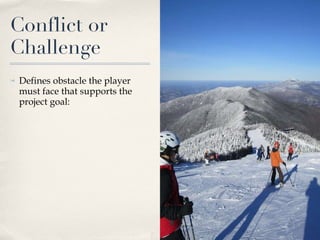
Conflict or Challenge Defines obstacle the player must face that supports the project goal:
Conflict or Challenge Physical Challenges  Speed and reaction time (twitch games) Accuracy and precision (steering and shooting)  Timing and rhythm (dance games) Learning special moves (fighting games) Races – achieving something first Logical challenges (puzzles) Should be based on an underlying goal Time Trial-and-error solution is a sign of bad design Exploration Challenges Locked doors and traps Mazes and illogical spaces  Conflict Strategy, tactics, and logistics - logistics (food for armies) is rarely used Survival and reduction of enemy forces Defending vulnerable items or units Stealth Economic Challenges  Accumulating wealth or points  Efficient Manufacturing  Achieving balance or stability in a system Caring for living things within a system Conceptual Challenges Understanding something new Deduction, observation, interpretation Detective games offer conceptual challenges
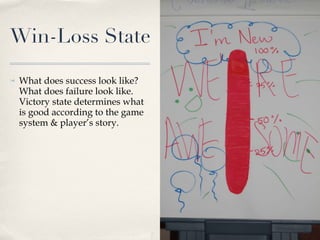
Win-Loss State What does success look like? What does failure look like. Victory state determines what is good according to the game system & player’s story.
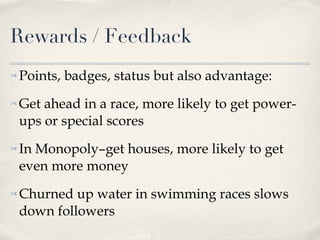
Rewards / Feedback Points, badges, status but also advantage: Get ahead in a race, more likely to get power-ups or special scores In Monopoly–get houses, more likely to get even more money Churned up water in swimming races slows down followers
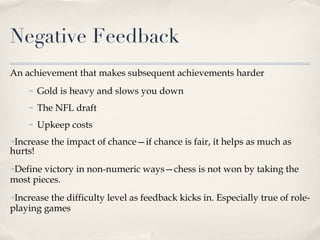
Negative Feedback An achievement that makes subsequent achievements harder Gold is heavy and slows you down The NFL draft  Upkeep costs Increase the impact of chance—if chance is fair, it helps as much as hurts! Define victory in non-numeric ways—chess is not won by taking the most pieces. Increase the difficulty level as feedback kicks in. Especially true of role-playing games
Feedback System
Rules of the Game What constraints are in place to define the play, engender trust in the system, and balance the system?

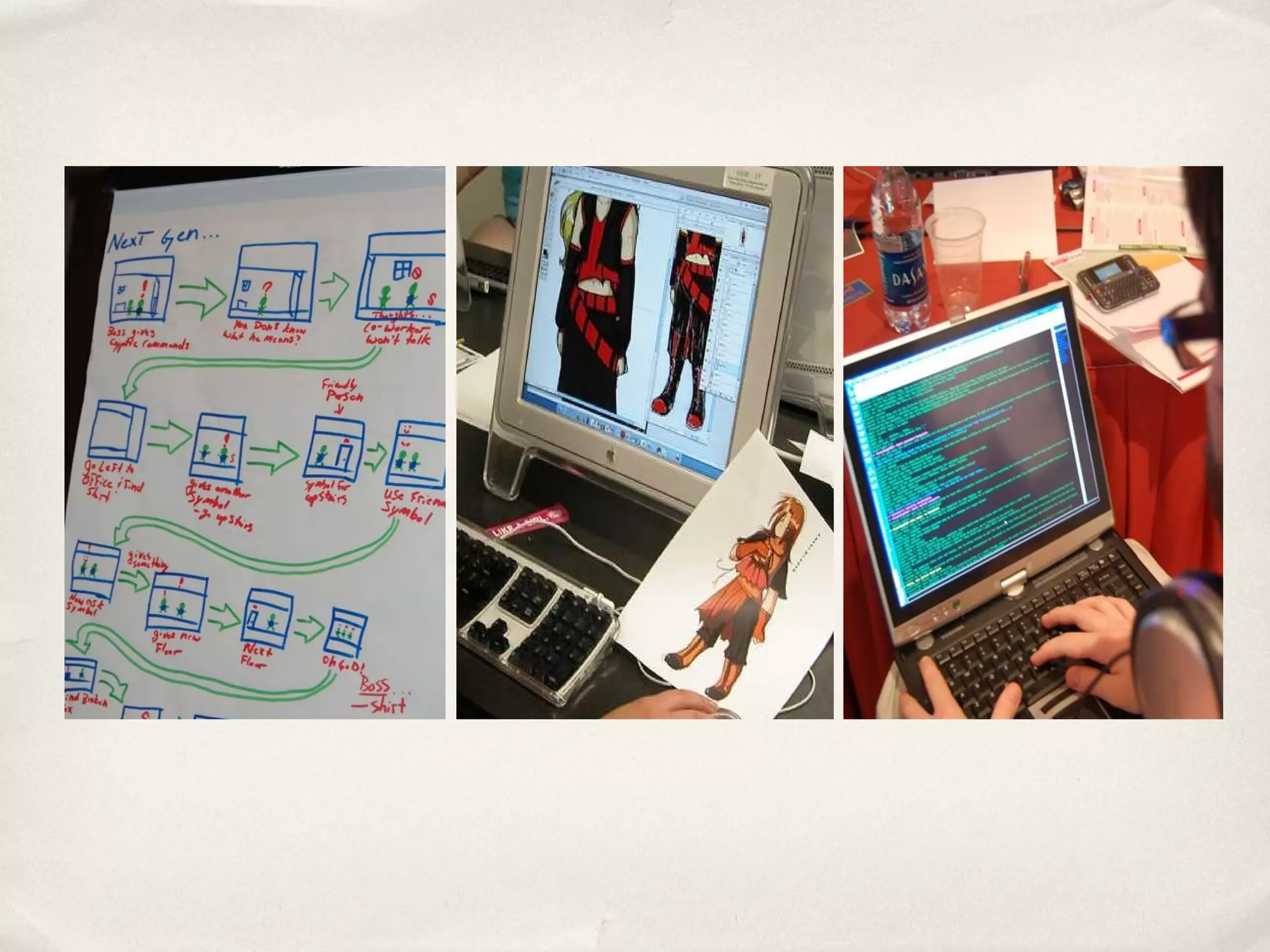
Brainstorming session

  • 1.
  • 2.
    Player Styles AgonGames of competition & conflict Alea Games of chance & “fate” Mimicry Games of simulation & copying Ilinx Games of vertigo & reckless abandon.
  • 3.
    Project Goal Defineaim of the project to experience a value they don’t normally feel through experience the world, build a better world Tailor your values to balance relationships Allow players to explore, express, and then exchange with one another Encouraging values in daily life Empowering relaxation that allows reflection on value Experiential, differing short games focusing n 3-4 values Tolerance - working on otehr values - going to other places in the world, make friends, experience different cultural values Experience love & peace in engaging way that leads to greater awareness Appreciate values as more than words but as a force of change Experience is best way to learn values.
  • 4.
    Project Goal Toexperience a value they don’t normally feel Through experience the world, build a better world Tailor your values to balance relationships Allow players to explore, express, and then exchange with one another Encouraging values in daily life Empowering relaxation that allows reflection on value Experiential, differing short games focusing n 3-4 values Tolerance - working on otehr values - going to other places in the world, make friends, experience different cultural values Experience love & peace in engaging way that leads to greater awareness Appreciate values as more than words but as a force of change Experience is best way to learn values.
  • 5.
    Who is thePlayer? What is their Role? What are they going to do? Who is playing the game - age, gender, location? Who is the player trying to be? Critical for representational & realistic games. In single game may have multiple roles/multiple modes. Ex. football–manager, coach, player. In a role , as an avatar: A single character or object that represents the play Player’s actions are limited to location Omnipresence Player can act in many or all places in the world Chess
  • 6.
    Who is thePlayer? What is Goal? Player: 13-24, middle ages 18-25 or 13-17? Goal: Taking a value going deeper into experience of value, doing something out in real life. Inspire to action. Move emotionally, reflect in real life. Internal connection within selves. Group progression. Player: middle ages - 18-25 but appealing to olders. Goal: Tolerance. Experience world, goal-making friends buy being differing characters. Goal 2: world - use values from OmCafe type experience to build environment building - values have consequences. Player: cross-generational 13-25. Goal: Enlightment, building a better world, gaining a concrete result. Feel value, enter make choices in action, then create world - being fleshed out like an art piece. I do this action, this is the result. Layers of world that is built. Message becomes more subtle. (Social Game - Restaurant City - FB reflection). Player: 13-18, appeals to adults like Pixar. Goal: To experience a goal they don’t usually feel. Avatar fantasy world with different kingdoms, characters on journey. Create unity. Kingdoms are values. Master elements sequentially. Discipline way to discovering values.
  • 7.
    Who is thePlayer? What are they going to do? Define in relationship to achievement of the goal.
  • 8.
    Conflict or ChallengePhysical Challenges Speed and reaction time (twitch games) Accuracy and precision (steering and shooting) Timing and rhythm (dance games) Learning special moves (fighting games) Races – achieving something first Logical challenges (puzzles) Should be based on an underlying goal Time Trial-and-error solution is a sign of bad design Exploration Challenges Locked doors and traps Mazes and illogical spaces
  • 9.
    Conflict or Challenge(continued) Conflict Strategy, tactics, and logistics - logistics (food for armies) is rarely used Survival and reduction of enemy forces Defending vulnerable items or units Stealth Economic Challenges Accumulating wealth or points Efficient Manufacturing Achieving balance or stability in a system Caring for living things within a system Conceptual Challenges Understanding something new Deduction, observation, interpretation Detective games offer conceptual challenges
  • 10.
    Conflict or ChallengeDefines obstacle the player must face that supports the project goal:
  • 11.
    Conflict or ChallengePhysical Challenges Speed and reaction time (twitch games) Accuracy and precision (steering and shooting) Timing and rhythm (dance games) Learning special moves (fighting games) Races – achieving something first Logical challenges (puzzles) Should be based on an underlying goal Time Trial-and-error solution is a sign of bad design Exploration Challenges Locked doors and traps Mazes and illogical spaces Conflict Strategy, tactics, and logistics - logistics (food for armies) is rarely used Survival and reduction of enemy forces Defending vulnerable items or units Stealth Economic Challenges Accumulating wealth or points Efficient Manufacturing Achieving balance or stability in a system Caring for living things within a system Conceptual Challenges Understanding something new Deduction, observation, interpretation Detective games offer conceptual challenges
  • 12.
    Win-Loss State Whatdoes success look like? What does failure look like. Victory state determines what is good according to the game system & player’s story.
  • 13.
    Rewards / FeedbackPoints, badges, status but also advantage: Get ahead in a race, more likely to get power-ups or special scores In Monopoly–get houses, more likely to get even more money Churned up water in swimming races slows down followers
  • 14.
    Negative Feedback Anachievement that makes subsequent achievements harder Gold is heavy and slows you down The NFL draft Upkeep costs Increase the impact of chance—if chance is fair, it helps as much as hurts! Define victory in non-numeric ways—chess is not won by taking the most pieces. Increase the difficulty level as feedback kicks in. Especially true of role-playing games
  • 15.
  • 16.
    Rules of theGame What constraints are in place to define the play, engender trust in the system, and balance the system?