Principles of Game Design
Player Empathy
 A good designer always has an idea of what’s
going on in the players head.
 One of the hardest things for a designer to do
is to keep his mouth shut while watching
someone test his game.
 Player Empathy not only help you create good
gameplay, but also lets you identify and
eliminate problems during the design phase
rather than during production.
Feedback
 Feedback is what distinguishes a game from
every other form of entertainment. It’s the
interactivity that makes our games unique.
 Every input the player makes in the game should
give him a discernable response. No input should
go unanswered.
Grounding the Player
 The player should always know where he is in
the game and why he is doing what he is
doing.
 If a player has an overall map in his head, it
encourages him to come back to the game
again and again until he’s done.
 Throughout the game, as the player wrestles
with the problem in front of him, he should
always have some idea of how this single step
fits into the longer path that will eventually
lead to success.
The Moment-to-Moment Experience
 Verbs – The positive side of creating a good
moment-to-moment experience is giving the
player a constant stream of interesting
choices that have significant outcomes.
 The more verbs you can give a player, the
more you allow him to do. It’s the doing that’s
at the heart of good game play and a positive
moment-to-moment experience.
The Moment-to-Moment Experience
 Hazards (Risk) – Don’t make the player
perform a complex action twice. Or listen to
every line of dialog over and over to get a bit
of information he forgot. The same applies to
cutscenes.
 In general, have the computer do the set-up
tasks the player might find boring.
 Make the game entertaining moment-to-
moment, by keeping it interesting. Give the
player a lot to do – but make sure that what
he does is fun.
Immersion
 Immersion is what happens when you make
the moment-to-moment experience so
compelling that the player is drawn completely
into the game and the real world disappears.
 Continuous Dream – You bathe the player in
a constant stream of images that pull him into
your world, and you avoid gaffes that jar him
out of his reverie. If you break the dream, you
lose the immersion.
Writing
 Good writing is invisible. Bad writing draws
attention to itself and instantly destroys the
player’s sense of immersion.
 Writing well is hard. People spend a lifetime
learning how to do it. If you’ve never given
writing much thought before – don’t write. You
should bring in someone else to do it.
Design Within Limits
Designers often forget that building a game is
actually a software development project. It has a
cost and a schedule, and its ultimate success or
failure hinges not just on good gameplay but
whether you can deliver that gameplay on time , on
budget, with technical features that work, and
without crashing the players machine.
Removing Impediments
 Disk Swapping
 Load Times
 Game Interruptions
 Saving the Game
 Housekeeping
 Bugs
Interface Design
 “Make things as simple as possible, but no
simpler.” – Albert Einstein
 Design must convey the essence of a devices
operation; the possible actions that can be
taken, and, through feedback, just what it is
doing at any particular moment.
 The surest way to make something easy to
use … is make it impossible to do otherwise–
to constrain the choices.
 Let the player do what he wants without
having to think about it.
The Start –Up Screen
 Going right into the game for the first time
 Loading a saved game
 Going to the tutorial or practice area
 Opening the options menu to tweak features
 Replaying the opening movie
Customizable Controls
 Give the player as much control over the interface as
possible
 Different things are important to different players
 On the options screen, explain what each option
does
Cheat Codes
 Include as many cheat codes as you can
 Let the player decide what’s fun for himself
 These cheats need to be tested too
 If you can’t preserve the design integrity of while
allowing the players to cheat, let him do it anyway
Tutorial or Practice Mode
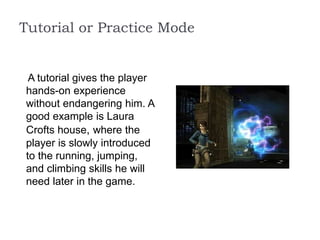
A tutorial gives the player
hands-on experience
without endangering him. A
good example is Laura
Crofts house, where the
player is slowly introduced
to the running, jumping,
and climbing skills he will
need later in the game.
Structure ands Progression
 “A game should be easy to learn but difficult to
master.” “Let the game begin“ should be your
motto. If you don’t get a player involved in the first
15 minutes, you’ve probably lost him
forever.Throughout the process, you must listen to
your testers.
Taking Care of the Player
 Dead Man Walking –
 Protect Newbies
 Play it Again, Sam
 Give the Player the information he needs
 Reduce Player Paranoia
 Offer Levels of Difficulty
How to Design
 Create an Integrated Whole
 Economy of Design
 Where Do You Get Your Ideas
- If you are designing something of interest to you, the
ideas will come naturally. The game should be about
something you are interested in, and it should be a
genre you are familiar with.
 Brainstorming – “The best way to get aq goods idea
is to get lots of ideas.” Don’t talk about your idea too
soon .

Principles of Game Design (Lecture 5 Game Development)

  • 1.
  • 2.
    Player Empathy  Agood designer always has an idea of what’s going on in the players head.  One of the hardest things for a designer to do is to keep his mouth shut while watching someone test his game.  Player Empathy not only help you create good gameplay, but also lets you identify and eliminate problems during the design phase rather than during production.
  • 3.
    Feedback  Feedback iswhat distinguishes a game from every other form of entertainment. It’s the interactivity that makes our games unique.  Every input the player makes in the game should give him a discernable response. No input should go unanswered.
  • 4.
    Grounding the Player The player should always know where he is in the game and why he is doing what he is doing.  If a player has an overall map in his head, it encourages him to come back to the game again and again until he’s done.  Throughout the game, as the player wrestles with the problem in front of him, he should always have some idea of how this single step fits into the longer path that will eventually lead to success.
  • 5.
    The Moment-to-Moment Experience Verbs – The positive side of creating a good moment-to-moment experience is giving the player a constant stream of interesting choices that have significant outcomes.  The more verbs you can give a player, the more you allow him to do. It’s the doing that’s at the heart of good game play and a positive moment-to-moment experience.
  • 6.
    The Moment-to-Moment Experience Hazards (Risk) – Don’t make the player perform a complex action twice. Or listen to every line of dialog over and over to get a bit of information he forgot. The same applies to cutscenes.  In general, have the computer do the set-up tasks the player might find boring.  Make the game entertaining moment-to- moment, by keeping it interesting. Give the player a lot to do – but make sure that what he does is fun.
  • 7.
    Immersion  Immersion iswhat happens when you make the moment-to-moment experience so compelling that the player is drawn completely into the game and the real world disappears.  Continuous Dream – You bathe the player in a constant stream of images that pull him into your world, and you avoid gaffes that jar him out of his reverie. If you break the dream, you lose the immersion.
  • 8.
    Writing  Good writingis invisible. Bad writing draws attention to itself and instantly destroys the player’s sense of immersion.  Writing well is hard. People spend a lifetime learning how to do it. If you’ve never given writing much thought before – don’t write. You should bring in someone else to do it.
  • 9.
    Design Within Limits Designersoften forget that building a game is actually a software development project. It has a cost and a schedule, and its ultimate success or failure hinges not just on good gameplay but whether you can deliver that gameplay on time , on budget, with technical features that work, and without crashing the players machine.
  • 10.
    Removing Impediments  DiskSwapping  Load Times  Game Interruptions  Saving the Game  Housekeeping  Bugs
  • 11.
    Interface Design  “Makethings as simple as possible, but no simpler.” – Albert Einstein  Design must convey the essence of a devices operation; the possible actions that can be taken, and, through feedback, just what it is doing at any particular moment.  The surest way to make something easy to use … is make it impossible to do otherwise– to constrain the choices.  Let the player do what he wants without having to think about it.
  • 12.
    The Start –UpScreen  Going right into the game for the first time  Loading a saved game  Going to the tutorial or practice area  Opening the options menu to tweak features  Replaying the opening movie
  • 13.
    Customizable Controls  Givethe player as much control over the interface as possible  Different things are important to different players  On the options screen, explain what each option does
  • 14.
    Cheat Codes  Includeas many cheat codes as you can  Let the player decide what’s fun for himself  These cheats need to be tested too  If you can’t preserve the design integrity of while allowing the players to cheat, let him do it anyway
  • 15.
    Tutorial or PracticeMode A tutorial gives the player hands-on experience without endangering him. A good example is Laura Crofts house, where the player is slowly introduced to the running, jumping, and climbing skills he will need later in the game.
  • 16.
    Structure ands Progression “A game should be easy to learn but difficult to master.” “Let the game begin“ should be your motto. If you don’t get a player involved in the first 15 minutes, you’ve probably lost him forever.Throughout the process, you must listen to your testers.
  • 17.
    Taking Care ofthe Player  Dead Man Walking –  Protect Newbies  Play it Again, Sam  Give the Player the information he needs  Reduce Player Paranoia  Offer Levels of Difficulty
  • 18.
    How to Design Create an Integrated Whole  Economy of Design  Where Do You Get Your Ideas - If you are designing something of interest to you, the ideas will come naturally. The game should be about something you are interested in, and it should be a genre you are familiar with.  Brainstorming – “The best way to get aq goods idea is to get lots of ideas.” Don’t talk about your idea too soon .