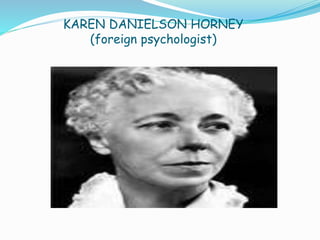
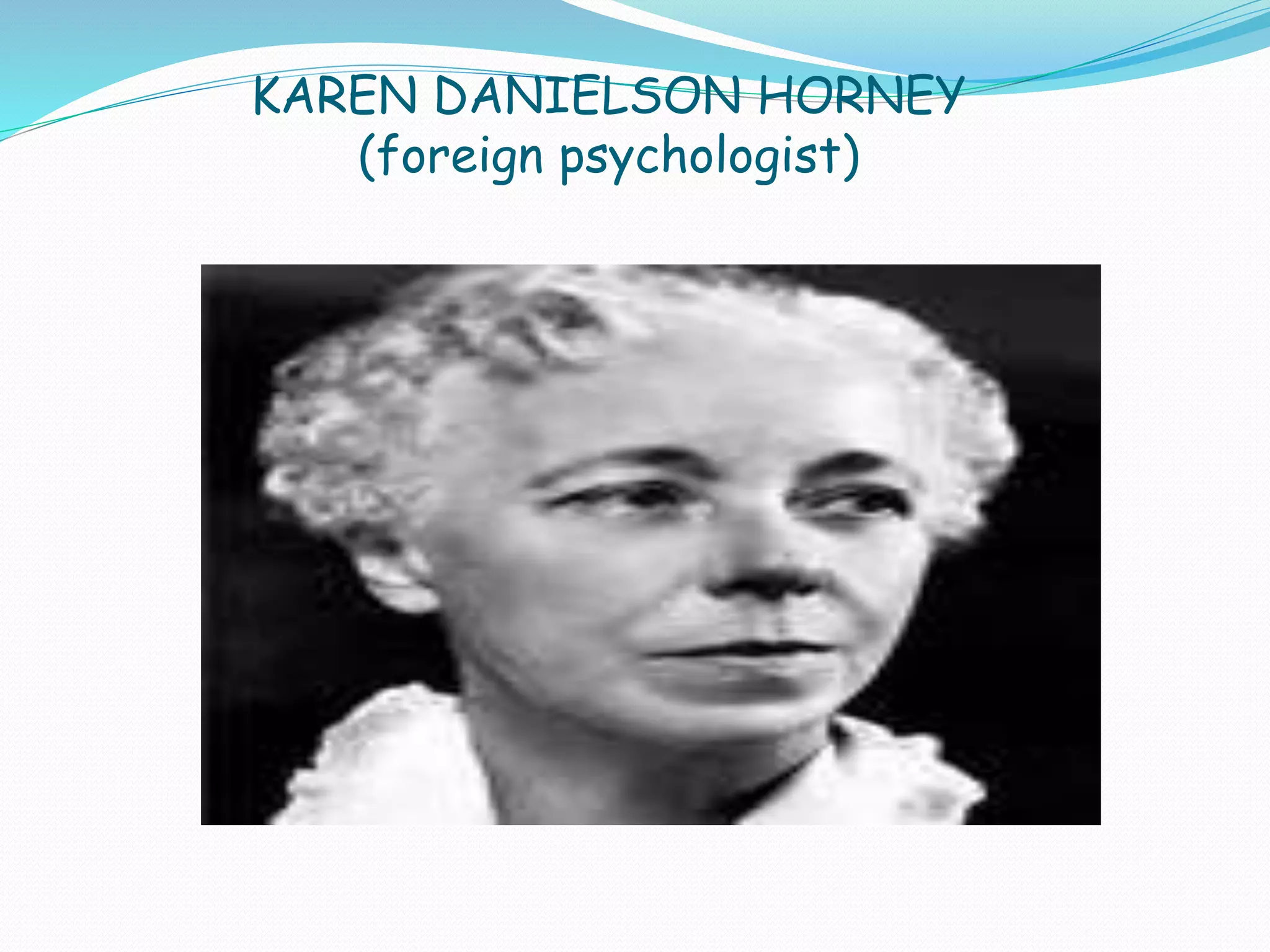







KAREN DANIELSON HORNEY
(foreign psychologist)
INTRODUCTION
 Born:
September 16, 1885
Blankenese
Hamburg, Germany
 Died:
December 4, 1952
New York City,
New York, United States
 Karen Horney was a German psychoanalyst
best-known for her theories of neurosis,
feminine psychology, and self psychology.
 Karen Horney was a pioneering theorist in
personality, psychoanalysis, and "feminine
psychology".
 While Horney was a neo-Freudian, she also
challenged many of Sigmund Freud's theories
about female psychology.
 For example, Horney countered Freud's
assertion that women experience "penis envy"
by suggesting that men feel "womb envy"
because they are unable to bear children.
 Horney devoted herself to school, believing
that, "If I couldn't be pretty, I decided I
would be smart.“
 She described her father as a strict
disciplinarian and was very close to her older
brother, Berndt.When he distanced himself
from her, Horney became depressed, a
problem she would deal with throughout her
life.
 The death of her mother and then brother in
1911 and 1923 were extremely difficult for
Horney.
 In 1926, Horney left her husband and in 1930
moved to the United States with her three
daughters, Brigitte, Marianne and Renate,
 she became friends with other prominent
intellectuals and developed her theories on
psychology .
 Karen Horney developed a theory of neurosis.Unlike
previous theorists, Horney viewed these neuroses as a
sort of coping mechanism that is a large part of
normal life. It is mild personality dis-order typefied
excessive anxiety or indecision and a degree of social
inter-personal maladjustment.
 She identified ten neuroses, including the need for
power, the need for affection, the need for social
prestige, and the need for independence.
FAMILY BACKGROUND
 PARENTS:
Clotilde and Berndt Wackels Danielson
 Spouse: Oscar Horney(m. 1909–1937)
 Children:
Brigitte, Marianne and Renate
EDUCATIONAL BACKGROUND
 1906, Horney was able to enroll inAlbert Ludwigs
University of Freiburg, Medical School, one of a
few medical schools admitting women at that time.
 She transferred from there to the University of
Gottingen,
 finally to the Humboldt University of Berlin in
1909, where Horney elected to study the
emerging field of psychoanalysis.
 Horney graduated from the University of Berlin in
1915.
ACHIEVEMENTS
 She made significant contributions to
humanism, self-psychology, psychoanalysis, and
feminine psychology
 She taught psychoanalysis at both the Berlin
and New York Psychoanalytic Institute.
 She worked in Psychoanalytic Institute as an
analyst and teacher in 1920.
 She was a frequent lecturer at the New School for
Social Research and a teacher at the New York
Psychoanalytic Institute
 Karen's first American job was as the Associate
Director of the Chicago Institute for
Psychoanalysis, a position she held for two years
 From 1915 to 1920 she engaged in clinical and
outpatient psychiatric work in connection with
Berlin hospitals,
 1920 she joined the teaching staff of the newly
founded Berlin Psychoanalytic Institute.
 1920 to 1932 she taught in Institute for
Psychoanalysis in Berlin,
 1934 She moved to New York City in to return to
private practice and teach at the New School for
Social Research
 In 1941, in collaboration with other
dissenters, she founded the American
Institute for Psychoanalysis and served as
dean until her death in 1952.
 She also founded the American Journal of
Psychoanalysis. Shortly after, she began
teaching at the New York Medical College.
 She developed a theory of neurosis based on
her experiences as a psychotherapist
BOOKS BY KAREN HORNEY
 The Neurotic Personality of our Time (1937)
 New Ways in Psychoanalysis (1939)
 Self-Analysis (1942)
 Our Inner Conflicts: A Constructive Theory
of Neurosis� (1945)
 Are You Considering Psychoanalysis? (1946)
 Neurosis and Human Growth (1950)
 The Collected Works of Karen Horney (1950)
 1967 Feminine Psychology
CONTRIBUTION TO PSYCHOLOGY
 Horney is widely regarded as the founder of
feminine psychiatry, which focuses on the
psychiatric treatment of women, and feminist
psychology, which studies the ways in
which gender power imbalances affect both
mental health and the development of
psychological theories.
 She strongly advocated that differences between
men and women are manifest from differences in
culture and socialization rather than biology.
CONCLUSSION
Karen Horney was a feminine psychologist and a Neo-
Freudian psychologist. she developed a theory of
neurosis based on her experiences as a
psychotherapist
Karen Horney was undoubtedly a great influence to
numerous self-psychologists, humanists, cognitive
therapists, psychoanalysts, feminists, and
existentialists. As a theorist, leader, teacher, and
therapist, Horney made numerous contributions that
have been highly significant in shaping and advancing
psychological thought.
She has Karen Horney Clinic is a research, training, and
low-cost treatment center. The institution was opened
on May 6, 1955 in honor of the woman's important
achievements.
Prepared by:
cristina c. cranillo
Thank you very much to all sources you make my report
possible!

KAREN DANIELSON HORNEY-FOREIGN PSYCHOLOGIST

  • 1.
  • 2.
    INTRODUCTION  Born: September 16,1885 Blankenese Hamburg, Germany  Died: December 4, 1952 New York City, New York, United States
  • 3.
     Karen Horneywas a German psychoanalyst best-known for her theories of neurosis, feminine psychology, and self psychology.  Karen Horney was a pioneering theorist in personality, psychoanalysis, and "feminine psychology".  While Horney was a neo-Freudian, she also challenged many of Sigmund Freud's theories about female psychology.  For example, Horney countered Freud's assertion that women experience "penis envy" by suggesting that men feel "womb envy" because they are unable to bear children.
  • 5.
     Horney devotedherself to school, believing that, "If I couldn't be pretty, I decided I would be smart.“  She described her father as a strict disciplinarian and was very close to her older brother, Berndt.When he distanced himself from her, Horney became depressed, a problem she would deal with throughout her life.
  • 6.
     The deathof her mother and then brother in 1911 and 1923 were extremely difficult for Horney.  In 1926, Horney left her husband and in 1930 moved to the United States with her three daughters, Brigitte, Marianne and Renate,  she became friends with other prominent intellectuals and developed her theories on psychology .
  • 7.
     Karen Horneydeveloped a theory of neurosis.Unlike previous theorists, Horney viewed these neuroses as a sort of coping mechanism that is a large part of normal life. It is mild personality dis-order typefied excessive anxiety or indecision and a degree of social inter-personal maladjustment.  She identified ten neuroses, including the need for power, the need for affection, the need for social prestige, and the need for independence.
  • 8.
    FAMILY BACKGROUND  PARENTS: Clotildeand Berndt Wackels Danielson  Spouse: Oscar Horney(m. 1909–1937)  Children: Brigitte, Marianne and Renate
  • 9.
    EDUCATIONAL BACKGROUND  1906,Horney was able to enroll inAlbert Ludwigs University of Freiburg, Medical School, one of a few medical schools admitting women at that time.  She transferred from there to the University of Gottingen,  finally to the Humboldt University of Berlin in 1909, where Horney elected to study the emerging field of psychoanalysis.  Horney graduated from the University of Berlin in 1915.
  • 10.
    ACHIEVEMENTS  She madesignificant contributions to humanism, self-psychology, psychoanalysis, and feminine psychology  She taught psychoanalysis at both the Berlin and New York Psychoanalytic Institute.  She worked in Psychoanalytic Institute as an analyst and teacher in 1920.
  • 11.
     She wasa frequent lecturer at the New School for Social Research and a teacher at the New York Psychoanalytic Institute  Karen's first American job was as the Associate Director of the Chicago Institute for Psychoanalysis, a position she held for two years  From 1915 to 1920 she engaged in clinical and outpatient psychiatric work in connection with Berlin hospitals,
  • 12.
     1920 shejoined the teaching staff of the newly founded Berlin Psychoanalytic Institute.  1920 to 1932 she taught in Institute for Psychoanalysis in Berlin,  1934 She moved to New York City in to return to private practice and teach at the New School for Social Research
  • 13.
     In 1941,in collaboration with other dissenters, she founded the American Institute for Psychoanalysis and served as dean until her death in 1952.  She also founded the American Journal of Psychoanalysis. Shortly after, she began teaching at the New York Medical College.  She developed a theory of neurosis based on her experiences as a psychotherapist
  • 14.
    BOOKS BY KARENHORNEY  The Neurotic Personality of our Time (1937)  New Ways in Psychoanalysis (1939)  Self-Analysis (1942)  Our Inner Conflicts: A Constructive Theory of Neurosisâ�� (1945)  Are You Considering Psychoanalysis? (1946)  Neurosis and Human Growth (1950)  The Collected Works of Karen Horney (1950)  1967 Feminine Psychology
  • 15.
    CONTRIBUTION TO PSYCHOLOGY Horney is widely regarded as the founder of feminine psychiatry, which focuses on the psychiatric treatment of women, and feminist psychology, which studies the ways in which gender power imbalances affect both mental health and the development of psychological theories.  She strongly advocated that differences between men and women are manifest from differences in culture and socialization rather than biology.
  • 16.
    CONCLUSSION Karen Horney wasa feminine psychologist and a Neo- Freudian psychologist. she developed a theory of neurosis based on her experiences as a psychotherapist Karen Horney was undoubtedly a great influence to numerous self-psychologists, humanists, cognitive therapists, psychoanalysts, feminists, and existentialists. As a theorist, leader, teacher, and therapist, Horney made numerous contributions that have been highly significant in shaping and advancing psychological thought. She has Karen Horney Clinic is a research, training, and low-cost treatment center. The institution was opened on May 6, 1955 in honor of the woman's important achievements.
  • 17.
    Prepared by: cristina c.cranillo Thank you very much to all sources you make my report possible!