U.S. Forests
Conditions and Trends
Courtesy of U.S. Forest Service
U.S. Forests in a Global Context
Since 1630, about 256 million acres of
forest land have been converted to other
uses—mainly agricultural. Nearly two-
thirds of the net conversion to other uses occurred
in the second half of the 19th
century, when an
average of 13 square miles (mi2) of forest was
cleared every day for 50 years. By 1910, the area
of forest land had declined to an estimated 754
million acres, or 34 percent of the total land area.
In 2012, forest land comprised 766 million acres, or
33 percent of the total land area of the United
States.
Global forestry issues are of
considerable significance to the
United States, which has 5 percent of
the Earth’s population and consumes
an estimated 28 percent of the
Earth’s industrial wood products.
Although domestic timber inventory
is only 10 percent of the Earth’s total,
96 percent of U.S. consumption of
industrial wood comes from domestic
supplies.
http://www.fia.fs.fed.us/library/brochures/default.asp.
Ecosystem Services & Carbon
Sequestration in the U.S.
U.S. Forest Ownership
Forests provide a variety
of critical services to
human societies,
including carbon
sequestration, water
purification, and habitat
for millions of species.
Nearly 20 Federal
programs currently pay
private forest landowners
to enhance ecosystem
services through improved
forest management,
retention of lands in forest
or undeveloped uses,
protection of soil and
water quality,
preservation of forested
wetlands, and wildlife
habitat improvement.
Forest ecosystems are the
largest terrestrial carbon
sink on earth and their
management has been
recognized as a relatively
cost-effective strategy for
offsetting greenhouse gas
emissions.
Forests in the United States
continue to sequester more
carbon than they emit each
year, and combined with
urban forest, and harvested
wood products, offset nearly
15 percent (955 tetragrams of
carbon dioxide equivalent [Tg
CO2 eq.]) of total greenhouse
gas emissions in 2012.http://www.fia.fs.fed.us/library/brochures/default.asp.
U.S. forest ownership patterns are
quite diverse with public forests
dominant in the West and private
forests dominant in the East. Private
industrial forest ownership is
concentrated in the South, Pacific
Northwest, upper Lake States, and
northern New England.
Private ownership accounts for 56 percent of total forest land. More than 10 million
individual and family forest landowners own 42 percent of total forest land,
representing a diverse group of people who have many reasons for owning their forest
land.
http://www.fia.fs.fed.us/library/brochures/default.asp.
U.S. Forest Ownership
In the United States,
an estimated 4 billion
urban trees provide
many valuable
benefits based on their
current composition
and function.
Besides the basic value
of the trees—estimated
at $2.4 trillion (Nowak et
al. 2002), additional
benefits of urban trees
include air-pollution
removal and carbon
sequestration.
http://www.fia.fs.fed.us/library/brochures/default.asp.
Recreation activities are
increasingly important as a source
of forest-based employment and
income. Engaging in outdoor
recreation and tourism in forests
tends to build support among
participants for protecting and
managing forests, indirectly
building support for sustainable
forests.
Forest-foraged foods for
urbanites is a phenomenon that
may have an extraordinary
impact on forest resources. This
burgeoning industry depends on
a steady and reliable source of
native plants, some of which
may only be available for a short
time eachyear.
Urban Forests in the U.S.
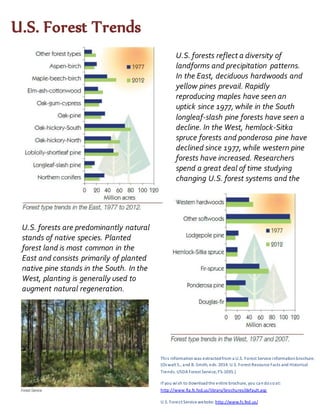
U.S. forests reflect a diversity of
landforms and precipitation patterns.
In the East, deciduous hardwoods and
yellow pines prevail. Rapidly
reproducing maples have seen an
uptick since 1977, while in the South
longleaf-slash pine forests have seen a
decline. In the West, hemlock-Sitka
spruce forests and ponderosa pine have
declined since 1977, while western pine
forests have increased. Researchers
spend a great deal of time studying
changing U.S. forest systems and the
potential impacts to the economy and
environment.
U.S. forests are predominantly natural
stands of native species. Planted
forest land is most common in the
East and consists primarily of planted
native pine stands in the South. In the
West, planting is generally used to
augment natural regeneration.
This informationwas extractedfrom a U.S. Forest Service informationbrochure.
(Oswalt S., and B. Smith, eds. 2014. U.S. Forest Resource Facts and Historical
Trends. USDA Forest Service, FS-1035.)
If you wish to downloadthe entire brochure, you candosoat:
http://www.fia.fs.fed.us/library/brochures/default.asp
U.S. Forest Service website: http://www.fs.fed.us/
U.S. Forest Trends
U.S. Forest Service website: http://www.fs.fed.us/

Forest Brochure

  • 1.
    U.S. Forests Conditions andTrends Courtesy of U.S. Forest Service
  • 2.
    U.S. Forests ina Global Context Since 1630, about 256 million acres of forest land have been converted to other uses—mainly agricultural. Nearly two- thirds of the net conversion to other uses occurred in the second half of the 19th century, when an average of 13 square miles (mi2) of forest was cleared every day for 50 years. By 1910, the area of forest land had declined to an estimated 754 million acres, or 34 percent of the total land area. In 2012, forest land comprised 766 million acres, or 33 percent of the total land area of the United States. Global forestry issues are of considerable significance to the United States, which has 5 percent of the Earth’s population and consumes an estimated 28 percent of the Earth’s industrial wood products. Although domestic timber inventory is only 10 percent of the Earth’s total, 96 percent of U.S. consumption of industrial wood comes from domestic supplies. http://www.fia.fs.fed.us/library/brochures/default.asp.
  • 3.
    Ecosystem Services &Carbon Sequestration in the U.S. U.S. Forest Ownership Forests provide a variety of critical services to human societies, including carbon sequestration, water purification, and habitat for millions of species. Nearly 20 Federal programs currently pay private forest landowners to enhance ecosystem services through improved forest management, retention of lands in forest or undeveloped uses, protection of soil and water quality, preservation of forested wetlands, and wildlife habitat improvement. Forest ecosystems are the largest terrestrial carbon sink on earth and their management has been recognized as a relatively cost-effective strategy for offsetting greenhouse gas emissions. Forests in the United States continue to sequester more carbon than they emit each year, and combined with urban forest, and harvested wood products, offset nearly 15 percent (955 tetragrams of carbon dioxide equivalent [Tg CO2 eq.]) of total greenhouse gas emissions in 2012.http://www.fia.fs.fed.us/library/brochures/default.asp.
  • 4.
    U.S. forest ownershippatterns are quite diverse with public forests dominant in the West and private forests dominant in the East. Private industrial forest ownership is concentrated in the South, Pacific Northwest, upper Lake States, and northern New England. Private ownership accounts for 56 percent of total forest land. More than 10 million individual and family forest landowners own 42 percent of total forest land, representing a diverse group of people who have many reasons for owning their forest land. http://www.fia.fs.fed.us/library/brochures/default.asp. U.S. Forest Ownership
  • 5.
    In the UnitedStates, an estimated 4 billion urban trees provide many valuable benefits based on their current composition and function. Besides the basic value of the trees—estimated at $2.4 trillion (Nowak et al. 2002), additional benefits of urban trees include air-pollution removal and carbon sequestration. http://www.fia.fs.fed.us/library/brochures/default.asp. Recreation activities are increasingly important as a source of forest-based employment and income. Engaging in outdoor recreation and tourism in forests tends to build support among participants for protecting and managing forests, indirectly building support for sustainable forests. Forest-foraged foods for urbanites is a phenomenon that may have an extraordinary impact on forest resources. This burgeoning industry depends on a steady and reliable source of native plants, some of which may only be available for a short time eachyear. Urban Forests in the U.S.
  • 6.
    U.S. forests reflecta diversity of landforms and precipitation patterns. In the East, deciduous hardwoods and yellow pines prevail. Rapidly reproducing maples have seen an uptick since 1977, while in the South longleaf-slash pine forests have seen a decline. In the West, hemlock-Sitka spruce forests and ponderosa pine have declined since 1977, while western pine forests have increased. Researchers spend a great deal of time studying changing U.S. forest systems and the potential impacts to the economy and environment. U.S. forests are predominantly natural stands of native species. Planted forest land is most common in the East and consists primarily of planted native pine stands in the South. In the West, planting is generally used to augment natural regeneration. This informationwas extractedfrom a U.S. Forest Service informationbrochure. (Oswalt S., and B. Smith, eds. 2014. U.S. Forest Resource Facts and Historical Trends. USDA Forest Service, FS-1035.) If you wish to downloadthe entire brochure, you candosoat: http://www.fia.fs.fed.us/library/brochures/default.asp U.S. Forest Service website: http://www.fs.fed.us/ U.S. Forest Trends
  • 7.
    U.S. Forest Servicewebsite: http://www.fs.fed.us/