HYDROPONICS
PRESENTED BY:-
SUBHASHREE SUBHRAJYOTI SAHOO
M.SC. PART-2(BOTANY)
ROLL NO.-BY4420
CONTENT
S
INTRODUCTION
HISTORY
WHAT IS HYDROPONIC SYSTEM?
TYPES OF HYDROPONIC SYSTEM
COMMON TYPES OF GROWING MEDIA USED
WHAT PLANTS NEED ?
WHAT IS SYSTEM REQUIREMENT?
HOW WE CAN GROW HYDROPONIC GARDEN AT OUR HOME USING JUST WATER BOTTLES
ADVANTAGES
DISADVANTAGES
CONCLUSION
INTRODUCTION
• Hydroponics is a dirt-free, space saving ,water effective method of
soilless growing.
• Hydroponics is a Greek term ,made from 2 words that is:-"Hydro"
means water and "Ponos" means labour & hence "working water" is
it's actual meaning.
• Hydroponics is usually grown indoors/in a green house.
HISTORY
600b.c.
In the 600b.c. “Hanging gardens of Babylon” are believed to
havebeen one of the 1st mass scale hydroponics projects.
1000–1100
In 1000A.D.-1100A.D. ,the Azetects developed a system Of
floating gardens called “chinampas” in the island city of
tenochtitlan of Mexico.
1920s & 1930s
In 1920s & 1930s, Hydroponics terms coined by W.F.Gericke. He
experimented & popularised the practice of growing plants in a
water solution. Hence he termed this technique as Hydroponics.
PHOTOSYNTHETIC PROCESS:-
• 6CO2+6H2O---------
>6C6H12O6+6O2
WHAT IS HYDROPONICS SYSTEM ?
TYPES OF HYDROPONICS SYSTEMS
• .There are many different types of
Hydroponics systems are present .
These systems can be either
active/passive.
• '6'basic types of Hydroponics systems are
present ,they include:
1.The wick system
2.Deep water culture
3.Nutrient film technique
4.Ebb and flow
5.Drip system
6.Aeroponics
COMMON TYPES OF GROWING MEDIA USED
• 1.COCONUT COIR:-
• “Coconut coir”/“coco-tek” is also called
as “Cocopeat”,&“Ultrapeat” is an organic
material created from the coconut shell
husks.
• 2.ROCK WOOL:-
• This material is created by melting
rocks & spinning them into bundles
of filament fibers.
• 3.EXPANDED CLAY
PELLETS:-
• Most popular media
• Drain quickly & ph neutral
• Used in ebb & flow,water culture
technique.
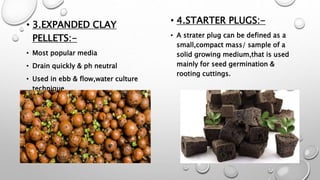
• 4.STARTER PLUGS:-
• A strater plug can be defined as a
small,compact mass/ sample of a
solid growing medium,that is used
mainly for seed germination &
rooting cuttings.
• 5.GROWSTONES:-
• The porous rocks created from
recycled glass is a versatile
medium that can fit almost
hydroponic system.
• 6.VERMICULITE:-
• It is a mined material that is
made from expanded pebbles
under extreme heat.
• WHAT PLANTS NEED?
• Water
• Light
• Air
• Anchorage
• Nutrients
• NUTRIENT SOLUTIONS :-
• N:-Nitrogen for the production of leaves ,
stem growth & building plant cells.
• P:-”P” for the development of flowers ,
fruits & healthy root growth.
• K:-”K” For Photosynthesis.
• TRACE
ELEMENTS:-
• SULPHUR
• IRON
• ZINC
• MANGANESE
• COPPER
• BORON
• MAGNESIUM
• CALCIUM
• CHLORINE
• SYSTEM REQUIREMENTS:-
1.Ph
2.Electrical conductivity
3.Horticultural lighting
4.Temp. & Environmental Control
• WHAT CAN WE GROW?
• List of the hydroponics plants:-
1.Vegetable: lettuce ,spinach, tomatoes,
capsicum etc.
2.Herbs:-basil, oregano ,mint etc.
3.Fruits:-strawberries, hot peppers etc.
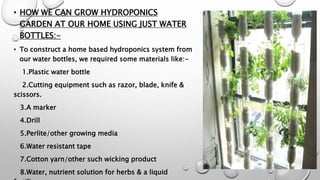
• HOW WE CAN GROW HYDROPONICS
GARDEN AT OUR HOME USING JUST WATER
BOTTLES:-
• To construct a home based hydroponics system from
our water bottles, we required some materials like:-
1.Plastic water bottle
2.Cutting equipment such as razor, blade, knife &
scissors.
3.A marker
4.Drill
5.Perlite/other growing media
6.Water resistant tape
7.Cotton yarn/other such wicking product
8.Water, nutrient solution for herbs & a liquid
• ADVANTAGES:-
• High yields achieved in a smaller space.
• Nutrients precisely controlled.
• 30-55% faster growing than the soil
growing plants.
• Indoor gardens grown using full-
spectrum horticultural lighting.
• Soil-borne pests & diseases are
eliminated.
• Weeds are eliminated.
• Plants are healthier & reach maturity
faster.
• Can farm all year round.
• DISADVANTAGES:-
• Cost of initial investment.
• Production is management & labour
intensive.
• A high level of expertise is
required.
• Daily attention is necessary.
• Specially formulated, soluble
nutrients must always be used.
• Some water-borne diseases can
rapidly spread in recirculation
system.
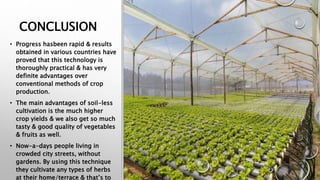
CONCLUSION
• Progress hasbeen rapid & results
obtained in various countries have
proved that this technology is
thoroughly practical & has very
definite advantages over
conventional methods of crop
production.
• The main advantages of soil-less
cultivation is the much higher
crop yields & we also get so much
tasty & good quality of vegetables
& fruits as well.
• Now-a-days people living in
crowded city streets, without
gardens. By using this technique
they cultivate any types of herbs
at their home/terrace & that’s to
• REFERENCES:-
• NCERT Book(BIOLOGY XI CLASS)
• https://www.trees.com
• https://www.academia.edu
Hydroponics

Hydroponics

  • 1.
    HYDROPONICS PRESENTED BY:- SUBHASHREE SUBHRAJYOTISAHOO M.SC. PART-2(BOTANY) ROLL NO.-BY4420
  • 2.
    CONTENT S INTRODUCTION HISTORY WHAT IS HYDROPONICSYSTEM? TYPES OF HYDROPONIC SYSTEM COMMON TYPES OF GROWING MEDIA USED WHAT PLANTS NEED ? WHAT IS SYSTEM REQUIREMENT? HOW WE CAN GROW HYDROPONIC GARDEN AT OUR HOME USING JUST WATER BOTTLES ADVANTAGES DISADVANTAGES CONCLUSION
  • 3.
    INTRODUCTION • Hydroponics isa dirt-free, space saving ,water effective method of soilless growing. • Hydroponics is a Greek term ,made from 2 words that is:-"Hydro" means water and "Ponos" means labour & hence "working water" is it's actual meaning. • Hydroponics is usually grown indoors/in a green house. HISTORY 600b.c. In the 600b.c. “Hanging gardens of Babylon” are believed to havebeen one of the 1st mass scale hydroponics projects. 1000–1100 In 1000A.D.-1100A.D. ,the Azetects developed a system Of floating gardens called “chinampas” in the island city of tenochtitlan of Mexico. 1920s & 1930s In 1920s & 1930s, Hydroponics terms coined by W.F.Gericke. He experimented & popularised the practice of growing plants in a water solution. Hence he termed this technique as Hydroponics.
  • 4.
  • 5.
    TYPES OF HYDROPONICSSYSTEMS • .There are many different types of Hydroponics systems are present . These systems can be either active/passive. • '6'basic types of Hydroponics systems are present ,they include: 1.The wick system 2.Deep water culture 3.Nutrient film technique 4.Ebb and flow 5.Drip system 6.Aeroponics
  • 7.
    COMMON TYPES OFGROWING MEDIA USED • 1.COCONUT COIR:- • “Coconut coir”/“coco-tek” is also called as “Cocopeat”,&“Ultrapeat” is an organic material created from the coconut shell husks. • 2.ROCK WOOL:- • This material is created by melting rocks & spinning them into bundles of filament fibers.
  • 8.
    • 3.EXPANDED CLAY PELLETS:- •Most popular media • Drain quickly & ph neutral • Used in ebb & flow,water culture technique. • 4.STARTER PLUGS:- • A strater plug can be defined as a small,compact mass/ sample of a solid growing medium,that is used mainly for seed germination & rooting cuttings.
  • 9.
    • 5.GROWSTONES:- • Theporous rocks created from recycled glass is a versatile medium that can fit almost hydroponic system. • 6.VERMICULITE:- • It is a mined material that is made from expanded pebbles under extreme heat.
  • 10.
    • WHAT PLANTSNEED? • Water • Light • Air • Anchorage • Nutrients • NUTRIENT SOLUTIONS :- • N:-Nitrogen for the production of leaves , stem growth & building plant cells. • P:-”P” for the development of flowers , fruits & healthy root growth. • K:-”K” For Photosynthesis. • TRACE ELEMENTS:- • SULPHUR • IRON • ZINC • MANGANESE • COPPER • BORON • MAGNESIUM • CALCIUM • CHLORINE
  • 11.
    • SYSTEM REQUIREMENTS:- 1.Ph 2.Electricalconductivity 3.Horticultural lighting 4.Temp. & Environmental Control • WHAT CAN WE GROW? • List of the hydroponics plants:- 1.Vegetable: lettuce ,spinach, tomatoes, capsicum etc. 2.Herbs:-basil, oregano ,mint etc. 3.Fruits:-strawberries, hot peppers etc.
  • 12.
    • HOW WECAN GROW HYDROPONICS GARDEN AT OUR HOME USING JUST WATER BOTTLES:- • To construct a home based hydroponics system from our water bottles, we required some materials like:- 1.Plastic water bottle 2.Cutting equipment such as razor, blade, knife & scissors. 3.A marker 4.Drill 5.Perlite/other growing media 6.Water resistant tape 7.Cotton yarn/other such wicking product 8.Water, nutrient solution for herbs & a liquid
  • 13.
    • ADVANTAGES:- • Highyields achieved in a smaller space. • Nutrients precisely controlled. • 30-55% faster growing than the soil growing plants. • Indoor gardens grown using full- spectrum horticultural lighting. • Soil-borne pests & diseases are eliminated. • Weeds are eliminated. • Plants are healthier & reach maturity faster. • Can farm all year round. • DISADVANTAGES:- • Cost of initial investment. • Production is management & labour intensive. • A high level of expertise is required. • Daily attention is necessary. • Specially formulated, soluble nutrients must always be used. • Some water-borne diseases can rapidly spread in recirculation system.
  • 14.
    CONCLUSION • Progress hasbeenrapid & results obtained in various countries have proved that this technology is thoroughly practical & has very definite advantages over conventional methods of crop production. • The main advantages of soil-less cultivation is the much higher crop yields & we also get so much tasty & good quality of vegetables & fruits as well. • Now-a-days people living in crowded city streets, without gardens. By using this technique they cultivate any types of herbs at their home/terrace & that’s to
  • 15.
    • REFERENCES:- • NCERTBook(BIOLOGY XI CLASS) • https://www.trees.com • https://www.academia.edu