
PRESENTS
AGRICULTURAL TRAINING PROGRAM
The trust was incorporated in Dec 2009 under the Society
Act. The main objective of the trust is to spread the education
and educational training to the area where it is require
outmost. it has been organizing various workshops and
training program in the field of management, education,
medicals, rural development, agricultural development etc
since its inception. An entrepreneurial institution in the name
of Indian School of Management & Entrepreneurship (ISME)
providing Management & Entrepreneurial program and a
training institute The Preparation has been already promoted
by the trust and a Book Bank free book to the downtrodden
section of the society all over the country.
This program is going to be conducted at every panchayats /blocs/districts to
trained and motivate the farmer to use the more scientific methods of the
agriculture. In the recent years many mishappenings has taken place in other state,
to avoid such situation this programs is designed to provide a holistic training to the
farmer. This training will focus on certain important issues like:-
To increase the farm produce
Selection of the farm crop
Use of the suitable seeds
Use of insecticide and pesticide
Type and use of farm manure
System of irrigation facilities
Community farming
Crop protection during flood, famine and other calamities
Provision at the end of the govt.
Crop insurance and protection
Organic farming
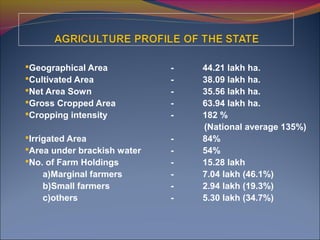
Geographical Area - 44.21 lakh ha.
Cultivated Area - 38.09 lakh ha.
Net Area Sown - 35.56 lakh ha.
Gross Cropped Area - 63.94 lakh ha.
Cropping intensity - 182 %
(National average 135%)
Irrigated Area - 84%
Area under brackish water - 54%
No. of Farm Holdings - 15.28 lakh
a)Marginal farmers - 7.04 lakh (46.1%)
b)Small farmers - 2.94 lakh (19.3%)
c)others - 5.30 lakh (34.7%)
(I) Sustainability of Soil
a) Salinity
b) Alkalinity
c) Deficiency of Micro nutrients
d) Poor organic carbon
(II) Conservation of water resources
(III) Crop diversification
(IV) Management of insects/pests
(V) Seeds
S – STRENGTHS
W – WEAKNESSES
O – OPPORTUNITIES
T - THEREATS
•Haryana, with its rich cultural heritage, is a land of warriors and hardworking
farmers.
•Mixed farming is a way of life and the state is known for its famous breeds
of Murrah buffalo and Haryana cattle.
•Also the climate of Haryana is uniquely favorable for Basmati rice
cultivation.
•About 2/3rd
of the State has assured irrigation, most suited for rice-wheat
production system.
•The State is also ideally located nearer to NCR with access to a range of big
markets.
•Cauliflower, onion, potato, tomato, chilies, guava and kinnow are the
important horticultural corps having good potential.
•Allied sectors like dairying, poultry, fishery, arid- horticultural, mushroom
farming.
•The land and water resources are indeed valuable and the State is fortunate
to have very good cultivable land with high cropping instentaly.
•Rapid diversion of cultivated land for non-agricultural purpose is currently a
matter of great concern.
•Soil health and water quality are declining.
•Soil organic carbon is low and the organic matter recycling is not practiced
as mostly the wheat paddy straw is burnt in the fields and cow dung is
mostly used as fuel.
•In arid region, ground water is mostly brackish and in canal command
areas, water table is rapidly declining.
•The shortage of labour is emerging as a major problem hindering
agricultural growth.
•Lack of storage, primary processing and cold chain facilities, inadequate,
uncertain and untimely supply of electricity, inhibition for agricultural
diversification as well as for change in food habits are some of the other
weaknesses.
•Relatively less investment in agricultural research and development is also
an important factor adversely affecting faster growth of agricultural in the
State.
•Proximity to the NCR as well other big cities, the fast growing domestic
demand and expending markets for agricultural products is a rare
opportunities especially for the farming community of Haryana.
•Well developed research and extension system to bridge the existing
productivity gaps in corps, animals and other sectors.
•Increasing demand for fruits, vegetable, milk, meat, eggs, fish and other
dairy products due to fast expansion of middle income group, is seen as
positive indicator.
•Existing cooperative societies can also be revitalized for organized credit,
marketing and other services in the agricultural sector.
•Will open new opportunities for increased profitability and income, organic
farming is another area for cutting down cost, improved soil fertility and
increased farm income.
•Scope for development of peri-urban agricultural and protected cultivation of
good quality vegetable and flowers is another untapped/under-tapped
opportunities for the farmers of Haryana.
Declining total factor productivity (TFP), rising cost of production and
increasing concern on quality of food, increasing international competition due
to globalization of agriculture, more area under cereal based (rice-wheat)
cropping system, declining acreage under leguminous crops, degrading soil
fertility/soil health with low organic matter, sulphur, potash and
micronutrients are, indeed, the emerging threats for the State agriculture. In
addition, fast depletion of ground water; rising salinity and water table in the
arid areas; release of untreated industrial effluent and sewage water in fresh
water canals, increased competition for land and water on account of fast
urbanization and industrialization are some of the other emerging threats.
Invariably, ineffective monitoring and poor quality control on inputs and
planting materials, increasing incidence of pests and diseases are also emerging
threats. Only selective insurance for crops and livestock and lack of insurance
for poultry and fish farming, non-availability of electricity during day time for
agriculture, higher rate of electricity and water charges for dairying and fish
farming, higher costs of feed and fertilizers, lack of interest of young generation
in pursuing agriculture as a profession are some of the discouraging trends,
lately.
•Good cultivable land be protected from non-agricultural uses
•Diversion of only waste and less productive land for non-
agriculture uses
•Declining soil health needs priority attention
•Emphasis on organic recycling and balanced use of nutrients
•Rules and procedures for land reforms to be revisited
•Scientific land use ensured for sustainability
•Reduce seepage losses in channels by lining them or using
closed conditions.
•Reduce evaporation by avoiding midday irrigation and using
under canopy rather than overhead sprinkling.
•Avoid over irrigation
•Control weeds on inter-row strips and keep them dry.
•Plant and harvest at optimal times.
•Irrigated frequently with just the right amount of water to
avoid crop distress.
•Export crops which are produced using agronomic techniques with which
small farmers are already familiar are less likely to present difficulties than
crops which are completely new to an area.
•Crops which make full use of family labour and do not require large amounts
of purchased inputs are more manageable for small holders than crops which
are best suited to mechanical cultivation and which need heavy applications
of agro-chemicals.
•Crops whose planting, weeding and harvesting dates come at periods of
peek labour demand for other activities in the small holder year are more
difficult to fit in to the small holder farming system than crops whose peak
labour needs come at an off season period in the small holder year.
•The main consideration in selecting the crops that are most suitable for small
holder production is of course the demands of the markets. There is no point
in producing something unless some one wants to buy it.
•Sampling in seed testing laboratory
•Mixing and dividing of seeds
•Mechanical method
•Random cup method
•Modified halving method
•Spoon method
•Hand halving method
•Method of purity separation
•What do you think is the main goal of agriculture, agriculture was
developed to produce crops and livestock for human consumption.
As the human population increase, the amount of food produced is
very important.
•Unfortunately, there are other organisms out there that want to
consume. It is crops that are meant for humans. It is estimated that
nearly 37% of all crops produced in the united states each year are
destroyed by agriculture pests, which results in an economic loss of
around $ 122 billion a year.
•Due to this loss in food production, pesticides are often used to try to
combat the problem.
Pesticides are chemicals that kill or manage the population of pests.
•Manure consistency is determined by factors including the kind of
animal, feeding intensity, type and amount of bedding material and
climate conditions along with other factors such as waste water from
the parlor.
•Slurry manure with up to 10% dry matter content.
Semi – solid manure with 10 to 20% dry matter content.
•Solid manure with more than 20% dry matter content.
Once you know the type of manure, you can start building the
appropriate handling system.
•Every component works together to maximize the system’s overall
profitability for your farm.
•A system approach also gives you flexibility
•Modern irrigation system planning and construction.
•Modern drainage system planning and construction.
•Land reclamation through irrigation and drainage.
•Irrigation and drainage throughout the world
•Irrigation and drainage improvements are not necessarily mutually
exclusive.
•Often both may be required together to assure sustained high level
production of crops.
•Get to spend time marketing the food early in the year, before
their 16 hour days in the field begin.
•Receive payment early in the season, which helps with the
farm’s cash grow.
•Have an opportunity to get to know the people who eat the
food they grow.
•Eat ultra-fresh food, with all the flavor and vitamin benefits.
•Get exposed to new vegetables and new ways of cooking
•Usually get to visit the farm at least once a season
•Find that kids typically favor food from their farm even veggies
they’ve never been known to eat.
•Pesticide-based approaches such as herbicides, insecticides
and fungicides
•Biological pest control approaches such as cover crops, trap
crops and beetle banks
•Barrier-based approaches such as agro textiles and bird
netting
•Animal psychology-based approaches such as bird scares
•Biotechnology- based approaches such as plant breeding and
genetic modification
An agricultural subsidy is a governmental and agribusinesses to
supplement their income manage the supply of agricultural
commodities and influence the cost and supply of such
commodities examples of such commodities include wheat, feed
grains ,cotton, milk, rice, peanuts, sugar, tobacco, oilseeds such
as soybeans, and meat products such as beef , pork and meat
products such as beef pork and lamb and mutton . Such
subsidies are extremely controversial, both because of their
complex effects and because of their political origins, which
involve heavy lobbying from groups representing the interests of
agribusiness.
•Crop hail policies are not part of the federal crop insurance
program and are provided directly to farmers by private insurer.
•Many farmers purchase crop hail coverage because hail has
the unique ability to totally destroy a significant part of planned
field while leaving the rest undamaged.
•In areas of the country where hail is a frequent event, farmers
often purchase a crop hail policy to protect high-yielding crops.
Unlike MPCI, a crop- hail policy can be purchased at any time
during the growing season.
•Also organic farming is very much helpful in protecting natural
resources in addition to ensuring higher profit to the farmers.
•Demand for organically produced agricultural commodities is
increasing at faster pace with increased income and health
consciousness.
•The State being in close proximity to national capital having ever
ready market, every effort will be made to facilitate farmers in
producing organic products.
•Suitable compensation shall be ensured to the organic farmers in the
initial stage.
•The State shall make elaborate arrangements for establishing needed
facilities for certification of organic produce/products.
We are having the pool of trainers and scantiest from the
prestigious institutions like University of Delhi, CSSIR, KVK’s
and other institutions.
Our trainers will be equipped with all the required training
gadgets and other required resources.
SUSANSAKARA EDUCATIONAL TRUST
CONTACT TO US :- NH.8,RANGPURI
NEW DELHI:-110037
MOB. No. 9212145099
E Mail: - ismeworld@gmail.com

AGRICULTURAL TRAINING PROGRAM

  • 1.
  • 2.
    The trust wasincorporated in Dec 2009 under the Society Act. The main objective of the trust is to spread the education and educational training to the area where it is require outmost. it has been organizing various workshops and training program in the field of management, education, medicals, rural development, agricultural development etc since its inception. An entrepreneurial institution in the name of Indian School of Management & Entrepreneurship (ISME) providing Management & Entrepreneurial program and a training institute The Preparation has been already promoted by the trust and a Book Bank free book to the downtrodden section of the society all over the country.
  • 3.
    This program isgoing to be conducted at every panchayats /blocs/districts to trained and motivate the farmer to use the more scientific methods of the agriculture. In the recent years many mishappenings has taken place in other state, to avoid such situation this programs is designed to provide a holistic training to the farmer. This training will focus on certain important issues like:- To increase the farm produce Selection of the farm crop Use of the suitable seeds Use of insecticide and pesticide Type and use of farm manure System of irrigation facilities Community farming Crop protection during flood, famine and other calamities Provision at the end of the govt. Crop insurance and protection Organic farming
  • 4.
    Geographical Area -44.21 lakh ha. Cultivated Area - 38.09 lakh ha. Net Area Sown - 35.56 lakh ha. Gross Cropped Area - 63.94 lakh ha. Cropping intensity - 182 % (National average 135%) Irrigated Area - 84% Area under brackish water - 54% No. of Farm Holdings - 15.28 lakh a)Marginal farmers - 7.04 lakh (46.1%) b)Small farmers - 2.94 lakh (19.3%) c)others - 5.30 lakh (34.7%)
  • 5.
    (I) Sustainability ofSoil a) Salinity b) Alkalinity c) Deficiency of Micro nutrients d) Poor organic carbon (II) Conservation of water resources (III) Crop diversification (IV) Management of insects/pests (V) Seeds
  • 6.
    S – STRENGTHS W– WEAKNESSES O – OPPORTUNITIES T - THEREATS
  • 7.
    •Haryana, with itsrich cultural heritage, is a land of warriors and hardworking farmers. •Mixed farming is a way of life and the state is known for its famous breeds of Murrah buffalo and Haryana cattle. •Also the climate of Haryana is uniquely favorable for Basmati rice cultivation. •About 2/3rd of the State has assured irrigation, most suited for rice-wheat production system. •The State is also ideally located nearer to NCR with access to a range of big markets. •Cauliflower, onion, potato, tomato, chilies, guava and kinnow are the important horticultural corps having good potential. •Allied sectors like dairying, poultry, fishery, arid- horticultural, mushroom farming. •The land and water resources are indeed valuable and the State is fortunate to have very good cultivable land with high cropping instentaly.
  • 8.
    •Rapid diversion ofcultivated land for non-agricultural purpose is currently a matter of great concern. •Soil health and water quality are declining. •Soil organic carbon is low and the organic matter recycling is not practiced as mostly the wheat paddy straw is burnt in the fields and cow dung is mostly used as fuel. •In arid region, ground water is mostly brackish and in canal command areas, water table is rapidly declining. •The shortage of labour is emerging as a major problem hindering agricultural growth. •Lack of storage, primary processing and cold chain facilities, inadequate, uncertain and untimely supply of electricity, inhibition for agricultural diversification as well as for change in food habits are some of the other weaknesses. •Relatively less investment in agricultural research and development is also an important factor adversely affecting faster growth of agricultural in the State.
  • 9.
    •Proximity to theNCR as well other big cities, the fast growing domestic demand and expending markets for agricultural products is a rare opportunities especially for the farming community of Haryana. •Well developed research and extension system to bridge the existing productivity gaps in corps, animals and other sectors. •Increasing demand for fruits, vegetable, milk, meat, eggs, fish and other dairy products due to fast expansion of middle income group, is seen as positive indicator. •Existing cooperative societies can also be revitalized for organized credit, marketing and other services in the agricultural sector. •Will open new opportunities for increased profitability and income, organic farming is another area for cutting down cost, improved soil fertility and increased farm income. •Scope for development of peri-urban agricultural and protected cultivation of good quality vegetable and flowers is another untapped/under-tapped opportunities for the farmers of Haryana.
  • 10.
    Declining total factorproductivity (TFP), rising cost of production and increasing concern on quality of food, increasing international competition due to globalization of agriculture, more area under cereal based (rice-wheat) cropping system, declining acreage under leguminous crops, degrading soil fertility/soil health with low organic matter, sulphur, potash and micronutrients are, indeed, the emerging threats for the State agriculture. In addition, fast depletion of ground water; rising salinity and water table in the arid areas; release of untreated industrial effluent and sewage water in fresh water canals, increased competition for land and water on account of fast urbanization and industrialization are some of the other emerging threats. Invariably, ineffective monitoring and poor quality control on inputs and planting materials, increasing incidence of pests and diseases are also emerging threats. Only selective insurance for crops and livestock and lack of insurance for poultry and fish farming, non-availability of electricity during day time for agriculture, higher rate of electricity and water charges for dairying and fish farming, higher costs of feed and fertilizers, lack of interest of young generation in pursuing agriculture as a profession are some of the discouraging trends, lately.
  • 11.
    •Good cultivable landbe protected from non-agricultural uses •Diversion of only waste and less productive land for non- agriculture uses •Declining soil health needs priority attention •Emphasis on organic recycling and balanced use of nutrients •Rules and procedures for land reforms to be revisited •Scientific land use ensured for sustainability
  • 12.
    •Reduce seepage lossesin channels by lining them or using closed conditions. •Reduce evaporation by avoiding midday irrigation and using under canopy rather than overhead sprinkling. •Avoid over irrigation •Control weeds on inter-row strips and keep them dry. •Plant and harvest at optimal times. •Irrigated frequently with just the right amount of water to avoid crop distress.
  • 13.
    •Export crops whichare produced using agronomic techniques with which small farmers are already familiar are less likely to present difficulties than crops which are completely new to an area. •Crops which make full use of family labour and do not require large amounts of purchased inputs are more manageable for small holders than crops which are best suited to mechanical cultivation and which need heavy applications of agro-chemicals. •Crops whose planting, weeding and harvesting dates come at periods of peek labour demand for other activities in the small holder year are more difficult to fit in to the small holder farming system than crops whose peak labour needs come at an off season period in the small holder year. •The main consideration in selecting the crops that are most suitable for small holder production is of course the demands of the markets. There is no point in producing something unless some one wants to buy it.
  • 14.
    •Sampling in seedtesting laboratory •Mixing and dividing of seeds •Mechanical method •Random cup method •Modified halving method •Spoon method •Hand halving method •Method of purity separation
  • 15.
    •What do youthink is the main goal of agriculture, agriculture was developed to produce crops and livestock for human consumption. As the human population increase, the amount of food produced is very important. •Unfortunately, there are other organisms out there that want to consume. It is crops that are meant for humans. It is estimated that nearly 37% of all crops produced in the united states each year are destroyed by agriculture pests, which results in an economic loss of around $ 122 billion a year. •Due to this loss in food production, pesticides are often used to try to combat the problem. Pesticides are chemicals that kill or manage the population of pests.
  • 16.
    •Manure consistency isdetermined by factors including the kind of animal, feeding intensity, type and amount of bedding material and climate conditions along with other factors such as waste water from the parlor. •Slurry manure with up to 10% dry matter content. Semi – solid manure with 10 to 20% dry matter content. •Solid manure with more than 20% dry matter content. Once you know the type of manure, you can start building the appropriate handling system. •Every component works together to maximize the system’s overall profitability for your farm. •A system approach also gives you flexibility
  • 17.
    •Modern irrigation systemplanning and construction. •Modern drainage system planning and construction. •Land reclamation through irrigation and drainage. •Irrigation and drainage throughout the world •Irrigation and drainage improvements are not necessarily mutually exclusive. •Often both may be required together to assure sustained high level production of crops.
  • 18.
    •Get to spendtime marketing the food early in the year, before their 16 hour days in the field begin. •Receive payment early in the season, which helps with the farm’s cash grow. •Have an opportunity to get to know the people who eat the food they grow. •Eat ultra-fresh food, with all the flavor and vitamin benefits. •Get exposed to new vegetables and new ways of cooking •Usually get to visit the farm at least once a season •Find that kids typically favor food from their farm even veggies they’ve never been known to eat.
  • 19.
    •Pesticide-based approaches suchas herbicides, insecticides and fungicides •Biological pest control approaches such as cover crops, trap crops and beetle banks •Barrier-based approaches such as agro textiles and bird netting •Animal psychology-based approaches such as bird scares •Biotechnology- based approaches such as plant breeding and genetic modification
  • 20.
    An agricultural subsidyis a governmental and agribusinesses to supplement their income manage the supply of agricultural commodities and influence the cost and supply of such commodities examples of such commodities include wheat, feed grains ,cotton, milk, rice, peanuts, sugar, tobacco, oilseeds such as soybeans, and meat products such as beef , pork and meat products such as beef pork and lamb and mutton . Such subsidies are extremely controversial, both because of their complex effects and because of their political origins, which involve heavy lobbying from groups representing the interests of agribusiness.
  • 21.
    •Crop hail policiesare not part of the federal crop insurance program and are provided directly to farmers by private insurer. •Many farmers purchase crop hail coverage because hail has the unique ability to totally destroy a significant part of planned field while leaving the rest undamaged. •In areas of the country where hail is a frequent event, farmers often purchase a crop hail policy to protect high-yielding crops. Unlike MPCI, a crop- hail policy can be purchased at any time during the growing season.
  • 22.
    •Also organic farmingis very much helpful in protecting natural resources in addition to ensuring higher profit to the farmers. •Demand for organically produced agricultural commodities is increasing at faster pace with increased income and health consciousness. •The State being in close proximity to national capital having ever ready market, every effort will be made to facilitate farmers in producing organic products. •Suitable compensation shall be ensured to the organic farmers in the initial stage. •The State shall make elaborate arrangements for establishing needed facilities for certification of organic produce/products.
  • 23.
    We are havingthe pool of trainers and scantiest from the prestigious institutions like University of Delhi, CSSIR, KVK’s and other institutions. Our trainers will be equipped with all the required training gadgets and other required resources.
  • 24.
    SUSANSAKARA EDUCATIONAL TRUST CONTACTTO US :- NH.8,RANGPURI NEW DELHI:-110037 MOB. No. 9212145099 E Mail: - ismeworld@gmail.com