Forest Ecology Arlington Regional Master Naturalists Basic Training Course Spring 2011 Jim McGlone Urban Forest Conservationist Virginia Department of Forestry
Outline How Trees Grow Distribution and Diversity Forest Habitats Forest Ecology Management Forest Threats DOF Citizen Action
How a Tree Grows
What is a tree? How is a tree different from a perennial  herbaceous plant? How is a tree different from a vine? How is a tree different from a shrub?
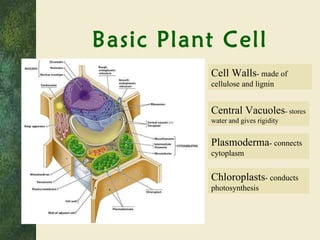
Basic Plant Cell Cell Walls - made of cellulose and lignin Central Vacuoles - stores water and gives rigidity Plasmoderma - connects cytoplasm Chloroplasts - conducts photosynthesis
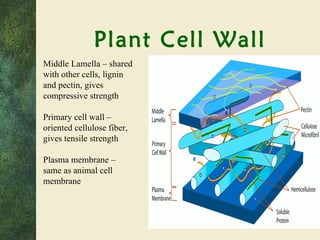
Plant Cell Wall Middle Lamella – shared with other cells, lignin and pectin, gives compressive strength Primary cell wall – oriented cellulose fiber, gives tensile strength Plasma membrane – same as animal cell membrane
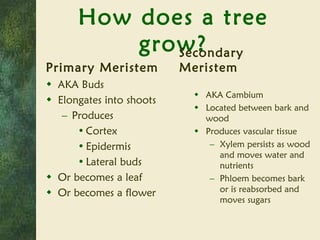
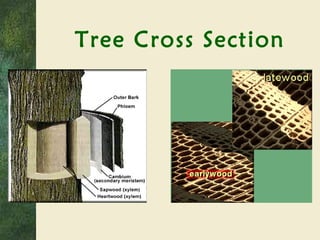
How does a tree grow? Primary Meristem AKA Buds Elongates into shoots Produces Cortex Epidermis Lateral buds Or becomes a leaf Or becomes a flower Secondary Meristem AKA Cambium Located between bark and wood Produces vascular tissue Xylem persists as wood and moves water and nutrients Phloem becomes bark or is reabsorbed and moves sugars
 
 
Tree Cross Section
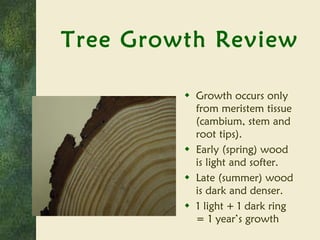
Tree Growth Review Growth occurs only from meristem tissue (cambium, stem and root tips). Early (spring) wood is light and softer. Late (summer) wood is dark and denser. 1 light + 1 dark ring = 1 year’s growth
Aging and Death Must grow new sapwood every year.  Why? This becomes a bigger and bigger energy drain.  [ π (2nr + n 2 )] Can grow less wood, but that means less water for energy production. Eventually growth in energy demand is greater than growth in energy production, the tree goes into energy deficit, declines and dies.
Distribution of Forests
Horizontal Distribution Large scale Climate Geology Landscape scale Soil types topography
Climate Average Temperature Date of First/Last Frost Average & Timing of Rainfall Soil weathering
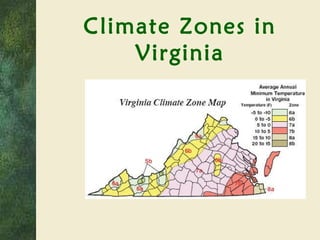
Climate Zones in Virginia
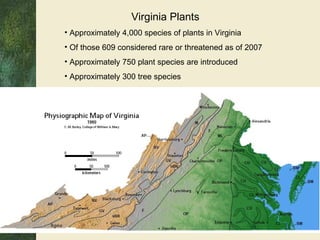
Virginia Plants Approximately 4,000 species of plants in Virginia Of those 609 considered rare or threatened as of 2007 Approximately 750 plant species are introduced Approximately 300 tree species
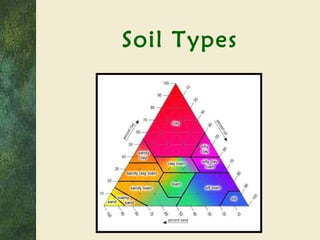
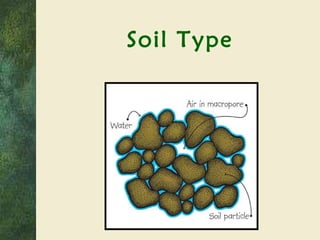
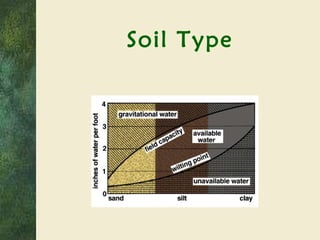
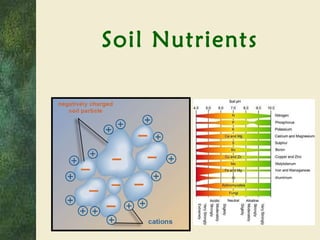
Soil Types Moisture Nutrients
Soil Types
Soil Type
Soil Type
Soil Nutrients
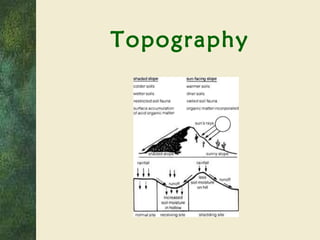
Topography
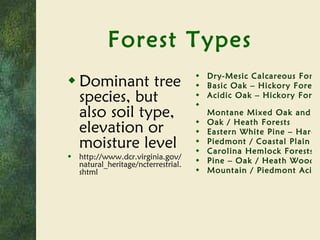
Forest Types Dominant tree species, but also soil type, elevation or moisture level http://www.dcr.virginia.gov/natural_heritage/ncterrestrial.shtml Dry-Mesic Calcareous Forests  Basic Oak – Hickory Forests  Acidic Oak – Hickory Forests   Montane Mixed Oak and Oak – Hickory Forests  Oak / Heath Forests  Eastern White Pine – Hardwood Forests  Piedmont / Coastal Plain Oak – Beech / Heath Forests Carolina Hemlock Forests Pine – Oak / Heath Woodlands  Mountain / Piedmont Acidic Woodlands
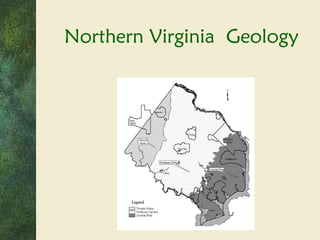
Northern Virginia  Geology
Forest Habitats
Fauna Birds Mammals Herps Insects
Habitat Needs Food Nesting Resting Water
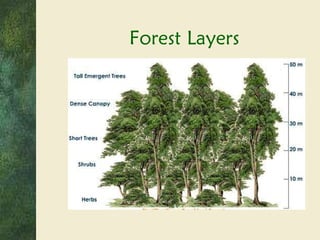
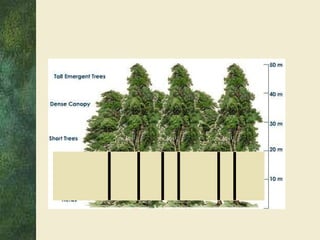
Forest Layers
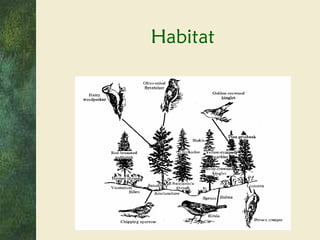
Habitat
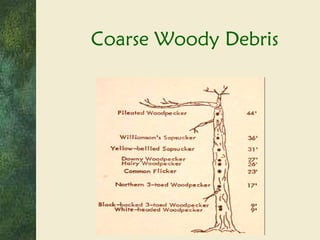
Coarse Woody Debris
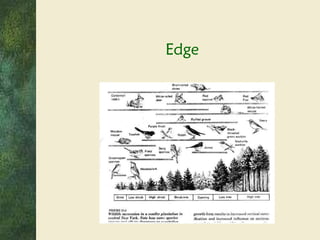
Edge
Forest Ecology
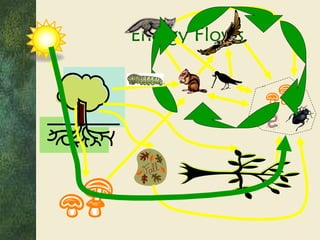
Energy Flows
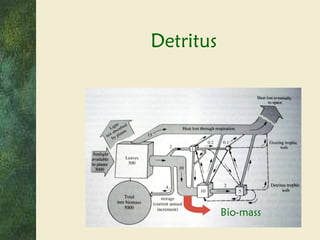
Detritus Bio-mass
FOREST ECOLOGY PART 2 Some Important Processes
Trophic Regulation
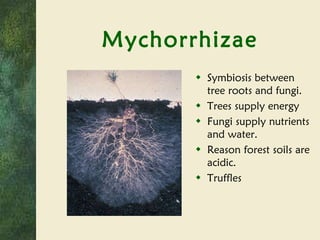
Mychorrhizae Symbiosis between tree roots and fungi. Trees supply energy Fungi supply nutrients and water. Reason forest soils are acidic. Truffles
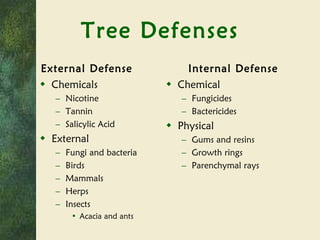
Tree Defenses External Defense Chemicals Nicotine Tannin Salicylic Acid External Fungi and bacteria Birds Mammals Herps Insects Acacia and ants Internal Defense Chemical Fungicides Bactericides Physical Gums and resins Growth rings Parenchymal rays
Evolution of Natural Communities Past Management Seed Availability Luck Microclimates and Topography
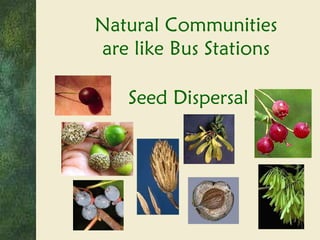
Natural Communities are like Bus Stations Seed Dispersal
 
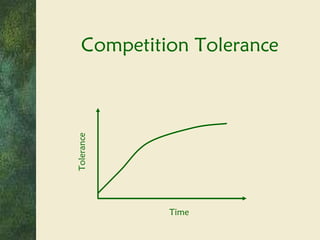
Competition Tolerance Tolerance Time
Tolerance Pioneer species are usually intolerant of competition for light – Virginia Pine, Eastern Red Cedar, Tulip poplar Climax species are very tolerant of competition and can regenerate themselves in their own shade – Maple, Beech, Holly
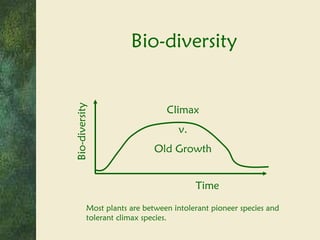
Bio-diversity Bio-diversity Time Most plants are between intolerant pioneer species and tolerant climax species. Climax v. Old Growth
Disturbance resets successional clock Highly disturbed systems are stuck in early succession Undisturbed systems progress to climax stage Intermediate disturbance cycles a system between stages of succession Disturbance
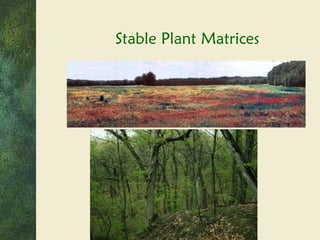
Stable Plant Matrices
FOREST MANAGEMENT
Why Manage a Forest? Break down in regulatory processes Loss of apex predators Loss of disturbance regime Introduction of stressors Air pollution Invasive species Human decisions Increase bio-diversity Loss of habitat type
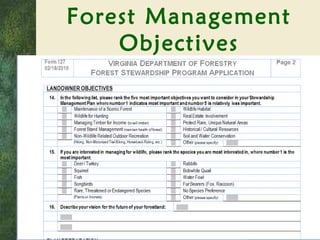
Forest Management Objectives
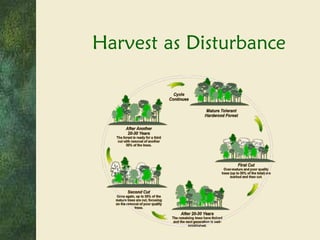
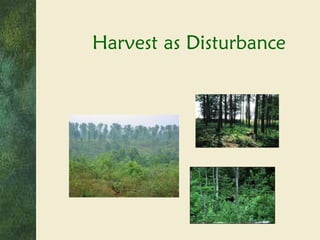
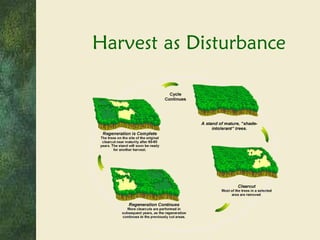
Harvest as Disturbance
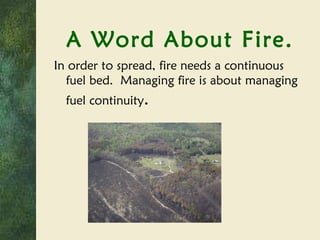
A Word About Fire. In order to spread, fire needs a continuous fuel bed.  Managing fire is about managing fuel continuity .
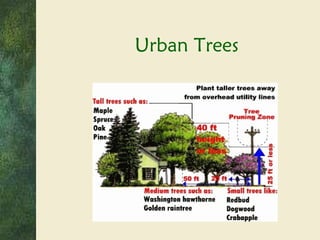
Urban Trees
Threats to the Forest
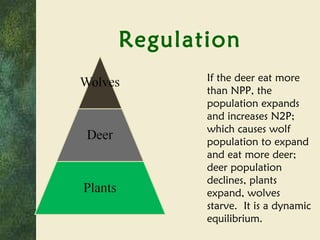
Regulation If the deer eat more than NPP, the population expands and increases N2P; which causes wolf population to expand and eat more deer; deer population declines, plants expand, wolves starve.  It is a dynamic equilibrium.
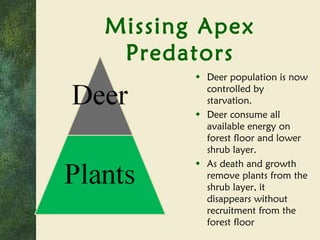
Missing Apex Predators Deer population is now controlled by starvation. Deer consume all available energy on forest floor and lower shrub layer. As death and growth remove plants from the shrub layer, it disappears without recruitment from the forest floor
 
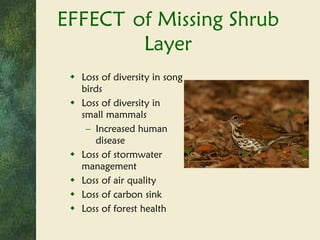
EFFECT   of Missing Shrub Layer Loss of diversity in song birds Loss of diversity in small mammals Increased human disease Loss of stormwater management Loss of air quality Loss of carbon sink Loss of forest health
Deer and Invasive Plants Deer and other native herbivores prefer native plants Excessive browse on natives can create a vacuum into which non-natives invade
Non-native Invasive Plants Compete with forest plants for sun and sprouting space Vines can kill mature trees Are generally free from predation.
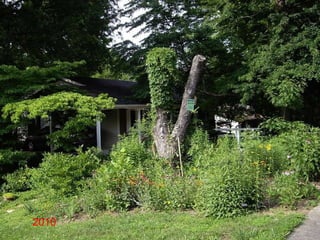
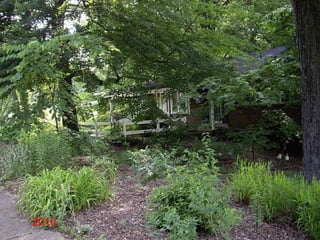
Citizen Action Start at home ASNV Wildlife Sanctuary NWF Backyard Habitat Develop a Layered Landscape with herbs, shrubs and trees in the same space
2010
2010
Citizen Action Deer Management Fairfax County Wildlife Biologist FCPA Deer Pellet Program Venison Stew Invasive Plants ACE Program
Recommended Reading Forests in Peril , Delcourt, 2002 McNaughton & Gunn 1491: New Revelations of the Americas Before  Columbus, Charles C. Mann Collapse , Jared Diamond Positive Impact Forestry,  Thom J. McEvoy, Island Press, 2004 Bringing Nature Home , Douglas Tallamy, Timber Press, 2007 Teaming With Microbes , Jeff Lowenfels and Wayne Lewis, Timber Press, 2010 (Revised)

Forest ecology 2011 armn

  • 1.
    Forest Ecology ArlingtonRegional Master Naturalists Basic Training Course Spring 2011 Jim McGlone Urban Forest Conservationist Virginia Department of Forestry
  • 2.
    Outline How TreesGrow Distribution and Diversity Forest Habitats Forest Ecology Management Forest Threats DOF Citizen Action
  • 3.
  • 4.
    What is atree? How is a tree different from a perennial herbaceous plant? How is a tree different from a vine? How is a tree different from a shrub?
  • 5.
    Basic Plant CellCell Walls - made of cellulose and lignin Central Vacuoles - stores water and gives rigidity Plasmoderma - connects cytoplasm Chloroplasts - conducts photosynthesis
  • 6.
    Plant Cell WallMiddle Lamella – shared with other cells, lignin and pectin, gives compressive strength Primary cell wall – oriented cellulose fiber, gives tensile strength Plasma membrane – same as animal cell membrane
  • 7.
    How does atree grow? Primary Meristem AKA Buds Elongates into shoots Produces Cortex Epidermis Lateral buds Or becomes a leaf Or becomes a flower Secondary Meristem AKA Cambium Located between bark and wood Produces vascular tissue Xylem persists as wood and moves water and nutrients Phloem becomes bark or is reabsorbed and moves sugars
  • 8.
  • 9.
  • 10.
  • 11.
    Tree Growth ReviewGrowth occurs only from meristem tissue (cambium, stem and root tips). Early (spring) wood is light and softer. Late (summer) wood is dark and denser. 1 light + 1 dark ring = 1 year’s growth
  • 12.
    Aging and DeathMust grow new sapwood every year. Why? This becomes a bigger and bigger energy drain. [ π (2nr + n 2 )] Can grow less wood, but that means less water for energy production. Eventually growth in energy demand is greater than growth in energy production, the tree goes into energy deficit, declines and dies.
  • 13.
  • 14.
    Horizontal Distribution Largescale Climate Geology Landscape scale Soil types topography
  • 15.
    Climate Average TemperatureDate of First/Last Frost Average & Timing of Rainfall Soil weathering
  • 16.
  • 17.
    Virginia Plants Approximately4,000 species of plants in Virginia Of those 609 considered rare or threatened as of 2007 Approximately 750 plant species are introduced Approximately 300 tree species
  • 18.
  • 19.
  • 20.
  • 21.
  • 22.
  • 23.
  • 24.
    Forest Types Dominanttree species, but also soil type, elevation or moisture level http://www.dcr.virginia.gov/natural_heritage/ncterrestrial.shtml Dry-Mesic Calcareous Forests Basic Oak – Hickory Forests Acidic Oak – Hickory Forests Montane Mixed Oak and Oak – Hickory Forests Oak / Heath Forests Eastern White Pine – Hardwood Forests Piedmont / Coastal Plain Oak – Beech / Heath Forests Carolina Hemlock Forests Pine – Oak / Heath Woodlands Mountain / Piedmont Acidic Woodlands
  • 25.
  • 26.
  • 27.
    Fauna Birds MammalsHerps Insects
  • 28.
    Habitat Needs FoodNesting Resting Water
  • 29.
  • 30.
  • 31.
  • 32.
  • 33.
  • 34.
  • 35.
  • 36.
    FOREST ECOLOGY PART2 Some Important Processes
  • 37.
  • 38.
    Mychorrhizae Symbiosis betweentree roots and fungi. Trees supply energy Fungi supply nutrients and water. Reason forest soils are acidic. Truffles
  • 39.
    Tree Defenses ExternalDefense Chemicals Nicotine Tannin Salicylic Acid External Fungi and bacteria Birds Mammals Herps Insects Acacia and ants Internal Defense Chemical Fungicides Bactericides Physical Gums and resins Growth rings Parenchymal rays
  • 40.
    Evolution of NaturalCommunities Past Management Seed Availability Luck Microclimates and Topography
  • 41.
    Natural Communities arelike Bus Stations Seed Dispersal
  • 42.
  • 43.
  • 44.
    Tolerance Pioneer speciesare usually intolerant of competition for light – Virginia Pine, Eastern Red Cedar, Tulip poplar Climax species are very tolerant of competition and can regenerate themselves in their own shade – Maple, Beech, Holly
  • 45.
    Bio-diversity Bio-diversity TimeMost plants are between intolerant pioneer species and tolerant climax species. Climax v. Old Growth
  • 46.
    Disturbance resets successionalclock Highly disturbed systems are stuck in early succession Undisturbed systems progress to climax stage Intermediate disturbance cycles a system between stages of succession Disturbance
  • 47.
  • 48.
  • 49.
    Why Manage aForest? Break down in regulatory processes Loss of apex predators Loss of disturbance regime Introduction of stressors Air pollution Invasive species Human decisions Increase bio-diversity Loss of habitat type
  • 50.
  • 51.
  • 52.
  • 53.
  • 54.
    A Word AboutFire. In order to spread, fire needs a continuous fuel bed. Managing fire is about managing fuel continuity .
  • 55.
  • 56.
  • 57.
    Regulation If thedeer eat more than NPP, the population expands and increases N2P; which causes wolf population to expand and eat more deer; deer population declines, plants expand, wolves starve. It is a dynamic equilibrium.
  • 58.
    Missing Apex PredatorsDeer population is now controlled by starvation. Deer consume all available energy on forest floor and lower shrub layer. As death and growth remove plants from the shrub layer, it disappears without recruitment from the forest floor
  • 59.
  • 60.
    EFFECT of Missing Shrub Layer Loss of diversity in song birds Loss of diversity in small mammals Increased human disease Loss of stormwater management Loss of air quality Loss of carbon sink Loss of forest health
  • 61.
    Deer and InvasivePlants Deer and other native herbivores prefer native plants Excessive browse on natives can create a vacuum into which non-natives invade
  • 62.
    Non-native Invasive PlantsCompete with forest plants for sun and sprouting space Vines can kill mature trees Are generally free from predation.
  • 63.
    Citizen Action Startat home ASNV Wildlife Sanctuary NWF Backyard Habitat Develop a Layered Landscape with herbs, shrubs and trees in the same space
  • 64.
  • 65.
  • 66.
    Citizen Action DeerManagement Fairfax County Wildlife Biologist FCPA Deer Pellet Program Venison Stew Invasive Plants ACE Program
  • 67.
    Recommended Reading Forestsin Peril , Delcourt, 2002 McNaughton & Gunn 1491: New Revelations of the Americas Before Columbus, Charles C. Mann Collapse , Jared Diamond Positive Impact Forestry, Thom J. McEvoy, Island Press, 2004 Bringing Nature Home , Douglas Tallamy, Timber Press, 2007 Teaming With Microbes , Jeff Lowenfels and Wayne Lewis, Timber Press, 2010 (Revised)

Editor's Notes

  • #6 Plant cells are similar to animal cells except that they have cell walls, central vacuoles, and plasmoderma. Some also have chloroplasts.
  • #16 Soils have a big effect on forest types, but climate also plays a role
  • #26 Fairfax has three main geologic areas: Coastal plain is mixed hardwood and acidic oak-hickory types Upland piedmont is mostly acidic oak-hickory Triassic basin is basic oak-hickory
  • #30 Healthy forests are vertically complex
  • #31 Animals use different layers of the forest
  • #32 Dead trees are also part of a healthy forest. Layers again.
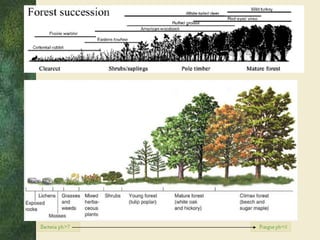
  • #33 An old field will usually progress from bare soil to annuals to perennials to shrubs and eastern red cedar and/or Virginia pine to oak-hickory to maple-beech. Different animals use different stages.
  • #36 Most forest ecosystems are detritus systems rather than grazing systems. This means energy flows from producers to consumers mainly through dead tissues.
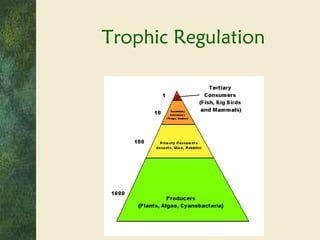
  • #38 Notice 90% reduction in biomass/energy at each level.
  • #42 Maple, ash, poplar seeds – have wings Black gum, hackberry, service berry have pulpy fruit that birds and animals eat Acorns and hickory nuts rely on forgotten storage.
  • #44 Species that are intolerant of highly competitive low light conditions are incapable of reproducing, establishing, growing, and maintaining themselves under their own canopies.
  • #47 Disturbances: Fire Wind Ice Man
  • #48 Along successional path there are some stable plant matrices that can be maintained by appropriate disturbance regimes. Meadow, oak-hickory, and loblolly pine forests can be maintained by fire.
  • #52 By using appropriate harvest practices we can manage successional clock to maintain resource values we want. Some harvest is useful for maintaining mosaic landscape favored by wildlife and increasing diversity.
  • #53 Regeneration harvest creates large early successional blocks with high diversity because it will contain meadow and forest species for a time. Seed tree does the same as regeneration but maintains a few mature trees Shelter wood is more forested, lower diversity but good for maintaining oaks Group select will create small meadows within mature forest. Select cut creates room to grow.
  • #54 Two year old clear cut One year old and five year old shelter woods
  • #56 When planting trees plant the right tree in the right place. Does it have room to grow canopy and roots without compromising infrastructure. Generally when a tree conflict with human construct, the tree loses.