M.M.C.B Ehelamalpe
PGIA/2015/182
PP 5260 Advances in Plant Protection Methods for Plantation Crops and
Forest Species
Diseases and Disorders
 Tree disease is caused by varying factors, including the
tree’s geographical location, weather, soil conditions, and
the overall health of the tree and other plant life
surrounding it.
 Disorders of forest trees is to determine whether the stress
is biotic (living) or abiotic (non-living) in nature. Biotic
stresses are caused by insects, mites, disease (i.e. bacteria,
fungi, and viruses), animals or other living organisms.
Abiotic stresses are caused by non-living factors and often
involve the excess or deficiency of water (flooding or
drought), nutrients, chemicals (de-icing salts), heat or cold
(freezing or low temperature injury) and wind.
Leaf diseases
1. BACTERIAL BLIGHT
 The causal agent of bacterial blight is Pantoea ananatis.
Other bacterial leaf spots, caused by Xathomonas sp.
also occur, but under field conditions P. ananatis is the
major problem.
 Species affected:
 It has been reported from Eucalyptus clones, hybrids and
species including E. grandis, E. saligna, E. dunnii, E. nitens, E.
smithii, E. grandis x E. camadulensis (GC) and E. grandis x E.
urophylla (GU).
Symptoms:
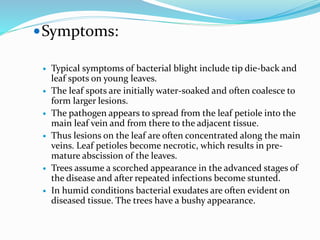
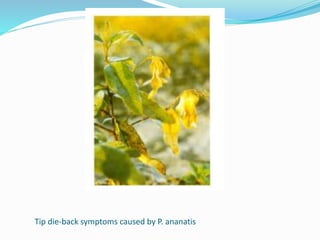
 Typical symptoms of bacterial blight include tip die-back and
leaf spots on young leaves.
 The leaf spots are initially water-soaked and often coalesce to
form larger lesions.
 The pathogen appears to spread from the leaf petiole into the
main leaf vein and from there to the adjacent tissue.
 Thus lesions on the leaf are often concentrated along the main
veins. Leaf petioles become necrotic, which results in pre-
mature abscission of the leaves.
 Trees assume a scorched appearance in the advanced stages of
the disease and after repeated infections become stunted.
 In humid conditions bacterial exudates are often evident on
diseased tissue. The trees have a bushy appearance.
 Spread of disease:
 Bacterial blight and die-back on Eucalyptus is more prevalent
in areas in temperatures are warm, rather than hot and the
relative humidity high. Bacteria such as P. ananatis can be
spread by water, infected plant material, insects and
equipment such as pruning shears in nurseries.
Tip die-back symptoms caused by P. ananatis
 Management:
 Bacterial blight and die-back has become a serious problem in
nurseries and young plantations throughout South Africa.
There are differences in susceptibility among E. grandis
clones, and disease tolerant plants should be selected.
Stem Diseases
 Pink disease
 Causal organism (fungi)
 Erythricium salmonicolor (Berk. & Br.) Burds. As Corticium
salmonicolor, this fungus is described in IMI Description 511
(Mordue and Gibson 1976). Other synonyms include Thanatephorus,
Phanerochaete and Pellicularia spp.
 Host range
 The fungus has a very wide host range, including Eucalyptus, Acacia
and other genera important in forestry plantations. Erythricium
salmonicolor is also a pathogen of fruit trees in orchards and in
home gardens. It has caused serious damage to many tropical crops
such as cacao, citrus coffee, tea, and rubber (Hilton 1958, Browne
1968).
 Symptoms
 Erythricium salmonicolor attacks trees of all ages.
 The fungus forms four distinct types of growth on stems and
branches, namely ‘cobweb’, ‘pustule’, ‘necator’ and ‘pink incrustation’.
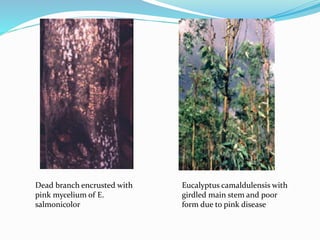
 The cobweb stage is the first sign of infection with white, sparse
mycelium growing rapidly across stem surfaces.
 As the fungus invades the bark and cambium, a diffuse canker
develops and can be seen by stripping off the bark. The necator stage
is less frequently seen than the pustule phase and is formed late in
the disease cycle.
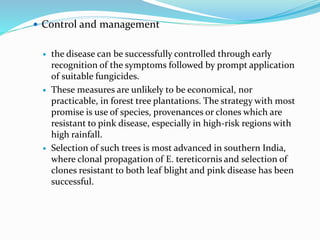
 Whole-tree symptoms include crown dieback and stem breakage,
especially during high winds. Dieback is due to elongated diffuse
cankers, which eventually girdle stems. Eucalyptus and acacias
respond to infection by production of clusters of epicormic shoots in
the vicinity of cankers and these are useful indicators of disease.
Crown dieback, stem breakage and tree death lead to gaps in the
plantation, further increasing susceptibility to wind damage.
Dead branch encrusted with
pink mycelium of E.
salmonicolor
Eucalyptus camaldulensis with
girdled main stem and poor
form due to pink disease
 Control and management
 the disease can be successfully controlled through early
recognition of the symptoms followed by prompt application
of suitable fungicides.
 These measures are unlikely to be economical, nor
practicable, in forest tree plantations. The strategy with most
promise is use of species, provenances or clones which are
resistant to pink disease, especially in high-risk regions with
high rainfall.
 Selection of such trees is most advanced in southern India,
where clonal propagation of E. tereticornis and selection of
clones resistant to both leaf blight and pink disease has been
successful.
Root
diseases
 PHYTOPHTHORA ROOT ROT/BLACK BUTT
 Black butt of Acacia mearnsii caused by Phytophthora
nicotianea is perhaps the best known disease of this tree
in forests. Black butt generally does not lead to tree
death, but reduces both the yield and quality of the
bark. This disease affects trees of all ages.
 Species affected:
 Acacia mearnsii and A. decurrens.
 Symptoms:
 The black butt symptom is only visible on older trees and
refers to the black discolouration of the bark on the butt log of
the tree.
 This discoloration is accompanied by cracking of the bark and
the exudation of gum from active cankers .Black butt affects
the thickest, most valuable bark at the base of trees.
 It not only reduces the quality of the bark, due to the cracking
and blackening, but also results in difficulty with bark
stripping. It does not always kill trees except in extreme cases,
but it reduces tree growth.
 Trees often die during drought periods as a result of the root
death caused by P. nicotianea infection.
 Spread of disease:
 Phytophthora species require moist conditions for spread and
infection, since infection takes place by motile, water-borne
zoospores. The pathogen is spread via infected soil and water.
 Management:
 The best strategy for disease avoidance is to plant selected
seed, tolerant to this disease. Limiting damage to the roots
and bases of the trees is also advised, as well as the avoidance
of water logged soils.
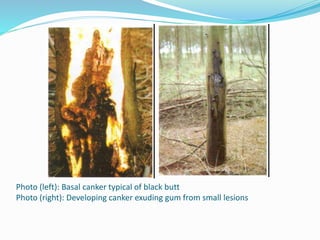
Photo (left): Basal canker typical of black butt
Photo (right): Developing canker exuding gum from small lesions
Needle diseases
 DOTHISTROMA NEEDLE BLIGHT
 Dothistroma needle blight, also known as red band
needle blight, is a serious foliar disease of many pine
species. It is caused by the fungus Dothistroma
septospora.
 Species affected:
 Affects only P. radiata in South Africa.
 Symptoms:
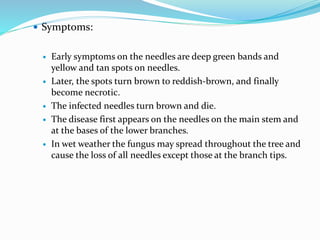
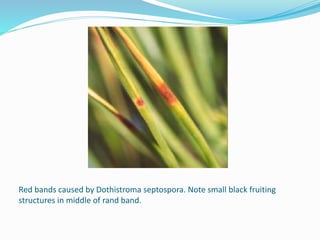
 Early symptoms on the needles are deep green bands and
yellow and tan spots on needles.
 Later, the spots turn brown to reddish-brown, and finally
become necrotic.
 The infected needles turn brown and die.
 The disease first appears on the needles on the main stem and
at the bases of the lower branches.
 In wet weather the fungus may spread throughout the tree and
cause the loss of all needles except those at the branch tips.
Red bands caused by Dothistroma septospora. Note small black fruiting
structures in middle of rand band.
 Spread of disease:
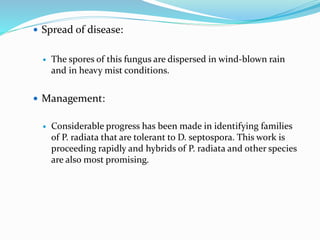
 The spores of this fungus are dispersed in wind-blown rain
and in heavy mist conditions.
 Management:
 Considerable progress has been made in identifying families
of P. radiata that are tolerant to D. septospora. This work is
proceeding rapidly and hybrids of P. radiata and other species
are also most promising.
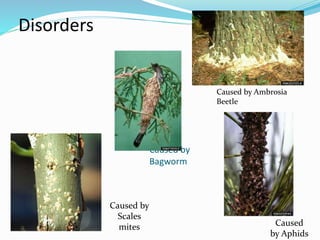
Caused by
Bagworm
Caused by
Scales
mites
Caused by Ambrosia
Beetle
Caused
by Aphids
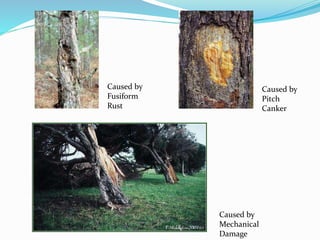
Disorders
Caused by
Fusiform
Rust
Caused by
Pitch
Canker
Caused by
Mechanical
Damage
Most serious consequences of deforestation and forest
Degradation.
 Biodiversity reduction
 Irregular water flow and drying up of natural
streams
 Shortened lifespan of irrigation channels and
reservoirs
 Soil erosion and associated loss of fertility
 Increasing fuelwood scarcity
 Contribution to the greenhouse gas emissions
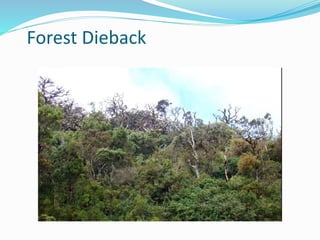
Forest Dieback
Causes for Forest Dieback
 Air pollution
 Fire
 Insects and diseases
 Invasive species
 Wild animals and Livestock : eg- Sambar damages
 Storms
 Direct human induced damages
 Climate Change

Forest diseases and disorders

  • 1.
    M.M.C.B Ehelamalpe PGIA/2015/182 PP 5260Advances in Plant Protection Methods for Plantation Crops and Forest Species
  • 2.
    Diseases and Disorders Tree disease is caused by varying factors, including the tree’s geographical location, weather, soil conditions, and the overall health of the tree and other plant life surrounding it.  Disorders of forest trees is to determine whether the stress is biotic (living) or abiotic (non-living) in nature. Biotic stresses are caused by insects, mites, disease (i.e. bacteria, fungi, and viruses), animals or other living organisms. Abiotic stresses are caused by non-living factors and often involve the excess or deficiency of water (flooding or drought), nutrients, chemicals (de-icing salts), heat or cold (freezing or low temperature injury) and wind.
  • 3.
    Leaf diseases 1. BACTERIALBLIGHT  The causal agent of bacterial blight is Pantoea ananatis. Other bacterial leaf spots, caused by Xathomonas sp. also occur, but under field conditions P. ananatis is the major problem.  Species affected:  It has been reported from Eucalyptus clones, hybrids and species including E. grandis, E. saligna, E. dunnii, E. nitens, E. smithii, E. grandis x E. camadulensis (GC) and E. grandis x E. urophylla (GU).
  • 4.
    Symptoms:  Typical symptomsof bacterial blight include tip die-back and leaf spots on young leaves.  The leaf spots are initially water-soaked and often coalesce to form larger lesions.  The pathogen appears to spread from the leaf petiole into the main leaf vein and from there to the adjacent tissue.  Thus lesions on the leaf are often concentrated along the main veins. Leaf petioles become necrotic, which results in pre- mature abscission of the leaves.  Trees assume a scorched appearance in the advanced stages of the disease and after repeated infections become stunted.  In humid conditions bacterial exudates are often evident on diseased tissue. The trees have a bushy appearance.
  • 5.
     Spread ofdisease:  Bacterial blight and die-back on Eucalyptus is more prevalent in areas in temperatures are warm, rather than hot and the relative humidity high. Bacteria such as P. ananatis can be spread by water, infected plant material, insects and equipment such as pruning shears in nurseries.
  • 6.
    Tip die-back symptomscaused by P. ananatis
  • 7.
     Management:  Bacterialblight and die-back has become a serious problem in nurseries and young plantations throughout South Africa. There are differences in susceptibility among E. grandis clones, and disease tolerant plants should be selected.
  • 8.
    Stem Diseases  Pinkdisease  Causal organism (fungi)  Erythricium salmonicolor (Berk. & Br.) Burds. As Corticium salmonicolor, this fungus is described in IMI Description 511 (Mordue and Gibson 1976). Other synonyms include Thanatephorus, Phanerochaete and Pellicularia spp.  Host range  The fungus has a very wide host range, including Eucalyptus, Acacia and other genera important in forestry plantations. Erythricium salmonicolor is also a pathogen of fruit trees in orchards and in home gardens. It has caused serious damage to many tropical crops such as cacao, citrus coffee, tea, and rubber (Hilton 1958, Browne 1968).
  • 9.
     Symptoms  Erythriciumsalmonicolor attacks trees of all ages.  The fungus forms four distinct types of growth on stems and branches, namely ‘cobweb’, ‘pustule’, ‘necator’ and ‘pink incrustation’.  The cobweb stage is the first sign of infection with white, sparse mycelium growing rapidly across stem surfaces.  As the fungus invades the bark and cambium, a diffuse canker develops and can be seen by stripping off the bark. The necator stage is less frequently seen than the pustule phase and is formed late in the disease cycle.  Whole-tree symptoms include crown dieback and stem breakage, especially during high winds. Dieback is due to elongated diffuse cankers, which eventually girdle stems. Eucalyptus and acacias respond to infection by production of clusters of epicormic shoots in the vicinity of cankers and these are useful indicators of disease. Crown dieback, stem breakage and tree death lead to gaps in the plantation, further increasing susceptibility to wind damage.
  • 10.
    Dead branch encrustedwith pink mycelium of E. salmonicolor Eucalyptus camaldulensis with girdled main stem and poor form due to pink disease
  • 11.
     Control andmanagement  the disease can be successfully controlled through early recognition of the symptoms followed by prompt application of suitable fungicides.  These measures are unlikely to be economical, nor practicable, in forest tree plantations. The strategy with most promise is use of species, provenances or clones which are resistant to pink disease, especially in high-risk regions with high rainfall.  Selection of such trees is most advanced in southern India, where clonal propagation of E. tereticornis and selection of clones resistant to both leaf blight and pink disease has been successful.
  • 12.
    Root diseases  PHYTOPHTHORA ROOTROT/BLACK BUTT  Black butt of Acacia mearnsii caused by Phytophthora nicotianea is perhaps the best known disease of this tree in forests. Black butt generally does not lead to tree death, but reduces both the yield and quality of the bark. This disease affects trees of all ages.  Species affected:  Acacia mearnsii and A. decurrens.
  • 13.
     Symptoms:  Theblack butt symptom is only visible on older trees and refers to the black discolouration of the bark on the butt log of the tree.  This discoloration is accompanied by cracking of the bark and the exudation of gum from active cankers .Black butt affects the thickest, most valuable bark at the base of trees.  It not only reduces the quality of the bark, due to the cracking and blackening, but also results in difficulty with bark stripping. It does not always kill trees except in extreme cases, but it reduces tree growth.  Trees often die during drought periods as a result of the root death caused by P. nicotianea infection.
  • 14.
     Spread ofdisease:  Phytophthora species require moist conditions for spread and infection, since infection takes place by motile, water-borne zoospores. The pathogen is spread via infected soil and water.  Management:  The best strategy for disease avoidance is to plant selected seed, tolerant to this disease. Limiting damage to the roots and bases of the trees is also advised, as well as the avoidance of water logged soils.
  • 15.
    Photo (left): Basalcanker typical of black butt Photo (right): Developing canker exuding gum from small lesions
  • 16.
    Needle diseases  DOTHISTROMANEEDLE BLIGHT  Dothistroma needle blight, also known as red band needle blight, is a serious foliar disease of many pine species. It is caused by the fungus Dothistroma septospora.  Species affected:  Affects only P. radiata in South Africa.
  • 17.
     Symptoms:  Earlysymptoms on the needles are deep green bands and yellow and tan spots on needles.  Later, the spots turn brown to reddish-brown, and finally become necrotic.  The infected needles turn brown and die.  The disease first appears on the needles on the main stem and at the bases of the lower branches.  In wet weather the fungus may spread throughout the tree and cause the loss of all needles except those at the branch tips.
  • 18.
    Red bands causedby Dothistroma septospora. Note small black fruiting structures in middle of rand band.
  • 19.
     Spread ofdisease:  The spores of this fungus are dispersed in wind-blown rain and in heavy mist conditions.  Management:  Considerable progress has been made in identifying families of P. radiata that are tolerant to D. septospora. This work is proceeding rapidly and hybrids of P. radiata and other species are also most promising.
  • 20.
    Caused by Bagworm Caused by Scales mites Causedby Ambrosia Beetle Caused by Aphids Disorders
  • 21.
  • 22.
    Most serious consequencesof deforestation and forest Degradation.  Biodiversity reduction  Irregular water flow and drying up of natural streams  Shortened lifespan of irrigation channels and reservoirs  Soil erosion and associated loss of fertility  Increasing fuelwood scarcity  Contribution to the greenhouse gas emissions
  • 23.
  • 24.
    Causes for ForestDieback  Air pollution  Fire  Insects and diseases  Invasive species  Wild animals and Livestock : eg- Sambar damages  Storms  Direct human induced damages  Climate Change