Michael Milken
· Background
· Drexel Burnham
· The most highly paid financier
· "The Junk Bond King"
· Success before the scandal
· Create “Junk bond” market
· Fraud -- security trading (Insider Trading)
· Detail of the fraud
· Criminal charges
· Go to prison
· $600M fine
· Contribution after release from prison
· Education?
· Knowledge Universe
· Charity
· Fund medical research
· Lessons and how does it relate to forensic accounting
Chapter 7: Conducting a Fraud Investigation
©2015 Pearson Education, Inc. All rights reserved
1
Fraud Investigation: Introduction
Objective is to gather evidence of a suspected fraud
Forensic accountants might be engaged as:
Agent of law enforcement
Member of an audit team
Private accountant engaged by victim or victim’s counsel
Private accountant engaged by accused or accused’s counsel
©2015 Pearson Education, Inc. All rights reserved
2
Cautions and Reminders
In conducting a fraud investigation, the following cautions and
reminders are presented:
Unique and has its own cast of characters, facts, and
circumstances
Initiated after the fact
Forensic accountants should operate in a state of disbelief or
suspended belief
The scientific process is most effective and efficient approach
Gather and analyze both documentary evidence and interactive
evidence
©2015 Pearson Education, Inc. All rights reserved
The purpose of this chapter is to employ the many concepts,
tools, and techniques to the challenge of conducting a fraud
investigation.
In preparation for this challenge, the following cautions and
reminders are presented:
Every fraud investigation is unique and has its own cast of
characters, facts, and circumstances.
Fraud investigations are initiated after the fact—that is, in
response to an allegation or suspicion of fraud. In other words,
once an allegation of fraud is received or a suspicion identified,
the company (that is, the victim) is faced with the decision of
whether to pursue an investigation. Another necessary decision
is who should conduct the investigation—in-house personnel,
law enforcement, an external audit team, or a private outside
firm.
Although the initial suspicion of fraud might help frame your
case and develop your working hypothesis, it is imperative to
remain objective. Forensic accountants should operate in a state
of disbelief or suspended belief, where information and
representations are evaluated in a rational, curious, objective,
and systematic manner.
The scientific process is the most effective and efficient
approach to conducting a fraud investigation. Remember, a
hypothesis is not a statement of fact; it is simply a tentative
explanation based on preliminary observations or suspicions
that must be tested. Without a working hypothesis, a fraud
investigation is only random data collection.
Evidence is something that tends to prove or disprove the
existence of an alleged fact. Forensic accountants gather and
analyze both documentary evidence, such as financial data and
other business records, and interactive evidence, such as
interviews and observations.
3
Cautions and Reminders
Financial statements analysis: Most valuable evidence-gathering
technique
Interview: Another widely used investigation tool
Fraud is a crime of intent
Cressey’s fraud triangle suggests that fraud results from
convergence of three conditions:
Need (pressure)
Opportunity
Rationalization
Fraud: Not an accounting problem, rather a social phenomenon
©2015 Pearson Education, Inc. All rights reserved
One of the most valuable evidence-gathering techniques
forensic accountants use is financial statements analysis.
Financial statements rarely reflect economic reality and often
conceal more than they reveal.
Another widely used investigation tool is the interview, which
has two primary advantages: It is a direct means of obtaining
evidence, and it provides immediate results. Interviewing is
much more than just asking questions. It is a systematic process
that requires planning, staging, execution, and active listening.
Fraud is a crime of intent. Absent an admission, circumstantial
evidence is used to establish or infer fraudulent intent. The
reliability of circumstantial evidence for the purpose of
establishing intent depends on two key factors: alternative
explanations and degree of impact. Because the results of your
investigation cannot provide certainty, you should avoid
conclusions of guilt or innocence.
Cressey’s fraud triangle suggests that fraud results from the
convergence of three conditions: need (pressure), opportunity,
and rationalization. Research has identified many red flags, or
indicators of fraud, that support Cressey’s framework.
Identifying red flags helps to evaluate the reasonableness of
suspicions and allegations of fraud.
Fraud is not an accounting problem—it is a social phenomenon.
Forensic accounting is rooted in law and economics, not
psychology or criminology. Thus, our interest in “why” people
commit fraud, especially when conducting a fraud investigation,
is explanatory (cause and effect), not predictive. Applying
traditional economic theory, we propose that people commit
fraud when the perceived reward ($) is greater than the probable
loss—the calculus of fraud. Because fraud investigators are
called in after a suspicion of fraud has been identified, the focus
is who, when, how, and how much—not why.
4
Phase I of Investigation
Phase I(a): Confirm the reasonableness of the suspicions of
fraud
Review case profile presented previously
Identify ten conditions (red flags) that either confirm or fail to
confirm the reasonableness of Smith’s suspicions
Employ the fraud triangle
Phase I(b): Create a fraud hypothesis
Hypothesis: An educated guess about how something works or
an explanation for an event
Exercise critical thinking and reasoning skills
©2015 Pearson Education, Inc. All rights reserved
Phase I(a): Confirm the Reasonableness of the Suspicions of
Fraud
Review the case profile presented previously, and identify ten
conditions (red flags) that either confirm or fail to confirm the
reasonableness of the Smith’s suspicions of fraud.
To this end, employ the fraud triangle (need, opportunity, and
rationalization) and professional skepticism.
Phase I(b): Create a Fraud Hypothesis
Having confirmed the reasonableness of the Smith’s suspicions
of fraud, you must now develop a fraud hypothesis.
A hypothesis is not a statement of fact—it is simply an educated
guess about how something works or an explanation for an
event.
In this phase, you will exercise your critical thinking and
reasoning skills.
Brainstorming can also be used.
Look at hypothesis in text: Workman has systematically eroded
the company’s internal controls and oversight functions to
facilitate fraud
Consider another hypothesis: Workman’s lifestyle creates
incentive to commit fraud
5
The Fraud Triangle
©2015 Pearson Education, Inc. All rights reserved
Cressey’s research suggests that violations of trust (fraud) occur
when the position of trust (opportunity) is viewed by the trusted
person as a rational means (solution) to solve a nonshareable
problem (pressure).
This research is the foundation for the fraud triangle, which
proposes that three factors—pressure (or need), opportunity,
and rationalization— constitute the conditions under which
fraud occurs. The implication, of course, is that influencing any
one of these conditions can impact the likelihood that fraud will
occur.
Walk through the student suggestions for hypotheses
Look at hypotheses in book-
Workman has systematically eroded the company’s internal
controls and oversight function to facilitate fraudulent schemes
6
Phase II(a) of Investigation
Phase II(a): Test hypothesis via financial statements analysis
Examination of financial statements for the purpose of
acquiring additional information
This analysis may reveal unexpected relationships or the
absence of expected relationships
Use various analytical techniques
Consider the implications of your findings
©2015 Pearson Education, Inc. All rights reserved
Phase II(a): Test Your Hypothesis via Financial Statements
Analysis
Financial statements analysis is the examination of financial
statements for the purpose of acquiring additional information
about the activities of a business.
This analysis may reveal unexpected relationships or the
absence of expected relationships.
Your next challenge is to use various analytical techniques,
such as
Trend analysis,
Common-size analysis,
Ratio analysis, and
Cash flow analysis, to analyze the company’s financial
statements
Walk through financial statement findings
Refine hypotheses
7
The Cash Cycle
Concerns about controls over cash
Are all corporate collections and disbursements recorded?
Authorization and review controls
Calculating the cash flow statement
Resolving differences in ending cash balance
©2015 Pearson Education, Inc. All rights reserved
Phases II(b) of Investigation
Phase II(b): Test hypothesis via journal entry testing
Can potentially undermine the validity of financial statements
and the financial reporting process
Objective is to identify and assess any inappropriate or unusual
activity
Important when there is ineffective system of internal controls
and management has ability to override the journal entry
process
Consider characteristics of fraudulent journal entries
©2015 Pearson Education, Inc. All rights reserved
PhaseII(b): Test Your Hypothesis via Journal Entry Testing
Journal entries (JEs) can potentially undermine the validity of
financial statements and the financial reporting process.
Thus, the importance of JE testing cannot be overstated.
The objective of this testing is to identify and assess any
inappropriate or unusual activity.
This is especially important when, as in this case, there is an
ineffective system of internal controls and management has the
ability to override the JE process.
As outlined in SAS No. 99, fraudulent JEs have several common
characteristics:
JEs made to unrelated, unusual, or seldom-used accounts
JEs recorded at the end of the period or as post-closing entries
with little or no explanation
JEs containing round numbers or a consistent ending number
JEs applied to intercompany or related parties
9
Phase III of Investigation
Phase III: Refine and confirm hypothesis via interviews
At this stage, you should have:
Developed a working knowledge of the business
Developed a working knowledge of company’s accounting
system
Identified any questionable financial statement reporting issues
Identified the key players to be interviewed and the information
sought
Follow the interview sequence
©2015 Pearson Education, Inc. All rights reserved
Phase III: Refine and Confirm Your Hypothesis via Interviews
An interview is a primary tool used by forensic accountants to
gather information and make assessments.
At this phase of your investigation, you should have:
1. Developed a working knowledge of the business (including
the pawn shop operation).
2. Developed a working knowledge of the company’s accounting
system, especially the internal controls (or lack thereof).
3. Identified any questionable financial statement (tax return)
reporting issues (for example, no pawn receivables, no interest
expense, and questionable JEs).
4. Identified the key players to be interviewed and the
information sought.
Who should be interviewed? In what order? Should the
interviews be formal or informal? To assist you in this phase,
we propose the following interview sequence:
1. Neutral third parties (Sue Bryant)
2. Corroborative witnesses and possible co-conspirators (Anita
Workman)
3. Suspected co-conspirators (Charles Hess)
4. Target (Thomas Workman)
10
Assignment for Next Class
Phase 4- draw conclusions and communicate results
Determination of amount misappropriated
Discussion of specific schemes employed
Loss components
Specific transactions
Unreported pawn loan interest ( from Exhibit 7I)
Unreported forfeited pawn sales (from Exhibit 7I)
Add statutory interest at 7.5%
©2015 Pearson Education, Inc. All rights reserved
Assignment for Next Class
Phase 5: Present a discussion of Mr. Hess’s roles, duties and
responsibilities
Evidences indicate that Mr. Hess may be a co- conspirator and
may have violated the AICPA ethical and professional standards
in his service
Address these concerns in a discussion
©2015 Pearson Education, Inc. All rights reserved
13
Chapter 4: Gathering Evidence—Interviews and Observations
©2015 Pearson Education, Inc. All rights reserved
Much of this is very basic.
Has anyone had experience with interviewing?
Why should we care about this?
1
Types of Evidence
Documentary
Financial records
Organizational documents
Communication logs
Photographs
Interactive
Information gathered through dynamic relational processes—
interviews and observations
Interpersonal nature
©2015 Pearson Education, Inc. All rights reserved
The types of evidence considered by forensic accountants
generally fall into one of two categories:
Documentary or interactive
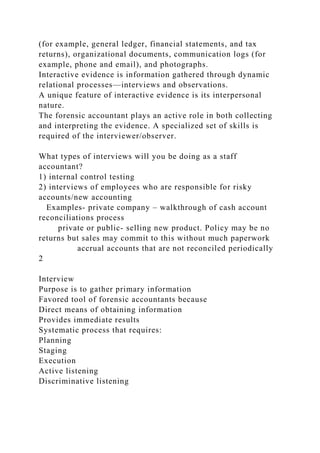
Examples of documentary evidence include financial records
(for example, general ledger, financial statements, and tax
returns), organizational documents, communication logs (for
example, phone and email), and photographs.
Interactive evidence is information gathered through dynamic
relational processes—interviews and observations.
A unique feature of interactive evidence is its interpersonal
nature.
The forensic accountant plays an active role in both collecting
and interpreting the evidence. A specialized set of skills is
required of the interviewer/observer.
What types of interviews will you be doing as a staff
accountant?
1) internal control testing
2) interviews of employees who are responsible for risky
accounts/new accounting
Examples- private company – walkthrough of cash account
reconciliations process
private or public- selling new product. Policy may be no
returns but sales may commit to this without much paperwork
accrual accounts that are not reconciled periodically
2
Interview
Purpose is to gather primary information
Favored tool of forensic accountants because
Direct means of obtaining information
Provides immediate results
Systematic process that requires:
Planning
Staging
Execution
Active listening
Discriminative listening
©2015 Pearson Education, Inc. All rights reserved
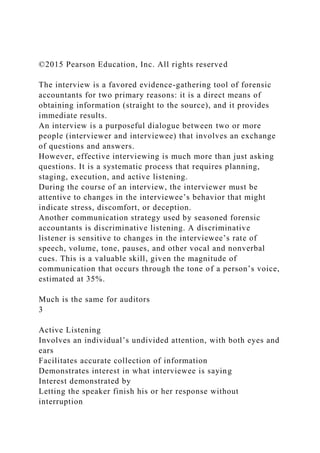
The interview is a favored evidence-gathering tool of forensic
accountants for two primary reasons: it is a direct means of
obtaining information (straight to the source), and it provides
immediate results.
An interview is a purposeful dialogue between two or more
people (interviewer and interviewee) that involves an exchange
of questions and answers.
However, effective interviewing is much more than just asking
questions. It is a systematic process that requires planning,
staging, execution, and active listening.
During the course of an interview, the interviewer must be
attentive to changes in the interviewee’s behavior that might
indicate stress, discomfort, or deception.
Another communication strategy used by seasoned forensic
accountants is discriminative listening. A discriminative
listener is sensitive to changes in the interviewee’s rate of
speech, volume, tone, pauses, and other vocal and nonverbal
cues. This is a valuable skill, given the magnitude of
communication that occurs through the tone of a person’s voice,
estimated at 35%.
Much is the same for auditors
3
Active Listening
Involves an individual’s undivided attention, with both eyes and
ears
Facilitates accurate collection of information
Demonstrates interest in what interviewee is saying
Interest demonstrated by
Letting the speaker finish his or her response without
interruption
Accepting the response without judgment
©2015 Pearson Education, Inc. All rights reserved
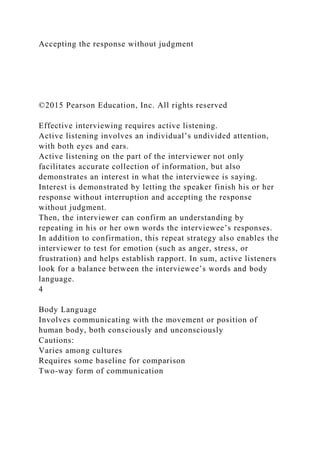
Effective interviewing requires active listening.
Active listening involves an individual’s undivided attention,
with both eyes and ears.
Active listening on the part of the interviewer not only
facilitates accurate collection of information, but also
demonstrates an interest in what the interviewee is saying.
Interest is demonstrated by letting the speaker finish his or her
response without interruption and accepting the response
without judgment.
Then, the interviewer can confirm an understanding by
repeating in his or her own words the interviewee’s responses.
In addition to confirmation, this repeat strategy also enables the
interviewer to test for emotion (such as anger, stress, or
frustration) and helps establish rapport. In sum, active listeners
look for a balance between the interviewee’s words and body
language.
4
Body Language
Involves communicating with the movement or position of
human body, both consciously and unconsciously
Cautions:
Varies among cultures
Requires some baseline for comparison
Two-way form of communication
©2015 Pearson Education, Inc. All rights reserved
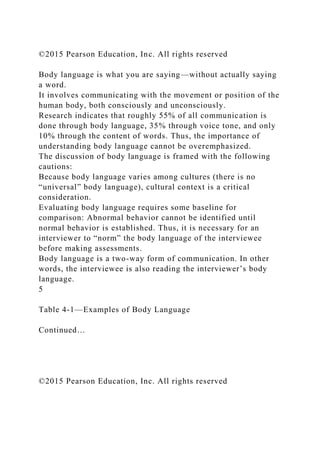
Body language is what you are saying—without actually saying
a word.
It involves communicating with the movement or position of the
human body, both consciously and unconsciously.
Research indicates that roughly 55% of all communication is
done through body language, 35% through voice tone, and only
10% through the content of words. Thus, the importance of
understanding body language cannot be overemphasized.
The discussion of body language is framed with the following
cautions:
Because body language varies among cultures (there is no
“universal” body language), cultural context is a critical
consideration.
Evaluating body language requires some baseline for
comparison: Abnormal behavior cannot be identified until
normal behavior is established. Thus, it is necessary for an
interviewer to “norm” the body language of the interviewee
before making assessments.
Body language is a two-way form of communication. In other
words, the interviewee is also reading the interviewer’s body
language.
5
Table 4-1—Examples of Body Language
Continued…
©2015 Pearson Education, Inc. All rights reserved
6
Table 4-1—Examples of Body Language
©2015 Pearson Education, Inc. All rights reserved
7
Types of Interviews
Formal: Systematic in nature, with a blend of
Open-ended questions
Structured questions
Most formal interviews begin with structured questions and
progress to open-ended
Informal: Unsystematic in nature; not controlled by specific set
of detailed questions
©2015 Pearson Education, Inc. All rights reserved
A formal interview is systematic in nature, with a blend of
open-ended and structured questions.
Open-ended questions, which do not call for a yes or no
response, are designed to stimulate conversation.
They allow interviewees to tell their own stories, using their
own terms, and offering information they consider important.
In contrast, structured questions are short-answer (for example,
age, marital status, and education) or closed-ended (yes or no).
Most formal interviews begin with structured (introductory)
questions and progress to open-ended (informational) questions.
An informal interview is unsystematic in nature in that it is not
controlled by a specific set of detailed questions.
What types of interviews would you use as an
auditor?
8
Types of Questions
Information gathered logically flows from the questions being
proposed
Careful consideration should be paid to type, placement, and
wording
Three types of questions:
Introductory
Informational
Closing
©2015 Pearson Education, Inc. All rights reserved
The three types of questions forensic accountants commonly
employ during interviews are:
Introductory questions:
Personal information (name, address, and so on)
Used to establish rapport (create comfort and a connection)
Generally structured questions (short answer or yes/no)
Should be nonconfrontational and nonthreatening
Can be used to norm the interviewee (observe body language,
tone of voice, and attitude)
Informational questions
Open-ended questions (require a monologue response)
Closed-ended questions (limit responses to yes or no)
Leading questions (contain the answer as part of the question)
Direct questions (address specific facts and events)
Cross questions (the same question asked different ways and at
different times to confirm consistency)
Review (repeat) questions (used to summarize and confirm
understanding)
Closing questions
Intended to summarize and gather any additional information
the interviewee wants to share. Includes leading questions,
based on previous responses. These conclude the interview.
9
Stages of the Interview
The interview process includes three fundamental stages:
Planning
Conducting
Memorializing
©2015 Pearson Education, Inc. All rights reserved
10
Planning Stage
Three basic tasks:
Identify the role of the witness relative to the specific
engagement and to other witnesses
Develop question bank
Develop an interview schedule
©2015 Pearson Education, Inc. All rights reserved
In the planning stage, the forensic accountant completes three
basic tasks:
Identify the role of the witness relative to the specific
engagement and to other witnesses.
Examples of relevant considerations include the following:
What information is the witness expected to provide?
How close was the witness to the people or activities of
interest?
Can the witness corroborate or refute representations of other
witnesses?
Develop a question bank or outline based on the working
hypothesis and any preliminary information that may be
available.
Each question should have a purpose related to the ultimate goal
of gathering relevant evidence.
Develop an interview schedule (that is, who, when, and where).
11
Conducting the Interview
Implementation of interview plan
Guidelines:
Create desired setting
Begin with introductory, progress to informational questions
Norm the interviewee
Be an active listener
Encourage interviewee to do most of the talking
Terminate interview if threatened or lost control of situation
Take notes
Close interview by offering to give additional information
©2015 Pearson Education, Inc. All rights reserved
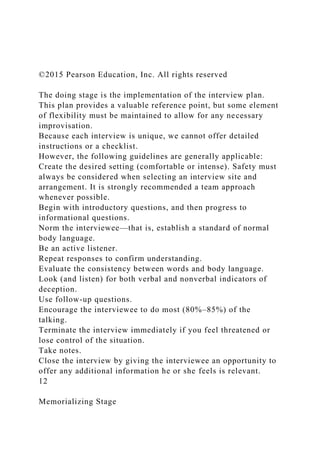
The doing stage is the implementation of the interview plan.
This plan provides a valuable reference point, but some element
of flexibility must be maintained to allow for any necessary
improvisation.
Because each interview is unique, we cannot offer detailed
instructions or a checklist.
However, the following guidelines are generally applicable:
Create the desired setting (comfortable or intense). Safety must
always be considered when selecting an interview site and
arrangement. It is strongly recommended a team approach
whenever possible.
Begin with introductory questions, and then progress to
informational questions.
Norm the interviewee—that is, establish a standard of normal
body language.
Be an active listener.
Repeat responses to confirm understanding.
Evaluate the consistency between words and body language.
Look (and listen) for both verbal and nonverbal indicators of
deception.
Use follow-up questions.
Encourage the interviewee to do most (80%–85%) of the
talking.
Terminate the interview immediately if you feel threatened or
lose control of the situation.
Take notes.
Close the interview by giving the interviewee an opportunity to
offer any additional information he or she feels is relevant.
12
Memorializing Stage
Transcribing notes
Note taking
Communicates to interviewees the importance of their responses
Provides documentation
Hand-written notes should be transcribed into memorandum of
interview
©2015 Pearson Education, Inc. All rights reserved
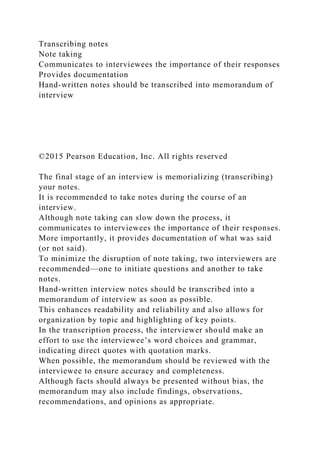
The final stage of an interview is memorializing (transcribing)
your notes.
It is recommended to take notes during the course of an
interview.
Although note taking can slow down the process, it
communicates to interviewees the importance of their responses.
More importantly, it provides documentation of what was said
(or not said).
To minimize the disruption of note taking, two interviewers are
recommended—one to initiate questions and another to take
notes.
Hand-written interview notes should be transcribed into a
memorandum of interview as soon as possible.
This enhances readability and reliability and also allows for
organization by topic and highlighting of key points.
In the transcription process, the interviewer should make an
effort to use the interviewee’s word choices and grammar,
indicating direct quotes with quotation marks.
When possible, the memorandum should be reviewed with the
interviewee to ensure accuracy and completeness.
Although facts should always be presented without bias, the
memorandum may also include findings, observations,
recommendations, and opinions as appropriate.
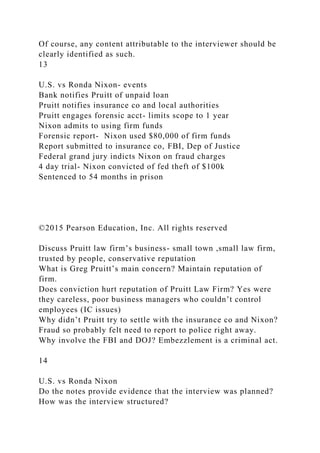
Of course, any content attributable to the interviewer should be
clearly identified as such.
13
U.S. vs Ronda Nixon- events
Bank notifies Pruitt of unpaid loan
Pruitt notifies insurance co and local authorities
Pruitt engages forensic acct- limits scope to 1 year
Nixon admits to using firm funds
Forensic report- Nixon used $80,000 of firm funds
Report submitted to insurance co, FBI, Dep of Justice
Federal grand jury indicts Nixon on fraud charges
4 day trial- Nixon convicted of fed theft of $100k
Sentenced to 54 months in prison
©2015 Pearson Education, Inc. All rights reserved
Discuss Pruitt law firm’s business- small town ,small law firm,
trusted by people, conservative reputation
What is Greg Pruitt’s main concern? Maintain reputation of
firm.
Does conviction hurt reputation of Pruitt Law Firm? Yes were
they careless, poor business managers who couldn’t control
employees (IC issues)
Why didn’t Pruitt try to settle with the insurance co and Nixon?
Fraud so probably felt need to report to police right away.
Why involve the FBI and DOJ? Embezzlement is a criminal act.
14
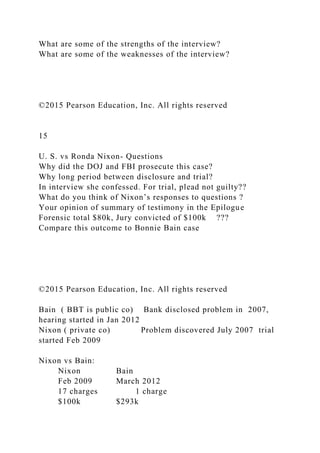
U.S. vs Ronda Nixon
Do the notes provide evidence that the interview was planned?
How was the interview structured?
What are some of the strengths of the interview?
What are some of the weaknesses of the interview?
©2015 Pearson Education, Inc. All rights reserved
15
U. S. vs Ronda Nixon- Questions
Why did the DOJ and FBI prosecute this case?
Why long period between disclosure and trial?
In interview she confessed. For trial, plead not guilty??
What do you think of Nixon’s responses to questions ?
Your opinion of summary of testimony in the Epilogue
Forensic total $80k, Jury convicted of $100k ???
Compare this outcome to Bonnie Bain case
©2015 Pearson Education, Inc. All rights reserved
Bain ( BBT is public co) Bank disclosed problem in 2007,
hearing started in Jan 2012
Nixon ( private co) Problem discovered July 2007 trial
started Feb 2009
Nixon vs Bain:
Nixon Bain
Feb 2009 March 2012
17 charges 1 charge
$100k $293k
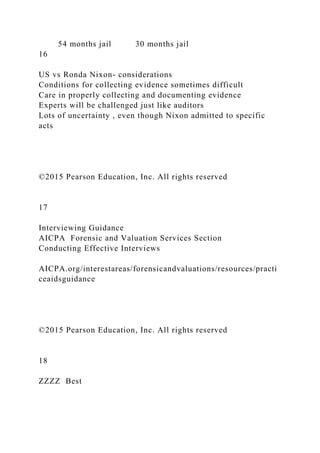
54 months jail 30 months jail
16
US vs Ronda Nixon- considerations
Conditions for collecting evidence sometimes difficult
Care in properly collecting and documenting evidence
Experts will be challenged just like auditors
Lots of uncertainty , even though Nixon admitted to specific
acts
©2015 Pearson Education, Inc. All rights reserved
17
Interviewing Guidance
AICPA Forensic and Valuation Services Section
Conducting Effective Interviews
AICPA.org/interestareas/forensicandvaluations/resources/practi
ceaidsguidance
©2015 Pearson Education, Inc. All rights reserved
18
ZZZZ Best
©2015 Pearson Education, Inc. All rights reserved
Today an overview of this case. Focus primarily on one audit
procedure- site visit
19
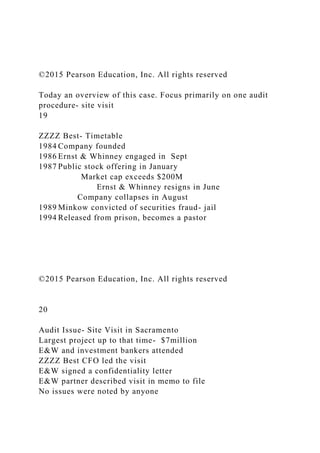
ZZZZ Best- Timetable
1984 Company founded
1986 Ernst & Whinney engaged in Sept
1987 Public stock offering in January
Market cap exceeds $200M
Ernst & Whinney resigns in June
Company collapses in August
1989 Minkow convicted of securities fraud- jail
1994 Released from prison, becomes a pastor
©2015 Pearson Education, Inc. All rights reserved
20
Audit Issue- Site Visit in Sacramento
Largest project up to that time- $7million
E&W and investment bankers attended
ZZZZ Best CFO led the visit
E&W signed a confidentiality letter
E&W partner described visit in memo to file
No issues were noted by anyone
©2015 Pearson Education, Inc. All rights reserved
21
Asking the Right Questions
ZZZZ Best CFO Mark Morse , when asked how the
professionals missed this fraud, said simply that: they did not
ask the right questions.
What about the site visit and related letter?
Consider the memo to be similar to an interview summary and
comment on the quality of the memo.
What should some of the right questions be?
Did the confidentiality letter limit the audit scope?
©2015 Pearson Education, Inc. All rights reserved
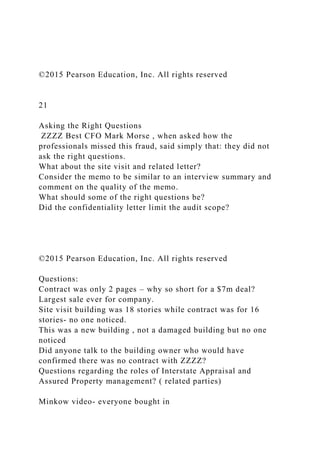
Questions:
Contract was only 2 pages – why so short for a $7m deal?
Largest sale ever for company.
Site visit building was 18 stories while contract was for 16
stories- no one noticed.
This was a new building , not a damaged building but no one
noticed
Did anyone talk to the building owner who would have
confirmed there was no contract with ZZZZ?
Questions regarding the roles of Interstate Appraisal and
Assured Property management? ( related parties)
Minkow video- everyone bought in
the guy was on Wall Street so if this was a fake, someone
would have noticed
he leveraged the auditors through threats
you need to pull yourself away from the numbers
Joe Dominic , author
no one wanted to look too hard, everyone was making
money
22
ZZZZ Best
Assignment for next week:
Could the ZZZZ Best fraud have been uncovered through a
thorough analysis of the financial statements?
©2015 Pearson Education, Inc. All rights reserved
23
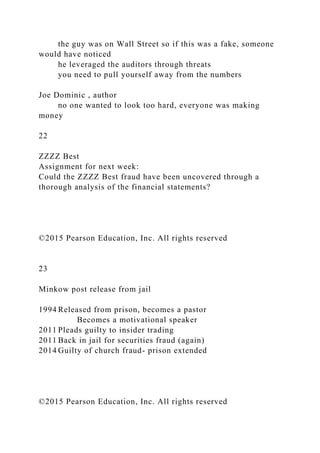
Minkow post release from jail
1994 Released from prison, becomes a pastor
Becomes a motivational speaker
2011 Pleads guilty to insider trading
2011 Back in jail for securities fraud (again)
2014 Guilty of church fraud- prison extended
©2015 Pearson Education, Inc. All rights reserved
In pre sentencing evaluation performed by a doctor, Minkow
was diagnosed as having antisocial personality disorder,
narcissistic personality disorder, attention deficit hyperactivity
disorder, anxiety disorder, opioid dependence, anabolic steroid
dependence, and migraine headaches
Minkow quote: There are a lot of Barry Minkows out there.
24
©2015 Pearson Education, Inc. All rights reserved
25
Chapter 2:
The Legal Environment
of Forensic Accounting
©2015 Pearson Education, Inc. All rights reserved
1
Understanding—Legal Environment
Law
Governance by cumulative body of legal principles
Rule of law doctrine
Basic functions
Dispute resolution
Protection of property
Preservation of the state
Enforcement by sanctions
©2015 Pearson Education, Inc. All rights reserved
Definition and Functions of Law
In the United States, we advocate a rule of law doctrine, which
proposes that governance via a cumulative body of legal
principles is superior to the rule of any human leader (for
example, a dictator, king, or president) and that all people stand
equal in the eyes of the law—that is, no person is above the law.
Black’s Law Dictionary defines law as the “legal order, system,
or regime that orders human activities and relations through
systematic application of the force of politically organized
society, backed by force.” According to this definition, the law
serves to influence, protect, regulate, and maintain our society.
Moreover, it suggests that the law is fluid, forever evolving in
response to social, economic, and political forces.
Law has three basic functions: (1) dispute resolution (criminal
and civil actions), (2) protection of property (such as use and
contract rights), and (3) preservation of the state. The law is
enforced with the use of sanctions. In criminal cases, sanctions
include imprisonment, home confinement, probation, day
reporting, fines, or even capital punishment. In civil cases,
sanctions generally involve compensation for loss or wrongs
suffered (for example, economic damages).
2
Understanding—Legal Environment
Law and justice
Constitutional promise of justice
Forms of justice
Civil justice
Criminal justice
Personal justice
Social justice
Substantial justice
©2015 Pearson Education, Inc. All rights reserved
Law and Justice
U.S. citizens enjoy the constitutional promise of justice, which
appears in the Preamble to the United States Constitution.
Justice is a profound concept generally defined by its context.
For example, Black’s Law Dictionary defines multiple forms of
justice:
• Civil justice. Justice concerned with the private affairs of
citizens and their respective rights, including certain freedoms
of speech and action and equal treatment,
protection, and opportunities regardless of race, sex, or religion.
• Criminal justice. A system directly involved in the
apprehension, prosecution, defense, sentencing, incarceration,
and supervision of those suspected of or charged
with criminal offenses.
• Personal justice. Justice between parties to a dispute,
regardless of any larger principles that might be involved.
• Social justice. Justice that conforms to a moral principle (for
example, all people are equal).
• Substantial justice. Justice fairly administered according to
the rules of substantive law (such as a fair trial). In a legal
setting, justice is
viewed as both a process and an outcome.
As a process, justice implies fair and equal treatment (rights and
protections) within the judicial system. The judicial process is
administered and managed by the court, acting as the trier of
law. Two components of the judicial process that are important
to forensic accountants include procedures and evidence, both
of which are discussed in later sections of this chapter.
Outcomes (or verdicts) are determined by the trier of fact,
which is the jury in a jury trial or the judge in a bench trial.
Verdicts are (or are expected to be) decided based on the
evidence presented during the trial.
3
Figure 2-1—Classification of Law
©2015 Pearson Education, Inc. All rights reserved
4
Procedure: The Anatomy of a Trial
Different from what is shown on television shows or the movies
Three stages
Pleading
Discovery
Trial
©2015 Pearson Education, Inc. All rights reserved
What most of us know about our justice system comes primarily
from television shows or the movies. Such portrayals, however
entertaining, do not represent reality. Our experience suggests
at least five key differences:
The law is not fast. There is no one- or two-hour litigation.
Rather, civil trials commonly last two days, following a year (or
more) of pleadings.
There is rarely (if ever) a “gotcha” moment (such as “You can’t
handle the truth!”). The discovery process (discussed in a later
section) serves to eliminate such surprises at trial. Moreover,
witnesses are generally well prepared by counsel.
TV shows are about drama. Given the extended discovery
process, real trials (aside from the verdict) rarely provide much
drama— that is, unless you are the plaintiff or defendant.
Jury selection and opening statements are the most important
parts of a trial—not cross examination and closing arguments,
as often represented on TV. Selecting who is responsible for
rendering the verdict is, of course, paramount. Opening
statements provide the first chance for the parties to connect
with jurors and tell their sides of the story.
The role of the jury is not passive. Because jurors serve as the
trier of fact, they must actively evaluate the evidence and
decide who and what to believe. To operationalize these
concepts, let’s consider the anatomy (or structure) of a civil
trial, which includes three basic stages: pleading stage,
discovery stage, and trial stage. As previously noted, a civil
action is a non-criminal complaint involving private property
rights.
The three stages of trial are: pleading, discovery, and trial.
5
Procedure: Pleading Stage
Filing of complaint
Identifies the parties
Outlines facts and violations
Demand for relief
Defendant files answer
Failing to file may result in default judgment
Default judgment: Binding judgment against a party based on
some failure to take action
©2015 Pearson Education, Inc. All rights reserved
A civil proceeding starts with the filing of a complaint (or
lawsuit), which identifies the parties, outlines the alleged facts
and one or more violations, and presents a demand for relief.
Once a defendant has been served with the complaint, the
individual or entity has a limited amount of time (20 days) to
respond by filing an answer. The answer addresses each
paragraph of the complaint by admitting, denying, or claiming
lack of sufficient knowledge to respond. The answer also asserts
affirmative defenses. Failing to file a timely response can result
in a default judgment, which is a binding judgment against a
party based on some failure to take action (similar to a
forfeiture in sports).
6
Procedure: Discovery Stage
Allows for gathering of information
Interrogatories, requests for production of documents
Subpoenas and depositions
In civil cases, process governed by Federal Rules of Civil
Procedure (FRCP)
©2015 Pearson Education, Inc. All rights reserved
Discovery allows for the gathering of information from the
opposing party as well as third-party witnesses. Information is
typically gathered (discovered) via a request for production of
documents, subpoenas, interrogatories, and depositions. In
federal courts, the discovery process in a civil case is governed
by the Federal Rules of Civil Procedure (FRCP).
What typically gets discovered?
7
Procedure: Trial Stage
Selection of jury
Selected through a process known as voir dire
Opening arguments by both parties
Plaintiff presents case
Defendant presents case
Closing arguments by both parties
Verdict
©2015 Pearson Education, Inc. All rights reserved
Trial Stage
Following completion of discovery, the proceeding advances to
the trial stage. In the case of a jury trial, this stage begins with
the selection of a jury. The jury is selected through a process
known as voir dire, wherein the judge and the attorneys
question prospective jurors about their backgrounds and beliefs.
As previously emphasized, the selection of the jury is a critical
part of the trial. Generally, there are twelve jurors in a criminal
case and six in a civil case. These individuals collectively
serve as the trier of fact, with the responsibility of rendering the
verdict. Following jury selection, the attorneys for both parties
make their opening arguments (statements). The first to present
is the plaintiff, whose opening statement serves to outline its
theory of the case and any supporting evidence.
The plaintiff is followed by the defendant. After opening
arguments, the plaintiff presents its witnesses, which the
defendant may cross-examine. The plaintiff continues the
presentation of its case (known as the “case in chief”) until
complete. A similar process is then followed by the defendant.
After the defendant completes its presentation, the plaintiff is
afforded an opportunity for rebuttal witnesses, which is then
followed by the defendant’s opportunity for sub-rebuttal
witnesses. Closing arguments are the last opportunity for the
parties to summarize the testimony and highlight key points
Following closing arguments and instructions by the judge, the
case proceeds to jury deliberation. During this time, the jurors
collectively evaluate the evidence to render a verdict.
8
Structure of a Criminal Case
Criminal complaint with investigator’s affidavit
First appearance—arraignment
Defendant informed of charges and rights
Defendant pleas guilty or not guilty
Discovery stage
The trial stage
Defendant found guilty
Sentencing stage
©2015 Pearson Education, Inc. All rights reserved
The basic structure of a criminal case is similar to that of a civil
case, with the addition of a fourth stage—sentencing. Criminal
cases are initiated with a criminal complaint accompanied by an
investigator’s affidavit that summarizes the evidence against the
defendant. During the first appearance (arraignment), the
defendant is informed of the charges and advised of his or her
rights. At this time, the defendant also enters a plea to the
charge or charges—guilty or not guilty. This is followed by the
discovery stage and the trial stage, as discussed previously. If
the defendant is found not guilty, the case is over; if found
guilty, the case then moves to the sentencing stage. The verdict
in a criminal case (guilty or not guilty) differs from the verdict
in a civil case, wherein the defendant is found either liable or
not liable (for damages). Prior to sentencing by the court, the
case is evaluated by the probation department, which prepares a
pre-sentence report (PSR). The PSR summarizes the case
(including the crime, the case facts, and the offender’s profile)
and offers a recommendation for sentencing.
9
Table 2-1 : Comparison of Civil and Criminal Actions
©2015 Pearson Education, Inc. All rights reserved
A comparison of the key elements of civil and criminal actions
is provided in Table 2-1.
10
Burden of Proof and Alternative Dispute Resolution
Burden of proof
Obligation of the plaintiff
Defendant presumed innocent
Alternative Dispute Resolution (ADR)
Mediation
Arbitration
ADR preferred over litigation
Less expensive and faster
Greater privacy
©2015 Pearson Education, Inc. All rights reserved
Burden and Standards of Proof
The burden of proof is the obligation of the plaintiff or
prosecution to prove liability (in a civil case) or guilt (in a
criminal case). The defendant is not required to prove his or her
innocence—it is presumed.
Alternative Dispute Resolution
Litigation is not the only means for settling disputes between
parties. Forensic accountants may also participate in alternative
dispute resolution (ADR), the most common forms of which are
mediation and arbitration. Mediation is a non-binding informal
process wherein a mediator (mutually selected by the parties)
evaluates the arguments of both sides and helps the parties
reach common ground. If mediation fails, the parties may
proceed with litigation. Arbitration, on the other hand, is a
“mini trial” wherein each party presents its case to one or more
arbitrators, who render a binding decision that generally cannot
be appealed. Arbitration is often voluntary but can also be
mandatory (required by a statute or a contract between the
parties). ADR may be preferred over litigation because it is less
expensive, is generally faster, and allows for greater privacy.
Moreover, ADR is often used in disputes regarding complex or
technical issues, because mediators or arbitrators with the
necessary expertise can be selected.
11
Figure 2-2 : Ascending Levels (Standards) of Proof
©2015 Pearson Education, Inc. All rights reserved
The presumption of innocence must be overcome by a certain
standard of proof, which describes the amount of evidence the
plaintiff must present to prove its case. In a civil case, the
requisite standard is a preponderance of the evidence—more
likely than not (>50% probability). Some civil cases (such as
civil fraud) must be proven by clear and convincing evidence.
Clear and convincing is greater than a preponderance, but no
specific percentage can be assigned. In a criminal case, the
prosecution has a legal obligation to prove all elements of an
alleged offense (such as fraud, tax evasion, or murder) beyond a
reasonable doubt. Again, no percentage can be assigned. The
applicable burden and standard of proof are explained to the
jury by the judge and included in the jury instructions. Figure 2-
2 illustrates the ascending levels (or standards) of proof. The
forensic accountant must understand the requisite standard of
proof for any litigation engagement and articulate his or her
opinion accordingly. For example, in a civil case with a
preponderance standard, the expert’s opinion must be stated
within a reasonable degree of professional certainty, meaning
more probable than not (>50%). This is critical, because expert
testimony that does not meet the necessary threshold will be
rejected by the court.
12
Evidence and the Expert
Evidence: Something that tends to prove or disprove the
existence of an alleged fact
Relevant evidence
Tendency to make a fact more or less probable
Of consequence in determining the action
Probative value: Evidence be sufficiently useful to help prove
something during the course of a trial
©2015 Pearson Education, Inc. All rights reserved
Evidence is something, including testimony, documents, and
tangible objects, that tends to prove or disprove the existence of
an alleged fact. In other words, evidence is presented to
persuade the fact finder (judge or jury) of the probability of the
truth of some fact asserted in the case.
According to FRE 401, relevant evidence must have the
“tendency to make a fact more or less probable than it would be
without the evidence,” and the fact must be “of consequence in
determining the action.”
13
Expert Methodology
Daubert challenge
Conducted before the trial judge
Purpose is to measure the validity of expert’s opinion
Set forth several factors to be considered when evaluating
expert testimony
Either party can initiate a challenge
Judge acts as a gatekeeper
The Daubert Trilogy
Applied to all expert testimony
©2015 Pearson Education, Inc. All rights reserved
A Daubert challenge is a special hearing conducted before the
trial judge to determine the relevance and reliability of an
expert’s opinion—that is, to rule on its admissibility. For an
expert’s opinion to satisfy the reliability requirement, the expert
must be qualified in the relevant field, and the expert’s opinion
must be the product of sufficient relevant facts and data,
reliable methodology, and the reasonable application of the
methodology to the case facts.
Daubert established that a trial court judge has the duty to act as
a “gatekeeper” under the FRE to ensure the scientific validity of
the expert’s testimony. Moreover, it set forth several factors
that should be considered when evaluating expert testimony:
• Whether the methodology employed has been tested
• Whether the theory has been peer-reviewed
• What the known or potential error rate of the method is
• How well accepted the methodology is within the professional
community
• Whether the expert’s methodology existed before the subject
litigation began
As provided in Daubert, the “court must focus on the
methodology, not on the conclusions generated by the
methodology.” In other words, a Daubert hearing is not to
decide whether the expert is correct. Opposing evidence
(including opposing expert opinions) and cross-examination are
traditional and appropriate means of attacking dubious but
admissible expert testimony.
The Daubert Trilogy
Four years after Daubert, in G.E. v. Joiner (1997), the Supreme
Court limited appellate review of the trial court’s decision to
admit or exclude expert testimony. Later, in Kumho Tire v.
Carmichael (1999), the Supreme Court directed that the Daubert
factors be applied to all expert testimony, including testimony
of a non-scientific nature (such as forensic accounting). In this
ruling, the Supreme Court also granted trial courts freedom to
consider other factors. Together, these three cases, known as the
“Daubert trilogy,” serve to interpret Rule 702.
14
Privileged Communication
Legal principle that protects communications within protected
relationship
Attorney–Client Privilege
©2015 Pearson Education, Inc. All rights reserved
Privileged communication is a legal principle that protects
communications taking place within a protected relationship.
Commonly recognized protected relationships include attorney–
client, husband–wife, doctor–patient, and clergyman–penitent.
The privilege is a legal right of the source (for example, the
client or patient rather than the lawyer or doctor). The
underlying theory of privileged communication, articulated by
the U.S. Supreme Court in Upjohn Co. v. United States (1981),
is that in certain instances, society is best served by the
suppression (protection from disclosure) of information.
Suppression of information, however, is inconsistent with the
general duty to disclose and is thus closely guarded by the
courts. As previously discussed, in the discovery phase of civil
litigation, each party is obligated to disclose to the opposing
party all relevant and nonprivileged evidence it proposes to use
at trial, whether favorable or unfavorable.
15
Privileged Communication
Attorney–Client privilege
Client’s right to refuse to disclose and to prevent any other
person from disclosing confidential communications between
the client and the attorney
Communication must
Relate to the rendering of legal services
Be made in confidence
Be made to a person the client believed was an attorney
Work product doctrine
Protection from discovery of documents, interviews, statements,
and other items prepared by attorney
©2015 Pearson Education, Inc. All rights reserved
Attorney–Client Privilege
Attorney–client privilege, the oldest of the protected privileges
in law, is defined as the “client’s right to refuse to disclose and
to prevent any other person from disclosing confidential
communications between the client and the attorney.” The
requisite elements for establishing privilege include a
communication that:
• Relates to the rendering of legal services,
• Is made in confidence, and
• Is made to a person the client reasonably believed was an
attorney.
The attorney–client privilege is intended to encourage
individuals involved in legal disputes to be candid with their
attorneys, thus enabling the attorneys to give sound legal
advice. Once the attorney–client privilege has been established,
it may be extended to non-attorneys (such as subordinates and
consulting experts) who assist attorneys in rendering legal
advice or services.
The Work Product Doctrine (1947) provides protection from
discovery of documents, interviews, statements, and other items
prepared by an attorney in anticipation of trial. The work
product doctrine allows lawyers to prepare for litigation without
risk that their work will be revealed to court adversaries.
Consistent with the rules governing attorney–client privilege,
the work product doctrine can be extended to items prepared by
non-attorneys who assist in rendering legal services.
Extending Attorney–Client Privilege and the Work Product
Doctrine
Communications between attorneys and consulting experts are
generally protected under the attorney–client privilege and/or
work product doctrine. Until recently, no such protection was
afforded to communications with a testifying expert. This
changed in December 2010, when FRCP 26(b)(4) was amended
to allow the extension of work product protection to most
attorney–expert communications and to all draft expert reports.
This was a highly practical change, which served to reduce the
cost of litigation and make the process more efficient.
16
U. S. vs Bonnie Bain
…..it’s all about the evidence
©2015 Pearson Education, Inc. All rights reserved
17
U S vs Bonnie Bain
©2015 Pearson Education, Inc. All rights reserved
U.S. vs Bain- Summary of Events
Oct 2007 Regional cash manager notices unusual cash activity-
involves bank analyst then Internal Audit then Corp Invest. Div
Bank Corp Investigation Division investigates , hypothesis Bain
embezzled funds from 2000-2005
Bank presents investigative findings to federal authorities
U S Attorney files criminal complaint against Bain
Bain hires forensic accountant
Before trial Bain pleads guilty to false bank entry but disputes
amount
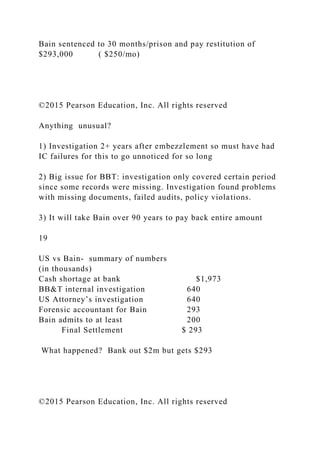
Bain sentenced to 30 months/prison and pay restitution of
$293,000 ( $250/mo)
©2015 Pearson Education, Inc. All rights reserved
Anything unusual?
1) Investigation 2+ years after embezzlement so must have had
IC failures for this to go unnoticed for so long
2) Big issue for BBT: investigation only covered certain period
since some records were missing. Investigation found problems
with missing documents, failed audits, policy violations.
3) It will take Bain over 90 years to pay back entire amount
19
US vs Bain- summary of numbers
(in thousands)
Cash shortage at bank $1,973
BB&T internal investigation 640
US Attorney’s investigation 640
Forensic accountant for Bain 293
Bain admits to at least 200
Final Settlement $ 293
What happened? Bank out $2m but gets $293
©2015 Pearson Education, Inc. All rights reserved
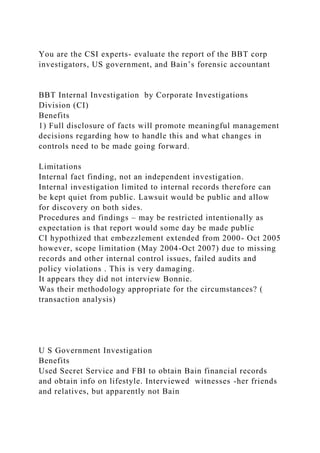
You are the CSI experts- evaluate the report of the BBT corp
investigators, US government, and Bain’s forensic accountant
BBT Internal Investigation by Corporate Investigations
Division (CI)
Benefits
1) Full disclosure of facts will promote meaningful management
decisions regarding how to handle this and what changes in
controls need to be made going forward.
Limitations
Internal fact finding, not an independent investigation.
Internal investigation limited to internal records therefore can
be kept quiet from public. Lawsuit would be public and allow
for discovery on both sides.
Procedures and findings – may be restricted intentionally as
expectation is that report would some day be made public
CI hypothized that embezzlement extended from 2000- Oct 2005
however, scope limitation (May 2004-Oct 2007) due to missing
records and other internal control issues, failed audits and
policy violations . This is very damaging.
It appears they did not interview Bonnie.
Was their methodology appropriate for the circumstances? (
transaction analysis)
U S Government Investigation
Benefits
Used Secret Service and FBI to obtain Bain financial records
and obtain info on lifestyle. Interviewed witnesses -her friends
and relatives, but apparently not Bain
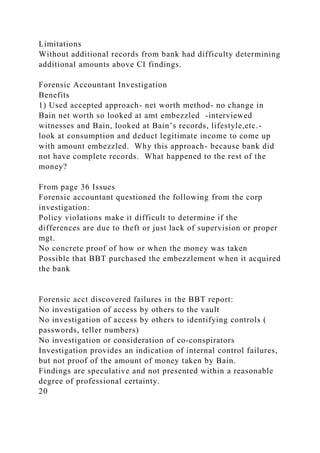
Limitations
Without additional records from bank had difficulty determining
additional amounts above CI findings.
Forensic Accountant Investigation
Benefits
1) Used accepted approach- net worth method- no change in
Bain net worth so looked at amt embezzled -interviewed
witnesses and Bain, looked at Bain’s records, lifestyle,etc.-
look at consumption and deduct legitimate income to come up
with amount embezzled. Why this approach- because bank did
not have complete records. What happened to the rest of the
money?
From page 36 Issues
Forensic accountant questioned the following from the corp
investigation:
Policy violations make it difficult to determine if the
differences are due to theft or just lack of supervision or proper
mgt.
No concrete proof of how or when the money was taken
Possible that BBT purchased the embezzlement when it acquired
the bank
Forensic acct discovered failures in the BBT report:
No investigation of access by others to the vault
No investigation of access by others to identifying controls (
passwords, teller numbers)
No investigation or consideration of co-conspirators
Investigation provides an indication of internal control failures,
but not proof of the amount of money taken by Bain.
Findings are speculative and not presented within a reasonable
degree of professional certainty.
20
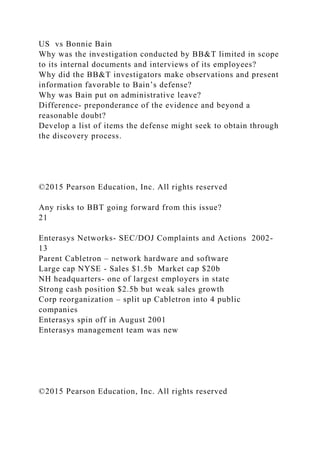
US vs Bonnie Bain
Why was the investigation conducted by BB&T limited in scope
to its internal documents and interviews of its employees?
Why did the BB&T investigators make observations and present
information favorable to Bain’s defense?
Why was Bain put on administrative leave?
Difference- preponderance of the evidence and beyond a
reasonable doubt?
Develop a list of items the defense might seek to obtain through
the discovery process.
©2015 Pearson Education, Inc. All rights reserved
Any risks to BBT going forward from this issue?
21
Enterasys Networks- SEC/DOJ Complaints and Actions 2002-
13
Parent Cabletron – network hardware and software
Large cap NYSE - Sales $1.5b Market cap $20b
NH headquarters- one of largest employers in state
Strong cash position $2.5b but weak sales growth
Corp reorganization – split up Cabletron into 4 public
companies
Enterasys spin off in August 2001
Enterasys management team was new
©2015 Pearson Education, Inc. All rights reserved
22
Enterasys- Key events during 2002
Contract that appeared to be altered identified
Company notified of SEC informal inquiry
Company initiates independent investigation- led by corporate
lawyers ( Ropes & Gray) and Deloitte forensic group
Findings included numerous potential fraud items
Findings of investigation presented to SEC/DOJ
©2015 Pearson Education, Inc. All rights reserved
What does Company do during this period of the investigation?
23
Enterasys- SEC Criminal Charges Phase (2003-7)
SEC identifies potential complaint issues: backdating and
altering documents, undisclosed side agreements, wire fraud,
securities fraud , financial statement fraud
Files criminal complaints against certain management
SEC agrees to plea bargains for certain lower level
management. Mgt received prison sentences/ fines
SEC goes to court with criminal charges for senior mgt and
wins convictions for 4 or 5 members of mgt. Mgt receives jail
sentences
©2015 Pearson Education, Inc. All rights reserved
24
Enterasys SEC Civil Phase (2007-13)
SEC files civil charges of securities fraud against management
seeking unspecified fines and return of ill gotten gains
Settlement of some charges with significant fines while other
charges were dropped
©2015 Pearson Education, Inc. All rights reserved
Handout SEC civil complaint and review charges. Similar to
charges in criminal complaint. Several but not all of defendants
were convicted of criminal charges and sentenced to prison
terms. This civil action is to require them to pay fines for their
misdeeds.
Lower level employees were also charged( criminal and civil)
and some entered into plea agreements. Discuss Tony Hurley-
pled guilty to one charge of wire fraud and participated as a
witness in the criminal charges of more senior managers. He
served jail time and paid a fine. See SEC release.
Auditors- see representation letter and discuss violations. What
protection is the rep letter to auditors?
25
Enterasys - Final Resolution (2013)
Most members of management- terminated
SEC issues resolved- cease and desist order
Shareholder class action lawsuits- settled
Company sold to a private company so no longer public.
Enterasys stockholders at time of investigation lost almost all of
their money ( over $2bill )
Elapsed time from discovery to resolution- 12 years
©2015 Pearson Education, Inc. All rights reserved
26
Financial Shenanigans
…….management misleading investors about financial
performance
©2015 Pearson Education, Inc. All rights reserved
27
Accounting maneuvers may lead to fraud
Small changes that may become significant
Management testing to see what they can get away with
Test internal accounting management
Test external auditors
Test Board of Directors
©2015 Pearson Education, Inc. All rights reserved
28
Environmental issues of concern
Inadequate checks and balances among management
Powers of the CEO
Family members
Board of Directors lacking competence or independence
Auditors lacking objectivity and appearance of independence
©2015 Pearson Education, Inc. All rights reserved
Inadequate checks and balances- Tyco CEO and CFO too
powerful. Too much control over acquisition accounting.
Adelphia had family member issues
BOD- HP/Autonomy
Enron
Auditors lacking objectivity- Enron
29
©2015 Pearson Education, Inc. All rights reserved
30

Michael Milken· Background· Drexel Burnham· The most highl.docx

  • 1.
    Michael Milken · Background ·Drexel Burnham · The most highly paid financier · "The Junk Bond King" · Success before the scandal · Create “Junk bond” market · Fraud -- security trading (Insider Trading) · Detail of the fraud · Criminal charges · Go to prison · $600M fine · Contribution after release from prison · Education? · Knowledge Universe · Charity · Fund medical research · Lessons and how does it relate to forensic accounting Chapter 7: Conducting a Fraud Investigation ©2015 Pearson Education, Inc. All rights reserved ©2015 Pearson Education, Inc. All rights reserved
  • 2.
    1 Fraud Investigation: Introduction Objectiveis to gather evidence of a suspected fraud Forensic accountants might be engaged as: Agent of law enforcement Member of an audit team Private accountant engaged by victim or victim’s counsel Private accountant engaged by accused or accused’s counsel ©2015 Pearson Education, Inc. All rights reserved 2 Cautions and Reminders In conducting a fraud investigation, the following cautions and reminders are presented: Unique and has its own cast of characters, facts, and circumstances Initiated after the fact Forensic accountants should operate in a state of disbelief or suspended belief The scientific process is most effective and efficient approach Gather and analyze both documentary evidence and interactive evidence ©2015 Pearson Education, Inc. All rights reserved
  • 3.
    The purpose ofthis chapter is to employ the many concepts, tools, and techniques to the challenge of conducting a fraud investigation. In preparation for this challenge, the following cautions and reminders are presented: Every fraud investigation is unique and has its own cast of characters, facts, and circumstances. Fraud investigations are initiated after the fact—that is, in response to an allegation or suspicion of fraud. In other words, once an allegation of fraud is received or a suspicion identified, the company (that is, the victim) is faced with the decision of whether to pursue an investigation. Another necessary decision is who should conduct the investigation—in-house personnel, law enforcement, an external audit team, or a private outside firm. Although the initial suspicion of fraud might help frame your case and develop your working hypothesis, it is imperative to remain objective. Forensic accountants should operate in a state of disbelief or suspended belief, where information and representations are evaluated in a rational, curious, objective, and systematic manner. The scientific process is the most effective and efficient approach to conducting a fraud investigation. Remember, a hypothesis is not a statement of fact; it is simply a tentative explanation based on preliminary observations or suspicions that must be tested. Without a working hypothesis, a fraud investigation is only random data collection. Evidence is something that tends to prove or disprove the existence of an alleged fact. Forensic accountants gather and analyze both documentary evidence, such as financial data and other business records, and interactive evidence, such as interviews and observations. 3
  • 4.
    Cautions and Reminders Financialstatements analysis: Most valuable evidence-gathering technique Interview: Another widely used investigation tool Fraud is a crime of intent Cressey’s fraud triangle suggests that fraud results from convergence of three conditions: Need (pressure) Opportunity Rationalization Fraud: Not an accounting problem, rather a social phenomenon ©2015 Pearson Education, Inc. All rights reserved One of the most valuable evidence-gathering techniques forensic accountants use is financial statements analysis. Financial statements rarely reflect economic reality and often conceal more than they reveal. Another widely used investigation tool is the interview, which has two primary advantages: It is a direct means of obtaining evidence, and it provides immediate results. Interviewing is much more than just asking questions. It is a systematic process that requires planning, staging, execution, and active listening. Fraud is a crime of intent. Absent an admission, circumstantial evidence is used to establish or infer fraudulent intent. The reliability of circumstantial evidence for the purpose of establishing intent depends on two key factors: alternative explanations and degree of impact. Because the results of your investigation cannot provide certainty, you should avoid conclusions of guilt or innocence. Cressey’s fraud triangle suggests that fraud results from the convergence of three conditions: need (pressure), opportunity, and rationalization. Research has identified many red flags, or
  • 5.
    indicators of fraud,that support Cressey’s framework. Identifying red flags helps to evaluate the reasonableness of suspicions and allegations of fraud. Fraud is not an accounting problem—it is a social phenomenon. Forensic accounting is rooted in law and economics, not psychology or criminology. Thus, our interest in “why” people commit fraud, especially when conducting a fraud investigation, is explanatory (cause and effect), not predictive. Applying traditional economic theory, we propose that people commit fraud when the perceived reward ($) is greater than the probable loss—the calculus of fraud. Because fraud investigators are called in after a suspicion of fraud has been identified, the focus is who, when, how, and how much—not why. 4 Phase I of Investigation Phase I(a): Confirm the reasonableness of the suspicions of fraud Review case profile presented previously Identify ten conditions (red flags) that either confirm or fail to confirm the reasonableness of Smith’s suspicions Employ the fraud triangle Phase I(b): Create a fraud hypothesis Hypothesis: An educated guess about how something works or an explanation for an event Exercise critical thinking and reasoning skills ©2015 Pearson Education, Inc. All rights reserved Phase I(a): Confirm the Reasonableness of the Suspicions of Fraud Review the case profile presented previously, and identify ten
  • 6.
    conditions (red flags)that either confirm or fail to confirm the reasonableness of the Smith’s suspicions of fraud. To this end, employ the fraud triangle (need, opportunity, and rationalization) and professional skepticism. Phase I(b): Create a Fraud Hypothesis Having confirmed the reasonableness of the Smith’s suspicions of fraud, you must now develop a fraud hypothesis. A hypothesis is not a statement of fact—it is simply an educated guess about how something works or an explanation for an event. In this phase, you will exercise your critical thinking and reasoning skills. Brainstorming can also be used. Look at hypothesis in text: Workman has systematically eroded the company’s internal controls and oversight functions to facilitate fraud Consider another hypothesis: Workman’s lifestyle creates incentive to commit fraud 5 The Fraud Triangle ©2015 Pearson Education, Inc. All rights reserved Cressey’s research suggests that violations of trust (fraud) occur when the position of trust (opportunity) is viewed by the trusted person as a rational means (solution) to solve a nonshareable problem (pressure). This research is the foundation for the fraud triangle, which proposes that three factors—pressure (or need), opportunity,
  • 7.
    and rationalization— constitutethe conditions under which fraud occurs. The implication, of course, is that influencing any one of these conditions can impact the likelihood that fraud will occur. Walk through the student suggestions for hypotheses Look at hypotheses in book- Workman has systematically eroded the company’s internal controls and oversight function to facilitate fraudulent schemes 6 Phase II(a) of Investigation Phase II(a): Test hypothesis via financial statements analysis Examination of financial statements for the purpose of acquiring additional information This analysis may reveal unexpected relationships or the absence of expected relationships Use various analytical techniques Consider the implications of your findings ©2015 Pearson Education, Inc. All rights reserved Phase II(a): Test Your Hypothesis via Financial Statements Analysis Financial statements analysis is the examination of financial statements for the purpose of acquiring additional information about the activities of a business. This analysis may reveal unexpected relationships or the absence of expected relationships. Your next challenge is to use various analytical techniques, such as
  • 8.
    Trend analysis, Common-size analysis, Ratioanalysis, and Cash flow analysis, to analyze the company’s financial statements Walk through financial statement findings Refine hypotheses 7 The Cash Cycle Concerns about controls over cash Are all corporate collections and disbursements recorded? Authorization and review controls Calculating the cash flow statement Resolving differences in ending cash balance ©2015 Pearson Education, Inc. All rights reserved Phases II(b) of Investigation Phase II(b): Test hypothesis via journal entry testing Can potentially undermine the validity of financial statements and the financial reporting process Objective is to identify and assess any inappropriate or unusual activity Important when there is ineffective system of internal controls and management has ability to override the journal entry process
  • 9.
    Consider characteristics offraudulent journal entries ©2015 Pearson Education, Inc. All rights reserved PhaseII(b): Test Your Hypothesis via Journal Entry Testing Journal entries (JEs) can potentially undermine the validity of financial statements and the financial reporting process. Thus, the importance of JE testing cannot be overstated. The objective of this testing is to identify and assess any inappropriate or unusual activity. This is especially important when, as in this case, there is an ineffective system of internal controls and management has the ability to override the JE process. As outlined in SAS No. 99, fraudulent JEs have several common characteristics: JEs made to unrelated, unusual, or seldom-used accounts JEs recorded at the end of the period or as post-closing entries with little or no explanation JEs containing round numbers or a consistent ending number JEs applied to intercompany or related parties 9 Phase III of Investigation Phase III: Refine and confirm hypothesis via interviews At this stage, you should have: Developed a working knowledge of the business Developed a working knowledge of company’s accounting system Identified any questionable financial statement reporting issues Identified the key players to be interviewed and the information
  • 10.
    sought Follow the interviewsequence ©2015 Pearson Education, Inc. All rights reserved Phase III: Refine and Confirm Your Hypothesis via Interviews An interview is a primary tool used by forensic accountants to gather information and make assessments. At this phase of your investigation, you should have: 1. Developed a working knowledge of the business (including the pawn shop operation). 2. Developed a working knowledge of the company’s accounting system, especially the internal controls (or lack thereof). 3. Identified any questionable financial statement (tax return) reporting issues (for example, no pawn receivables, no interest expense, and questionable JEs). 4. Identified the key players to be interviewed and the information sought. Who should be interviewed? In what order? Should the interviews be formal or informal? To assist you in this phase, we propose the following interview sequence: 1. Neutral third parties (Sue Bryant) 2. Corroborative witnesses and possible co-conspirators (Anita Workman) 3. Suspected co-conspirators (Charles Hess) 4. Target (Thomas Workman) 10 Assignment for Next Class Phase 4- draw conclusions and communicate results Determination of amount misappropriated Discussion of specific schemes employed
  • 11.
    Loss components Specific transactions Unreportedpawn loan interest ( from Exhibit 7I) Unreported forfeited pawn sales (from Exhibit 7I) Add statutory interest at 7.5% ©2015 Pearson Education, Inc. All rights reserved Assignment for Next Class Phase 5: Present a discussion of Mr. Hess’s roles, duties and responsibilities Evidences indicate that Mr. Hess may be a co- conspirator and may have violated the AICPA ethical and professional standards in his service Address these concerns in a discussion ©2015 Pearson Education, Inc. All rights reserved ©2015 Pearson Education, Inc. All rights reserved 13
  • 12.
    Chapter 4: GatheringEvidence—Interviews and Observations ©2015 Pearson Education, Inc. All rights reserved ©2015 Pearson Education, Inc. All rights reserved Much of this is very basic. Has anyone had experience with interviewing? Why should we care about this? 1 Types of Evidence Documentary Financial records Organizational documents Communication logs Photographs Interactive Information gathered through dynamic relational processes— interviews and observations Interpersonal nature ©2015 Pearson Education, Inc. All rights reserved The types of evidence considered by forensic accountants generally fall into one of two categories: Documentary or interactive Examples of documentary evidence include financial records
  • 13.
    (for example, generalledger, financial statements, and tax returns), organizational documents, communication logs (for example, phone and email), and photographs. Interactive evidence is information gathered through dynamic relational processes—interviews and observations. A unique feature of interactive evidence is its interpersonal nature. The forensic accountant plays an active role in both collecting and interpreting the evidence. A specialized set of skills is required of the interviewer/observer. What types of interviews will you be doing as a staff accountant? 1) internal control testing 2) interviews of employees who are responsible for risky accounts/new accounting Examples- private company – walkthrough of cash account reconciliations process private or public- selling new product. Policy may be no returns but sales may commit to this without much paperwork accrual accounts that are not reconciled periodically 2 Interview Purpose is to gather primary information Favored tool of forensic accountants because Direct means of obtaining information Provides immediate results Systematic process that requires: Planning Staging Execution Active listening Discriminative listening
  • 14.
    ©2015 Pearson Education,Inc. All rights reserved The interview is a favored evidence-gathering tool of forensic accountants for two primary reasons: it is a direct means of obtaining information (straight to the source), and it provides immediate results. An interview is a purposeful dialogue between two or more people (interviewer and interviewee) that involves an exchange of questions and answers. However, effective interviewing is much more than just asking questions. It is a systematic process that requires planning, staging, execution, and active listening. During the course of an interview, the interviewer must be attentive to changes in the interviewee’s behavior that might indicate stress, discomfort, or deception. Another communication strategy used by seasoned forensic accountants is discriminative listening. A discriminative listener is sensitive to changes in the interviewee’s rate of speech, volume, tone, pauses, and other vocal and nonverbal cues. This is a valuable skill, given the magnitude of communication that occurs through the tone of a person’s voice, estimated at 35%. Much is the same for auditors 3 Active Listening Involves an individual’s undivided attention, with both eyes and ears Facilitates accurate collection of information Demonstrates interest in what interviewee is saying Interest demonstrated by Letting the speaker finish his or her response without interruption
  • 15.
    Accepting the responsewithout judgment ©2015 Pearson Education, Inc. All rights reserved Effective interviewing requires active listening. Active listening involves an individual’s undivided attention, with both eyes and ears. Active listening on the part of the interviewer not only facilitates accurate collection of information, but also demonstrates an interest in what the interviewee is saying. Interest is demonstrated by letting the speaker finish his or her response without interruption and accepting the response without judgment. Then, the interviewer can confirm an understanding by repeating in his or her own words the interviewee’s responses. In addition to confirmation, this repeat strategy also enables the interviewer to test for emotion (such as anger, stress, or frustration) and helps establish rapport. In sum, active listeners look for a balance between the interviewee’s words and body language. 4 Body Language Involves communicating with the movement or position of human body, both consciously and unconsciously Cautions: Varies among cultures Requires some baseline for comparison Two-way form of communication
  • 16.
    ©2015 Pearson Education,Inc. All rights reserved Body language is what you are saying—without actually saying a word. It involves communicating with the movement or position of the human body, both consciously and unconsciously. Research indicates that roughly 55% of all communication is done through body language, 35% through voice tone, and only 10% through the content of words. Thus, the importance of understanding body language cannot be overemphasized. The discussion of body language is framed with the following cautions: Because body language varies among cultures (there is no “universal” body language), cultural context is a critical consideration. Evaluating body language requires some baseline for comparison: Abnormal behavior cannot be identified until normal behavior is established. Thus, it is necessary for an interviewer to “norm” the body language of the interviewee before making assessments. Body language is a two-way form of communication. In other words, the interviewee is also reading the interviewer’s body language. 5 Table 4-1—Examples of Body Language Continued… ©2015 Pearson Education, Inc. All rights reserved
  • 17.
    6 Table 4-1—Examples ofBody Language ©2015 Pearson Education, Inc. All rights reserved 7 Types of Interviews Formal: Systematic in nature, with a blend of Open-ended questions Structured questions Most formal interviews begin with structured questions and progress to open-ended Informal: Unsystematic in nature; not controlled by specific set of detailed questions ©2015 Pearson Education, Inc. All rights reserved A formal interview is systematic in nature, with a blend of open-ended and structured questions. Open-ended questions, which do not call for a yes or no response, are designed to stimulate conversation. They allow interviewees to tell their own stories, using their own terms, and offering information they consider important. In contrast, structured questions are short-answer (for example,
  • 18.
    age, marital status,and education) or closed-ended (yes or no). Most formal interviews begin with structured (introductory) questions and progress to open-ended (informational) questions. An informal interview is unsystematic in nature in that it is not controlled by a specific set of detailed questions. What types of interviews would you use as an auditor? 8 Types of Questions Information gathered logically flows from the questions being proposed Careful consideration should be paid to type, placement, and wording Three types of questions: Introductory Informational Closing ©2015 Pearson Education, Inc. All rights reserved The three types of questions forensic accountants commonly employ during interviews are: Introductory questions: Personal information (name, address, and so on) Used to establish rapport (create comfort and a connection) Generally structured questions (short answer or yes/no) Should be nonconfrontational and nonthreatening Can be used to norm the interviewee (observe body language, tone of voice, and attitude) Informational questions
  • 19.
    Open-ended questions (requirea monologue response) Closed-ended questions (limit responses to yes or no) Leading questions (contain the answer as part of the question) Direct questions (address specific facts and events) Cross questions (the same question asked different ways and at different times to confirm consistency) Review (repeat) questions (used to summarize and confirm understanding) Closing questions Intended to summarize and gather any additional information the interviewee wants to share. Includes leading questions, based on previous responses. These conclude the interview. 9 Stages of the Interview The interview process includes three fundamental stages: Planning Conducting Memorializing ©2015 Pearson Education, Inc. All rights reserved 10 Planning Stage Three basic tasks: Identify the role of the witness relative to the specific engagement and to other witnesses Develop question bank Develop an interview schedule
  • 20.
    ©2015 Pearson Education,Inc. All rights reserved In the planning stage, the forensic accountant completes three basic tasks: Identify the role of the witness relative to the specific engagement and to other witnesses. Examples of relevant considerations include the following: What information is the witness expected to provide? How close was the witness to the people or activities of interest? Can the witness corroborate or refute representations of other witnesses? Develop a question bank or outline based on the working hypothesis and any preliminary information that may be available. Each question should have a purpose related to the ultimate goal of gathering relevant evidence. Develop an interview schedule (that is, who, when, and where). 11 Conducting the Interview Implementation of interview plan Guidelines: Create desired setting Begin with introductory, progress to informational questions Norm the interviewee Be an active listener Encourage interviewee to do most of the talking Terminate interview if threatened or lost control of situation Take notes Close interview by offering to give additional information
  • 21.
    ©2015 Pearson Education,Inc. All rights reserved The doing stage is the implementation of the interview plan. This plan provides a valuable reference point, but some element of flexibility must be maintained to allow for any necessary improvisation. Because each interview is unique, we cannot offer detailed instructions or a checklist. However, the following guidelines are generally applicable: Create the desired setting (comfortable or intense). Safety must always be considered when selecting an interview site and arrangement. It is strongly recommended a team approach whenever possible. Begin with introductory questions, and then progress to informational questions. Norm the interviewee—that is, establish a standard of normal body language. Be an active listener. Repeat responses to confirm understanding. Evaluate the consistency between words and body language. Look (and listen) for both verbal and nonverbal indicators of deception. Use follow-up questions. Encourage the interviewee to do most (80%–85%) of the talking. Terminate the interview immediately if you feel threatened or lose control of the situation. Take notes. Close the interview by giving the interviewee an opportunity to offer any additional information he or she feels is relevant. 12 Memorializing Stage
  • 22.
    Transcribing notes Note taking Communicatesto interviewees the importance of their responses Provides documentation Hand-written notes should be transcribed into memorandum of interview ©2015 Pearson Education, Inc. All rights reserved The final stage of an interview is memorializing (transcribing) your notes. It is recommended to take notes during the course of an interview. Although note taking can slow down the process, it communicates to interviewees the importance of their responses. More importantly, it provides documentation of what was said (or not said). To minimize the disruption of note taking, two interviewers are recommended—one to initiate questions and another to take notes. Hand-written interview notes should be transcribed into a memorandum of interview as soon as possible. This enhances readability and reliability and also allows for organization by topic and highlighting of key points. In the transcription process, the interviewer should make an effort to use the interviewee’s word choices and grammar, indicating direct quotes with quotation marks. When possible, the memorandum should be reviewed with the interviewee to ensure accuracy and completeness. Although facts should always be presented without bias, the memorandum may also include findings, observations, recommendations, and opinions as appropriate.
  • 23.
    Of course, anycontent attributable to the interviewer should be clearly identified as such. 13 U.S. vs Ronda Nixon- events Bank notifies Pruitt of unpaid loan Pruitt notifies insurance co and local authorities Pruitt engages forensic acct- limits scope to 1 year Nixon admits to using firm funds Forensic report- Nixon used $80,000 of firm funds Report submitted to insurance co, FBI, Dep of Justice Federal grand jury indicts Nixon on fraud charges 4 day trial- Nixon convicted of fed theft of $100k Sentenced to 54 months in prison ©2015 Pearson Education, Inc. All rights reserved Discuss Pruitt law firm’s business- small town ,small law firm, trusted by people, conservative reputation What is Greg Pruitt’s main concern? Maintain reputation of firm. Does conviction hurt reputation of Pruitt Law Firm? Yes were they careless, poor business managers who couldn’t control employees (IC issues) Why didn’t Pruitt try to settle with the insurance co and Nixon? Fraud so probably felt need to report to police right away. Why involve the FBI and DOJ? Embezzlement is a criminal act. 14 U.S. vs Ronda Nixon Do the notes provide evidence that the interview was planned? How was the interview structured?
  • 24.
    What are someof the strengths of the interview? What are some of the weaknesses of the interview? ©2015 Pearson Education, Inc. All rights reserved 15 U. S. vs Ronda Nixon- Questions Why did the DOJ and FBI prosecute this case? Why long period between disclosure and trial? In interview she confessed. For trial, plead not guilty?? What do you think of Nixon’s responses to questions ? Your opinion of summary of testimony in the Epilogue Forensic total $80k, Jury convicted of $100k ??? Compare this outcome to Bonnie Bain case ©2015 Pearson Education, Inc. All rights reserved Bain ( BBT is public co) Bank disclosed problem in 2007, hearing started in Jan 2012 Nixon ( private co) Problem discovered July 2007 trial started Feb 2009 Nixon vs Bain: Nixon Bain Feb 2009 March 2012 17 charges 1 charge $100k $293k
  • 25.
    54 months jail30 months jail 16 US vs Ronda Nixon- considerations Conditions for collecting evidence sometimes difficult Care in properly collecting and documenting evidence Experts will be challenged just like auditors Lots of uncertainty , even though Nixon admitted to specific acts ©2015 Pearson Education, Inc. All rights reserved 17 Interviewing Guidance AICPA Forensic and Valuation Services Section Conducting Effective Interviews AICPA.org/interestareas/forensicandvaluations/resources/practi ceaidsguidance ©2015 Pearson Education, Inc. All rights reserved 18 ZZZZ Best
  • 26.
    ©2015 Pearson Education,Inc. All rights reserved Today an overview of this case. Focus primarily on one audit procedure- site visit 19 ZZZZ Best- Timetable 1984 Company founded 1986 Ernst & Whinney engaged in Sept 1987 Public stock offering in January Market cap exceeds $200M Ernst & Whinney resigns in June Company collapses in August 1989 Minkow convicted of securities fraud- jail 1994 Released from prison, becomes a pastor ©2015 Pearson Education, Inc. All rights reserved 20 Audit Issue- Site Visit in Sacramento Largest project up to that time- $7million E&W and investment bankers attended ZZZZ Best CFO led the visit E&W signed a confidentiality letter E&W partner described visit in memo to file No issues were noted by anyone
  • 27.
    ©2015 Pearson Education,Inc. All rights reserved 21 Asking the Right Questions ZZZZ Best CFO Mark Morse , when asked how the professionals missed this fraud, said simply that: they did not ask the right questions. What about the site visit and related letter? Consider the memo to be similar to an interview summary and comment on the quality of the memo. What should some of the right questions be? Did the confidentiality letter limit the audit scope? ©2015 Pearson Education, Inc. All rights reserved Questions: Contract was only 2 pages – why so short for a $7m deal? Largest sale ever for company. Site visit building was 18 stories while contract was for 16 stories- no one noticed. This was a new building , not a damaged building but no one noticed Did anyone talk to the building owner who would have confirmed there was no contract with ZZZZ? Questions regarding the roles of Interstate Appraisal and Assured Property management? ( related parties) Minkow video- everyone bought in
  • 28.
    the guy wason Wall Street so if this was a fake, someone would have noticed he leveraged the auditors through threats you need to pull yourself away from the numbers Joe Dominic , author no one wanted to look too hard, everyone was making money 22 ZZZZ Best Assignment for next week: Could the ZZZZ Best fraud have been uncovered through a thorough analysis of the financial statements? ©2015 Pearson Education, Inc. All rights reserved 23 Minkow post release from jail 1994 Released from prison, becomes a pastor Becomes a motivational speaker 2011 Pleads guilty to insider trading 2011 Back in jail for securities fraud (again) 2014 Guilty of church fraud- prison extended ©2015 Pearson Education, Inc. All rights reserved
  • 29.
    In pre sentencingevaluation performed by a doctor, Minkow was diagnosed as having antisocial personality disorder, narcissistic personality disorder, attention deficit hyperactivity disorder, anxiety disorder, opioid dependence, anabolic steroid dependence, and migraine headaches Minkow quote: There are a lot of Barry Minkows out there. 24 ©2015 Pearson Education, Inc. All rights reserved 25 Chapter 2: The Legal Environment of Forensic Accounting ©2015 Pearson Education, Inc. All rights reserved ©2015 Pearson Education, Inc. All rights reserved 1
  • 30.
    Understanding—Legal Environment Law Governance bycumulative body of legal principles Rule of law doctrine Basic functions Dispute resolution Protection of property Preservation of the state Enforcement by sanctions ©2015 Pearson Education, Inc. All rights reserved Definition and Functions of Law In the United States, we advocate a rule of law doctrine, which proposes that governance via a cumulative body of legal principles is superior to the rule of any human leader (for example, a dictator, king, or president) and that all people stand equal in the eyes of the law—that is, no person is above the law. Black’s Law Dictionary defines law as the “legal order, system, or regime that orders human activities and relations through systematic application of the force of politically organized society, backed by force.” According to this definition, the law serves to influence, protect, regulate, and maintain our society. Moreover, it suggests that the law is fluid, forever evolving in response to social, economic, and political forces. Law has three basic functions: (1) dispute resolution (criminal and civil actions), (2) protection of property (such as use and contract rights), and (3) preservation of the state. The law is enforced with the use of sanctions. In criminal cases, sanctions include imprisonment, home confinement, probation, day reporting, fines, or even capital punishment. In civil cases, sanctions generally involve compensation for loss or wrongs
  • 31.
    suffered (for example,economic damages). 2 Understanding—Legal Environment Law and justice Constitutional promise of justice Forms of justice Civil justice Criminal justice Personal justice Social justice Substantial justice ©2015 Pearson Education, Inc. All rights reserved Law and Justice U.S. citizens enjoy the constitutional promise of justice, which appears in the Preamble to the United States Constitution. Justice is a profound concept generally defined by its context. For example, Black’s Law Dictionary defines multiple forms of justice: • Civil justice. Justice concerned with the private affairs of citizens and their respective rights, including certain freedoms of speech and action and equal treatment, protection, and opportunities regardless of race, sex, or religion. • Criminal justice. A system directly involved in the apprehension, prosecution, defense, sentencing, incarceration, and supervision of those suspected of or charged with criminal offenses. • Personal justice. Justice between parties to a dispute, regardless of any larger principles that might be involved. • Social justice. Justice that conforms to a moral principle (for
  • 32.
    example, all peopleare equal). • Substantial justice. Justice fairly administered according to the rules of substantive law (such as a fair trial). In a legal setting, justice is viewed as both a process and an outcome. As a process, justice implies fair and equal treatment (rights and protections) within the judicial system. The judicial process is administered and managed by the court, acting as the trier of law. Two components of the judicial process that are important to forensic accountants include procedures and evidence, both of which are discussed in later sections of this chapter. Outcomes (or verdicts) are determined by the trier of fact, which is the jury in a jury trial or the judge in a bench trial. Verdicts are (or are expected to be) decided based on the evidence presented during the trial. 3 Figure 2-1—Classification of Law ©2015 Pearson Education, Inc. All rights reserved 4 Procedure: The Anatomy of a Trial Different from what is shown on television shows or the movies Three stages Pleading Discovery Trial
  • 33.
    ©2015 Pearson Education,Inc. All rights reserved What most of us know about our justice system comes primarily from television shows or the movies. Such portrayals, however entertaining, do not represent reality. Our experience suggests at least five key differences: The law is not fast. There is no one- or two-hour litigation. Rather, civil trials commonly last two days, following a year (or more) of pleadings. There is rarely (if ever) a “gotcha” moment (such as “You can’t handle the truth!”). The discovery process (discussed in a later section) serves to eliminate such surprises at trial. Moreover, witnesses are generally well prepared by counsel. TV shows are about drama. Given the extended discovery process, real trials (aside from the verdict) rarely provide much drama— that is, unless you are the plaintiff or defendant. Jury selection and opening statements are the most important parts of a trial—not cross examination and closing arguments, as often represented on TV. Selecting who is responsible for rendering the verdict is, of course, paramount. Opening statements provide the first chance for the parties to connect with jurors and tell their sides of the story. The role of the jury is not passive. Because jurors serve as the trier of fact, they must actively evaluate the evidence and decide who and what to believe. To operationalize these concepts, let’s consider the anatomy (or structure) of a civil trial, which includes three basic stages: pleading stage, discovery stage, and trial stage. As previously noted, a civil action is a non-criminal complaint involving private property rights. The three stages of trial are: pleading, discovery, and trial. 5
  • 34.
    Procedure: Pleading Stage Filingof complaint Identifies the parties Outlines facts and violations Demand for relief Defendant files answer Failing to file may result in default judgment Default judgment: Binding judgment against a party based on some failure to take action ©2015 Pearson Education, Inc. All rights reserved A civil proceeding starts with the filing of a complaint (or lawsuit), which identifies the parties, outlines the alleged facts and one or more violations, and presents a demand for relief. Once a defendant has been served with the complaint, the individual or entity has a limited amount of time (20 days) to respond by filing an answer. The answer addresses each paragraph of the complaint by admitting, denying, or claiming lack of sufficient knowledge to respond. The answer also asserts affirmative defenses. Failing to file a timely response can result in a default judgment, which is a binding judgment against a party based on some failure to take action (similar to a forfeiture in sports). 6 Procedure: Discovery Stage Allows for gathering of information Interrogatories, requests for production of documents
  • 35.
    Subpoenas and depositions Incivil cases, process governed by Federal Rules of Civil Procedure (FRCP) ©2015 Pearson Education, Inc. All rights reserved Discovery allows for the gathering of information from the opposing party as well as third-party witnesses. Information is typically gathered (discovered) via a request for production of documents, subpoenas, interrogatories, and depositions. In federal courts, the discovery process in a civil case is governed by the Federal Rules of Civil Procedure (FRCP). What typically gets discovered? 7 Procedure: Trial Stage Selection of jury Selected through a process known as voir dire Opening arguments by both parties Plaintiff presents case Defendant presents case Closing arguments by both parties Verdict
  • 36.
    ©2015 Pearson Education,Inc. All rights reserved Trial Stage Following completion of discovery, the proceeding advances to the trial stage. In the case of a jury trial, this stage begins with the selection of a jury. The jury is selected through a process known as voir dire, wherein the judge and the attorneys question prospective jurors about their backgrounds and beliefs. As previously emphasized, the selection of the jury is a critical part of the trial. Generally, there are twelve jurors in a criminal case and six in a civil case. These individuals collectively serve as the trier of fact, with the responsibility of rendering the verdict. Following jury selection, the attorneys for both parties make their opening arguments (statements). The first to present is the plaintiff, whose opening statement serves to outline its theory of the case and any supporting evidence. The plaintiff is followed by the defendant. After opening arguments, the plaintiff presents its witnesses, which the defendant may cross-examine. The plaintiff continues the presentation of its case (known as the “case in chief”) until complete. A similar process is then followed by the defendant. After the defendant completes its presentation, the plaintiff is afforded an opportunity for rebuttal witnesses, which is then followed by the defendant’s opportunity for sub-rebuttal witnesses. Closing arguments are the last opportunity for the parties to summarize the testimony and highlight key points Following closing arguments and instructions by the judge, the case proceeds to jury deliberation. During this time, the jurors collectively evaluate the evidence to render a verdict. 8 Structure of a Criminal Case Criminal complaint with investigator’s affidavit First appearance—arraignment Defendant informed of charges and rights Defendant pleas guilty or not guilty
  • 37.
    Discovery stage The trialstage Defendant found guilty Sentencing stage ©2015 Pearson Education, Inc. All rights reserved The basic structure of a criminal case is similar to that of a civil case, with the addition of a fourth stage—sentencing. Criminal cases are initiated with a criminal complaint accompanied by an investigator’s affidavit that summarizes the evidence against the defendant. During the first appearance (arraignment), the defendant is informed of the charges and advised of his or her rights. At this time, the defendant also enters a plea to the charge or charges—guilty or not guilty. This is followed by the discovery stage and the trial stage, as discussed previously. If the defendant is found not guilty, the case is over; if found guilty, the case then moves to the sentencing stage. The verdict in a criminal case (guilty or not guilty) differs from the verdict in a civil case, wherein the defendant is found either liable or not liable (for damages). Prior to sentencing by the court, the case is evaluated by the probation department, which prepares a pre-sentence report (PSR). The PSR summarizes the case (including the crime, the case facts, and the offender’s profile) and offers a recommendation for sentencing. 9 Table 2-1 : Comparison of Civil and Criminal Actions
  • 38.
    ©2015 Pearson Education,Inc. All rights reserved A comparison of the key elements of civil and criminal actions is provided in Table 2-1. 10 Burden of Proof and Alternative Dispute Resolution Burden of proof Obligation of the plaintiff Defendant presumed innocent Alternative Dispute Resolution (ADR) Mediation Arbitration ADR preferred over litigation Less expensive and faster Greater privacy ©2015 Pearson Education, Inc. All rights reserved Burden and Standards of Proof The burden of proof is the obligation of the plaintiff or prosecution to prove liability (in a civil case) or guilt (in a criminal case). The defendant is not required to prove his or her innocence—it is presumed. Alternative Dispute Resolution Litigation is not the only means for settling disputes between parties. Forensic accountants may also participate in alternative dispute resolution (ADR), the most common forms of which are
  • 39.
    mediation and arbitration.Mediation is a non-binding informal process wherein a mediator (mutually selected by the parties) evaluates the arguments of both sides and helps the parties reach common ground. If mediation fails, the parties may proceed with litigation. Arbitration, on the other hand, is a “mini trial” wherein each party presents its case to one or more arbitrators, who render a binding decision that generally cannot be appealed. Arbitration is often voluntary but can also be mandatory (required by a statute or a contract between the parties). ADR may be preferred over litigation because it is less expensive, is generally faster, and allows for greater privacy. Moreover, ADR is often used in disputes regarding complex or technical issues, because mediators or arbitrators with the necessary expertise can be selected. 11 Figure 2-2 : Ascending Levels (Standards) of Proof ©2015 Pearson Education, Inc. All rights reserved The presumption of innocence must be overcome by a certain standard of proof, which describes the amount of evidence the plaintiff must present to prove its case. In a civil case, the requisite standard is a preponderance of the evidence—more likely than not (>50% probability). Some civil cases (such as civil fraud) must be proven by clear and convincing evidence. Clear and convincing is greater than a preponderance, but no specific percentage can be assigned. In a criminal case, the prosecution has a legal obligation to prove all elements of an alleged offense (such as fraud, tax evasion, or murder) beyond a
  • 40.
    reasonable doubt. Again,no percentage can be assigned. The applicable burden and standard of proof are explained to the jury by the judge and included in the jury instructions. Figure 2- 2 illustrates the ascending levels (or standards) of proof. The forensic accountant must understand the requisite standard of proof for any litigation engagement and articulate his or her opinion accordingly. For example, in a civil case with a preponderance standard, the expert’s opinion must be stated within a reasonable degree of professional certainty, meaning more probable than not (>50%). This is critical, because expert testimony that does not meet the necessary threshold will be rejected by the court. 12 Evidence and the Expert Evidence: Something that tends to prove or disprove the existence of an alleged fact Relevant evidence Tendency to make a fact more or less probable Of consequence in determining the action Probative value: Evidence be sufficiently useful to help prove something during the course of a trial ©2015 Pearson Education, Inc. All rights reserved Evidence is something, including testimony, documents, and tangible objects, that tends to prove or disprove the existence of an alleged fact. In other words, evidence is presented to persuade the fact finder (judge or jury) of the probability of the truth of some fact asserted in the case. According to FRE 401, relevant evidence must have the “tendency to make a fact more or less probable than it would be
  • 41.
    without the evidence,”and the fact must be “of consequence in determining the action.” 13 Expert Methodology Daubert challenge Conducted before the trial judge Purpose is to measure the validity of expert’s opinion Set forth several factors to be considered when evaluating expert testimony Either party can initiate a challenge Judge acts as a gatekeeper The Daubert Trilogy Applied to all expert testimony ©2015 Pearson Education, Inc. All rights reserved A Daubert challenge is a special hearing conducted before the trial judge to determine the relevance and reliability of an expert’s opinion—that is, to rule on its admissibility. For an expert’s opinion to satisfy the reliability requirement, the expert must be qualified in the relevant field, and the expert’s opinion must be the product of sufficient relevant facts and data, reliable methodology, and the reasonable application of the methodology to the case facts. Daubert established that a trial court judge has the duty to act as a “gatekeeper” under the FRE to ensure the scientific validity of the expert’s testimony. Moreover, it set forth several factors that should be considered when evaluating expert testimony: • Whether the methodology employed has been tested • Whether the theory has been peer-reviewed • What the known or potential error rate of the method is
  • 42.
    • How wellaccepted the methodology is within the professional community • Whether the expert’s methodology existed before the subject litigation began As provided in Daubert, the “court must focus on the methodology, not on the conclusions generated by the methodology.” In other words, a Daubert hearing is not to decide whether the expert is correct. Opposing evidence (including opposing expert opinions) and cross-examination are traditional and appropriate means of attacking dubious but admissible expert testimony. The Daubert Trilogy Four years after Daubert, in G.E. v. Joiner (1997), the Supreme Court limited appellate review of the trial court’s decision to admit or exclude expert testimony. Later, in Kumho Tire v. Carmichael (1999), the Supreme Court directed that the Daubert factors be applied to all expert testimony, including testimony of a non-scientific nature (such as forensic accounting). In this ruling, the Supreme Court also granted trial courts freedom to consider other factors. Together, these three cases, known as the “Daubert trilogy,” serve to interpret Rule 702. 14 Privileged Communication Legal principle that protects communications within protected relationship Attorney–Client Privilege ©2015 Pearson Education, Inc. All rights reserved
  • 43.
    Privileged communication isa legal principle that protects communications taking place within a protected relationship. Commonly recognized protected relationships include attorney– client, husband–wife, doctor–patient, and clergyman–penitent. The privilege is a legal right of the source (for example, the client or patient rather than the lawyer or doctor). The underlying theory of privileged communication, articulated by the U.S. Supreme Court in Upjohn Co. v. United States (1981), is that in certain instances, society is best served by the suppression (protection from disclosure) of information. Suppression of information, however, is inconsistent with the general duty to disclose and is thus closely guarded by the courts. As previously discussed, in the discovery phase of civil litigation, each party is obligated to disclose to the opposing party all relevant and nonprivileged evidence it proposes to use at trial, whether favorable or unfavorable. 15 Privileged Communication Attorney–Client privilege Client’s right to refuse to disclose and to prevent any other person from disclosing confidential communications between the client and the attorney Communication must Relate to the rendering of legal services Be made in confidence Be made to a person the client believed was an attorney Work product doctrine Protection from discovery of documents, interviews, statements, and other items prepared by attorney ©2015 Pearson Education, Inc. All rights reserved
  • 44.
    Attorney–Client Privilege Attorney–client privilege,the oldest of the protected privileges in law, is defined as the “client’s right to refuse to disclose and to prevent any other person from disclosing confidential communications between the client and the attorney.” The requisite elements for establishing privilege include a communication that: • Relates to the rendering of legal services, • Is made in confidence, and • Is made to a person the client reasonably believed was an attorney. The attorney–client privilege is intended to encourage individuals involved in legal disputes to be candid with their attorneys, thus enabling the attorneys to give sound legal advice. Once the attorney–client privilege has been established, it may be extended to non-attorneys (such as subordinates and consulting experts) who assist attorneys in rendering legal advice or services. The Work Product Doctrine (1947) provides protection from discovery of documents, interviews, statements, and other items prepared by an attorney in anticipation of trial. The work product doctrine allows lawyers to prepare for litigation without risk that their work will be revealed to court adversaries. Consistent with the rules governing attorney–client privilege, the work product doctrine can be extended to items prepared by non-attorneys who assist in rendering legal services. Extending Attorney–Client Privilege and the Work Product Doctrine Communications between attorneys and consulting experts are generally protected under the attorney–client privilege and/or work product doctrine. Until recently, no such protection was afforded to communications with a testifying expert. This changed in December 2010, when FRCP 26(b)(4) was amended
  • 45.
    to allow theextension of work product protection to most attorney–expert communications and to all draft expert reports. This was a highly practical change, which served to reduce the cost of litigation and make the process more efficient. 16 U. S. vs Bonnie Bain …..it’s all about the evidence ©2015 Pearson Education, Inc. All rights reserved 17 U S vs Bonnie Bain ©2015 Pearson Education, Inc. All rights reserved U.S. vs Bain- Summary of Events Oct 2007 Regional cash manager notices unusual cash activity- involves bank analyst then Internal Audit then Corp Invest. Div Bank Corp Investigation Division investigates , hypothesis Bain embezzled funds from 2000-2005 Bank presents investigative findings to federal authorities U S Attorney files criminal complaint against Bain Bain hires forensic accountant Before trial Bain pleads guilty to false bank entry but disputes amount
  • 46.
    Bain sentenced to30 months/prison and pay restitution of $293,000 ( $250/mo) ©2015 Pearson Education, Inc. All rights reserved Anything unusual? 1) Investigation 2+ years after embezzlement so must have had IC failures for this to go unnoticed for so long 2) Big issue for BBT: investigation only covered certain period since some records were missing. Investigation found problems with missing documents, failed audits, policy violations. 3) It will take Bain over 90 years to pay back entire amount 19 US vs Bain- summary of numbers (in thousands) Cash shortage at bank $1,973 BB&T internal investigation 640 US Attorney’s investigation 640 Forensic accountant for Bain 293 Bain admits to at least 200 Final Settlement $ 293 What happened? Bank out $2m but gets $293 ©2015 Pearson Education, Inc. All rights reserved
  • 47.
    You are theCSI experts- evaluate the report of the BBT corp investigators, US government, and Bain’s forensic accountant BBT Internal Investigation by Corporate Investigations Division (CI) Benefits 1) Full disclosure of facts will promote meaningful management decisions regarding how to handle this and what changes in controls need to be made going forward. Limitations Internal fact finding, not an independent investigation. Internal investigation limited to internal records therefore can be kept quiet from public. Lawsuit would be public and allow for discovery on both sides. Procedures and findings – may be restricted intentionally as expectation is that report would some day be made public CI hypothized that embezzlement extended from 2000- Oct 2005 however, scope limitation (May 2004-Oct 2007) due to missing records and other internal control issues, failed audits and policy violations . This is very damaging. It appears they did not interview Bonnie. Was their methodology appropriate for the circumstances? ( transaction analysis) U S Government Investigation Benefits Used Secret Service and FBI to obtain Bain financial records and obtain info on lifestyle. Interviewed witnesses -her friends and relatives, but apparently not Bain
  • 48.
    Limitations Without additional recordsfrom bank had difficulty determining additional amounts above CI findings. Forensic Accountant Investigation Benefits 1) Used accepted approach- net worth method- no change in Bain net worth so looked at amt embezzled -interviewed witnesses and Bain, looked at Bain’s records, lifestyle,etc.- look at consumption and deduct legitimate income to come up with amount embezzled. Why this approach- because bank did not have complete records. What happened to the rest of the money? From page 36 Issues Forensic accountant questioned the following from the corp investigation: Policy violations make it difficult to determine if the differences are due to theft or just lack of supervision or proper mgt. No concrete proof of how or when the money was taken Possible that BBT purchased the embezzlement when it acquired the bank Forensic acct discovered failures in the BBT report: No investigation of access by others to the vault No investigation of access by others to identifying controls ( passwords, teller numbers) No investigation or consideration of co-conspirators Investigation provides an indication of internal control failures, but not proof of the amount of money taken by Bain. Findings are speculative and not presented within a reasonable degree of professional certainty. 20
  • 49.
    US vs BonnieBain Why was the investigation conducted by BB&T limited in scope to its internal documents and interviews of its employees? Why did the BB&T investigators make observations and present information favorable to Bain’s defense? Why was Bain put on administrative leave? Difference- preponderance of the evidence and beyond a reasonable doubt? Develop a list of items the defense might seek to obtain through the discovery process. ©2015 Pearson Education, Inc. All rights reserved Any risks to BBT going forward from this issue? 21 Enterasys Networks- SEC/DOJ Complaints and Actions 2002- 13 Parent Cabletron – network hardware and software Large cap NYSE - Sales $1.5b Market cap $20b NH headquarters- one of largest employers in state Strong cash position $2.5b but weak sales growth Corp reorganization – split up Cabletron into 4 public companies Enterasys spin off in August 2001 Enterasys management team was new ©2015 Pearson Education, Inc. All rights reserved
  • 50.
    22 Enterasys- Key eventsduring 2002 Contract that appeared to be altered identified Company notified of SEC informal inquiry Company initiates independent investigation- led by corporate lawyers ( Ropes & Gray) and Deloitte forensic group Findings included numerous potential fraud items Findings of investigation presented to SEC/DOJ ©2015 Pearson Education, Inc. All rights reserved What does Company do during this period of the investigation? 23 Enterasys- SEC Criminal Charges Phase (2003-7) SEC identifies potential complaint issues: backdating and altering documents, undisclosed side agreements, wire fraud, securities fraud , financial statement fraud Files criminal complaints against certain management SEC agrees to plea bargains for certain lower level management. Mgt received prison sentences/ fines SEC goes to court with criminal charges for senior mgt and wins convictions for 4 or 5 members of mgt. Mgt receives jail sentences
  • 51.
    ©2015 Pearson Education,Inc. All rights reserved 24 Enterasys SEC Civil Phase (2007-13) SEC files civil charges of securities fraud against management seeking unspecified fines and return of ill gotten gains Settlement of some charges with significant fines while other charges were dropped ©2015 Pearson Education, Inc. All rights reserved Handout SEC civil complaint and review charges. Similar to charges in criminal complaint. Several but not all of defendants were convicted of criminal charges and sentenced to prison terms. This civil action is to require them to pay fines for their misdeeds. Lower level employees were also charged( criminal and civil) and some entered into plea agreements. Discuss Tony Hurley- pled guilty to one charge of wire fraud and participated as a witness in the criminal charges of more senior managers. He served jail time and paid a fine. See SEC release. Auditors- see representation letter and discuss violations. What protection is the rep letter to auditors? 25 Enterasys - Final Resolution (2013) Most members of management- terminated SEC issues resolved- cease and desist order
  • 52.
    Shareholder class actionlawsuits- settled Company sold to a private company so no longer public. Enterasys stockholders at time of investigation lost almost all of their money ( over $2bill ) Elapsed time from discovery to resolution- 12 years ©2015 Pearson Education, Inc. All rights reserved 26 Financial Shenanigans …….management misleading investors about financial performance ©2015 Pearson Education, Inc. All rights reserved 27 Accounting maneuvers may lead to fraud Small changes that may become significant Management testing to see what they can get away with Test internal accounting management Test external auditors Test Board of Directors
  • 53.
    ©2015 Pearson Education,Inc. All rights reserved 28 Environmental issues of concern Inadequate checks and balances among management Powers of the CEO Family members Board of Directors lacking competence or independence Auditors lacking objectivity and appearance of independence ©2015 Pearson Education, Inc. All rights reserved Inadequate checks and balances- Tyco CEO and CFO too powerful. Too much control over acquisition accounting. Adelphia had family member issues BOD- HP/Autonomy Enron Auditors lacking objectivity- Enron 29 ©2015 Pearson Education, Inc. All rights reserved
  • 54.