FRAUD AUDITING
Chapter
Auditing
two
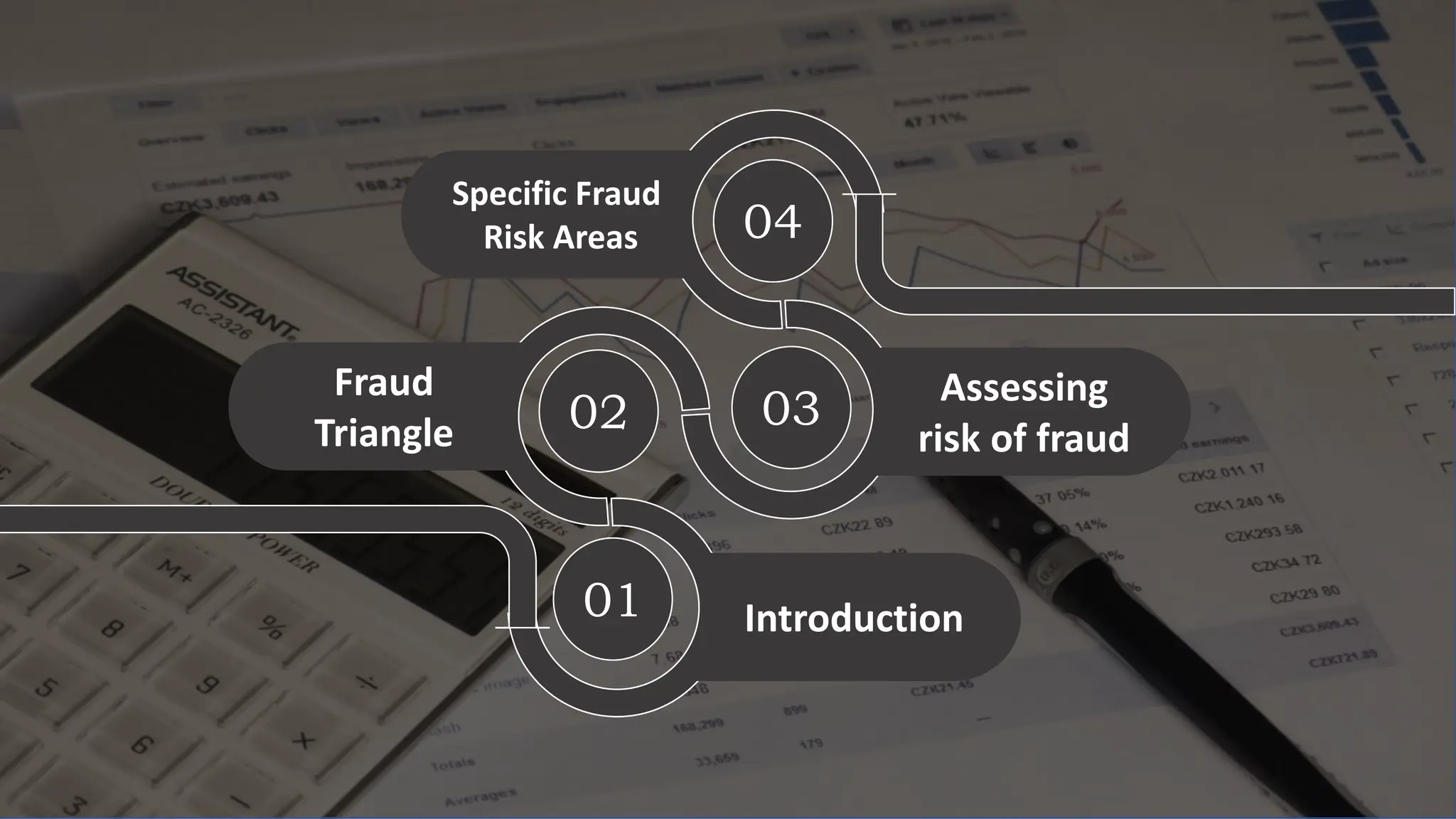
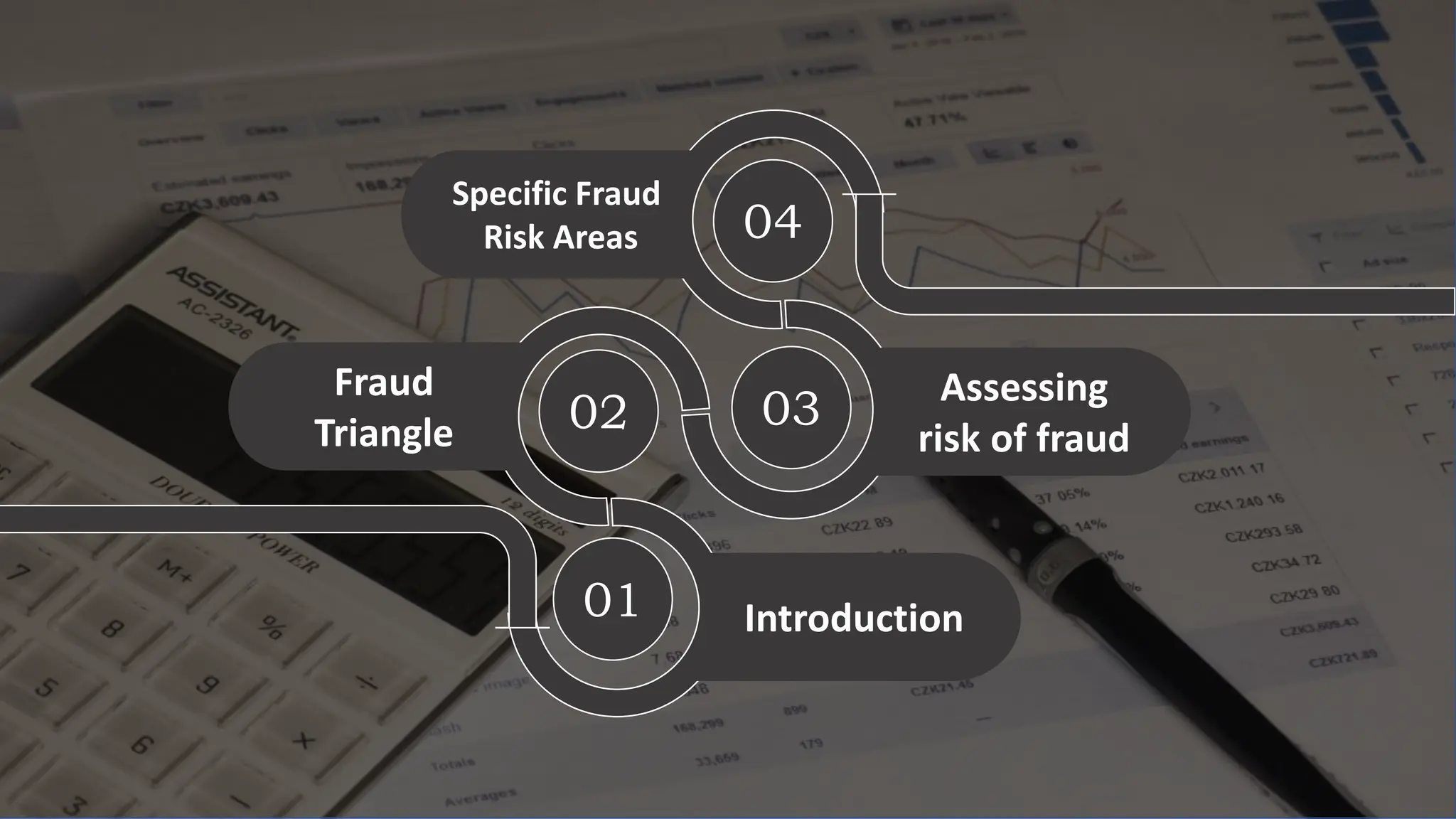
01
02 03
04
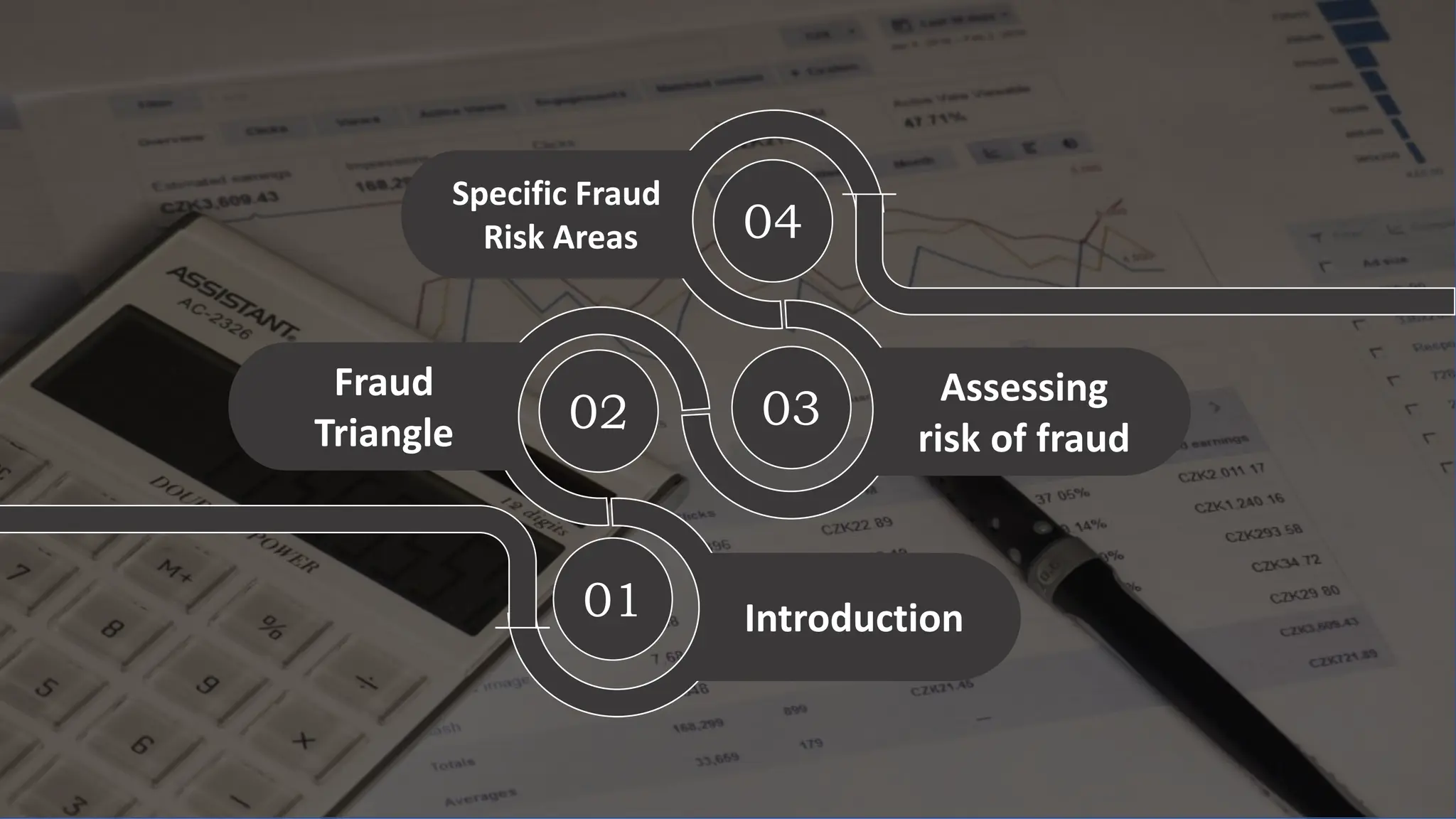
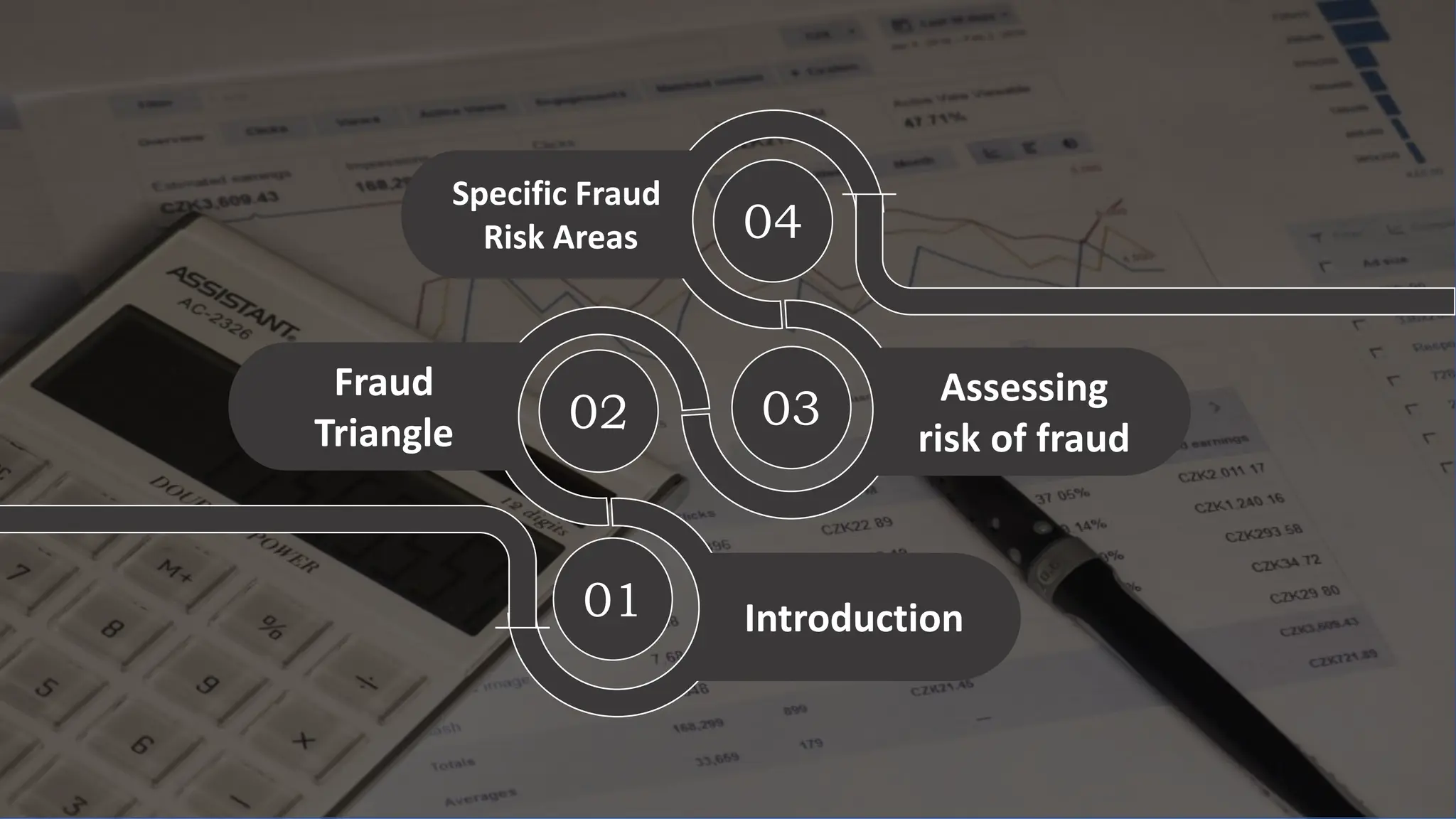
Introduction
Assessing
risk of fraud
Fraud
Triangle
Specific Fraud
Risk Areas
01 Introduction
01 The Concept of Auditing
Point one: What is Fraud and its main types?
Fraud is an intentional act
involving the use of deception
that results in a material
misstatement of the financial
statements
01 The Concept of Auditing
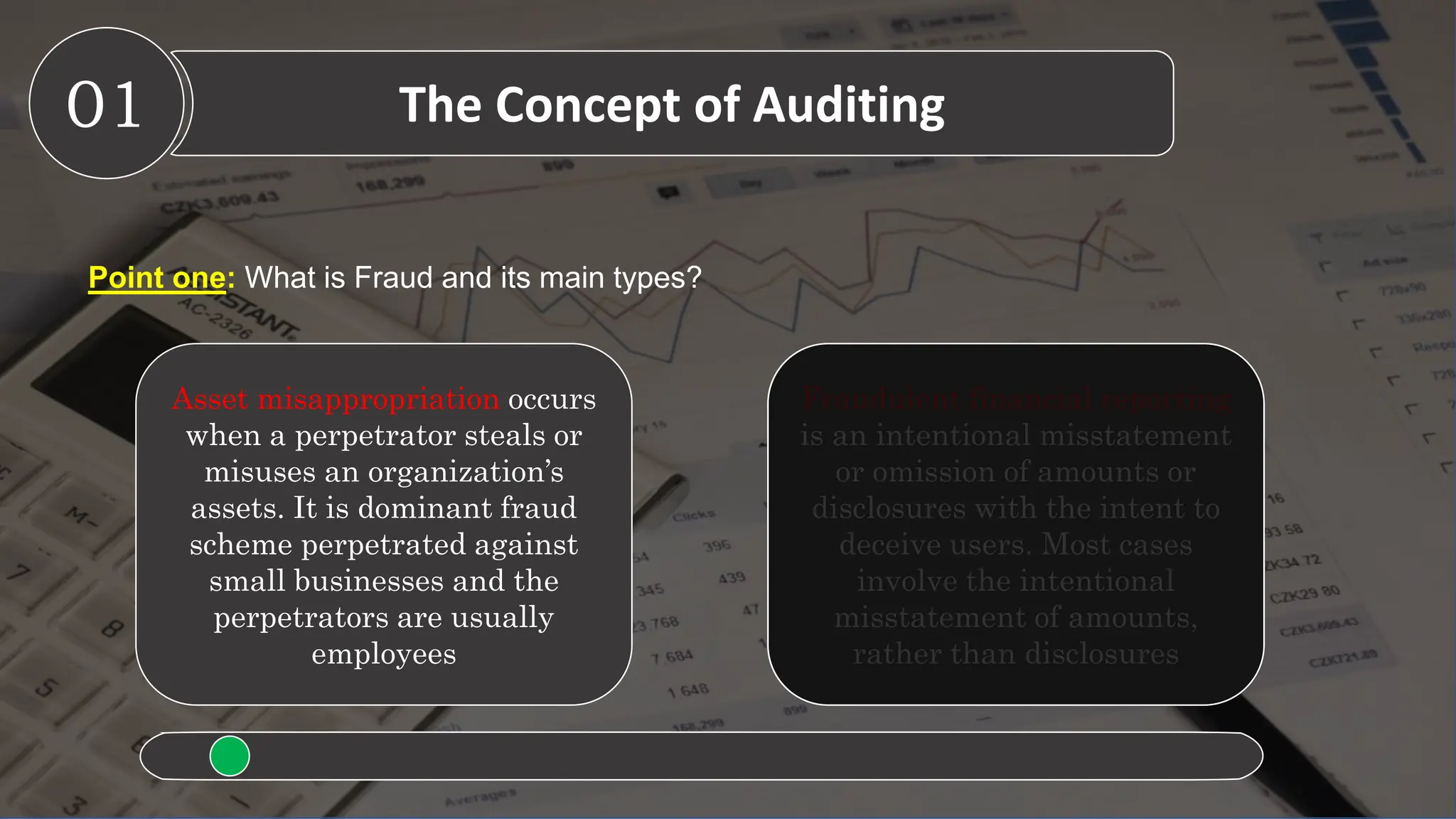
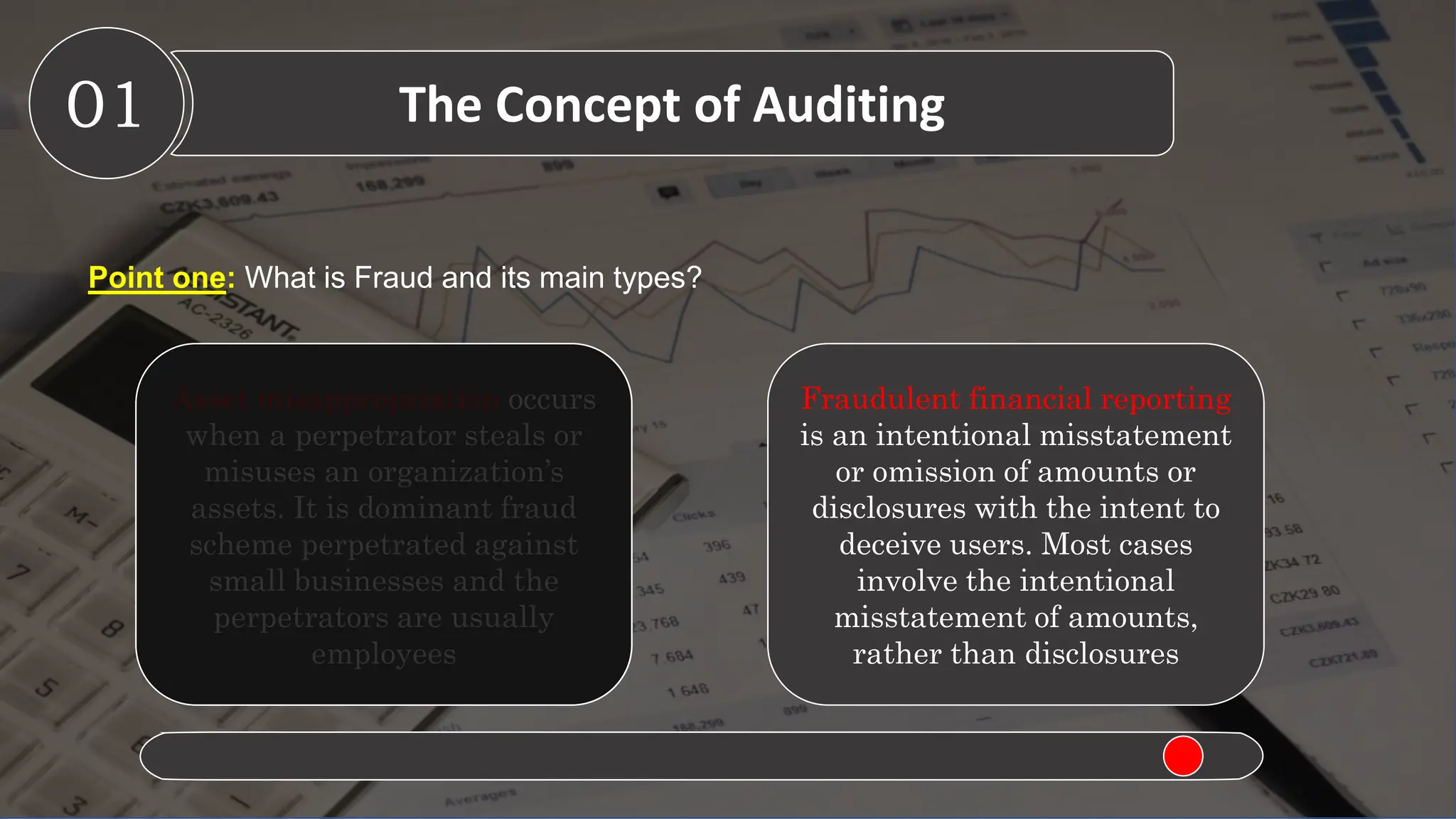
Asset misappropriation occurs
when a perpetrator steals or
misuses an organization’s
assets. It is dominant fraud
scheme perpetrated against
small businesses and the
perpetrators are usually
employees
Fraudulent financial reporting
is an intentional misstatement
or omission of amounts or
disclosures with the intent to
deceive users. Most cases
involve the intentional
misstatement of amounts,
rather than disclosures
Point one: What is Fraud and its main types?
01 The Concept of Auditing
Asset misappropriation occurs
when a perpetrator steals or
misuses an organization’s
assets. It is dominant fraud
scheme perpetrated against
small businesses and the
perpetrators are usually
employees
Fraudulent financial reporting
is an intentional misstatement
or omission of amounts or
disclosures with the intent to
deceive users. Most cases
involve the intentional
misstatement of amounts,
rather than disclosures
Point one: What is Fraud and its main types?
01 The Concept of Auditing
Point one: What is Fraud and its main types?
01 The Concept of Auditing
Asset misappropriation occurs when
Point one: What is Fraud and its main types?
01 The Concept of Auditing
Asset misappropriation occurs when
Gain access to cash and manipulate accounts to cover up cash thefts
Manipulate cash disbursements through fake companies
Steal inventory or other assets and manipulate the financial records to cover up the fraud
Point one: What is Fraud and its main types?
01 The Concept of Auditing
C
a
Point one: What is Fraud and its main types?
01 The Concept of Auditing
Fraudulent financial reporting
C
a
Point one: What is Fraud and its main types?
01 The Concept of Auditing
Fraudulent financial reporting
Companies may also intentionally understate income when earnings are high to create
a reserve of earnings or “cookie jar reserves” that may be used to increase earnings in
future periods
Point one: What is Fraud and its main types?
01
02 03
04
Introduction
Assessing
risk of fraud
Fraud
Triangle
Specific Fraud
Risk Areas
Fraud
Triangle 02
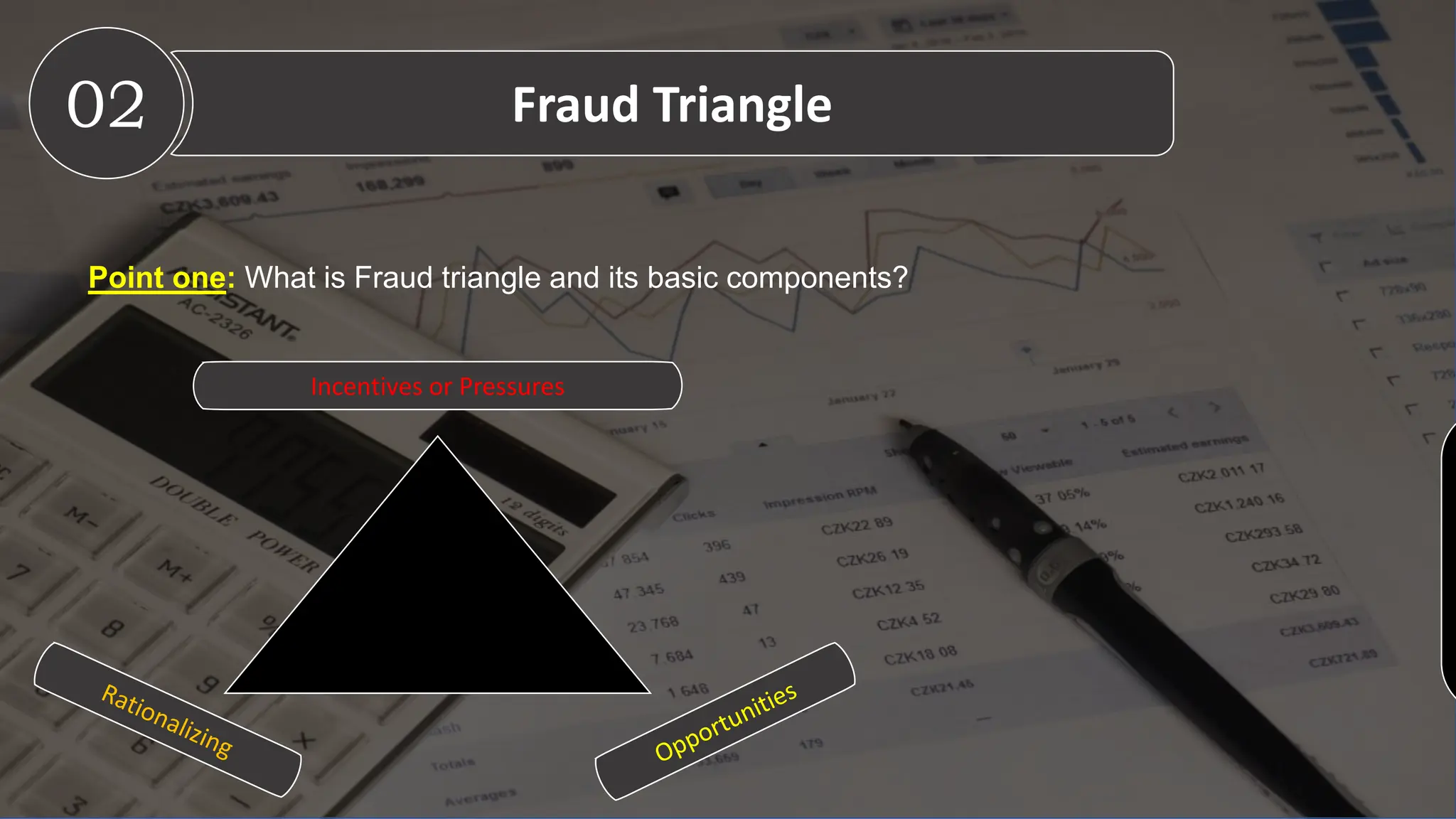
02 Fraud Triangle
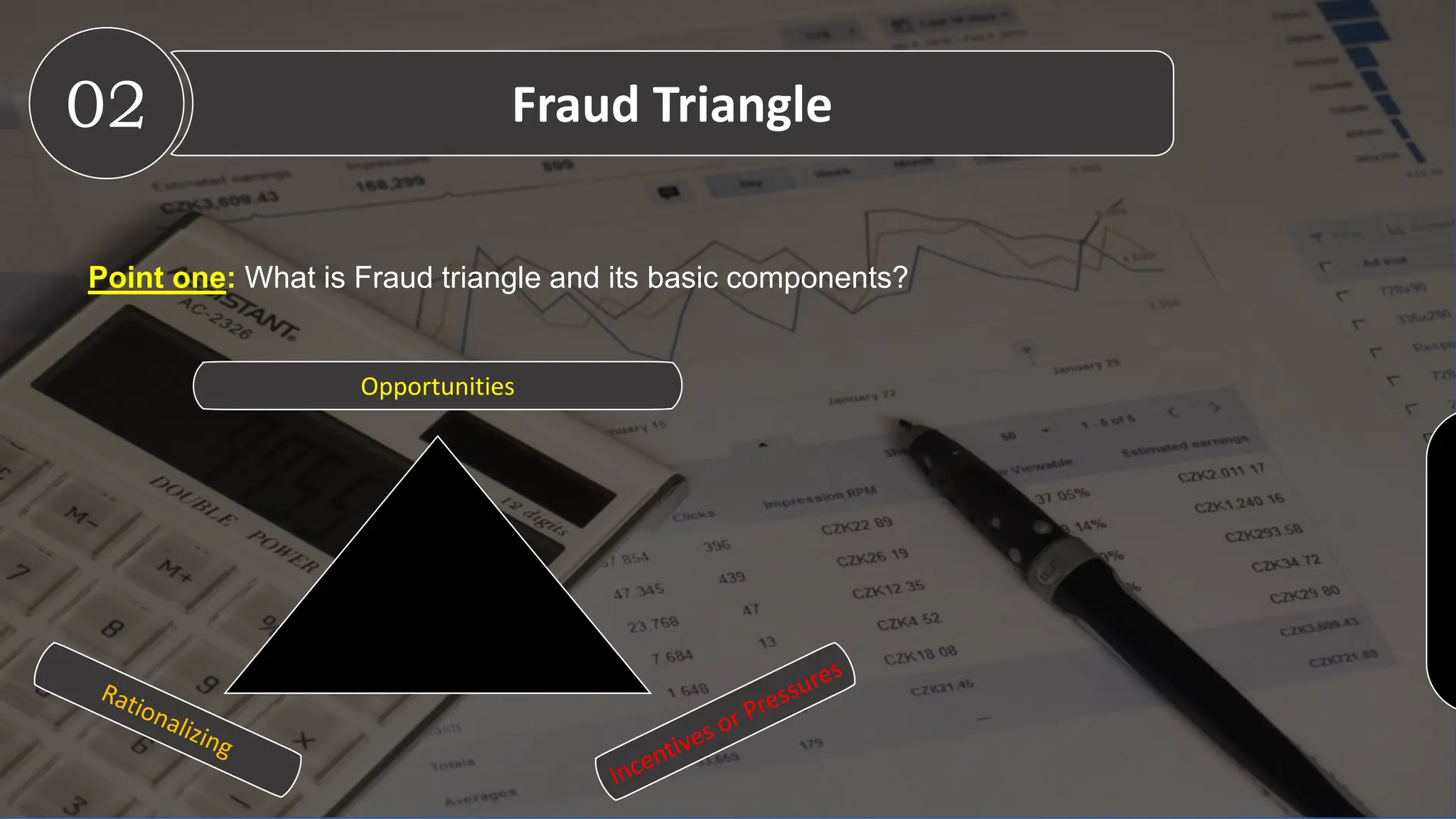
Point one: What is Fraud triangle and its basic components?
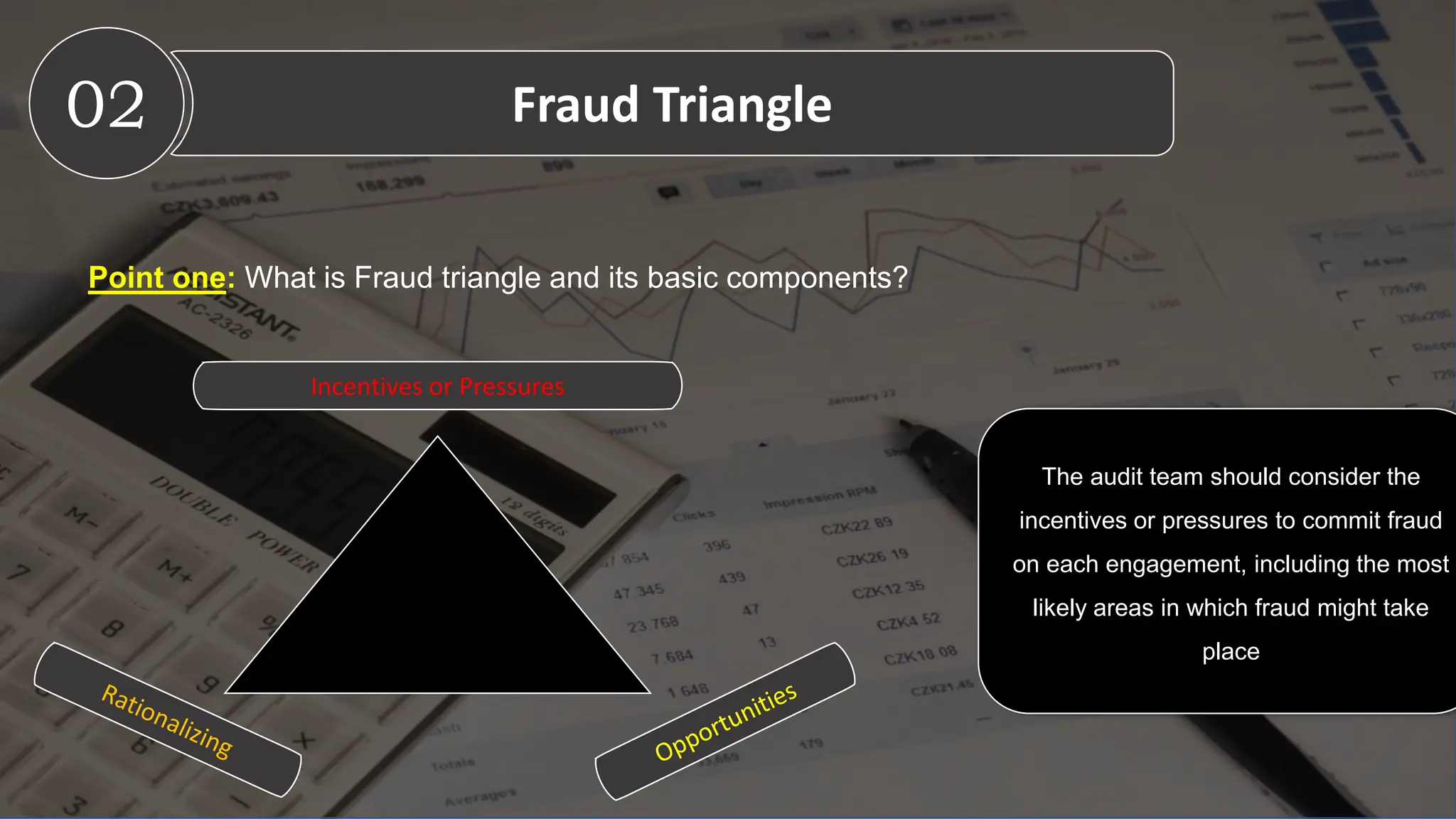
Incentives or Pressures
02 Fraud Triangle
Point one: What is Fraud triangle and its basic components?
Incentives or Pressures
The audit team should consider the
incentives or pressures to commit fraud
on each engagement, including the most
likely areas in which fraud might take
place
02 Fraud Triangle
Point one: What is Fraud triangle and its basic components?
Opportunities
02 Fraud Triangle
Point one: What is Fraud triangle and its basic components?
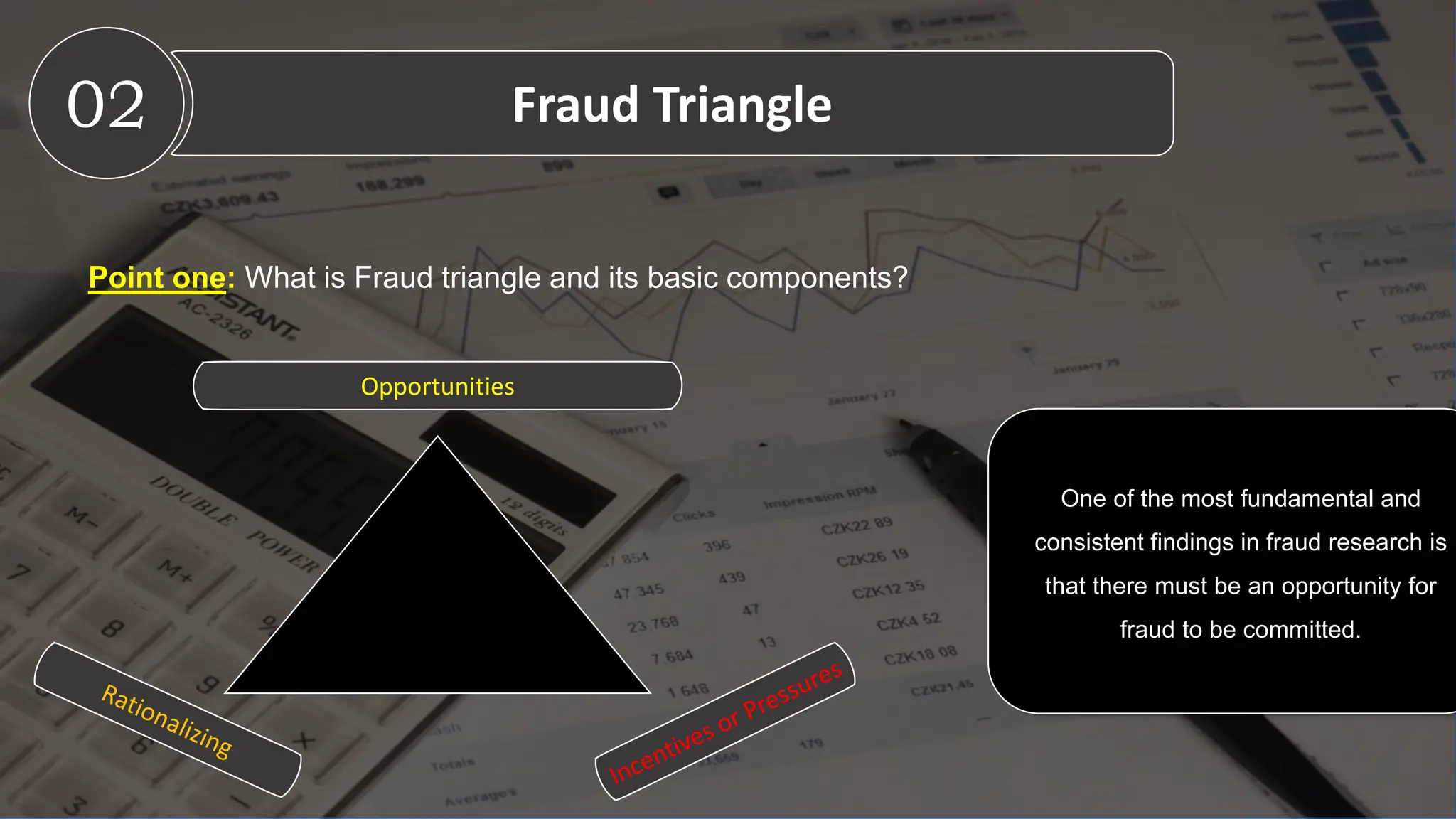
Opportunities
One of the most fundamental and
consistent findings in fraud research is
that there must be an opportunity for
fraud to be committed.
02 Fraud Triangle
Point one: What is Fraud triangle and its basic components?
Rationalizing
02 Fraud Triangle
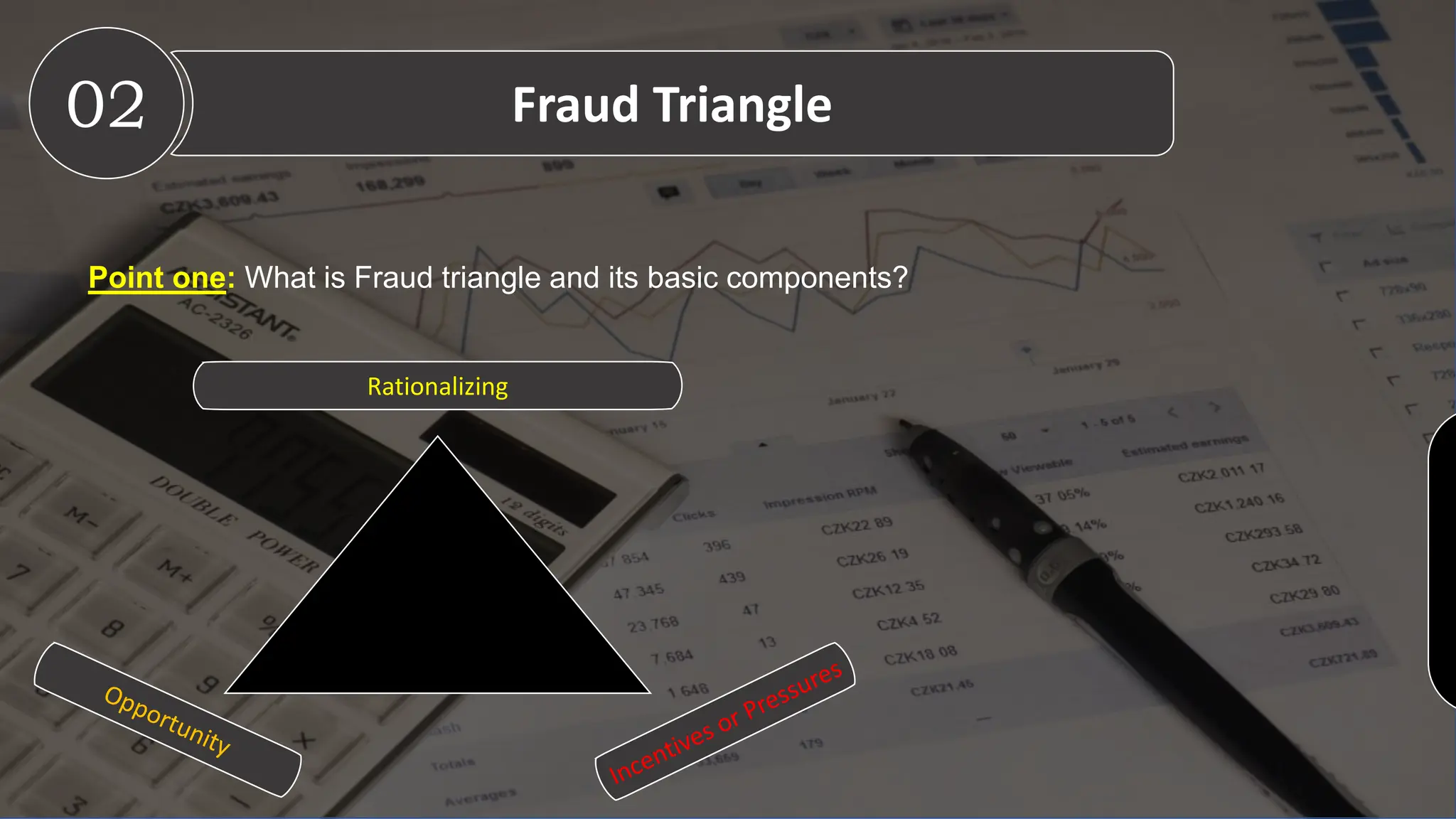
Point one: What is Fraud triangle and its basic components?
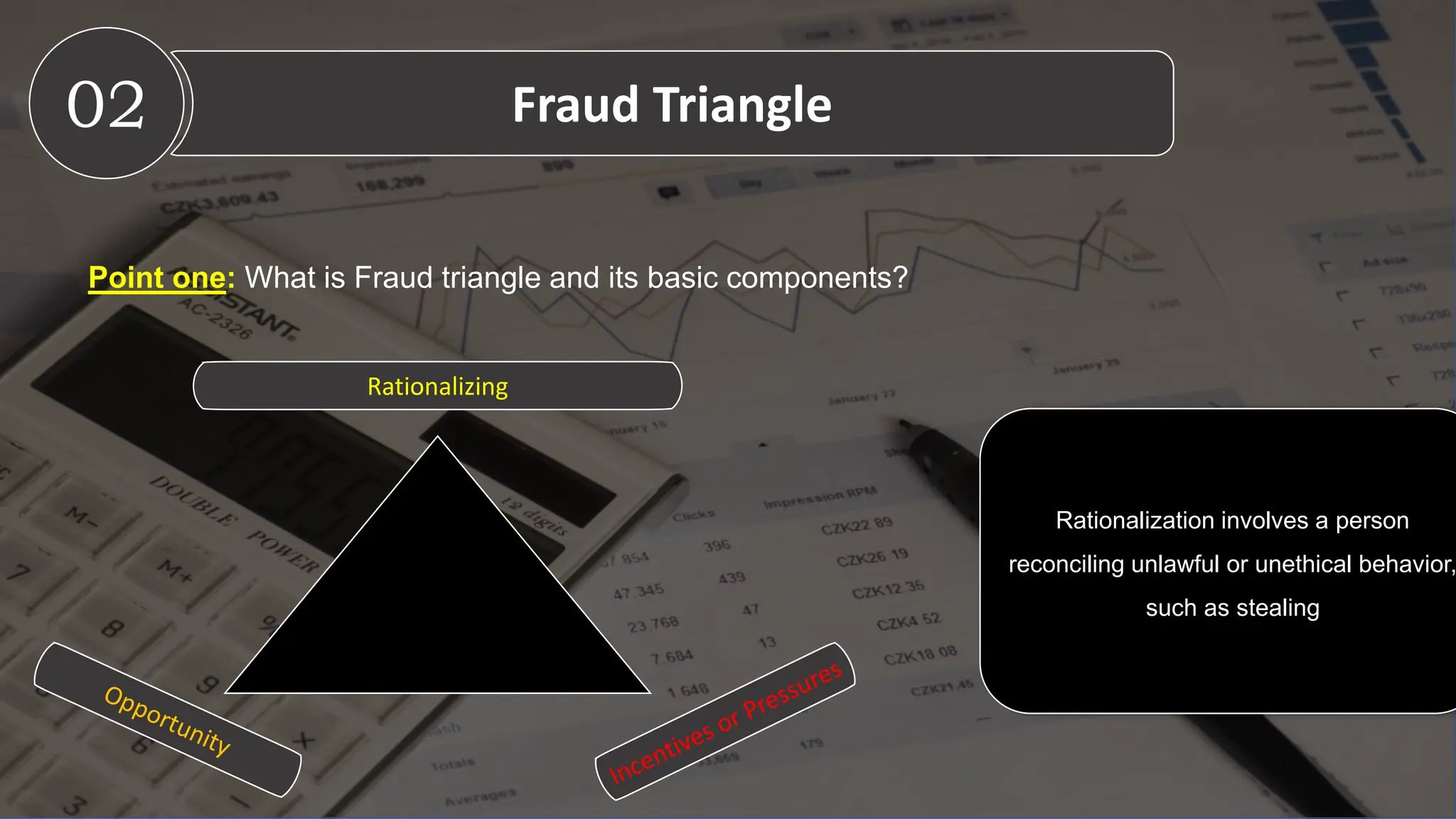
Rationalizing
Rationalization involves a person
reconciling unlawful or unethical behavior,
such as stealing
01
02 03
04
Introduction
Assessing
risk of fraud
Fraud
Triangle
Specific Fraud
Risk Areas
03 Assessing
risk of fraud
03 Assessing risk of fraud
Point one: guidance to auditors in assessing the risk of fraud?
C
Professional Skepticism: Auditing standards state that, in exercising professional skepticism, an auditor
“neither assumes that management is dishonest nor assumes unquestioned honesty.”
Point one: guidance to auditors in assessing the risk of fraud?
03 Assessing risk of fraud
Questioning Mind: Auditing standards emphasize consideration of a client’s susceptibility to fraud, regardless of the auditor’s
beliefs about the likelihood of fraud and management’s honesty and integrity
Point one: guidance to auditors in assessing the risk of fraud?
03 Assessing risk of fraud
Point one: guidance to auditors in assessing the risk of fraud?
Critical Evaluation of Audit Evidence Upon discovering information or other conditions that indicate a material misstatemen
due to fraud may have occurred, auditors should thoroughly probe the issues, acquire additional evidence as needed, and
consult with other team members
03 Assessing risk of fraud
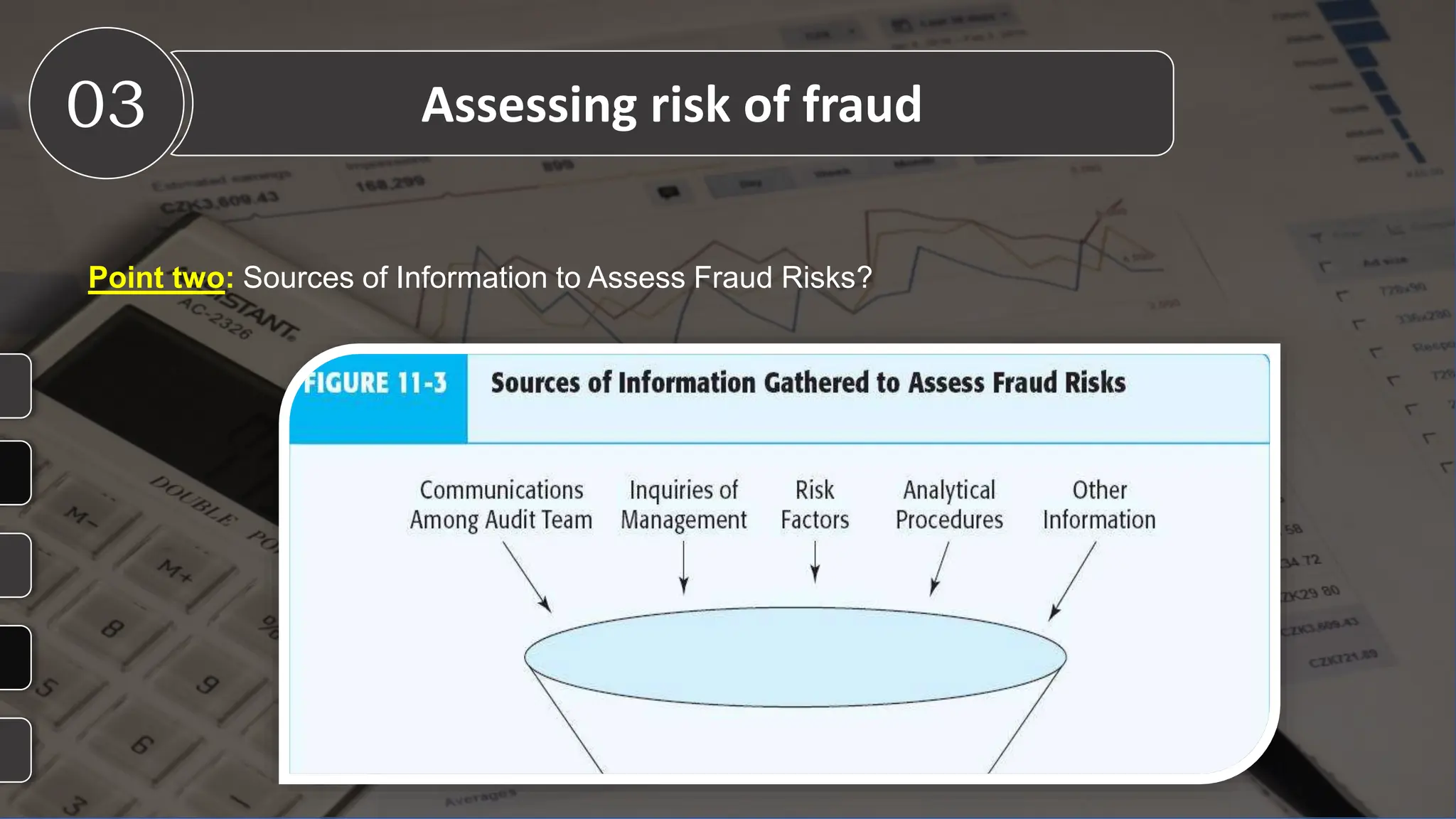
Point two: Sources of Information to Assess Fraud Risks?
03 Assessing risk of fraud
Communications among audit team
Point two: Sources of Information to Assess Fraud Risks?
03 Assessing risk of fraud
Point two: Sources of Information to Assess Fraud Risks?
Inquiries of Management
03 Assessing risk of fraud
Point two: Sources of Information to Assess Fraud Risks?
Risk Factors
03 Assessing risk of fraud
Point two: Sources of Information to Assess Fraud Risks?
03 Assessing risk of fraud
Analytical procedure
Point two: Sources of Information to Assess Fraud Risks?
Other Information
03 Assessing risk of fraud
Point two: Sources of Information to Assess Fraud Risks?
03 Assessing risk of fraud
Point three: Documenting Fraud Assessment?
03 Assessing risk of fraud
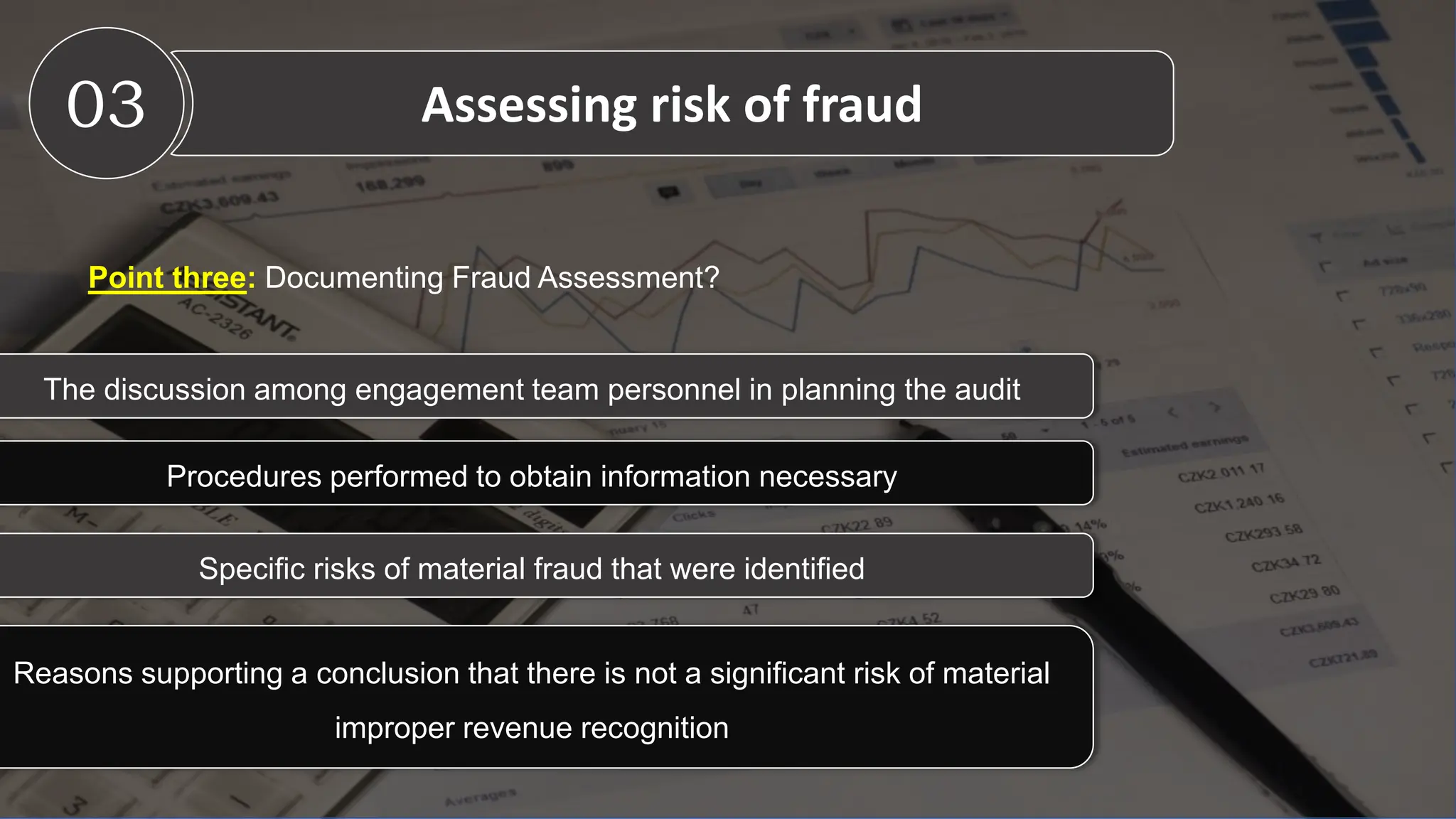
The discussion among engagement team personnel in planning the audit
Point three: Documenting Fraud Assessment?
Procedures performed to obtain information necessary
Specific risks of material fraud that were identified
Reasons supporting a conclusion that there is not a significant risk of material
improper revenue recognition
03 Assessing risk of fraud
Point three: Documenting Fraud Assessment?
03 Assessing risk of fraud
Point three: Documenting Fraud Assessment?
Results of the procedures performed to address the risk of management override of controls.
03 Assessing risk of fraud
Other conditions and analytical relationships indicating that additional auditing procedures or other
responses were required, and the actions taken by the auditor.
The nature of communications about fraud made to management, the audit committee, or others.
Point four: Corporate Governance and Fraud Risks?
03 Assessing risk of fraud
C
Point four: Corporate Governance and Fraud Risks?
03 Assessing risk of fraud
Corporate governance is a process by which the owners (stockholders) and creditors of
an organization exert control and require accountability for the resources entrusted to
the organization. The owners elect a board of directors to provide oversight of the
organization’s activities and accountability to stakeholders.
Point four: Corporate Governance and Fraud Risks?
03 Assessing risk of fraud
C
Management is responsible for implementing corporate governance and control
procedures to minimize the risk of fraud, which can be reduced through a combination
of prevention, deterrence, and detection measures. Because collusion and false
documentation make detection of fraud a challenge
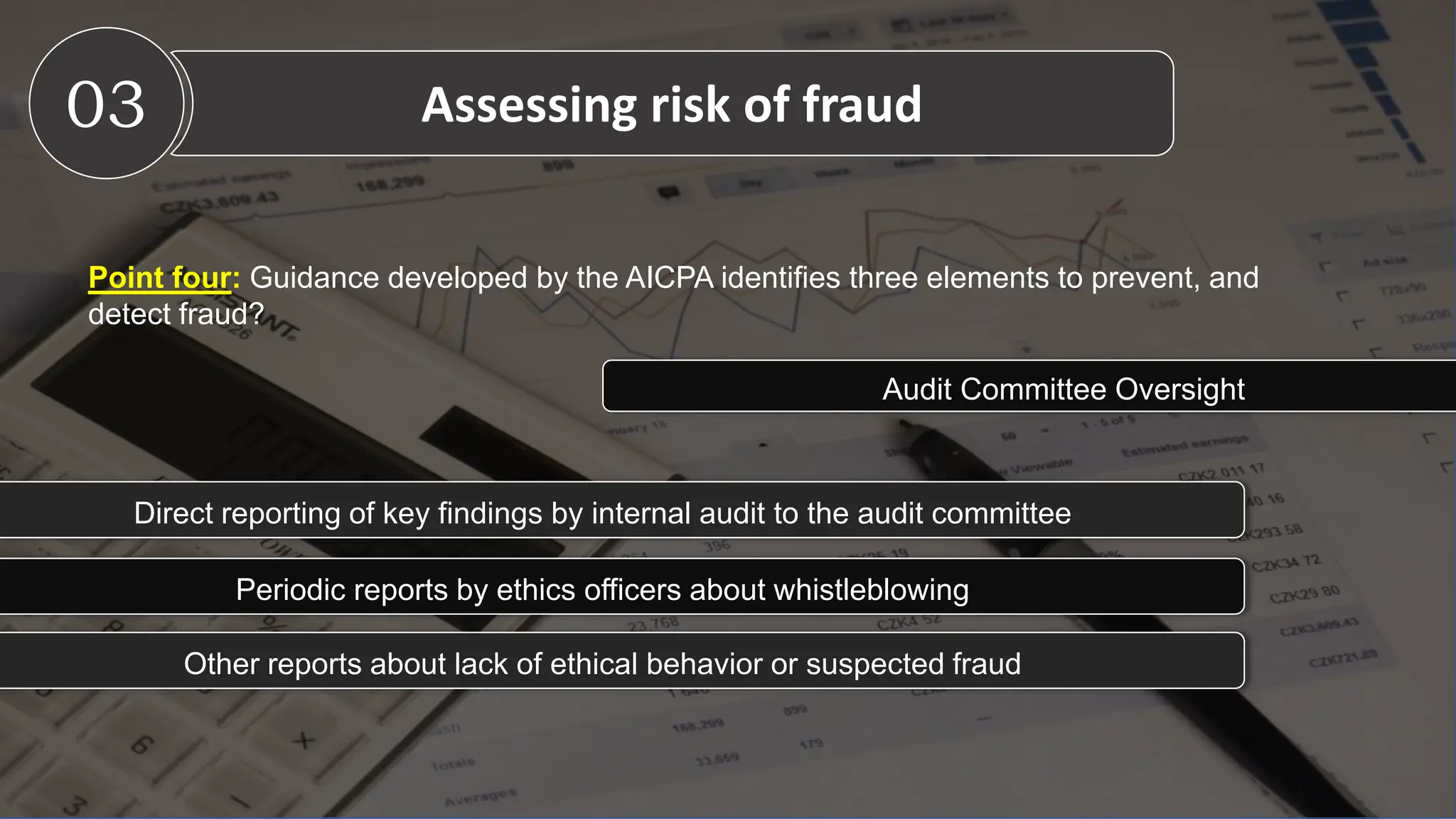
Point four: Guidance developed by the AICPA identifies three elements to prevent, and
detect fraud?
03 Assessing risk of fraud
Point four: Guidance developed by the AICPA identifies three elements to prevent, and
detect fraud?
03 Assessing risk of fraud
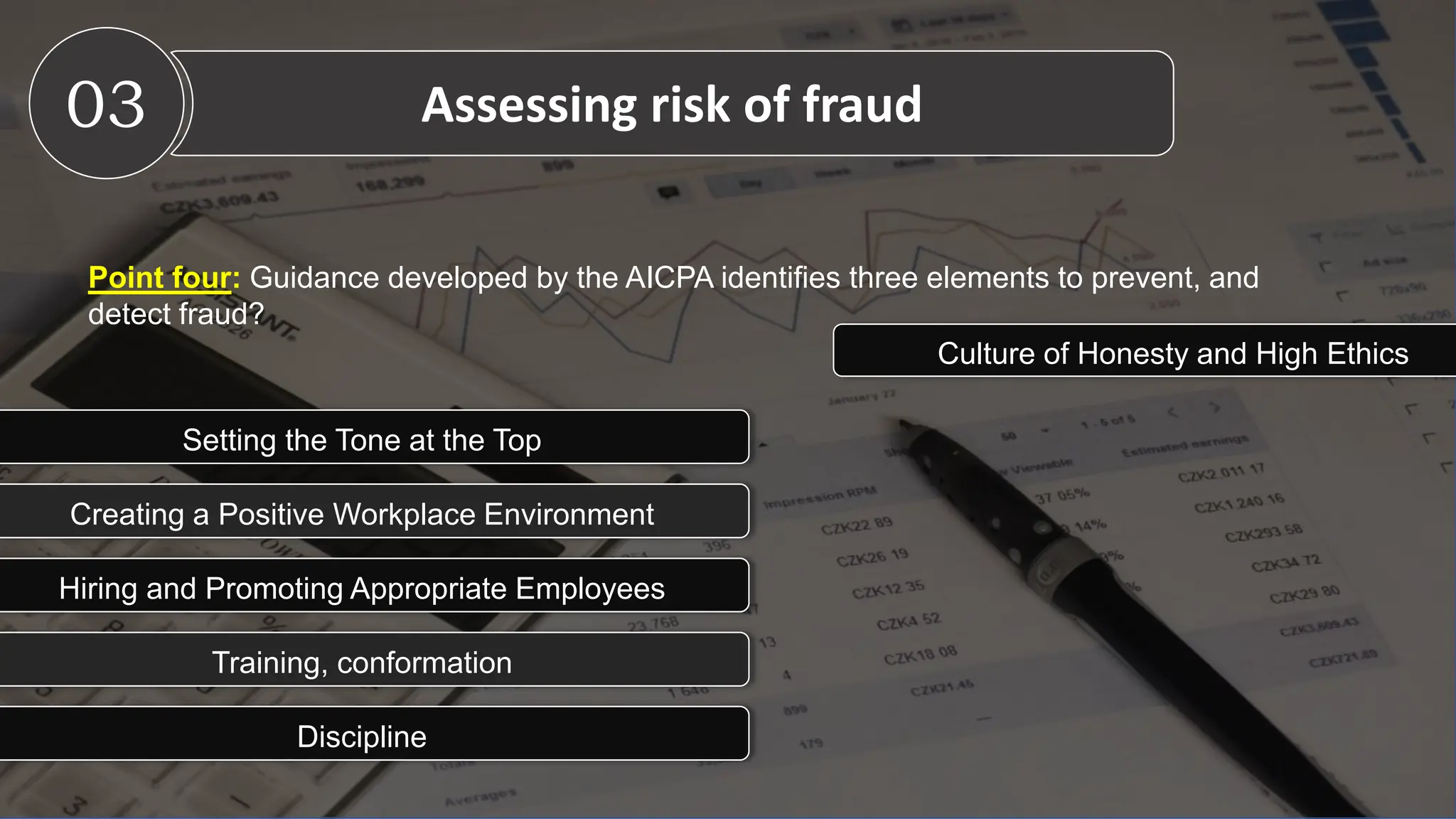
Culture of Honesty and High Ethics
Point four: Guidance developed by the AICPA identifies three elements to prevent, and
detect fraud?
03 Assessing risk of fraud
Culture of Honesty and High Ethics
Setting the Tone at the Top
Creating a Positive Workplace Environment
Hiring and Promoting Appropriate Employees
Training, conformation
Discipline
Point four: Guidance developed by the AICPA identifies three elements to prevent, and
detect fraud?
03 Assessing risk of fraud
Management’s Responsibility to Evaluate Risks of Fraud
Point four: Guidance developed by the AICPA identifies three elements to prevent, and
detect fraud?
03 Assessing risk of fraud
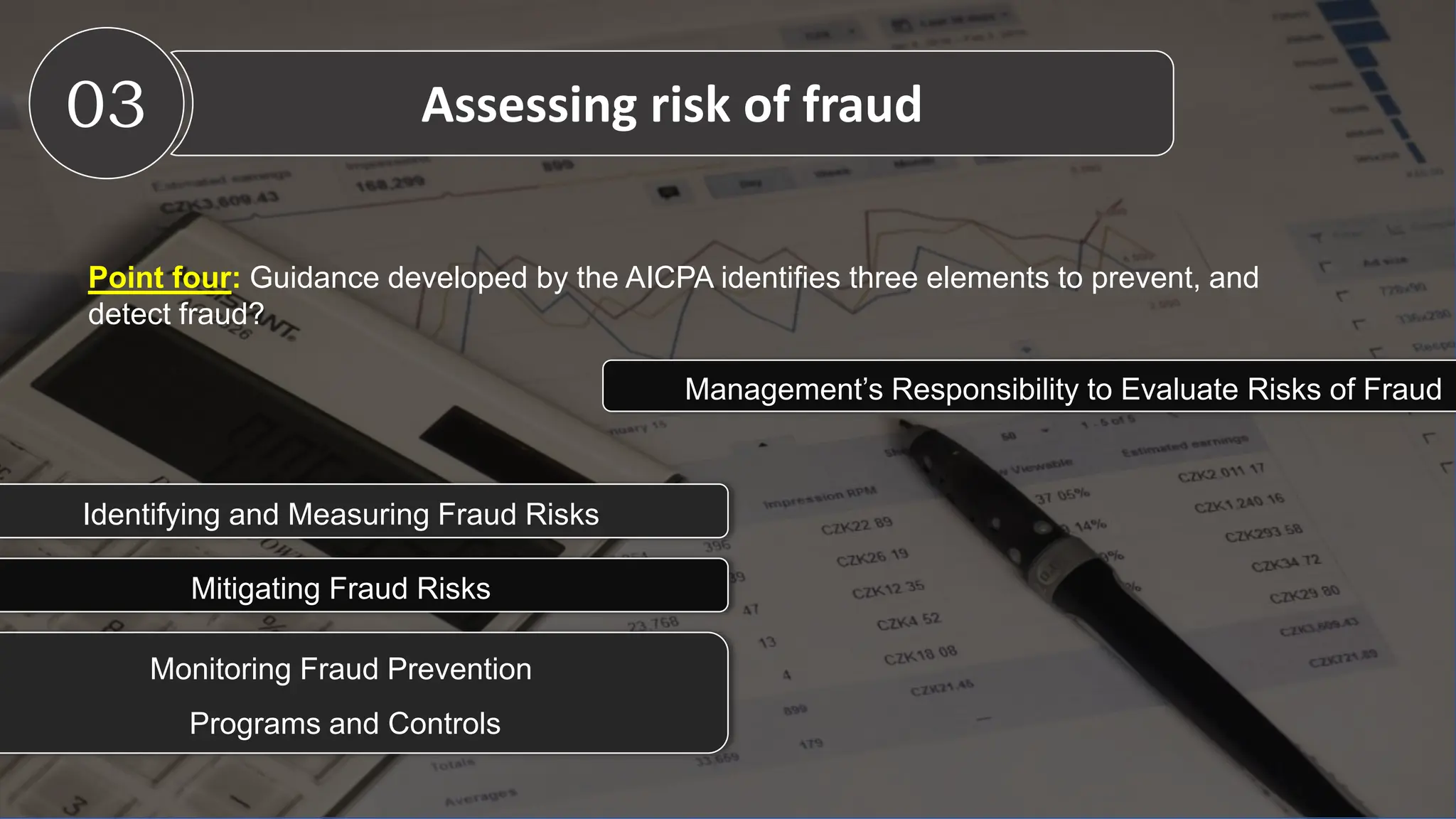
Management’s Responsibility to Evaluate Risks of Fraud
Identifying and Measuring Fraud Risks
Mitigating Fraud Risks
Monitoring Fraud Prevention
Programs and Controls
Point four: Guidance developed by the AICPA identifies three elements to prevent, and
detect fraud?
03 Assessing risk of fraud
Audit Committee Oversight
Point four: Guidance developed by the AICPA identifies three elements to prevent, and
detect fraud?
03 Assessing risk of fraud
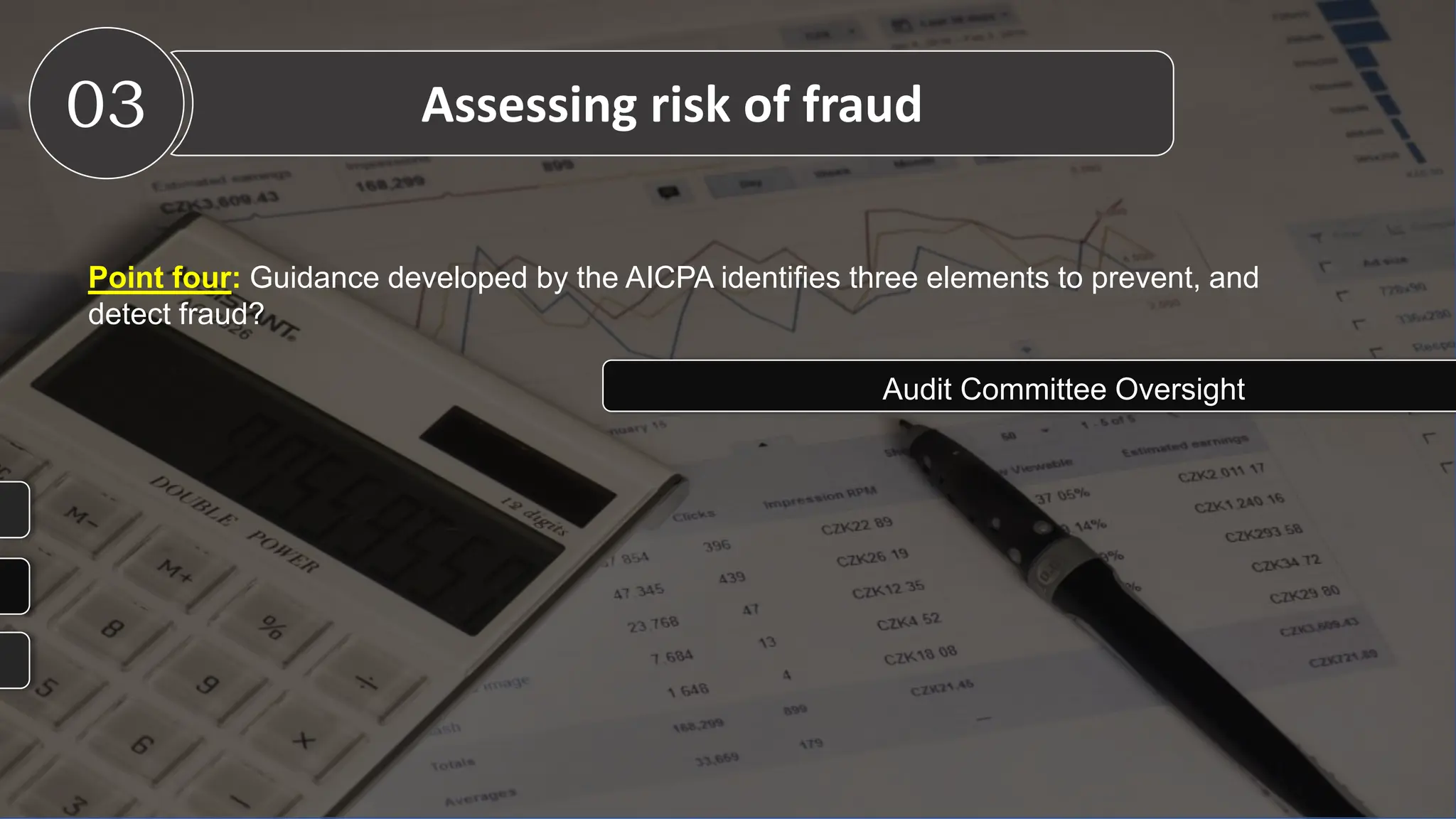
Audit Committee Oversight
Direct reporting of key findings by internal audit to the audit committee
Periodic reports by ethics officers about whistleblowing
Other reports about lack of ethical behavior or suspected fraud
01
02 03
04
Introduction
Assessing
risk of fraud
Fraud
Triangle
Specific Fraud
Risk Areas
Specific Fraud
Risk Areas 04
Point one: Specific Fraud Risk Areas?
04 Specific Fraud Risk Areas
Point one: Specific Fraud Risk Areas?
04 Specific Fraud Risk Areas
Audit Committee Oversight
Point one: Specific Fraud Risk Areas?
04 Specific Fraud Risk Areas
Direct reporting of key findings by internal audit to the audit committee
Point one: Specific Fraud Risk Areas?
04 Specific Fraud Risk Areas
Periodic reports by ethics officers about whistleblowing
Point one: Specific Fraud Risk Areas?
04 Specific Fraud Risk Areas
Other reports about lack of ethical behavior or suspected fraud
Point one: Specific Fraud Risk Areas?
04 Specific Fraud Risk Areas
Think!
 Determine which Factor of fraud triangle
 A cashier in a retail store with weak cash register controls might see an opportunity to steal money by voiding fake sales
transactions
 An employee who inflates expense reports might rationalize it by telling themselves
that they are simply "evening the score" for all the extra hours they work for free
 An accountant facing foreclosure on their house might feel pressured to cook the books to make the company
look more profitable and secure a loan.
Opportunity
Rationalization
Incentive (Pressure)
00 Main questions
Think!
 Determine which Factor of fraud triangle
 There was intense pressure to keep the corporation’s stock from declining further. This pressure came from investors,
analysts, and the CEO, whose financial well-being was significantly dependent on the corporation’s stock price.
 Top management of the company closely guards internal financial information, to the
extent that even some employees on a “need-to-know basis” are denied full access.
Incentive/Pressure
Opportunity
00 Main questions
Think!
 Determine which Factor of fraud triangle
 Managing specific financial ratios is very important to the company, and both management and analysts are keenly
observant of variability in key ratios. Key ratios for the company changed very little even though the ratios for the overall
industry were quite volatile during the time period.
Opportunity
00 Main questions
Think!
 Discuss
 Define fraud and its main types
 What are the three conditions of fraud often referred to as “the fraud triangle?”
 What sources are used by the auditor to gather information to assess fraud risks?
00 Main questions
Think!
 True or false
 The three elements of the fraud triangle include incentive, opportunity, and rationalization.
 Professional skepticism involves the validation of information through probing questions, critical assessment of
evidence, and attention to inconsistencies.
 Corporate governance is the process by which the owners and creditors of an organization exert control over
and require accountability for the resources entrusted to the organization.
00 Main questions
True
True
True
 Companies with effective corporate governance are riskier to audit. False
Think!
 MCQ
00 Main questions
 What is the primary difference between fraud and errors in financial statement reporting?
A) The materiality of the misstatement.
B) The intent to deceive.
C) The level of management involved.
D) The type of transaction effected.
B
 Because of the risk of material misstatements due to fraud (fraud risk), an audit of financial statements in accordance
with generally accepted auditing standards should be performed with an attitude of
A) professional skepticism B) objective judgment.
C) independent integrity. D) impartial conservatism.
A
Discussion on our main
points and conclusion
Any questions
Thank you

Chapter one.ppt fraud auditing material section

  • 1.
  • 3.
    01 02 03 04 Introduction Assessing risk offraud Fraud Triangle Specific Fraud Risk Areas
  • 4.
  • 5.
    01 The Conceptof Auditing Point one: What is Fraud and its main types? Fraud is an intentional act involving the use of deception that results in a material misstatement of the financial statements
  • 6.
    01 The Conceptof Auditing Asset misappropriation occurs when a perpetrator steals or misuses an organization’s assets. It is dominant fraud scheme perpetrated against small businesses and the perpetrators are usually employees Fraudulent financial reporting is an intentional misstatement or omission of amounts or disclosures with the intent to deceive users. Most cases involve the intentional misstatement of amounts, rather than disclosures Point one: What is Fraud and its main types?
  • 7.
    01 The Conceptof Auditing Asset misappropriation occurs when a perpetrator steals or misuses an organization’s assets. It is dominant fraud scheme perpetrated against small businesses and the perpetrators are usually employees Fraudulent financial reporting is an intentional misstatement or omission of amounts or disclosures with the intent to deceive users. Most cases involve the intentional misstatement of amounts, rather than disclosures Point one: What is Fraud and its main types?
  • 8.
    01 The Conceptof Auditing Point one: What is Fraud and its main types?
  • 9.
    01 The Conceptof Auditing Asset misappropriation occurs when Point one: What is Fraud and its main types?
  • 10.
    01 The Conceptof Auditing Asset misappropriation occurs when Gain access to cash and manipulate accounts to cover up cash thefts Manipulate cash disbursements through fake companies Steal inventory or other assets and manipulate the financial records to cover up the fraud Point one: What is Fraud and its main types?
  • 11.
    01 The Conceptof Auditing C a Point one: What is Fraud and its main types?
  • 12.
    01 The Conceptof Auditing Fraudulent financial reporting C a Point one: What is Fraud and its main types?
  • 13.
    01 The Conceptof Auditing Fraudulent financial reporting Companies may also intentionally understate income when earnings are high to create a reserve of earnings or “cookie jar reserves” that may be used to increase earnings in future periods Point one: What is Fraud and its main types?
  • 14.
    01 02 03 04 Introduction Assessing risk offraud Fraud Triangle Specific Fraud Risk Areas
  • 15.
  • 16.
    02 Fraud Triangle Pointone: What is Fraud triangle and its basic components? Incentives or Pressures
  • 17.
    02 Fraud Triangle Pointone: What is Fraud triangle and its basic components? Incentives or Pressures The audit team should consider the incentives or pressures to commit fraud on each engagement, including the most likely areas in which fraud might take place
  • 18.
    02 Fraud Triangle Pointone: What is Fraud triangle and its basic components? Opportunities
  • 19.
    02 Fraud Triangle Pointone: What is Fraud triangle and its basic components? Opportunities One of the most fundamental and consistent findings in fraud research is that there must be an opportunity for fraud to be committed.
  • 20.
    02 Fraud Triangle Pointone: What is Fraud triangle and its basic components? Rationalizing
  • 21.
    02 Fraud Triangle Pointone: What is Fraud triangle and its basic components? Rationalizing Rationalization involves a person reconciling unlawful or unethical behavior, such as stealing
  • 22.
    01 02 03 04 Introduction Assessing risk offraud Fraud Triangle Specific Fraud Risk Areas
  • 23.
  • 24.
    03 Assessing riskof fraud Point one: guidance to auditors in assessing the risk of fraud? C
  • 25.
    Professional Skepticism: Auditingstandards state that, in exercising professional skepticism, an auditor “neither assumes that management is dishonest nor assumes unquestioned honesty.” Point one: guidance to auditors in assessing the risk of fraud? 03 Assessing risk of fraud
  • 26.
    Questioning Mind: Auditingstandards emphasize consideration of a client’s susceptibility to fraud, regardless of the auditor’s beliefs about the likelihood of fraud and management’s honesty and integrity Point one: guidance to auditors in assessing the risk of fraud? 03 Assessing risk of fraud
  • 27.
    Point one: guidanceto auditors in assessing the risk of fraud? Critical Evaluation of Audit Evidence Upon discovering information or other conditions that indicate a material misstatemen due to fraud may have occurred, auditors should thoroughly probe the issues, acquire additional evidence as needed, and consult with other team members 03 Assessing risk of fraud
  • 28.
    Point two: Sourcesof Information to Assess Fraud Risks? 03 Assessing risk of fraud
  • 29.
    Communications among auditteam Point two: Sources of Information to Assess Fraud Risks? 03 Assessing risk of fraud
  • 30.
    Point two: Sourcesof Information to Assess Fraud Risks? Inquiries of Management 03 Assessing risk of fraud
  • 31.
    Point two: Sourcesof Information to Assess Fraud Risks? Risk Factors 03 Assessing risk of fraud
  • 32.
    Point two: Sourcesof Information to Assess Fraud Risks? 03 Assessing risk of fraud Analytical procedure
  • 33.
    Point two: Sourcesof Information to Assess Fraud Risks? Other Information 03 Assessing risk of fraud
  • 34.
    Point two: Sourcesof Information to Assess Fraud Risks? 03 Assessing risk of fraud
  • 35.
    Point three: DocumentingFraud Assessment? 03 Assessing risk of fraud
  • 36.
    The discussion amongengagement team personnel in planning the audit Point three: Documenting Fraud Assessment? Procedures performed to obtain information necessary Specific risks of material fraud that were identified Reasons supporting a conclusion that there is not a significant risk of material improper revenue recognition 03 Assessing risk of fraud
  • 37.
    Point three: DocumentingFraud Assessment? 03 Assessing risk of fraud
  • 38.
    Point three: DocumentingFraud Assessment? Results of the procedures performed to address the risk of management override of controls. 03 Assessing risk of fraud Other conditions and analytical relationships indicating that additional auditing procedures or other responses were required, and the actions taken by the auditor. The nature of communications about fraud made to management, the audit committee, or others.
  • 39.
    Point four: CorporateGovernance and Fraud Risks? 03 Assessing risk of fraud C
  • 40.
    Point four: CorporateGovernance and Fraud Risks? 03 Assessing risk of fraud Corporate governance is a process by which the owners (stockholders) and creditors of an organization exert control and require accountability for the resources entrusted to the organization. The owners elect a board of directors to provide oversight of the organization’s activities and accountability to stakeholders.
  • 41.
    Point four: CorporateGovernance and Fraud Risks? 03 Assessing risk of fraud C Management is responsible for implementing corporate governance and control procedures to minimize the risk of fraud, which can be reduced through a combination of prevention, deterrence, and detection measures. Because collusion and false documentation make detection of fraud a challenge
  • 42.
    Point four: Guidancedeveloped by the AICPA identifies three elements to prevent, and detect fraud? 03 Assessing risk of fraud
  • 43.
    Point four: Guidancedeveloped by the AICPA identifies three elements to prevent, and detect fraud? 03 Assessing risk of fraud Culture of Honesty and High Ethics
  • 44.
    Point four: Guidancedeveloped by the AICPA identifies three elements to prevent, and detect fraud? 03 Assessing risk of fraud Culture of Honesty and High Ethics Setting the Tone at the Top Creating a Positive Workplace Environment Hiring and Promoting Appropriate Employees Training, conformation Discipline
  • 45.
    Point four: Guidancedeveloped by the AICPA identifies three elements to prevent, and detect fraud? 03 Assessing risk of fraud Management’s Responsibility to Evaluate Risks of Fraud
  • 46.
    Point four: Guidancedeveloped by the AICPA identifies three elements to prevent, and detect fraud? 03 Assessing risk of fraud Management’s Responsibility to Evaluate Risks of Fraud Identifying and Measuring Fraud Risks Mitigating Fraud Risks Monitoring Fraud Prevention Programs and Controls
  • 47.
    Point four: Guidancedeveloped by the AICPA identifies three elements to prevent, and detect fraud? 03 Assessing risk of fraud Audit Committee Oversight
  • 48.
    Point four: Guidancedeveloped by the AICPA identifies three elements to prevent, and detect fraud? 03 Assessing risk of fraud Audit Committee Oversight Direct reporting of key findings by internal audit to the audit committee Periodic reports by ethics officers about whistleblowing Other reports about lack of ethical behavior or suspected fraud
  • 49.
    01 02 03 04 Introduction Assessing risk offraud Fraud Triangle Specific Fraud Risk Areas
  • 50.
  • 51.
    Point one: SpecificFraud Risk Areas? 04 Specific Fraud Risk Areas
  • 52.
    Point one: SpecificFraud Risk Areas? 04 Specific Fraud Risk Areas Audit Committee Oversight
  • 53.
    Point one: SpecificFraud Risk Areas? 04 Specific Fraud Risk Areas Direct reporting of key findings by internal audit to the audit committee
  • 54.
    Point one: SpecificFraud Risk Areas? 04 Specific Fraud Risk Areas Periodic reports by ethics officers about whistleblowing
  • 55.
    Point one: SpecificFraud Risk Areas? 04 Specific Fraud Risk Areas Other reports about lack of ethical behavior or suspected fraud
  • 56.
    Point one: SpecificFraud Risk Areas? 04 Specific Fraud Risk Areas
  • 57.
    Think!  Determine whichFactor of fraud triangle  A cashier in a retail store with weak cash register controls might see an opportunity to steal money by voiding fake sales transactions  An employee who inflates expense reports might rationalize it by telling themselves that they are simply "evening the score" for all the extra hours they work for free  An accountant facing foreclosure on their house might feel pressured to cook the books to make the company look more profitable and secure a loan. Opportunity Rationalization Incentive (Pressure) 00 Main questions
  • 58.
    Think!  Determine whichFactor of fraud triangle  There was intense pressure to keep the corporation’s stock from declining further. This pressure came from investors, analysts, and the CEO, whose financial well-being was significantly dependent on the corporation’s stock price.  Top management of the company closely guards internal financial information, to the extent that even some employees on a “need-to-know basis” are denied full access. Incentive/Pressure Opportunity 00 Main questions
  • 59.
    Think!  Determine whichFactor of fraud triangle  Managing specific financial ratios is very important to the company, and both management and analysts are keenly observant of variability in key ratios. Key ratios for the company changed very little even though the ratios for the overall industry were quite volatile during the time period. Opportunity 00 Main questions
  • 60.
    Think!  Discuss  Definefraud and its main types  What are the three conditions of fraud often referred to as “the fraud triangle?”  What sources are used by the auditor to gather information to assess fraud risks? 00 Main questions
  • 61.
    Think!  True orfalse  The three elements of the fraud triangle include incentive, opportunity, and rationalization.  Professional skepticism involves the validation of information through probing questions, critical assessment of evidence, and attention to inconsistencies.  Corporate governance is the process by which the owners and creditors of an organization exert control over and require accountability for the resources entrusted to the organization. 00 Main questions True True True  Companies with effective corporate governance are riskier to audit. False
  • 62.
    Think!  MCQ 00 Mainquestions  What is the primary difference between fraud and errors in financial statement reporting? A) The materiality of the misstatement. B) The intent to deceive. C) The level of management involved. D) The type of transaction effected. B  Because of the risk of material misstatements due to fraud (fraud risk), an audit of financial statements in accordance with generally accepted auditing standards should be performed with an attitude of A) professional skepticism B) objective judgment. C) independent integrity. D) impartial conservatism. A
  • 63.
    Discussion on ourmain points and conclusion Any questions
  • 64.