Aid and Development Policy 
Behrooz Morvaridi
This Session Covers: 
Types of Aid 
Importance of Aid 
Aid Projects and distribution 
Three perspectives on Aid: 
1. Radicals 
2. Sceptics 
3. Optimisits
A New Aid Paradigm 
Since the late 1990s a new Aid paradigm has emerged 
Donor agencies are now concerned with the question of how to 
reduce poverty. 
Central themes of growth but pro-poor and sustainable growth, 
governance (and by implication greater empowerment for the poor) 
and social development (leading to improved human capital). 
The Millennium Development Goals (MDGs) reflect the aspirations of 
the donor community to halve extreme poverty between 1990 and 
2015. Symbolically this is the first goal.
MDG 8: Global Partnership for Development 
 Since 2001 many aid donors have embarked on an expansionary 
phase, proposing a scaling-up of aid volumes in support of the 
Millennium Development Goals. 
 ‘A global partnership for development’ (Goal 8) is considered essential 
to achieve the MDGs. 
 Effectively this means that rich nations have an obligation to transfer 
resources to poor countries by way of fair trade regimes, debt relief, 
transfer of technology, foreign direct investment and more importantly 
enhanced development assistance or Official Development Assistant 
(ODA) or Foreign aid.
MDG 8: Global Partnership for Development 
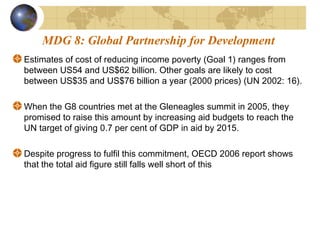
Estimates of cost of reducing income poverty (Goal 1) ranges from 
between US54 and US$62 billion. Other goals are likely to cost 
between US$35 and US$76 billion a year (2000 prices) (UN 2002: 16). 
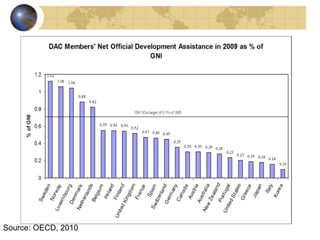
When the G8 countries met at the Gleneagles summit in 2005, they 
promised to raise this amount by increasing aid budgets to reach the 
UN target of giving 0.7 per cent of GDP in aid by 2015. 
Despite progress to fulfil this commitment, OECD 2006 report shows 
that the total aid figure still falls well short of this
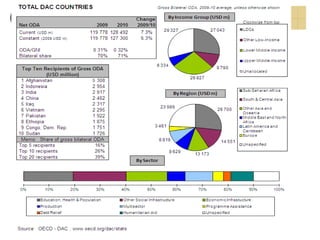
Source: OECD, 2010
Types of Aid 
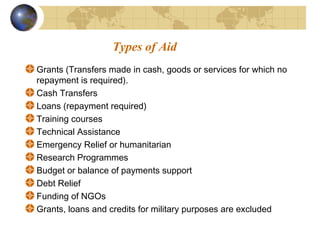
Grants (Transfers made in cash, goods or services for which no 
repayment is required). 
Cash Transfers 
Loans (repayment required) 
Training courses 
Technical Assistance 
Emergency Relief or humanitarian 
Research Programmes 
Budget or balance of payments support 
Debt Relief 
Funding of NGOs 
Grants, loans and credits for military purposes are excluded
Aid projects 
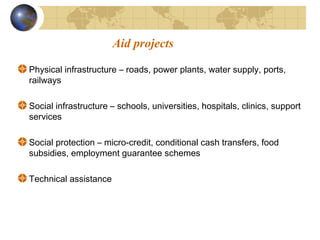
Physical infrastructure – roads, power plants, water supply, ports, 
railways 
Social infrastructure – schools, universities, hospitals, clinics, support 
services 
Social protection – micro-credit, conditional cash transfers, food 
subsidies, employment guarantee schemes 
Technical assistance
Review of Paris Declaration Aid Effectiveness 2011
Aid 
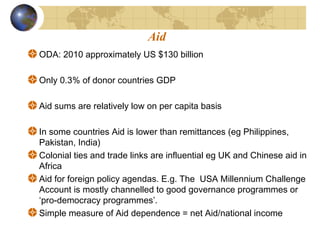
ODA: 2010 approximately US $130 billion 
Only 0.3% of donor countries GDP 
Aid sums are relatively low on per capita basis 
In some countries Aid is lower than remittances (eg Philippines, 
Pakistan, India) 
Colonial ties and trade links are influential eg UK and Chinese aid in 
Africa 
Aid for foreign policy agendas. E.g. The USA Millennium Challenge 
Account is mostly channelled to good governance programmes or 
‘pro-democracy programmes’. 
Simple measure of Aid dependence = net Aid/national income
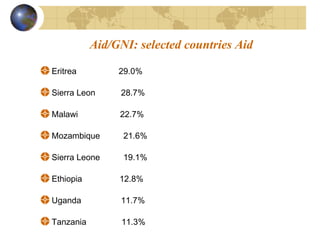
Aid/GNI: selected countries Aid 
Eritrea 29.0% 
Sierra Leon 28.7% 
Malawi 22.7% 
Mozambique 21.6% 
Sierra Leone 19.1% 
Ethiopia 12.8% 
Uganda 11.7% 
Tanzania 11.3%
Regional distribution 
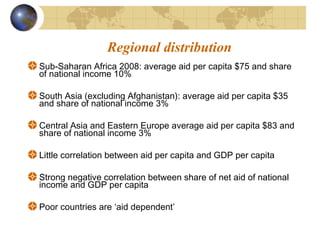
Sub-Saharan Africa 2008: average aid per capita $75 and share 
of national income 10% 
South Asia (excluding Afghanistan): average aid per capita $35 
and share of national income 3% 
Central Asia and Eastern Europe average aid per capita $83 and 
share of national income 3% 
Little correlation between aid per capita and GDP per capita 
Strong negative correlation between share of net aid of national 
income and GDP per capita 
Poor countries are ‘aid dependent’
Private Aid 
 Funds from NGOs and charities are also growing – estimated 
$24 billion in 2010 
 Remittances estimated $350 billion in 2010, 3 times amount of 
Aid monies 
 Between 10-15% of total financial flows to developing 
countries depend on private flows (FDI, equity, loans) 
 Remittances and contributions from non-state actors, such as 
the mega-rich and large corporations, are transforming the 
concept of foreign aid and gradually replacing it with a foreign 
aid business model based. 
 Suggestion that private aid is more effective than official 
development assistance and that solving the problem of global 
poverty requires a network of public-private, philanthropic and 
civil society partnerships.
Key Questions 
 How can you value foreign aid? Is it a vehicle for achieving the main 
development objectives of economic growth and poverty reduction? 
 Has aid been effective in achieving development objectives? 
 Has aid been harmful? 
 Has aid been constructed by the west to control others for their own 
economic and political interest?
Different Perspectives on Aid 
Three Perspectives on Aid: 
1. Radicals: Rejection of aid, aid and power – rejection of aid as post-colonial 
guilt. 
2. Sceptics: Aid is harmful 
3. Optimists: Aid effectiveness, ownership
Sceptics 
Easterly in the White Men’s Burden (2008) and Moya’s Dead Aid 
(2009) are critical of the way in which foreign aid is organised, 
managed and delivered by aid agencies. They believe that Official 
Foreign Aid: 
has failed to realize its developmental objectives 
creates a dependency culture 
crowds out investment by hindering the operation of free markets 
encourages corruption and fosters reliance on foreign benevolence 
and philanthropy 
sustains inefficient donor bureaucracies that contribute to the 
overall lack of performance of the industry. 
is anti-market and represses innovation and accountability. 
Moya argues that there is a need to end the myth that aid is 
effective. ODA and its modus operandi has been a kind of
Sceptics 
Moya argues that there is a need to end the myth that aid is effective. 
ODA and its modus operandi has been a kind of ‘authoritarian 
paternalism’: 
‘Scarcely does one see Africa’s (elected) officials or … African 
policymakers… offer an opinion on what should be done, or what might 
actually work to save the continent from its regression. This very 
important responsibility has, for all intents and purposes, and to the 
bewilderment of many an African, been left to musicians who reside 
outside Africa’. 
She complains ‘public discourse became a public disco’, when ‘pop and 
movie stars’ took on Africa as a cause ‘to carve out niches for 
themselves’. President George W. Bush consulted with Bono on Africa in 
October 2005, and Bob Geldof (allegedly representing Africa’s interests) 
practically had equal status to national leaders attending the 2005 G-8 
summit.
What is the alternative to Aid? 
Support an end to the Western aid industry, that has in Moya’s view, 
been harmful and unproductive. 
The alternative is to replace aid with development policy that focuses 
on: 
Market and market based policies that address the root causes of 
poverty 
Capital and remittances 
Free Trade Policy and Openness that addresses inadequate 
trading opportunities 
Microfinance 
Encourage investment and entrepreneurial activities
Paris Declaration 2005 
The Declaration defines aid effectiveness in terms of five principles: 
1. Ownership: Developing countries set their own strategies for 
poverty reduction, improve their institutions and tackle corruption. 
2. Alignment: Donor countries align behind these objectives and use 
local systems. 
3. Harmonisation: Donor countries coordinate, simplify procedures 
and share information to avoid duplication. 
4. Results: Developing countries and donors shift focus to 
development results and results get measured. 
5. Mutual accountability: Donors and partners are accountable for 
development results. 
Read recent Evaluation of Paris Declaration (2011) , available at 
http://www.oecd.org/statisticsdata/0,3381,en_2649_34447_1_119656_1_1 
_1,00.html
Conclusions 
 Aid is complex 
 Aid dependence undermines governments 
 Well designed projects can make a difference 
But it is unlikely that the ingenious ideas (ownership) that have 
been proposed to improve aid effectiveness 
 Recent successes of some Latin American countries, China and 
India little to do with Aid 
http://www.youtube.com/watch?v=inClCwsVwjY&feature=related

Aid and Development Policy

  • 1.
    Aid and DevelopmentPolicy Behrooz Morvaridi
  • 2.
    This Session Covers: Types of Aid Importance of Aid Aid Projects and distribution Three perspectives on Aid: 1. Radicals 2. Sceptics 3. Optimisits
  • 3.
    A New AidParadigm Since the late 1990s a new Aid paradigm has emerged Donor agencies are now concerned with the question of how to reduce poverty. Central themes of growth but pro-poor and sustainable growth, governance (and by implication greater empowerment for the poor) and social development (leading to improved human capital). The Millennium Development Goals (MDGs) reflect the aspirations of the donor community to halve extreme poverty between 1990 and 2015. Symbolically this is the first goal.
  • 4.
    MDG 8: GlobalPartnership for Development  Since 2001 many aid donors have embarked on an expansionary phase, proposing a scaling-up of aid volumes in support of the Millennium Development Goals.  ‘A global partnership for development’ (Goal 8) is considered essential to achieve the MDGs.  Effectively this means that rich nations have an obligation to transfer resources to poor countries by way of fair trade regimes, debt relief, transfer of technology, foreign direct investment and more importantly enhanced development assistance or Official Development Assistant (ODA) or Foreign aid.
  • 5.
    MDG 8: GlobalPartnership for Development Estimates of cost of reducing income poverty (Goal 1) ranges from between US54 and US$62 billion. Other goals are likely to cost between US$35 and US$76 billion a year (2000 prices) (UN 2002: 16). When the G8 countries met at the Gleneagles summit in 2005, they promised to raise this amount by increasing aid budgets to reach the UN target of giving 0.7 per cent of GDP in aid by 2015. Despite progress to fulfil this commitment, OECD 2006 report shows that the total aid figure still falls well short of this
  • 6.
  • 7.
    Types of Aid Grants (Transfers made in cash, goods or services for which no repayment is required). Cash Transfers Loans (repayment required) Training courses Technical Assistance Emergency Relief or humanitarian Research Programmes Budget or balance of payments support Debt Relief Funding of NGOs Grants, loans and credits for military purposes are excluded
  • 8.
    Aid projects Physicalinfrastructure – roads, power plants, water supply, ports, railways Social infrastructure – schools, universities, hospitals, clinics, support services Social protection – micro-credit, conditional cash transfers, food subsidies, employment guarantee schemes Technical assistance
  • 9.
    Review of ParisDeclaration Aid Effectiveness 2011
  • 10.
    Aid ODA: 2010approximately US $130 billion Only 0.3% of donor countries GDP Aid sums are relatively low on per capita basis In some countries Aid is lower than remittances (eg Philippines, Pakistan, India) Colonial ties and trade links are influential eg UK and Chinese aid in Africa Aid for foreign policy agendas. E.g. The USA Millennium Challenge Account is mostly channelled to good governance programmes or ‘pro-democracy programmes’. Simple measure of Aid dependence = net Aid/national income
  • 11.
    Aid/GNI: selected countriesAid Eritrea 29.0% Sierra Leon 28.7% Malawi 22.7% Mozambique 21.6% Sierra Leone 19.1% Ethiopia 12.8% Uganda 11.7% Tanzania 11.3%
  • 12.
    Regional distribution Sub-SaharanAfrica 2008: average aid per capita $75 and share of national income 10% South Asia (excluding Afghanistan): average aid per capita $35 and share of national income 3% Central Asia and Eastern Europe average aid per capita $83 and share of national income 3% Little correlation between aid per capita and GDP per capita Strong negative correlation between share of net aid of national income and GDP per capita Poor countries are ‘aid dependent’
  • 13.
    Private Aid Funds from NGOs and charities are also growing – estimated $24 billion in 2010  Remittances estimated $350 billion in 2010, 3 times amount of Aid monies  Between 10-15% of total financial flows to developing countries depend on private flows (FDI, equity, loans)  Remittances and contributions from non-state actors, such as the mega-rich and large corporations, are transforming the concept of foreign aid and gradually replacing it with a foreign aid business model based.  Suggestion that private aid is more effective than official development assistance and that solving the problem of global poverty requires a network of public-private, philanthropic and civil society partnerships.
  • 14.
    Key Questions How can you value foreign aid? Is it a vehicle for achieving the main development objectives of economic growth and poverty reduction?  Has aid been effective in achieving development objectives?  Has aid been harmful?  Has aid been constructed by the west to control others for their own economic and political interest?
  • 15.
    Different Perspectives onAid Three Perspectives on Aid: 1. Radicals: Rejection of aid, aid and power – rejection of aid as post-colonial guilt. 2. Sceptics: Aid is harmful 3. Optimists: Aid effectiveness, ownership
  • 16.
    Sceptics Easterly inthe White Men’s Burden (2008) and Moya’s Dead Aid (2009) are critical of the way in which foreign aid is organised, managed and delivered by aid agencies. They believe that Official Foreign Aid: has failed to realize its developmental objectives creates a dependency culture crowds out investment by hindering the operation of free markets encourages corruption and fosters reliance on foreign benevolence and philanthropy sustains inefficient donor bureaucracies that contribute to the overall lack of performance of the industry. is anti-market and represses innovation and accountability. Moya argues that there is a need to end the myth that aid is effective. ODA and its modus operandi has been a kind of
  • 17.
    Sceptics Moya arguesthat there is a need to end the myth that aid is effective. ODA and its modus operandi has been a kind of ‘authoritarian paternalism’: ‘Scarcely does one see Africa’s (elected) officials or … African policymakers… offer an opinion on what should be done, or what might actually work to save the continent from its regression. This very important responsibility has, for all intents and purposes, and to the bewilderment of many an African, been left to musicians who reside outside Africa’. She complains ‘public discourse became a public disco’, when ‘pop and movie stars’ took on Africa as a cause ‘to carve out niches for themselves’. President George W. Bush consulted with Bono on Africa in October 2005, and Bob Geldof (allegedly representing Africa’s interests) practically had equal status to national leaders attending the 2005 G-8 summit.
  • 18.
    What is thealternative to Aid? Support an end to the Western aid industry, that has in Moya’s view, been harmful and unproductive. The alternative is to replace aid with development policy that focuses on: Market and market based policies that address the root causes of poverty Capital and remittances Free Trade Policy and Openness that addresses inadequate trading opportunities Microfinance Encourage investment and entrepreneurial activities
  • 19.
    Paris Declaration 2005 The Declaration defines aid effectiveness in terms of five principles: 1. Ownership: Developing countries set their own strategies for poverty reduction, improve their institutions and tackle corruption. 2. Alignment: Donor countries align behind these objectives and use local systems. 3. Harmonisation: Donor countries coordinate, simplify procedures and share information to avoid duplication. 4. Results: Developing countries and donors shift focus to development results and results get measured. 5. Mutual accountability: Donors and partners are accountable for development results. Read recent Evaluation of Paris Declaration (2011) , available at http://www.oecd.org/statisticsdata/0,3381,en_2649_34447_1_119656_1_1 _1,00.html
  • 20.
    Conclusions  Aidis complex  Aid dependence undermines governments  Well designed projects can make a difference But it is unlikely that the ingenious ideas (ownership) that have been proposed to improve aid effectiveness  Recent successes of some Latin American countries, China and India little to do with Aid http://www.youtube.com/watch?v=inClCwsVwjY&feature=related