Foreign
Exchange
Derivative
Market
© 2003 South-Western/Thomson Learning
Chapter Objectives
 Explain how various factors affect exchange
rates
 Describe how foreign exchange risk can be
hedged with foreign exchange derivatives
 Describe how to use foreign exchange
derivatives to capitalize (speculate) on
expected exchange rate movements
Background On Foreign Exchange
Markets
 Exchanging currencies is needed when:
 Trade (real) prompts need for forex
 Capital flows (financial) prompts need for forex
 Foreign exchange trading
 Via global telecommunications network between
mostly large banks
 Bid/ask spread
Foreign Exchange Rates
 Quoted two ways:
 Foreign currency per U.S. dollar
 Dollar cost of unit of foreign exchange
 Appreciation/depreciation of currency
 Appreciation = more forex to buy $
 Purchase more forex with $
 Depreciation = foreign goods cost more $
 Total return to foreign investor decreases
Background on Foreign Exchange
Markets
 Exchange rate quotations are available in the
financial press and on the Internet with spot
exchange rate quotes for immediate delivery
 Forward exchange rate is for delivery at some
specified future point in time
 Forward premium is the percent annualized
appreciation of a currency
 Forward discount is the percent annualized
depreciation of a currency
Background on Foreign Exchange
Markets
 Exchange rates involve different kinds of
quotes for comparing the value of the U.S.
dollar to various foreign currencies
 1 unit of foreign currency worth some amount of
U.S. dollars—e.g. $.70 U.S. per Canadian Dollar
 1 U.S. dollar’s value in terms of some amount of
foreign currency– e.g. CD$1.43 per U.S. dollar
 Note reciprocal relationship
 Cross-exchange rates express relative values
of two different foreign currencies per $1 U.S.
Background on Foreign Exchange
Markets
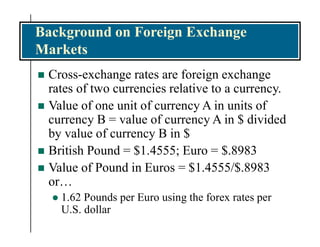
 Cross-exchange rates are foreign exchange
rates of two currencies relative to a currency.
 Value of one unit of currency A in units of
currency B = value of currency A in $ divided
by value of currency B in $
 British Pound = $1.4555; Euro = $.8983
 Value of Pound in Euros = $1.4555/$.8983
or…
 1.62 Pounds per Euro using the forex rates per
U.S. dollar
Background on Foreign Exchange
Markets
 Currency terminology
 Appreciation means a currency’s value increases
relative to another currency
 Depreciation means a currency’s value decreases
relative to another currency
 Supply and demand influences the values of
currencies
 Many factors can simultaneously affect supply
and demand
Background on Foreign Exchange
Markets
 1944–1971 known as the Bretton Woods Era
 Government maintained exchange rates within a
1% range
 Required government intervention and control
 By 1971 the U.S. dollar was clearly
overvalued
Background on Foreign Exchange Markets
Background on Foreign Exchange
Markets
 Smithsonian Agreement (1971) among major
countries allowed dollar devaluation and
widened boundaries around set values for each
currency
 No formal agreements since 1973 to fix
exchange rates for major currencies
 Freely floating exchange rates involve values set
by the market without government intervention
 Dirty float involves some government intervention
Classification of Exchange Rate
Arrangement
 There is a wide variation in how countries
approach managing or influencing their
currency’s value
 Float with periodic intervention
 Pegged to the dollar or some kind of composite
 Some countries have both controlled and floating
rates
 Some arrangements are temporary and others
more permanent
Factors Affecting Exchange Rates: Real
Sector
 Differential country inflation rates affect the
exchange rate for euros and dollars if inflation
is suddenly higher in Europe
 Theory of Purchasing Power Parity suggests
the exchange rate will change to reflect the
inflation differential—influence from real
sector of economy
 Currency of the higher inflation country (euro)
depreciates compared to the lower inflation
country ($)
Factors Affecting Exchange Rates:
Financial Sector
 Differential interest rates affect exchange rates
by influencing capital flows between countries
 For example, the interest rates are suddenly
higher in the United States than in Europe
 Investors want to buy dollar-denominated
securities and sell European securities
 Euros are sold, dollars bought to buy U.S.
securities
 Downward pressure on the euro, appreciation
of the dollar
Factors Affecting Exchange Rates
 Direct intervention occurs when a country’s
central bank buys/sells currency reserves
 For example, the U.S. central bank, the
Federal Reserve sells one currency and buys
another
 Sale by central bank creates excess supply and that
currency’s value drops relative to the one
purchased
 Market forces of supply and demand can
overwhelm the intervention
Factors Affecting Exchange Rates
 Indirect intervention involves influencing the
factors that affect exchange rates rather than
central bank purchases or sales of currencies
 Interest rates, money supply and inflationary
expectations affect exchange rates
 Historical perspective on indirect intervention
 Peso crisis in 1994
 Asian crisis in 1997
 Russian crisis in 1998
Factors Affecting Exchange Rates
 Some countries use foreign exchange controls
as a form of indirect intervention to maintain
their exchange rates
 Place restrictions on the exchange of currency
 May change based on market pressures on the
currency
 Venezuela in mid-1990s illustrates the issues
involved in controlling rates via intervention
and the affect of market forces
Movements in Exchange Rates
 Foreign exchange rate changes can have an
important effect on the performance of
multinational firms and economic conditions
 Many market participants forecast rates
 Market participants take positions in derivatives
based on their expectations of future rates
 Speculators attempt to anticipate the direction of
exchange rates
 There are several forecasting techniques
Forecasting Techniques
Technical Forecasting
Fundamental Forecasting
Market-based
Forecasting
Mixed Forecasting
Forecasting Exchange Rates: Technical
 Technical forecasting is a technique that uses
historical exchange rate data to predict the
future
 Uses statistics and develops rules about the
price patterns—depends on orderly cycles
 If price movements are random, this method
won’t work
 Models may work well some of the time and
not work other times
Forecasting Exchange Rates:
Fundamental
 Fundamental forecasting is based on
fundamental relationships between economic
variables and exchange rates
 May be statistical and based on quantitative
models or be based on subjective judgement
 Regression used to forecast if values of
influential factors have a lagged impact
 Not all factors are known and some have an
instant impact so sensitivity analysis is used to
deal with uncertainty
Forecasting Exchange Rates:
Fundamental
 Limitation of fundamental forecasting
methods:
 Some factors that are important to determining
exchange rates are not easily quantifiable
 Random events can and do affect exchange rates
 Predictor models may not account for these
unexpected events
Forecasting Exchange Rates: Market-
Based
 Market-based forecasting uses market
indicators like the spot and forward rates to
develop a forecast
 Spot rate: recognizes the current value of the
spot rate as based on expectations of
currency’s value in the near future
 Forward rate: used as the best estimate of the
future spot rate based on the expectations of
market participants
Forecasting Exchange Rates: Mixed
 Mixed forecasting is used because no one
method has been found superior to another
 Multinational corporations use a combination
of methods
 Assign a weight to each technique and the
forecast is a weighted average
 Perhaps a weighted combination of technical,
fundamental, and market-based forecasting
Forecasting Exchange Rate Volatility
 Market participants forecast not only exchange
rates but also volatility
 Volatility forecast
 Recognizes how difficult it is to forecast the actual
rate
 Provides a range around the forecast
Forecasting Exchange Rate Volatility
 Volatility of historical data
 Use a times series of volatility patterns in
previous periods
 Derive the exchange rate’s implied standard
deviation from the currency option pricing
model
Methods Used To Forecast Volatility
Speculation in Foreign Exchange Markets
 For example, a dealer takes a short position in
a foreign currency to profit from expected
depreciation
 Dealer forecasts currency 1 to depreciate
relative to foreign currency 2 so the first step
is to borrow currency 1 and then exchange
currency 1 for currency 2
 Invest in currency 2 and receive the investment
returns at maturity
 Convert back to foreign currency 1 and pay back
loan denominated in currency 1
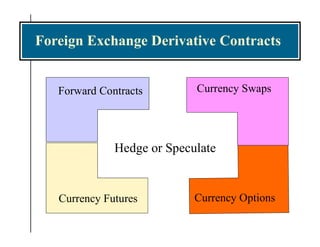
Foreign Exchange Derivative Contracts
Currency Futures
Hedge or Speculate
Forward Contracts Currency Swaps
Currency Options
Foreign Exchange Derivatives-Hedge
 Forward contracts
 Negotiated with a counterparty
 Specify a maturity date, amount and which
currency to buy or sell
 Negotiated in over-the-counter market
 Used to lock in the price paid or price received for
a future currency transaction
 Classic hedging contract
Foreign Exchange Derivatives-Hedge
 Forward contracts can be used to hedge if a
corporation must pay a foreign currency
invoice in the future
 Purchase foreign currency for amount/date of
invoice
 Locks in cost of invoice
 Hedges foreign exchange risk of transaction
 Forward contracts are also used by hedgers
who have a foreign currency inflow on some
future date
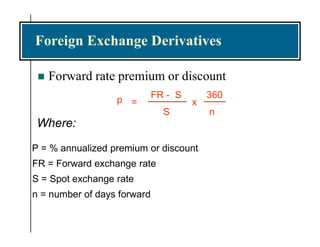
Foreign Exchange Derivatives
 Forward rate premium or discount
P = % annualized premium or discount
FR = Forward exchange rate
S = Spot exchange rate
n = number of days forward
Where:
x
FR - S
S
360
n
p =
Foreign Exchange Derivatives-Hedge
 Currency futures contracts trade on exchanges,
are standardized in terms of the maturity and
amount
 Currency swaps allow one currency to be
periodically swapped for another at a specified
exchange rate
 Currency options contracts offer one-way
insurance to buy (call) or sell (put) a currency
Foreign Exchange Derivatives-Hedge
 Buying a call option on a foreign currency is
the right to purchase a specified amount of
currency at the strike price within the specified
time period
 Exercise the option if the spot rate rises above the
strike price
 Do not exercise if the spot rate does not reach or
exceed the strike price
 U.S. business that owes Canadian in 60 days buys
currency call options to hedge spot forex risk
Foreign Exchange Derivatives-Hedge
 Buying a put option on a foreign currency is the right
to sell a specified amount of currency at the strike
price within the specified time period
 Exercise the option if the spot rate falls below the strike
price
 Do not exercise if the spot rate does not decline below the
strike price
 U.S. business hedges Canadian dollar payment it will
receive in 30 days by buying CD currency put options—if
CD depreciates against U.S., gain will offset spot loss
Foreign Exchange Derivatives-Speculate
 Business or person has no spot interest in
underlying asset—takes position based on
forecast of currency movements
 Forward contracts
 Buy/sell foreign currency forward
 When received, sell in the spot market
 Purchase/sell futures contracts
 Purchase call/put options
Foreign Exchange Derivatives-
Speculation
 For example, what position in derivates would
a speculator take if he/she anticipates a
depreciation in a currency?
 Forward contracts
 Sell foreign currency forward
 At maturity, buy in the spot market
 Sell futures contracts
 Purchase put options
International Arbitrage
 Arbitrage takes advantage of a temporary
price difference in two locations to make
profits buying at a lower price than you can
receive via the simultaneous sale of an asset,
financial instrument or currency
 Risk free because the purchase and sale price
are locked in simultaneously
 As arbitrage occurs, prices in both locations
change until equilibrium (one price) returns
International Arbitrage
 Covered interest arbitrage activity creates a
relationships between spot rates, interest rates and
forward rates
 Borrow in country 1
 Convert the funds to currency for country 2 using the
spot rate; buy forward contract for return
 Invest in country 2 and earn an investment rate of
return
 Convert back to country 1 currency using forward
contract, repay loan
International Arbitrage
 Covered interest arbitrage activity makes
forward premium approximately equal to the
differential in interest rates between two
countries
 If forward premium does not equal the interest
rate differential, covered interest arbitrage is
possible
 If the forward premium or discount equals the
interest rate differential, there are no
opportunities for arbitrage
International Arbitrage
 Equation for covered interest arbitrage
P = Forward premium or discount
ih = Home country interest rate
if = Foreign interest rate
Where:
–
( 1 + ih)
(1 + if )
1
P =
Explaining Price Movements of Foreign
Exchange Derivatives
 Indicators of foreign exchange derivatives are
closely monitored by market participants
 Hedgers and speculators continuously forecast
direction and degree of movement and
monitor
 Inflation rates between countries
 Interest rates
 Economic indicators
Foreign Exchange Markets
 Exchanging Currencies Is Needed When:
 Trade (real) prompts need For forex
 Capital flows (financial) prompts need for forex
 Foreign Exchange Trading
 Via global telecommunications network between
mostly large banks
 Bid/ask spread
Foreign Exchange Rates
 Quoted Two Ways:
 Foreign currency per U.S. Dollar
 Dollar cost Of unit Of foreign exchange
 Appreciation/Depreciation of Currency
 Appreciation = more forex To buy $
 Purchase more forex with $
 Depreciation = foreign goods cost more $
 Return To foreign investor decreases
Exchange Rate Systems
 Bretton Woods Era (1944-1971)
 Fixed Or pegged forex rates
 Central bank maintained rates
 Could not adjust To major economic change
 Smithsonian Agreement (1971)
 Devalued dollar
 Widened trading range Of forex
 First Step Toward Market-Determined Forex
Exchange Rate Systems
 Market-Determined Rates (1973)
 Dirty Float
 Exchange Rate Mechanisms:
Currencies pegged to another
European currency unit (ECU)
Central Bank involvement
ERM problems
Major Factors Affecting Forex
 Differential inflation rates between countries
 Goods and services impact demand/supply for
foreign exchange
 Inflating currency declines to provide….
 Purchasing power parity
Major Factors Affecting Forex
 Differential interest rates between countries
 Reflect expected differential inflation rates
 Global Fisher Effect
 Governmental Intervention
 Domestic Economic Policy
 Direct Intervention, e.g., Forex Controls
 Market Forces Reign!!!
Forecasting Foreign Exchange Rates
 Technical forecasting
 Fundamental forecasting
 Market-based forecasting
 Mixed forecasting
Forecasting Forex Volatility
 Forex prices difficult to forecast
 Forecasting volatility creates range of
probable forex rates
 Use best- and worst-case scenarios in planning
 Define future period
 Consider historical volatility
 Time series of previous volatility
Speculation In Forex Market
 Take position based on forex expectations
 Expect To appreciate
 Take long position (buy)
 Forward contract to buy
 Buy forex currency futures contract
 Buy forex call options
 Action taken if depreciation expected??
Foreign Exchange Derivatives
 Speculate vs. Hedging
 Forward contracts
 Contract To buy/sell forex at specified price on
specified date
 OTC market characteristics
 Reflects expected future spot rate
 Premium vs. Discount from spot
 Interest rate parity concept
Other Forex Derivatives
 Currency futures contracts
 Currency swaps
 Currency option contracts
International Arbitrage
 Arbitrage defined
 Locational arbitrage
 Covered interest arbitrage
 Maintains interest rate parity
 Forward/spot differential =
Differential inflation rates
Interest rate differentials
Expected future spot rate
Institutional Use Of Forex Market
 Intermediary or dealer of forwards or other
derivative contracts
 Speculating/hedging
 Future investment flows (loans, interest)
 Future financing flows (principal and interest)

Forex -i

  • 1.
  • 2.
    Chapter Objectives  Explainhow various factors affect exchange rates  Describe how foreign exchange risk can be hedged with foreign exchange derivatives  Describe how to use foreign exchange derivatives to capitalize (speculate) on expected exchange rate movements
  • 3.
    Background On ForeignExchange Markets  Exchanging currencies is needed when:  Trade (real) prompts need for forex  Capital flows (financial) prompts need for forex  Foreign exchange trading  Via global telecommunications network between mostly large banks  Bid/ask spread
  • 4.
    Foreign Exchange Rates Quoted two ways:  Foreign currency per U.S. dollar  Dollar cost of unit of foreign exchange  Appreciation/depreciation of currency  Appreciation = more forex to buy $  Purchase more forex with $  Depreciation = foreign goods cost more $  Total return to foreign investor decreases
  • 5.
    Background on ForeignExchange Markets  Exchange rate quotations are available in the financial press and on the Internet with spot exchange rate quotes for immediate delivery  Forward exchange rate is for delivery at some specified future point in time  Forward premium is the percent annualized appreciation of a currency  Forward discount is the percent annualized depreciation of a currency
  • 6.
    Background on ForeignExchange Markets  Exchange rates involve different kinds of quotes for comparing the value of the U.S. dollar to various foreign currencies  1 unit of foreign currency worth some amount of U.S. dollars—e.g. $.70 U.S. per Canadian Dollar  1 U.S. dollar’s value in terms of some amount of foreign currency– e.g. CD$1.43 per U.S. dollar  Note reciprocal relationship  Cross-exchange rates express relative values of two different foreign currencies per $1 U.S.
  • 7.
    Background on ForeignExchange Markets  Cross-exchange rates are foreign exchange rates of two currencies relative to a currency.  Value of one unit of currency A in units of currency B = value of currency A in $ divided by value of currency B in $  British Pound = $1.4555; Euro = $.8983  Value of Pound in Euros = $1.4555/$.8983 or…  1.62 Pounds per Euro using the forex rates per U.S. dollar
  • 8.
    Background on ForeignExchange Markets  Currency terminology  Appreciation means a currency’s value increases relative to another currency  Depreciation means a currency’s value decreases relative to another currency  Supply and demand influences the values of currencies  Many factors can simultaneously affect supply and demand
  • 9.
    Background on ForeignExchange Markets  1944–1971 known as the Bretton Woods Era  Government maintained exchange rates within a 1% range  Required government intervention and control  By 1971 the U.S. dollar was clearly overvalued Background on Foreign Exchange Markets
  • 10.
    Background on ForeignExchange Markets  Smithsonian Agreement (1971) among major countries allowed dollar devaluation and widened boundaries around set values for each currency  No formal agreements since 1973 to fix exchange rates for major currencies  Freely floating exchange rates involve values set by the market without government intervention  Dirty float involves some government intervention
  • 11.
    Classification of ExchangeRate Arrangement  There is a wide variation in how countries approach managing or influencing their currency’s value  Float with periodic intervention  Pegged to the dollar or some kind of composite  Some countries have both controlled and floating rates  Some arrangements are temporary and others more permanent
  • 12.
    Factors Affecting ExchangeRates: Real Sector  Differential country inflation rates affect the exchange rate for euros and dollars if inflation is suddenly higher in Europe  Theory of Purchasing Power Parity suggests the exchange rate will change to reflect the inflation differential—influence from real sector of economy  Currency of the higher inflation country (euro) depreciates compared to the lower inflation country ($)
  • 13.
    Factors Affecting ExchangeRates: Financial Sector  Differential interest rates affect exchange rates by influencing capital flows between countries  For example, the interest rates are suddenly higher in the United States than in Europe  Investors want to buy dollar-denominated securities and sell European securities  Euros are sold, dollars bought to buy U.S. securities  Downward pressure on the euro, appreciation of the dollar
  • 14.
    Factors Affecting ExchangeRates  Direct intervention occurs when a country’s central bank buys/sells currency reserves  For example, the U.S. central bank, the Federal Reserve sells one currency and buys another  Sale by central bank creates excess supply and that currency’s value drops relative to the one purchased  Market forces of supply and demand can overwhelm the intervention
  • 15.
    Factors Affecting ExchangeRates  Indirect intervention involves influencing the factors that affect exchange rates rather than central bank purchases or sales of currencies  Interest rates, money supply and inflationary expectations affect exchange rates  Historical perspective on indirect intervention  Peso crisis in 1994  Asian crisis in 1997  Russian crisis in 1998
  • 16.
    Factors Affecting ExchangeRates  Some countries use foreign exchange controls as a form of indirect intervention to maintain their exchange rates  Place restrictions on the exchange of currency  May change based on market pressures on the currency  Venezuela in mid-1990s illustrates the issues involved in controlling rates via intervention and the affect of market forces
  • 17.
    Movements in ExchangeRates  Foreign exchange rate changes can have an important effect on the performance of multinational firms and economic conditions  Many market participants forecast rates  Market participants take positions in derivatives based on their expectations of future rates  Speculators attempt to anticipate the direction of exchange rates  There are several forecasting techniques
  • 18.
    Forecasting Techniques Technical Forecasting FundamentalForecasting Market-based Forecasting Mixed Forecasting
  • 19.
    Forecasting Exchange Rates:Technical  Technical forecasting is a technique that uses historical exchange rate data to predict the future  Uses statistics and develops rules about the price patterns—depends on orderly cycles  If price movements are random, this method won’t work  Models may work well some of the time and not work other times
  • 20.
    Forecasting Exchange Rates: Fundamental Fundamental forecasting is based on fundamental relationships between economic variables and exchange rates  May be statistical and based on quantitative models or be based on subjective judgement  Regression used to forecast if values of influential factors have a lagged impact  Not all factors are known and some have an instant impact so sensitivity analysis is used to deal with uncertainty
  • 21.
    Forecasting Exchange Rates: Fundamental Limitation of fundamental forecasting methods:  Some factors that are important to determining exchange rates are not easily quantifiable  Random events can and do affect exchange rates  Predictor models may not account for these unexpected events
  • 22.
    Forecasting Exchange Rates:Market- Based  Market-based forecasting uses market indicators like the spot and forward rates to develop a forecast  Spot rate: recognizes the current value of the spot rate as based on expectations of currency’s value in the near future  Forward rate: used as the best estimate of the future spot rate based on the expectations of market participants
  • 23.
    Forecasting Exchange Rates:Mixed  Mixed forecasting is used because no one method has been found superior to another  Multinational corporations use a combination of methods  Assign a weight to each technique and the forecast is a weighted average  Perhaps a weighted combination of technical, fundamental, and market-based forecasting
  • 24.
    Forecasting Exchange RateVolatility  Market participants forecast not only exchange rates but also volatility  Volatility forecast  Recognizes how difficult it is to forecast the actual rate  Provides a range around the forecast
  • 25.
    Forecasting Exchange RateVolatility  Volatility of historical data  Use a times series of volatility patterns in previous periods  Derive the exchange rate’s implied standard deviation from the currency option pricing model Methods Used To Forecast Volatility
  • 26.
    Speculation in ForeignExchange Markets  For example, a dealer takes a short position in a foreign currency to profit from expected depreciation  Dealer forecasts currency 1 to depreciate relative to foreign currency 2 so the first step is to borrow currency 1 and then exchange currency 1 for currency 2  Invest in currency 2 and receive the investment returns at maturity  Convert back to foreign currency 1 and pay back loan denominated in currency 1
  • 27.
    Foreign Exchange DerivativeContracts Currency Futures Hedge or Speculate Forward Contracts Currency Swaps Currency Options
  • 28.
    Foreign Exchange Derivatives-Hedge Forward contracts  Negotiated with a counterparty  Specify a maturity date, amount and which currency to buy or sell  Negotiated in over-the-counter market  Used to lock in the price paid or price received for a future currency transaction  Classic hedging contract
  • 29.
    Foreign Exchange Derivatives-Hedge Forward contracts can be used to hedge if a corporation must pay a foreign currency invoice in the future  Purchase foreign currency for amount/date of invoice  Locks in cost of invoice  Hedges foreign exchange risk of transaction  Forward contracts are also used by hedgers who have a foreign currency inflow on some future date
  • 30.
    Foreign Exchange Derivatives Forward rate premium or discount P = % annualized premium or discount FR = Forward exchange rate S = Spot exchange rate n = number of days forward Where: x FR - S S 360 n p =
  • 31.
    Foreign Exchange Derivatives-Hedge Currency futures contracts trade on exchanges, are standardized in terms of the maturity and amount  Currency swaps allow one currency to be periodically swapped for another at a specified exchange rate  Currency options contracts offer one-way insurance to buy (call) or sell (put) a currency
  • 32.
    Foreign Exchange Derivatives-Hedge Buying a call option on a foreign currency is the right to purchase a specified amount of currency at the strike price within the specified time period  Exercise the option if the spot rate rises above the strike price  Do not exercise if the spot rate does not reach or exceed the strike price  U.S. business that owes Canadian in 60 days buys currency call options to hedge spot forex risk
  • 33.
    Foreign Exchange Derivatives-Hedge Buying a put option on a foreign currency is the right to sell a specified amount of currency at the strike price within the specified time period  Exercise the option if the spot rate falls below the strike price  Do not exercise if the spot rate does not decline below the strike price  U.S. business hedges Canadian dollar payment it will receive in 30 days by buying CD currency put options—if CD depreciates against U.S., gain will offset spot loss
  • 34.
    Foreign Exchange Derivatives-Speculate Business or person has no spot interest in underlying asset—takes position based on forecast of currency movements  Forward contracts  Buy/sell foreign currency forward  When received, sell in the spot market  Purchase/sell futures contracts  Purchase call/put options
  • 35.
    Foreign Exchange Derivatives- Speculation For example, what position in derivates would a speculator take if he/she anticipates a depreciation in a currency?  Forward contracts  Sell foreign currency forward  At maturity, buy in the spot market  Sell futures contracts  Purchase put options
  • 36.
    International Arbitrage  Arbitragetakes advantage of a temporary price difference in two locations to make profits buying at a lower price than you can receive via the simultaneous sale of an asset, financial instrument or currency  Risk free because the purchase and sale price are locked in simultaneously  As arbitrage occurs, prices in both locations change until equilibrium (one price) returns
  • 37.
    International Arbitrage  Coveredinterest arbitrage activity creates a relationships between spot rates, interest rates and forward rates  Borrow in country 1  Convert the funds to currency for country 2 using the spot rate; buy forward contract for return  Invest in country 2 and earn an investment rate of return  Convert back to country 1 currency using forward contract, repay loan
  • 38.
    International Arbitrage  Coveredinterest arbitrage activity makes forward premium approximately equal to the differential in interest rates between two countries  If forward premium does not equal the interest rate differential, covered interest arbitrage is possible  If the forward premium or discount equals the interest rate differential, there are no opportunities for arbitrage
  • 39.
    International Arbitrage  Equationfor covered interest arbitrage P = Forward premium or discount ih = Home country interest rate if = Foreign interest rate Where: – ( 1 + ih) (1 + if ) 1 P =
  • 40.
    Explaining Price Movementsof Foreign Exchange Derivatives  Indicators of foreign exchange derivatives are closely monitored by market participants  Hedgers and speculators continuously forecast direction and degree of movement and monitor  Inflation rates between countries  Interest rates  Economic indicators
  • 41.
    Foreign Exchange Markets Exchanging Currencies Is Needed When:  Trade (real) prompts need For forex  Capital flows (financial) prompts need for forex  Foreign Exchange Trading  Via global telecommunications network between mostly large banks  Bid/ask spread
  • 42.
    Foreign Exchange Rates Quoted Two Ways:  Foreign currency per U.S. Dollar  Dollar cost Of unit Of foreign exchange  Appreciation/Depreciation of Currency  Appreciation = more forex To buy $  Purchase more forex with $  Depreciation = foreign goods cost more $  Return To foreign investor decreases
  • 43.
    Exchange Rate Systems Bretton Woods Era (1944-1971)  Fixed Or pegged forex rates  Central bank maintained rates  Could not adjust To major economic change  Smithsonian Agreement (1971)  Devalued dollar  Widened trading range Of forex  First Step Toward Market-Determined Forex
  • 44.
    Exchange Rate Systems Market-Determined Rates (1973)  Dirty Float  Exchange Rate Mechanisms: Currencies pegged to another European currency unit (ECU) Central Bank involvement ERM problems
  • 45.
    Major Factors AffectingForex  Differential inflation rates between countries  Goods and services impact demand/supply for foreign exchange  Inflating currency declines to provide….  Purchasing power parity
  • 46.
    Major Factors AffectingForex  Differential interest rates between countries  Reflect expected differential inflation rates  Global Fisher Effect  Governmental Intervention  Domestic Economic Policy  Direct Intervention, e.g., Forex Controls  Market Forces Reign!!!
  • 47.
    Forecasting Foreign ExchangeRates  Technical forecasting  Fundamental forecasting  Market-based forecasting  Mixed forecasting
  • 48.
    Forecasting Forex Volatility Forex prices difficult to forecast  Forecasting volatility creates range of probable forex rates  Use best- and worst-case scenarios in planning  Define future period  Consider historical volatility  Time series of previous volatility
  • 49.
    Speculation In ForexMarket  Take position based on forex expectations  Expect To appreciate  Take long position (buy)  Forward contract to buy  Buy forex currency futures contract  Buy forex call options  Action taken if depreciation expected??
  • 50.
    Foreign Exchange Derivatives Speculate vs. Hedging  Forward contracts  Contract To buy/sell forex at specified price on specified date  OTC market characteristics  Reflects expected future spot rate  Premium vs. Discount from spot  Interest rate parity concept
  • 51.
    Other Forex Derivatives Currency futures contracts  Currency swaps  Currency option contracts
  • 52.
    International Arbitrage  Arbitragedefined  Locational arbitrage  Covered interest arbitrage  Maintains interest rate parity  Forward/spot differential = Differential inflation rates Interest rate differentials Expected future spot rate
  • 53.
    Institutional Use OfForex Market  Intermediary or dealer of forwards or other derivative contracts  Speculating/hedging  Future investment flows (loans, interest)  Future financing flows (principal and interest)