FORCE AND LAWS OF MOTION
FORCE:-
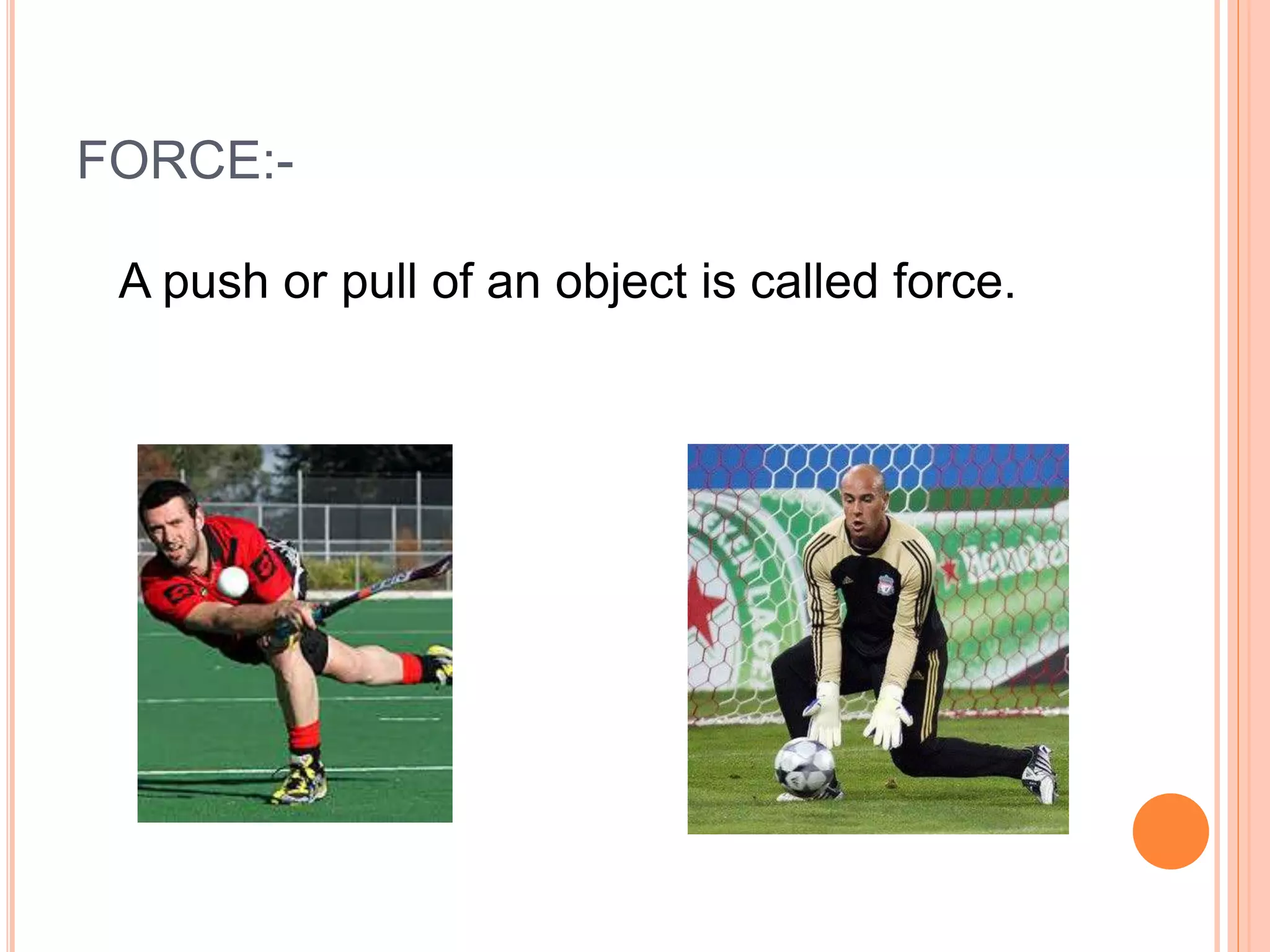
A push or pull of an object is called force.
MORE TYPES OF FORCE
1. FRICITIONAL FORCE
2. GRAVITATIONAL FORCE
3. MAGNETIC FORCE
4. MUSCLUAR FORCE
5. ELECTROSTATIC FORCE
6. NORMAL FORCE
FRICITONAL FORCE:The friction force is the force exerted by a
surface as an object moves across it or makes an effort to move
across it. There are at least two types of friction force - sliding and
static friction. Thought it is not always the case, the friction force often
opposes the motion of an object. For example, if a book slides across
the surface of a desk, then the desk exerts a friction force in the
opposite direction of its motion. Friction results from the two surfaces
being pressed together closely, causing intermolecular attractive
forces between molecules of different surfaces. As such, friction
depends upon the nature of the two surfaces and upon the degree to
which they are pressed together. The maximum amount of friction
force that a surface can exert upon an object can be calculated using
the formula below:
Ffrict = µ • Fnorm
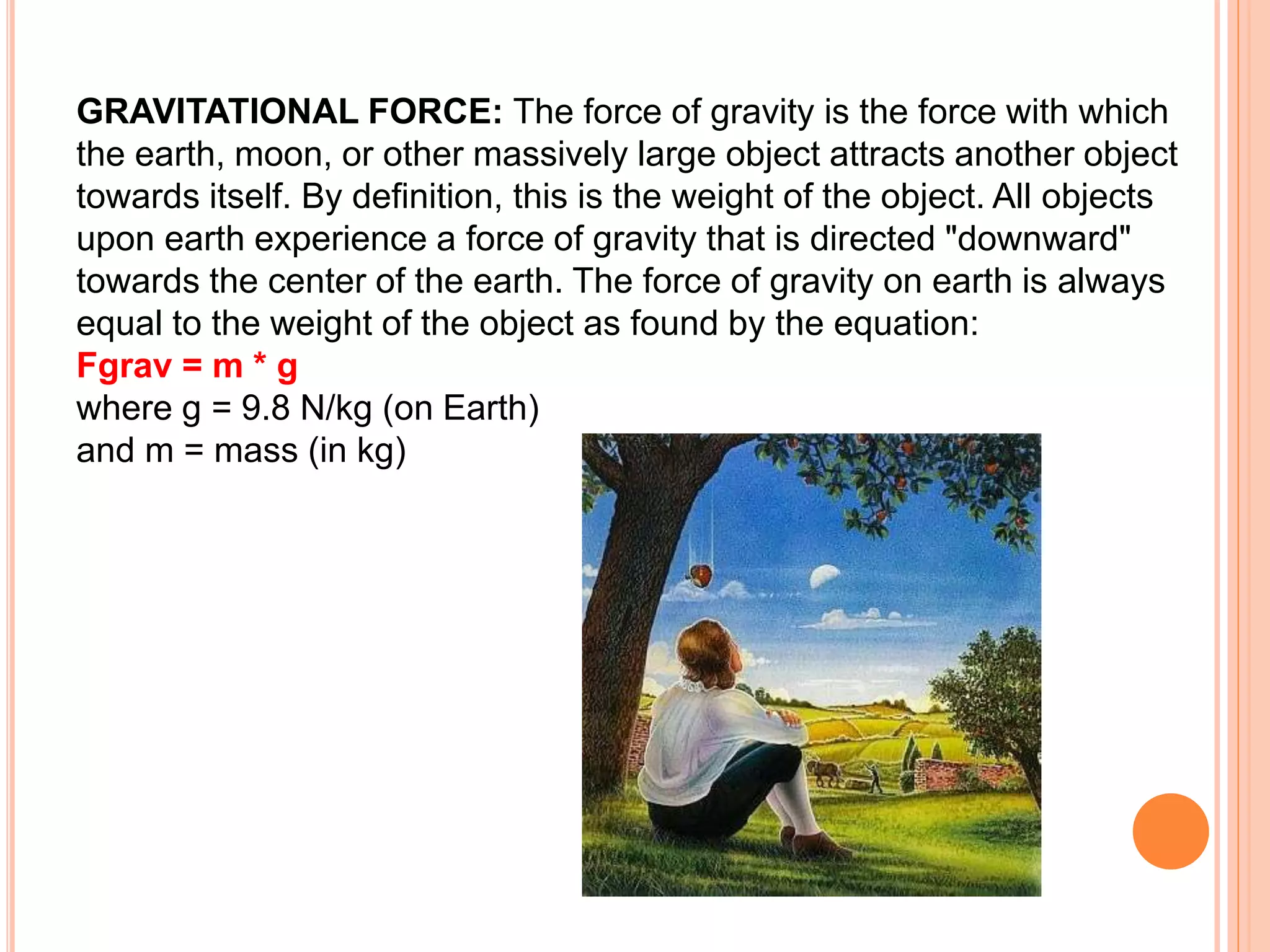
GRAVITATIONAL FORCE: The force of gravity is the force with which
the earth, moon, or other massively large object attracts another object
towards itself. By definition, this is the weight of the object. All objects
upon earth experience a force of gravity that is directed "downward"
towards the center of the earth. The force of gravity on earth is always
equal to the weight of the object as found by the equation:
Fgrav = m * g
where g = 9.8 N/kg (on Earth)
and m = mass (in kg)
MAGNETIC FORCE: Force exerted by a
magnet is called magnetic force
MUSCLUAR FORCE: The force resulting due to
the action of muscles is called muscular force.
ELECTROSTATIC FORCE: The force exerted by
a charged on another uncharged or charged body
is called electrostatic force.
Normal force: The normal force is the support force
exerted upon an object that is in contact with another
stable object. For example, if a book is resting upon a
surface, then the surface is exerting an upward force
upon the book in order to support the weight of the
book. On occasions, a normal force is exerted
horizontally between two objects that are in contact
with each other. For instance, if a person leans against
a wall, the wall pushes horizontally on the person.
BALANCED AND UNBALANCED FORCE
If we apply a force by pulling
the string X the block moves
right, but if we pull string Y
then the block moves left. If
The block is pulled by both sides with equal
force, the block will not move. Such force is
called balanced force.
LAWS OF MOTION
First law: When viewed in an inertial reference frame, an
object either remains at rest or continues to move at a
constant velocity, unless acted upon by an external force.
Second law: F = ma. The vector sum of the forces F on an
object is equal to the mass m of that object multiplied by
the acceleration vector a of the object.
Third law: When one body exerts a force on a second
body, the second body simultaneously exerts a force equal
in magnitude and opposite in direction on the first body.

Force and laws of motion

  • 1.
    FORCE AND LAWSOF MOTION
  • 2.
    FORCE:- A push orpull of an object is called force.
  • 3.
    MORE TYPES OFFORCE 1. FRICITIONAL FORCE 2. GRAVITATIONAL FORCE 3. MAGNETIC FORCE 4. MUSCLUAR FORCE 5. ELECTROSTATIC FORCE 6. NORMAL FORCE
  • 4.
    FRICITONAL FORCE:The frictionforce is the force exerted by a surface as an object moves across it or makes an effort to move across it. There are at least two types of friction force - sliding and static friction. Thought it is not always the case, the friction force often opposes the motion of an object. For example, if a book slides across the surface of a desk, then the desk exerts a friction force in the opposite direction of its motion. Friction results from the two surfaces being pressed together closely, causing intermolecular attractive forces between molecules of different surfaces. As such, friction depends upon the nature of the two surfaces and upon the degree to which they are pressed together. The maximum amount of friction force that a surface can exert upon an object can be calculated using the formula below: Ffrict = µ • Fnorm
  • 5.
    GRAVITATIONAL FORCE: Theforce of gravity is the force with which the earth, moon, or other massively large object attracts another object towards itself. By definition, this is the weight of the object. All objects upon earth experience a force of gravity that is directed "downward" towards the center of the earth. The force of gravity on earth is always equal to the weight of the object as found by the equation: Fgrav = m * g where g = 9.8 N/kg (on Earth) and m = mass (in kg)
  • 6.
    MAGNETIC FORCE: Forceexerted by a magnet is called magnetic force
  • 7.
    MUSCLUAR FORCE: Theforce resulting due to the action of muscles is called muscular force.
  • 8.
    ELECTROSTATIC FORCE: Theforce exerted by a charged on another uncharged or charged body is called electrostatic force.
  • 9.
    Normal force: Thenormal force is the support force exerted upon an object that is in contact with another stable object. For example, if a book is resting upon a surface, then the surface is exerting an upward force upon the book in order to support the weight of the book. On occasions, a normal force is exerted horizontally between two objects that are in contact with each other. For instance, if a person leans against a wall, the wall pushes horizontally on the person.
  • 10.
    BALANCED AND UNBALANCEDFORCE If we apply a force by pulling the string X the block moves right, but if we pull string Y then the block moves left. If The block is pulled by both sides with equal force, the block will not move. Such force is called balanced force.
  • 11.
    LAWS OF MOTION Firstlaw: When viewed in an inertial reference frame, an object either remains at rest or continues to move at a constant velocity, unless acted upon by an external force. Second law: F = ma. The vector sum of the forces F on an object is equal to the mass m of that object multiplied by the acceleration vector a of the object. Third law: When one body exerts a force on a second body, the second body simultaneously exerts a force equal in magnitude and opposite in direction on the first body.