Food Preparation
and Nutrition GCSE
What will you learn?
GCSE Food Preparation and Nutrition will
help you to develop a greater understanding of
nutrition, food provenance and the working
characteristics of food materials. You’ll also
learn about food from around the world,
through the study of British and international
culinary traditions as well as developing an
understanding of where food comes from and
the challenges surrounding food security.
You’ll master culinary skills and appreciate the
science behind food and cooking.
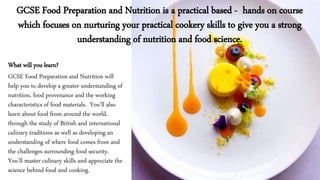
GCSE Food Preparation and Nutrition is a practical based - hands on course
which focuses on nurturing your practical cookery skills to give you a strong
understanding of nutrition and food science.
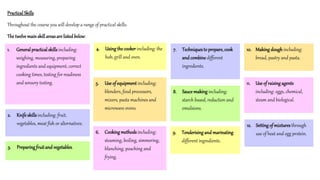
Practical Skills
Throughout the course you will develop a range of practical skills.
The twelve mainskill areas are listedbelow:
1. Generalpracticalskills including:
weighing, measuring, preparing
ingredients and equipment, correct
cooking times, testing for readiness
and sensory testing.
2. Knife skills including: fruit,
vegetables, meat fish or alternatives.
3. Preparing fruitand vegetables.
4. Using the cooker including: the
hob, grill and oven.
5. Use of equipment including:
blenders, food processors,
mixers, pasta machines and
microwave ovens.
6. Cooking methodsincluding:
steaming, boiling, simmering,
blanching, poaching and
frying.
7. Techniquesto prepare,cook
and combine different
ingredients.
8. Sauce making including:
starch based, reduction and
emulsions.
9. Tenderising and marinating
different ingredients.
10. Making dough including:
bread, pastry and pasta.
11. Use of raising agents
including: eggs, chemical,
steam and biological.
12. Setting of mixturesthrough
use of heat and egg protein.
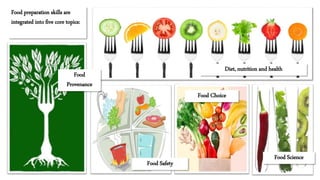
Food preparation skills are
integrated into five core topics:
Diet, nutrition and health
Food Safety
Food Choice
Food Science
Food
Provenance
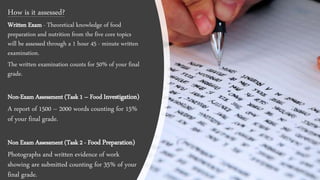
How is it assessed?
Written Exam - Theoretical knowledge of food
preparation and nutrition from the five core topics
will be assessed through a 1 hour 45 - minute written
examination.
The written examination counts for 50% of your final
grade.
Non-Exam Assessment (Task 1 – Food Investigation)
A report of 1500 – 2000 words counting for 15%
of your final grade.
Non Exam Assessment (Task 2 - Food Preparation)
Photographs and written evidence of work
showing are submitted counting for 35% of your
final grade.
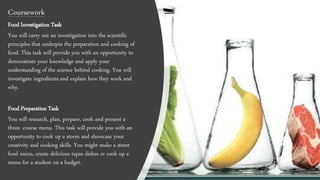
Coursework
Food Investigation Task
You will carry out an investigation into the scientific
principles that underpin the preparation and cooking of
food. This task will provide you with an opportunity to
demonstrate your knowledge and apply your
understanding of the science behind cooking. You will
investigate ingredients and explain how they work and
why.
Food Preparation Task
You will research, plan, prepare, cook and present a
three- course menu. This task will provide you with an
opportunity to cook up a storm and showcase your
creativity and cooking skills. You might make a street
food menu, create delicious tapas dishes or cook up a
menu for a student on a budget.
Further Study
GCSE Food Preparation and Nutrition provides a core of
knowledge which is advantageous if pursuing further
studies in Science-related A levels and beyond, for
example, Sport & Exercise Science, Medicine, Sport
Biomedicine & Nutrition. It also provides an excellent
foundation for vocational courses in Hospitality and
Catering.
Careers
Food Preparation and Nutrition GCSE provides an excellent
grounding in practical food skills and nutrition that you will use
every day, no matter what career choice. Careers are plentiful in
such a huge and diverse industry. Opportunities may include
jobs in food manufacture such as product development and
marketing as well as quality control jobs in health and safety
such as environmental health work, nutrition and dietetics. The
course could also lead to a whole host of careers in the
hospitality industry.
If you answered yes to these questions, then Food Preparation
and Nutrition is the course for you!
Is Food Preparation and Nutrition for
you?
• Are you interested in current food and
nutrition issues?
• Do you enjoy working with food?
• Do you like a practical challenge?
• Do you enjoy food science and want to
know more about the function of
ingredients?

Food

  • 1.
  • 2.
    What will youlearn? GCSE Food Preparation and Nutrition will help you to develop a greater understanding of nutrition, food provenance and the working characteristics of food materials. You’ll also learn about food from around the world, through the study of British and international culinary traditions as well as developing an understanding of where food comes from and the challenges surrounding food security. You’ll master culinary skills and appreciate the science behind food and cooking. GCSE Food Preparation and Nutrition is a practical based - hands on course which focuses on nurturing your practical cookery skills to give you a strong understanding of nutrition and food science.
  • 3.
    Practical Skills Throughout thecourse you will develop a range of practical skills. The twelve mainskill areas are listedbelow: 1. Generalpracticalskills including: weighing, measuring, preparing ingredients and equipment, correct cooking times, testing for readiness and sensory testing. 2. Knife skills including: fruit, vegetables, meat fish or alternatives. 3. Preparing fruitand vegetables. 4. Using the cooker including: the hob, grill and oven. 5. Use of equipment including: blenders, food processors, mixers, pasta machines and microwave ovens. 6. Cooking methodsincluding: steaming, boiling, simmering, blanching, poaching and frying. 7. Techniquesto prepare,cook and combine different ingredients. 8. Sauce making including: starch based, reduction and emulsions. 9. Tenderising and marinating different ingredients. 10. Making dough including: bread, pastry and pasta. 11. Use of raising agents including: eggs, chemical, steam and biological. 12. Setting of mixturesthrough use of heat and egg protein.
  • 4.
    Food preparation skillsare integrated into five core topics: Diet, nutrition and health Food Safety Food Choice Food Science Food Provenance
  • 5.
    How is itassessed? Written Exam - Theoretical knowledge of food preparation and nutrition from the five core topics will be assessed through a 1 hour 45 - minute written examination. The written examination counts for 50% of your final grade. Non-Exam Assessment (Task 1 – Food Investigation) A report of 1500 – 2000 words counting for 15% of your final grade. Non Exam Assessment (Task 2 - Food Preparation) Photographs and written evidence of work showing are submitted counting for 35% of your final grade.
  • 6.
    Coursework Food Investigation Task Youwill carry out an investigation into the scientific principles that underpin the preparation and cooking of food. This task will provide you with an opportunity to demonstrate your knowledge and apply your understanding of the science behind cooking. You will investigate ingredients and explain how they work and why. Food Preparation Task You will research, plan, prepare, cook and present a three- course menu. This task will provide you with an opportunity to cook up a storm and showcase your creativity and cooking skills. You might make a street food menu, create delicious tapas dishes or cook up a menu for a student on a budget.
  • 8.
    Further Study GCSE FoodPreparation and Nutrition provides a core of knowledge which is advantageous if pursuing further studies in Science-related A levels and beyond, for example, Sport & Exercise Science, Medicine, Sport Biomedicine & Nutrition. It also provides an excellent foundation for vocational courses in Hospitality and Catering. Careers Food Preparation and Nutrition GCSE provides an excellent grounding in practical food skills and nutrition that you will use every day, no matter what career choice. Careers are plentiful in such a huge and diverse industry. Opportunities may include jobs in food manufacture such as product development and marketing as well as quality control jobs in health and safety such as environmental health work, nutrition and dietetics. The course could also lead to a whole host of careers in the hospitality industry.
  • 9.
    If you answeredyes to these questions, then Food Preparation and Nutrition is the course for you! Is Food Preparation and Nutrition for you? • Are you interested in current food and nutrition issues? • Do you enjoy working with food? • Do you like a practical challenge? • Do you enjoy food science and want to know more about the function of ingredients?