CARBON MECHANISMS, 
MARKETS, AND PROJECTS 
The Climate Trust 
Sean Penrith, Executive Director 
Portland-Kunming Exhibition 
Kunming Urban Planning Exhibition Center 
122 Tuodong Rd, Panlong, Kunming, Yunnan China 
October 22, 2014 
Transforming the economy to value our climate
Framing 
¨ Low carbon policies & programs improve health, 
energy security, and deliver economic gain 
¨ Offer revenue opportunity to state/provinces/ 
countries that administer such programs 
¨ Stimulate low carbon entrepreneurship in multiple 
project sectors 
¨ Help transition to a low carbon economy, now 
2
About 
3 
¨ We are a carbon fund manager for 
Oregon’s existing mandatory and 
voluntary ($43 million) commitments to 
emissions reduction 
¨ 16 years of expertise in climate solutions 
for utilities, businesses, and governments 
¨ Created in 1997 in response to the 
passage of the Oregon Carbon Dioxide 
Standard 
¨ Establish & maintain processes for the 
evaluation, verification and funding of 
carbon mitigation projects for both 
compliance & voluntary markets. 
¨ Work nationally & internationally 
¨ Focus on agriculture, livestock, forestry 
and energy efficiency sectors
Basics of Cap & Trade 
4 
Offsets can be used 
for compliance (up 
to 8% in CA, 3% in 
REGGI)
GHG Emission Trading Globally 
5 
• China has 7 
pilot regions 
underway 
ending 2016 
• National ETS 
planned for 
2018 
• Regional 
schemes have 
been illiquid
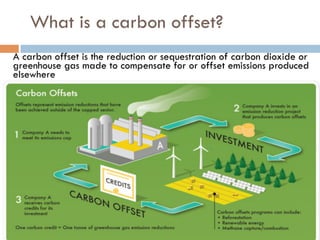
What is a carbon offset? 
A carbon offset is the reduction or sequestration of carbon dioxide or 
greenhouse gas made to compensate for or offset emissions produced 
elsewhere
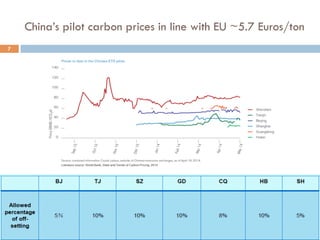
China’s pilot carbon prices in line with EU ~5.7 Euros/ton 
7
Offsets Should: 
¨ Be real, independently verified, with clear 
ownership 
¨ Be additional & address leakage 
¤ Demonstrate that offset funding incentivized the 
implementation of the reduction project 
¨ Have a realistic 
baseline & address permanence 
¨ Be quantified and monitored
Oregon’s Carbon Dioxide Standard 
9 
1997: Reduce CO2 17% below level of best gas 
combustions-turbine plant in the US over lifetime of 
the plant 
1. Reduce at site 
2. Directly manage offset projects 
3. Pay a “Qualified New energy facility Organization” to manage offset projects
The Climate Trust’s Role 
10 
3. Pay a “Qualified Organization” to manage offset projects 
Monetary Pathway calculates the $ amount 
S&C 
Oregon Department 
of Energy oversees 
TCT 
• Select projects for review & due diligence 
• Enter into Emissions Reduction Purchase Agreement (ERPA) 
PM 
• Ensure adherence to recognized protocol for credits generated 
• Monitor carbon credit stream that results from selected projects 
CO2 
• Offsets verified by 3rd party 
• Pay for the credits on delivery 
• Retire the credits on behalf of the energy facility 
CURRENT MONETARY PATH RATE 
$0.23 per 
metric ton 
$0.92 per 
metric ton 
Offset management 
funds 
Offset funds
TCT Business Model 
Producers cannot take carbon market risks. 
Aggregators must structure business models 
that take on that risk. 
Participants" 
Aggregation of Greenhouse Gas Emissions Offsets: Benefits, Existing Methods and Key 
Challenges. Electric Power Research Institute, Palo Alto, CA: October 2011. 
Carbon 
Fund Market" 
Manager"
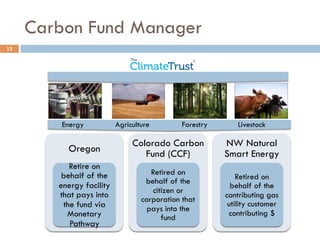
Carbon Fund Manager 
12 
Energy Agriculture Forestry Livestock 
Oregon 
Retire on 
behalf of the 
energy facility 
that pays into 
the fund via 
Monetary 
Pathway 
Colorado Carbon 
Fund (CCF) 
Retired on 
behalf of the 
citizen or 
corporation that 
pays into the 
fund 
NW Natural 
Smart Energy 
Retired on 
behalf of the 
contributing gas 
utility customer 
contributing $
TCT U.S. Projects 
13 
• 33 active project in 8 sectors 
• Average cost to retire $4.32/ton 
• Plan to retire another 4.2 million tons equal to 
950,000 passenger vehicles taken off the road
Carbon Credit Management 
14 
Smart 
Energy 
WA 
program 
OR 
program 
Credit Supply 
Contract with 
projects for 
credits 
Retired 
Voluntary 
Market 
Regulated 
Market
California’s 
Assembly 
Bill 
32 
2020 
Emissions 
(507 
million 
mtCO2e) 
= 
1990 
Emissions 
(427 
million 
mtCO2e) 
=> 
Reduce 
2020 
Emissions 
by 
80 
million 
mt 
CO2e 
Source: California Air Resource Board. “California’s GHG Emissions – Forecast (2008-2020).” Updated October 2010.
California 
Cap 
and 
Trade 
Program 
Source: Image from Fine, Steve. “The Interaction of Complementary Measures and the Cap & Trade Program under AB-32.” 
April 16, 2013 presentation at the EPRI-IETA Joint Symposium GHG Offsets Policy Dialogue in San Francisco, CA.
Offset Market Activity 
¨ All years of market activity has reduced 844 
MtCO2e valued at $4 billion ($5.9/tCO2e) 
¨ Private sector energy, transportation, finance, and 
insurance sectors top buyers 
¨ “Combatting climate change” – top buyer 
motivation.
Carbon offset projects types 
FIGURE 7: TRANSACTED VOLUME BY PROJECT CATEGORY, OTC 2012 
MtCO2e and % Share 
Notes: Findings pertain to the 75.5 MtCO2e associated with a response to this question, including “N/A” and “Other”. 
Source: Forest Trends’ Ecosystem Marketplace. State of the Voluntary Carbon Markets 2013. 
* First Biennial report of the United States of America, 2014
Global Carbon Project Sectors 
FIGURE 24: MARKET SHARE BY PROJECT TYPE, OTC 2012 
% Share 
Notes: Findings pertain to the 75.5 MtCO2e associated with a response to this question, including “N/A” and “Other”. 
Source: Forest Trends’ Ecosystem Marketplace. State of the Voluntary Carbon Markets 2013.
U.S. Offset Project Types 
California Market 
¨ Approved 
¤ Livestock Digesters 
¤ Forestry 
¤ Urban Forestry 
¤ Destruction of Ozone Depleting 
Substances 
¤ Coal Mine Methane (Apr 2014) 
¨ Anticipated (October) 
¤ Rice Cultivation 
Voluntary Standards 
¨ CAR: Climate Action 
Reserve (5%) 
¨ ACR – American Carbon 
Registry (1%) 
¨ ACR & CAR focusing on 
CA’s compliance market 
¨ VCS – Verified Carbon 
Standard (29%)
Voluntary Market Pricing 
Source: Forest Trends Ecosystem Marketplace. Sharing the Stage: State of the Voluntary 
Carbon Markets 2014.
PROJECT STAGE & VALUE 
Source: Climate Action Reserve & Parhelion
Compliance Pricing (California) 
$22 
$21 
$20 
$19 
$18 
$17 
$16 
$15 
$14 
$13 
$12 
$11 
$10 
$9 
$8 
$7 
$6 
$5 
Golden CCO 
CCO (8 year buyer liability) 
Current CCA (auction) 
ODS CRT & Livestock CRT & Forestry CRT 
Jan 13 Feb 13M ar 13A pr 13M ay 13J un 13 Jul 13 Aug 13S ep 13O ct 13 Nov 13D ec 13 Jan 14 Feb 14M ar 14A pr 14M ay 14J un 14 Jul 14 Aug 14S ep 14
ARB Offset Credits Issued 
Project Type Volume 
Ozone Depleting Substance 5,406,692 
U.S. Forest 5,997,317 
Livestock 594,019 
Urban Forestry 0 
TOTAL 11,998,028 
Source: Argus Media, Sept 2014
CA Offset Supply (Shortage?) 
• Over the California market's three compliance periods, total cumulative 
offset demand could reach just over 200 million tons. 
• Could be 67% or 134M short by third CP 2018-2020 
Source: Stevenson, Sam et al. American Carbon Registry. Compliance Offset Supply Forecast. April 2014
Low Carbon Fuel Standard Overview 
¨ Sets annual carbon intensity standard for gasoline, diesel 
and the fuels that replace them 
¨ Carbon Intensity (CI) is the measure of GHG emissions 
associated with producing & consuming a fuel (gCO2e/MJ) 
¨ LCFS goal in California is reduce CI of transportation fuel by 
at least 10% by 2020 
¨ Regulated party: Tradition fuel refiners and importers 
¨ Credit: LCFS Credit (1 mt CO2e reduced from target) 
¤ Separate and distinct from carbon offset 
¨ Sunset: 2020 
- 2020 target applies until changed or rescinded
LCFS Accounting System 
27
Fuels Generating LCFS Credits 
28 
• ‘12 – ’14 ~1,8 
million tons 
traded 
• Price range $10 
- $85/MT
LCFS & Cap & Trade Policy Effect = 
Economic & Health Gain 
29 
• Save $4.3 billion by 2020 and $8.3 billion by 2025 in California 
• Reduce 167,000 tons of NOX (Nitrogen Oxide) 
• Reduce 9,000 tons of PM2.5(Air Particulates) 
• Reduce 3,850 tons of SOX (Sulfur Dioxide)
Health Benefits of LCFS 
30
Renewable Fuel Standard 2 
¨ Federal mandate on quantity of renewable fuel that 
is consumed for transportation in the US 
¨ Regulated party: Transportation fuel refiners and 
importers 
¨ Credit: Renewable Identification Number (RIN) 
¨ Sunset: 2022
Multiple Environmental Credit Benefits 
32 
Bedding 
1% 
Transporta7on 
Gas 
Sales 
58% 
Nutrients 
6% 
Tipping 
Fees 
10% 
Carbon 
Credits 
2% 
RINs 
10% 
LCFS 
13% 
Environmental 
Markets 
25% 
RECs 8%
Environmental Market Returns: 5,000 cow digester 
$5,000,000 
$4,500,000 
$4,000,000 
$3,500,000 
$3,000,000 
$2,500,000 
$2,000,000 
$1,500,000 
$1,000,000 
Low 
Carbon 
Fuel 
Standard 
Credits 
Renewable 
IdenOficaOon 
Numbers 
Carbon 
Credits 
2013 
2014 
2015 
2016 
2017 
2018 
2019 
2020 
2021 
2022 
Annual 
Net 
Revenue 
Environmental 
Markets 
-­‐ 
High 
Price 
(IRR 
= 
34.36%) 
Environmental 
Markets 
-­‐ 
Low 
Price 
(IRR 
= 
15.30%) 
Baseline 
-­‐ 
No 
Environmental 
Markets 
(IRR 
= 
7.83%)
Nexus: Agriculture, Carbon Markets, Finance 
Sector Potential Status 
Anaerobic digestion. Installation of covered lagoon or 
22 million mtCO2e per 
enclosed vessel digesters at livestock facilities, avoiding 
year1 
methane emissions normally release from anaerobic 
lagoons. 
Compliance. Livestock 
digesters (anywhere in the 
US) qualify for California’s 
cap-and-trade system. 
Grassland conservation. Avoiding the conversion of 
grassland into marginal cropland, maintaining carbon 
sequestered in soils. 
2 million mtCO2e per 
year2 
Voluntary. Voluntary 
protocol developed (with 
USDA CIG). First 
transaction to be 
completed in October. 
Nutrient management. Increasing the efficiency of 
nitrogen fertilizer application, reducing emissions of 
N2O. 
55 million mtCO2e per 
year3 
Voluntary. Three major 
protocols. Pilot transaction 
only. 
Switch to no-till. Decreasing the amount of soil tillage, 
maintaining carbon sequestered in soils. 
138 million mtCO2e 
per year3 
Voluntary. No modern 
transaction. 
1 Carbon Prices and the Adoption of Methane Digesters on Dairy and Hog Farms. USDA Economic Research Service Economic Brief Number 16, Washington DC: 
February 2011. 
2 Evaluation of Avoided Grassland Conversion and Cropland Conversion to Grassland as Potential Carbon Offset Project Types. Issue paper prepared for the 
Climate Action Reserve, Los Angeles, CA: December 2012. 
3 Greenhouse Gas Mitigation Potential of Agricultural Land Management in the United States A Synthesis of the Literature. Second Edition. Nicholas Institute for 
Environmental Policy Solutions, Durham, NC: March 2011. Report NI R 10-04, page 26.
Project Case: 
Ducks Unlimited 
- Grassland Conservation 
¨ The Climate Trust entered into forward 
contract to purchase tons from Ducks 
Unlimited 
¨ Contract was then used to back the upfront 
payment to 100 landowners to enroll 
50,000 acres in easements 
¨ Ducks Unlimited offered landowners 
upfront purchase of carbon rights in 
exchange for easement rights 
¨ Found that 13,000 of the 50,000 acres 
enrolled were additional. 
¨ These 13,000 acres are anticipated to 
deliver 384,000 mtCO2e over a 10-year 
crediting period ~ $4 million 
Photo : Amy Taborski. Ducks Unlimited. Sheridan County, North Dakota. June 2010.
Double Benefit of Biogas
Avoided Methane 
Projects that digest 
eligible feedstocks 
and combust biogas 
can earn carbon 
credits for avoided 
methane emissions.
First Merchant Food Waste Digester in U.S. 
38 
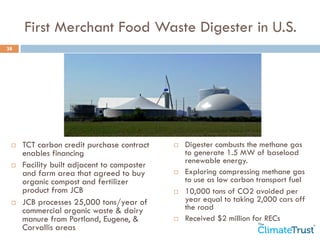
¨ TCT carbon credit purchase contract 
enables financing 
¨ Facility built adjacent to composter 
and farm area that agreed to buy 
organic compost and fertilizer 
product from JCB 
¨ JCB processes 25,000 tons/year of 
commercial organic waste & dairy 
manure from Portland, Eugene, & 
Corvallis areas 
¨ Digester combusts the methane gas 
to generate 1.5 MW of baseload 
renewable energy. 
¨ Exploring compressing methane gas 
to use as low carbon transport fuel 
¨ 10,000 tons of CO2 avoided per 
year equal to taking 2,000 cars off 
the road 
¨ Received $2 million for RECs
Total market potential for U.S. dairies in 
bio-economy 
39
Benefit of Suite of Credit Policies 
¨ Complementary carbon mechanisms and fuel policies add: 
¤ Economic gain 
¤ Energy security, and 
¤ Reduce negative health impacts 
¤ Reduce CO2 emissions 
¨ Can channel a portion of tax or cap and trade revenues to a special 
purpose fund manager for targeted reinvestment in multi-sector 
projects to support transition to low carbon economy. 
¨ Due to China's growing consumption of dairy products and growth of 
Yunnan's dairy developing a competitive edge in Southwest China 
and for export to ASEAN neighbors, commercial scale biodigesters 
would be suitable. 
¨ China ETS in 2018 will set the stage for offset project development 
opportunities.
Thank you! 
Sean Penrith, Executive Director, spenrith@climatetrust.org

Carbon Mechanisms, Markets, and Projects

  • 1.
    CARBON MECHANISMS, MARKETS,AND PROJECTS The Climate Trust Sean Penrith, Executive Director Portland-Kunming Exhibition Kunming Urban Planning Exhibition Center 122 Tuodong Rd, Panlong, Kunming, Yunnan China October 22, 2014 Transforming the economy to value our climate
  • 2.
    Framing ¨ Lowcarbon policies & programs improve health, energy security, and deliver economic gain ¨ Offer revenue opportunity to state/provinces/ countries that administer such programs ¨ Stimulate low carbon entrepreneurship in multiple project sectors ¨ Help transition to a low carbon economy, now 2
  • 3.
    About 3 ¨We are a carbon fund manager for Oregon’s existing mandatory and voluntary ($43 million) commitments to emissions reduction ¨ 16 years of expertise in climate solutions for utilities, businesses, and governments ¨ Created in 1997 in response to the passage of the Oregon Carbon Dioxide Standard ¨ Establish & maintain processes for the evaluation, verification and funding of carbon mitigation projects for both compliance & voluntary markets. ¨ Work nationally & internationally ¨ Focus on agriculture, livestock, forestry and energy efficiency sectors
  • 4.
    Basics of Cap& Trade 4 Offsets can be used for compliance (up to 8% in CA, 3% in REGGI)
  • 5.
    GHG Emission TradingGlobally 5 • China has 7 pilot regions underway ending 2016 • National ETS planned for 2018 • Regional schemes have been illiquid
  • 6.
    What is acarbon offset? A carbon offset is the reduction or sequestration of carbon dioxide or greenhouse gas made to compensate for or offset emissions produced elsewhere
  • 7.
    China’s pilot carbonprices in line with EU ~5.7 Euros/ton 7
  • 8.
    Offsets Should: ¨Be real, independently verified, with clear ownership ¨ Be additional & address leakage ¤ Demonstrate that offset funding incentivized the implementation of the reduction project ¨ Have a realistic baseline & address permanence ¨ Be quantified and monitored
  • 9.
    Oregon’s Carbon DioxideStandard 9 1997: Reduce CO2 17% below level of best gas combustions-turbine plant in the US over lifetime of the plant 1. Reduce at site 2. Directly manage offset projects 3. Pay a “Qualified New energy facility Organization” to manage offset projects
  • 10.
    The Climate Trust’sRole 10 3. Pay a “Qualified Organization” to manage offset projects Monetary Pathway calculates the $ amount S&C Oregon Department of Energy oversees TCT • Select projects for review & due diligence • Enter into Emissions Reduction Purchase Agreement (ERPA) PM • Ensure adherence to recognized protocol for credits generated • Monitor carbon credit stream that results from selected projects CO2 • Offsets verified by 3rd party • Pay for the credits on delivery • Retire the credits on behalf of the energy facility CURRENT MONETARY PATH RATE $0.23 per metric ton $0.92 per metric ton Offset management funds Offset funds
  • 11.
    TCT Business Model Producers cannot take carbon market risks. Aggregators must structure business models that take on that risk. Participants" Aggregation of Greenhouse Gas Emissions Offsets: Benefits, Existing Methods and Key Challenges. Electric Power Research Institute, Palo Alto, CA: October 2011. Carbon Fund Market" Manager"
  • 12.
    Carbon Fund Manager 12 Energy Agriculture Forestry Livestock Oregon Retire on behalf of the energy facility that pays into the fund via Monetary Pathway Colorado Carbon Fund (CCF) Retired on behalf of the citizen or corporation that pays into the fund NW Natural Smart Energy Retired on behalf of the contributing gas utility customer contributing $
  • 13.
    TCT U.S. Projects 13 • 33 active project in 8 sectors • Average cost to retire $4.32/ton • Plan to retire another 4.2 million tons equal to 950,000 passenger vehicles taken off the road
  • 14.
    Carbon Credit Management 14 Smart Energy WA program OR program Credit Supply Contract with projects for credits Retired Voluntary Market Regulated Market
  • 15.
    California’s Assembly Bill 32 2020 Emissions (507 million mtCO2e) = 1990 Emissions (427 million mtCO2e) => Reduce 2020 Emissions by 80 million mt CO2e Source: California Air Resource Board. “California’s GHG Emissions – Forecast (2008-2020).” Updated October 2010.
  • 16.
    California Cap and Trade Program Source: Image from Fine, Steve. “The Interaction of Complementary Measures and the Cap & Trade Program under AB-32.” April 16, 2013 presentation at the EPRI-IETA Joint Symposium GHG Offsets Policy Dialogue in San Francisco, CA.
  • 17.
    Offset Market Activity ¨ All years of market activity has reduced 844 MtCO2e valued at $4 billion ($5.9/tCO2e) ¨ Private sector energy, transportation, finance, and insurance sectors top buyers ¨ “Combatting climate change” – top buyer motivation.
  • 18.
    Carbon offset projectstypes FIGURE 7: TRANSACTED VOLUME BY PROJECT CATEGORY, OTC 2012 MtCO2e and % Share Notes: Findings pertain to the 75.5 MtCO2e associated with a response to this question, including “N/A” and “Other”. Source: Forest Trends’ Ecosystem Marketplace. State of the Voluntary Carbon Markets 2013. * First Biennial report of the United States of America, 2014
  • 19.
    Global Carbon ProjectSectors FIGURE 24: MARKET SHARE BY PROJECT TYPE, OTC 2012 % Share Notes: Findings pertain to the 75.5 MtCO2e associated with a response to this question, including “N/A” and “Other”. Source: Forest Trends’ Ecosystem Marketplace. State of the Voluntary Carbon Markets 2013.
  • 20.
    U.S. Offset ProjectTypes California Market ¨ Approved ¤ Livestock Digesters ¤ Forestry ¤ Urban Forestry ¤ Destruction of Ozone Depleting Substances ¤ Coal Mine Methane (Apr 2014) ¨ Anticipated (October) ¤ Rice Cultivation Voluntary Standards ¨ CAR: Climate Action Reserve (5%) ¨ ACR – American Carbon Registry (1%) ¨ ACR & CAR focusing on CA’s compliance market ¨ VCS – Verified Carbon Standard (29%)
  • 21.
    Voluntary Market Pricing Source: Forest Trends Ecosystem Marketplace. Sharing the Stage: State of the Voluntary Carbon Markets 2014.
  • 22.
    PROJECT STAGE &VALUE Source: Climate Action Reserve & Parhelion
  • 23.
    Compliance Pricing (California) $22 $21 $20 $19 $18 $17 $16 $15 $14 $13 $12 $11 $10 $9 $8 $7 $6 $5 Golden CCO CCO (8 year buyer liability) Current CCA (auction) ODS CRT & Livestock CRT & Forestry CRT Jan 13 Feb 13M ar 13A pr 13M ay 13J un 13 Jul 13 Aug 13S ep 13O ct 13 Nov 13D ec 13 Jan 14 Feb 14M ar 14A pr 14M ay 14J un 14 Jul 14 Aug 14S ep 14
  • 24.
    ARB Offset CreditsIssued Project Type Volume Ozone Depleting Substance 5,406,692 U.S. Forest 5,997,317 Livestock 594,019 Urban Forestry 0 TOTAL 11,998,028 Source: Argus Media, Sept 2014
  • 25.
    CA Offset Supply(Shortage?) • Over the California market's three compliance periods, total cumulative offset demand could reach just over 200 million tons. • Could be 67% or 134M short by third CP 2018-2020 Source: Stevenson, Sam et al. American Carbon Registry. Compliance Offset Supply Forecast. April 2014
  • 26.
    Low Carbon FuelStandard Overview ¨ Sets annual carbon intensity standard for gasoline, diesel and the fuels that replace them ¨ Carbon Intensity (CI) is the measure of GHG emissions associated with producing & consuming a fuel (gCO2e/MJ) ¨ LCFS goal in California is reduce CI of transportation fuel by at least 10% by 2020 ¨ Regulated party: Tradition fuel refiners and importers ¨ Credit: LCFS Credit (1 mt CO2e reduced from target) ¤ Separate and distinct from carbon offset ¨ Sunset: 2020 - 2020 target applies until changed or rescinded
  • 27.
  • 28.
    Fuels Generating LCFSCredits 28 • ‘12 – ’14 ~1,8 million tons traded • Price range $10 - $85/MT
  • 29.
    LCFS & Cap& Trade Policy Effect = Economic & Health Gain 29 • Save $4.3 billion by 2020 and $8.3 billion by 2025 in California • Reduce 167,000 tons of NOX (Nitrogen Oxide) • Reduce 9,000 tons of PM2.5(Air Particulates) • Reduce 3,850 tons of SOX (Sulfur Dioxide)
  • 30.
  • 31.
    Renewable Fuel Standard2 ¨ Federal mandate on quantity of renewable fuel that is consumed for transportation in the US ¨ Regulated party: Transportation fuel refiners and importers ¨ Credit: Renewable Identification Number (RIN) ¨ Sunset: 2022
  • 32.
    Multiple Environmental CreditBenefits 32 Bedding 1% Transporta7on Gas Sales 58% Nutrients 6% Tipping Fees 10% Carbon Credits 2% RINs 10% LCFS 13% Environmental Markets 25% RECs 8%
  • 33.
    Environmental Market Returns:5,000 cow digester $5,000,000 $4,500,000 $4,000,000 $3,500,000 $3,000,000 $2,500,000 $2,000,000 $1,500,000 $1,000,000 Low Carbon Fuel Standard Credits Renewable IdenOficaOon Numbers Carbon Credits 2013 2014 2015 2016 2017 2018 2019 2020 2021 2022 Annual Net Revenue Environmental Markets -­‐ High Price (IRR = 34.36%) Environmental Markets -­‐ Low Price (IRR = 15.30%) Baseline -­‐ No Environmental Markets (IRR = 7.83%)
  • 34.
    Nexus: Agriculture, CarbonMarkets, Finance Sector Potential Status Anaerobic digestion. Installation of covered lagoon or 22 million mtCO2e per enclosed vessel digesters at livestock facilities, avoiding year1 methane emissions normally release from anaerobic lagoons. Compliance. Livestock digesters (anywhere in the US) qualify for California’s cap-and-trade system. Grassland conservation. Avoiding the conversion of grassland into marginal cropland, maintaining carbon sequestered in soils. 2 million mtCO2e per year2 Voluntary. Voluntary protocol developed (with USDA CIG). First transaction to be completed in October. Nutrient management. Increasing the efficiency of nitrogen fertilizer application, reducing emissions of N2O. 55 million mtCO2e per year3 Voluntary. Three major protocols. Pilot transaction only. Switch to no-till. Decreasing the amount of soil tillage, maintaining carbon sequestered in soils. 138 million mtCO2e per year3 Voluntary. No modern transaction. 1 Carbon Prices and the Adoption of Methane Digesters on Dairy and Hog Farms. USDA Economic Research Service Economic Brief Number 16, Washington DC: February 2011. 2 Evaluation of Avoided Grassland Conversion and Cropland Conversion to Grassland as Potential Carbon Offset Project Types. Issue paper prepared for the Climate Action Reserve, Los Angeles, CA: December 2012. 3 Greenhouse Gas Mitigation Potential of Agricultural Land Management in the United States A Synthesis of the Literature. Second Edition. Nicholas Institute for Environmental Policy Solutions, Durham, NC: March 2011. Report NI R 10-04, page 26.
  • 35.
    Project Case: DucksUnlimited - Grassland Conservation ¨ The Climate Trust entered into forward contract to purchase tons from Ducks Unlimited ¨ Contract was then used to back the upfront payment to 100 landowners to enroll 50,000 acres in easements ¨ Ducks Unlimited offered landowners upfront purchase of carbon rights in exchange for easement rights ¨ Found that 13,000 of the 50,000 acres enrolled were additional. ¨ These 13,000 acres are anticipated to deliver 384,000 mtCO2e over a 10-year crediting period ~ $4 million Photo : Amy Taborski. Ducks Unlimited. Sheridan County, North Dakota. June 2010.
  • 36.
  • 37.
    Avoided Methane Projectsthat digest eligible feedstocks and combust biogas can earn carbon credits for avoided methane emissions.
  • 38.
    First Merchant FoodWaste Digester in U.S. 38 ¨ TCT carbon credit purchase contract enables financing ¨ Facility built adjacent to composter and farm area that agreed to buy organic compost and fertilizer product from JCB ¨ JCB processes 25,000 tons/year of commercial organic waste & dairy manure from Portland, Eugene, & Corvallis areas ¨ Digester combusts the methane gas to generate 1.5 MW of baseload renewable energy. ¨ Exploring compressing methane gas to use as low carbon transport fuel ¨ 10,000 tons of CO2 avoided per year equal to taking 2,000 cars off the road ¨ Received $2 million for RECs
  • 39.
    Total market potentialfor U.S. dairies in bio-economy 39
  • 40.
    Benefit of Suiteof Credit Policies ¨ Complementary carbon mechanisms and fuel policies add: ¤ Economic gain ¤ Energy security, and ¤ Reduce negative health impacts ¤ Reduce CO2 emissions ¨ Can channel a portion of tax or cap and trade revenues to a special purpose fund manager for targeted reinvestment in multi-sector projects to support transition to low carbon economy. ¨ Due to China's growing consumption of dairy products and growth of Yunnan's dairy developing a competitive edge in Southwest China and for export to ASEAN neighbors, commercial scale biodigesters would be suitable. ¨ China ETS in 2018 will set the stage for offset project development opportunities.
  • 41.
    Thank you! SeanPenrith, Executive Director, spenrith@climatetrust.org