NATIONAL FOOD CONTROL SYSTEM
IN THE MALDIVES
SatheeshSatheeshSatheeshSatheesh MoosaMoosaMoosaMoosa
Food Control Division
Maldives Food & Drug Authority
Ministry of Health
INTRODUCTION
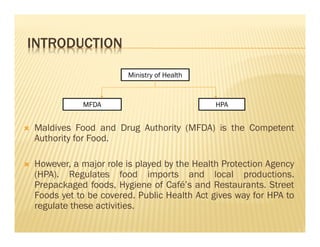
Maldives Food and Drug Authority (MFDA) is the Competent
Authority for Food.
However, a major role is played by the Health Protection Agency
(HPA). Regulates food imports and local productions.
Prepackaged foods, Hygiene of Café’s and Restaurants. Street
Foods yet to be covered. Public Health Act gives way for HPA to
regulate these activities.
Ministry of Health
HPAMFDA
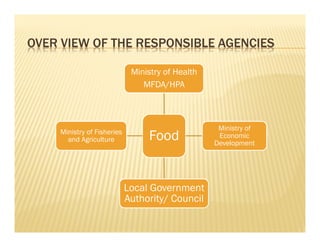
OVER VIEW OF THE RESPONSIBLE AGENCIES
Food
Ministry of Health
MFDA/HPA
Ministry of
Economic
Development
Local Government
Authority/ Council
Ministry of Fisheries
and Agriculture
MINISTRY OF HEALTH
MOH
HPA
Inspectorate Division
PH
Inspectorate
MFDA
FCD
NHL
MTG
NDA NSPA MBS Hospitals
Department
Division
Section
CURRENT SITUATION
The draft Food bill is currently being aligned with the
Public Health Act.
And some of the other food standards and regulations
have been drafted and awaiting approval. In the
meanwhile we are adapting some of the CODEX
standards as national standards.
at present food hygiene of food establishments and
imported food is regulated through Public Health Act and
Food establishment regulation.
However, current agricultural policies highlight food
security and there are few regulations related to food
safety and hygiene, and the Fisheries Law of Maldives
controls fishin.
IMPLEMENTATION OF LAWS AND REGULATION
Regulations in force:
Food establishment Regulation 2007
Food Advertisement Regulation
• Port Health Regulation
• BMS Regulation
• National Standard for labelling
• Food bill: Drafted in 2007 -2009. Submitted to Attorney
General office in June 2014.
ENSURING SAFE FOOD AT HOME, MARKETS
AND STREETS
Regulated by a regulation known as Food Establishment
Regulation.
The one single regulation itself is not enough to
regulate.
A product registration system for the local produces
were established in 2011.
- There are hiccups in the process due to geographical
distribution and lack of technical capacity.
Street food problem is not significant. – This is being
very low in the country.
Imported products are being regulated at Border.
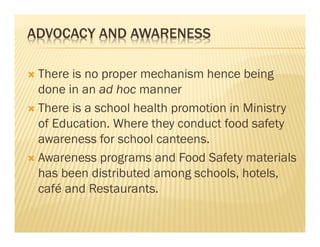
ADVOCACY AND AWARENESS
There is no proper mechanism hence being
done in an ad hoc manner
There is a school health promotion in Ministry
of Education. Where they conduct food safety
awareness for school canteens.
Awareness programs and Food Safety materials
has been distributed among schools, hotels,
café and Restaurants.
LABORATORY SERVICES AND RESPONSE
A food laboratory Known as National Health
Laboratory exists. It is accredited to ISO 17025.
Most of Microbiological testing can be done.
Chemical testing still needs to strengthened
especially for pesticide residues, Veterinary
medicines, contaminants…etc
During food safety events MFDA and HPA
coordinates and collaborates
EXPORT – QUALITY ASSURANCE
Main market is EU, MFDA is the competent
authority for EU
All factories are HACCP certified, majority ISO
22000, BRC certified.
Audited every 6 months. All necessary
laboratory analysis are performed
Competent staff
Health certificates issued at the airport
CHALLENGES
There is no proper system in place for food safety and
security. Also the geological distribution of islands
make implementation and communication difficult
as there is no effective system for monitoring and
regulating the food safety concerns through the
country.
Existing regulations for food safety and quality are very
weak in the light of the current constitution and have
many loopholes, thus making enforcement ineffective.
(absence of Food Law)
CHALLENGES
Lack of trained staff is one of the other
difficulties in implementing food safety
Need better infrastructure at ports especially
for chilled and frozen products.
Thank you!
Q & A ?

Food Control System Maldives

  • 1.
    NATIONAL FOOD CONTROLSYSTEM IN THE MALDIVES SatheeshSatheeshSatheeshSatheesh MoosaMoosaMoosaMoosa Food Control Division Maldives Food & Drug Authority Ministry of Health
  • 2.
    INTRODUCTION Maldives Food andDrug Authority (MFDA) is the Competent Authority for Food. However, a major role is played by the Health Protection Agency (HPA). Regulates food imports and local productions. Prepackaged foods, Hygiene of Café’s and Restaurants. Street Foods yet to be covered. Public Health Act gives way for HPA to regulate these activities. Ministry of Health HPAMFDA
  • 3.
    OVER VIEW OFTHE RESPONSIBLE AGENCIES Food Ministry of Health MFDA/HPA Ministry of Economic Development Local Government Authority/ Council Ministry of Fisheries and Agriculture
  • 4.
    MINISTRY OF HEALTH MOH HPA InspectorateDivision PH Inspectorate MFDA FCD NHL MTG NDA NSPA MBS Hospitals Department Division Section
  • 5.
    CURRENT SITUATION The draftFood bill is currently being aligned with the Public Health Act. And some of the other food standards and regulations have been drafted and awaiting approval. In the meanwhile we are adapting some of the CODEX standards as national standards. at present food hygiene of food establishments and imported food is regulated through Public Health Act and Food establishment regulation. However, current agricultural policies highlight food security and there are few regulations related to food safety and hygiene, and the Fisheries Law of Maldives controls fishin.
  • 6.
    IMPLEMENTATION OF LAWSAND REGULATION Regulations in force: Food establishment Regulation 2007 Food Advertisement Regulation • Port Health Regulation • BMS Regulation • National Standard for labelling • Food bill: Drafted in 2007 -2009. Submitted to Attorney General office in June 2014.
  • 7.
    ENSURING SAFE FOODAT HOME, MARKETS AND STREETS Regulated by a regulation known as Food Establishment Regulation. The one single regulation itself is not enough to regulate. A product registration system for the local produces were established in 2011. - There are hiccups in the process due to geographical distribution and lack of technical capacity. Street food problem is not significant. – This is being very low in the country. Imported products are being regulated at Border.
  • 8.
    ADVOCACY AND AWARENESS Thereis no proper mechanism hence being done in an ad hoc manner There is a school health promotion in Ministry of Education. Where they conduct food safety awareness for school canteens. Awareness programs and Food Safety materials has been distributed among schools, hotels, café and Restaurants.
  • 9.
    LABORATORY SERVICES ANDRESPONSE A food laboratory Known as National Health Laboratory exists. It is accredited to ISO 17025. Most of Microbiological testing can be done. Chemical testing still needs to strengthened especially for pesticide residues, Veterinary medicines, contaminants…etc During food safety events MFDA and HPA coordinates and collaborates
  • 10.
    EXPORT – QUALITYASSURANCE Main market is EU, MFDA is the competent authority for EU All factories are HACCP certified, majority ISO 22000, BRC certified. Audited every 6 months. All necessary laboratory analysis are performed Competent staff Health certificates issued at the airport
  • 11.
    CHALLENGES There is noproper system in place for food safety and security. Also the geological distribution of islands make implementation and communication difficult as there is no effective system for monitoring and regulating the food safety concerns through the country. Existing regulations for food safety and quality are very weak in the light of the current constitution and have many loopholes, thus making enforcement ineffective. (absence of Food Law)
  • 12.
    CHALLENGES Lack of trainedstaff is one of the other difficulties in implementing food safety Need better infrastructure at ports especially for chilled and frozen products.
  • 13.