FOOD IMPORT 
CONTROL 
Submitted by: Divya Chhabra 
M.Tech (FPT) 
01316014913
UNDERSTANDING THE TERM 
 As the name explains “FOOD IMPORT 
CONTROL” means the quality and safety of food 
i.e. imported to protect consumers and facilitate fair 
practices in food trade while ensuring unjustified 
technical barriers to trade are not introduced.
OBJECTIVE 
To provide information for the design and 
implementation of inspection programmes for 
imported food, based on the food safety risks.
GUIDELINES GIVEN UNDER: 
CAC/GL 47-2003 (codex alimentarius commission) 
1 Principles for Food Import and Export Inspection and 
Certification (CAC/GL 20–1995) 
2 Guidelines for the Design, Operation, Assessment and 
Accreditation of Food Import and Export Inspection and 
Certification Systems (CAC/GL 26–1997).
AUTHORITY REGULATING FOOD 
IMPORT IN INDIA
SOME DEFINITIONS 
 Appropriate Level of Protection (ALOP) is the level of protection deemed 
appropriate by the country establishing a sanitary measure to protect 
human life or health within its territory. 
 Audit is a systematic and functionally independent examination to 
determine whether activities and related results comply with planned 
objectives. 
 Certification is the procedure by which official certification bodies and 
officially recognized bodies provide written or equivalent assurance that 
foods or food control systems conform to requirements. 
 Inspection is the examination of food or systems for control of food, raw 
materials, processing and distribution, including in-process and finished 
product testing, in order to verify that they conform to requirements. 
 Legislation includes acts, regulations, requirements or procedures, issued 
by public authorities, related to foods and covering the protection of public 
health, the protection of consumers and conditions of fair trading.
CONT…. 
 Official accreditation is the procedure by which a government agency having 
jurisdiction formally recognizes the competence of an inspection and/or 
certification body to provide inspection and certification services. 
 Official inspection systems and official certification systems are systems 
administered by a government agency having jurisdiction empowered to perform a 
regulatory or enforcement function or both. 
 Officially recognized inspection systems and officially recognized certification 
systems are systems which have been formally approved or recognized by a 
government agency having jurisdiction. 
 Requirements are the criteria set down by the competent authorities relating to 
trade in foodstuffs covering the protection of public health, the protection of 
consumers and conditions of fair trading. 
 Risk assessment A scientifically based process consisting of the following steps (i) 
hazard identification, (ii) hazard characterisation, (iii) exposure assessment, and 
(iv) risk characterisation. 
 Risk analysis A process consisting of three components: risk assessment, risk 
management and risk communication.
GENERAL CHARACTERISTICS OF 
FOOD IMPORT CONTROL SYSTEMS 
 requirements for imported food that are consistent with 
requirements for domestic foods; 
 clearly defined responsibilities for the competent authority or 
authorities; 
 clearly defined and transparent legislation and operating 
procedures; 
 precedence to the protection of consumers; 
 provision of the importing country for recognition of the food 
control system applied by an exporting country's competent 
authority; 
 uniform nationwide implementation; 
 implementation that ensures the levels of protection achieved are 
consistent with those for domestic food.
IMPLEMENTATION OF THE 
CONTROL SYSTEM
Point of control 
 – origin, where agreed upon with the exporting 
country; 
 – entry to the country of destination; 
 – further processing; 
 – transport and distribution; 
 – storage; and, 
 – sale, (retail or wholesale).
Information about food to be imported 
 – date and point of entry; 
 – mode of transport; 
 – comprehensive description of the commodity (including for 
example product description, amount, means of preservation, 
country of origin and/or of dispatch, identifying marks such as lot 
identifier or seal identification numbers etc); 
 – exporter’s and importer’s name and address; 
 – manufacturer and/or producer, including establishment 
registration number; 
 – destination; and, 
 – other information.
Frequency of inspection and testing of 
imported food 
 the risk to human health posed by the product or its 
packaging; 
 the likelihood of non-compliance with requirements; 
 the target consumer group; 
 the extent and nature of any further processing of the product; 
 food inspection and certification system in the exporting 
country and existence of any equivalence, mutual recognition 
agreements or other trade agreements; and, 
 history of conformity of producers, processors, 
manufacturers, exporters, importers and distributors.
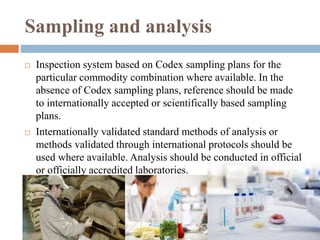
Sampling and analysis 
 Inspection system based on Codex sampling plans for the 
particular commodity combination where available. In the 
absence of Codex sampling plans, reference should be made 
to internationally accepted or scientifically based sampling 
plans. 
 Internationally validated standard methods of analysis or 
methods validated through international protocols should be 
used where available. Analysis should be conducted in official 
or officially accredited laboratories.
Decisions 
 acceptance; 
 entry if cleared upon inspection or verification of 
conformance; 
 release of non-conforming product after re-conditioning 
and/or corrective measures have been taken; 
 rejection notice, with redirecting product for uses other than 
human consumption; 
 rejection notice, with re-exportation option or return to 
country of export option at exporter expense; 
 rejection notice with destruction order.
Dealing with emergency situations 
 The responsible authority should have procedures that can 
respond appropriately to emergency situations. This will 
include holding suspect product upon arrival and recall 
procedures for suspect product already cleared and, if 
relevant, rapid notification of the problem to international 
bodies and possible measures to take. 
 If the food control authorities in importing countries detect 
problems during import control of foodstuffs which they 
consider to be so serious as to indicate a food control 
emergency situation, they should inform the exporting country 
promptly by telecommunication.
Documenting the system 
 an organizational chart of the official inspection system, 
including geographical location and the roles of each level in 
the hierarchy; 
 job functions as appropriate; 
 operating procedures including methods of sampling, 
inspection and testing; 
 relevant legislation and requirements that should be met by 
imported food; 
 important contacts; 
 relevant information about food contamination and food 
inspection; and, 
 relevant information on staff training.
SYSTEM VERIFICATION 
Verification should be carried out on the basis of 
Section 9 of the Guidelines for the Design, 
Operation, Assessment and Accreditation of Food 
Import and Export Inspection and Certification 
Systems (CAC/GL 26–1997) and the food import 
control system should be independently assessed on 
a regular basis.
THANK YOU

Food import control

  • 1.
    FOOD IMPORT CONTROL Submitted by: Divya Chhabra M.Tech (FPT) 01316014913
  • 2.
    UNDERSTANDING THE TERM  As the name explains “FOOD IMPORT CONTROL” means the quality and safety of food i.e. imported to protect consumers and facilitate fair practices in food trade while ensuring unjustified technical barriers to trade are not introduced.
  • 3.
    OBJECTIVE To provideinformation for the design and implementation of inspection programmes for imported food, based on the food safety risks.
  • 4.
    GUIDELINES GIVEN UNDER: CAC/GL 47-2003 (codex alimentarius commission) 1 Principles for Food Import and Export Inspection and Certification (CAC/GL 20–1995) 2 Guidelines for the Design, Operation, Assessment and Accreditation of Food Import and Export Inspection and Certification Systems (CAC/GL 26–1997).
  • 5.
    AUTHORITY REGULATING FOOD IMPORT IN INDIA
  • 6.
    SOME DEFINITIONS Appropriate Level of Protection (ALOP) is the level of protection deemed appropriate by the country establishing a sanitary measure to protect human life or health within its territory.  Audit is a systematic and functionally independent examination to determine whether activities and related results comply with planned objectives.  Certification is the procedure by which official certification bodies and officially recognized bodies provide written or equivalent assurance that foods or food control systems conform to requirements.  Inspection is the examination of food or systems for control of food, raw materials, processing and distribution, including in-process and finished product testing, in order to verify that they conform to requirements.  Legislation includes acts, regulations, requirements or procedures, issued by public authorities, related to foods and covering the protection of public health, the protection of consumers and conditions of fair trading.
  • 7.
    CONT….  Officialaccreditation is the procedure by which a government agency having jurisdiction formally recognizes the competence of an inspection and/or certification body to provide inspection and certification services.  Official inspection systems and official certification systems are systems administered by a government agency having jurisdiction empowered to perform a regulatory or enforcement function or both.  Officially recognized inspection systems and officially recognized certification systems are systems which have been formally approved or recognized by a government agency having jurisdiction.  Requirements are the criteria set down by the competent authorities relating to trade in foodstuffs covering the protection of public health, the protection of consumers and conditions of fair trading.  Risk assessment A scientifically based process consisting of the following steps (i) hazard identification, (ii) hazard characterisation, (iii) exposure assessment, and (iv) risk characterisation.  Risk analysis A process consisting of three components: risk assessment, risk management and risk communication.
  • 8.
    GENERAL CHARACTERISTICS OF FOOD IMPORT CONTROL SYSTEMS  requirements for imported food that are consistent with requirements for domestic foods;  clearly defined responsibilities for the competent authority or authorities;  clearly defined and transparent legislation and operating procedures;  precedence to the protection of consumers;  provision of the importing country for recognition of the food control system applied by an exporting country's competent authority;  uniform nationwide implementation;  implementation that ensures the levels of protection achieved are consistent with those for domestic food.
  • 9.
    IMPLEMENTATION OF THE CONTROL SYSTEM
  • 10.
    Point of control  – origin, where agreed upon with the exporting country;  – entry to the country of destination;  – further processing;  – transport and distribution;  – storage; and,  – sale, (retail or wholesale).
  • 11.
    Information about foodto be imported  – date and point of entry;  – mode of transport;  – comprehensive description of the commodity (including for example product description, amount, means of preservation, country of origin and/or of dispatch, identifying marks such as lot identifier or seal identification numbers etc);  – exporter’s and importer’s name and address;  – manufacturer and/or producer, including establishment registration number;  – destination; and,  – other information.
  • 12.
    Frequency of inspectionand testing of imported food  the risk to human health posed by the product or its packaging;  the likelihood of non-compliance with requirements;  the target consumer group;  the extent and nature of any further processing of the product;  food inspection and certification system in the exporting country and existence of any equivalence, mutual recognition agreements or other trade agreements; and,  history of conformity of producers, processors, manufacturers, exporters, importers and distributors.
  • 13.
    Sampling and analysis  Inspection system based on Codex sampling plans for the particular commodity combination where available. In the absence of Codex sampling plans, reference should be made to internationally accepted or scientifically based sampling plans.  Internationally validated standard methods of analysis or methods validated through international protocols should be used where available. Analysis should be conducted in official or officially accredited laboratories.
  • 14.
    Decisions  acceptance;  entry if cleared upon inspection or verification of conformance;  release of non-conforming product after re-conditioning and/or corrective measures have been taken;  rejection notice, with redirecting product for uses other than human consumption;  rejection notice, with re-exportation option or return to country of export option at exporter expense;  rejection notice with destruction order.
  • 15.
    Dealing with emergencysituations  The responsible authority should have procedures that can respond appropriately to emergency situations. This will include holding suspect product upon arrival and recall procedures for suspect product already cleared and, if relevant, rapid notification of the problem to international bodies and possible measures to take.  If the food control authorities in importing countries detect problems during import control of foodstuffs which they consider to be so serious as to indicate a food control emergency situation, they should inform the exporting country promptly by telecommunication.
  • 16.
    Documenting the system  an organizational chart of the official inspection system, including geographical location and the roles of each level in the hierarchy;  job functions as appropriate;  operating procedures including methods of sampling, inspection and testing;  relevant legislation and requirements that should be met by imported food;  important contacts;  relevant information about food contamination and food inspection; and,  relevant information on staff training.
  • 17.
    SYSTEM VERIFICATION Verificationshould be carried out on the basis of Section 9 of the Guidelines for the Design, Operation, Assessment and Accreditation of Food Import and Export Inspection and Certification Systems (CAC/GL 26–1997) and the food import control system should be independently assessed on a regular basis.
  • 18.