
FOG
NETWORKING
Name
Content
 Overview: From Cloud to Fog
 What is Fog?
 Client / Edge / IoT Devices
 Why Fog?
 Case: Client Resource Pooling
 Fog as a Network Architecture
 Cloud – Fog Interface & Hybrid Cloud
 Research Challenges
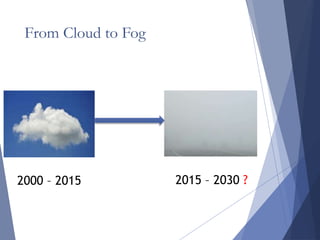
From Cloud to Fog
2000 – 2015 2015 – 2030 ?
What is “Fog Network”?
 A network architecture that uses one or a
collaborative multitude of end-user clients or
near-user edge devices to carry out a substantial
amount of storage (rather than stored primarily in
cloud data centers), communication (rather than
routed over backbone networks), and control,
configuration, measurement and management
(rather than controlled primarily by network
gateways such as those in LTE core).
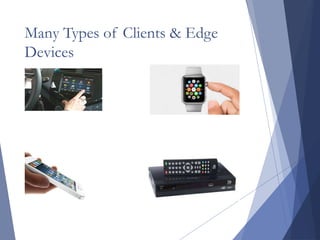
Many Types of Clients & Edge
Devices
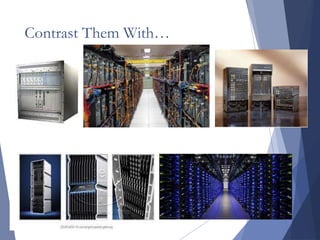
Contrast Them With…
Client/Edge/IoT Devices
 Are recently becoming
 Powerful (in sensing, storage, computing, control, comm.)
 Still limited (in battery, storage, computing, information)
 Maybe mobile
 Crowds of clients/edge devices are
 Dense
 Distributed
 Under-organized
It has become both feasible and
interesting to ask:
“Can ‘this’ be done at
clients/edge?”
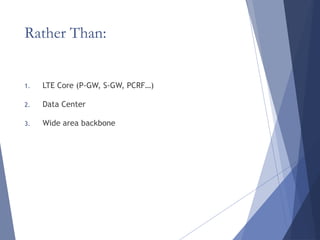
Rather Than:
1. LTE Core (P-GW, S-GW, PCRF…)
2. Data Center
3. Wide area backbone
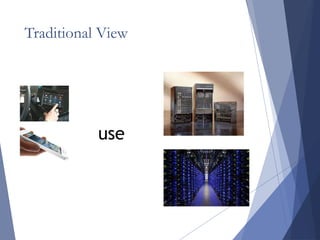
Traditional View
use
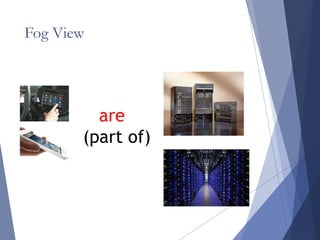
Fog View
are
(part of)
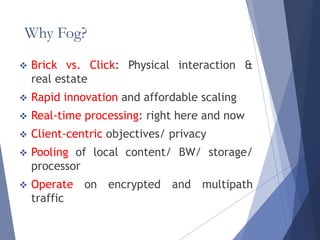
Why Fog?
 Brick vs. Click: Physical interaction &
real estate
 Rapid innovation and affordable scaling
 Real-time processing: right here and now
 Client-centric objectives/ privacy
 Pooling of local content/ BW/ storage/
processor
 Operate on encrypted and multipath
traffic
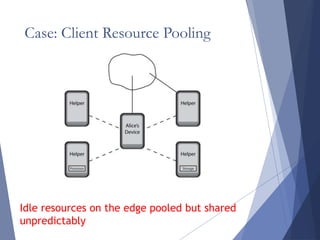
Case: Client Resource Pooling
Idle resources on the edge pooled but shared
unpredictably
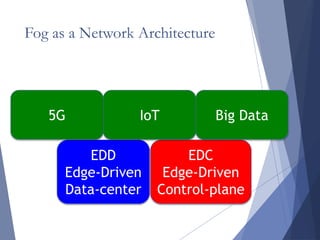
Fog as a Network Architecture
EDD
Edge-Driven
Data-center
EDC
Edge-Driven
Control-plane
5G IoT Big Data
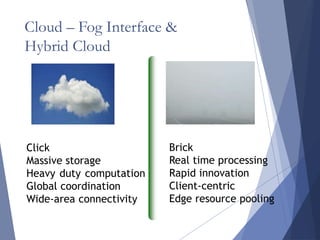
Cloud – Fog Interface &
Hybrid Cloud
Click
Massive storage
Heavy duty computation
Global coordination
Wide-area connectivity
Brick
Real time processing
Rapid innovation
Client-centric
Edge resource pooling
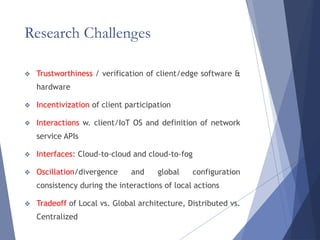
Research Challenges
 Trustworthiness / verification of client/edge software &
hardware
 Incentivization of client participation
 Interactions w. client/IoT OS and definition of network
service APIs
 Interfaces: Cloud-to-cloud and cloud-to-fog
 Oscillation/divergence and global configuration
consistency during the interactions of local actions
 Tradeoff of Local vs. Global architecture, Distributed vs.
Centralized
THANK YOU

Fog Networking

  • 1.
  • 2.
    Content  Overview: FromCloud to Fog  What is Fog?  Client / Edge / IoT Devices  Why Fog?  Case: Client Resource Pooling  Fog as a Network Architecture  Cloud – Fog Interface & Hybrid Cloud  Research Challenges
  • 3.
    From Cloud toFog 2000 – 2015 2015 – 2030 ?
  • 4.
    What is “FogNetwork”?  A network architecture that uses one or a collaborative multitude of end-user clients or near-user edge devices to carry out a substantial amount of storage (rather than stored primarily in cloud data centers), communication (rather than routed over backbone networks), and control, configuration, measurement and management (rather than controlled primarily by network gateways such as those in LTE core).
  • 5.
    Many Types ofClients & Edge Devices
  • 6.
  • 7.
    Client/Edge/IoT Devices  Arerecently becoming  Powerful (in sensing, storage, computing, control, comm.)  Still limited (in battery, storage, computing, information)  Maybe mobile  Crowds of clients/edge devices are  Dense  Distributed  Under-organized
  • 8.
    It has becomeboth feasible and interesting to ask: “Can ‘this’ be done at clients/edge?”
  • 9.
    Rather Than: 1. LTECore (P-GW, S-GW, PCRF…) 2. Data Center 3. Wide area backbone
  • 10.
  • 11.
  • 12.
    Why Fog?  Brickvs. Click: Physical interaction & real estate  Rapid innovation and affordable scaling  Real-time processing: right here and now  Client-centric objectives/ privacy  Pooling of local content/ BW/ storage/ processor  Operate on encrypted and multipath traffic
  • 13.
    Case: Client ResourcePooling Idle resources on the edge pooled but shared unpredictably
  • 14.
    Fog as aNetwork Architecture EDD Edge-Driven Data-center EDC Edge-Driven Control-plane 5G IoT Big Data
  • 15.
    Cloud – FogInterface & Hybrid Cloud Click Massive storage Heavy duty computation Global coordination Wide-area connectivity Brick Real time processing Rapid innovation Client-centric Edge resource pooling
  • 16.
    Research Challenges  Trustworthiness/ verification of client/edge software & hardware  Incentivization of client participation  Interactions w. client/IoT OS and definition of network service APIs  Interfaces: Cloud-to-cloud and cloud-to-fog  Oscillation/divergence and global configuration consistency during the interactions of local actions  Tradeoff of Local vs. Global architecture, Distributed vs. Centralized
  • 17.