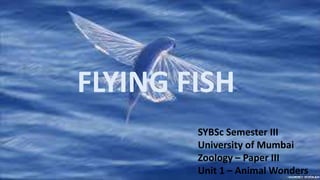
FLYING FISH
SYBSc Semester III
University of Mumbai
Zoology – Paper III
Unit 1 – Animal Wonders
Classification
Kingdom – Animalia
Phyllum – Chordata
Class – Actinopterygii ( fins supported by rays, bony fish )
Order – Beloniformes ( small and shallow bodied, upturned mouth )
Family – Exocoetidae ( family of flying fish )
Genus – Exocoetus
Common Indian specie : Exocoetus volitans L.
Common name – Tropical two-winged flying fish
Name in Marathi – पाखारू मासा , काठाळा
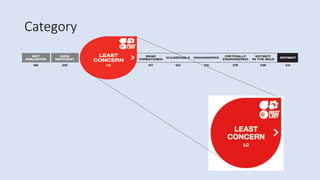
Category
Geographic Range and Habitat
• Tropical and Sub-tropical zone of ocean
• Found in warmer tropical , climate
• At the surface of ocean , at depth 0 – 20 meter
• Oceanodromous migration
External
appearance
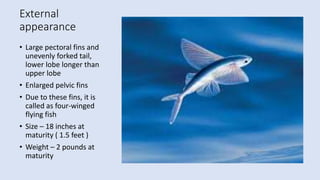
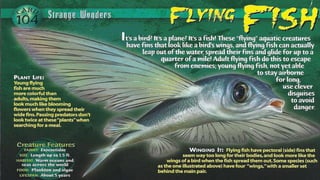
• Large pectoral fins and
unevenly forked tail,
lower lobe longer than
upper lobe
• Enlarged pelvic fins
• Due to these fins, it is
called as four-winged
flying fish
• Size – 18 inches at
maturity ( 1.5 feet )
• Weight – 2 pounds at
maturity
Amazing facts
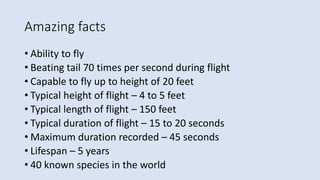
• Ability to fly
• Beating tail 70 times per second during flight
• Capable to fly up to height of 20 feet
• Typical height of flight – 4 to 5 feet
• Typical length of flight – 150 feet
• Typical duration of flight – 15 to 20 seconds
• Maximum duration recorded – 45 seconds
• Lifespan – 5 years
• 40 known species in the world
Mechanism of flight
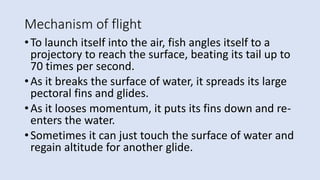
•To launch itself into the air, fish angles itself to a
projectory to reach the surface, beating its tail up to
70 times per second.
•As it breaks the surface of water, it spreads its large
pectoral fins and glides.
•As it looses momentum, it puts its fins down and re-
enters the water.
•Sometimes it can just touch the surface of water and
regain altitude for another glide.
Prey and Predator
• Flying fish feeds on – smaller fish , plankton (small
finfishes, pteropods, ostracods, amphipods, decapods,
chaetognaths, ascidians, siphonophores, salp )
• Predators of flying fish –
 Marine mammals : Dolphins, Sea lions ,Swordfish ,
Tuna , Marlin
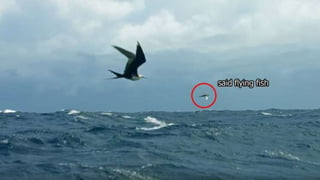
Sea birds : Boobies, Noddies, Frigate birds
Migration
• Migration is oceanodromous
• Migration within ocean typically between spawning and different
feeding areas
• Migration cyclical and predictable
• Migration covers more than 100 km
Economic importance
• Commercial fishing as a food, especially in
Barbados, Taiwan
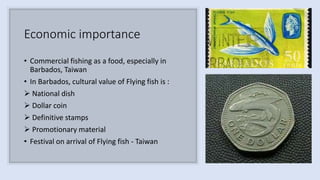
• In Barbados, cultural value of Flying fish is :
 National dish
 Dollar coin
 Definitive stamps
 Promotionary material
• Festival on arrival of Flying fish - Taiwan
Thank You !

Flying fish

  • 1.
    FLYING FISH SYBSc SemesterIII University of Mumbai Zoology – Paper III Unit 1 – Animal Wonders
  • 2.
    Classification Kingdom – Animalia Phyllum– Chordata Class – Actinopterygii ( fins supported by rays, bony fish ) Order – Beloniformes ( small and shallow bodied, upturned mouth ) Family – Exocoetidae ( family of flying fish ) Genus – Exocoetus Common Indian specie : Exocoetus volitans L. Common name – Tropical two-winged flying fish Name in Marathi – पाखारू मासा , काठाळा
  • 3.
  • 4.
    Geographic Range andHabitat • Tropical and Sub-tropical zone of ocean • Found in warmer tropical , climate • At the surface of ocean , at depth 0 – 20 meter • Oceanodromous migration
  • 5.
    External appearance • Large pectoralfins and unevenly forked tail, lower lobe longer than upper lobe • Enlarged pelvic fins • Due to these fins, it is called as four-winged flying fish • Size – 18 inches at maturity ( 1.5 feet ) • Weight – 2 pounds at maturity
  • 6.
    Amazing facts • Abilityto fly • Beating tail 70 times per second during flight • Capable to fly up to height of 20 feet • Typical height of flight – 4 to 5 feet • Typical length of flight – 150 feet • Typical duration of flight – 15 to 20 seconds • Maximum duration recorded – 45 seconds • Lifespan – 5 years • 40 known species in the world
  • 7.
    Mechanism of flight •Tolaunch itself into the air, fish angles itself to a projectory to reach the surface, beating its tail up to 70 times per second. •As it breaks the surface of water, it spreads its large pectoral fins and glides. •As it looses momentum, it puts its fins down and re- enters the water. •Sometimes it can just touch the surface of water and regain altitude for another glide.
  • 8.
    Prey and Predator •Flying fish feeds on – smaller fish , plankton (small finfishes, pteropods, ostracods, amphipods, decapods, chaetognaths, ascidians, siphonophores, salp ) • Predators of flying fish –  Marine mammals : Dolphins, Sea lions ,Swordfish , Tuna , Marlin Sea birds : Boobies, Noddies, Frigate birds
  • 9.
    Migration • Migration isoceanodromous • Migration within ocean typically between spawning and different feeding areas • Migration cyclical and predictable • Migration covers more than 100 km
  • 12.
    Economic importance • Commercialfishing as a food, especially in Barbados, Taiwan • In Barbados, cultural value of Flying fish is :  National dish  Dollar coin  Definitive stamps  Promotionary material • Festival on arrival of Flying fish - Taiwan
  • 13.