SPECTROFLUORIMETRY
INTRODUCTION
• Absorbtion of UV/Visible radiation cause
transition of electrons from singlet ground state to
singlet excited state. As the state is not stable, it
emits the energy in the form of uv/visible
radiation and returns to singlet ground state.
• The study of measurement of emitted radiation
when electron undergoes transition from singlet
excited state to singlet ground state is the
principal of fluorimetry.
ELECTRONIC STATES
• Singlet ground state: A state in which all the
electrons in a molecule are paired.(↑↓)
• Doublet state: A state in which an unpaired
electron is present e.g. Free radicals ↓or↑.
• Triplet state: A state in which unpaired
electrons of same spin present(↑)(↑)
• Singlet excited state: A state in which
electrons are unpaired but of opposite spin like
(↑)(↓)
THEORY
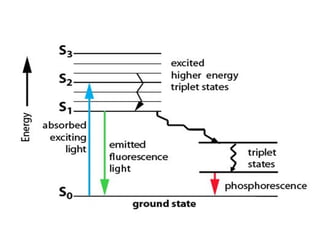
• FLUORESCENCE: Fluorescence is the
phenomena of emission of radiation when
there is transition from singlet excited state to
singlet ground state. The wavelength of
absorbed radiation is called as excitation
wavelength and that of emitted radiation is
called as emission wavelength.
• PHOSPHORESCENCE: At favorable conditions
like low temperature and absence of oxygen
there is transition from excited singlet state to
triplet sate which is called inter system
crossing. The emission of radiation when
electrons undergo transition from triplet state
to singlet ground state is called as
phosphoresence.
TYPES OF FLUORESCENCE
1. Based upon the wavelength of emitted radiation
compared to absorbed radiations.
a) Stokes fluorescence: wavelength of emitted
radiation is longer than the absorbed radiation.
b) Anti-stoke fluorescence: the wavelength of
emitted radiations is shorter than the absorbed
radiation.
c) Resonance fluorescence: when the wavelength
of emitted radiation is equal to absorbed
radiation.
–Based upon the phenomenon:
a) Sensitized fluorescence: when elements like thallium, zinc,
cadmium or an alkali metals are added to mercury are
sensitized and thus gives fluorescence.
b) Direct line fluorescence: when even after the emission of
radiation the molecules remain metastable state and
finally comes to ground state after loss of energy by
vibrational transition.
c) Stepwise fluorescence: this is nothing but the
conventional type of fluorescence where a part of energy
is lost by vibrational transition before the emission of
fluorescent radiation.
d) Thermally assisted fluorescence: the excitation is partly by
electromagnetic radiation and partly by thermal energy.
QUENCHING
• Quenching is decrease in fluorescence intensity
due to specific effects of constituents of solution
itself. These effects is may be due to to various
factors like concentration, pH, presence of
specific chemical substances, temperature,
viscosity, etc.
TYPES OF QUENCHING
• SELF QUENCHING:
• At low concentration linearity is observed.
• At high concentration(mg/ml) of the same
substance, proportionate increase in
fluoresence intensity does not occur.
This phenomenon is called as self quenching.
• Collisional quenching: It is result of several
factors like presence of halides,heavy metals,
increased temperature and decrease in
viscosity. where number of collision are
increased.Hence quenching take place
INSTRUMENTATION
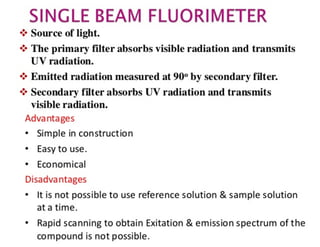
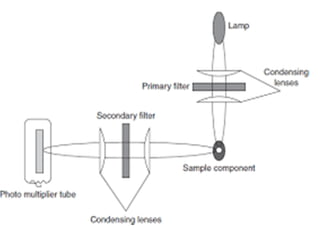
• SOURCE LIGHT
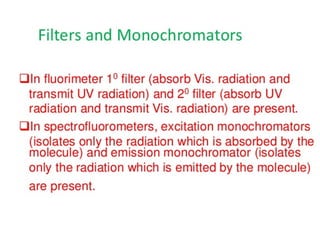
• FILTERS AND MONOCHROMATORS
• SAMPLE CELLS
• DETECTORS
• READOUT DEVICE
DOUBLE BEAM
SPECTROFLUORIMETER
• The primary filter in double beam fluorimeter
is replaced by excitation monochromator and
secondary filter is replaced by emission
monochromator. The incident beam is split
into sample and reference beam by using
beam splitter.
• Detector used is photomultiplier tube.
SPECTROFLUORIMETRY.pdf

SPECTROFLUORIMETRY.pdf

  • 1.
  • 2.
    INTRODUCTION • Absorbtion ofUV/Visible radiation cause transition of electrons from singlet ground state to singlet excited state. As the state is not stable, it emits the energy in the form of uv/visible radiation and returns to singlet ground state. • The study of measurement of emitted radiation when electron undergoes transition from singlet excited state to singlet ground state is the principal of fluorimetry.
  • 3.
    ELECTRONIC STATES • Singletground state: A state in which all the electrons in a molecule are paired.(↑↓) • Doublet state: A state in which an unpaired electron is present e.g. Free radicals ↓or↑. • Triplet state: A state in which unpaired electrons of same spin present(↑)(↑) • Singlet excited state: A state in which electrons are unpaired but of opposite spin like (↑)(↓)
  • 4.
    THEORY • FLUORESCENCE: Fluorescenceis the phenomena of emission of radiation when there is transition from singlet excited state to singlet ground state. The wavelength of absorbed radiation is called as excitation wavelength and that of emitted radiation is called as emission wavelength.
  • 5.
    • PHOSPHORESCENCE: Atfavorable conditions like low temperature and absence of oxygen there is transition from excited singlet state to triplet sate which is called inter system crossing. The emission of radiation when electrons undergo transition from triplet state to singlet ground state is called as phosphoresence.
  • 7.
    TYPES OF FLUORESCENCE 1.Based upon the wavelength of emitted radiation compared to absorbed radiations. a) Stokes fluorescence: wavelength of emitted radiation is longer than the absorbed radiation. b) Anti-stoke fluorescence: the wavelength of emitted radiations is shorter than the absorbed radiation. c) Resonance fluorescence: when the wavelength of emitted radiation is equal to absorbed radiation.
  • 8.
    –Based upon thephenomenon: a) Sensitized fluorescence: when elements like thallium, zinc, cadmium or an alkali metals are added to mercury are sensitized and thus gives fluorescence. b) Direct line fluorescence: when even after the emission of radiation the molecules remain metastable state and finally comes to ground state after loss of energy by vibrational transition. c) Stepwise fluorescence: this is nothing but the conventional type of fluorescence where a part of energy is lost by vibrational transition before the emission of fluorescent radiation. d) Thermally assisted fluorescence: the excitation is partly by electromagnetic radiation and partly by thermal energy.
  • 14.
    QUENCHING • Quenching isdecrease in fluorescence intensity due to specific effects of constituents of solution itself. These effects is may be due to to various factors like concentration, pH, presence of specific chemical substances, temperature, viscosity, etc.
  • 15.
    TYPES OF QUENCHING •SELF QUENCHING: • At low concentration linearity is observed. • At high concentration(mg/ml) of the same substance, proportionate increase in fluoresence intensity does not occur. This phenomenon is called as self quenching.
  • 18.
    • Collisional quenching:It is result of several factors like presence of halides,heavy metals, increased temperature and decrease in viscosity. where number of collision are increased.Hence quenching take place
  • 19.
    INSTRUMENTATION • SOURCE LIGHT •FILTERS AND MONOCHROMATORS • SAMPLE CELLS • DETECTORS • READOUT DEVICE
  • 31.
    DOUBLE BEAM SPECTROFLUORIMETER • Theprimary filter in double beam fluorimeter is replaced by excitation monochromator and secondary filter is replaced by emission monochromator. The incident beam is split into sample and reference beam by using beam splitter. • Detector used is photomultiplier tube.