

2017 Offshore Strategikonferansen
Konkuransekraft- Hva er gjort og gjøres for varige endringer
Stavanger 6. Februar 2017
Celebrating TechnipFMC | 2
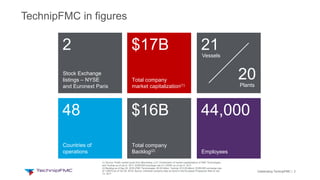
TechnipFMC in figures
Stock Exchange
listings – NYSE
and Euronext Paris
2
Total company
Backlog(2)
$16B
Countries of
operations
48
Total company
market capitalization(1)
$17B
Employees
44,000
21Vessels
20Plants
(1) Source: Public market quote from Bloomberg, LLP; Combination of market capitalizations of FMC Technologies
and Technip as of Jan 6, 2017; EUR/USD exchange rate of 1.05361 as of Jan 6, 2017
(2) Backlog as of Sep 30, 2016 (FMC Technologies: $3.02 billion; Technip: €12,28 billion), EUR/USD exchange rate
of 1.09072 as of Oct 28, 2016; Source: individual company data as found in the European Prospectus filed on Jan
13, 2017
3
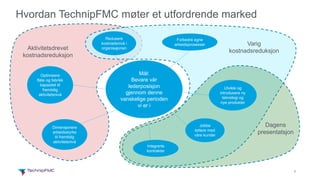
Hvordan TechnipFMC møter et utfordrende marked
Optimisere
flåte og fabrikk
kapasitet til
fremtidig
aktivitetsnivå
Aktivitetsdrevet
kostnadsreduksjon
Redusere
kostnadsnivå i
organisajonen
Forbedre egne
arbeidsprosesser Varig
kostnadsreduksjon
Utvikle og
introdusere ny
teknologi og
nye produkter
Jobbe
tettere med
våre kunder
Dagens
presentatsjon
Integrerte
kontrakter
Dimensjonere
arbeidsstyrke
til fremtidig
aktivitetsnivå
Mål:
Bevare vår
lederposisjon
gjennom denne
vanskelige perioden
vi er i
4
Utvikle og introdusere ny teknologi og
nye produkter
§ Connector
5
5
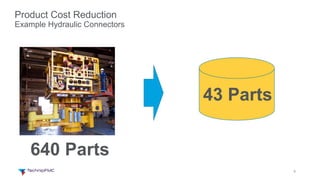
Product Cost Reduction
Example Hydraulic Connectors
640 Parts
43 Parts
6
Jobbe tettere med våre kunder
§ Oil og gass UK
§ Dvalin
7
90%
100%
110%
120%
130%
140%
150%
160%
170%
90% 100% 110% 120% 130% 140% 150% 160% 170%
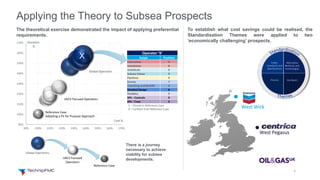
Applying the Theory to Subsea Prospects
To establish what cost savings could be realised, the
Standardisation Themes were applied to two
‘economically challenging’ prospects.
The theoretical exercise demonstrated the impact of applying preferential
requirements.
West	Pegasus
West	Wick
Global	Operators
UKCS	Focused	Operators
Reference	Case:	
Adopting	a	Fit	for	Purpose	Approach
Operator	‘X’
Scope Position
Fabrication 9
Installation 8
Umbilicals 9
Subsea	Valves 9
Pipelines 9
Survey 7
Trenching	and	Backfill 9
Detailed	Design 8
Flexibles 9
SPS	– Controls 9
SPS	- Trees 9
1	– Closest	to	Reference	Case
9	– Furthest	from	Reference	Case
There is a journey
necessary to achieve
viability for subsea
developments.
Reference	Case
UKCS	Focused	
Operators
Global	Operators
Duration
%
Cost	%
X
8
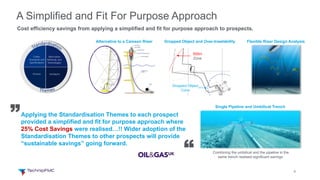
A Simplified and Fit For Purpose Approach
Applying the Standardisation Themes to each prospect
provided a simplified and fit for purpose approach where
25% Cost Savings were realised…!! Wider adoption of the
Standardisation Themes to other prospects will provide
“sustainable savings” going forward.
Alternative to a Caisson Riser Flexible Riser Design AnalysisDropped Object and Over-trawlability
Dropped Object
Cone
500m
Zone
Combining the umbilical and the pipeline in the
same trench realised significant savings.
Single Pipeline and Umbilical Trench
Cost efficiency savings from applying a simplified and fit for purpose approach to prospects.
„
„
9
4 Sustainable cost reductions requires that
the Client and Contractor work “smarter”
and more integrated
4 Close corporation during development of
documents – Client located at Contractor
office for short communication lines
4 Common understanding of needs to ensure
the right quality at first issue - Client review
only ‘one time’
4 Challenge established practices – replacing
“need to have” with “must have”
4 Reducing cost with less document transfer,
less 3rd party verification and optimized
use of site inspectors
4 Using functional requirements rather than
detailed specifications, giving the
Contractor the opportunity to optimize
solutions
4 Question Status Quo – limit repeat testing
of well proven technology
Dvalin – Working Smarter Together
10
4 DEA Norge AS is leading the change with
implementation of DnV RP O-101,
Technical Documentation for Subsea
Projects
4 Significantly reduce the amount of
documentation transferred between Client
and Contractor for review, more for
information
4 Effectiveness of the RP will be measured in
the project through introduction of quality
KPIs
4 Measuring documents that have to be re-
issued for client review (i.e. more than
one issue)
4 Missed/waived Review/Hold points in
inspection plans – indicates unnecessary
quality assurance requirements
4 Measure success versus existing
documentation practice
4 Compare with similar project: document
volume issued for review, total no off review
cycles, manhours spent
Dvalin – Working Smarter Together
11
Integrerte kontrakter TechnipFMC
§ Noen betraktninger
§ Trestakk
12
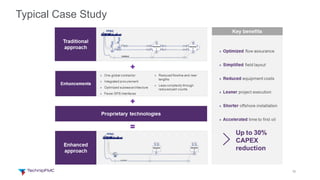
Typical Case Study
13
Level of Trust/
Perceived client value
Maturity	of project
Low Medium High
Low
Medium
High
DG0 DG3DG2
Dialog with customer
Value-oriented Technical
Client
Commitment
curve
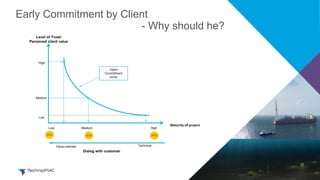
Early Commitment by Client
- Why should he?
14
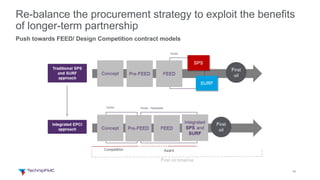
Re-balance the procurement strategy to exploit the benefits
of longer-term partnership
Push towards FEED/ Design Competition contract models
15
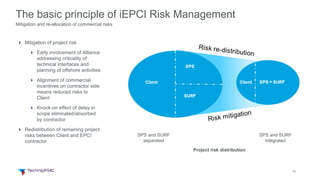
The basic principle of iEPCI Risk Management
Mitigation and re-allocation of commercial risks
SPS and SURF
separated
SPS and SURF
integrated
Project risk distribution
4 Mitigation of project risk
4 Early involvement of Alliance
addressing criticality of
technical interfaces and
planning of offshore activities
4 Alignment of commercial
incentives on contractor side
means reduced risks to
Client
4 Knock-on effect of delay in
scope eliminated/absorbed
by contractor
4 Redistribution of remaining project
risks between Client and EPCI
contractor
16
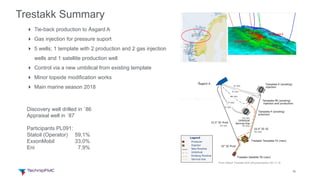
Trestakk Summary
From Statoil Trestakk Kick-off presentation 08.11.16
4 Tie-back production to Åsgard A
4 Gas injection for pressure suport
4 5 wells; 1 template with 2 production and 2 gas injection
wells and 1 satellite production well
4 Control via a new umbilical from existing template
4 Minor topside modification works
4 Main marine season 2018
Discovery well drilled in `86
Appraisal well in `87
Participants PL091:
Statoil (Operator) 59,1%
ExxonMobil 33,0%
Eni 7,9%
17
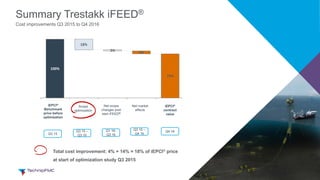
Summary Trestakk iFEED®
Cost improvements Q3 2015 to Q4 2016
Scope
optimization
iEPCI®
Benchmark
price before
optimization
iEPCI®
contract
value
Total cost improvement: 4% + 14% = 18% of iEPCI® price
at start of optimization study Q3 2015
Q3 15
Q1 16-
Q3 16
Net scope
changes post
start iFEED®
Q4 16Q3 15 –
Q3 16
Q3 15 –
Q4 16
Net market
effects
100%
18%
2%
5%
75%
18
Konklusjon
4Store muligheter til å oppnå varige kostnadsreduksjoner
4De markedsdrevne kostnadsreduksjoner vil reversere før eller senere og bli en
kostnadsøkning
4Vi bør slutte å kun referere til kostnadsreduksjoner. Vi bør differensiere mellom varige
og ikke varige reduksjoner

Knut Bøe

  • 1.
    2017 Offshore Strategikonferansen Konkuransekraft-Hva er gjort og gjøres for varige endringer Stavanger 6. Februar 2017
  • 2.
    Celebrating TechnipFMC |2 TechnipFMC in figures Stock Exchange listings – NYSE and Euronext Paris 2 Total company Backlog(2) $16B Countries of operations 48 Total company market capitalization(1) $17B Employees 44,000 21Vessels 20Plants (1) Source: Public market quote from Bloomberg, LLP; Combination of market capitalizations of FMC Technologies and Technip as of Jan 6, 2017; EUR/USD exchange rate of 1.05361 as of Jan 6, 2017 (2) Backlog as of Sep 30, 2016 (FMC Technologies: $3.02 billion; Technip: €12,28 billion), EUR/USD exchange rate of 1.09072 as of Oct 28, 2016; Source: individual company data as found in the European Prospectus filed on Jan 13, 2017
  • 3.
    3 Hvordan TechnipFMC møteret utfordrende marked Optimisere flåte og fabrikk kapasitet til fremtidig aktivitetsnivå Aktivitetsdrevet kostnadsreduksjon Redusere kostnadsnivå i organisajonen Forbedre egne arbeidsprosesser Varig kostnadsreduksjon Utvikle og introdusere ny teknologi og nye produkter Jobbe tettere med våre kunder Dagens presentatsjon Integrerte kontrakter Dimensjonere arbeidsstyrke til fremtidig aktivitetsnivå Mål: Bevare vår lederposisjon gjennom denne vanskelige perioden vi er i
  • 4.
    4 Utvikle og introdusereny teknologi og nye produkter § Connector
  • 5.
    5 5 Product Cost Reduction ExampleHydraulic Connectors 640 Parts 43 Parts
  • 6.
    6 Jobbe tettere medvåre kunder § Oil og gass UK § Dvalin
  • 7.
    7 90% 100% 110% 120% 130% 140% 150% 160% 170% 90% 100% 110%120% 130% 140% 150% 160% 170% Applying the Theory to Subsea Prospects To establish what cost savings could be realised, the Standardisation Themes were applied to two ‘economically challenging’ prospects. The theoretical exercise demonstrated the impact of applying preferential requirements. West Pegasus West Wick Global Operators UKCS Focused Operators Reference Case: Adopting a Fit for Purpose Approach Operator ‘X’ Scope Position Fabrication 9 Installation 8 Umbilicals 9 Subsea Valves 9 Pipelines 9 Survey 7 Trenching and Backfill 9 Detailed Design 8 Flexibles 9 SPS – Controls 9 SPS - Trees 9 1 – Closest to Reference Case 9 – Furthest from Reference Case There is a journey necessary to achieve viability for subsea developments. Reference Case UKCS Focused Operators Global Operators Duration % Cost % X
  • 8.
    8 A Simplified andFit For Purpose Approach Applying the Standardisation Themes to each prospect provided a simplified and fit for purpose approach where 25% Cost Savings were realised…!! Wider adoption of the Standardisation Themes to other prospects will provide “sustainable savings” going forward. Alternative to a Caisson Riser Flexible Riser Design AnalysisDropped Object and Over-trawlability Dropped Object Cone 500m Zone Combining the umbilical and the pipeline in the same trench realised significant savings. Single Pipeline and Umbilical Trench Cost efficiency savings from applying a simplified and fit for purpose approach to prospects. „ „
  • 9.
    9 4 Sustainable costreductions requires that the Client and Contractor work “smarter” and more integrated 4 Close corporation during development of documents – Client located at Contractor office for short communication lines 4 Common understanding of needs to ensure the right quality at first issue - Client review only ‘one time’ 4 Challenge established practices – replacing “need to have” with “must have” 4 Reducing cost with less document transfer, less 3rd party verification and optimized use of site inspectors 4 Using functional requirements rather than detailed specifications, giving the Contractor the opportunity to optimize solutions 4 Question Status Quo – limit repeat testing of well proven technology Dvalin – Working Smarter Together
  • 10.
    10 4 DEA NorgeAS is leading the change with implementation of DnV RP O-101, Technical Documentation for Subsea Projects 4 Significantly reduce the amount of documentation transferred between Client and Contractor for review, more for information 4 Effectiveness of the RP will be measured in the project through introduction of quality KPIs 4 Measuring documents that have to be re- issued for client review (i.e. more than one issue) 4 Missed/waived Review/Hold points in inspection plans – indicates unnecessary quality assurance requirements 4 Measure success versus existing documentation practice 4 Compare with similar project: document volume issued for review, total no off review cycles, manhours spent Dvalin – Working Smarter Together
  • 11.
    11 Integrerte kontrakter TechnipFMC §Noen betraktninger § Trestakk
  • 12.
  • 13.
    13 Level of Trust/ Perceivedclient value Maturity of project Low Medium High Low Medium High DG0 DG3DG2 Dialog with customer Value-oriented Technical Client Commitment curve Early Commitment by Client - Why should he?
  • 14.
    14 Re-balance the procurementstrategy to exploit the benefits of longer-term partnership Push towards FEED/ Design Competition contract models
  • 15.
    15 The basic principleof iEPCI Risk Management Mitigation and re-allocation of commercial risks SPS and SURF separated SPS and SURF integrated Project risk distribution 4 Mitigation of project risk 4 Early involvement of Alliance addressing criticality of technical interfaces and planning of offshore activities 4 Alignment of commercial incentives on contractor side means reduced risks to Client 4 Knock-on effect of delay in scope eliminated/absorbed by contractor 4 Redistribution of remaining project risks between Client and EPCI contractor
  • 16.
    16 Trestakk Summary From StatoilTrestakk Kick-off presentation 08.11.16 4 Tie-back production to Åsgard A 4 Gas injection for pressure suport 4 5 wells; 1 template with 2 production and 2 gas injection wells and 1 satellite production well 4 Control via a new umbilical from existing template 4 Minor topside modification works 4 Main marine season 2018 Discovery well drilled in `86 Appraisal well in `87 Participants PL091: Statoil (Operator) 59,1% ExxonMobil 33,0% Eni 7,9%
  • 17.
    17 Summary Trestakk iFEED® Costimprovements Q3 2015 to Q4 2016 Scope optimization iEPCI® Benchmark price before optimization iEPCI® contract value Total cost improvement: 4% + 14% = 18% of iEPCI® price at start of optimization study Q3 2015 Q3 15 Q1 16- Q3 16 Net scope changes post start iFEED® Q4 16Q3 15 – Q3 16 Q3 15 – Q4 16 Net market effects 100% 18% 2% 5% 75%
  • 18.
    18 Konklusjon 4Store muligheter tilå oppnå varige kostnadsreduksjoner 4De markedsdrevne kostnadsreduksjoner vil reversere før eller senere og bli en kostnadsøkning 4Vi bør slutte å kun referere til kostnadsreduksjoner. Vi bør differensiere mellom varige og ikke varige reduksjoner