1
How does it scale?
A thing about the flexibility of Shared Service Centers
Since many years international companies try to be more productive and more profitable to their
stakeholders and owners. An outsourcing approach is one of the popular ideas that are changing the
way on how corporations operate. Outsourcing supports global sustainable growth by transferring
advanced solutions from developed economies to less advanced countries. There are other positives
like ability of lowering operational costs. I doubt anyone thinks of outsourcing without bearing in mind
such benefit.
But, is this approach still valid? Do we use all the opportunities economy gives us? How to set up a BPO
business correctly to avoid traps and mistakes? If we have established a business and we have
experienced obstacles: how to implement countermeasures? What is the next logical move after
applying techniques supporting increase of the efficiency and effectiveness? What is the answer to
challenges we face in the battle of profitability? And last but not least, how the BPO sector will look
like in 3 to 5 years and what happens next?
By writing this article I am trying to describe what are the most important factors that affect profit
generation and income increase. I also provide a set of solutions and key focus points that would lead
to the flexibility, which is the answer to most of current problems in the outsourcing environment.
Let’s consider a number of scenarios. You have built a Service Centre. It operates and delivers. Costs
are under control. Additionally, you have just won a very big deal. A prospect that was behind your
imagination materialized and now you need to increase your operational capacity by 30% in 1 or 2
months. What would you do? Let’s imagine a different situation. In a country where you performing
your operations a new government have changed the business rules. Now you need to increase
a number of reports twice or three times. What would you do then? Or, you have bought your
competitor. You have doubled amount of processes and your delivery is not efficient anymore. You
need to merge two companies and perform a fast reengineering. Maybe there is a way of avoiding
unplanned interruptions or minimizing negative impact they have on the business and its results?
Let’s look at the other side. Your financial results have been lower than expected. Maybe you have lost
a very profitable customer. You need to cut operational budget by 20% in a very short time. Maybe
you have performed operations in a low or medium cost place. Due to the increase of currency value
or the staff salaries, your business is no longer profitable. Or, hard Brexit has occurred. You need to
decrease your UK operations and increase hiring elsewhere. Maybe a new and innovative technology
(i.e. robotics, machine learning etc.) was advertised on the market. It gives you a possibility to reduce
your manual processes by 1/3 (i.e. coping cell A342 to the cell XZ443 and putting results to the monthly
MBod’s presentation). Would you decide to take advantage? Are your processes support such fast
changes?
Flexibility is the answer
Flexibility allows companies to adjust their operational capability relatively fast. It gives a chance to
reduce processes or increase number of operations in a structured way, within the borders of
controlled risk. Some say that without any risk, which is not necessarily true. Flexibility also provides
a mechanism to adjust to the market’s volatility.
2
A Shared Service Centre in the middle of scalable operations
The Flexible SSC is capable to perform flexible operations (a factor that enables increase or decrease
number of concurrent simultaneous operations without incurring penalties or changes in the process
performance) by using flexible work force (where number of staff can be adjusted to the changing
demand) in environment which is exposed to flexible expansion (both ways: increase or decrease).
Architecture of the Flexible Service Centre should be carefully designed without compromises. One of
the most important success factor that enables flexibility is a Transition and Transformation planning
phase and its further execution. Avoiding of appropriate preparations causes many potential problems
in the future. Applying it does not guarantee 100% success in the flexible environment, but it is a very
important prerequisite.
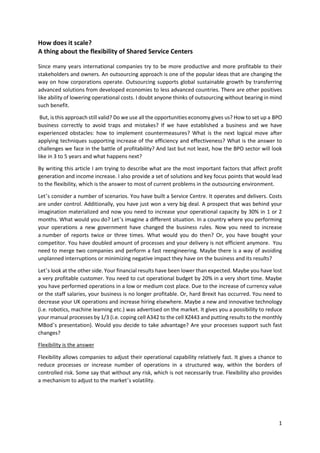
This step makes a real difference when it comes to the competition
between the concept of a Standard and a Flexible Service Center. While
designing a regular center it usually happens that companies establish
a set of mirrored processes in a remote location. In this example,
a person who works on invoice processing in a service center would
have the same amount of monitors, workstations, phone lines etc. as the staff in the sending hub. If
a process requires 6-eye check, new process would also require 6-eye check. It is common to make
a role redundant in a high cost location and transfer it with everything to the mid or low cost country.
But does it make sense? It is easier to migrate roles in that way – I agree. However, is it cheaper, more
effective or flexible? I do not think so.
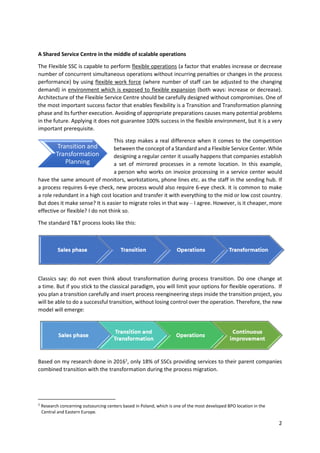
The standard T&T process looks like this:
Classics say: do not even think about transformation during process transition. Do one change at
a time. But if you stick to the classical paradigm, you will limit your options for flexible operations. If
you plan a transition carefully and insert process reengineering steps inside the transition project, you
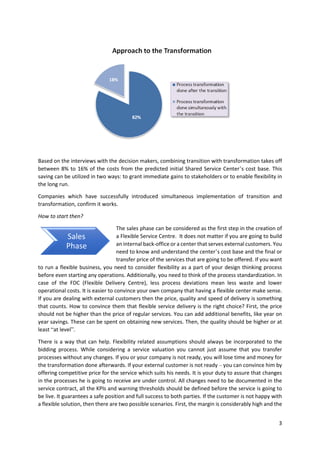
will be able to do a successful transition, without losing control over the operation. Therefore, the new
model will emerge:
Based on my research done in 20161
, only 18% of SSCs providing services to their parent companies
combined transition with the transformation during the process migration.
1
Research concerning outsourcing centers based in Poland, which is one of the most developed BPO location in the
Central and Eastern Europe.
Transition and
Transformation
Planning
3
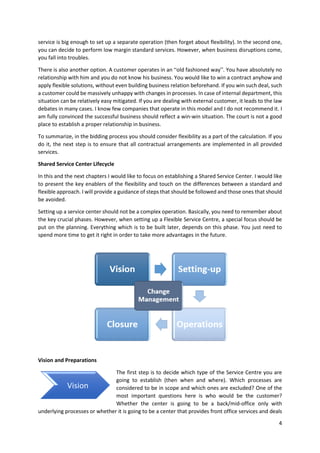
Based on the interviews with the decision makers, combining transition with transformation takes off
between 8% to 16% of the costs from the predicted initial Shared Service Center’s cost base. This
saving can be utilized in two ways: to grant immediate gains to stakeholders or to enable flexibility in
the long run.
Companies which have successfully introduced simultaneous implementation of transition and
transformation, confirm it works.
How to start then?
The sales phase can be considered as the first step in the creation of
a Flexible Service Centre. It does not matter if you are going to build
an internal back-office or a center that serves external customers. You
need to know and understand the center’s cost base and the final or
transfer price of the services that are going to be offered. If you want
to run a flexible business, you need to consider flexibility as a part of your design thinking process
before even starting any operations. Additionally, you need to think of the process standardization. In
case of the FDC (Flexible Delivery Centre), less process deviations mean less waste and lower
operational costs. It is easier to convince your own company that having a flexible center make sense.
If you are dealing with external customers then the price, quality and speed of delivery is something
that counts. How to convince them that flexible service delivery is the right choice? First, the price
should not be higher than the price of regular services. You can add additional benefits, like year on
year savings. These can be spent on obtaining new services. Then, the quality should be higher or at
least “at level”.
There is a way that can help. Flexibility related assumptions should always be incorporated to the
bidding process. While considering a service valuation you cannot just assume that you transfer
processes without any changes. If you or your company is not ready, you will lose time and money for
the transformation done afterwards. If your external customer is not ready – you can convince him by
offering competitive price for the service which suits his needs. It is your duty to assure that changes
in the processes he is going to receive are under control. All changes need to be documented in the
service contract, all the KPIs and warning thresholds should be defined before the service is going to
be live. It guarantees a safe position and full success to both parties. If the customer is not happy with
a flexible solution, then there are two possible scenarios. First, the margin is considerably high and the
Sales
Phase
4
service is big enough to set up a separate operation (then forget about flexibility). In the second one,
you can decide to perform low margin standard services. However, when business disruptions come,
you fall into troubles.
There is also another option. A customer operates in an “old fashioned way”. You have absolutely no
relationship with him and you do not know his business. You would like to win a contract anyhow and
apply flexible solutions, without even building business relation beforehand. If you win such deal, such
a customer could be massively unhappy with changes in processes. In case of internal department, this
situation can be relatively easy mitigated. If you are dealing with external customer, it leads to the law
debates in many cases. I know few companies that operate in this model and I do not recommend it. I
am fully convinced the successful business should reflect a win-win situation. The court is not a good
place to establish a proper relationship in business.
To summarize, in the bidding process you should consider flexibility as a part of the calculation. If you
do it, the next step is to ensure that all contractual arrangements are implemented in all provided
services.
Shared Service Center Lifecycle
In this and the next chapters I would like to focus on establishing a Shared Service Center. I would like
to present the key enablers of the flexibility and touch on the differences between a standard and
flexible approach. I will provide a guidance of steps that should be followed and those ones that should
be avoided.
Setting up a service center should not be a complex operation. Basically, you need to remember about
the key crucial phases. However, when setting up a Flexible Service Centre, a special focus should be
put on the planning. Everything which is to be built later, depends on this phase. You just need to
spend more time to get it right in order to take more advantages in the future.
Vision and Preparations
The first step is to decide which type of the Service Centre you are
going to establish (then when and where). Which processes are
considered to be in scope and which ones are excluded? One of the
most important questions here is who would be the customer?
Whether the center is going to be a back/mid-office only with
underlying processes or whether it is going to be a center that provides front office services and deals
Vision
5
with external customers on a daily basis. In the latter case, you need to build a sales and marketing
department.
If you would like to decrease operational costs somehow, the first logical step is to simplify processes.
Then, you need to implement lean or agile methodologies to ensure if YoY efficiency and effectiveness
are possible. You should also consider a service centralization. Maybe you would even like to go flex?
From the business perspective, it is very important what your motivations are and what your Vision is.
Future operations will be adjusted to it. What (is going to be provided), Where, When? These three
questions should be answered in the Planning phase. The sooner you have the answer the better.
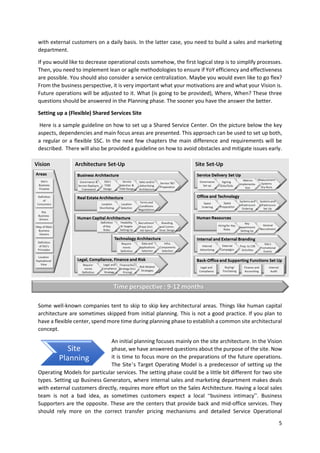
Setting up a (Flexible) Shared Services Site
Here is a sample guideline on how to set up a Shared Service Center. On the picture below the key
aspects, dependencies and main focus areas are presented. This approach can be used to set up both,
a regular or a flexible SSC. In the next few chapters the main difference and requirements will be
described. There will also be provided a guideline on how to avoid obstacles and mitigate issues early.
Some well-known companies tent to skip to skip key architectural areas. Things like human capital
architecture are sometimes skipped from initial planning. This is not a good practice. If you plan to
have a flexible center, spend more time during planning phase to establish a common site architectural
concept.
An initial planning focuses mainly on the site architecture. In the Vision
phase, we have answered questions about the purpose of the site. Now
it is time to focus more on the preparations of the future operations.
The Site’s Target Operating Model is a predecessor of setting up the
Operating Models for particular services. The setting phase could be a little bit different for two site
types. Setting up Business Generators, where internal sales and marketing department makes deals
with external customers directly, requires more effort on the Sales Architecture. Having a local sales
team is not a bad idea, as sometimes customers expect a local “business intimacy”. Business
Supporters are the opposite. These are the centers that provide back and mid-office services. They
should rely more on the correct transfer pricing mechanisms and detailed Service Operational
Site
Planning
6
Agreements. Such centers do not need to invest in in CRM systems or hire sales representatives. In
both cases a location aspirational view should be defined. It is something more than the description of
the place where the site is to be settled. This is also a definition of the goals that SSC needs to achieve
in the future.
At the end of the planning phase you will have the full working site with processes defined in details.
Then the Site head (site CEO) is able to manage the site by utilizing implemented metrics and control
systems. Policies and principles are integrated as a part of the site’s delivery model. Both, internal and
external advertising campaigns provide access to the pool of talented individuals who work together
to deliver the highest value of the products or services.
Companies tend to underestimate efforts necessary to careful
planning of the governance. Its general purpose is to support seamless
delivery from the site. It is achieved by providing optimized structure
aligned to company’s requirements, applicable law and regulations.
SSC’s governance model includes:
- the site’s governance containing governing bodies and their specification
- description of the key role’s responsibilities (i.e. Site Head/Site CEO/Site Manager or site’s CFO)
- governance for processes and projects
- responsibilities for risk, compliance and audit
- reporting lines with the specification of solid line reporting and dotted line responsibilities
- structures (standard or matrix)
- etc.
Key aspects of the governance
What sometimes happens when it comes to establishing a new service center is the settlement of
company’s basic structure without defined responsibilities. Even though it fulfills local regulations,
senior management who supposed to be responsible for the site, do not control service delivery. Such
“ad-hoc governance” leads to massive ineffectiveness.
As the Flexible Service Centre operates as the service provider, therefore its head bears the full
responsibility for the entire site’s delivery. To achieve such capability, it is necessary to ensure that the
site head has a clear mandate to govern. Structuring the site head’s role in that way guarantees the
consistency in approach, effectiveness of the service provision and the processes’ efficiency. Such
manager is able to determine service demand and can initiate switching resources between business
divisions when necessary. The role’s responsibility concerns also planning the site’s capacity for an
increase or decrease. Subsequently, division heads are responsible for strategy implementation in their
areas, therefore they need to report to site head directly. This concept is crucial to the flexible SSC
success. In terms of the execution speed, a solid line reporting gives the site’s CEO appropriate tool to
enforce decisions quickly. If the site’s service capacity is about to expand, then each decision maker is
going to support the move. Problems arise when the site is to reduce its capacity. Taking it into
consideration, a single decision instance has a mandate to solve never-ending debates and fights for
saving divisional resources. If there is no single person with responsibility for the site, it might happen
that restructuring activities move costs from one division to another within the same delivery center
(or even from low cost location to a hub). When responsibility for the cost center structure falls under
the site’s CFO, such situations are mitigated. The site’s manager should have an ability to influence his
directs’ incentive structure, which is aligned to their goals and objectives. In an ideal situation, a person
who has a functional head’s role is fully accountable for the entire division, including the business
delivery and division’s KPIs. It is the role’s responsibility to organize and implement processes
Governance
and
Leadership
7
according to the business needs, company’s directives and regulations. This accountability cannot be
delegated.
If the site is to generate business by selling products or services (i.e. software development, financial
services, HR, payroll, or scientific research done on newly discovered chemical compounds) the
governance function needs to be built around the sales and marketing functions. Departments like FA,
controlling, internal audit or the business operations should support the sales processes. CFO is to be
responsible for ensuring positive cash flow and guaranteeing that sale related costs are lower than
incomes. Securing compliance with the financial law is also his duty. In case the site is a back-office
center a different type of governance needs to be established. CEO and CFO should ensure that the
site capabilities are aligned to Hub locations’ needs. P&L is also constructed differently. For the site
which does not generate profits, P&L calculation reflects correct transfer pricing and site’s costs
recharging.
What about other required functions? Big corporations tend to organize themselves as the sets of
governing committees. It sometimes leads to blurred responsibility. As the result, we may observe
regular issues with the provision of effective operations. Finally, the companies try to resolve problems
generated by themselves. Governing bodies can help to structure and coordinate site operations by
enabling cooperation between divisions. However, the responsibility for the delivery cannot be passed
over to any kind of body. There always should be a specific role that holds accountability. It does not
matter if you are responsible for company’s back office or client facing operations. The site needs to
deliver. And this should be an effective and efficient delivery.
It might happen that you are an executive who is leading an operation where reporting lines are not
connected to you anyhow. In such a case, you can gradually migrate to flexible SSC concept by
increasing your area of responsibility, supporting solid and dotted line creation, and giving your directs
more control over the delivery. Your accountability will increase over the time.
A word about the business leader
Who should steer a site? What skills and qualities are required and recommended? It depends on the
site’s purpose. If you are to establish a sales oriented service center, you need to have a sales person
on the site’s CEO function. This manager needs to drive sales and marketing activities, make profitable
relationships and navigate the facility in the direction of successful deals. If you are about to create
a back office for your hub location than the different skill set is needed from a leader. He will be
building relationships in hub locations, convincing stakeholders that the site is able to deliver and
supporting services transition. Moreover, such manager will be responsible for making connections
with the local officials, society and developing Corporate Social Responsibility. These two roles are
similar to some extent. The difference is in the approach to sales activities.
While considering a Target Operating Model (TOM) you need to
differentiate the site’s TOM from TOMs created for particular
services. Distinction is important as the former tells how the site
operates and the latter refers to the services provided from the
center. The TOM document describes the final state of the operations
once the transition and transformation ends. It illustrates who does what and when. If you design
automatic processes, this area also must be considered as the part of TOM. The document describes
how to recover from a crisis or how to escalate in case of an issue or unusual incident. TOM for the site
describes governance model with defined responsibilities. When considering a site as a whole, the
document should cover all transformation steps for services in the portfolio. The main question that is
to be asked here is how the operations should be designed. In terms of processes it means
Target
Operating
Model
8
implementation of agile and lean methodologies, reducing unnecessary steps, checking for
inefficiencies and their constant elimination. “Lean” gates and checkouts should become a part of
business review meetings. It is not about reporting yet another set of KPIs. It is about making a center
as much efficient as possible and ensuring an “agile management” is a vital part of the governance.
“Lean” alone however does not make the center flexible.
What else should be considered? Migrated or newly created processes can’t be just “copy pasted”
from the sending location or client’s company. Flexibility means scalability which is closely related to
process standardization. Less process deviations equals lower operational costs. Increase in common
tasks’ workload can be supported by resources that are trained already. They know how to perform
the work based on SOPs (Standard Operating Procedures). Automation is also a good example on how
to enhance process capacity. If you properly implement robotics and machine learning technologies,
the reduction of workforce would not be a bad thing, though. Automated solutions are far more
reliable, stable and less expensive in the long run. In case of using them, you need to take care of
recruiting different type of supporting employees. While hiring, consider people who are able to
implement and control robots. Savings will be high, quality will improve and you will be able to process
more operations from a server room rather than from a regular service center. When properly
implemented, automation increases scalability as robots do less errors. A very good idea of automation
implementation could be in a SSC’s purchasing department. Sometime it happens that the offer
available in public is provided in better quality and at a lower price than the same service or product
available in the site. Some say the bigger companies pay more for the same thing. Unfortunately, in
many cases it is true. If you are responsible for the site, you might think of implementing mechanisms
to prevent such situations. Site purchases can be monitored and constantly analyzed in an automatic
way. If external providers offer a 30% lower price for a VIP apartment, then the site should not pay
a regular price for a standard room in the same hotel.
Once you’ve identified the type of desired future operations, you need
to focus on selection of process domains that are going be migrated or
taken over from the customer. These could be HR, legal support, IT,
marketing, translation services, risk, internal audit and many more.
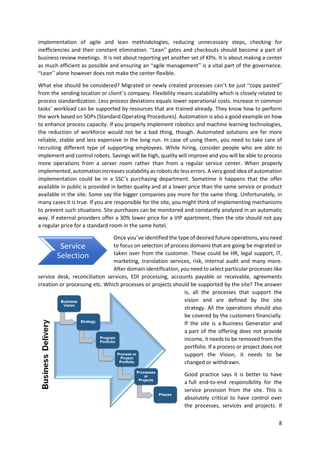
After domain identification, you need to select particular processes like
service desk, reconciliation services, EDI processing, accounts payable or receivable, agreements
creation or processing etc. Which processes or projects should be supported by the site? The answer
is, all the processes that support the
vision and are defined by the site
strategy. All the operations should also
be covered by the customers financially.
If the site is a Business Generator and
a part of the offering does not provide
income, it needs to be removed from the
portfolio. If a process or project does not
support the Vision, it needs to be
changed or withdrawn.
Good practice says it is better to have
a full end-to-end responsibility for the
service provision from the site. This is
absolutely critical to have control over
the processes, services and projects. If
Service
Selection
9
there is a need of taking over an old/legacy environment, a correct transition and transformation phase
should enforce the migration to the new platform. Without full E2E accountability it is extremely hard
to perform such reengineering.
Processes not only need to be selected. They need also to be enabled
for flexibility. It means the company needs to have ability to change
capacity of the particular process smoothly, according to the variable
demand. If a new customer comes and requires additional support,
the Shared Service Center needs to be able to process the request.
This can be done in two ways. The SSC either hires 2%-3% resources more or it employs or orders an
additional external workforce capacity i.e. via managed services. Company can also ask its employees
to work overtime for short amount of time. Flexible processes are developed in order to accommodate
additional workload without unnecessary interruptions. It means the processes should be heavily
unified. Process scalability depends on the standardization. If a company provides services to multiple
customers, the main effort should be placed on process simplification over the accounts. Leaders and
managers responsible for services need to be able to accommodate an additional workload and
process additional tasks. However, asking employees to work overtime for longer periods is not
sustainable and generates more costs. If you expect to have additional work within the next 3 to 6
months, it is not a bad idea to hire consultants or contractors. To achieve flexibility, it is needed to
have some additional workforce that is able to train or guide new joiners and introduce processes to
the external workers. Moves in the site’s workload need to be supported by flexible real estate services
and flexible human resources (described later).
If you have defined the profile of your site, you have chosen processes,
and the delivery model, the next step would be a location selection.
First of all, you need to consider all local regulations. Sometimes it is
not possible to provide certain services from a certain location as it is
against the law. Swiss secrecy is a good example, where it is not
allowed to transfer any client related data outside the country. In some cases, only a part of the
portfolio can be delivered by a remote center. Costs matter but they are not the most important. If it
is hard to drive a business from a particular place, it is not worth to invest money there. As the service
provision is to be performed by employees, the workforce availability should be considered in the first
place. The most experienced individuals should be hired for key roles. For other types of jobs, you can
consider less experienced talents. They have necessary background and willingness to learn. Such an
approach will enable you to build a motivated and loyal team. While considering a place, pursue
locations with number of universities and high schools with the specialization aligned to your
company’s profile. Look also for cities where your competitors are present. You will have a chance to
attract their employees. Time zone also matters. Therefore, there should be no big difference between
your front office or customer’s location and a service center. Time difference can be mitigated, but it
generates additional costs. However, if the business case is positive, you can look at this as well.
Location’s flexibility should be added to the equation. If a service demand increases you need to have
office space available on the market to hire more people. The Shared Service Centre should be
established in the place where all supporting infrastructure is secured and open for growth. Local
authorities at least should support your initiative. If you experience hostile environment, do not put
your money there. Time to market is another important factor. Examine how fast you will be able to
establish and expand a center. If it takes too long, lower costs will not compensate your time. A location
needs to be also well communicated. Many people will visit SSC in the future. Direct flights and other
means of transport should be considered as a part of the business case. Stability of local law is yet
another important point. In volatile legal environment, it is not easy or even impossible to perform
A Location
Flexible
Processes
10
a stable business. If you have a choice, invest in sustainable economies. Define how long you are going
to perform operations from a Shared Service Centre and calculate TCO for each location. It is up to you
how you define your weights. If you consider everything important to your business, your choice will
lead you to the success.
Flexible Shared Service Centre requires a little different approach to
the workforce. To leverage the model, you need to be open to both,
an increase or decrease. Flexible approach should be incorporated
into the HR architecture. The company needs to hire employees in an
easy way. If a situation goes in the wrong direction the workforce
should be adjusted to a lower demand. This cannot be executed easily if you have 100% of permanent
staff. Therefore, you should be open either for contractors or managed service providers, or both. It is
obvious that contracting workforce comes with the premium. You pay more for the same amount of
staff. However, there are some benefits. You are able to adjust amount of contractors relatively fast.
If you need to release people you can retain your permanent employees. Contract employment is
usually less regulated. Most of administrative tasks are done either by contractors themselves or the
vendors who are their providers. Thus, you save the money in a legal and HR departments. You need
to remember that in some countries the labor law does not allow to hire contractors directly. For
instance, in Romania all employees should have regular work agreements. In such case the vendors
come with a helping hand. They deliver their employees to variety of companies. Such “contractors”
have their work contracts, you are allowed to engage them, but they are not your employees. In case
of using managed services, the workforce is even more adjustable. You can order a service but not
people. You lose ability to influence particular employees engaged in the delivery. However, you have
a service provider to speak to if you are experiencing any problems with speed, quality or accuracy,
etc. There is also a positive aspect, quite important for some companies. External workers are not
usually headcountable.
What is the correct balance between contingent and permanent staff? It depends. In most cases, if the
company is well established on the market, the number of perms vs contingent employees should be
around 60-70% to enable sustainable growth and process stability. Each company should recognize
top talents as their key employees. This is the area where all people-related investments should go. It
is not good to relay on the contractors in the key processes. After all, your perm employees maintain
company’s knowledge base. You need to be very careful when engaging external workers. They should
be hired to tasks where you need an instant support. If the crisis is over, do the knowledge transfer
and engage your employees. You also need to balance between costs and gains. If you know that
contractors are more expensive, do not allow them to perform tasks for longer periods. It still happens
that companies use them for 5-10. If that is your case, consider internalization. Margin on the external
workforce differs on the market. It starts from 5% to 10% and reaches up to 60% for the same service.
If there is a company which provides the same skillset, or even the same people, at lower rates, there
is no need to overpay.
How to keep talents?
According to Tenacity’s research2
a true attrition cost could be as high as 8,437.50 USD per an attrit in
the BPO sector (up to 6159.85 USD in a call center). Therefore, if you operate a BPO business with 3000
FTEs and experience 10% of attrition, the total yearly cost would reach up to 2 531 250 USD. Are the
numbers worth your consideration?
2
Tenacity CFO Guide: Eight steps to measuring the true cost of agent turnover in a call center
Flexible
Workforce
11
There are many ways of retaining employees. People like being engaged in meaningful tasks.
Moreover, they do not want to deliver bad quality work. Even if your company needs to sacrifice the
quality over the speed, conduct lessons-learned sessions and implement improvements.
People would like to be treated in a fair and equal way. It means that you need to invest time and
money on the talent recognition programs. If you have talents reward them in an appropriate way. If
you have somebody who has won a 200mUSD deal or was able to drive the costs down by 50mUSD,
then there are other ways to say “thank you” than a shoulder tapping. Money is attractive but if an
employee makes an appropriate amount, then the salary is only an additional gratification. In most
cases talents need new challenges and exciting tasks. It leads to more accountability. Sometimes
recognition comes with the promotion, sometimes, it does not. But you should always take care on
the people who deliver.
You may buy private medical care programs or provide company cars. You may even implement cross
company career paths, band driven bonus schemes, pension fund allowances, etc. However, without
fulfilling basics the best ones resign.
Flexible permanent workforce
How to prepare to the increase in the perm employees area? If you plan an expansion, you need to
invest in having an extra 2%-3% of internal employees who will drive the move. When the time comes,
these people who have knowledge of products, processes and projects constitute the core of new
teams. For a small amount of time they will be engaged in regular projects or they will support regular
operations. Company needs to have this capacity to take care of new team members, contractors and
consultants. These core people do a knowledge transfer and train new employees. Investing in
additional capacity is worth having a flexibility option for the future expansion.
Releasing perms
There are situations when you need to make your SSC’s staff redundant. Usually you start from
external employees as releasing perms is more complex. If you need to reduce perms, you have to
check legal conditions first. Some regulations allow to lay off employees relatively easy. In case you are
operating in more difficult environment you need to use options that local law gives you. If dismissing
employees is not legally possible, then you can try to offer them positions in other service centers or
hub locations. If you cannot do it, you need to offer a good outplacement program. In such case, an
employee needs to agree on offered terms and conditions.
12
Appropriate and open communication will help to maintain engagement, productivity, and motivation
of these who stay in your company.
How to control separate operations and ensure consistency in
approach among departments? There are many types of actions that
help to achieve the goal. First of all, KPI sets should be defined for both:
all delivered services and all divisions in the center. Quantitative and
qualitative KPIs need also to be applied to all departments, including
accounting, HR, risk, audit and others. This can be hard to implement, but if KPIs work with the service
delivery area, then they might be applied to entire organization. A site head must be able to control
and influence his area of responsibility. Processes and projects do not need to be micro-managed. If
there are problems in financial area (i.e. high amount of not processed operations or significant value
of not recharged invoices) or in HR (i.e. high number of candidates who resigned before being hired,
high attrition in certain departments, big differences in salaries on the same positions etc.), there
should be a mechanism that rings a bell as soon as possible. A dashboard with high-lights and low-
lights reviewed on regular basis helps. Operational flexibility can be achieved when the management
has the clarity of the site’s state.
Another thing, which steers and shapes company’s culture, introduces minimum management rule-
set to every function and department. Its content should be adjusted to the needs. It can include
mechanisms that enforce implementation of correct governance structures in departments, a check if
there is no conflict of interest within functions or control of all mandatory training execution etc.
These are the basics. However, companies sometimes neglect necessity of implementation.
A site’s closure should be considered if, for any reason, there is no
service demand or a center cannot perform its operations. Every
company should have its own exit strategy. The most important aspect
is to retain knowledge within the organization. Securing remaining
processes and exiting businesses that are no longer supported should
also be considered. Exit strategy needs to be documented in the site’s TOM. Site management is
responsible for its execution. Establishing a new center in another location could be a part of the
strategy. If it happens, all the steps mentioned above apply to the new site and our journey starts
again. After the closure, you should calculate all gains, savings and total expenses (TCO). This step is to
be your starting point to the estimations concerning a future location.
I have written about current situation in the SSC sector. I have also
described key points that should be considered while establishing
a flexible service center. There are companies that are performing
their operations in such way already. Other ones migrate to achieve
benefits coming from flexibility. It impacts the entire BPO sector at the
moment. Have you thought of the future of the outsourcing industry? How would the SSCs look like in
5 to 10 year time? I try to focus on the centers that are established by big players and market shapers.
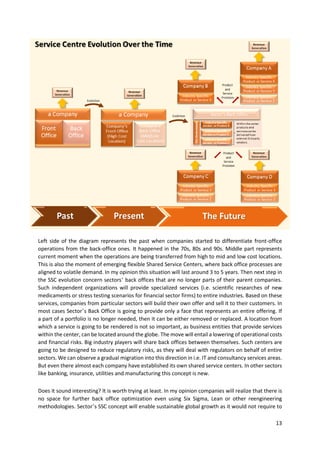
Let me guide you through the evolution cycle.
Future of
SSCs
Closure
Operations
13
Left side of the diagram represents the past when companies started to differentiate front-office
operations from the back-office ones. It happened in the 70s, 80s and 90s. Middle part represents
current moment when the operations are being transferred from high to mid and low cost locations.
This is also the moment of emerging flexible Shared Service Centers, where back office processes are
aligned to volatile demand. In my opinion this situation will last around 3 to 5 years. Then next step in
the SSC evolution concern sectors’ back offices that are no longer parts of their parent companies.
Such independent organizations will provide specialized services (i.e. scientific researches of new
medicaments or stress testing scenarios for financial sector firms) to entire industries. Based on these
services, companies from particular sectors will build their own offer and sell it to their customers. In
most cases Sector’s Back Office is going to provide only a face that represents an entire offering. If
a part of a portfolio is no longer needed, then it can be either removed or replaced. A location from
which a service is going to be rendered is not so important, as business entities that provide services
within the center, can be located around the globe. The move will entail a lowering of operational costs
and financial risks. Big industry players will share back offices between themselves. Such centers are
going to be designed to reduce regulatory risks, as they will deal with regulators on behalf of entire
sectors. We can observe a gradual migration into this direction in i.e. IT and consultancy services areas.
But even there almost each company have established its own shared service centers. In other sectors
like banking, insurance, utilities and manufacturing this concept is new.
Does it sound interesting? It is worth trying at least. In my opinion companies will realize that there is
no space for further back office optimization even using Six Sigma, Lean or other reengineering
methodologies. Sector’s SSC concept will enable sustainable global growth as it would not require to
14
gather all resources in dedicated locations. Services are going to be provided according to the needs
and specializations. Global companies would have a choice where and when they hire resources
needed for certain tasks.
However, this approach requires constant focus on the governance to be able to fulfill all legal and
regulatory requirements. Moreover, a shift in the management paradigm is needed. In the future
managers will not be responsible for their own workforce. The responsibility will be closely coupled
with managed service delivery, sometimes from 3rd
party vendors to front office operations. A new
back office will employ less people in the favor of automatic scripts and programs. The concept not
only strengthens but rather enforces flexibility. I think it is something we all are looking for.
About the author…
Wojciech Warzecha is an experienced outsourcing manager. Skilled in the Business Process
Outsourcing, including: nearshoring and offshoring. Certified in the area of corporate architecture. He
has delivered change programs, projects and services to and from the SSC. He was responsible for site’s
transformational projects, including strategy development, human capital aspects, governance and
branding. He is passionate about “Flexible BDC" concept (key drivers: vision and mission statement,
appropriate governance, elastic workforce, correct span of control, robust processes, KPI/SLA based
delivery). His many years’ outsourcing experience is complemented by participation in seminars and
conferences (as attendee and lecturer) and constant interaction with business owners and BPO
managers.

Flexible Service Centres

  • 2.
    1 How does itscale? A thing about the flexibility of Shared Service Centers Since many years international companies try to be more productive and more profitable to their stakeholders and owners. An outsourcing approach is one of the popular ideas that are changing the way on how corporations operate. Outsourcing supports global sustainable growth by transferring advanced solutions from developed economies to less advanced countries. There are other positives like ability of lowering operational costs. I doubt anyone thinks of outsourcing without bearing in mind such benefit. But, is this approach still valid? Do we use all the opportunities economy gives us? How to set up a BPO business correctly to avoid traps and mistakes? If we have established a business and we have experienced obstacles: how to implement countermeasures? What is the next logical move after applying techniques supporting increase of the efficiency and effectiveness? What is the answer to challenges we face in the battle of profitability? And last but not least, how the BPO sector will look like in 3 to 5 years and what happens next? By writing this article I am trying to describe what are the most important factors that affect profit generation and income increase. I also provide a set of solutions and key focus points that would lead to the flexibility, which is the answer to most of current problems in the outsourcing environment. Let’s consider a number of scenarios. You have built a Service Centre. It operates and delivers. Costs are under control. Additionally, you have just won a very big deal. A prospect that was behind your imagination materialized and now you need to increase your operational capacity by 30% in 1 or 2 months. What would you do? Let’s imagine a different situation. In a country where you performing your operations a new government have changed the business rules. Now you need to increase a number of reports twice or three times. What would you do then? Or, you have bought your competitor. You have doubled amount of processes and your delivery is not efficient anymore. You need to merge two companies and perform a fast reengineering. Maybe there is a way of avoiding unplanned interruptions or minimizing negative impact they have on the business and its results? Let’s look at the other side. Your financial results have been lower than expected. Maybe you have lost a very profitable customer. You need to cut operational budget by 20% in a very short time. Maybe you have performed operations in a low or medium cost place. Due to the increase of currency value or the staff salaries, your business is no longer profitable. Or, hard Brexit has occurred. You need to decrease your UK operations and increase hiring elsewhere. Maybe a new and innovative technology (i.e. robotics, machine learning etc.) was advertised on the market. It gives you a possibility to reduce your manual processes by 1/3 (i.e. coping cell A342 to the cell XZ443 and putting results to the monthly MBod’s presentation). Would you decide to take advantage? Are your processes support such fast changes? Flexibility is the answer Flexibility allows companies to adjust their operational capability relatively fast. It gives a chance to reduce processes or increase number of operations in a structured way, within the borders of controlled risk. Some say that without any risk, which is not necessarily true. Flexibility also provides a mechanism to adjust to the market’s volatility.
  • 3.
    2 A Shared ServiceCentre in the middle of scalable operations The Flexible SSC is capable to perform flexible operations (a factor that enables increase or decrease number of concurrent simultaneous operations without incurring penalties or changes in the process performance) by using flexible work force (where number of staff can be adjusted to the changing demand) in environment which is exposed to flexible expansion (both ways: increase or decrease). Architecture of the Flexible Service Centre should be carefully designed without compromises. One of the most important success factor that enables flexibility is a Transition and Transformation planning phase and its further execution. Avoiding of appropriate preparations causes many potential problems in the future. Applying it does not guarantee 100% success in the flexible environment, but it is a very important prerequisite. This step makes a real difference when it comes to the competition between the concept of a Standard and a Flexible Service Center. While designing a regular center it usually happens that companies establish a set of mirrored processes in a remote location. In this example, a person who works on invoice processing in a service center would have the same amount of monitors, workstations, phone lines etc. as the staff in the sending hub. If a process requires 6-eye check, new process would also require 6-eye check. It is common to make a role redundant in a high cost location and transfer it with everything to the mid or low cost country. But does it make sense? It is easier to migrate roles in that way – I agree. However, is it cheaper, more effective or flexible? I do not think so. The standard T&T process looks like this: Classics say: do not even think about transformation during process transition. Do one change at a time. But if you stick to the classical paradigm, you will limit your options for flexible operations. If you plan a transition carefully and insert process reengineering steps inside the transition project, you will be able to do a successful transition, without losing control over the operation. Therefore, the new model will emerge: Based on my research done in 20161 , only 18% of SSCs providing services to their parent companies combined transition with the transformation during the process migration. 1 Research concerning outsourcing centers based in Poland, which is one of the most developed BPO location in the Central and Eastern Europe. Transition and Transformation Planning
  • 4.
    3 Based on theinterviews with the decision makers, combining transition with transformation takes off between 8% to 16% of the costs from the predicted initial Shared Service Center’s cost base. This saving can be utilized in two ways: to grant immediate gains to stakeholders or to enable flexibility in the long run. Companies which have successfully introduced simultaneous implementation of transition and transformation, confirm it works. How to start then? The sales phase can be considered as the first step in the creation of a Flexible Service Centre. It does not matter if you are going to build an internal back-office or a center that serves external customers. You need to know and understand the center’s cost base and the final or transfer price of the services that are going to be offered. If you want to run a flexible business, you need to consider flexibility as a part of your design thinking process before even starting any operations. Additionally, you need to think of the process standardization. In case of the FDC (Flexible Delivery Centre), less process deviations mean less waste and lower operational costs. It is easier to convince your own company that having a flexible center make sense. If you are dealing with external customers then the price, quality and speed of delivery is something that counts. How to convince them that flexible service delivery is the right choice? First, the price should not be higher than the price of regular services. You can add additional benefits, like year on year savings. These can be spent on obtaining new services. Then, the quality should be higher or at least “at level”. There is a way that can help. Flexibility related assumptions should always be incorporated to the bidding process. While considering a service valuation you cannot just assume that you transfer processes without any changes. If you or your company is not ready, you will lose time and money for the transformation done afterwards. If your external customer is not ready – you can convince him by offering competitive price for the service which suits his needs. It is your duty to assure that changes in the processes he is going to receive are under control. All changes need to be documented in the service contract, all the KPIs and warning thresholds should be defined before the service is going to be live. It guarantees a safe position and full success to both parties. If the customer is not happy with a flexible solution, then there are two possible scenarios. First, the margin is considerably high and the Sales Phase
  • 5.
    4 service is bigenough to set up a separate operation (then forget about flexibility). In the second one, you can decide to perform low margin standard services. However, when business disruptions come, you fall into troubles. There is also another option. A customer operates in an “old fashioned way”. You have absolutely no relationship with him and you do not know his business. You would like to win a contract anyhow and apply flexible solutions, without even building business relation beforehand. If you win such deal, such a customer could be massively unhappy with changes in processes. In case of internal department, this situation can be relatively easy mitigated. If you are dealing with external customer, it leads to the law debates in many cases. I know few companies that operate in this model and I do not recommend it. I am fully convinced the successful business should reflect a win-win situation. The court is not a good place to establish a proper relationship in business. To summarize, in the bidding process you should consider flexibility as a part of the calculation. If you do it, the next step is to ensure that all contractual arrangements are implemented in all provided services. Shared Service Center Lifecycle In this and the next chapters I would like to focus on establishing a Shared Service Center. I would like to present the key enablers of the flexibility and touch on the differences between a standard and flexible approach. I will provide a guidance of steps that should be followed and those ones that should be avoided. Setting up a service center should not be a complex operation. Basically, you need to remember about the key crucial phases. However, when setting up a Flexible Service Centre, a special focus should be put on the planning. Everything which is to be built later, depends on this phase. You just need to spend more time to get it right in order to take more advantages in the future. Vision and Preparations The first step is to decide which type of the Service Centre you are going to establish (then when and where). Which processes are considered to be in scope and which ones are excluded? One of the most important questions here is who would be the customer? Whether the center is going to be a back/mid-office only with underlying processes or whether it is going to be a center that provides front office services and deals Vision
  • 6.
    5 with external customerson a daily basis. In the latter case, you need to build a sales and marketing department. If you would like to decrease operational costs somehow, the first logical step is to simplify processes. Then, you need to implement lean or agile methodologies to ensure if YoY efficiency and effectiveness are possible. You should also consider a service centralization. Maybe you would even like to go flex? From the business perspective, it is very important what your motivations are and what your Vision is. Future operations will be adjusted to it. What (is going to be provided), Where, When? These three questions should be answered in the Planning phase. The sooner you have the answer the better. Setting up a (Flexible) Shared Services Site Here is a sample guideline on how to set up a Shared Service Center. On the picture below the key aspects, dependencies and main focus areas are presented. This approach can be used to set up both, a regular or a flexible SSC. In the next few chapters the main difference and requirements will be described. There will also be provided a guideline on how to avoid obstacles and mitigate issues early. Some well-known companies tent to skip to skip key architectural areas. Things like human capital architecture are sometimes skipped from initial planning. This is not a good practice. If you plan to have a flexible center, spend more time during planning phase to establish a common site architectural concept. An initial planning focuses mainly on the site architecture. In the Vision phase, we have answered questions about the purpose of the site. Now it is time to focus more on the preparations of the future operations. The Site’s Target Operating Model is a predecessor of setting up the Operating Models for particular services. The setting phase could be a little bit different for two site types. Setting up Business Generators, where internal sales and marketing department makes deals with external customers directly, requires more effort on the Sales Architecture. Having a local sales team is not a bad idea, as sometimes customers expect a local “business intimacy”. Business Supporters are the opposite. These are the centers that provide back and mid-office services. They should rely more on the correct transfer pricing mechanisms and detailed Service Operational Site Planning
  • 7.
    6 Agreements. Such centersdo not need to invest in in CRM systems or hire sales representatives. In both cases a location aspirational view should be defined. It is something more than the description of the place where the site is to be settled. This is also a definition of the goals that SSC needs to achieve in the future. At the end of the planning phase you will have the full working site with processes defined in details. Then the Site head (site CEO) is able to manage the site by utilizing implemented metrics and control systems. Policies and principles are integrated as a part of the site’s delivery model. Both, internal and external advertising campaigns provide access to the pool of talented individuals who work together to deliver the highest value of the products or services. Companies tend to underestimate efforts necessary to careful planning of the governance. Its general purpose is to support seamless delivery from the site. It is achieved by providing optimized structure aligned to company’s requirements, applicable law and regulations. SSC’s governance model includes: - the site’s governance containing governing bodies and their specification - description of the key role’s responsibilities (i.e. Site Head/Site CEO/Site Manager or site’s CFO) - governance for processes and projects - responsibilities for risk, compliance and audit - reporting lines with the specification of solid line reporting and dotted line responsibilities - structures (standard or matrix) - etc. Key aspects of the governance What sometimes happens when it comes to establishing a new service center is the settlement of company’s basic structure without defined responsibilities. Even though it fulfills local regulations, senior management who supposed to be responsible for the site, do not control service delivery. Such “ad-hoc governance” leads to massive ineffectiveness. As the Flexible Service Centre operates as the service provider, therefore its head bears the full responsibility for the entire site’s delivery. To achieve such capability, it is necessary to ensure that the site head has a clear mandate to govern. Structuring the site head’s role in that way guarantees the consistency in approach, effectiveness of the service provision and the processes’ efficiency. Such manager is able to determine service demand and can initiate switching resources between business divisions when necessary. The role’s responsibility concerns also planning the site’s capacity for an increase or decrease. Subsequently, division heads are responsible for strategy implementation in their areas, therefore they need to report to site head directly. This concept is crucial to the flexible SSC success. In terms of the execution speed, a solid line reporting gives the site’s CEO appropriate tool to enforce decisions quickly. If the site’s service capacity is about to expand, then each decision maker is going to support the move. Problems arise when the site is to reduce its capacity. Taking it into consideration, a single decision instance has a mandate to solve never-ending debates and fights for saving divisional resources. If there is no single person with responsibility for the site, it might happen that restructuring activities move costs from one division to another within the same delivery center (or even from low cost location to a hub). When responsibility for the cost center structure falls under the site’s CFO, such situations are mitigated. The site’s manager should have an ability to influence his directs’ incentive structure, which is aligned to their goals and objectives. In an ideal situation, a person who has a functional head’s role is fully accountable for the entire division, including the business delivery and division’s KPIs. It is the role’s responsibility to organize and implement processes Governance and Leadership
  • 8.
    7 according to thebusiness needs, company’s directives and regulations. This accountability cannot be delegated. If the site is to generate business by selling products or services (i.e. software development, financial services, HR, payroll, or scientific research done on newly discovered chemical compounds) the governance function needs to be built around the sales and marketing functions. Departments like FA, controlling, internal audit or the business operations should support the sales processes. CFO is to be responsible for ensuring positive cash flow and guaranteeing that sale related costs are lower than incomes. Securing compliance with the financial law is also his duty. In case the site is a back-office center a different type of governance needs to be established. CEO and CFO should ensure that the site capabilities are aligned to Hub locations’ needs. P&L is also constructed differently. For the site which does not generate profits, P&L calculation reflects correct transfer pricing and site’s costs recharging. What about other required functions? Big corporations tend to organize themselves as the sets of governing committees. It sometimes leads to blurred responsibility. As the result, we may observe regular issues with the provision of effective operations. Finally, the companies try to resolve problems generated by themselves. Governing bodies can help to structure and coordinate site operations by enabling cooperation between divisions. However, the responsibility for the delivery cannot be passed over to any kind of body. There always should be a specific role that holds accountability. It does not matter if you are responsible for company’s back office or client facing operations. The site needs to deliver. And this should be an effective and efficient delivery. It might happen that you are an executive who is leading an operation where reporting lines are not connected to you anyhow. In such a case, you can gradually migrate to flexible SSC concept by increasing your area of responsibility, supporting solid and dotted line creation, and giving your directs more control over the delivery. Your accountability will increase over the time. A word about the business leader Who should steer a site? What skills and qualities are required and recommended? It depends on the site’s purpose. If you are to establish a sales oriented service center, you need to have a sales person on the site’s CEO function. This manager needs to drive sales and marketing activities, make profitable relationships and navigate the facility in the direction of successful deals. If you are about to create a back office for your hub location than the different skill set is needed from a leader. He will be building relationships in hub locations, convincing stakeholders that the site is able to deliver and supporting services transition. Moreover, such manager will be responsible for making connections with the local officials, society and developing Corporate Social Responsibility. These two roles are similar to some extent. The difference is in the approach to sales activities. While considering a Target Operating Model (TOM) you need to differentiate the site’s TOM from TOMs created for particular services. Distinction is important as the former tells how the site operates and the latter refers to the services provided from the center. The TOM document describes the final state of the operations once the transition and transformation ends. It illustrates who does what and when. If you design automatic processes, this area also must be considered as the part of TOM. The document describes how to recover from a crisis or how to escalate in case of an issue or unusual incident. TOM for the site describes governance model with defined responsibilities. When considering a site as a whole, the document should cover all transformation steps for services in the portfolio. The main question that is to be asked here is how the operations should be designed. In terms of processes it means Target Operating Model
  • 9.
    8 implementation of agileand lean methodologies, reducing unnecessary steps, checking for inefficiencies and their constant elimination. “Lean” gates and checkouts should become a part of business review meetings. It is not about reporting yet another set of KPIs. It is about making a center as much efficient as possible and ensuring an “agile management” is a vital part of the governance. “Lean” alone however does not make the center flexible. What else should be considered? Migrated or newly created processes can’t be just “copy pasted” from the sending location or client’s company. Flexibility means scalability which is closely related to process standardization. Less process deviations equals lower operational costs. Increase in common tasks’ workload can be supported by resources that are trained already. They know how to perform the work based on SOPs (Standard Operating Procedures). Automation is also a good example on how to enhance process capacity. If you properly implement robotics and machine learning technologies, the reduction of workforce would not be a bad thing, though. Automated solutions are far more reliable, stable and less expensive in the long run. In case of using them, you need to take care of recruiting different type of supporting employees. While hiring, consider people who are able to implement and control robots. Savings will be high, quality will improve and you will be able to process more operations from a server room rather than from a regular service center. When properly implemented, automation increases scalability as robots do less errors. A very good idea of automation implementation could be in a SSC’s purchasing department. Sometime it happens that the offer available in public is provided in better quality and at a lower price than the same service or product available in the site. Some say the bigger companies pay more for the same thing. Unfortunately, in many cases it is true. If you are responsible for the site, you might think of implementing mechanisms to prevent such situations. Site purchases can be monitored and constantly analyzed in an automatic way. If external providers offer a 30% lower price for a VIP apartment, then the site should not pay a regular price for a standard room in the same hotel. Once you’ve identified the type of desired future operations, you need to focus on selection of process domains that are going be migrated or taken over from the customer. These could be HR, legal support, IT, marketing, translation services, risk, internal audit and many more. After domain identification, you need to select particular processes like service desk, reconciliation services, EDI processing, accounts payable or receivable, agreements creation or processing etc. Which processes or projects should be supported by the site? The answer is, all the processes that support the vision and are defined by the site strategy. All the operations should also be covered by the customers financially. If the site is a Business Generator and a part of the offering does not provide income, it needs to be removed from the portfolio. If a process or project does not support the Vision, it needs to be changed or withdrawn. Good practice says it is better to have a full end-to-end responsibility for the service provision from the site. This is absolutely critical to have control over the processes, services and projects. If Service Selection
  • 10.
    9 there is aneed of taking over an old/legacy environment, a correct transition and transformation phase should enforce the migration to the new platform. Without full E2E accountability it is extremely hard to perform such reengineering. Processes not only need to be selected. They need also to be enabled for flexibility. It means the company needs to have ability to change capacity of the particular process smoothly, according to the variable demand. If a new customer comes and requires additional support, the Shared Service Center needs to be able to process the request. This can be done in two ways. The SSC either hires 2%-3% resources more or it employs or orders an additional external workforce capacity i.e. via managed services. Company can also ask its employees to work overtime for short amount of time. Flexible processes are developed in order to accommodate additional workload without unnecessary interruptions. It means the processes should be heavily unified. Process scalability depends on the standardization. If a company provides services to multiple customers, the main effort should be placed on process simplification over the accounts. Leaders and managers responsible for services need to be able to accommodate an additional workload and process additional tasks. However, asking employees to work overtime for longer periods is not sustainable and generates more costs. If you expect to have additional work within the next 3 to 6 months, it is not a bad idea to hire consultants or contractors. To achieve flexibility, it is needed to have some additional workforce that is able to train or guide new joiners and introduce processes to the external workers. Moves in the site’s workload need to be supported by flexible real estate services and flexible human resources (described later). If you have defined the profile of your site, you have chosen processes, and the delivery model, the next step would be a location selection. First of all, you need to consider all local regulations. Sometimes it is not possible to provide certain services from a certain location as it is against the law. Swiss secrecy is a good example, where it is not allowed to transfer any client related data outside the country. In some cases, only a part of the portfolio can be delivered by a remote center. Costs matter but they are not the most important. If it is hard to drive a business from a particular place, it is not worth to invest money there. As the service provision is to be performed by employees, the workforce availability should be considered in the first place. The most experienced individuals should be hired for key roles. For other types of jobs, you can consider less experienced talents. They have necessary background and willingness to learn. Such an approach will enable you to build a motivated and loyal team. While considering a place, pursue locations with number of universities and high schools with the specialization aligned to your company’s profile. Look also for cities where your competitors are present. You will have a chance to attract their employees. Time zone also matters. Therefore, there should be no big difference between your front office or customer’s location and a service center. Time difference can be mitigated, but it generates additional costs. However, if the business case is positive, you can look at this as well. Location’s flexibility should be added to the equation. If a service demand increases you need to have office space available on the market to hire more people. The Shared Service Centre should be established in the place where all supporting infrastructure is secured and open for growth. Local authorities at least should support your initiative. If you experience hostile environment, do not put your money there. Time to market is another important factor. Examine how fast you will be able to establish and expand a center. If it takes too long, lower costs will not compensate your time. A location needs to be also well communicated. Many people will visit SSC in the future. Direct flights and other means of transport should be considered as a part of the business case. Stability of local law is yet another important point. In volatile legal environment, it is not easy or even impossible to perform A Location Flexible Processes
  • 11.
    10 a stable business.If you have a choice, invest in sustainable economies. Define how long you are going to perform operations from a Shared Service Centre and calculate TCO for each location. It is up to you how you define your weights. If you consider everything important to your business, your choice will lead you to the success. Flexible Shared Service Centre requires a little different approach to the workforce. To leverage the model, you need to be open to both, an increase or decrease. Flexible approach should be incorporated into the HR architecture. The company needs to hire employees in an easy way. If a situation goes in the wrong direction the workforce should be adjusted to a lower demand. This cannot be executed easily if you have 100% of permanent staff. Therefore, you should be open either for contractors or managed service providers, or both. It is obvious that contracting workforce comes with the premium. You pay more for the same amount of staff. However, there are some benefits. You are able to adjust amount of contractors relatively fast. If you need to release people you can retain your permanent employees. Contract employment is usually less regulated. Most of administrative tasks are done either by contractors themselves or the vendors who are their providers. Thus, you save the money in a legal and HR departments. You need to remember that in some countries the labor law does not allow to hire contractors directly. For instance, in Romania all employees should have regular work agreements. In such case the vendors come with a helping hand. They deliver their employees to variety of companies. Such “contractors” have their work contracts, you are allowed to engage them, but they are not your employees. In case of using managed services, the workforce is even more adjustable. You can order a service but not people. You lose ability to influence particular employees engaged in the delivery. However, you have a service provider to speak to if you are experiencing any problems with speed, quality or accuracy, etc. There is also a positive aspect, quite important for some companies. External workers are not usually headcountable. What is the correct balance between contingent and permanent staff? It depends. In most cases, if the company is well established on the market, the number of perms vs contingent employees should be around 60-70% to enable sustainable growth and process stability. Each company should recognize top talents as their key employees. This is the area where all people-related investments should go. It is not good to relay on the contractors in the key processes. After all, your perm employees maintain company’s knowledge base. You need to be very careful when engaging external workers. They should be hired to tasks where you need an instant support. If the crisis is over, do the knowledge transfer and engage your employees. You also need to balance between costs and gains. If you know that contractors are more expensive, do not allow them to perform tasks for longer periods. It still happens that companies use them for 5-10. If that is your case, consider internalization. Margin on the external workforce differs on the market. It starts from 5% to 10% and reaches up to 60% for the same service. If there is a company which provides the same skillset, or even the same people, at lower rates, there is no need to overpay. How to keep talents? According to Tenacity’s research2 a true attrition cost could be as high as 8,437.50 USD per an attrit in the BPO sector (up to 6159.85 USD in a call center). Therefore, if you operate a BPO business with 3000 FTEs and experience 10% of attrition, the total yearly cost would reach up to 2 531 250 USD. Are the numbers worth your consideration? 2 Tenacity CFO Guide: Eight steps to measuring the true cost of agent turnover in a call center Flexible Workforce
  • 12.
    11 There are manyways of retaining employees. People like being engaged in meaningful tasks. Moreover, they do not want to deliver bad quality work. Even if your company needs to sacrifice the quality over the speed, conduct lessons-learned sessions and implement improvements. People would like to be treated in a fair and equal way. It means that you need to invest time and money on the talent recognition programs. If you have talents reward them in an appropriate way. If you have somebody who has won a 200mUSD deal or was able to drive the costs down by 50mUSD, then there are other ways to say “thank you” than a shoulder tapping. Money is attractive but if an employee makes an appropriate amount, then the salary is only an additional gratification. In most cases talents need new challenges and exciting tasks. It leads to more accountability. Sometimes recognition comes with the promotion, sometimes, it does not. But you should always take care on the people who deliver. You may buy private medical care programs or provide company cars. You may even implement cross company career paths, band driven bonus schemes, pension fund allowances, etc. However, without fulfilling basics the best ones resign. Flexible permanent workforce How to prepare to the increase in the perm employees area? If you plan an expansion, you need to invest in having an extra 2%-3% of internal employees who will drive the move. When the time comes, these people who have knowledge of products, processes and projects constitute the core of new teams. For a small amount of time they will be engaged in regular projects or they will support regular operations. Company needs to have this capacity to take care of new team members, contractors and consultants. These core people do a knowledge transfer and train new employees. Investing in additional capacity is worth having a flexibility option for the future expansion. Releasing perms There are situations when you need to make your SSC’s staff redundant. Usually you start from external employees as releasing perms is more complex. If you need to reduce perms, you have to check legal conditions first. Some regulations allow to lay off employees relatively easy. In case you are operating in more difficult environment you need to use options that local law gives you. If dismissing employees is not legally possible, then you can try to offer them positions in other service centers or hub locations. If you cannot do it, you need to offer a good outplacement program. In such case, an employee needs to agree on offered terms and conditions.
  • 13.
    12 Appropriate and opencommunication will help to maintain engagement, productivity, and motivation of these who stay in your company. How to control separate operations and ensure consistency in approach among departments? There are many types of actions that help to achieve the goal. First of all, KPI sets should be defined for both: all delivered services and all divisions in the center. Quantitative and qualitative KPIs need also to be applied to all departments, including accounting, HR, risk, audit and others. This can be hard to implement, but if KPIs work with the service delivery area, then they might be applied to entire organization. A site head must be able to control and influence his area of responsibility. Processes and projects do not need to be micro-managed. If there are problems in financial area (i.e. high amount of not processed operations or significant value of not recharged invoices) or in HR (i.e. high number of candidates who resigned before being hired, high attrition in certain departments, big differences in salaries on the same positions etc.), there should be a mechanism that rings a bell as soon as possible. A dashboard with high-lights and low- lights reviewed on regular basis helps. Operational flexibility can be achieved when the management has the clarity of the site’s state. Another thing, which steers and shapes company’s culture, introduces minimum management rule- set to every function and department. Its content should be adjusted to the needs. It can include mechanisms that enforce implementation of correct governance structures in departments, a check if there is no conflict of interest within functions or control of all mandatory training execution etc. These are the basics. However, companies sometimes neglect necessity of implementation. A site’s closure should be considered if, for any reason, there is no service demand or a center cannot perform its operations. Every company should have its own exit strategy. The most important aspect is to retain knowledge within the organization. Securing remaining processes and exiting businesses that are no longer supported should also be considered. Exit strategy needs to be documented in the site’s TOM. Site management is responsible for its execution. Establishing a new center in another location could be a part of the strategy. If it happens, all the steps mentioned above apply to the new site and our journey starts again. After the closure, you should calculate all gains, savings and total expenses (TCO). This step is to be your starting point to the estimations concerning a future location. I have written about current situation in the SSC sector. I have also described key points that should be considered while establishing a flexible service center. There are companies that are performing their operations in such way already. Other ones migrate to achieve benefits coming from flexibility. It impacts the entire BPO sector at the moment. Have you thought of the future of the outsourcing industry? How would the SSCs look like in 5 to 10 year time? I try to focus on the centers that are established by big players and market shapers. Let me guide you through the evolution cycle. Future of SSCs Closure Operations
  • 14.
    13 Left side ofthe diagram represents the past when companies started to differentiate front-office operations from the back-office ones. It happened in the 70s, 80s and 90s. Middle part represents current moment when the operations are being transferred from high to mid and low cost locations. This is also the moment of emerging flexible Shared Service Centers, where back office processes are aligned to volatile demand. In my opinion this situation will last around 3 to 5 years. Then next step in the SSC evolution concern sectors’ back offices that are no longer parts of their parent companies. Such independent organizations will provide specialized services (i.e. scientific researches of new medicaments or stress testing scenarios for financial sector firms) to entire industries. Based on these services, companies from particular sectors will build their own offer and sell it to their customers. In most cases Sector’s Back Office is going to provide only a face that represents an entire offering. If a part of a portfolio is no longer needed, then it can be either removed or replaced. A location from which a service is going to be rendered is not so important, as business entities that provide services within the center, can be located around the globe. The move will entail a lowering of operational costs and financial risks. Big industry players will share back offices between themselves. Such centers are going to be designed to reduce regulatory risks, as they will deal with regulators on behalf of entire sectors. We can observe a gradual migration into this direction in i.e. IT and consultancy services areas. But even there almost each company have established its own shared service centers. In other sectors like banking, insurance, utilities and manufacturing this concept is new. Does it sound interesting? It is worth trying at least. In my opinion companies will realize that there is no space for further back office optimization even using Six Sigma, Lean or other reengineering methodologies. Sector’s SSC concept will enable sustainable global growth as it would not require to
  • 15.
    14 gather all resourcesin dedicated locations. Services are going to be provided according to the needs and specializations. Global companies would have a choice where and when they hire resources needed for certain tasks. However, this approach requires constant focus on the governance to be able to fulfill all legal and regulatory requirements. Moreover, a shift in the management paradigm is needed. In the future managers will not be responsible for their own workforce. The responsibility will be closely coupled with managed service delivery, sometimes from 3rd party vendors to front office operations. A new back office will employ less people in the favor of automatic scripts and programs. The concept not only strengthens but rather enforces flexibility. I think it is something we all are looking for. About the author… Wojciech Warzecha is an experienced outsourcing manager. Skilled in the Business Process Outsourcing, including: nearshoring and offshoring. Certified in the area of corporate architecture. He has delivered change programs, projects and services to and from the SSC. He was responsible for site’s transformational projects, including strategy development, human capital aspects, governance and branding. He is passionate about “Flexible BDC" concept (key drivers: vision and mission statement, appropriate governance, elastic workforce, correct span of control, robust processes, KPI/SLA based delivery). His many years’ outsourcing experience is complemented by participation in seminars and conferences (as attendee and lecturer) and constant interaction with business owners and BPO managers.