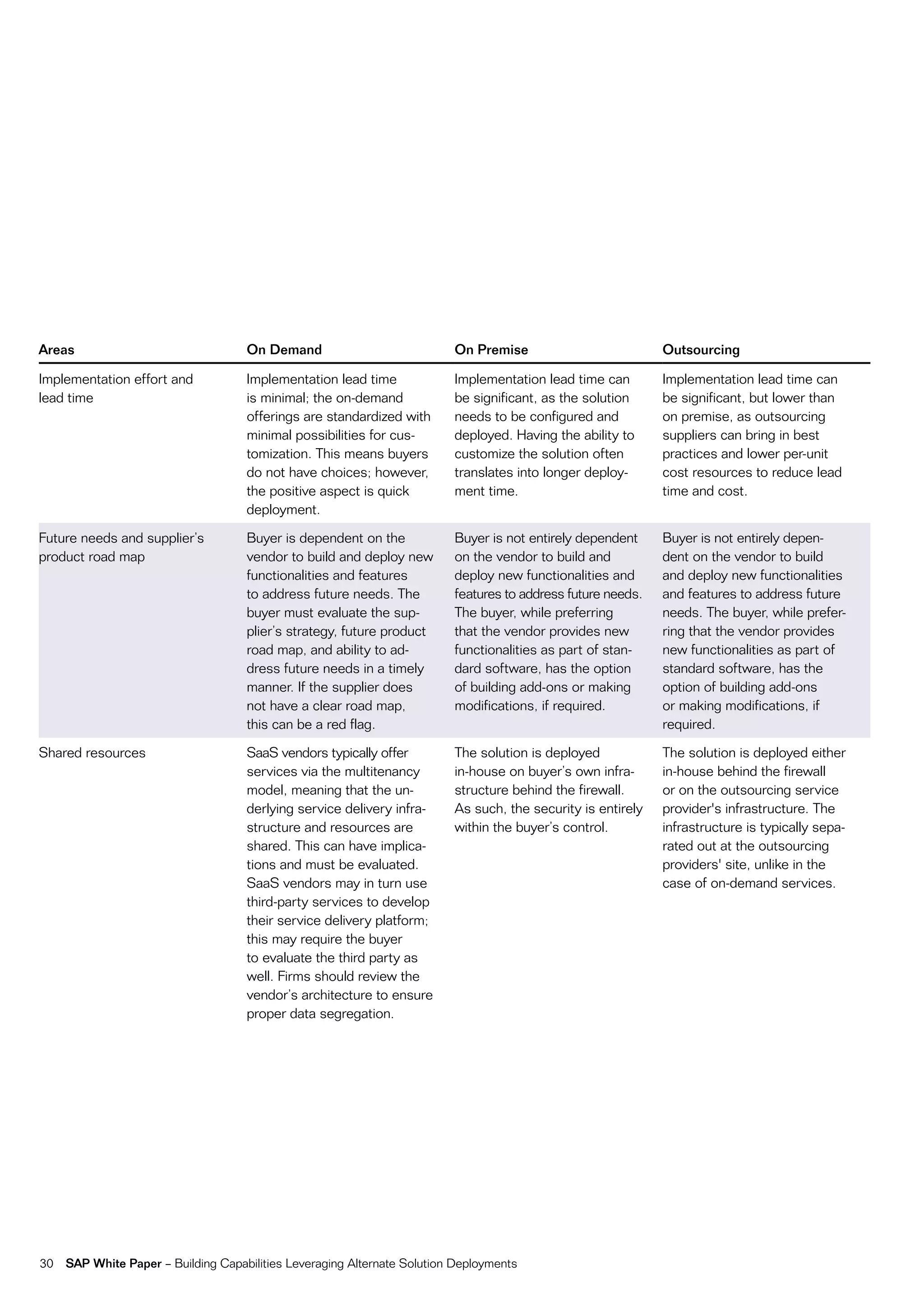
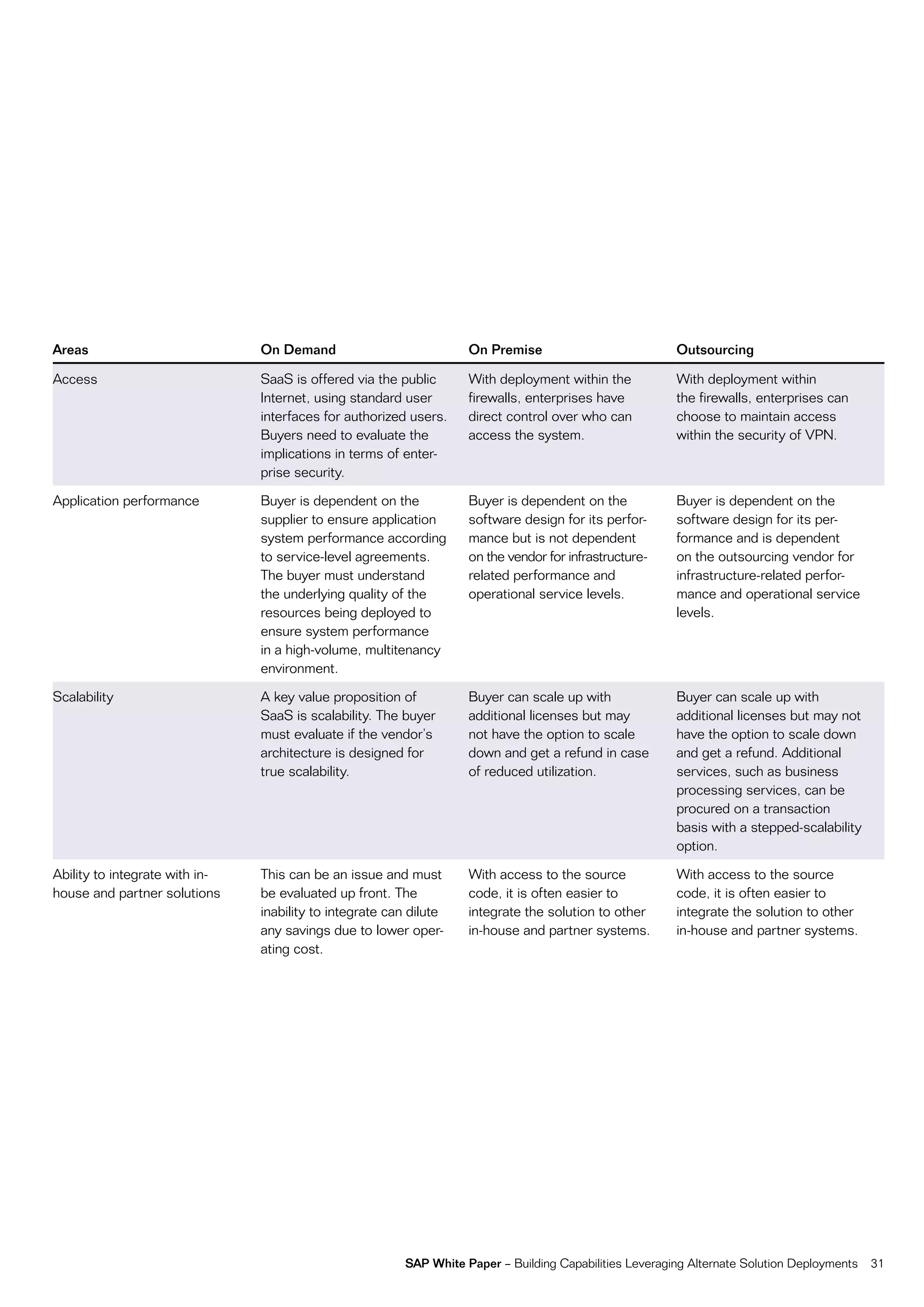
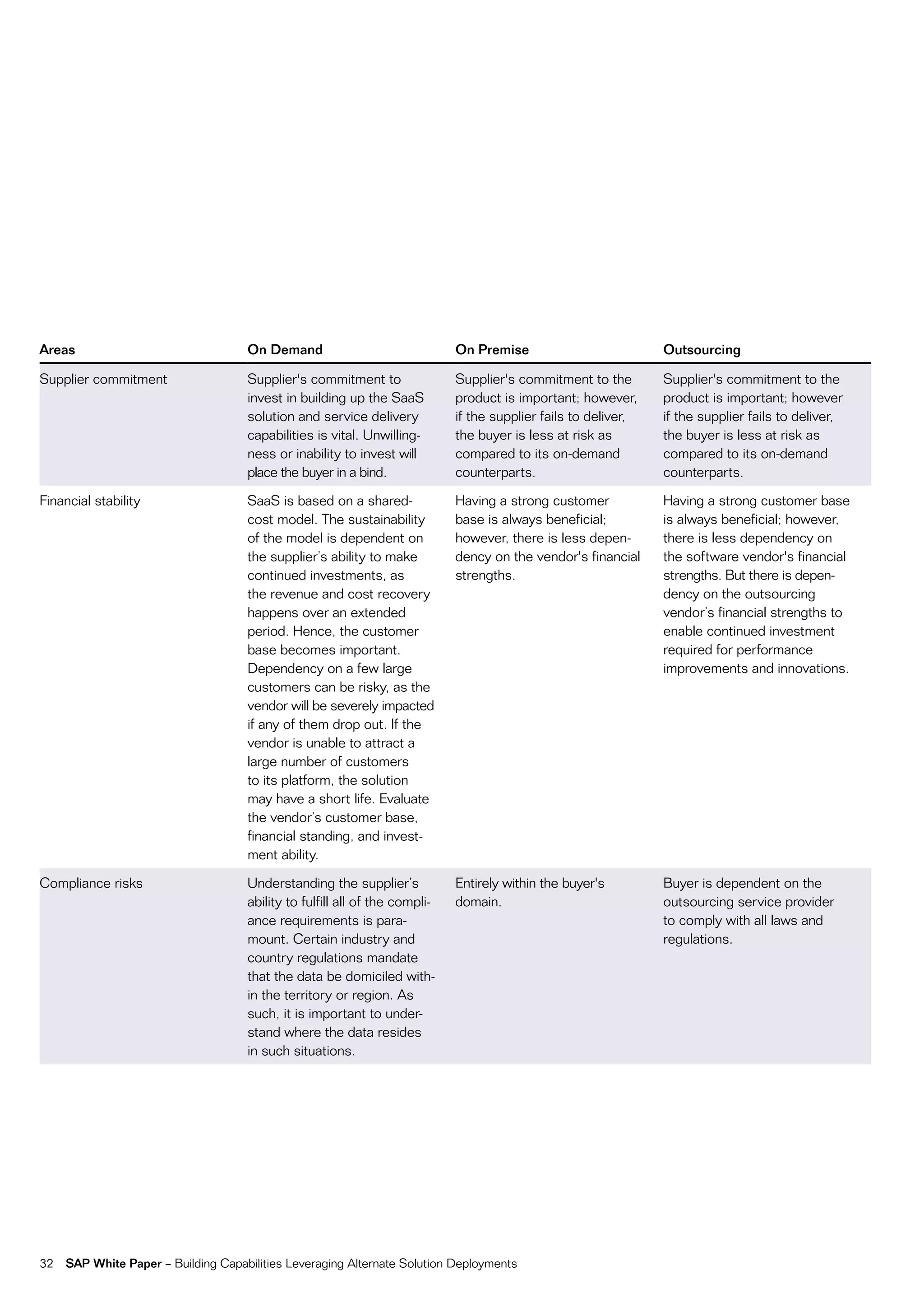
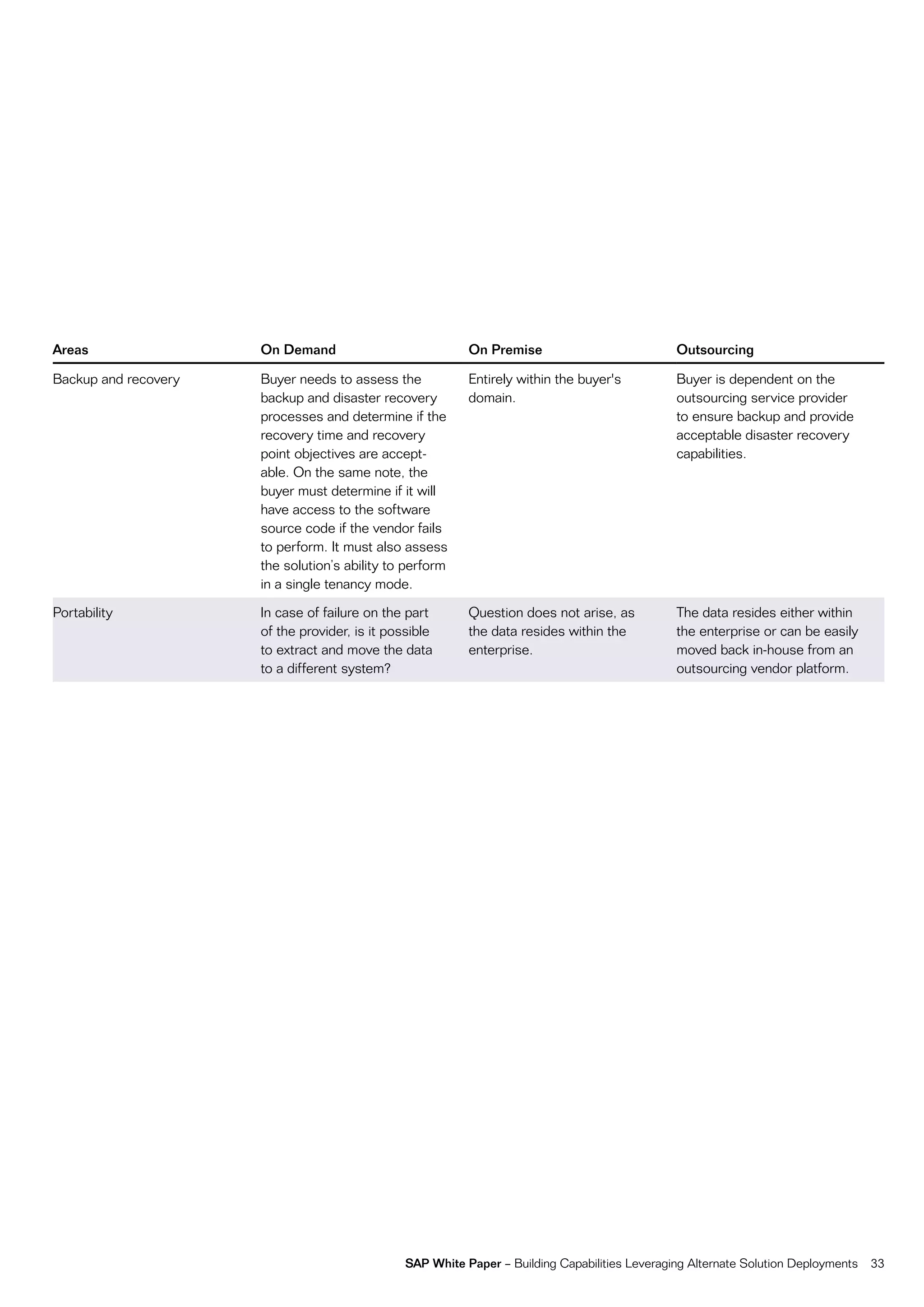
SAP White Paper
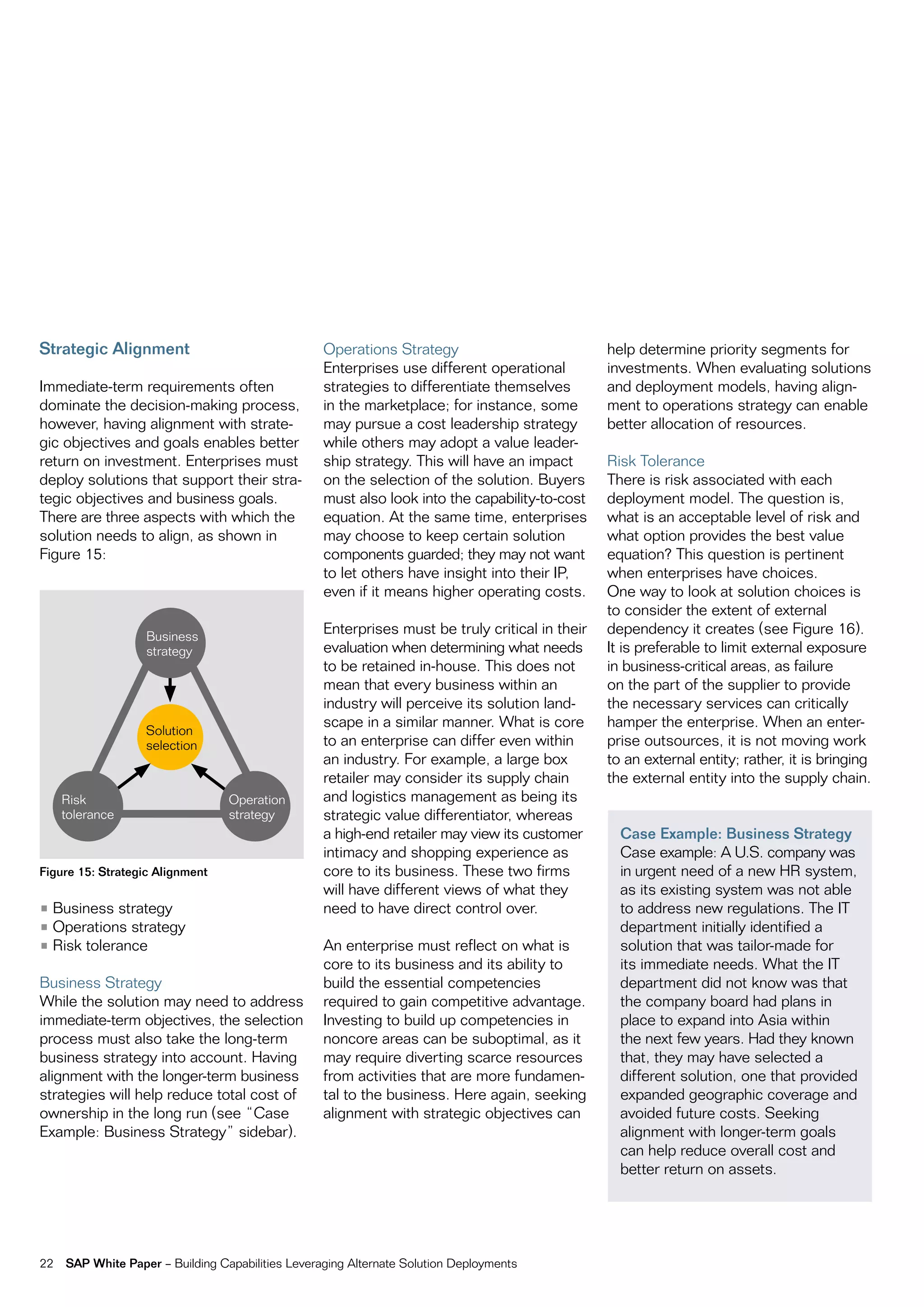
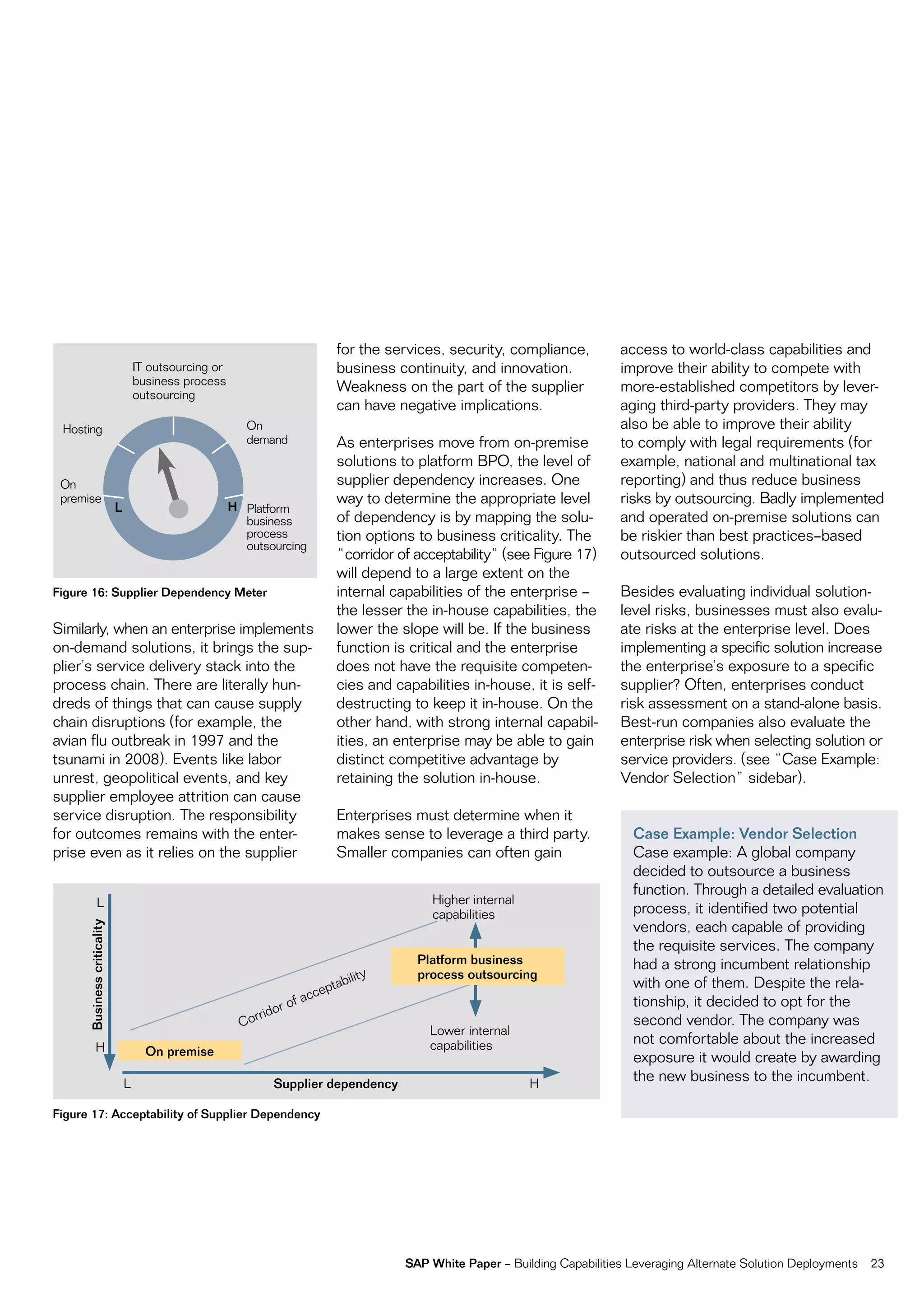
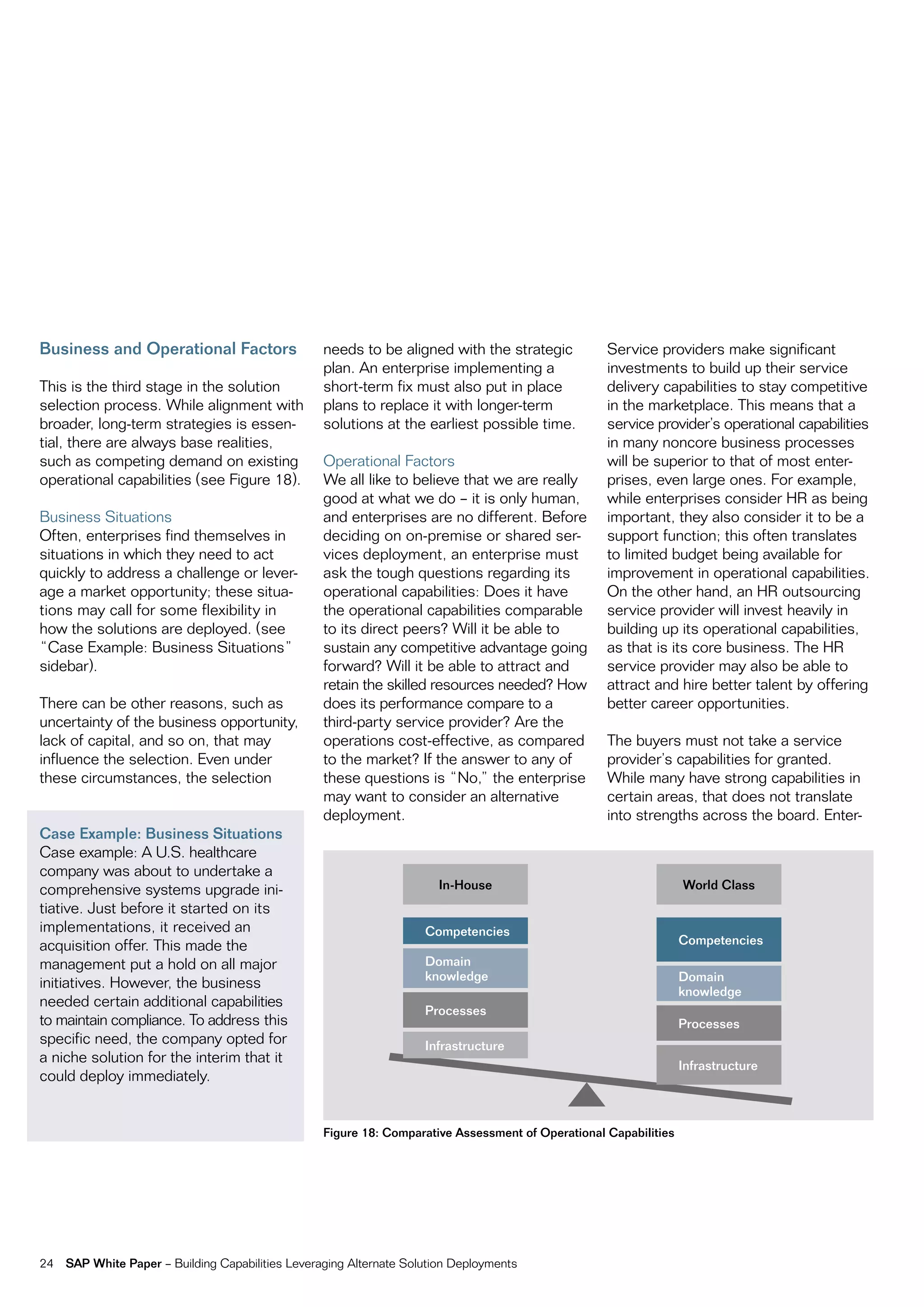
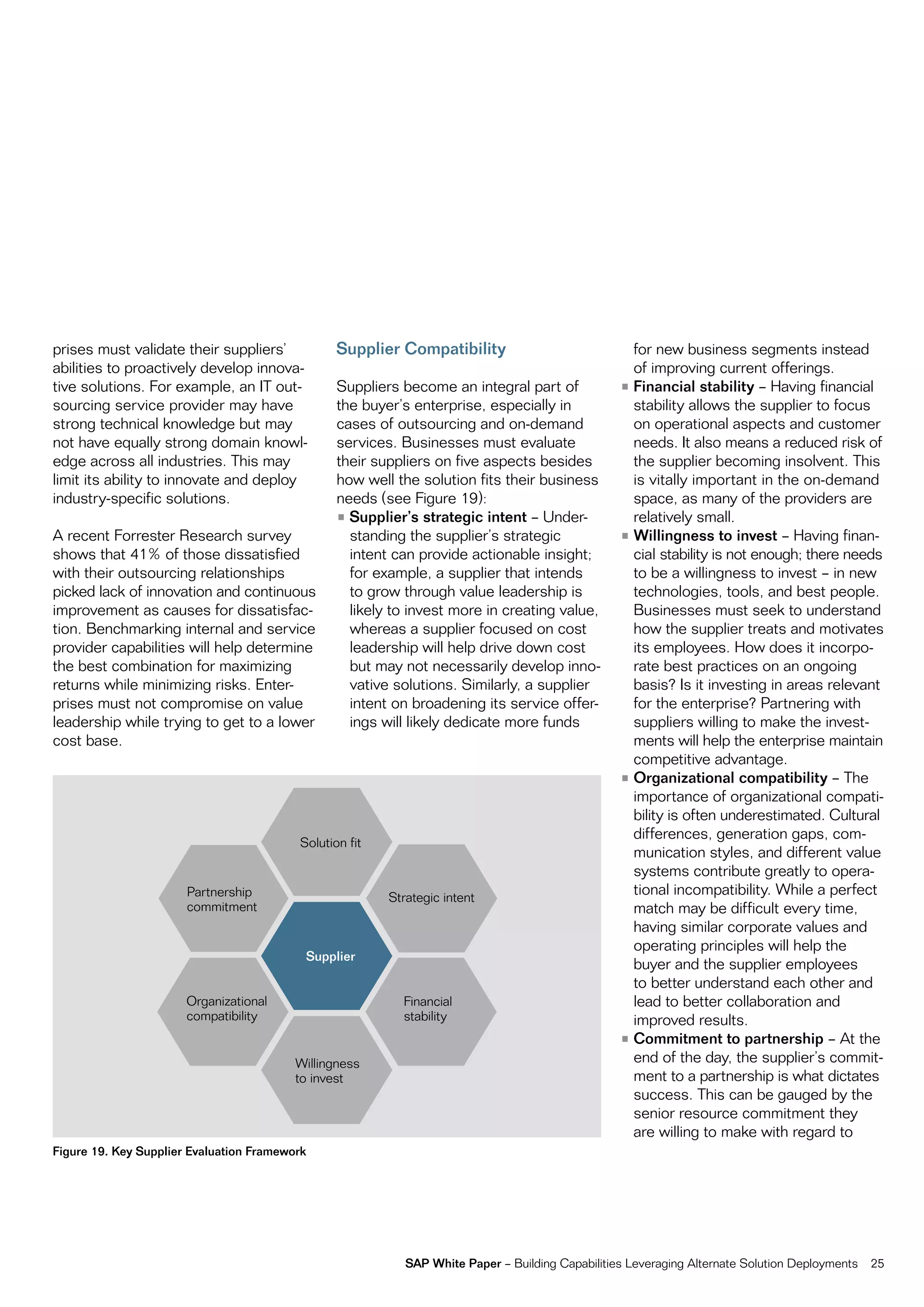
adaptive operating models


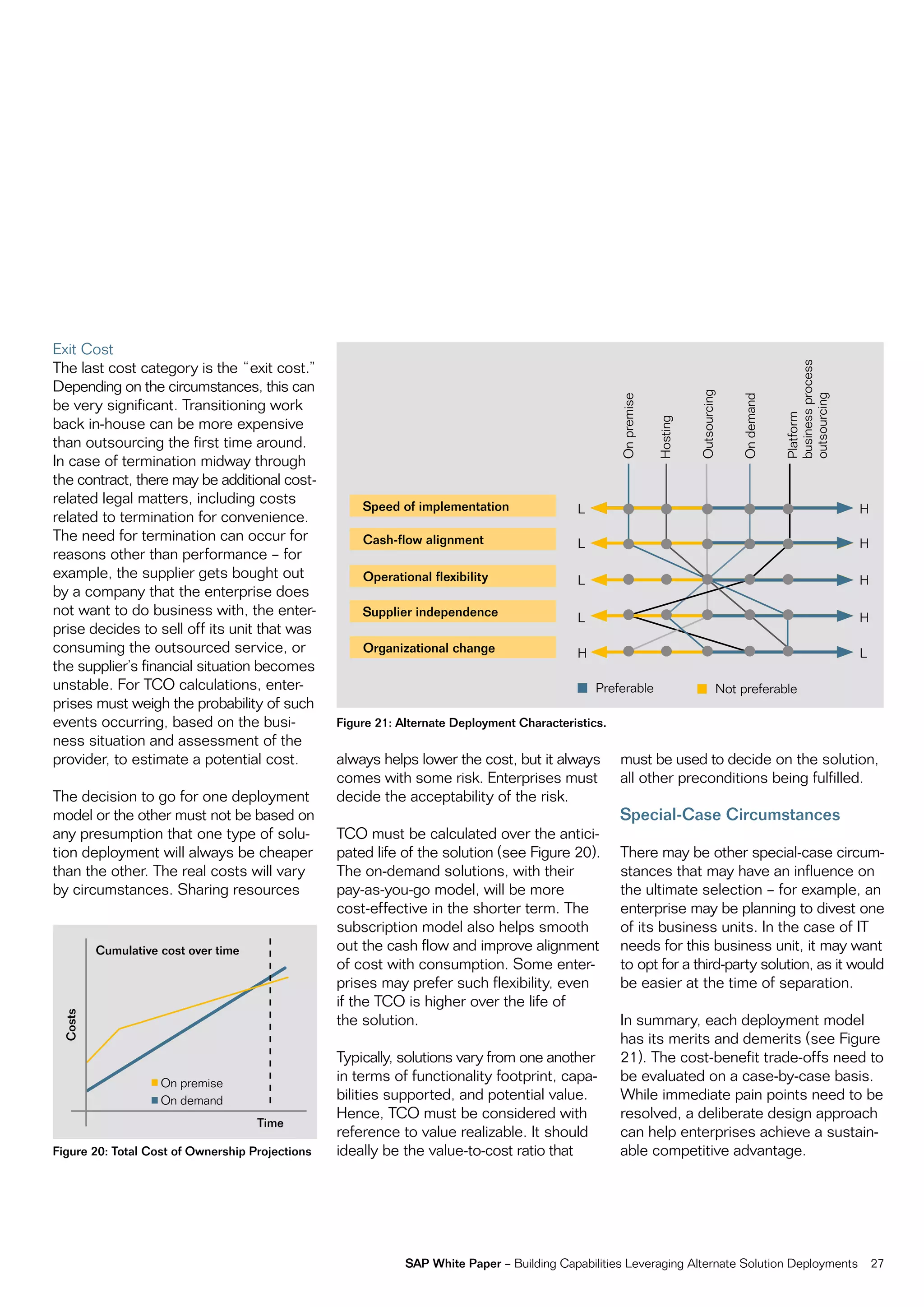
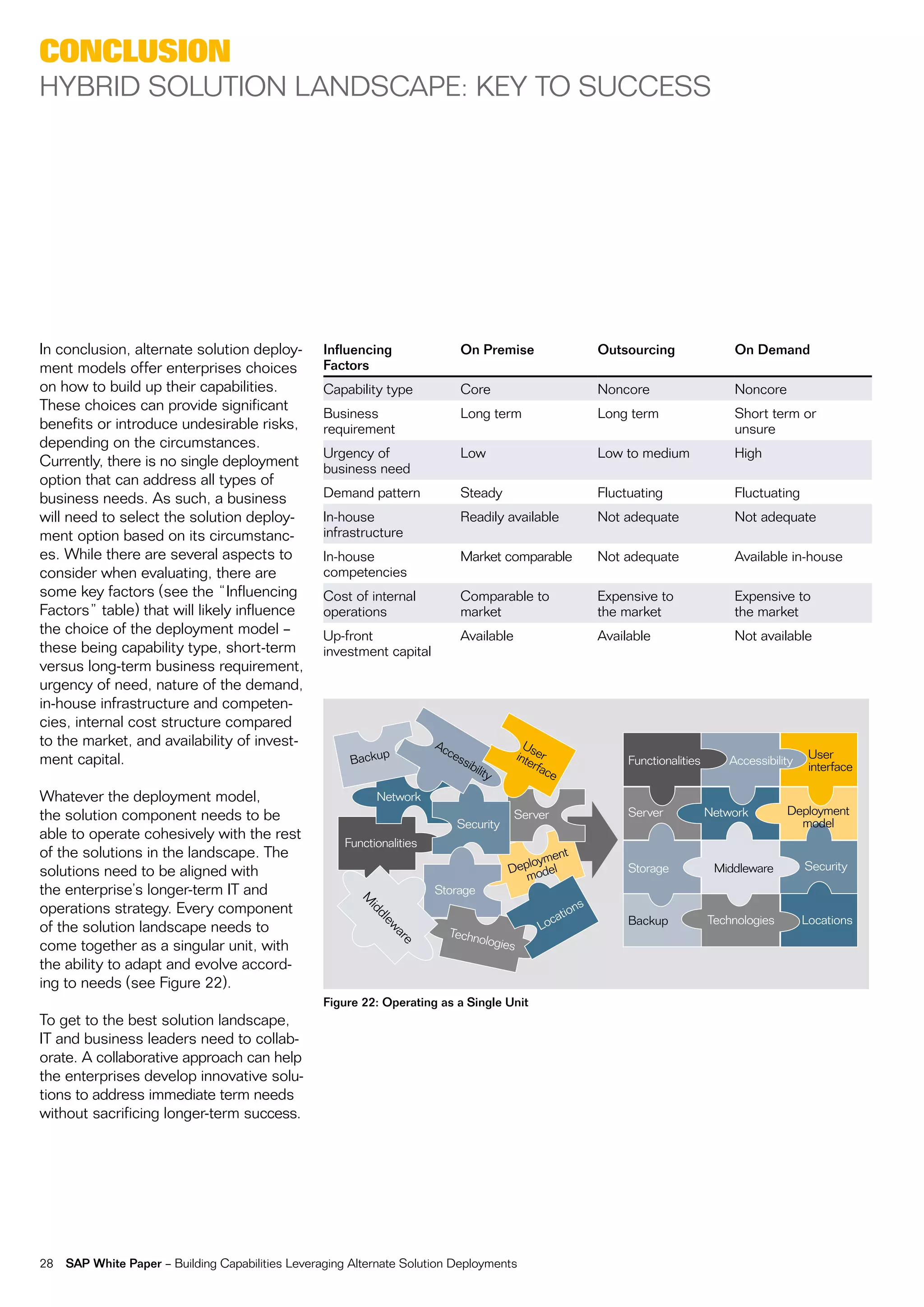
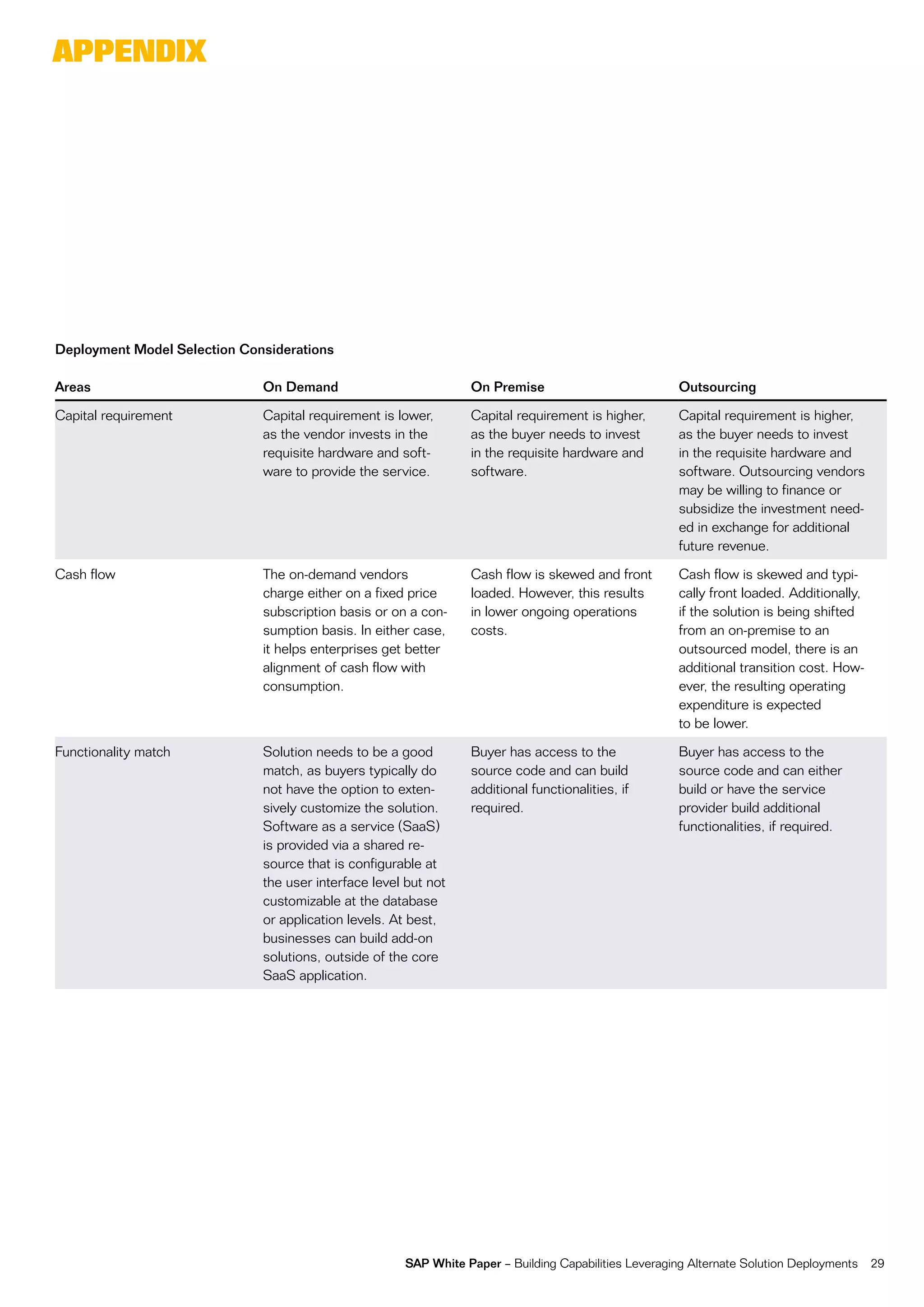
Building CapaBilities leveraging alternate
solution deployments
Strategic LeverS for competitive poSitioning
Content


 4   Executive Summary                   16   Deliberate Design process
 4   the need to go Beyond               16   clarity of vision:
     the traditional approach                 enabling alignment
 4   Leveraging alternate Solution       16   Knowing the Base: reality check
     Deployment models                   17   Knowing the options:
 5   constructing a Best-in-class             increased probability of Success
     Solution Landscape and              18   value-Based Decisions:0
     operating model                          improved roi
 5   need for Deliberate Design          18   managing the transformation
 5   need for orchestration:             18   process alignment to Drive
     operating as a Singular Unit             efficiency
 5   no Shortcuts: collaborating for     18   retained organization –
     the Best results                         vital to Success
                                         18   operational Discipline
 6   Capability Needs and                18   governance and orchestration
     Acquisition Options
 6   existing Landscape:                 20   Architecting the Solution
     often convoluted                         Landscape
 6   Scarcity of resources: increasing   21   Hygiene factors
     the challenge                       22   Strategic alignment
 7   new Service Delivery models         22   Business Strategy
     offering possibilities galore       22   operations Strategy
 8   challenge: choosing the right       22   risk tolerance
     Solution Deployment model           24   Business and operational factors
 8   on-premise Deployment:              24   Business Situations
     the traditional Workhorse           24   operational factors
 8   outsourcing Services:               25   Supplier compatibility
     Leveraging partner capabilities     26   financial evaluation
10   Shared Service centers:             26   one-time costs
     an alternative to outsourcing       26   ongoing costs
11   on-Demand Deployment:               26   Scope creep and overtime cost
     more flexibility and reduced        26   Business continuity costs
     expenditure                         27   exit cost
12   Business process as a Service:      27   Special-case circumstances
     Ultimate partner network
13   private versus public cloud:        28   Conclusion
     Security comfort versus cost
     Benefit                             29   Appendix
14   Key to Success – getting it right
     the first time                      35   Glossary of Terms

15   Deliberate Design                   36   Bibliography
15   Best-in-class Landscape Qualities   36   Sap references
15   evolutionary
15   Delightful to Use
15   operate as a Singular Unit
16   Simplicity – the Key to Success
exeCutive summary
neeD for fLexiBiLity anD SpeeD


in today’s global economy, enterprises are faced with                                         the operating costs but also reduce
                                                                                              capital expenditure and provide the
intense competition. new network-based business models                                        flexibility to scale based on business
and practices are transforming the way enterprises collab-                                    needs. this can be very attractive, as
                                                                                              the vendor makes all the investments
orate and grow. Businesses need to be highly flexible,                                        needed and provides businesses with
scalable, and nimble to stay successful. it requires their                                    access to ready-to-use solutions or
                                                                                              services through a pay-as-you-go model.
operations to be able to adapt quickly to market conditions                                   this reduces and sometimes even elimi-
and be responsive to customer demands. However, this is                                       nates the need for initial investment on
                                                                                              the part of the buyer while providing
easier said than done; building and maintaining such capa-                                    the ability to scale according to needs.
bilities the traditional way is laborious and challenging. it is
                                                                                              these options provide businesses with
imperative that businesses innovate and seek alternate ways                                   opportunities to build the capabilities
to acquire essential capabilities in a cost-effective manner.                                 they need while reducing capital and
                                                                                              operating expenditures. However, like
                                                                                              everything in life, there are limitations
The Need to Go Beyond                             evaluating alternatives to acquire          and downsides with these models as
the Traditional Approach                          best-in-class capabilities. this includes   well. enterprises need to evaluate the
                                                  building a network of strategic business    implications for their businesses and
Business needs are not homogeneous;               partners that are able to provide the       determine the best combination of
while some may be short term, others              required capabilities at a competitive      deployment models that will suit their
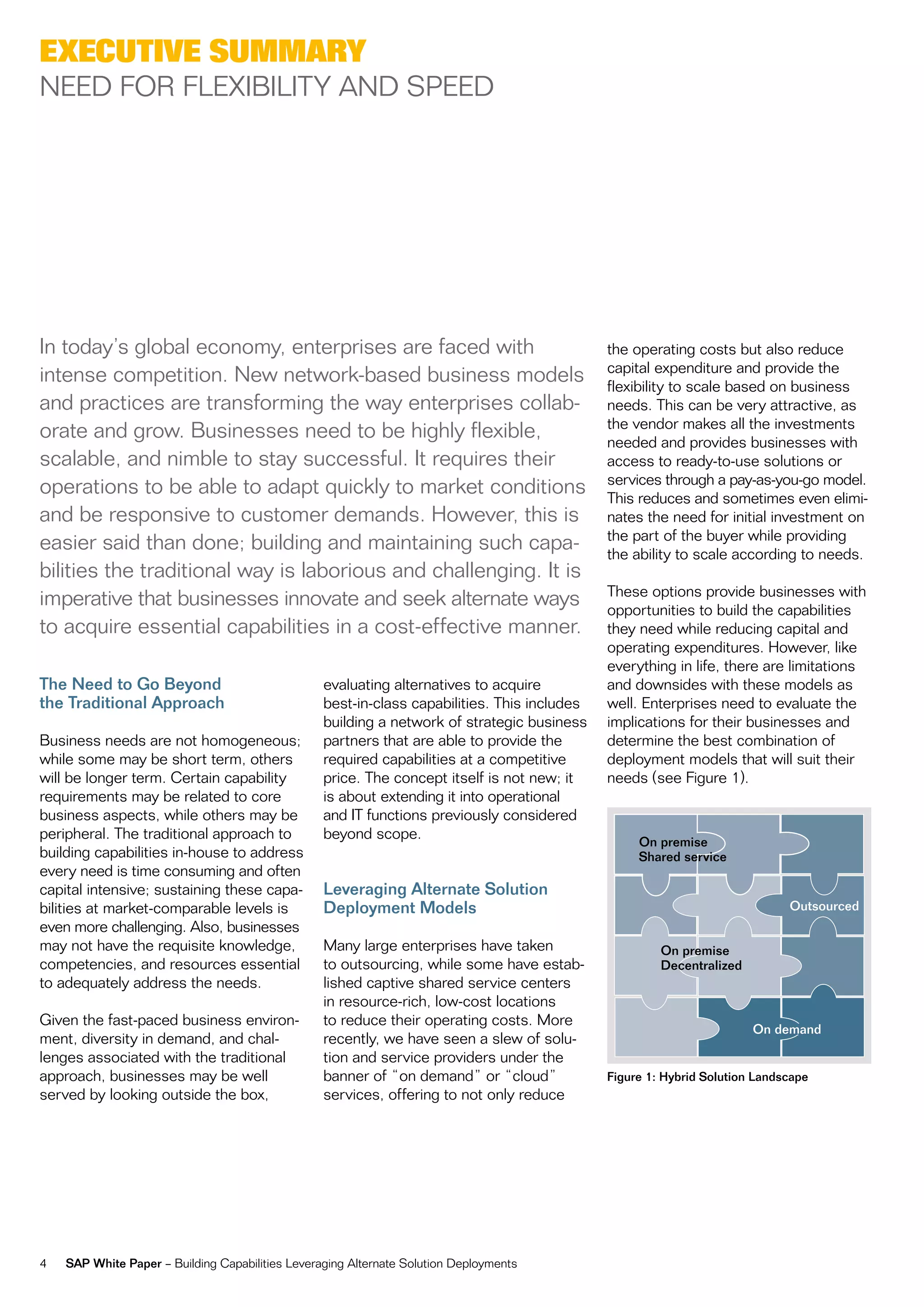
will be longer term. certain capability           price. the concept itself is not new; it    needs (see figure 1).
requirements may be related to core               is about extending it into operational
business aspects, while others may be             and it functions previously considered
peripheral. the traditional approach to           beyond scope.                                    On premise
building capabilities in-house to address                                                          Shared service
every need is time consuming and often
capital intensive; sustaining these capa-         Leveraging Alternate Solution
bilities at market-comparable levels is           Deployment Models                                                          Outsourced
even more challenging. also, businesses
may not have the requisite knowledge,             many large enterprises have taken                    On premise
competencies, and resources essential             to outsourcing, while some have estab-               Decentralized
to adequately address the needs.                  lished captive shared service centers
                                                  in resource-rich, low-cost locations
given the fast-paced business environ-            to reduce their operating costs. more
                                                                                                                       On demand
ment, diversity in demand, and chal-              recently, we have seen a slew of solu-
lenges associated with the traditional            tion and service providers under the
approach, businesses may be well                  banner of “on demand” or “cloud”            Figure 1: Hybrid Solution Landscape
served by looking outside the box,                services, offering to not only reduce


4   SAP White Paper – Building capabilities Leveraging alternate Solution Deployments
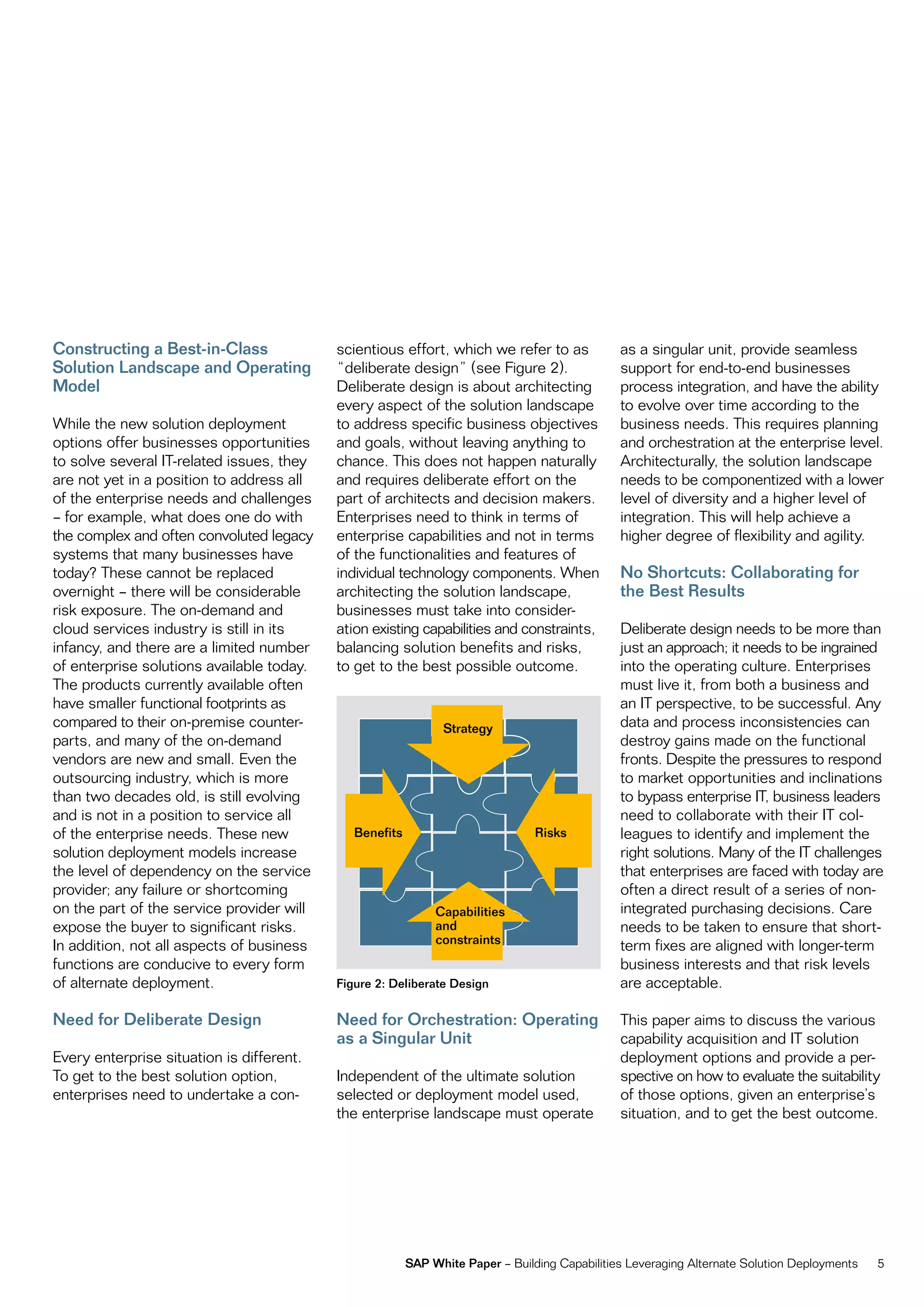
Constructing a Best-in-Class               scientious effort, which we refer to as             as a singular unit, provide seamless
Solution Landscape and Operating           “deliberate design” (see figure 2).                 support for end-to-end businesses
Model                                      Deliberate design is about architecting             process integration, and have the ability
                                           every aspect of the solution landscape              to evolve over time according to the
While the new solution deployment          to address specific business objectives             business needs. this requires planning
options offer businesses opportunities     and goals, without leaving anything to              and orchestration at the enterprise level.
to solve several it-related issues, they   chance. this does not happen naturally              architecturally, the solution landscape
are not yet in a position to address all   and requires deliberate effort on the               needs to be componentized with a lower
of the enterprise needs and challenges     part of architects and decision makers.             level of diversity and a higher level of
– for example, what does one do with       enterprises need to think in terms of               integration. this will help achieve a
the complex and often convoluted legacy    enterprise capabilities and not in terms            higher degree of flexibility and agility.
systems that many businesses have          of the functionalities and features of
today? these cannot be replaced            individual technology components. When              No Shortcuts: Collaborating for
overnight – there will be considerable     architecting the solution landscape,                the Best Results
risk exposure. the on-demand and           businesses must take into consider-
cloud services industry is still in its    ation existing capabilities and constraints,        Deliberate design needs to be more than
infancy, and there are a limited number    balancing solution benefits and risks,              just an approach; it needs to be ingrained
of enterprise solutions available today.   to get to the best possible outcome.                into the operating culture. enterprises
the products currently available often                                                         must live it, from both a business and
have smaller functional footprints as                                                          an it perspective, to be successful. any
compared to their on-premise counter-                          Strategy                        data and process inconsistencies can
parts, and many of the on-demand                                                               destroy gains made on the functional
vendors are new and small. even the                                                            fronts. Despite the pressures to respond
outsourcing industry, which is more                                                            to market opportunities and inclinations
than two decades old, is still evolving                                                        to bypass enterprise it, business leaders
and is not in a position to service all                                                        need to collaborate with their it col-
of the enterprise needs. these new            Benefits                          Risks          leagues to identify and implement the
solution deployment models increase                                                            right solutions. many of the it challenges
the level of dependency on the service                                                         that enterprises are faced with today are
provider; any failure or shortcoming                                                           often a direct result of a series of non-
on the part of the service provider will                      Capabilities                     integrated purchasing decisions. care
expose the buyer to significant risks.                        and                              needs to be taken to ensure that short-
in addition, not all aspects of business                      constraints                      term fixes are aligned with longer-term
functions are conducive to every form                                                          business interests and that risk levels
of alternate deployment.                   Figure 2: Deliberate Design                         are acceptable.

Need for Deliberate Design                 Need for Orchestration: Operating                   this paper aims to discuss the various
                                           as a Singular Unit                                  capability acquisition and it solution
every enterprise situation is different.                                                       deployment options and provide a per-
to get to the best solution option,        independent of the ultimate solution                spective on how to evaluate the suitability
enterprises need to undertake a con-       selected or deployment model used,                  of those options, given an enterprise’s
                                           the enterprise landscape must operate               situation, and to get the best outcome.


                                                         SAP White Paper – Building capabilities Leveraging alternate Solution Deployments   5
CapaBility needs and aCquisition options
tHe cHaLLengeS


the marketplace has become more                    have ended up with – often a direct            to develop innovative solutions required
complex with globalization – having a              result of years of a piecemeal approach        to provide a competitive edge. even if
good strategy is not enough, the ability           to building it-driven capabilities. this       they are currently able to garner the
to execute is vital, and only the proficient       incoherent approach has left many              resources, will they be able to retain
and dexterous will survive. enterprises            enterprises with a plethora of technolo-       the talent on a long-term basis and what
need to have market-relevant capabilities          gies and systems, with varying degrees         will it cost? Businesses also need to
to stay competitive, and technology is             of antiquity and often with a suboptimal       determine if internal development is the
a key enabler. at the same time, there             level of integration, creating significant     most cost-effective option to acquiring
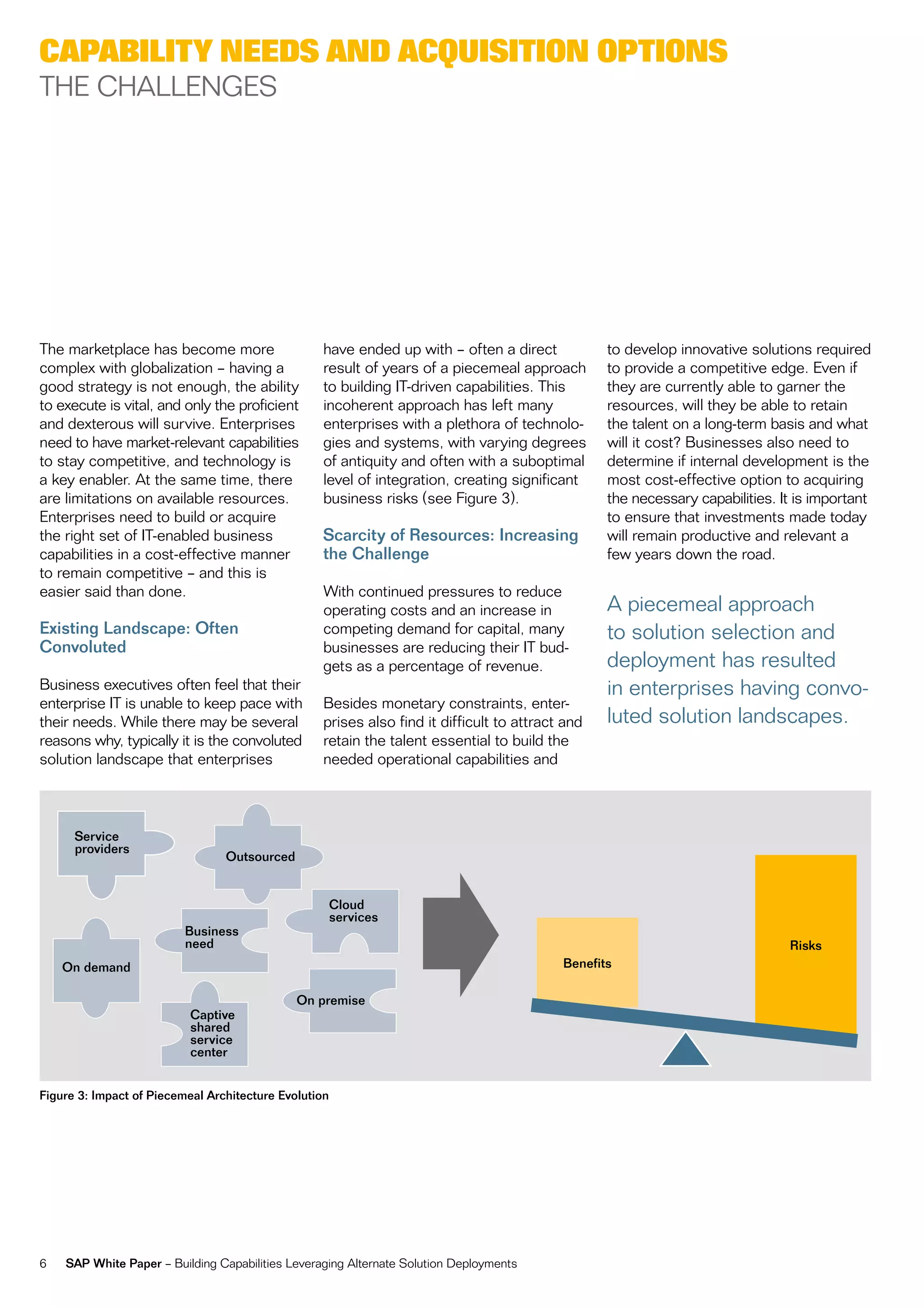
are limitations on available resources.            business risks (see figure 3).                 the necessary capabilities. it is important
enterprises need to build or acquire                                                              to ensure that investments made today
the right set of it-enabled business               Scarcity of Resources: Increasing              will remain productive and relevant a
capabilities in a cost-effective manner            the Challenge                                  few years down the road.
to remain competitive – and this is
easier said than done.                             With continued pressures to reduce
                                                   operating costs and an increase in             a piecemeal approach
Existing Landscape: Often                          competing demand for capital, many             to solution selection and
Convoluted                                         businesses are reducing their it bud-
                                                   gets as a percentage of revenue.               deployment has resulted
Business executives often feel that their                                                         in enterprises having convo-
enterprise it is unable to keep pace with          Besides monetary constraints, enter-
their needs. While there may be several            prises also find it difficult to attract and   luted solution landscapes.
reasons why, typically it is the convoluted        retain the talent essential to build the
solution landscape that enterprises                needed operational capabilities and


      Service
      providers
                                 Outsourced


                                                       Cloud
                                                       services
                          Business
                          need                                                                                                 Risks
    On demand                                                                              Benefits

                                              On premise
                           Captive
                           shared
                           service
                           center


Figure 3: Impact of Piecemeal Architecture Evolution


6   SAP White Paper – Building capabilities Leveraging alternate Solution Deployments
New Service Delivery Models                       However, the industry still has a long          for obvious reasons – low capital
Offering Possibilities Galore                     way to go before it can be categorized          expenditure, low deployment costs,
                                                  as being mature. recent advancements            faster implementation, better alignment
With increasing competitiveness, enter-           in internet technology, the growth of           of cash flow, quicker access to innova-
prises need to make best use of their             communication infrastructure, the               tion, lower internal resource needs, the
resources, focusing their own efforts             development of virtualization technolo-         ability to scale, and the ability to change
where they can make a difference while            gies, and new internet-based solutions          providers due to no fixed investments.
leveraging others to provide additional           have enabled the provisioning of a new
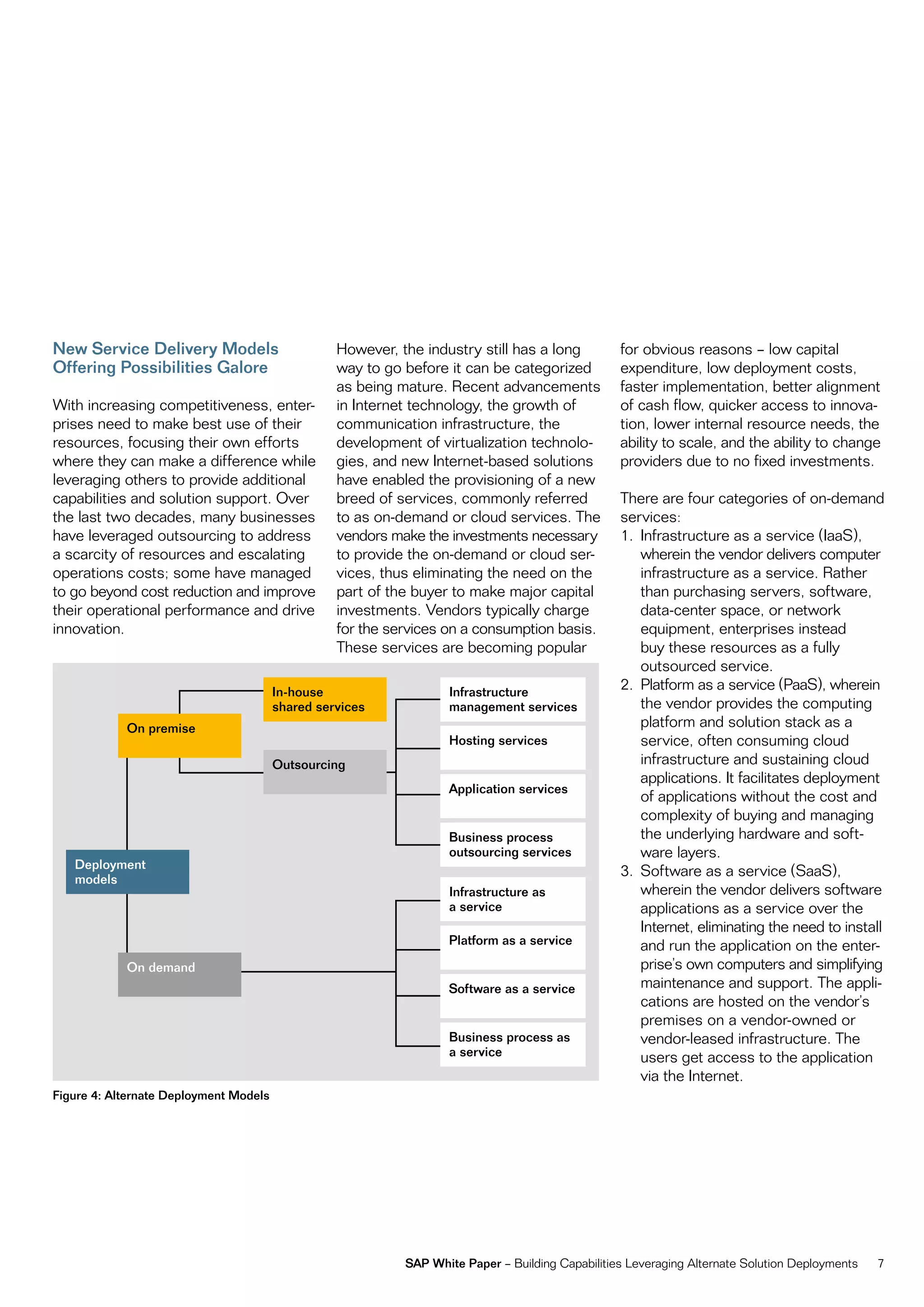
capabilities and solution support. over           breed of services, commonly referred            there are four categories of on-demand
the last two decades, many businesses             to as on-demand or cloud services. the          services:
have leveraged outsourcing to address             vendors make the investments necessary          1. infrastructure as a service (iaaS),
a scarcity of resources and escalating            to provide the on-demand or cloud ser-             wherein the vendor delivers computer
operations costs; some have managed               vices, thus eliminating the need on the            infrastructure as a service. rather
to go beyond cost reduction and improve           part of the buyer to make major capital            than purchasing servers, software,
their operational performance and drive           investments. vendors typically charge              data-center space, or network
innovation.                                       for the services on a consumption basis.           equipment, enterprises instead
                                                  these services are becoming popular                buy these resources as a fully
                                                                                                     outsourced service.
                                        In-house                   Infrastructure
                                                                                                  2. platform as a service (paaS), wherein
                                        shared services            management services               the vendor provides the computing
            On premise                                                                               platform and solution stack as a
                                                                   Hosting services                  service, often consuming cloud
                                        Outsourcing                                                  infrastructure and sustaining cloud
                                                                                                     applications. it facilitates deployment
                                                                   Application services
                                                                                                     of applications without the cost and
                                                                                                     complexity of buying and managing
                                                                   Business process                  the underlying hardware and soft-
                                                                   outsourcing services              ware layers.
   Deployment
   models
                                                                                                  3. Software as a service (SaaS),
                                                                   Infrastructure as                 wherein the vendor delivers software
                                                                   a service                         applications as a service over the
                                                                                                     internet, eliminating the need to install
                                                                   Platform as a service             and run the application on the enter-
            On demand                                                                                prise’s own computers and simplifying
                                                                   Software as a service             maintenance and support. the appli-
                                                                                                     cations are hosted on the vendor’s
                                                                                                     premises on a vendor-owned or
                                                                   Business process as               vendor-leased infrastructure. the
                                                                   a service                         users get access to the application
                                                                                                     via the internet.
Figure 4: Alternate Deployment Models


                                                            SAP White Paper – Building capabilities Leveraging alternate Solution Deployments   7
4. Business process as a service                  be advantageous for some and not so         downsides – the need to invest up front,
   (BpaaS), wherein the vendor pro-               for others, depending on their situation.   longer implementation lead time, opera-
   vides the business services, (for              enterprises need to fully understand        tions management, and ongoing access
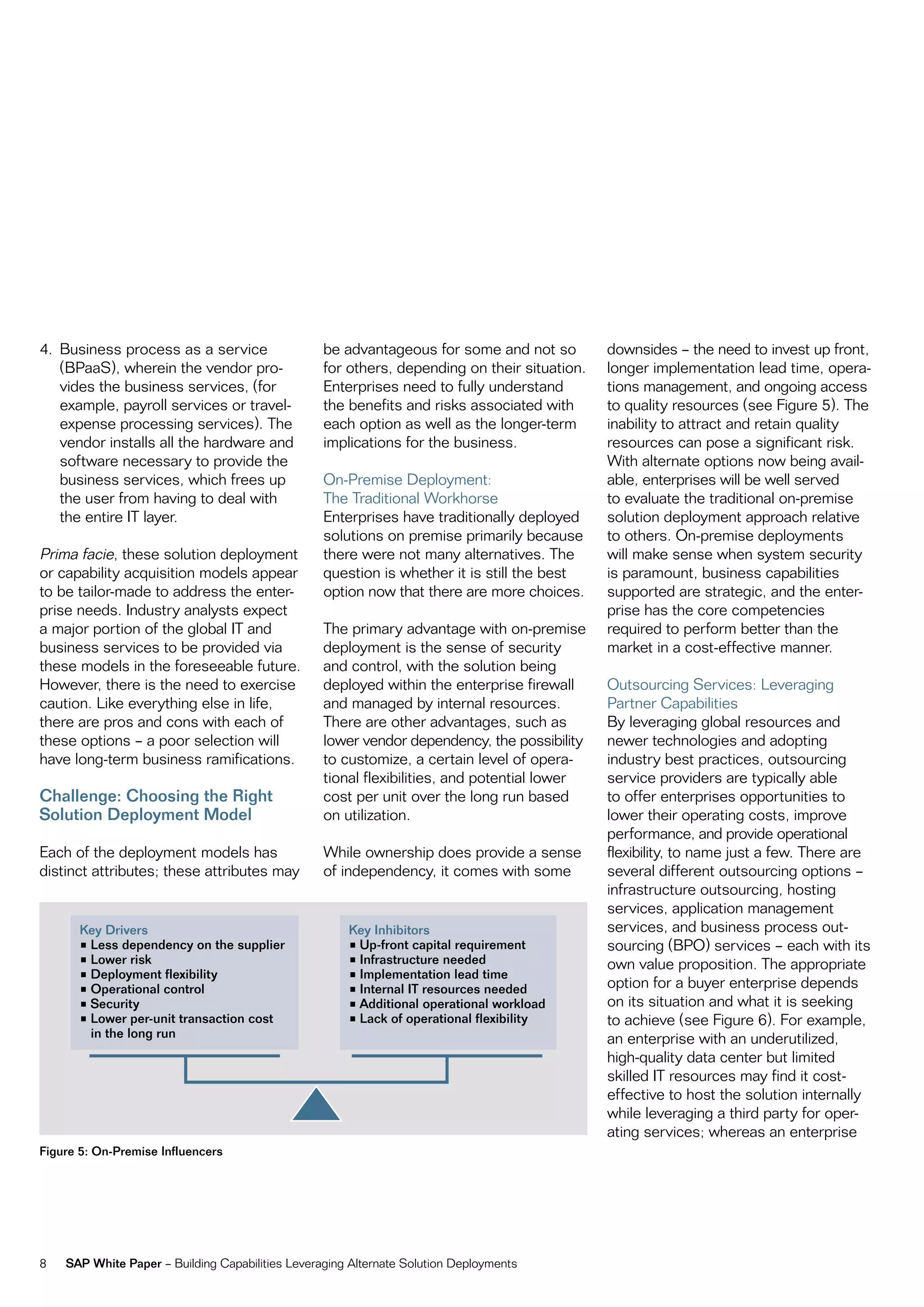
   example, payroll services or travel-           the benefits and risks associated with      to quality resources (see figure 5). the
   expense processing services). the              each option as well as the longer-term      inability to attract and retain quality
   vendor installs all the hardware and           implications for the business.              resources can pose a significant risk.
   software necessary to provide the                                                          With alternate options now being avail-
   business services, which frees up              on-premise Deployment:                      able, enterprises will be well served
   the user from having to deal with              the traditional Workhorse                   to evaluate the traditional on-premise
   the entire it layer.                           enterprises have traditionally deployed     solution deployment approach relative
                                                  solutions on premise primarily because      to others. on-premise deployments
prima facie, these solution deployment            there were not many alternatives. the       will make sense when system security
or capability acquisition models appear           question is whether it is still the best    is paramount, business capabilities
to be tailor-made to address the enter-           option now that there are more choices.     supported are strategic, and the enter-
prise needs. industry analysts expect                                                         prise has the core competencies
a major portion of the global it and              the primary advantage with on-premise       required to perform better than the
business services to be provided via              deployment is the sense of security         market in a cost-effective manner.
these models in the foreseeable future.           and control, with the solution being
However, there is the need to exercise            deployed within the enterprise firewall     outsourcing Services: Leveraging
caution. Like everything else in life,            and managed by internal resources.          partner capabilities
there are pros and cons with each of              there are other advantages, such as         By leveraging global resources and
these options – a poor selection will             lower vendor dependency, the possibility    newer technologies and adopting
have long-term business ramifications.            to customize, a certain level of opera-     industry best practices, outsourcing
                                                  tional flexibilities, and potential lower   service providers are typically able
Challenge: Choosing the Right                     cost per unit over the long run based       to offer enterprises opportunities to
Solution Deployment Model                         on utilization.                             lower their operating costs, improve
                                                                                              performance, and provide operational
each of the deployment models has                 While ownership does provide a sense        flexibility, to name just a few. there are
distinct attributes; these attributes may         of independency, it comes with some         several different outsourcing options –
                                                                                              infrastructure outsourcing, hosting
                                                                                              services, application management
       Key Drivers                                    Key Inhibitors                          services, and business process out-
       •	Less	dependency	on	the	supplier              •	Up-front	capital	requirement          sourcing (Bpo) services – each with its
       •	Lower	risk                                   •	Infrastructure	needed                 own value proposition. the appropriate
       •	Deployment	flexibility                       •	Implementation	lead	time
       •	Operational	control                          •	Internal	IT	resources	needed          option for a buyer enterprise depends
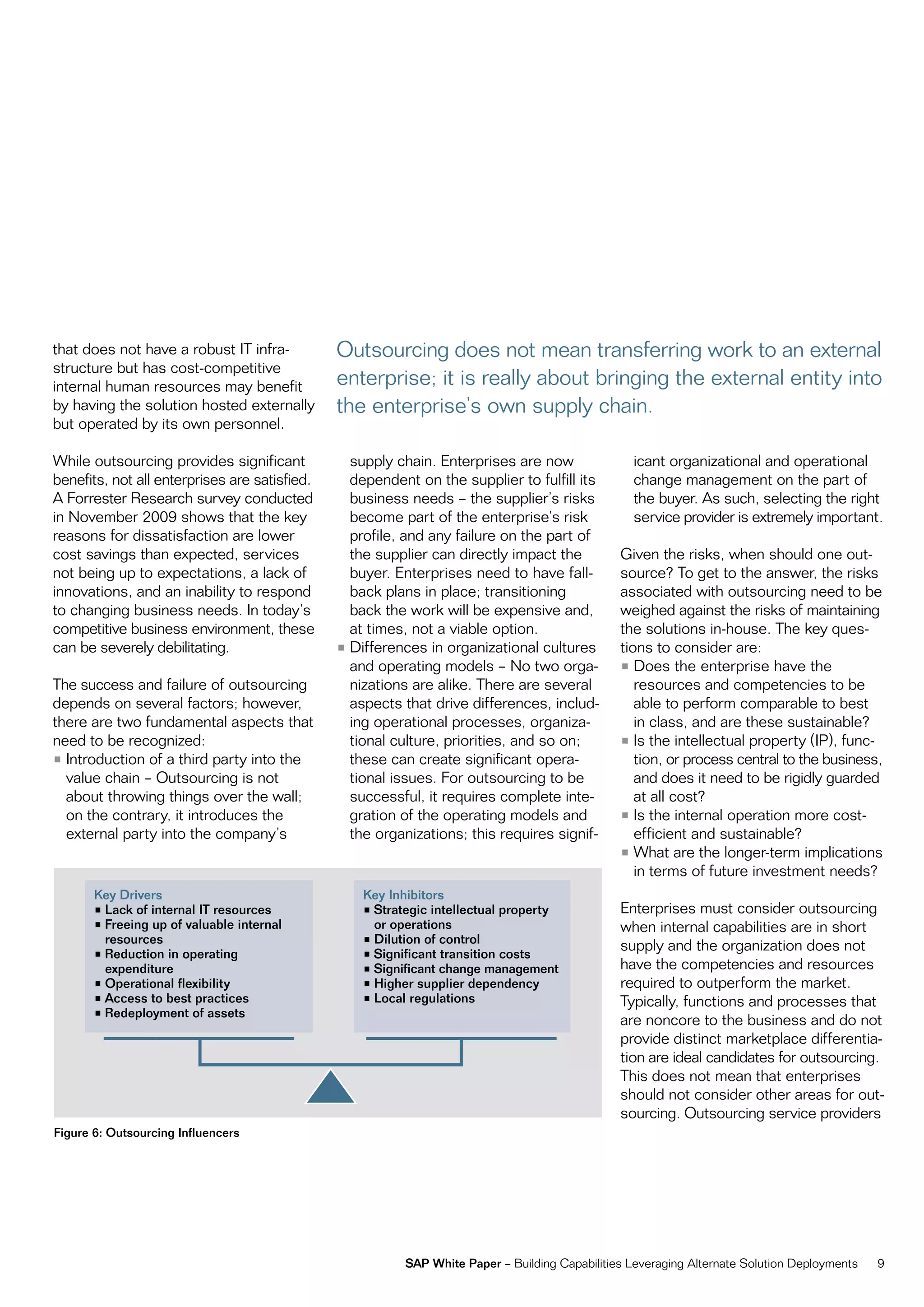
       •	Security                                     •	Additional	operational	workload       on its situation and what it is seeking
       •	Lower	per-unit	transaction	cost	             •	Lack	of	operational	flexibility       to achieve (see figure 6). for example,
         in the long run                                                                      an enterprise with an underutilized,
                                                                                              high-quality data center but limited
                                                                                              skilled it resources may find it cost-
                                                                                              effective to host the solution internally
                                                                                              while leveraging a third party for oper-
                                                                                              ating services; whereas an enterprise
Figure 5: On-Premise Influencers


8   SAP White Paper – Building capabilities Leveraging alternate Solution Deployments
that does not have a robust it infra-          outsourcing does not mean transferring work to an external
structure but has cost-competitive
internal human resources may benefit           enterprise; it is really about bringing the external entity into
by having the solution hosted externally       the enterprise’s own supply chain.
but operated by its own personnel.

While outsourcing provides significant           supply chain. enterprises are now                icant organizational and operational
benefits, not all enterprises are satisfied.     dependent on the supplier to fulfill its         change management on the part of
a forrester research survey conducted            business needs – the supplier’s risks            the buyer. as such, selecting the right
in november 2009 shows that the key              become part of the enterprise’s risk             service provider is extremely important.
reasons for dissatisfaction are lower            profile, and any failure on the part of
cost savings than expected, services             the supplier can directly impact the           given the risks, when should one out-
not being up to expectations, a lack of          buyer. enterprises need to have fall-          source? to get to the answer, the risks
innovations, and an inability to respond         back plans in place; transitioning             associated with outsourcing need to be
to changing business needs. in today’s           back the work will be expensive and,           weighed against the risks of maintaining
competitive business environment, these          at times, not a viable option.                 the solutions in-house. the key ques-
can be severely debilitating.                  • Differences in organizational cultures         tions to consider are:
                                                 and operating models – no two orga-            • Does the enterprise have the
the success and failure of outsourcing           nizations are alike. there are several            resources and competencies to be
depends on several factors; however,             aspects that drive differences, includ-           able to perform comparable to best
there are two fundamental aspects that           ing operational processes, organiza-              in class, and are these sustainable?
need to be recognized:                           tional culture, priorities, and so on;         • is the intellectual property (ip), func-
• introduction of a third party into the         these can create significant opera-               tion, or process central to the business,
  value chain – outsourcing is not               tional issues. for outsourcing to be              and does it need to be rigidly guarded
  about throwing things over the wall;           successful, it requires complete inte-            at all cost?
  on the contrary, it introduces the             gration of the operating models and            • is the internal operation more cost-
  external party into the company’s              the organizations; this requires signif-          efficient and sustainable?
                                                                                                • What are the longer-term implications
                                                                                                   in terms of future investment needs?
       Key Drivers                                 Key Inhibitors
       •	Lack	of	internal	IT	resources             •	Strategic	intellectual	property	           enterprises must consider outsourcing
       •	Freeing	up	of	valuable	internal	            or operations                              when internal capabilities are in short
         resources                                 •	Dilution	of	control
                                                                                                supply and the organization does not
       •	Reduction	in	operating	                   •	Significant	transition	costs
         expenditure                               •	Significant	change	management              have the competencies and resources
       •	Operational	flexibility                   •	Higher	supplier	dependency                 required to outperform the market.
       •	Access	to	best	practices                  •	Local	regulations                          typically, functions and processes that
       •	Redeployment	of	assets
                                                                                                are noncore to the business and do not
                                                                                                provide distinct marketplace differentia-
                                                                                                tion are ideal candidates for outsourcing.
                                                                                                this does not mean that enterprises
                                                                                                should not consider other areas for out-
                                                                                                sourcing. outsourcing service providers
Figure 6: Outsourcing Influencers


                                                          SAP White Paper – Building capabilities Leveraging alternate Solution Deployments   9
are often able to bring in innovation and
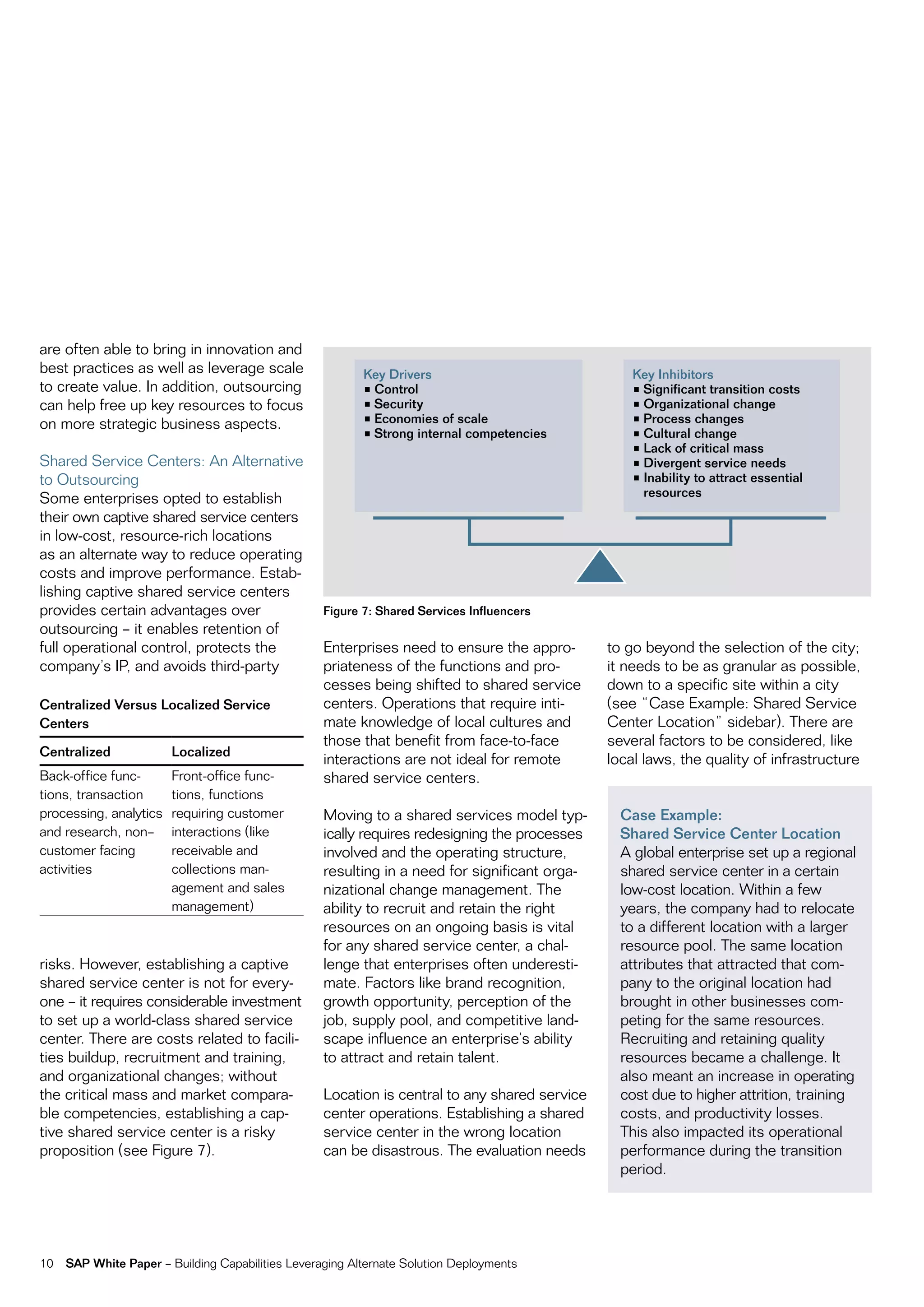
best practices as well as leverage scale                  Key Drivers                              Key Inhibitors
to create value. in addition, outsourcing                 •	Control                                •	Significant	transition	costs
can help free up key resources to focus                   •	Security                               •	Organizational	change	
on more strategic business aspects.                       •	Economies	of	scale                     •	Process	changes
                                                          •	Strong	internal	competencies           •	Cultural	change
                                                                                                   •	Lack	of	critical	mass
Shared Service centers: an alternative                                                             •	Divergent	service	needs
to outsourcing                                                                                     •	Inability	to	attract	essential	
Some enterprises opted to establish                                                                  resources
their own captive shared service centers
in low-cost, resource-rich locations
as an alternate way to reduce operating
costs and improve performance. estab-
lishing captive shared service centers
provides certain advantages over                   Figure 7: Shared Services Influencers
outsourcing – it enables retention of
full operational control, protects the             enterprises need to ensure the appro-       to go beyond the selection of the city;
company’s ip, and avoids third-party               priateness of the functions and pro-        it needs to be as granular as possible,
                                                   cesses being shifted to shared service      down to a specific site within a city
Centralized Versus Localized Service               centers. operations that require inti-      (see “case example: Shared Service
Centers                                            mate knowledge of local cultures and        center Location” sidebar). there are
                                                   those that benefit from face-to-face        several factors to be considered, like
Centralized             Localized
                                                   interactions are not ideal for remote       local laws, the quality of infrastructure
Back-office func-       front-office func-         shared service centers.
tions, transaction      tions, functions
processing, analytics   requiring customer         moving to a shared services model typ-        Case Example:
and research, non–      interactions (like         ically requires redesigning the processes     Shared Service Center Location
customer facing         receivable and             involved and the operating structure,         a global enterprise set up a regional
activities              collections man-           resulting in a need for significant orga-     shared service center in a certain
                        agement and sales          nizational change management. the             low-cost location. Within a few
                        management)                ability to recruit and retain the right       years, the company had to relocate
                                                   resources on an ongoing basis is vital        to a different location with a larger
                                                   for any shared service center, a chal-        resource pool. the same location
risks. However, establishing a captive             lenge that enterprises often underesti-       attributes that attracted that com-
shared service center is not for every-            mate. factors like brand recognition,         pany to the original location had
one – it requires considerable investment          growth opportunity, perception of the         brought in other businesses com-
to set up a world-class shared service             job, supply pool, and competitive land-       peting for the same resources.
center. there are costs related to facili-         scape influence an enterprise’s ability       recruiting and retaining quality
ties buildup, recruitment and training,            to attract and retain talent.                 resources became a challenge. it
and organizational changes; without                                                              also meant an increase in operating
the critical mass and market compara-              Location is central to any shared service     cost due to higher attrition, training
ble competencies, establishing a cap-              center operations. establishing a shared      costs, and productivity losses.
tive shared service center is a risky              service center in the wrong location          this also impacted its operational
proposition (see figure 7).                        can be disastrous. the evaluation needs       performance during the transition
                                                                                                 period.


10   SAP White Paper – Building capabilities Leveraging alternate Solution Deployments
or entirely eliminates the need for
                                                                                               the buyer to acquire assets. this is
  Legal system                                                                                 a major value proposition, especially
                                                                                               when businesses are faced with
  Location attractiveness                                                                      considerable competing demand
                                                                                               for investment capital.
  Brand attractiveness                                                                       • Standardized services – Services are
                                                                                               provided on a standardized basis with
  Economic stability                                                                           very limited or no ability to customize.
                                                                                               the inability to customize may impair
  Costs and inflation                                                                          an enterprise’s ability to optimally
                                                                                               leverage the solution to address its
  Geopolitical stability                                                                       unique needs and gain a market
                                                                                               advantage.
  Laws and regulations                                                                       • Speed – the other side of standardized
                                                                                               services is that businesses do not have
  Infrastructure                                                                               to go through a long, drawn-out imple-
                                                                                               mentation; for example, businesses
  Labor availability                                                                           can easily procure additional comput-
                                                                                               ing resources within minutes by simply
                                                                                               swiping their credit card. Similarly,
                            0         1        2               3         4            5        businesses can have access to certain
        Location B                                                                             desktop applications and collaboration
                                                   Minimum
        Location A                                 Threshold                                   tools by setting up a subscriber
                                                                                               account. enterprise applications, on
Figure 8: Location Assessment Grid                                                             the other hand, will be somewhat more
                                                                                               complicated but still faster than an
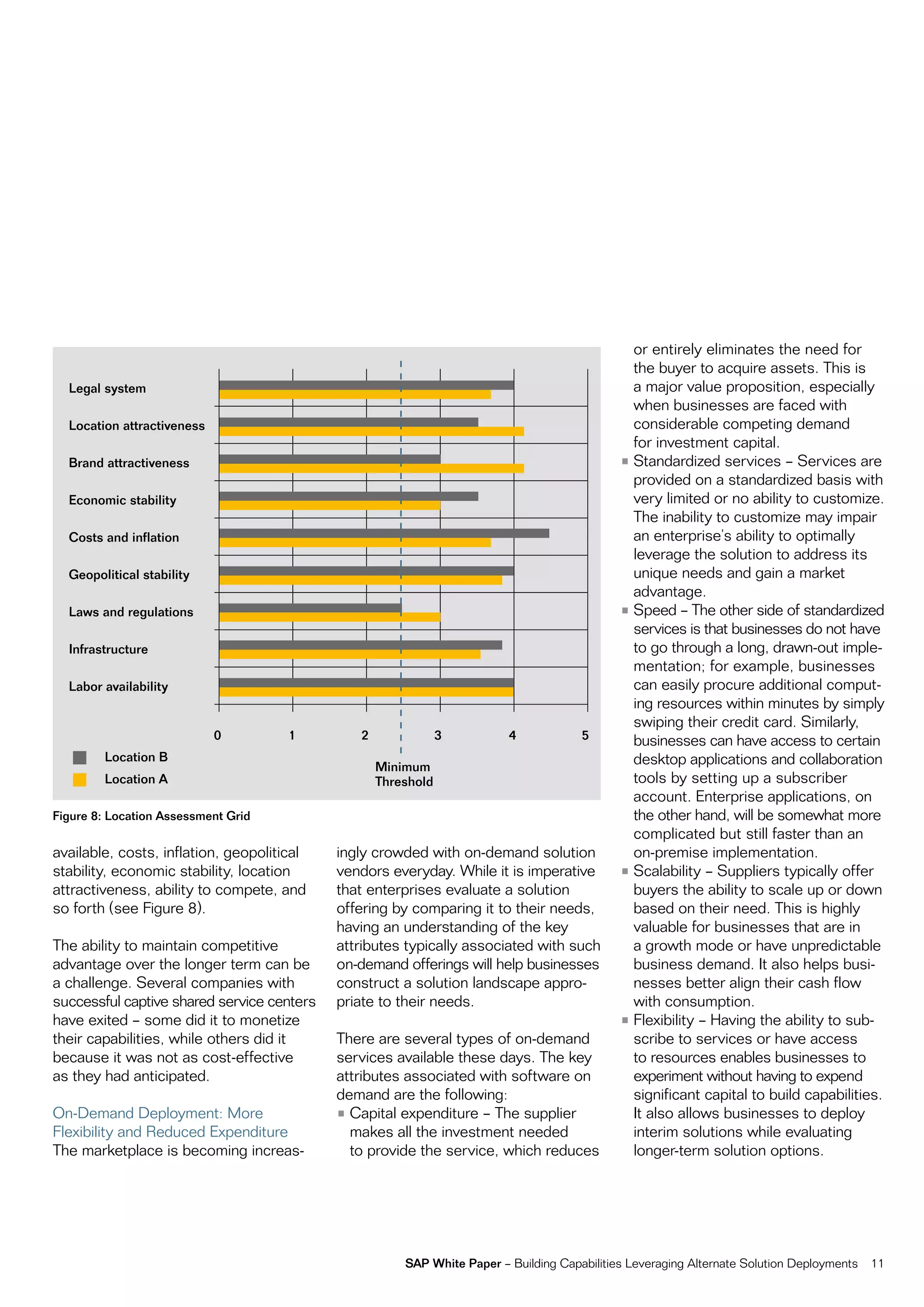
available, costs, inflation, geopolitical   ingly crowded with on-demand solution              on-premise implementation.
stability, economic stability, location     vendors everyday. While it is imperative         • Scalability – Suppliers typically offer
attractiveness, ability to compete, and     that enterprises evaluate a solution               buyers the ability to scale up or down
so forth (see figure 8).                    offering by comparing it to their needs,           based on their need. this is highly
                                            having an understanding of the key                 valuable for businesses that are in
the ability to maintain competitive         attributes typically associated with such          a growth mode or have unpredictable
advantage over the longer term can be       on-demand offerings will help businesses           business demand. it also helps busi-
a challenge. Several companies with         construct a solution landscape appro-              nesses better align their cash flow
successful captive shared service centers   priate to their needs.                             with consumption.
have exited – some did it to monetize                                                        • flexibility – Having the ability to sub-
their capabilities, while others did it     there are several types of on-demand               scribe to services or have access
because it was not as cost-effective        services available these days. the key             to resources enables businesses to
as they had anticipated.                    attributes associated with software on             experiment without having to expend
                                            demand are the following:                          significant capital to build capabilities.
on-Demand Deployment: more                  • capital expenditure – the supplier               it also allows businesses to deploy
flexibility and reduced expenditure           makes all the investment needed                  interim solutions while evaluating
the marketplace is becoming increas-          to provide the service, which reduces            longer-term solution options.


                                                       SAP White Paper – Building capabilities Leveraging alternate Solution Deployments   11
• Shared services basis –the on-demand               suppliers for all aspects of the opera-        by having rights to the software and
  services are typically offered on a                tions, including system performance,           other assets that may be essential
  shared services basis. the customers               service quality, and disaster recovery.        to operate the system efficiently. in
  share the application and the underly-             any weakness on the part of a sup-             case a supplier uses third-party
  ing infrastructure. While this is one              plier creates direct exposure for its          resources to provide the service,
  of the core value drivers, it is also the          customers.                                     a business must also seek to have
  biggest source of concern – about                • emerging industry – the on-demand              access rights to those assets or
  system security, performance, extent               industry is still in its infancy; the mar-     solutions.
  of operational control, and compliance             ket will invariably consolidate as it
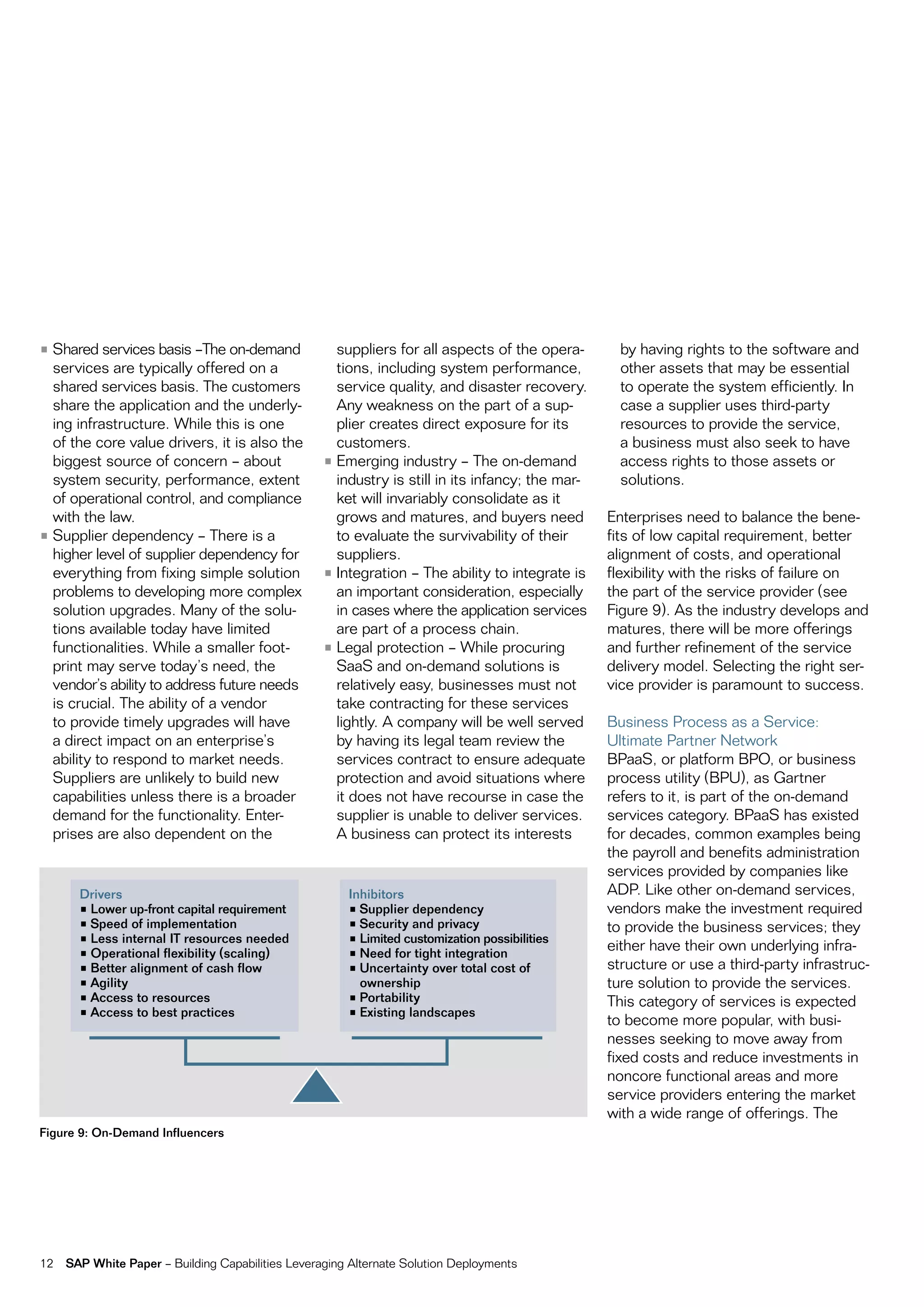
  with the law.                                      grows and matures, and buyers need           enterprises need to balance the bene-
• Supplier dependency – there is a                   to evaluate the survivability of their       fits of low capital requirement, better
  higher level of supplier dependency for            suppliers.                                   alignment of costs, and operational
  everything from fixing simple solution           • integration – the ability to integrate is    flexibility with the risks of failure on
  problems to developing more complex                an important consideration, especially       the part of the service provider (see
  solution upgrades. many of the solu-               in cases where the application services      figure 9). as the industry develops and
  tions available today have limited                 are part of a process chain.                 matures, there will be more offerings
  functionalities. While a smaller foot-           • Legal protection – While procuring           and further refinement of the service
  print may serve today’s need, the                  SaaS and on-demand solutions is              delivery model. Selecting the right ser-
  vendor’s ability to address future needs           relatively easy, businesses must not         vice provider is paramount to success.
  is crucial. the ability of a vendor                take contracting for these services
  to provide timely upgrades will have               lightly. a company will be well served       Business process as a Service:
  a direct impact on an enterprise’s                 by having its legal team review the          Ultimate partner network
  ability to respond to market needs.                services contract to ensure adequate         BpaaS, or platform Bpo, or business
  Suppliers are unlikely to build new                protection and avoid situations where        process utility (BpU), as gartner
  capabilities unless there is a broader             it does not have recourse in case the        refers to it, is part of the on-demand
  demand for the functionality. enter-               supplier is unable to deliver services.      services category. BpaaS has existed
  prises are also dependent on the                   a business can protect its interests         for decades, common examples being
                                                                                                  the payroll and benefits administration
                                                                                                  services provided by companies like
       Drivers                                         Inhibitors                                 aDp. Like other on-demand services,
       •	Lower	up-front	capital	requirement            •	Supplier	dependency                      vendors make the investment required
       •	Speed	of	implementation                       •	Security	and	privacy                     to provide the business services; they
       •	Less	internal	IT	resources	needed             •	Limited	customization	possibilities
       •	Operational	flexibility	(scaling)             •	Need	for	tight	integration
                                                                                                  either have their own underlying infra-
       •	Better	alignment	of	cash	flow                 •	Uncertainty	over	total	cost	of	          structure or use a third-party infrastruc-
       •	Agility                                         ownership                                ture solution to provide the services.
       •	Access	to	resources                           •	Portability                              this category of services is expected
       •	Access	to	best	practices                      •	Existing	landscapes
                                                                                                  to become more popular, with busi-
                                                                                                  nesses seeking to move away from
                                                                                                  fixed costs and reduce investments in
                                                                                                  noncore functional areas and more
                                                                                                  service providers entering the market
                                                                                                  with a wide range of offerings. the
Figure 9: On-Demand Influencers


12   SAP White Paper – Building capabilities Leveraging alternate Solution Deployments
option is attractive in a number of            While sharing resources helps reduce             potential benefits. enterprises need
situations:                                    cost, it brings up questions about safe-         to consider several aspects:
• enterprise does not have market-             guards, data security, ip protection,            • robustness of the supplier’s infra-
  comparable it and operational                statutory and regulatory compliance                structure – is it robust enough to
  capabilities in-house.                       obligations, liabilities, consumers’ legal         deliver the services at the expected
• the need for business services               rights in case of breach, backup and               performance level? is it fault tolerant,
  capability is immediate and does not         recovery, data portability, ability to audit,      and does it have built-in redundancies
  offer adequate lead time to build it         and system availability and performance.           to guard against failures?
  in-house.                                                                                     • Security – is the service delivery
• the cost of internal operations is           public cloud service providers will                infrastructure secure, and does it
  significantly higher than the cost of        argue that their infrastructure is safe.           adhere to international standards?
  externally sourced business services.        fortunately, there has not been any                Besides the systems, how robust
• the business needs are short term.           major incident of breach. However, with            are the supplier’s security policies
                                               increased global competition and                   and procedures?
external providers are better positioned       increasing industrial espionage via              • ease of integration – Will the enter-
to leverage economies of scale, lever-         the internet and attacks on Web sites,             prise be able to easily integrate the
age technology advances, and incorpo-          it is prudent to be cautious. the very             cloud solution with other in-house or
rate best practices, bringing value to their   resources that can provide computing               third-party systems? With a diversity
customers. However, opting for BpaaS           power to enterprises on demand are                 of business needs, enterprises are
also means greater supplier dependency;        also available to hackers. Whether                 likely to end up with a combination
buyers need to protect their investment        a cloud is safe or not depends on                  of in-house systems, outsourced
by having a comprehensive fall-back strat-     the quality of the underlying assets               solutions, and on-demand services.
egy in case of exigency.                       and tools and how they are deployed                the ability to easily integrate systems
                                               as well as the service provider’s                  will make the difference.
private versus public cloud: Security          operational practices. many leading              • ability to audit – Will the enterprise
comfort versus cost Benefit                    cloud infrastructure service providers             be able to perform system audits at
the on-demand story is not complete            are deploying best-in-class security               any time?
without discussing the private versus          solutions and building multilevel redun-         • portability – Will the enterprise be
public cloud. Simply put, cloud services       dancies to protect against breach and              able to easily transition the solution
are dynamically provisioned it and busi-       service failures. However, buyers must             back in-house or to a third party, if
ness services that are delivered over          not assume that this is always the case            the need arises?
the internet in a multitenancy mode,           and must verify the robustness and               • Business continuity – Will the enter-
leveraging shared it resources. With           security of the service provider’s deliv-          prise have the rights to the service
virtualization technology, it is possible      ery ecosystem. as with any in-house                delivery components in case the
to perform real-time assignment of             system, weakness at any level of the               supplier defaults or is unable to deliver
technology to consumers on demand.             technology stack can potentially impact            to contracted service levels?
Subscribers to cloud services share            service, security, and compliance.               • Business case – What is the incre-
the underlying infrastructure, operating                                                          mental cost savings as compared to
environment, applications system, and          opting for public cloud is primarily               other solution deployment options?
human resources, as the case may be.           a question of balancing risks with


                                                          SAP White Paper – Building capabilities Leveraging alternate Solution Deployments   13
not all enterprises are fully convinced            Key to Success – Getting It Right
about the safeguards and are opting for            the First Time
what is called a private cloud deploy-
ment. a private cloud is nothing but               With pressures to respond to the
a carving out of physical resources                customer, there is often a temptation
within the public cloud ecosystem for              to opt for quick fixes. History has
exclusive use. this allows the enter-              shown that such short-term fixes have
prise to incorporate additional security           the tendency to have longer-term
and other safeguards that it may desire.           consequences creating complexity
                                                   and adding to the challenge rather
the private cloud is not exactly new;              than reducing it. the “appendix” sec-
enterprises have used virtual private              tion contains a list of factors to consider
networks for a while. vendors are                  (see “Deployment model Selection
using the same concept by offering                 consideration” table) when deciding
standardized services via a dedicated              between the deployment models. as
infrastructure within the shared eco-              enterprises seek to address business
system. Having a private cloud is                  needs, it is not the lack of options that
analogous to having a reserved parking             is a constraining factor nor is it the extent
space in a public parking lot for exclu-           of potential benefits with the various
sive use, as opposed to using any                  solutions; it is the associated constraints
available parking space in the lot as              and risks that makes it a challenge. a
needed. Under the private cloud, the               comprehensive evaluation of the options
buyer pays for the dedicated parking               will enable the buyer to make informed
spot rather than paying based on                   decisions, guard against potentially
actual utilization.                                avoidable adverse impact, and increase
                                                   the probability of success.
at the end of the day, it is a question
of cost versus the ability to operate
on your own terms. it is important to
understand the potential risks and have
a plan in place in case of failure on the
part of the service provider.


14   SAP White Paper – Building capabilities Leveraging alternate Solution Deployments
deliBerate design
maKing oBjective-Driven,
fact-BaSeD DeciSionS


How does one optimally leverage the            scape to be flexible and evolutionary            enable the enterprise to take advantage
various deployment options without             as well – without having to expend               of innovation without adversely impact-
overly increasing the risks? a purist may      significant resources. this then requires        ing the business or losing out on previous
say, “Start with a clean slate.” the reality   the solution landscape to be modular             investments. Standardizing interfaces
is that enterprises cannot afford to start     in design, with plug-and-play solution           and integration points based on open
from scratch and need to be able to            components and with each having the              protocols will help enterprises to avoid
leverage their existing investments in         ability to evolve independently and              lock-ins and retain the power of choice.
the best possible manner. this requires        according to the needs of the business.          this approach will help minimize the
the enterprise to adopt a very systematic      to achieve this, the architecture needs          interdependencies and improve the
and deliberate approach to architecting        to be designed using the concept of              ability to swap components according
its solution landscapes, reevaluating          “capability units.” each capability unit is      to needs.
existing solutions, and designing every        a self-contained solution component
component such that it has a definitive        consisting of technology and operating           Delightful to Use
role to play in creating enterprise value.     resources, with the ability to execute           another important attribute is the ability
the “deliberate” design approach is            predefined processes, delivering spe-            to delight the users. When a solution is
based on strategic intent, as opposed          cific outcomes. Being self-contained             delightful to use, there will be a higher
to an “accidental” design, which is basi-      allows each capability unit to evolve on         adoption rate, reduced errors, and
cally a string of mostly opportunistic,        its own and according to business needs.         improved productivity, resulting in lower
stand-alone decisions without an over-                                                          cost and better business outcomes. this
arching set of guidelines or road map.         these units need to be built using proven        requires the solution to be intuitive to
                                               technology. Having components devel-             use, be easily configurable, and have
Deliberate design is anchored on busi-         oped on proven technology platforms              the ability to tune performance accord-
ness goals and objectives, the operating       by established firms will help improve           ing to the company’s needs. it must
environment, and constraints. it is based      the life of the capability units. this is        support company policies and processes,
on facts with metrics to measure success       because proven technologies have wider           promote productivity, and enable
in terms of final outcomes. for creating       adoption rates, which translates into a          informed decision making.
sustained value, the solution landscape        higher probability of new solutions being
needs to have certain qualities.               developed on the platform and the like-          operate as a Singular Unit
                                               lihood of a large resource pool, thereby         the solution landscape needs to oper-
Best-in-Class Landscape Qualities              extending the useful life of the compo-          ate as one singular unit despite being
                                               nent. Using appropriate adaptation               a collection of disparate components
there are several qualities that your          layers, namely middleware, and loose             with a diverse set of attributes. the
solution landscape should have in order        coupling between the components will             components need to complement each
to best support your business needs.

evolutionary                                   Deliberate design should be more than just an approach,
Businesses are not static and need
to continuously innovate to stay com-
                                               it should be a sacred tenet; enterprises need to ingrain it
petitive; this requires the solution land-     into their operating culture to benefit from it.


                                                          SAP White Paper – Building capabilities Leveraging alternate Solution Deployments   15
other to provide seamless support for              existing solution landscape, replace        where, when, and at what pace the
end-to-end business processes. the                 legacy technologies and systems, and        leadership wants to grow; what its
underlying technologies, solutions, or             implement a more modular architecture.      go-to-market strategy will be; whether
deployment models should be imper-                                                             it will go alone or partner with an existing
ceptible to the users. integration needs           Deliberate Design Process                   local firm; and so on. Such clarity and
to occur at all levels – technology, solu-                                                     granularity will help architects deter-
tion, process, and organizational. When            Deliberate design is all about designing    mine the organizational capabilities
multiple service delivery entities are             with an end in mind – the end being a set   that need to be built and determine
involved, integration needs to occur               of business capabilities that the enter-    the best approach to get them. time-
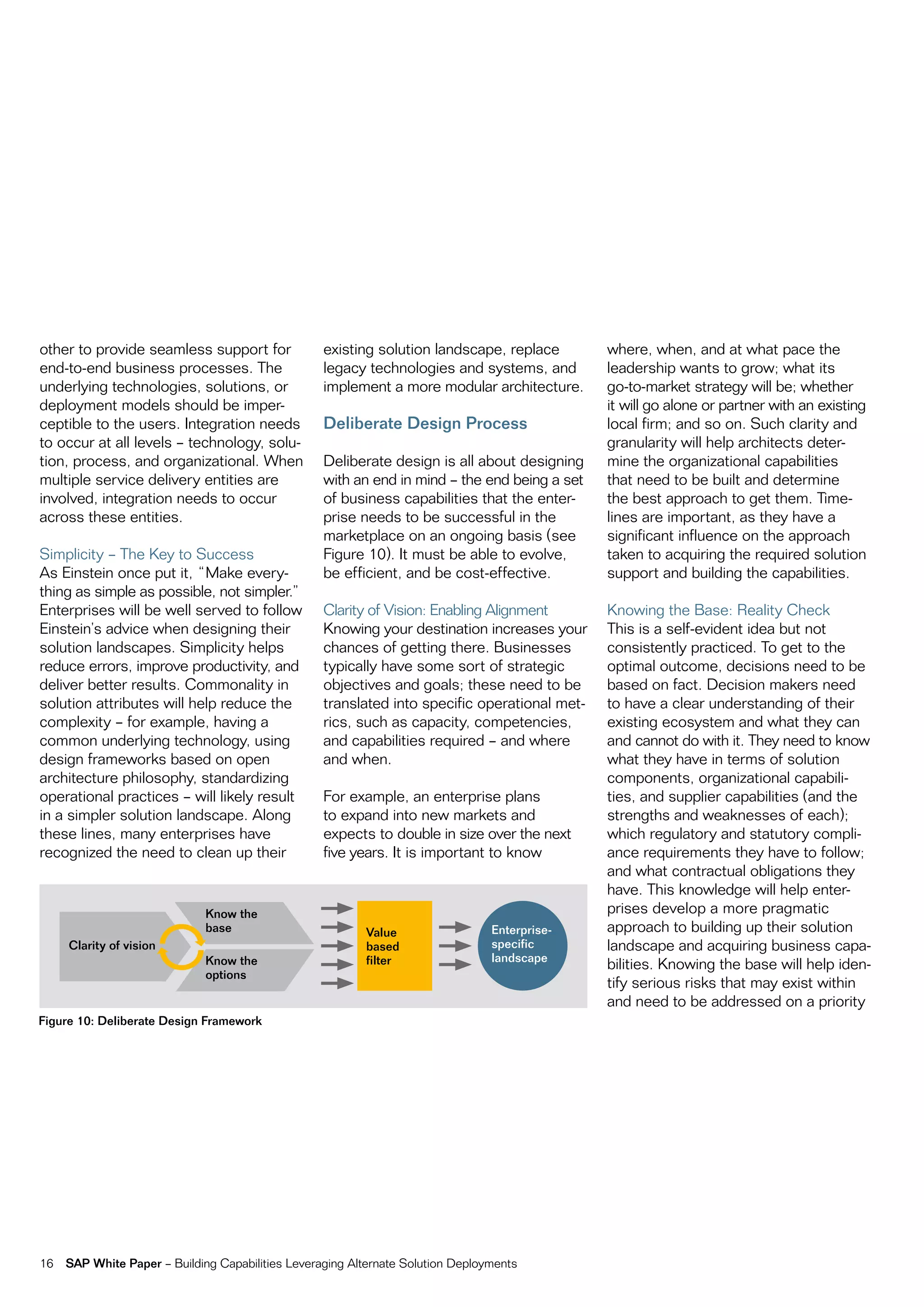
across these entities.                             prise needs to be successful in the         lines are important, as they have a
                                                   marketplace on an ongoing basis (see        significant influence on the approach
Simplicity – the Key to Success                    figure 10). it must be able to evolve,      taken to acquiring the required solution
as einstein once put it, “make every-              be efficient, and be cost-effective.        support and building the capabilities.
thing as simple as possible, not simpler.”
enterprises will be well served to follow          clarity of vision: enabling alignment       Knowing the Base: reality check
einstein’s advice when designing their             Knowing your destination increases your     this is a self-evident idea but not
solution landscapes. Simplicity helps              chances of getting there. Businesses        consistently practiced. to get to the
reduce errors, improve productivity, and           typically have some sort of strategic       optimal outcome, decisions need to be
deliver better results. commonality in             objectives and goals; these need to be      based on fact. Decision makers need
solution attributes will help reduce the           translated into specific operational met-   to have a clear understanding of their
complexity – for example, having a                 rics, such as capacity, competencies,       existing ecosystem and what they can
common underlying technology, using                and capabilities required – and where       and cannot do with it. they need to know
design frameworks based on open                    and when.                                   what they have in terms of solution
architecture philosophy, standardizing                                                         components, organizational capabili-
operational practices – will likely result         for example, an enterprise plans            ties, and supplier capabilities (and the
in a simpler solution landscape. along             to expand into new markets and              strengths and weaknesses of each);
these lines, many enterprises have                 expects to double in size over the next     which regulatory and statutory compli-
recognized the need to clean up their              five years. it is important to know         ance requirements they have to follow;
                                                                                               and what contractual obligations they
                                                                                               have. this knowledge will help enter-
                              Know the                                                         prises develop a more pragmatic
                              base                        Value                  Enterprise-   approach to building up their solution
     Clarity of vision                                    based                  specific      landscape and acquiring business capa-
                              Know the                    filter                 landscape
                                                                                               bilities. Knowing the base will help iden-
                              options
                                                                                               tify serious risks that may exist within
                                                                                               and need to be addressed on a priority
Figure 10: Deliberate Design Framework


16   SAP White Paper – Building capabilities Leveraging alternate Solution Deployments
basis. to do it right, enterprises will     • Know the shackles: understand the                Best-run companies actively manage
need to do the following:                     obligations – existing contracts and             their supplier relationships, often
• Benchmark to the marketplace –              legal obligations can become stumbling           working closely with their suppliers
  the organizational competencies and         blocks. enterprises need to know                 to understand and influence the sup-
  operational capabilities need to be         the restrictions and constraints that            pliers’ strategies and plans.
  evaluated relative to the marketplace,      may exist with respect to software
  to get a more accurate assessment           license transfer rights, employee              Knowing the options: increased
  of strengths and weaknesses. Best-          contracts, labor union or work council         probability of Success
  run companies benchmark not just            agreements, labor laws, and regula-            einstein once said, “We can’t solve
  within their industry but across other      tions prior to changing the deployment         problems by using the same kind of
  industries as well. reality checks can      models. for example, certain states            thinking we used when we created
  be painful but can help enterprises be      in the United States insist that health-       them.” Knowing the base helps enter-
  successful when appropriate remedial        care insurance claims processing               prises to better evaluate the options
  actions are taken. to ensure long-term      must be handled in-state; while out-           and avoid the mistakes; understanding
  sustainability of the solution, enter-      sourcing is possible, the work still           the options and their implications will
  prises must benchmark their ability         needs to be done in-state. there are           enable an enterprise to better deploy
  to attract and retain skilled resources     similar laws in the United Kingdom             its resources.
  on an ongoing basis.                        and europe that regulate where data
• Technology matters: business                needs to reside and how it must be             enterprises often look at obvious choices
  performance depends on it – Despite         handled. these can have a significant          and miss out on nontraditional options.
  the rhetoric that it should not matter      impact on the business case.                   for example, these days there are it
  when it comes to business services,       • Track suppliers: companies depend              outsourcing service providers that are
  the reality is that technology is the       on them more than they know –                  willing to finance the acquisition of soft-
  single greatest value driver; it helps      enterprises must periodically assess           ware, provided the buyer is willing to
  drive productivity, quality of service,     their suppliers for their ability to pro-      procure other related services (such
  decision-making ability, and overall        vide continued best-in-class services.         as implementation and operations) and
  success. enterprises must be selec-         Suppliers’ interests and capabilities          even provide it as software-as-a-service
  tive when it comes to technology.           change as well. it is important to know        to their customers via a subscription
  Whether the solution is internally          their strategic intent, where they plan        model. this means an enterprise now has
  deployed or provided by a third party,      to invest, and areas they plan to exit.        the ability to lower its capital expendi-
  they must evaluate the underlying           it is also important to know their             ture without having to forego the ability
  technology that is used to deliver the      relative standing in the marketplace.          to implement a customized solution. the
  services. it can provide early indica-      assess if they continue to be leaders          options need to be evaluated for longer-
  tion of the quality of service that the     in their space. With alternate deploy-         term impact on the organization and its
  enterprise can expect to receive.           ment models, suppliers become an               ability to remain competitive. Keeping
  Having reliable and flexible technology     integral part of an enterprise’s supply        the solution landscape simple goes a
  makes it easier for businesses to be        chain; their ability to deliver will impact    long way in improving effectiveness and
  responsive to business needs.               the enterprise’s ability to perform.           efficiencies. it is often tempting to opt


                                                       SAP White Paper – Building capabilities Leveraging alternate Solution Deployments   17
for the next new technology. But diver-            success. implementation of any new           many or too few resources increases
sity in technology across the solution             solution typically involves some form        risks and can dilute the value. they
landscape can become untenable.                    of operational or organizational change.     need to have clarity about what needs
                                                   for an alternate deployment to be suc-       to be done internally under the new
value-Based Decisions: improved roi                cessful, enterprises must align their        operating structure and eliminate
Saying that all decisions need to be               processes and organization structure,        redundancies. enterprises must avoid
value based is as basic as it can get.             instill operational discipline, and imple-   the temptation to shuffle existing
as there is no single right answer, each           ment joint governance.                       resources to these roles and must be
enterprise must determine the combi-                                                            open to recruiting from outside the firm
nation of solutions and deployment                 process alignment to Drive efficiency        to get the right skills essential for suc-
options that will enable it to get to its          When enterprises outsource, external         cess under the new operating model.
desired state in the most cost-effective           entities are introduced into the process     enterprises must proactively address
manner. When selecting the solution                chain. external service providers bring      the resulting change management
components, decision makers need                   their own operating policies, procedures,    requirement. extensive communication
to keep both the immediate-term and                and standards into the supply chain.         and retraining of resources are vital for
the long-term value in perspective.                there is a need to ensure that processes     enabling smooth organizational transition.
Having a well-defined, value-based pri-            between the entities dovetail, which may
oritization framework can help resolve             require enterprises to redesign the pro-     operational Discipline
conflicts and enable decision makers               cesses, taking into consideration the        another impact of outsourcing or on-
to select solutions that are better aligned        strengths and limitations of both parties.   demand deployment is the operational
with the enterprise’s value system.                enterprises must involve the suppliers       elasticity. Unlike in an on-premise situa-
                                                   in the redesign process. the transpar-       tion, an enterprise will not be able to make
the final choice may well depend on                ency will enable both parties to develop     operational changes at short notice
factors outside of the enterprise, such            a more comprehensive value chain.            without having to pay for them. Service
as supply constraints. Business situa-                                                          providers operate strictly to their con-
tions often change; what was important             retained organization – vital to Success     tracts. a poor demand management
yesterday may not be essential tomor-              one common mistake that enterprises          process can lead to increased overall
row. Hence, this process needs to be               often make when outsourcing is that they     costs, manifesting in additional service
iterative. an enterprise must not hesi-            do not redesign their retained organiza-     provider charges or the inability to meet
tate to pull the plug on an initiative if          tion for the new operating model. this       business needs. enterprises need to
there is a dilution in benefits or if it is        often leads to the creation of shadow        ensure that there is operational disci-
no longer required.                                organizations that are nonproductive         pline to avoid “scope creep” and ensure
                                                   and potentially disruptive. to avoid         realization of the business case benefits.
Managing the Transformation                        the creation of a shadow organization,
                                                   enterprises must clearly define the roles    governance and orchestration
Designing is only the first part of the            and responsibilities under the new           Having an efficient and effective gover-
equation; implementing and managing                operating model. enterprises need to be      nance organization is vital for ultimate
the transformation is key to the ultimate          deliberate in their design. retaining too    success. Buyer enterprises must ensure


18   SAP White Paper – Building capabilities Leveraging alternate Solution Deployments
Enterprise                                     Enterprise


   On-demand                     Business           On-demand                   Business
   supplier                      process            supplier                    process
                                 outsourcing                                    outsourcing
                                 supplier                                       supplier


         Hosting            Shared                      Hosting            Shared
         supplier           services                    supplier           services


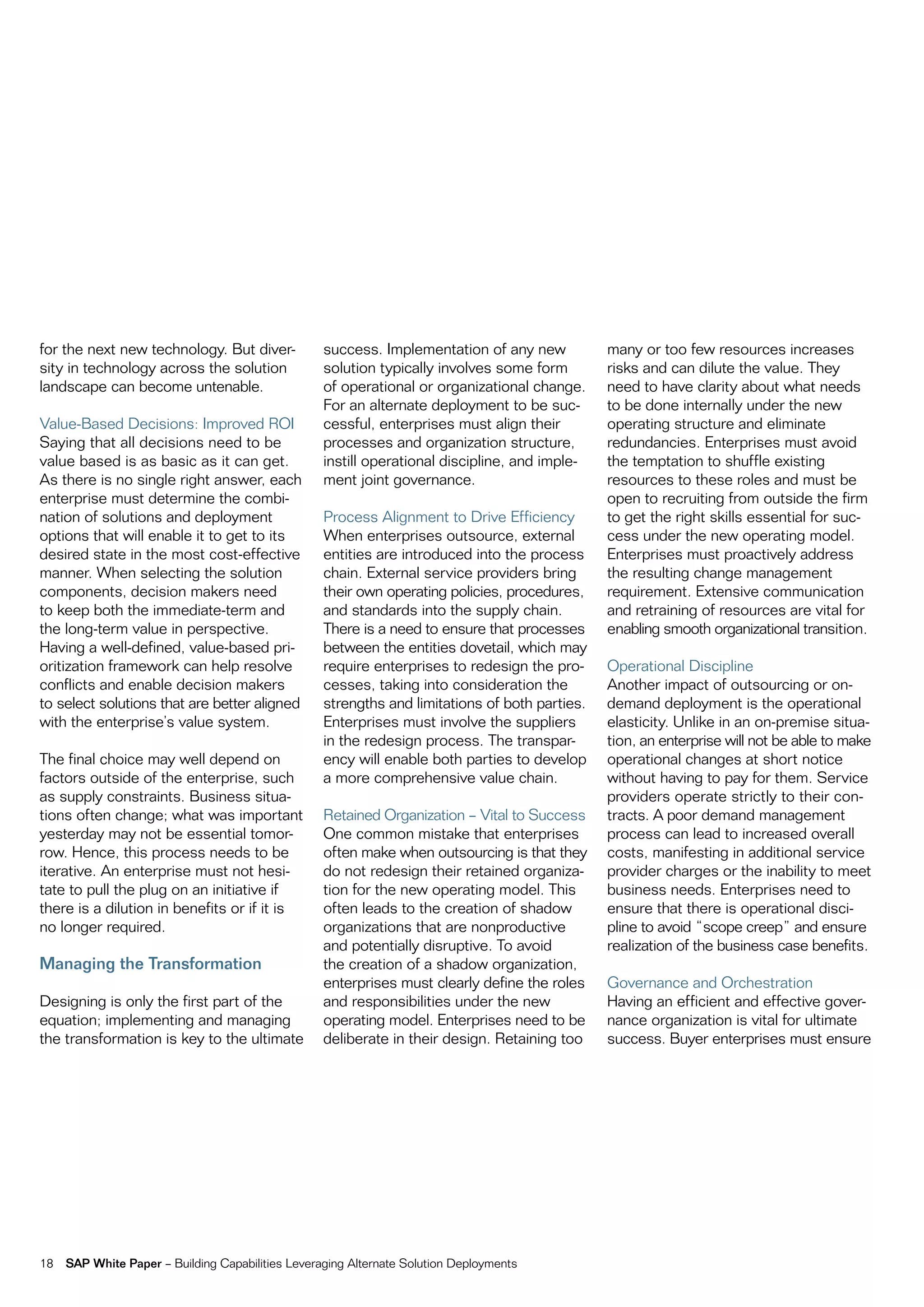
Figure 11: Integrated Service Delivery Management


that they do not become the bottleneck          issues quickly. there should be a clear
when multiple service providers are             set of goals, objectives, guiding principles,
involved in the delivery of a service           and issue resolution processes. enter-
(see figure 11). they must put in place         prises will be well served by establishing
an operating mechanism that enables             a competency center that defines stan-
the service delivery providers (except,         dards and coordinates activities related
perhaps, standard out-of-the-box SaaS           to alternate deployment models, sourc-
providers) to work collaboratively and          ing, contracting, administration, and
resolve any problem that may arise,             governance.
without having to depend on the buyer
enterprise to facilitate the interactions.

the governance organization must be
staffed with decision makers and key
individuals who are accountable for
business outcomes. it must include
executive-level representation from the
supplier organizations. internally, the
governance organization must have
representation from it, business, and Hr.
orchestrating the relationships at the
enterprise level will enable it to resolve


                                                            SAP White Paper – Building capabilities Leveraging alternate Solution Deployments   19
arChiteCting the solution landsCape
factorS to conSiDer


When buyers do not have choices,
decision making is relatively straightfor-           Solution models are a function of


                                                                                                                       p
                                                     ownership, technology deployment,


                                                                                                                    hi
ward. With increased choices, buyers


                                                                                                        rs
                                                                                                   w et
                                                     and operational responsibility


                                                                                                     ne

                                                                                                                       wn
                                                                                                 O ss
have a greater opportunity to choose


                                                                                                                      o
                                                                                                   A

                                                                                                nt
something that will make a difference.


                                                                                              re
alternate deployment models can pro-


                                                                                                      third-party
                                                                                                      operated
vide significant value as long as the


                                                                                         Operations
appropriate model is chosen for the
given circumstance. it is important to


                                                                                                      operated
                                                                                                      internally
note that no single model is appropriate
for every situation; as such, an enter-
prise must expect to have a combination                                                                             internally hosted   externally hosted

of solution deployment models within                                                                                  Technology Hosting
its landscape.
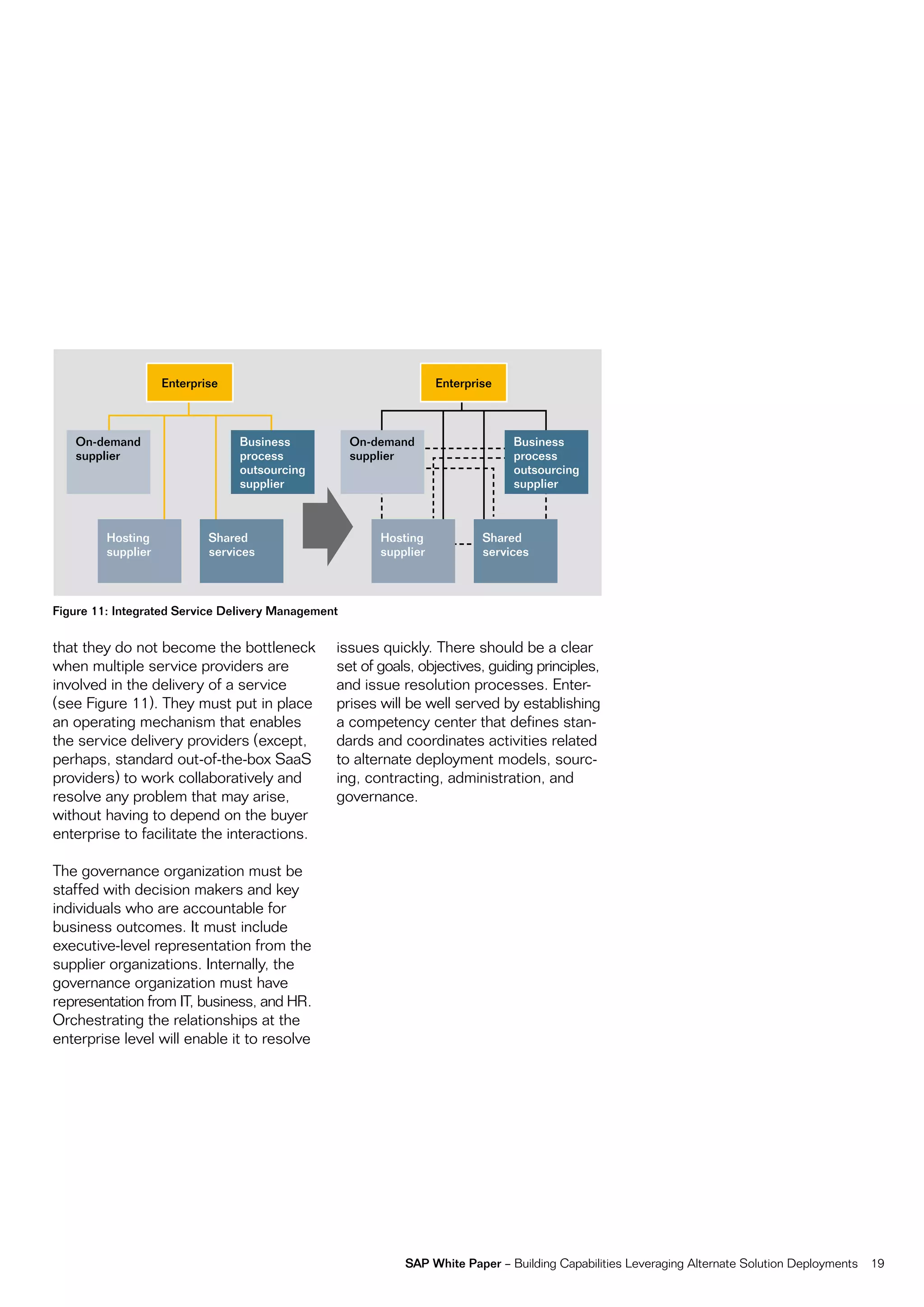
                                                   Figure 12: Three Dimensions of the Operating Model
a simplified way of looking at these
deployment models is in terms of asset             2. On-premise rental – Solution is
ownership, location of deployment, and                rented from a third party but hosted
operational responsibilities, as shown                and operated by internal resources.
in figure 12. fundamentally, there                 3. Classical hosting – this is the same
are three questions that need to be                   as classical on premise, except the                                                     Hygiene factors
addressed for any solution component:                 solution is hosted externally by a
• Should the enterprise own the tech-                 third party on its infrastructure.                                                      Strategic
  nology component?                                4. On demand or SaaS – a supplier                                                          alignment
• Where should it deploy the component                provides the solution platform or                                                       Business and
  – internally on the company’s infra-                the services using its own solution                                                     operational factors
  structure or externally on a third-                 components for the buyer to use.
                                                                                                                                              Supplier
  party infrastructure?                            5. Classical BPO – a supplier provides                                                     compatibility
• Who should operate it – internal                    the business services using the cus-
  resources or an external service                    tomer’s it platform (“labor arbitrage                                                   Financial evaluation
  provider?                                           Bpo”).
                                                   6. Bundled outsourcing – the supplier
the right answers may vary based on                   operates the customer’s technology
                                                                                                                                                    Best fit
component type and the circumstances                  and business process – that is,
that the enterprise finds itself in. We               bundling classic Bpo and classic
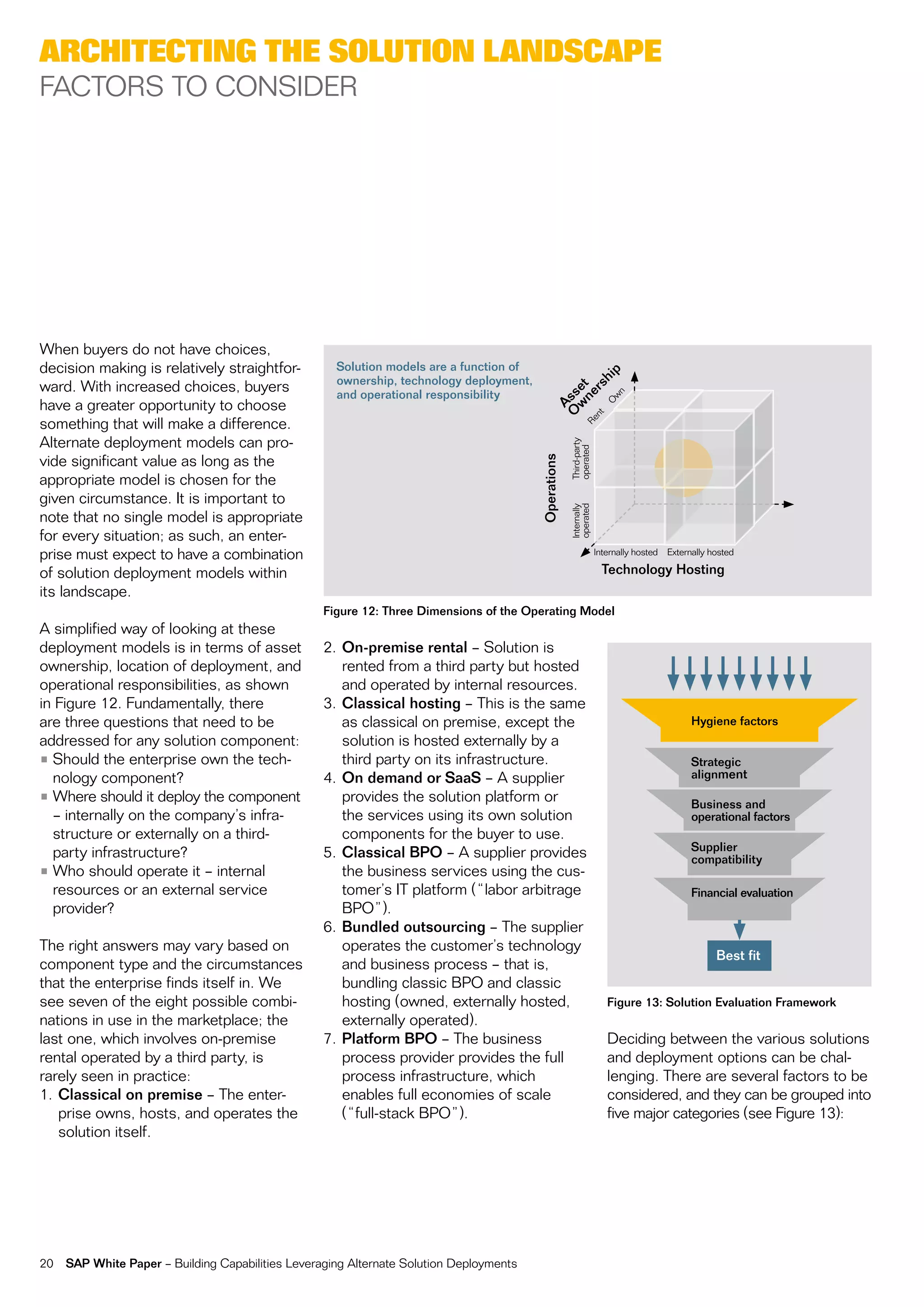
see seven of the eight possible combi-                hosting (owned, externally hosted,                               Figure 13: Solution Evaluation Framework
nations in use in the marketplace; the                externally operated).
last one, which involves on-premise                7. Platform BPO – the business                                      Deciding between the various solutions
rental operated by a third party, is                  process provider provides the full                               and deployment options can be chal-
rarely seen in practice:                              process infrastructure, which                                    lenging. there are several factors to be
1. Classical on premise – the enter-                  enables full economies of scale                                  considered, and they can be grouped into
   prise owns, hosts, and operates the                (“full-stack Bpo”).                                              five major categories (see figure 13):
   solution itself.


20   SAP White Paper – Building capabilities Leveraging alternate Solution Deployments
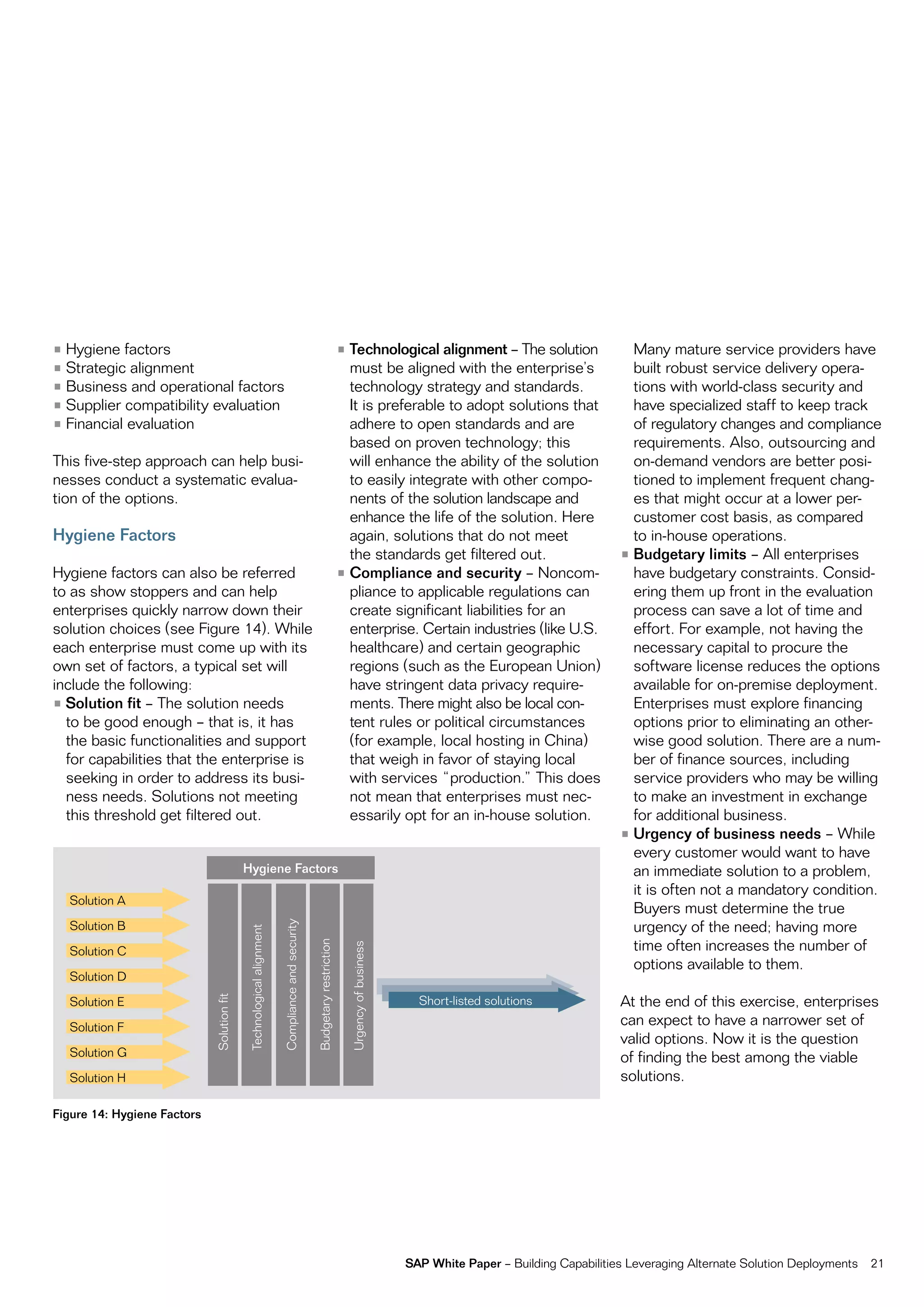
• Hygiene factors                                                                                                        • Technological alignment – the solution                        many mature service providers have
• Strategic alignment                                                                                                      must be aligned with the enterprise’s                         built robust service delivery opera-
• Business and operational factors                                                                                         technology strategy and standards.                            tions with world-class security and
• Supplier compatibility evaluation                                                                                        it is preferable to adopt solutions that                      have specialized staff to keep track
• financial evaluation                                                                                                     adhere to open standards and are                              of regulatory changes and compliance
                                                                                                                           based on proven technology; this                              requirements. also, outsourcing and
this five-step approach can help busi-                                                                                     will enhance the ability of the solution                      on-demand vendors are better posi-
nesses conduct a systematic evalua-                                                                                        to easily integrate with other compo-                         tioned to implement frequent chang-
tion of the options.                                                                                                       nents of the solution landscape and                           es that might occur at a lower per-
                                                                                                                           enhance the life of the solution. Here                        customer cost basis, as compared
Hygiene Factors                                                                                                            again, solutions that do not meet                             to in-house operations.
                                                                                                                           the standards get filtered out.                             • Budgetary limits – all enterprises
Hygiene factors can also be referred                                                                                     • Compliance and security – noncom-                             have budgetary constraints. consid-
to as show stoppers and can help                                                                                           pliance to applicable regulations can                         ering them up front in the evaluation
enterprises quickly narrow down their                                                                                      create significant liabilities for an                         process can save a lot of time and
solution choices (see figure 14). While                                                                                    enterprise. certain industries (like U.S.                     effort. for example, not having the
each enterprise must come up with its                                                                                      healthcare) and certain geographic                            necessary capital to procure the
own set of factors, a typical set will                                                                                     regions (such as the european Union)                          software license reduces the options
include the following:                                                                                                     have stringent data privacy require-                          available for on-premise deployment.
• Solution fit – the solution needs                                                                                        ments. there might also be local con-                         enterprises must explore financing
  to be good enough – that is, it has                                                                                      tent rules or political circumstances                         options prior to eliminating an other-
  the basic functionalities and support                                                                                    (for example, local hosting in china)                         wise good solution. there are a num-
  for capabilities that the enterprise is                                                                                  that weigh in favor of staying local                          ber of finance sources, including
  seeking in order to address its busi-                                                                                    with services “production.” this does                         service providers who may be willing
  ness needs. Solutions not meeting                                                                                        not mean that enterprises must nec-                           to make an investment in exchange
  this threshold get filtered out.                                                                                         essarily opt for an in-house solution.                        for additional business.
                                                                                                                                                                                       • Urgency of business needs – While
                                                                                                                                                                                         every customer would want to have
                                            Hygiene Factors                                                                                                                              an immediate solution to a problem,
                                                                                                                                                                                         it is often not a mandatory condition.
  Solution a
                                                                                                                                                                                         Buyers must determine the true
  Solution B                                                                                                                                                                             urgency of the need; having more
                                                                       compliance and security
                                             technological alignment


                                                                                                                                                                                         time often increases the number of
                                                                                                 Budgetary restriction

                                                                                                                           Urgency of business


  Solution c
                                                                                                                                                                                         options available to them.
  Solution D

                                                                                                                                                                                       at the end of this exercise, enterprises
                             Solution fit


  Solution e                                                                                                                                       Short-listed solutions

  Solution f
                                                                                                                                                                                       can expect to have a narrower set of
                                                                                                                                                                                       valid options. now it is the question
  Solution g                                                                                                                                                                           of finding the best among the viable
  Solution H                                                                                                                                                                           solutions.

Figure 14: Hygiene Factors


                                                                                                                                                 SAP White Paper – Building capabilities Leveraging alternate Solution Deployments   21
Strategic Alignment                                Operations Strategy                           help determine priority segments for
                                                   Enterprises use different operational         investments. When evaluating solutions
Immediate-term requirements often                  strategies to differentiate themselves        and deployment models, having align-
dominate the decision-making process,              in the marketplace; for instance, some        ment to operations strategy can enable
however, having alignment with strate-             may pursue a cost leadership strategy         better allocation of resources.
gic objectives and goals enables better            while others may adopt a value leader-
return on investment. Enterprises must             ship strategy. This will have an impact       Risk Tolerance
deploy solutions that support their stra-          on the selection of the solution. Buyers      There is risk associated with each
tegic objectives and business goals.               must also look into the capability-to-cost    deployment model. The question is,
There are three aspects with which the             equation. At the same time, enterprises       what is an acceptable level of risk and
solution needs to align, as shown in               may choose to keep certain solution           what option provides the best value
Figure 15:                                         components guarded; they may not want         equation? This question is pertinent
                                                   to let others have insight into their IP,     when enterprises have choices.
                                                   even if it means higher operating costs.      One way to look at solution choices is
                                                                                                 to consider the extent of external
                   Business
                                                   Enterprises must be truly critical in their   dependency it creates (see Figure 16).
                   strategy                        evaluation when determining what needs        It is preferable to limit external exposure
                                                   to be retained in-house. This does not        in business-critical areas, as failure
                                                   mean that every business within an            on the part of the supplier to provide
                                                   industry will perceive its solution land-     the necessary services can critically
                                                   scape in a similar manner. What is core       hamper the enterprise. When an enter-
                   Solution
                   selection                       to an enterprise can differ even within       prise outsources, it is not moving work
                                                   an industry. For example, a large box         to an external entity; rather, it is bringing
                                                   retailer may consider its supply chain        the external entity into the supply chain.
     Risk                         Operation        and logistics management as being its
     tolerance                    strategy         strategic value differentiator, whereas
                                                   a high-end retailer may view its customer       Case Example: Business Strategy
                                                   intimacy and shopping experience as             Case example: A U.S. company was
Figure 15: Strategic Alignment                     core to its business. These two firms           in urgent need of a new HR system,
                                                   will have different views of what they          as its existing system was not able
• Business strategy                                need to have direct control over.               to address new regulations. The IT
• Operations strategy                                                                              department initially identified a
• Risk tolerance                                   An enterprise must reflect on what is           solution that was tailor-made for
                                                   core to its business and its ability to         its immediate needs. What the IT
Business Strategy                                  build the essential competencies                department did not know was that
While the solution may need to address             required to gain competitive advantage.         the company board had plans in
immediate-term objectives, the selection           Investing to build up competencies in           place to expand into Asia within
process must also take the long-term               noncore areas can be suboptimal, as it          the next few years. Had they known
business strategy into account. Having             may require diverting scarce resources          that, they may have selected a
alignment with the longer-term business            from activities that are more fundamen-         different solution, one that provided
strategies will help reduce total cost of          tal to the business. Here again, seeking        expanded geographic coverage and
ownership in the long run (see “Case               alignment with strategic objectives can         avoided future costs. Seeking
Example: Business Strategy” sidebar).                                                              alignment with longer-term goals
                                                                                                   can help reduce overall cost and
                                                                                                   better return on assets.


22   SAP White Paper – Building Capabilities Leveraging Alternate Solution Deployments
for the services, security, compliance,            access to world-class capabilities and
                                     IT outsourcing or                            business continuity, and innovation.               improve their ability to compete with
                                     business process
                                     outsourcing
                                                                                  Weakness on the part of the supplier               more-established competitors by lever-
                                                                                  can have negative implications.                    aging third-party providers. They may
 Hosting                                                    On                                                                       also be able to improve their ability
                                                            demand                As enterprises move from on-premise                to comply with legal requirements (for
                                                                                  solutions to platform BPO, the level of            example, national and multinational tax
 On                                                                               supplier dependency increases. One                 reporting) and thus reduce business
 premise                                                                          way to determine the appropriate level             risks by outsourcing. Badly implemented
                             L                           H Platform
                                                            business              of dependency is by mapping the solu-              and operated on-premise solutions can
                                                            process               tion options to business criticality. The          be riskier than best practices–based
                                                            outsourcing
                                                                                  “corridor of acceptability” (see Figure 17)        outsourced solutions.
                                                                                  will depend to a large extent on the
Figure 16: Supplier Dependency Meter                                              internal capabilities of the enterprise –          Besides evaluating individual solution-
                                                                                  the lesser the in-house capabilities, the          level risks, businesses must also evalu-
Similarly, when an enterprise implements                                          lower the slope will be. If the business           ate risks at the enterprise level. Does
on-demand solutions, it brings the sup-                                           function is critical and the enterprise            implementing a specific solution increase
plier’s service delivery stack into the                                           does not have the requisite competen-              the enterprise’s exposure to a specific
process chain. There are literally hun-                                           cies and capabilities in-house, it is self-        supplier? Often, enterprises conduct
dreds of things that can cause supply                                             destructing to keep it in-house. On the            risk assessment on a stand-alone basis.
chain disruptions (for example, the                                               other hand, with strong internal capabil-          Best-run companies also evaluate the
avian flu outbreak in 1997 and the                                                ities, an enterprise may be able to gain           enterprise risk when selecting solution or
tsunami in 2008). Events like labor                                               distinct competitive advantage by                  service providers. (see “Case Example:
unrest, geopolitical events, and key                                              retaining the solution in-house.                   Vendor Selection” sidebar).
supplier employee attrition can cause
service disruption. The responsibility                                            Enterprises must determine when it
for outcomes remains with the enter-                                              makes sense to leverage a third party.               Case Example: Vendor Selection
prise even as it relies on the supplier                                           Smaller companies can often gain                     Case example: A global company
                                                                                                                                       decided to outsource a business
                                                                                                                                       function. Through a detailed evaluation
              L                                                                                    Higher internal
                                                                                                   capabilities                        process, it identified two potential
                                                                                                                                       vendors, each capable of providing
      Business criticality


                                                                                                                                       the requisite services. The company
                                                                                                 Platform business                     had a strong incumbent relationship
                                                                                      it   y     process outsourcing
                                                                                 abil                                                  with one of them. Despite the rela-
                                                                           cc ept
                                                                       of a                                                            tionship, it decided to opt for the
                                                                 dor
                                                           Corri                                                                       second vendor. The company was
                                                                                                   Lower internal
                                                                                                   capabilities                        not comfortable about the increased
             H                         On premise                                                                                      exposure it would create by awarding
                                 L                               Supplier dependency                                 H
                                                                                                                                       the new business to the incumbent.

Figure 17: Acceptability of Supplier Dependency


                                                                                               SAP White Paper – Building Capabilities Leveraging Alternate Solution Deployments   23
Business and Operational Factors                   needs to be aligned with the strategic           Service providers make significant
                                                   plan. an enterprise implementing a               investments to build up their service
this is the third stage in the solution            short-term fix must also put in place            delivery capabilities to stay competitive
selection process. While alignment with            plans to replace it with longer-term             in the marketplace. this means that a
broader, long-term strategies is essen-            solutions at the earliest possible time.         service provider’s operational capabilities
tial, there are always base realities,                                                              in many noncore business processes
such as competing demand on existing               operational factors                              will be superior to that of most enter-
operational capabilities (see figure 18).          We all like to believe that we are really        prises, even large ones. for example,
                                                   good at what we do – it is only human,           while enterprises consider Hr as being
Business Situations                                and enterprises are no different. Before         important, they also consider it to be a
often, enterprises find themselves in              deciding on on-premise or shared ser-            support function; this often translates
situations in which they need to act               vices deployment, an enterprise must             to limited budget being available for
quickly to address a challenge or lever-           ask the tough questions regarding its            improvement in operational capabilities.
age a market opportunity; these situa-             operational capabilities: Does it have           on the other hand, an Hr outsourcing
tions may call for some flexibility in             the operational capabilities comparable          service provider will invest heavily in
how the solutions are deployed. (see               to its direct peers? Will it be able to          building up its operational capabilities,
“case example: Business Situations”                sustain any competitive advantage going          as that is its core business. the Hr
sidebar).                                          forward? Will it be able to attract and          service provider may also be able to
                                                   retain the skilled resources needed? How         attract and hire better talent by offering
there can be other reasons, such as                does its performance compare to a                better career opportunities.
uncertainty of the business opportunity,           third-party service provider? are the
lack of capital, and so on, that may               operations cost-effective, as compared           the buyers must not take a service
influence the selection. even under                to the market? if the answer to any of           provider’s capabilities for granted.
these circumstances, the selection                 these questions is “no,” the enterprise          While many have strong capabilities in
                                                   may want to consider an alternative              certain areas, that does not translate
                                                   deployment.                                      into strengths across the board. enter-
Case Example: Business Situations
case example: a U.S. healthcare
company was about to undertake a
comprehensive systems upgrade ini-                                     In-House                                    World Class
tiative. just before it started on its
implementations, it received an                                      Competencies
acquisition offer. this made the                                                                                   Competencies
management put a hold on all major                                   Domain
                                                                     knowledge                                     Domain
initiatives. However, the business
                                                                                                                   knowledge
needed certain additional capabilities
                                                                     Processes
to maintain compliance. to address this                                                                            Processes
specific need, the company opted for                                 Infrastructure
a niche solution for the interim that it                                                                           Infrastructure
could deploy immediately.


                                                   Figure 18: Comparative Assessment of Operational Capabilities


24   SAP White Paper – Building capabilities Leveraging alternate Solution Deployments
prises must validate their suppliers’              Supplier Compatibility                             for new business segments instead
abilities to proactively develop innova-                                                              of improving current offerings.
tive solutions. for example, an it out-            Suppliers become an integral part of             • Financial stability – Having financial
sourcing service provider may have                 the buyer’s enterprise, especially in              stability allows the supplier to focus
strong technical knowledge but may                 cases of outsourcing and on-demand                 on operational aspects and customer
not have equally strong domain knowl-              services. Businesses must evaluate                 needs. it also means a reduced risk of
edge across all industries. this may               their suppliers on five aspects besides            the supplier becoming insolvent. this
limit its ability to innovate and deploy           how well the solution fits their business          is vitally important in the on-demand
industry-specific solutions.                       needs (see figure 19):                             space, as many of the providers are
                                                   • Supplier’s strategic intent – Under-             relatively small.
a recent forrester research survey                   standing the supplier’s strategic              • Willingness to invest – Having finan-
shows that 41% of those dissatisfied                 intent can provide actionable insight;           cial stability is not enough; there needs
with their outsourcing relationships                 for example, a supplier that intends             to be a willingness to invest – in new
picked lack of innovation and continuous             to grow through value leadership is              technologies, tools, and best people.
improvement as causes for dissatisfac-               likely to invest more in creating value,         Businesses must seek to understand
tion. Benchmarking internal and service              whereas a supplier focused on cost               how the supplier treats and motivates
provider capabilities will help determine            leadership will help drive down cost             its employees. How does it incorpo-
the best combination for maximizing                  but may not necessarily develop inno-            rate best practices on an ongoing
returns while minimizing risks. enter-               vative solutions. Similarly, a supplier          basis? is it investing in areas relevant
prises must not compromise on value                  intent on broadening its service offer-          for the enterprise? partnering with
leadership while trying to get to a lower            ings will likely dedicate more funds             suppliers willing to make the invest-
cost base.                                                                                            ments will help the enterprise maintain
                                                                                                      competitive advantage.
                                                                                                    • Organizational compatibility – the
                                                                                                      importance of organizational compati-
                                                                                                      bility is often underestimated. cultural
                                                                                                      differences, generation gaps, com-
                                          Solution fit
                                                                                                      munication styles, and different value
                                                                                                      systems contribute greatly to opera-
                       partnership                         Strategic intent
                                                                                                      tional incompatibility. While a perfect
                       commitment                                                                     match may be difficult every time,
                                                                                                      having similar corporate values and
                                                                                                      operating principles will help the
                                               Supplier
                                                                                                      buyer and the supplier employees
                                                                                                      to better understand each other and
                       organizational                        financial                                lead to better collaboration and
                       compatibility                         stability                                improved results.
                                                                                                    • Commitment to partnership – at the
                                          Willingness                                                 end of the day, the supplier’s commit-
                                          to invest                                                   ment to a partnership is what dictates
                                                                                                      success. this can be gauged by the
                                                                                                      senior resource commitment they
                                                                                                      are willing to make with regard to
Figure 19. Key Supplier Evaluation Framework


                                                              SAP White Paper – Building capabilities Leveraging alternate Solution Deployments   25
the relationship. the relevance of               example, a data migration cost is              typically straightforward, it is the ongo-
  the buyer’s business to the supplier’s           incurred if the enterprise is migrating        ing support structure cost – including
  goals will partly drive the level of             from an old system to a new one. Simi-         costs related to service delivery manage-
  commitment.                                      larly, the costs associated with transition,   ment, governance, and contract admin-
                                                   reorganization, and change management          istration – that can be a challenge.
Financial Evaluation                               are applicable only when enterprises
                                                   transition from an on-premise model            Scope creep and overtime cost
When everything else is acceptable,                to an alternate deployment model.              one aspect of operations cost that often
the selection boils down to financials:            these elements are often missed                gets overlooked is the cost associated
what will it cost over the productive              or underestimated.                             with overtime needs. in an outsourced
life of the solution, commonly referred                                                           situation, the service providers will charge
to as the total cost of ownership (tco)?           the training costs associated with             additional fees for services beyond the
enterprises must consider cost over                reskilling retained employees for their        contracted scope of work; the same is
the lifetime – initial cost, ongoing cost,         new roles and responsibilities can be          the case with on-demand and cloud
and exit cost. each category has                   significant, especially in the case of         services. the cost for enterprises with
a number of cost elements and applica-             outsourcing or establishing shared             fluctuating workload and absence of
bility of these elements may differ                service centers. there is a need for           operational discipline can be significant.
based on the deployment model                      extensive people management during             additionally, scope creeps are easier in
 (see the “Key tco cost elements”                  the transition process; the risks of           the case of outsourced services, as
table in the “appendix” section for                operational errors and productivity            service providers are
a list of key cost elements).                      losses are very high and can be expen-         typically not constrained by resource
                                                   sive. there are also costs associated          availability and are more likely to expect
one-time costs                                     with process and behavioral changes,           requests for additional work – of course,
the cost elements that get invoiced                in order to be effective under the new         for a fee.
by the supplier are the obvious ones;              operating model.
estimating internal costs are often the                                                           Business continuity costs
challenge, even in the case of SaaS                Besides internal change management,            enterprises must account for business
deployments. a survey by forrester                 there is a need to proactively manage          continuity under the different solution
research of customers using third-party            external stakeholders, such as custom-         options. in the case of supplier-provided
systems integration support to roll out            ers, suppliers, local governments, and         disaster recovery, it is important to
SaaS solutions found that 36% of the               others, as the case may be. these              determine the level of protection desired
SaaS projects involving enterprise solu-           can be onerous at times and must be            and the associated cost. While many
tions took more than a year to complete,           considered when calculating transition         enterprises do account for this, they
with only 7% completed within three                cost. Legal issues are a possibility and       often underestimate the cost associated
months. the survey also found that                 can be expensive. When functions and           with coordination and the complemen-
the key drivers of these were heavy                processes are outsourced, there are            tary effort needed on the part of the
integration with legacy systems, deeper            two types of integration costs – one           enterprise to bridge the gap in service
customization than previously anticipated,         relates to the technical integration and       levels during a disaster. enterprises
and significant process reengineering.             the second pertains to operational             must also account for the probability
                                                   integration. these can be significant.         of failure on the part of the service pro-
the cost of integration is, of course,                                                            vider for providing business continuity
dependent on the extent of integration             ongoing costs                                  and have their own fall-back plan in
involved. Some of the one-time costs               the ongoing costs are often difficult          place. there will be a cost element
are dependent on the situation – for               to gauge. While direct labor costs are         associated with such arrangements.


26   SAP White Paper – Building capabilities Leveraging alternate Solution Deployments
exit cost
the last cost category is the “exit cost.”


                                                                                                                                                     business process
Depending on the circumstances, this can


                                                                                                                           outsourcing


                                                                                                                                                     outsourcing
                                                                                                    on premise


                                                                                                                                         on demand
be very significant. transitioning work


                                                                                                                                                     platform
back in-house can be more expensive


                                                                                                                 Hosting
than outsourcing the first time around.
in case of termination midway through
the contract, there may be additional cost-
related legal matters, including costs               Speed of implementation               L                                                                            H
related to termination for convenience.
the need for termination can occur for               Cash-flow alignment                   L                                                                            H
reasons other than performance – for
example, the supplier gets bought out                Operational flexibility               L                                                                            H
by a company that the enterprise does
not want to do business with, the enter-             Supplier independence                 L                                                                            H
prise decides to sell off its unit that was
consuming the outsourced service, or                 Organizational change                 H                                                                            L
the supplier’s financial situation becomes
unstable. for tco calculations, enter-                                                         preferable                            not preferable
prises must weigh the probability of such
events occurring, based on the busi-             Figure 21: Alternate Deployment Characteristics.
ness situation and assessment of the
provider, to estimate a potential cost.          always helps lower the cost, but it always         must be used to decide on the solution,
                                                 comes with some risk. enterprises must             all other preconditions being fulfilled.
the decision to go for one deployment            decide the acceptability of the risk.
model or the other must not be based on                                                             Special-Case Circumstances
any presumption that one type of solu-           tco must be calculated over the antici-
tion deployment will always be cheaper           pated life of the solution (see figure 20).        there may be other special-case circum-
than the other. the real costs will vary         the on-demand solutions, with their                stances that may have an influence on
by circumstances. Sharing resources              pay-as-you-go model, will be more                  the ultimate selection – for example, an
                                                 cost-effective in the shorter term. the            enterprise may be planning to divest one
                                                 subscription model also helps smooth               of its business units. in the case of it
         Cumulative cost over time               out the cash flow and improve alignment            needs for this business unit, it may want
                                                 of cost with consumption. Some enter-              to opt for a third-party solution, as it would
                                                 prises may prefer such flexibility, even           be easier at the time of separation.
                                                 if the tco is higher over the life of
 Costs


                                                 the solution.                                      in summary, each deployment model
                                                                                                    has its merits and demerits (see figure
                                                 typically, solutions vary from one another         21). the cost-benefit trade-offs need to
                    on premise
                                                 in terms of functionality footprint, capa-         be evaluated on a case-by-case basis.
                    on demand                    bilities supported, and potential value.           While immediate pain points need to be
                                                 Hence, tco must be considered with                 resolved, a deliberate design approach
                                     Time
                                                 reference to value realizable. it should           can help enterprises achieve a sustain-
Figure 20: Total Cost of Ownership Projections   ideally be the value-to-cost ratio that            able competitive advantage.


                                                             SAP White Paper – Building capabilities Leveraging alternate Solution Deployments                              27
ConClusion
HyBriD SoLUtion LanDScape: Key to SUcceSS


in conclusion, alternate solution deploy-          Influencing                 On Premise                   Outsourcing                On Demand
ment models offer enterprises choices              Factors
on how to build up their capabilities.             capability type             core                         noncore                    noncore
these choices can provide significant
                                                   Business                    Long term                    Long term                  Short term or
benefits or introduce undesirable risks,           requirement                                                                         unsure
depending on the circumstances.
                                                   Urgency of                  Low                          Low to medium              High
currently, there is no single deployment           business need
option that can address all types of
business needs. as such, a business                Demand pattern              Steady                       fluctuating                fluctuating
will need to select the solution deploy-           in-house                    readily available            not adequate               not adequate
ment option based on its circumstanc-              infrastructure
es. While there are several aspects to             in-house                    market comparable            not adequate               available in-house
consider when evaluating, there are                competencies
some key factors (see the “influencing             cost of internal            comparable to                expensive to               expensive to
factors” table) that will likely influence         operations                  market                       the market                 the market
the choice of the deployment model –               Up-front                    available                    available                  not available
these being capability type, short-term            investment capital
versus long-term business requirement,
urgency of need, nature of the demand,
in-house infrastructure and competen-
cies, internal cost structure compared
to the market, and availability of invest-                               ac                  Us
                                                               p           ce              inte er                                                     User
ment capital.                                           Backu                ssi
                                                                                bili           rfa               functionalities      accessibility
                                                                                    ty            ce                                                   interface

Whatever the deployment model,                               network
the solution component needs to be                                                         Server                Server            network        Deployment
                                                                              Security                                                              model
able to operate cohesively with the rest
                                                       functionalities
of the solutions in the landscape. the                                                          ent
                                                                                            loym
solutions need to be aligned with                                                        Dep odel                Storage            middleware        Security
                                                                                            m
the enterprise’s longer-term it and                                      Storage
                                                                                                        s
                                                         m


operations strategy. every component                                                                 ion
                                                          id


                                                                                                  cat                              technologies       Locations
                                                            dl


                                                                                                Lo               Backup
of the solution landscape needs to
                                                              ew


                                                                            techn
                                                                                 ologie
                                                                ar


come together as a singular unit, with                                                 s
                                                                  e


the ability to adapt and evolve accord-
ing to needs (see figure 22).
                                                   Figure 22: Operating as a Single Unit
to get to the best solution landscape,
it and business leaders need to collab-
orate. a collaborative approach can help
the enterprises develop innovative solu-
tions to address immediate term needs
without sacrificing longer-term success.


28   SAP White Paper – Building capabilities Leveraging alternate Solution Deployments
appendix


Deployment Model Selection Considerations

Areas                         On Demand                          On Premise                           Outsourcing

capital requirement           capital requirement is lower,      capital requirement is higher,       capital requirement is higher,
                              as the vendor invests in the       as the buyer needs to invest         as the buyer needs to invest
                              requisite hardware and soft-       in the requisite hardware and        in the requisite hardware and
                              ware to provide the service.       software.                            software. outsourcing vendors
                                                                                                      may be willing to finance or
                                                                                                      subsidize the investment need-
                                                                                                      ed in exchange for additional
                                                                                                      future revenue.

cash flow                     the on-demand vendors              cash flow is skewed and front        cash flow is skewed and typi-
                              charge either on a fixed price     loaded. However, this results        cally front loaded. additionally,
                              subscription basis or on a con-    in lower ongoing operations          if the solution is being shifted
                              sumption basis. in either case,    costs.                               from an on-premise to an
                              it helps enterprises get better                                         outsourced model, there is an
                              alignment of cash flow with                                             additional transition cost. How-
                              consumption.                                                            ever, the resulting operating
                                                                                                      expenditure is expected
                                                                                                      to be lower.

functionality match           Solution needs to be a good        Buyer has access to the              Buyer has access to the
                              match, as buyers typically do      source code and can build            source code and can either
                              not have the option to exten-      additional functionalities, if       build or have the service
                              sively customize the solution.     required.                            provider build additional
                              Software as a service (SaaS)                                            functionalities, if required.
                              is provided via a shared re-
                              source that is configurable at
                              the user interface level but not
                              customizable at the database
                              or application levels. at best,
                              businesses can build add-on
                              solutions, outside of the core
                              SaaS application.


                                                      SAP White Paper – Building capabilities Leveraging alternate Solution Deployments   29
Areas                                On Demand                            On Premise                          Outsourcing

implementation effort and            implementation lead time             implementation lead time can        implementation lead time can
lead time                            is minimal; the on-demand            be significant, as the solution     be significant, but lower than
                                     offerings are standardized with      needs to be configured and          on premise, as outsourcing
                                     minimal possibilities for cus-       deployed. Having the ability to     suppliers can bring in best
                                     tomization. this means buyers        customize the solution often        practices and lower per-unit
                                     do not have choices; however,        translates into longer deploy-      cost resources to reduce lead
                                     the positive aspect is quick         ment time.                          time and cost.
                                     deployment.

future needs and supplier’s          Buyer is dependent on the            Buyer is not entirely dependent     Buyer is not entirely depen-
product road map                     vendor to build and deploy new       on the vendor to build and          dent on the vendor to build
                                     functionalities and features         deploy new functionalities and      and deploy new functionalities
                                     to address future needs. the         features to address future needs.   and features to address future
                                     buyer must evaluate the sup-         the buyer, while preferring         needs. the buyer, while prefer-
                                     plier’s strategy, future product     that the vendor provides new        ring that the vendor provides
                                     road map, and ability to ad-         functionalities as part of stan-    new functionalities as part of
                                     dress future needs in a timely       dard software, has the option       standard software, has the
                                     manner. if the supplier does         of building add-ons or making       option of building add-ons
                                     not have a clear road map,           modifications, if required.         or making modifications, if
                                     this can be a red flag.                                                  required.

Shared resources                     SaaS vendors typically offer         the solution is deployed            the solution is deployed either
                                     services via the multitenancy        in-house on buyer’s own infra-      in-house behind the firewall
                                     model, meaning that the un-          structure behind the firewall.      or on the outsourcing service
                                     derlying service delivery infra-     as such, the security is entirely   provider's infrastructure. the
                                     structure and resources are          within the buyer’s control.         infrastructure is typically sepa-
                                     shared. this can have implica-                                           rated out at the outsourcing
                                     tions and must be evaluated.                                             providers' site, unlike in the
                                     SaaS vendors may in turn use                                             case of on-demand services.
                                     third-party services to develop
                                     their service delivery platform;
                                     this may require the buyer
                                     to evaluate the third party as
                                     well. firms should review the
                                     vendor’s architecture to ensure
                                     proper data segregation.


30   SAP White Paper – Building capabilities Leveraging alternate Solution Deployments
Areas                           On Demand                            On Premise                           Outsourcing

access                          SaaS is offered via the public       With deployment within the           With deployment within
                                internet, using standard user        firewalls, enterprises have          the firewalls, enterprises can
                                interfaces for authorized users.     direct control over who can          choose to maintain access
                                Buyers need to evaluate the          access the system.                   within the security of vpn.
                                implications in terms of enter-
                                prise security.

application performance         Buyer is dependent on the            Buyer is dependent on the            Buyer is dependent on the
                                supplier to ensure application       software design for its perfor-      software design for its per-
                                system performance according         mance but is not dependent           formance and is dependent
                                to service-level agreements.         on the vendor for infrastructure-    on the outsourcing vendor for
                                the buyer must understand            related performance and              infrastructure-related perfor-
                                the underlying quality of the        operational service levels.          mance and operational service
                                resources being deployed to                                               levels.
                                ensure system performance
                                in a high-volume, multitenancy
                                environment.

Scalability                     a key value proposition of           Buyer can scale up with              Buyer can scale up with
                                SaaS is scalability. the buyer       additional licenses but may          additional licenses but may not
                                must evaluate if the vendor’s        not have the option to scale         have the option to scale down
                                architecture is designed for         down and get a refund in case        and get a refund. additional
                                true scalability.                    of reduced utilization.              services, such as business
                                                                                                          processing services, can be
                                                                                                          procured on a transaction
                                                                                                          basis with a stepped-scalability
                                                                                                          option.

ability to integrate with in-   this can be an issue and must        With access to the source            With access to the source
house and partner solutions     be evaluated up front. the           code, it is often easier to          code, it is often easier to
                                inability to integrate can dilute    integrate the solution to other      integrate the solution to other
                                any savings due to lower oper-       in-house and partner systems.        in-house and partner systems.
                                ating cost.


                                                          SAP White Paper – Building capabilities Leveraging alternate Solution Deployments   31
Areas                                On Demand                               On Premise                          Outsourcing

Supplier commitment                  Supplier's commitment to                Supplier's commitment to the        Supplier's commitment to the
                                     invest in building up the SaaS          product is important; however,      product is important; however
                                     solution and service delivery           if the supplier fails to deliver,   if the supplier fails to deliver,
                                     capabilities is vital. Unwilling-       the buyer is less at risk as        the buyer is less at risk as
                                     ness or inability to invest will        compared to its on-demand           compared to its on-demand
                                     place the buyer in a bind.              counterparts.                       counterparts.

financial stability                  SaaS is based on a shared-              Having a strong customer            Having a strong customer base
                                     cost model. the sustainability          base is always beneficial;          is always beneficial; however,
                                     of the model is dependent on            however, there is less depen-       there is less dependency on
                                     the supplier’s ability to make          dency on the vendor's financial     the software vendor's financial
                                     continued investments, as               strengths.                          strengths. But there is depen-
                                     the revenue and cost recovery                                               dency on the outsourcing
                                     happens over an extended                                                    vendor’s financial strengths to
                                     period. Hence, the customer                                                 enable continued investment
                                     base becomes important.                                                     required for performance
                                     Dependency on a few large                                                   improvements and innovations.
                                     customers can be risky, as the
                                     vendor will be severely impacted
                                     if any of them drop out. if the
                                     vendor is unable to attract a
                                     large number of customers
                                     to its platform, the solution
                                     may have a short life. evaluate
                                     the vendor’s customer base,
                                     financial standing, and invest-
                                     ment ability.

compliance risks                     Understanding the supplier’s            entirely within the buyer's         Buyer is dependent on the
                                     ability to fulfill all of the compli-   domain.                             outsourcing service provider
                                     ance requirements is para-                                                  to comply with all laws and
                                     mount. certain industry and                                                 regulations.
                                     country regulations mandate
                                     that the data be domiciled with-
                                     in the territory or region. as
                                     such, it is important to under-
                                     stand where the data resides
                                     in such situations.


32   SAP White Paper – Building capabilities Leveraging alternate Solution Deployments
Areas                 On Demand                            On Premise                           Outsourcing

Backup and recovery   Buyer needs to assess the            entirely within the buyer's          Buyer is dependent on the
                      backup and disaster recovery         domain.                              outsourcing service provider
                      processes and determine if the                                            to ensure backup and provide
                      recovery time and recovery                                                acceptable disaster recovery
                      point objectives are accept-                                              capabilities.
                      able. on the same note, the
                      buyer must determine if it will
                      have access to the software
                      source code if the vendor fails
                      to perform. it must also assess
                      the solution’s ability to perform
                      in a single tenancy mode.

portability           in case of failure on the part       Question does not arise, as          the data resides either within
                      of the provider, is it possible      the data resides within the          the enterprise or can be easily
                      to extract and move the data         enterprise.                          moved back in-house from an
                      to a different system?                                                    outsourcing vendor platform.


                                                SAP White Paper – Building capabilities Leveraging alternate Solution Deployments   33
Key TCO Cost Elements

Cost Elements                    Classic On      Classic          Classic          SaaS/       Classic   Bundled   Platform
                                 Premise         Rental           Hosting          On Demand   BPO       BPO       BPO

Initial cost
Software license                        ü                                ü                          ü         ü
Hardware                                ü               ü                                           ü        (ü)
facilities                              ü               ü                                           ü        (ü)
other software                          ü               ü                ü                          ü        (ü)
configuration and
implementation
                                        ü               ü                ü               (ü)        ü         ü         ü
Data migration                          ü               ü                ü                ü                              ü
integration                             ü               ü                ü                ü         ü         ü          ü
transition                                                                               (ü)        ü         ü         (ü)
reorganization                                                                           (ü)        ü         ü         (ü)
change management cost                                                                   (ü)        ü         ü         (ü)
Business user training                  ü               ü                ü                ü
Ongoing cost
Service charge                                          ü                ü               ü          ü         ü         ü
Standard software
maintenance support
                                        ü                                ü                          ü         ü
facility costs                          ü               ü                ü                          ü        (ü)
it operations                           ü               ü                                           ü
Business operations                     ü               ü                ü               ü
governance                                                               ü               ü          ü         ü         ü
contract administration                                                  ü               ü          ü         ü         ü
Business continuity                     ü               ü                ü               ü          ü         ü         ü
Exit cost
alternate solution selection                                             ü               ü          ü         ü         ü
migration                                                                ü               ü          ü         ü         ü
reorganization                                                                           ü          ü         ü         ü
User training                                                                            ü          ü         ü         ü

Legend: (ü) – Depends on the situation


34   SAP White Paper – Building capabilities Leveraging alternate Solution Deployments
glossary of terms


On premise – Solution that is deployed on enterprise-owned infrastructure and
operated by internal resources. this includes shared service centers that are fully
owned and operated by the company.

On demand – Solution or service that is provided in a fully hosted and ready-to-
use mode, either on a subscription basis or a consumption basis. the ownership
of the assets resides with the service provider. the on-demand services include
infrastructure services, application services, and business services.

Shared service – centralized service operations that provide services to multiple
business or operating units located in multiple geographies

Outsourcing – any operational activity performed by an external party; these can
be either it related or business related or both.

Platform BPO – Standardized business services using a single technology platform
to provide services to many clients

Cloud services – it-enabled solutions and services (including business services)
ubiquitously delivered, over the internet, to multiple customers and consumers,
on demand, using standardized processes and leveraging shared resources –
infrastructure, systems, and people

Hybrid landscape – Solution landscape that includes more than one of the deploy-
ment models – that is, on premise, outsourcing, and on demand


                                                      SAP White Paper – Building capabilities Leveraging alternate Solution Deployments   35
BiBliography


 1. forrester research inc., “real-World insights into SaaS implementation
    Success,” by Liz Herbert, with christina ferrusi ross and elizabeth rose,
    may 2010.
 2. forrester research inc., “Status, challenges, and near-term tactics for
    cloud Services in enterprise outsourcing Deals,” by paul roehrig, phD,
    november 2009.
 3. forrester research inc., “SaaS adoption 2010: Buyers See more options
    But must Balance tco, Security, and integration,” by Liz Herbert, with
    christine ferrusi ross and mark grannan, june 2010.
 4. forrester research inc., “SaaS valuation criteria,” by Liz Herbert; february
    2010.
 5. forrester research inc., “Best practices: SaaS Systems integration,” by Liz
    Herbert with christine ferrusi ross and mark grannan, november 2010.
 6. gartner research presentation, “Who really cares about the cloud – an
    industry perspective,” by jeff roster, cynthia moore, and Kristine pfeiler.
 7. gartner research, “SaaS Dynamics continue to act as a catalyst for the
    convergence of Services and Software,” by frances Karamouzis and
    matthew goldman, april 2010.
 8. gartner research, “four Steps to get in front of the SaaS curve,” by
    robert p. Desisto, june 2010.
 9. gartner research, “Hype cycle for cloud computing,” 2009.
10. iDc, “Success in outsourced cloud Services involves Building to the end
    State, Understanding your genetic code, and avoiding potential pitfalls and
    Dead ends,” by David tapper.
11. iDc, “Worldwide Software as a Service 2010 – 2014 forecast: Software
    Will never Be the Same,” by robert p. mahowald.
12. iBm 2010 global ceo Study.
13. HrBr 2010 volume 3, number 1, “to Bundle or not to Bundle?” by
    prof. Leslie Willcocks, Dr. ilan oshri, and Dr. john Hindle.
14. HrBr 2010 volume 3, number 1, “imperfect arbitrage,” by Deborah Kops.
15. Wikipedia Web site “cloud computing.”

SAP References

1.   “Business Solutions Without compromise – integrated on-Demand and
     on-premise applications from Sap.”
2.   “the impact of technology in Business process outsourcing – the complete
     Business process outsourcing cost picture.”


36   SAP White Paper – Building capabilities Leveraging alternate Solution Deployments
50	104	008	(11/03)
©2011 Sap ag. all rights reserved.

Sap, r/3, Sap netWeaver, Duet, partneredge, ByDesign,
Sap Businessobjects explorer, StreamWork, and other Sap products
and services mentioned herein as well as their respective logos are
trademarks or registered trademarks of Sap ag in germany and
other countries.

Business objects and the Business objects logo, Businessobjects,
crystal reports, crystal Decisions, Web intelligence, xcelsius, and
other Business objects products and services mentioned herein as well
as their respective logos are trademarks or registered trademarks of
Business objects Software Ltd. Business objects is an Sap company.

Sybase and adaptive Server, ianywhere, Sybase 365, SQL anywhere,
and other Sybase products and services mentioned herein as well
as their respective logos are trademarks or registered trademarks of
Sybase, inc. Sybase is an Sap company.

all other product and service names mentioned are the trademarks
of their respective companies. Data contained in this document serves
informational purposes only. national product specifications may vary.

these materials are subject to change without notice. these materials
are provided by Sap ag and its affiliated companies (“Sap group”)
for informational purposes only, without representation or warranty of
any kind, and Sap group shall not be liable for errors or omissions with
respect to the materials. the only warranties for Sap group products
and services are those that are set forth in the express warranty
statements accompanying such products and services, if any. nothing
herein should be construed as constituting an additional warranty.


   www.sap.com /contactsap

Building capabilities leveraging alternate solution deployments

  • 1.
    SAP White Paper adaptiveoperating models Building CapaBilities leveraging alternate solution deployments Strategic LeverS for competitive poSitioning
  • 3.
    Content 4 Executive Summary 16 Deliberate Design process 4 the need to go Beyond 16 clarity of vision: the traditional approach enabling alignment 4 Leveraging alternate Solution 16 Knowing the Base: reality check Deployment models 17 Knowing the options: 5 constructing a Best-in-class increased probability of Success Solution Landscape and 18 value-Based Decisions:0 operating model improved roi 5 need for Deliberate Design 18 managing the transformation 5 need for orchestration: 18 process alignment to Drive operating as a Singular Unit efficiency 5 no Shortcuts: collaborating for 18 retained organization – the Best results vital to Success 18 operational Discipline 6 Capability Needs and 18 governance and orchestration Acquisition Options 6 existing Landscape: 20 Architecting the Solution often convoluted Landscape 6 Scarcity of resources: increasing 21 Hygiene factors the challenge 22 Strategic alignment 7 new Service Delivery models 22 Business Strategy offering possibilities galore 22 operations Strategy 8 challenge: choosing the right 22 risk tolerance Solution Deployment model 24 Business and operational factors 8 on-premise Deployment: 24 Business Situations the traditional Workhorse 24 operational factors 8 outsourcing Services: 25 Supplier compatibility Leveraging partner capabilities 26 financial evaluation 10 Shared Service centers: 26 one-time costs an alternative to outsourcing 26 ongoing costs 11 on-Demand Deployment: 26 Scope creep and overtime cost more flexibility and reduced 26 Business continuity costs expenditure 27 exit cost 12 Business process as a Service: 27 Special-case circumstances Ultimate partner network 13 private versus public cloud: 28 Conclusion Security comfort versus cost Benefit 29 Appendix 14 Key to Success – getting it right the first time 35 Glossary of Terms 15 Deliberate Design 36 Bibliography 15 Best-in-class Landscape Qualities 36 Sap references 15 evolutionary 15 Delightful to Use 15 operate as a Singular Unit 16 Simplicity – the Key to Success
  • 4.
    exeCutive summary neeD forfLexiBiLity anD SpeeD in today’s global economy, enterprises are faced with the operating costs but also reduce capital expenditure and provide the intense competition. new network-based business models flexibility to scale based on business and practices are transforming the way enterprises collab- needs. this can be very attractive, as the vendor makes all the investments orate and grow. Businesses need to be highly flexible, needed and provides businesses with scalable, and nimble to stay successful. it requires their access to ready-to-use solutions or services through a pay-as-you-go model. operations to be able to adapt quickly to market conditions this reduces and sometimes even elimi- and be responsive to customer demands. However, this is nates the need for initial investment on the part of the buyer while providing easier said than done; building and maintaining such capa- the ability to scale according to needs. bilities the traditional way is laborious and challenging. it is these options provide businesses with imperative that businesses innovate and seek alternate ways opportunities to build the capabilities to acquire essential capabilities in a cost-effective manner. they need while reducing capital and operating expenditures. However, like everything in life, there are limitations The Need to Go Beyond evaluating alternatives to acquire and downsides with these models as the Traditional Approach best-in-class capabilities. this includes well. enterprises need to evaluate the building a network of strategic business implications for their businesses and Business needs are not homogeneous; partners that are able to provide the determine the best combination of while some may be short term, others required capabilities at a competitive deployment models that will suit their will be longer term. certain capability price. the concept itself is not new; it needs (see figure 1). requirements may be related to core is about extending it into operational business aspects, while others may be and it functions previously considered peripheral. the traditional approach to beyond scope. On premise building capabilities in-house to address Shared service every need is time consuming and often capital intensive; sustaining these capa- Leveraging Alternate Solution bilities at market-comparable levels is Deployment Models Outsourced even more challenging. also, businesses may not have the requisite knowledge, many large enterprises have taken On premise competencies, and resources essential to outsourcing, while some have estab- Decentralized to adequately address the needs. lished captive shared service centers in resource-rich, low-cost locations given the fast-paced business environ- to reduce their operating costs. more On demand ment, diversity in demand, and chal- recently, we have seen a slew of solu- lenges associated with the traditional tion and service providers under the approach, businesses may be well banner of “on demand” or “cloud” Figure 1: Hybrid Solution Landscape served by looking outside the box, services, offering to not only reduce 4 SAP White Paper – Building capabilities Leveraging alternate Solution Deployments
  • 5.
    Constructing a Best-in-Class scientious effort, which we refer to as as a singular unit, provide seamless Solution Landscape and Operating “deliberate design” (see figure 2). support for end-to-end businesses Model Deliberate design is about architecting process integration, and have the ability every aspect of the solution landscape to evolve over time according to the While the new solution deployment to address specific business objectives business needs. this requires planning options offer businesses opportunities and goals, without leaving anything to and orchestration at the enterprise level. to solve several it-related issues, they chance. this does not happen naturally architecturally, the solution landscape are not yet in a position to address all and requires deliberate effort on the needs to be componentized with a lower of the enterprise needs and challenges part of architects and decision makers. level of diversity and a higher level of – for example, what does one do with enterprises need to think in terms of integration. this will help achieve a the complex and often convoluted legacy enterprise capabilities and not in terms higher degree of flexibility and agility. systems that many businesses have of the functionalities and features of today? these cannot be replaced individual technology components. When No Shortcuts: Collaborating for overnight – there will be considerable architecting the solution landscape, the Best Results risk exposure. the on-demand and businesses must take into consider- cloud services industry is still in its ation existing capabilities and constraints, Deliberate design needs to be more than infancy, and there are a limited number balancing solution benefits and risks, just an approach; it needs to be ingrained of enterprise solutions available today. to get to the best possible outcome. into the operating culture. enterprises the products currently available often must live it, from both a business and have smaller functional footprints as an it perspective, to be successful. any compared to their on-premise counter- Strategy data and process inconsistencies can parts, and many of the on-demand destroy gains made on the functional vendors are new and small. even the fronts. Despite the pressures to respond outsourcing industry, which is more to market opportunities and inclinations than two decades old, is still evolving to bypass enterprise it, business leaders and is not in a position to service all need to collaborate with their it col- of the enterprise needs. these new Benefits Risks leagues to identify and implement the solution deployment models increase right solutions. many of the it challenges the level of dependency on the service that enterprises are faced with today are provider; any failure or shortcoming often a direct result of a series of non- on the part of the service provider will Capabilities integrated purchasing decisions. care expose the buyer to significant risks. and needs to be taken to ensure that short- in addition, not all aspects of business constraints term fixes are aligned with longer-term functions are conducive to every form business interests and that risk levels of alternate deployment. Figure 2: Deliberate Design are acceptable. Need for Deliberate Design Need for Orchestration: Operating this paper aims to discuss the various as a Singular Unit capability acquisition and it solution every enterprise situation is different. deployment options and provide a per- to get to the best solution option, independent of the ultimate solution spective on how to evaluate the suitability enterprises need to undertake a con- selected or deployment model used, of those options, given an enterprise’s the enterprise landscape must operate situation, and to get the best outcome. SAP White Paper – Building capabilities Leveraging alternate Solution Deployments 5
  • 6.
    CapaBility needs andaCquisition options tHe cHaLLengeS the marketplace has become more have ended up with – often a direct to develop innovative solutions required complex with globalization – having a result of years of a piecemeal approach to provide a competitive edge. even if good strategy is not enough, the ability to building it-driven capabilities. this they are currently able to garner the to execute is vital, and only the proficient incoherent approach has left many resources, will they be able to retain and dexterous will survive. enterprises enterprises with a plethora of technolo- the talent on a long-term basis and what need to have market-relevant capabilities gies and systems, with varying degrees will it cost? Businesses also need to to stay competitive, and technology is of antiquity and often with a suboptimal determine if internal development is the a key enabler. at the same time, there level of integration, creating significant most cost-effective option to acquiring are limitations on available resources. business risks (see figure 3). the necessary capabilities. it is important enterprises need to build or acquire to ensure that investments made today the right set of it-enabled business Scarcity of Resources: Increasing will remain productive and relevant a capabilities in a cost-effective manner the Challenge few years down the road. to remain competitive – and this is easier said than done. With continued pressures to reduce operating costs and an increase in a piecemeal approach Existing Landscape: Often competing demand for capital, many to solution selection and Convoluted businesses are reducing their it bud- gets as a percentage of revenue. deployment has resulted Business executives often feel that their in enterprises having convo- enterprise it is unable to keep pace with Besides monetary constraints, enter- their needs. While there may be several prises also find it difficult to attract and luted solution landscapes. reasons why, typically it is the convoluted retain the talent essential to build the solution landscape that enterprises needed operational capabilities and Service providers Outsourced Cloud services Business need Risks On demand Benefits On premise Captive shared service center Figure 3: Impact of Piecemeal Architecture Evolution 6 SAP White Paper – Building capabilities Leveraging alternate Solution Deployments
  • 7.
    New Service DeliveryModels However, the industry still has a long for obvious reasons – low capital Offering Possibilities Galore way to go before it can be categorized expenditure, low deployment costs, as being mature. recent advancements faster implementation, better alignment With increasing competitiveness, enter- in internet technology, the growth of of cash flow, quicker access to innova- prises need to make best use of their communication infrastructure, the tion, lower internal resource needs, the resources, focusing their own efforts development of virtualization technolo- ability to scale, and the ability to change where they can make a difference while gies, and new internet-based solutions providers due to no fixed investments. leveraging others to provide additional have enabled the provisioning of a new capabilities and solution support. over breed of services, commonly referred there are four categories of on-demand the last two decades, many businesses to as on-demand or cloud services. the services: have leveraged outsourcing to address vendors make the investments necessary 1. infrastructure as a service (iaaS), a scarcity of resources and escalating to provide the on-demand or cloud ser- wherein the vendor delivers computer operations costs; some have managed vices, thus eliminating the need on the infrastructure as a service. rather to go beyond cost reduction and improve part of the buyer to make major capital than purchasing servers, software, their operational performance and drive investments. vendors typically charge data-center space, or network innovation. for the services on a consumption basis. equipment, enterprises instead these services are becoming popular buy these resources as a fully outsourced service. In-house Infrastructure 2. platform as a service (paaS), wherein shared services management services the vendor provides the computing On premise platform and solution stack as a Hosting services service, often consuming cloud Outsourcing infrastructure and sustaining cloud applications. it facilitates deployment Application services of applications without the cost and complexity of buying and managing Business process the underlying hardware and soft- outsourcing services ware layers. Deployment models 3. Software as a service (SaaS), Infrastructure as wherein the vendor delivers software a service applications as a service over the internet, eliminating the need to install Platform as a service and run the application on the enter- On demand prise’s own computers and simplifying Software as a service maintenance and support. the appli- cations are hosted on the vendor’s premises on a vendor-owned or Business process as vendor-leased infrastructure. the a service users get access to the application via the internet. Figure 4: Alternate Deployment Models SAP White Paper – Building capabilities Leveraging alternate Solution Deployments 7
  • 8.
    4. Business processas a service be advantageous for some and not so downsides – the need to invest up front, (BpaaS), wherein the vendor pro- for others, depending on their situation. longer implementation lead time, opera- vides the business services, (for enterprises need to fully understand tions management, and ongoing access example, payroll services or travel- the benefits and risks associated with to quality resources (see figure 5). the expense processing services). the each option as well as the longer-term inability to attract and retain quality vendor installs all the hardware and implications for the business. resources can pose a significant risk. software necessary to provide the With alternate options now being avail- business services, which frees up on-premise Deployment: able, enterprises will be well served the user from having to deal with the traditional Workhorse to evaluate the traditional on-premise the entire it layer. enterprises have traditionally deployed solution deployment approach relative solutions on premise primarily because to others. on-premise deployments prima facie, these solution deployment there were not many alternatives. the will make sense when system security or capability acquisition models appear question is whether it is still the best is paramount, business capabilities to be tailor-made to address the enter- option now that there are more choices. supported are strategic, and the enter- prise needs. industry analysts expect prise has the core competencies a major portion of the global it and the primary advantage with on-premise required to perform better than the business services to be provided via deployment is the sense of security market in a cost-effective manner. these models in the foreseeable future. and control, with the solution being However, there is the need to exercise deployed within the enterprise firewall outsourcing Services: Leveraging caution. Like everything else in life, and managed by internal resources. partner capabilities there are pros and cons with each of there are other advantages, such as By leveraging global resources and these options – a poor selection will lower vendor dependency, the possibility newer technologies and adopting have long-term business ramifications. to customize, a certain level of opera- industry best practices, outsourcing tional flexibilities, and potential lower service providers are typically able Challenge: Choosing the Right cost per unit over the long run based to offer enterprises opportunities to Solution Deployment Model on utilization. lower their operating costs, improve performance, and provide operational each of the deployment models has While ownership does provide a sense flexibility, to name just a few. there are distinct attributes; these attributes may of independency, it comes with some several different outsourcing options – infrastructure outsourcing, hosting services, application management Key Drivers Key Inhibitors services, and business process out- • Less dependency on the supplier • Up-front capital requirement sourcing (Bpo) services – each with its • Lower risk • Infrastructure needed own value proposition. the appropriate • Deployment flexibility • Implementation lead time • Operational control • Internal IT resources needed option for a buyer enterprise depends • Security • Additional operational workload on its situation and what it is seeking • Lower per-unit transaction cost • Lack of operational flexibility to achieve (see figure 6). for example, in the long run an enterprise with an underutilized, high-quality data center but limited skilled it resources may find it cost- effective to host the solution internally while leveraging a third party for oper- ating services; whereas an enterprise Figure 5: On-Premise Influencers 8 SAP White Paper – Building capabilities Leveraging alternate Solution Deployments
  • 9.
    that does nothave a robust it infra- outsourcing does not mean transferring work to an external structure but has cost-competitive internal human resources may benefit enterprise; it is really about bringing the external entity into by having the solution hosted externally the enterprise’s own supply chain. but operated by its own personnel. While outsourcing provides significant supply chain. enterprises are now icant organizational and operational benefits, not all enterprises are satisfied. dependent on the supplier to fulfill its change management on the part of a forrester research survey conducted business needs – the supplier’s risks the buyer. as such, selecting the right in november 2009 shows that the key become part of the enterprise’s risk service provider is extremely important. reasons for dissatisfaction are lower profile, and any failure on the part of cost savings than expected, services the supplier can directly impact the given the risks, when should one out- not being up to expectations, a lack of buyer. enterprises need to have fall- source? to get to the answer, the risks innovations, and an inability to respond back plans in place; transitioning associated with outsourcing need to be to changing business needs. in today’s back the work will be expensive and, weighed against the risks of maintaining competitive business environment, these at times, not a viable option. the solutions in-house. the key ques- can be severely debilitating. • Differences in organizational cultures tions to consider are: and operating models – no two orga- • Does the enterprise have the the success and failure of outsourcing nizations are alike. there are several resources and competencies to be depends on several factors; however, aspects that drive differences, includ- able to perform comparable to best there are two fundamental aspects that ing operational processes, organiza- in class, and are these sustainable? need to be recognized: tional culture, priorities, and so on; • is the intellectual property (ip), func- • introduction of a third party into the these can create significant opera- tion, or process central to the business, value chain – outsourcing is not tional issues. for outsourcing to be and does it need to be rigidly guarded about throwing things over the wall; successful, it requires complete inte- at all cost? on the contrary, it introduces the gration of the operating models and • is the internal operation more cost- external party into the company’s the organizations; this requires signif- efficient and sustainable? • What are the longer-term implications in terms of future investment needs? Key Drivers Key Inhibitors • Lack of internal IT resources • Strategic intellectual property enterprises must consider outsourcing • Freeing up of valuable internal or operations when internal capabilities are in short resources • Dilution of control supply and the organization does not • Reduction in operating • Significant transition costs expenditure • Significant change management have the competencies and resources • Operational flexibility • Higher supplier dependency required to outperform the market. • Access to best practices • Local regulations typically, functions and processes that • Redeployment of assets are noncore to the business and do not provide distinct marketplace differentia- tion are ideal candidates for outsourcing. this does not mean that enterprises should not consider other areas for out- sourcing. outsourcing service providers Figure 6: Outsourcing Influencers SAP White Paper – Building capabilities Leveraging alternate Solution Deployments 9
  • 10.
    are often ableto bring in innovation and best practices as well as leverage scale Key Drivers Key Inhibitors to create value. in addition, outsourcing • Control • Significant transition costs can help free up key resources to focus • Security • Organizational change on more strategic business aspects. • Economies of scale • Process changes • Strong internal competencies • Cultural change • Lack of critical mass Shared Service centers: an alternative • Divergent service needs to outsourcing • Inability to attract essential Some enterprises opted to establish resources their own captive shared service centers in low-cost, resource-rich locations as an alternate way to reduce operating costs and improve performance. estab- lishing captive shared service centers provides certain advantages over Figure 7: Shared Services Influencers outsourcing – it enables retention of full operational control, protects the enterprises need to ensure the appro- to go beyond the selection of the city; company’s ip, and avoids third-party priateness of the functions and pro- it needs to be as granular as possible, cesses being shifted to shared service down to a specific site within a city Centralized Versus Localized Service centers. operations that require inti- (see “case example: Shared Service Centers mate knowledge of local cultures and center Location” sidebar). there are those that benefit from face-to-face several factors to be considered, like Centralized Localized interactions are not ideal for remote local laws, the quality of infrastructure Back-office func- front-office func- shared service centers. tions, transaction tions, functions processing, analytics requiring customer moving to a shared services model typ- Case Example: and research, non– interactions (like ically requires redesigning the processes Shared Service Center Location customer facing receivable and involved and the operating structure, a global enterprise set up a regional activities collections man- resulting in a need for significant orga- shared service center in a certain agement and sales nizational change management. the low-cost location. Within a few management) ability to recruit and retain the right years, the company had to relocate resources on an ongoing basis is vital to a different location with a larger for any shared service center, a chal- resource pool. the same location risks. However, establishing a captive lenge that enterprises often underesti- attributes that attracted that com- shared service center is not for every- mate. factors like brand recognition, pany to the original location had one – it requires considerable investment growth opportunity, perception of the brought in other businesses com- to set up a world-class shared service job, supply pool, and competitive land- peting for the same resources. center. there are costs related to facili- scape influence an enterprise’s ability recruiting and retaining quality ties buildup, recruitment and training, to attract and retain talent. resources became a challenge. it and organizational changes; without also meant an increase in operating the critical mass and market compara- Location is central to any shared service cost due to higher attrition, training ble competencies, establishing a cap- center operations. establishing a shared costs, and productivity losses. tive shared service center is a risky service center in the wrong location this also impacted its operational proposition (see figure 7). can be disastrous. the evaluation needs performance during the transition period. 10 SAP White Paper – Building capabilities Leveraging alternate Solution Deployments
  • 11.
    or entirely eliminatesthe need for the buyer to acquire assets. this is Legal system a major value proposition, especially when businesses are faced with Location attractiveness considerable competing demand for investment capital. Brand attractiveness • Standardized services – Services are provided on a standardized basis with Economic stability very limited or no ability to customize. the inability to customize may impair Costs and inflation an enterprise’s ability to optimally leverage the solution to address its Geopolitical stability unique needs and gain a market advantage. Laws and regulations • Speed – the other side of standardized services is that businesses do not have Infrastructure to go through a long, drawn-out imple- mentation; for example, businesses Labor availability can easily procure additional comput- ing resources within minutes by simply swiping their credit card. Similarly, 0 1 2 3 4 5 businesses can have access to certain Location B desktop applications and collaboration Minimum Location A Threshold tools by setting up a subscriber account. enterprise applications, on Figure 8: Location Assessment Grid the other hand, will be somewhat more complicated but still faster than an available, costs, inflation, geopolitical ingly crowded with on-demand solution on-premise implementation. stability, economic stability, location vendors everyday. While it is imperative • Scalability – Suppliers typically offer attractiveness, ability to compete, and that enterprises evaluate a solution buyers the ability to scale up or down so forth (see figure 8). offering by comparing it to their needs, based on their need. this is highly having an understanding of the key valuable for businesses that are in the ability to maintain competitive attributes typically associated with such a growth mode or have unpredictable advantage over the longer term can be on-demand offerings will help businesses business demand. it also helps busi- a challenge. Several companies with construct a solution landscape appro- nesses better align their cash flow successful captive shared service centers priate to their needs. with consumption. have exited – some did it to monetize • flexibility – Having the ability to sub- their capabilities, while others did it there are several types of on-demand scribe to services or have access because it was not as cost-effective services available these days. the key to resources enables businesses to as they had anticipated. attributes associated with software on experiment without having to expend demand are the following: significant capital to build capabilities. on-Demand Deployment: more • capital expenditure – the supplier it also allows businesses to deploy flexibility and reduced expenditure makes all the investment needed interim solutions while evaluating the marketplace is becoming increas- to provide the service, which reduces longer-term solution options. SAP White Paper – Building capabilities Leveraging alternate Solution Deployments 11
  • 12.
    • Shared servicesbasis –the on-demand suppliers for all aspects of the opera- by having rights to the software and services are typically offered on a tions, including system performance, other assets that may be essential shared services basis. the customers service quality, and disaster recovery. to operate the system efficiently. in share the application and the underly- any weakness on the part of a sup- case a supplier uses third-party ing infrastructure. While this is one plier creates direct exposure for its resources to provide the service, of the core value drivers, it is also the customers. a business must also seek to have biggest source of concern – about • emerging industry – the on-demand access rights to those assets or system security, performance, extent industry is still in its infancy; the mar- solutions. of operational control, and compliance ket will invariably consolidate as it with the law. grows and matures, and buyers need enterprises need to balance the bene- • Supplier dependency – there is a to evaluate the survivability of their fits of low capital requirement, better higher level of supplier dependency for suppliers. alignment of costs, and operational everything from fixing simple solution • integration – the ability to integrate is flexibility with the risks of failure on problems to developing more complex an important consideration, especially the part of the service provider (see solution upgrades. many of the solu- in cases where the application services figure 9). as the industry develops and tions available today have limited are part of a process chain. matures, there will be more offerings functionalities. While a smaller foot- • Legal protection – While procuring and further refinement of the service print may serve today’s need, the SaaS and on-demand solutions is delivery model. Selecting the right ser- vendor’s ability to address future needs relatively easy, businesses must not vice provider is paramount to success. is crucial. the ability of a vendor take contracting for these services to provide timely upgrades will have lightly. a company will be well served Business process as a Service: a direct impact on an enterprise’s by having its legal team review the Ultimate partner network ability to respond to market needs. services contract to ensure adequate BpaaS, or platform Bpo, or business Suppliers are unlikely to build new protection and avoid situations where process utility (BpU), as gartner capabilities unless there is a broader it does not have recourse in case the refers to it, is part of the on-demand demand for the functionality. enter- supplier is unable to deliver services. services category. BpaaS has existed prises are also dependent on the a business can protect its interests for decades, common examples being the payroll and benefits administration services provided by companies like Drivers Inhibitors aDp. Like other on-demand services, • Lower up-front capital requirement • Supplier dependency vendors make the investment required • Speed of implementation • Security and privacy to provide the business services; they • Less internal IT resources needed • Limited customization possibilities • Operational flexibility (scaling) • Need for tight integration either have their own underlying infra- • Better alignment of cash flow • Uncertainty over total cost of structure or use a third-party infrastruc- • Agility ownership ture solution to provide the services. • Access to resources • Portability this category of services is expected • Access to best practices • Existing landscapes to become more popular, with busi- nesses seeking to move away from fixed costs and reduce investments in noncore functional areas and more service providers entering the market with a wide range of offerings. the Figure 9: On-Demand Influencers 12 SAP White Paper – Building capabilities Leveraging alternate Solution Deployments
  • 13.
    option is attractivein a number of While sharing resources helps reduce potential benefits. enterprises need situations: cost, it brings up questions about safe- to consider several aspects: • enterprise does not have market- guards, data security, ip protection, • robustness of the supplier’s infra- comparable it and operational statutory and regulatory compliance structure – is it robust enough to capabilities in-house. obligations, liabilities, consumers’ legal deliver the services at the expected • the need for business services rights in case of breach, backup and performance level? is it fault tolerant, capability is immediate and does not recovery, data portability, ability to audit, and does it have built-in redundancies offer adequate lead time to build it and system availability and performance. to guard against failures? in-house. • Security – is the service delivery • the cost of internal operations is public cloud service providers will infrastructure secure, and does it significantly higher than the cost of argue that their infrastructure is safe. adhere to international standards? externally sourced business services. fortunately, there has not been any Besides the systems, how robust • the business needs are short term. major incident of breach. However, with are the supplier’s security policies increased global competition and and procedures? external providers are better positioned increasing industrial espionage via • ease of integration – Will the enter- to leverage economies of scale, lever- the internet and attacks on Web sites, prise be able to easily integrate the age technology advances, and incorpo- it is prudent to be cautious. the very cloud solution with other in-house or rate best practices, bringing value to their resources that can provide computing third-party systems? With a diversity customers. However, opting for BpaaS power to enterprises on demand are of business needs, enterprises are also means greater supplier dependency; also available to hackers. Whether likely to end up with a combination buyers need to protect their investment a cloud is safe or not depends on of in-house systems, outsourced by having a comprehensive fall-back strat- the quality of the underlying assets solutions, and on-demand services. egy in case of exigency. and tools and how they are deployed the ability to easily integrate systems as well as the service provider’s will make the difference. private versus public cloud: Security operational practices. many leading • ability to audit – Will the enterprise comfort versus cost Benefit cloud infrastructure service providers be able to perform system audits at the on-demand story is not complete are deploying best-in-class security any time? without discussing the private versus solutions and building multilevel redun- • portability – Will the enterprise be public cloud. Simply put, cloud services dancies to protect against breach and able to easily transition the solution are dynamically provisioned it and busi- service failures. However, buyers must back in-house or to a third party, if ness services that are delivered over not assume that this is always the case the need arises? the internet in a multitenancy mode, and must verify the robustness and • Business continuity – Will the enter- leveraging shared it resources. With security of the service provider’s deliv- prise have the rights to the service virtualization technology, it is possible ery ecosystem. as with any in-house delivery components in case the to perform real-time assignment of system, weakness at any level of the supplier defaults or is unable to deliver technology to consumers on demand. technology stack can potentially impact to contracted service levels? Subscribers to cloud services share service, security, and compliance. • Business case – What is the incre- the underlying infrastructure, operating mental cost savings as compared to environment, applications system, and opting for public cloud is primarily other solution deployment options? human resources, as the case may be. a question of balancing risks with SAP White Paper – Building capabilities Leveraging alternate Solution Deployments 13
  • 14.
    not all enterprisesare fully convinced Key to Success – Getting It Right about the safeguards and are opting for the First Time what is called a private cloud deploy- ment. a private cloud is nothing but With pressures to respond to the a carving out of physical resources customer, there is often a temptation within the public cloud ecosystem for to opt for quick fixes. History has exclusive use. this allows the enter- shown that such short-term fixes have prise to incorporate additional security the tendency to have longer-term and other safeguards that it may desire. consequences creating complexity and adding to the challenge rather the private cloud is not exactly new; than reducing it. the “appendix” sec- enterprises have used virtual private tion contains a list of factors to consider networks for a while. vendors are (see “Deployment model Selection using the same concept by offering consideration” table) when deciding standardized services via a dedicated between the deployment models. as infrastructure within the shared eco- enterprises seek to address business system. Having a private cloud is needs, it is not the lack of options that analogous to having a reserved parking is a constraining factor nor is it the extent space in a public parking lot for exclu- of potential benefits with the various sive use, as opposed to using any solutions; it is the associated constraints available parking space in the lot as and risks that makes it a challenge. a needed. Under the private cloud, the comprehensive evaluation of the options buyer pays for the dedicated parking will enable the buyer to make informed spot rather than paying based on decisions, guard against potentially actual utilization. avoidable adverse impact, and increase the probability of success. at the end of the day, it is a question of cost versus the ability to operate on your own terms. it is important to understand the potential risks and have a plan in place in case of failure on the part of the service provider. 14 SAP White Paper – Building capabilities Leveraging alternate Solution Deployments
  • 15.
    deliBerate design maKing oBjective-Driven, fact-BaSeDDeciSionS How does one optimally leverage the scape to be flexible and evolutionary enable the enterprise to take advantage various deployment options without as well – without having to expend of innovation without adversely impact- overly increasing the risks? a purist may significant resources. this then requires ing the business or losing out on previous say, “Start with a clean slate.” the reality the solution landscape to be modular investments. Standardizing interfaces is that enterprises cannot afford to start in design, with plug-and-play solution and integration points based on open from scratch and need to be able to components and with each having the protocols will help enterprises to avoid leverage their existing investments in ability to evolve independently and lock-ins and retain the power of choice. the best possible manner. this requires according to the needs of the business. this approach will help minimize the the enterprise to adopt a very systematic to achieve this, the architecture needs interdependencies and improve the and deliberate approach to architecting to be designed using the concept of ability to swap components according its solution landscapes, reevaluating “capability units.” each capability unit is to needs. existing solutions, and designing every a self-contained solution component component such that it has a definitive consisting of technology and operating Delightful to Use role to play in creating enterprise value. resources, with the ability to execute another important attribute is the ability the “deliberate” design approach is predefined processes, delivering spe- to delight the users. When a solution is based on strategic intent, as opposed cific outcomes. Being self-contained delightful to use, there will be a higher to an “accidental” design, which is basi- allows each capability unit to evolve on adoption rate, reduced errors, and cally a string of mostly opportunistic, its own and according to business needs. improved productivity, resulting in lower stand-alone decisions without an over- cost and better business outcomes. this arching set of guidelines or road map. these units need to be built using proven requires the solution to be intuitive to technology. Having components devel- use, be easily configurable, and have Deliberate design is anchored on busi- oped on proven technology platforms the ability to tune performance accord- ness goals and objectives, the operating by established firms will help improve ing to the company’s needs. it must environment, and constraints. it is based the life of the capability units. this is support company policies and processes, on facts with metrics to measure success because proven technologies have wider promote productivity, and enable in terms of final outcomes. for creating adoption rates, which translates into a informed decision making. sustained value, the solution landscape higher probability of new solutions being needs to have certain qualities. developed on the platform and the like- operate as a Singular Unit lihood of a large resource pool, thereby the solution landscape needs to oper- Best-in-Class Landscape Qualities extending the useful life of the compo- ate as one singular unit despite being nent. Using appropriate adaptation a collection of disparate components there are several qualities that your layers, namely middleware, and loose with a diverse set of attributes. the solution landscape should have in order coupling between the components will components need to complement each to best support your business needs. evolutionary Deliberate design should be more than just an approach, Businesses are not static and need to continuously innovate to stay com- it should be a sacred tenet; enterprises need to ingrain it petitive; this requires the solution land- into their operating culture to benefit from it. SAP White Paper – Building capabilities Leveraging alternate Solution Deployments 15
  • 16.
    other to provideseamless support for existing solution landscape, replace where, when, and at what pace the end-to-end business processes. the legacy technologies and systems, and leadership wants to grow; what its underlying technologies, solutions, or implement a more modular architecture. go-to-market strategy will be; whether deployment models should be imper- it will go alone or partner with an existing ceptible to the users. integration needs Deliberate Design Process local firm; and so on. Such clarity and to occur at all levels – technology, solu- granularity will help architects deter- tion, process, and organizational. When Deliberate design is all about designing mine the organizational capabilities multiple service delivery entities are with an end in mind – the end being a set that need to be built and determine involved, integration needs to occur of business capabilities that the enter- the best approach to get them. time- across these entities. prise needs to be successful in the lines are important, as they have a marketplace on an ongoing basis (see significant influence on the approach Simplicity – the Key to Success figure 10). it must be able to evolve, taken to acquiring the required solution as einstein once put it, “make every- be efficient, and be cost-effective. support and building the capabilities. thing as simple as possible, not simpler.” enterprises will be well served to follow clarity of vision: enabling alignment Knowing the Base: reality check einstein’s advice when designing their Knowing your destination increases your this is a self-evident idea but not solution landscapes. Simplicity helps chances of getting there. Businesses consistently practiced. to get to the reduce errors, improve productivity, and typically have some sort of strategic optimal outcome, decisions need to be deliver better results. commonality in objectives and goals; these need to be based on fact. Decision makers need solution attributes will help reduce the translated into specific operational met- to have a clear understanding of their complexity – for example, having a rics, such as capacity, competencies, existing ecosystem and what they can common underlying technology, using and capabilities required – and where and cannot do with it. they need to know design frameworks based on open and when. what they have in terms of solution architecture philosophy, standardizing components, organizational capabili- operational practices – will likely result for example, an enterprise plans ties, and supplier capabilities (and the in a simpler solution landscape. along to expand into new markets and strengths and weaknesses of each); these lines, many enterprises have expects to double in size over the next which regulatory and statutory compli- recognized the need to clean up their five years. it is important to know ance requirements they have to follow; and what contractual obligations they have. this knowledge will help enter- Know the prises develop a more pragmatic base Value Enterprise- approach to building up their solution Clarity of vision based specific landscape and acquiring business capa- Know the filter landscape bilities. Knowing the base will help iden- options tify serious risks that may exist within and need to be addressed on a priority Figure 10: Deliberate Design Framework 16 SAP White Paper – Building capabilities Leveraging alternate Solution Deployments
  • 17.
    basis. to doit right, enterprises will • Know the shackles: understand the Best-run companies actively manage need to do the following: obligations – existing contracts and their supplier relationships, often • Benchmark to the marketplace – legal obligations can become stumbling working closely with their suppliers the organizational competencies and blocks. enterprises need to know to understand and influence the sup- operational capabilities need to be the restrictions and constraints that pliers’ strategies and plans. evaluated relative to the marketplace, may exist with respect to software to get a more accurate assessment license transfer rights, employee Knowing the options: increased of strengths and weaknesses. Best- contracts, labor union or work council probability of Success run companies benchmark not just agreements, labor laws, and regula- einstein once said, “We can’t solve within their industry but across other tions prior to changing the deployment problems by using the same kind of industries as well. reality checks can models. for example, certain states thinking we used when we created be painful but can help enterprises be in the United States insist that health- them.” Knowing the base helps enter- successful when appropriate remedial care insurance claims processing prises to better evaluate the options actions are taken. to ensure long-term must be handled in-state; while out- and avoid the mistakes; understanding sustainability of the solution, enter- sourcing is possible, the work still the options and their implications will prises must benchmark their ability needs to be done in-state. there are enable an enterprise to better deploy to attract and retain skilled resources similar laws in the United Kingdom its resources. on an ongoing basis. and europe that regulate where data • Technology matters: business needs to reside and how it must be enterprises often look at obvious choices performance depends on it – Despite handled. these can have a significant and miss out on nontraditional options. the rhetoric that it should not matter impact on the business case. for example, these days there are it when it comes to business services, • Track suppliers: companies depend outsourcing service providers that are the reality is that technology is the on them more than they know – willing to finance the acquisition of soft- single greatest value driver; it helps enterprises must periodically assess ware, provided the buyer is willing to drive productivity, quality of service, their suppliers for their ability to pro- procure other related services (such decision-making ability, and overall vide continued best-in-class services. as implementation and operations) and success. enterprises must be selec- Suppliers’ interests and capabilities even provide it as software-as-a-service tive when it comes to technology. change as well. it is important to know to their customers via a subscription Whether the solution is internally their strategic intent, where they plan model. this means an enterprise now has deployed or provided by a third party, to invest, and areas they plan to exit. the ability to lower its capital expendi- they must evaluate the underlying it is also important to know their ture without having to forego the ability technology that is used to deliver the relative standing in the marketplace. to implement a customized solution. the services. it can provide early indica- assess if they continue to be leaders options need to be evaluated for longer- tion of the quality of service that the in their space. With alternate deploy- term impact on the organization and its enterprise can expect to receive. ment models, suppliers become an ability to remain competitive. Keeping Having reliable and flexible technology integral part of an enterprise’s supply the solution landscape simple goes a makes it easier for businesses to be chain; their ability to deliver will impact long way in improving effectiveness and responsive to business needs. the enterprise’s ability to perform. efficiencies. it is often tempting to opt SAP White Paper – Building capabilities Leveraging alternate Solution Deployments 17
  • 18.
    for the nextnew technology. But diver- success. implementation of any new many or too few resources increases sity in technology across the solution solution typically involves some form risks and can dilute the value. they landscape can become untenable. of operational or organizational change. need to have clarity about what needs for an alternate deployment to be suc- to be done internally under the new value-Based Decisions: improved roi cessful, enterprises must align their operating structure and eliminate Saying that all decisions need to be processes and organization structure, redundancies. enterprises must avoid value based is as basic as it can get. instill operational discipline, and imple- the temptation to shuffle existing as there is no single right answer, each ment joint governance. resources to these roles and must be enterprise must determine the combi- open to recruiting from outside the firm nation of solutions and deployment process alignment to Drive efficiency to get the right skills essential for suc- options that will enable it to get to its When enterprises outsource, external cess under the new operating model. desired state in the most cost-effective entities are introduced into the process enterprises must proactively address manner. When selecting the solution chain. external service providers bring the resulting change management components, decision makers need their own operating policies, procedures, requirement. extensive communication to keep both the immediate-term and and standards into the supply chain. and retraining of resources are vital for the long-term value in perspective. there is a need to ensure that processes enabling smooth organizational transition. Having a well-defined, value-based pri- between the entities dovetail, which may oritization framework can help resolve require enterprises to redesign the pro- operational Discipline conflicts and enable decision makers cesses, taking into consideration the another impact of outsourcing or on- to select solutions that are better aligned strengths and limitations of both parties. demand deployment is the operational with the enterprise’s value system. enterprises must involve the suppliers elasticity. Unlike in an on-premise situa- in the redesign process. the transpar- tion, an enterprise will not be able to make the final choice may well depend on ency will enable both parties to develop operational changes at short notice factors outside of the enterprise, such a more comprehensive value chain. without having to pay for them. Service as supply constraints. Business situa- providers operate strictly to their con- tions often change; what was important retained organization – vital to Success tracts. a poor demand management yesterday may not be essential tomor- one common mistake that enterprises process can lead to increased overall row. Hence, this process needs to be often make when outsourcing is that they costs, manifesting in additional service iterative. an enterprise must not hesi- do not redesign their retained organiza- provider charges or the inability to meet tate to pull the plug on an initiative if tion for the new operating model. this business needs. enterprises need to there is a dilution in benefits or if it is often leads to the creation of shadow ensure that there is operational disci- no longer required. organizations that are nonproductive pline to avoid “scope creep” and ensure and potentially disruptive. to avoid realization of the business case benefits. Managing the Transformation the creation of a shadow organization, enterprises must clearly define the roles governance and orchestration Designing is only the first part of the and responsibilities under the new Having an efficient and effective gover- equation; implementing and managing operating model. enterprises need to be nance organization is vital for ultimate the transformation is key to the ultimate deliberate in their design. retaining too success. Buyer enterprises must ensure 18 SAP White Paper – Building capabilities Leveraging alternate Solution Deployments
  • 19.
    Enterprise Enterprise On-demand Business On-demand Business supplier process supplier process outsourcing outsourcing supplier supplier Hosting Shared Hosting Shared supplier services supplier services Figure 11: Integrated Service Delivery Management that they do not become the bottleneck issues quickly. there should be a clear when multiple service providers are set of goals, objectives, guiding principles, involved in the delivery of a service and issue resolution processes. enter- (see figure 11). they must put in place prises will be well served by establishing an operating mechanism that enables a competency center that defines stan- the service delivery providers (except, dards and coordinates activities related perhaps, standard out-of-the-box SaaS to alternate deployment models, sourc- providers) to work collaboratively and ing, contracting, administration, and resolve any problem that may arise, governance. without having to depend on the buyer enterprise to facilitate the interactions. the governance organization must be staffed with decision makers and key individuals who are accountable for business outcomes. it must include executive-level representation from the supplier organizations. internally, the governance organization must have representation from it, business, and Hr. orchestrating the relationships at the enterprise level will enable it to resolve SAP White Paper – Building capabilities Leveraging alternate Solution Deployments 19
  • 20.
    arChiteCting the solutionlandsCape factorS to conSiDer When buyers do not have choices, decision making is relatively straightfor- Solution models are a function of p ownership, technology deployment, hi ward. With increased choices, buyers rs w et and operational responsibility ne wn O ss have a greater opportunity to choose o A nt something that will make a difference. re alternate deployment models can pro- third-party operated vide significant value as long as the Operations appropriate model is chosen for the given circumstance. it is important to operated internally note that no single model is appropriate for every situation; as such, an enter- prise must expect to have a combination internally hosted externally hosted of solution deployment models within Technology Hosting its landscape. Figure 12: Three Dimensions of the Operating Model a simplified way of looking at these deployment models is in terms of asset 2. On-premise rental – Solution is ownership, location of deployment, and rented from a third party but hosted operational responsibilities, as shown and operated by internal resources. in figure 12. fundamentally, there 3. Classical hosting – this is the same are three questions that need to be as classical on premise, except the Hygiene factors addressed for any solution component: solution is hosted externally by a • Should the enterprise own the tech- third party on its infrastructure. Strategic nology component? 4. On demand or SaaS – a supplier alignment • Where should it deploy the component provides the solution platform or Business and – internally on the company’s infra- the services using its own solution operational factors structure or externally on a third- components for the buyer to use. Supplier party infrastructure? 5. Classical BPO – a supplier provides compatibility • Who should operate it – internal the business services using the cus- resources or an external service tomer’s it platform (“labor arbitrage Financial evaluation provider? Bpo”). 6. Bundled outsourcing – the supplier the right answers may vary based on operates the customer’s technology Best fit component type and the circumstances and business process – that is, that the enterprise finds itself in. We bundling classic Bpo and classic see seven of the eight possible combi- hosting (owned, externally hosted, Figure 13: Solution Evaluation Framework nations in use in the marketplace; the externally operated). last one, which involves on-premise 7. Platform BPO – the business Deciding between the various solutions rental operated by a third party, is process provider provides the full and deployment options can be chal- rarely seen in practice: process infrastructure, which lenging. there are several factors to be 1. Classical on premise – the enter- enables full economies of scale considered, and they can be grouped into prise owns, hosts, and operates the (“full-stack Bpo”). five major categories (see figure 13): solution itself. 20 SAP White Paper – Building capabilities Leveraging alternate Solution Deployments
  • 21.
    • Hygiene factors • Technological alignment – the solution many mature service providers have • Strategic alignment must be aligned with the enterprise’s built robust service delivery opera- • Business and operational factors technology strategy and standards. tions with world-class security and • Supplier compatibility evaluation it is preferable to adopt solutions that have specialized staff to keep track • financial evaluation adhere to open standards and are of regulatory changes and compliance based on proven technology; this requirements. also, outsourcing and this five-step approach can help busi- will enhance the ability of the solution on-demand vendors are better posi- nesses conduct a systematic evalua- to easily integrate with other compo- tioned to implement frequent chang- tion of the options. nents of the solution landscape and es that might occur at a lower per- enhance the life of the solution. Here customer cost basis, as compared Hygiene Factors again, solutions that do not meet to in-house operations. the standards get filtered out. • Budgetary limits – all enterprises Hygiene factors can also be referred • Compliance and security – noncom- have budgetary constraints. consid- to as show stoppers and can help pliance to applicable regulations can ering them up front in the evaluation enterprises quickly narrow down their create significant liabilities for an process can save a lot of time and solution choices (see figure 14). While enterprise. certain industries (like U.S. effort. for example, not having the each enterprise must come up with its healthcare) and certain geographic necessary capital to procure the own set of factors, a typical set will regions (such as the european Union) software license reduces the options include the following: have stringent data privacy require- available for on-premise deployment. • Solution fit – the solution needs ments. there might also be local con- enterprises must explore financing to be good enough – that is, it has tent rules or political circumstances options prior to eliminating an other- the basic functionalities and support (for example, local hosting in china) wise good solution. there are a num- for capabilities that the enterprise is that weigh in favor of staying local ber of finance sources, including seeking in order to address its busi- with services “production.” this does service providers who may be willing ness needs. Solutions not meeting not mean that enterprises must nec- to make an investment in exchange this threshold get filtered out. essarily opt for an in-house solution. for additional business. • Urgency of business needs – While every customer would want to have Hygiene Factors an immediate solution to a problem, it is often not a mandatory condition. Solution a Buyers must determine the true Solution B urgency of the need; having more compliance and security technological alignment time often increases the number of Budgetary restriction Urgency of business Solution c options available to them. Solution D at the end of this exercise, enterprises Solution fit Solution e Short-listed solutions Solution f can expect to have a narrower set of valid options. now it is the question Solution g of finding the best among the viable Solution H solutions. Figure 14: Hygiene Factors SAP White Paper – Building capabilities Leveraging alternate Solution Deployments 21
  • 22.
    Strategic Alignment Operations Strategy help determine priority segments for Enterprises use different operational investments. When evaluating solutions Immediate-term requirements often strategies to differentiate themselves and deployment models, having align- dominate the decision-making process, in the marketplace; for instance, some ment to operations strategy can enable however, having alignment with strate- may pursue a cost leadership strategy better allocation of resources. gic objectives and goals enables better while others may adopt a value leader- return on investment. Enterprises must ship strategy. This will have an impact Risk Tolerance deploy solutions that support their stra- on the selection of the solution. Buyers There is risk associated with each tegic objectives and business goals. must also look into the capability-to-cost deployment model. The question is, There are three aspects with which the equation. At the same time, enterprises what is an acceptable level of risk and solution needs to align, as shown in may choose to keep certain solution what option provides the best value Figure 15: components guarded; they may not want equation? This question is pertinent to let others have insight into their IP, when enterprises have choices. even if it means higher operating costs. One way to look at solution choices is to consider the extent of external Business Enterprises must be truly critical in their dependency it creates (see Figure 16). strategy evaluation when determining what needs It is preferable to limit external exposure to be retained in-house. This does not in business-critical areas, as failure mean that every business within an on the part of the supplier to provide industry will perceive its solution land- the necessary services can critically scape in a similar manner. What is core hamper the enterprise. When an enter- Solution selection to an enterprise can differ even within prise outsources, it is not moving work an industry. For example, a large box to an external entity; rather, it is bringing retailer may consider its supply chain the external entity into the supply chain. Risk Operation and logistics management as being its tolerance strategy strategic value differentiator, whereas a high-end retailer may view its customer Case Example: Business Strategy intimacy and shopping experience as Case example: A U.S. company was Figure 15: Strategic Alignment core to its business. These two firms in urgent need of a new HR system, will have different views of what they as its existing system was not able • Business strategy need to have direct control over. to address new regulations. The IT • Operations strategy department initially identified a • Risk tolerance An enterprise must reflect on what is solution that was tailor-made for core to its business and its ability to its immediate needs. What the IT Business Strategy build the essential competencies department did not know was that While the solution may need to address required to gain competitive advantage. the company board had plans in immediate-term objectives, the selection Investing to build up competencies in place to expand into Asia within process must also take the long-term noncore areas can be suboptimal, as it the next few years. Had they known business strategy into account. Having may require diverting scarce resources that, they may have selected a alignment with the longer-term business from activities that are more fundamen- different solution, one that provided strategies will help reduce total cost of tal to the business. Here again, seeking expanded geographic coverage and ownership in the long run (see “Case alignment with strategic objectives can avoided future costs. Seeking Example: Business Strategy” sidebar). alignment with longer-term goals can help reduce overall cost and better return on assets. 22 SAP White Paper – Building Capabilities Leveraging Alternate Solution Deployments
  • 23.
    for the services,security, compliance, access to world-class capabilities and IT outsourcing or business continuity, and innovation. improve their ability to compete with business process outsourcing Weakness on the part of the supplier more-established competitors by lever- can have negative implications. aging third-party providers. They may Hosting On also be able to improve their ability demand As enterprises move from on-premise to comply with legal requirements (for solutions to platform BPO, the level of example, national and multinational tax On supplier dependency increases. One reporting) and thus reduce business premise way to determine the appropriate level risks by outsourcing. Badly implemented L H Platform business of dependency is by mapping the solu- and operated on-premise solutions can process tion options to business criticality. The be riskier than best practices–based outsourcing “corridor of acceptability” (see Figure 17) outsourced solutions. will depend to a large extent on the Figure 16: Supplier Dependency Meter internal capabilities of the enterprise – Besides evaluating individual solution- the lesser the in-house capabilities, the level risks, businesses must also evalu- Similarly, when an enterprise implements lower the slope will be. If the business ate risks at the enterprise level. Does on-demand solutions, it brings the sup- function is critical and the enterprise implementing a specific solution increase plier’s service delivery stack into the does not have the requisite competen- the enterprise’s exposure to a specific process chain. There are literally hun- cies and capabilities in-house, it is self- supplier? Often, enterprises conduct dreds of things that can cause supply destructing to keep it in-house. On the risk assessment on a stand-alone basis. chain disruptions (for example, the other hand, with strong internal capabil- Best-run companies also evaluate the avian flu outbreak in 1997 and the ities, an enterprise may be able to gain enterprise risk when selecting solution or tsunami in 2008). Events like labor distinct competitive advantage by service providers. (see “Case Example: unrest, geopolitical events, and key retaining the solution in-house. Vendor Selection” sidebar). supplier employee attrition can cause service disruption. The responsibility Enterprises must determine when it for outcomes remains with the enter- makes sense to leverage a third party. Case Example: Vendor Selection prise even as it relies on the supplier Smaller companies can often gain Case example: A global company decided to outsource a business function. Through a detailed evaluation L Higher internal capabilities process, it identified two potential vendors, each capable of providing Business criticality the requisite services. The company Platform business had a strong incumbent relationship it y process outsourcing abil with one of them. Despite the rela- cc ept of a tionship, it decided to opt for the dor Corri second vendor. The company was Lower internal capabilities not comfortable about the increased H On premise exposure it would create by awarding L Supplier dependency H the new business to the incumbent. Figure 17: Acceptability of Supplier Dependency SAP White Paper – Building Capabilities Leveraging Alternate Solution Deployments 23
  • 24.
    Business and OperationalFactors needs to be aligned with the strategic Service providers make significant plan. an enterprise implementing a investments to build up their service this is the third stage in the solution short-term fix must also put in place delivery capabilities to stay competitive selection process. While alignment with plans to replace it with longer-term in the marketplace. this means that a broader, long-term strategies is essen- solutions at the earliest possible time. service provider’s operational capabilities tial, there are always base realities, in many noncore business processes such as competing demand on existing operational factors will be superior to that of most enter- operational capabilities (see figure 18). We all like to believe that we are really prises, even large ones. for example, good at what we do – it is only human, while enterprises consider Hr as being Business Situations and enterprises are no different. Before important, they also consider it to be a often, enterprises find themselves in deciding on on-premise or shared ser- support function; this often translates situations in which they need to act vices deployment, an enterprise must to limited budget being available for quickly to address a challenge or lever- ask the tough questions regarding its improvement in operational capabilities. age a market opportunity; these situa- operational capabilities: Does it have on the other hand, an Hr outsourcing tions may call for some flexibility in the operational capabilities comparable service provider will invest heavily in how the solutions are deployed. (see to its direct peers? Will it be able to building up its operational capabilities, “case example: Business Situations” sustain any competitive advantage going as that is its core business. the Hr sidebar). forward? Will it be able to attract and service provider may also be able to retain the skilled resources needed? How attract and hire better talent by offering there can be other reasons, such as does its performance compare to a better career opportunities. uncertainty of the business opportunity, third-party service provider? are the lack of capital, and so on, that may operations cost-effective, as compared the buyers must not take a service influence the selection. even under to the market? if the answer to any of provider’s capabilities for granted. these circumstances, the selection these questions is “no,” the enterprise While many have strong capabilities in may want to consider an alternative certain areas, that does not translate deployment. into strengths across the board. enter- Case Example: Business Situations case example: a U.S. healthcare company was about to undertake a comprehensive systems upgrade ini- In-House World Class tiative. just before it started on its implementations, it received an Competencies acquisition offer. this made the Competencies management put a hold on all major Domain knowledge Domain initiatives. However, the business knowledge needed certain additional capabilities Processes to maintain compliance. to address this Processes specific need, the company opted for Infrastructure a niche solution for the interim that it Infrastructure could deploy immediately. Figure 18: Comparative Assessment of Operational Capabilities 24 SAP White Paper – Building capabilities Leveraging alternate Solution Deployments
  • 25.
    prises must validatetheir suppliers’ Supplier Compatibility for new business segments instead abilities to proactively develop innova- of improving current offerings. tive solutions. for example, an it out- Suppliers become an integral part of • Financial stability – Having financial sourcing service provider may have the buyer’s enterprise, especially in stability allows the supplier to focus strong technical knowledge but may cases of outsourcing and on-demand on operational aspects and customer not have equally strong domain knowl- services. Businesses must evaluate needs. it also means a reduced risk of edge across all industries. this may their suppliers on five aspects besides the supplier becoming insolvent. this limit its ability to innovate and deploy how well the solution fits their business is vitally important in the on-demand industry-specific solutions. needs (see figure 19): space, as many of the providers are • Supplier’s strategic intent – Under- relatively small. a recent forrester research survey standing the supplier’s strategic • Willingness to invest – Having finan- shows that 41% of those dissatisfied intent can provide actionable insight; cial stability is not enough; there needs with their outsourcing relationships for example, a supplier that intends to be a willingness to invest – in new picked lack of innovation and continuous to grow through value leadership is technologies, tools, and best people. improvement as causes for dissatisfac- likely to invest more in creating value, Businesses must seek to understand tion. Benchmarking internal and service whereas a supplier focused on cost how the supplier treats and motivates provider capabilities will help determine leadership will help drive down cost its employees. How does it incorpo- the best combination for maximizing but may not necessarily develop inno- rate best practices on an ongoing returns while minimizing risks. enter- vative solutions. Similarly, a supplier basis? is it investing in areas relevant prises must not compromise on value intent on broadening its service offer- for the enterprise? partnering with leadership while trying to get to a lower ings will likely dedicate more funds suppliers willing to make the invest- cost base. ments will help the enterprise maintain competitive advantage. • Organizational compatibility – the importance of organizational compati- bility is often underestimated. cultural differences, generation gaps, com- Solution fit munication styles, and different value systems contribute greatly to opera- partnership Strategic intent tional incompatibility. While a perfect commitment match may be difficult every time, having similar corporate values and operating principles will help the Supplier buyer and the supplier employees to better understand each other and organizational financial lead to better collaboration and compatibility stability improved results. • Commitment to partnership – at the Willingness end of the day, the supplier’s commit- to invest ment to a partnership is what dictates success. this can be gauged by the senior resource commitment they are willing to make with regard to Figure 19. Key Supplier Evaluation Framework SAP White Paper – Building capabilities Leveraging alternate Solution Deployments 25
  • 26.
    the relationship. therelevance of example, a data migration cost is typically straightforward, it is the ongo- the buyer’s business to the supplier’s incurred if the enterprise is migrating ing support structure cost – including goals will partly drive the level of from an old system to a new one. Simi- costs related to service delivery manage- commitment. larly, the costs associated with transition, ment, governance, and contract admin- reorganization, and change management istration – that can be a challenge. Financial Evaluation are applicable only when enterprises transition from an on-premise model Scope creep and overtime cost When everything else is acceptable, to an alternate deployment model. one aspect of operations cost that often the selection boils down to financials: these elements are often missed gets overlooked is the cost associated what will it cost over the productive or underestimated. with overtime needs. in an outsourced life of the solution, commonly referred situation, the service providers will charge to as the total cost of ownership (tco)? the training costs associated with additional fees for services beyond the enterprises must consider cost over reskilling retained employees for their contracted scope of work; the same is the lifetime – initial cost, ongoing cost, new roles and responsibilities can be the case with on-demand and cloud and exit cost. each category has significant, especially in the case of services. the cost for enterprises with a number of cost elements and applica- outsourcing or establishing shared fluctuating workload and absence of bility of these elements may differ service centers. there is a need for operational discipline can be significant. based on the deployment model extensive people management during additionally, scope creeps are easier in (see the “Key tco cost elements” the transition process; the risks of the case of outsourced services, as table in the “appendix” section for operational errors and productivity service providers are a list of key cost elements). losses are very high and can be expen- typically not constrained by resource sive. there are also costs associated availability and are more likely to expect one-time costs with process and behavioral changes, requests for additional work – of course, the cost elements that get invoiced in order to be effective under the new for a fee. by the supplier are the obvious ones; operating model. estimating internal costs are often the Business continuity costs challenge, even in the case of SaaS Besides internal change management, enterprises must account for business deployments. a survey by forrester there is a need to proactively manage continuity under the different solution research of customers using third-party external stakeholders, such as custom- options. in the case of supplier-provided systems integration support to roll out ers, suppliers, local governments, and disaster recovery, it is important to SaaS solutions found that 36% of the others, as the case may be. these determine the level of protection desired SaaS projects involving enterprise solu- can be onerous at times and must be and the associated cost. While many tions took more than a year to complete, considered when calculating transition enterprises do account for this, they with only 7% completed within three cost. Legal issues are a possibility and often underestimate the cost associated months. the survey also found that can be expensive. When functions and with coordination and the complemen- the key drivers of these were heavy processes are outsourced, there are tary effort needed on the part of the integration with legacy systems, deeper two types of integration costs – one enterprise to bridge the gap in service customization than previously anticipated, relates to the technical integration and levels during a disaster. enterprises and significant process reengineering. the second pertains to operational must also account for the probability integration. these can be significant. of failure on the part of the service pro- the cost of integration is, of course, vider for providing business continuity dependent on the extent of integration ongoing costs and have their own fall-back plan in involved. Some of the one-time costs the ongoing costs are often difficult place. there will be a cost element are dependent on the situation – for to gauge. While direct labor costs are associated with such arrangements. 26 SAP White Paper – Building capabilities Leveraging alternate Solution Deployments
  • 27.
    exit cost the lastcost category is the “exit cost.” business process Depending on the circumstances, this can outsourcing outsourcing on premise on demand be very significant. transitioning work platform back in-house can be more expensive Hosting than outsourcing the first time around. in case of termination midway through the contract, there may be additional cost- related legal matters, including costs Speed of implementation L H related to termination for convenience. the need for termination can occur for Cash-flow alignment L H reasons other than performance – for example, the supplier gets bought out Operational flexibility L H by a company that the enterprise does not want to do business with, the enter- Supplier independence L H prise decides to sell off its unit that was consuming the outsourced service, or Organizational change H L the supplier’s financial situation becomes unstable. for tco calculations, enter- preferable not preferable prises must weigh the probability of such events occurring, based on the busi- Figure 21: Alternate Deployment Characteristics. ness situation and assessment of the provider, to estimate a potential cost. always helps lower the cost, but it always must be used to decide on the solution, comes with some risk. enterprises must all other preconditions being fulfilled. the decision to go for one deployment decide the acceptability of the risk. model or the other must not be based on Special-Case Circumstances any presumption that one type of solu- tco must be calculated over the antici- tion deployment will always be cheaper pated life of the solution (see figure 20). there may be other special-case circum- than the other. the real costs will vary the on-demand solutions, with their stances that may have an influence on by circumstances. Sharing resources pay-as-you-go model, will be more the ultimate selection – for example, an cost-effective in the shorter term. the enterprise may be planning to divest one subscription model also helps smooth of its business units. in the case of it Cumulative cost over time out the cash flow and improve alignment needs for this business unit, it may want of cost with consumption. Some enter- to opt for a third-party solution, as it would prises may prefer such flexibility, even be easier at the time of separation. if the tco is higher over the life of Costs the solution. in summary, each deployment model has its merits and demerits (see figure typically, solutions vary from one another 21). the cost-benefit trade-offs need to on premise in terms of functionality footprint, capa- be evaluated on a case-by-case basis. on demand bilities supported, and potential value. While immediate pain points need to be Hence, tco must be considered with resolved, a deliberate design approach Time reference to value realizable. it should can help enterprises achieve a sustain- Figure 20: Total Cost of Ownership Projections ideally be the value-to-cost ratio that able competitive advantage. SAP White Paper – Building capabilities Leveraging alternate Solution Deployments 27
  • 28.
    ConClusion HyBriD SoLUtion LanDScape:Key to SUcceSS in conclusion, alternate solution deploy- Influencing On Premise Outsourcing On Demand ment models offer enterprises choices Factors on how to build up their capabilities. capability type core noncore noncore these choices can provide significant Business Long term Long term Short term or benefits or introduce undesirable risks, requirement unsure depending on the circumstances. Urgency of Low Low to medium High currently, there is no single deployment business need option that can address all types of business needs. as such, a business Demand pattern Steady fluctuating fluctuating will need to select the solution deploy- in-house readily available not adequate not adequate ment option based on its circumstanc- infrastructure es. While there are several aspects to in-house market comparable not adequate available in-house consider when evaluating, there are competencies some key factors (see the “influencing cost of internal comparable to expensive to expensive to factors” table) that will likely influence operations market the market the market the choice of the deployment model – Up-front available available not available these being capability type, short-term investment capital versus long-term business requirement, urgency of need, nature of the demand, in-house infrastructure and competen- cies, internal cost structure compared to the market, and availability of invest- ac Us p ce inte er User ment capital. Backu ssi bili rfa functionalities accessibility ty ce interface Whatever the deployment model, network the solution component needs to be Server Server network Deployment Security model able to operate cohesively with the rest functionalities of the solutions in the landscape. the ent loym solutions need to be aligned with Dep odel Storage middleware Security m the enterprise’s longer-term it and Storage s m operations strategy. every component ion id cat technologies Locations dl Lo Backup of the solution landscape needs to ew techn ologie ar come together as a singular unit, with s e the ability to adapt and evolve accord- ing to needs (see figure 22). Figure 22: Operating as a Single Unit to get to the best solution landscape, it and business leaders need to collab- orate. a collaborative approach can help the enterprises develop innovative solu- tions to address immediate term needs without sacrificing longer-term success. 28 SAP White Paper – Building capabilities Leveraging alternate Solution Deployments
  • 29.
    appendix Deployment Model SelectionConsiderations Areas On Demand On Premise Outsourcing capital requirement capital requirement is lower, capital requirement is higher, capital requirement is higher, as the vendor invests in the as the buyer needs to invest as the buyer needs to invest requisite hardware and soft- in the requisite hardware and in the requisite hardware and ware to provide the service. software. software. outsourcing vendors may be willing to finance or subsidize the investment need- ed in exchange for additional future revenue. cash flow the on-demand vendors cash flow is skewed and front cash flow is skewed and typi- charge either on a fixed price loaded. However, this results cally front loaded. additionally, subscription basis or on a con- in lower ongoing operations if the solution is being shifted sumption basis. in either case, costs. from an on-premise to an it helps enterprises get better outsourced model, there is an alignment of cash flow with additional transition cost. How- consumption. ever, the resulting operating expenditure is expected to be lower. functionality match Solution needs to be a good Buyer has access to the Buyer has access to the match, as buyers typically do source code and can build source code and can either not have the option to exten- additional functionalities, if build or have the service sively customize the solution. required. provider build additional Software as a service (SaaS) functionalities, if required. is provided via a shared re- source that is configurable at the user interface level but not customizable at the database or application levels. at best, businesses can build add-on solutions, outside of the core SaaS application. SAP White Paper – Building capabilities Leveraging alternate Solution Deployments 29
  • 30.
    Areas On Demand On Premise Outsourcing implementation effort and implementation lead time implementation lead time can implementation lead time can lead time is minimal; the on-demand be significant, as the solution be significant, but lower than offerings are standardized with needs to be configured and on premise, as outsourcing minimal possibilities for cus- deployed. Having the ability to suppliers can bring in best tomization. this means buyers customize the solution often practices and lower per-unit do not have choices; however, translates into longer deploy- cost resources to reduce lead the positive aspect is quick ment time. time and cost. deployment. future needs and supplier’s Buyer is dependent on the Buyer is not entirely dependent Buyer is not entirely depen- product road map vendor to build and deploy new on the vendor to build and dent on the vendor to build functionalities and features deploy new functionalities and and deploy new functionalities to address future needs. the features to address future needs. and features to address future buyer must evaluate the sup- the buyer, while preferring needs. the buyer, while prefer- plier’s strategy, future product that the vendor provides new ring that the vendor provides road map, and ability to ad- functionalities as part of stan- new functionalities as part of dress future needs in a timely dard software, has the option standard software, has the manner. if the supplier does of building add-ons or making option of building add-ons not have a clear road map, modifications, if required. or making modifications, if this can be a red flag. required. Shared resources SaaS vendors typically offer the solution is deployed the solution is deployed either services via the multitenancy in-house on buyer’s own infra- in-house behind the firewall model, meaning that the un- structure behind the firewall. or on the outsourcing service derlying service delivery infra- as such, the security is entirely provider's infrastructure. the structure and resources are within the buyer’s control. infrastructure is typically sepa- shared. this can have implica- rated out at the outsourcing tions and must be evaluated. providers' site, unlike in the SaaS vendors may in turn use case of on-demand services. third-party services to develop their service delivery platform; this may require the buyer to evaluate the third party as well. firms should review the vendor’s architecture to ensure proper data segregation. 30 SAP White Paper – Building capabilities Leveraging alternate Solution Deployments
  • 31.
    Areas On Demand On Premise Outsourcing access SaaS is offered via the public With deployment within the With deployment within internet, using standard user firewalls, enterprises have the firewalls, enterprises can interfaces for authorized users. direct control over who can choose to maintain access Buyers need to evaluate the access the system. within the security of vpn. implications in terms of enter- prise security. application performance Buyer is dependent on the Buyer is dependent on the Buyer is dependent on the supplier to ensure application software design for its perfor- software design for its per- system performance according mance but is not dependent formance and is dependent to service-level agreements. on the vendor for infrastructure- on the outsourcing vendor for the buyer must understand related performance and infrastructure-related perfor- the underlying quality of the operational service levels. mance and operational service resources being deployed to levels. ensure system performance in a high-volume, multitenancy environment. Scalability a key value proposition of Buyer can scale up with Buyer can scale up with SaaS is scalability. the buyer additional licenses but may additional licenses but may not must evaluate if the vendor’s not have the option to scale have the option to scale down architecture is designed for down and get a refund in case and get a refund. additional true scalability. of reduced utilization. services, such as business processing services, can be procured on a transaction basis with a stepped-scalability option. ability to integrate with in- this can be an issue and must With access to the source With access to the source house and partner solutions be evaluated up front. the code, it is often easier to code, it is often easier to inability to integrate can dilute integrate the solution to other integrate the solution to other any savings due to lower oper- in-house and partner systems. in-house and partner systems. ating cost. SAP White Paper – Building capabilities Leveraging alternate Solution Deployments 31
  • 32.
    Areas On Demand On Premise Outsourcing Supplier commitment Supplier's commitment to Supplier's commitment to the Supplier's commitment to the invest in building up the SaaS product is important; however, product is important; however solution and service delivery if the supplier fails to deliver, if the supplier fails to deliver, capabilities is vital. Unwilling- the buyer is less at risk as the buyer is less at risk as ness or inability to invest will compared to its on-demand compared to its on-demand place the buyer in a bind. counterparts. counterparts. financial stability SaaS is based on a shared- Having a strong customer Having a strong customer base cost model. the sustainability base is always beneficial; is always beneficial; however, of the model is dependent on however, there is less depen- there is less dependency on the supplier’s ability to make dency on the vendor's financial the software vendor's financial continued investments, as strengths. strengths. But there is depen- the revenue and cost recovery dency on the outsourcing happens over an extended vendor’s financial strengths to period. Hence, the customer enable continued investment base becomes important. required for performance Dependency on a few large improvements and innovations. customers can be risky, as the vendor will be severely impacted if any of them drop out. if the vendor is unable to attract a large number of customers to its platform, the solution may have a short life. evaluate the vendor’s customer base, financial standing, and invest- ment ability. compliance risks Understanding the supplier’s entirely within the buyer's Buyer is dependent on the ability to fulfill all of the compli- domain. outsourcing service provider ance requirements is para- to comply with all laws and mount. certain industry and regulations. country regulations mandate that the data be domiciled with- in the territory or region. as such, it is important to under- stand where the data resides in such situations. 32 SAP White Paper – Building capabilities Leveraging alternate Solution Deployments
  • 33.
    Areas On Demand On Premise Outsourcing Backup and recovery Buyer needs to assess the entirely within the buyer's Buyer is dependent on the backup and disaster recovery domain. outsourcing service provider processes and determine if the to ensure backup and provide recovery time and recovery acceptable disaster recovery point objectives are accept- capabilities. able. on the same note, the buyer must determine if it will have access to the software source code if the vendor fails to perform. it must also assess the solution’s ability to perform in a single tenancy mode. portability in case of failure on the part Question does not arise, as the data resides either within of the provider, is it possible the data resides within the the enterprise or can be easily to extract and move the data enterprise. moved back in-house from an to a different system? outsourcing vendor platform. SAP White Paper – Building capabilities Leveraging alternate Solution Deployments 33
  • 34.
    Key TCO CostElements Cost Elements Classic On Classic Classic SaaS/ Classic Bundled Platform Premise Rental Hosting On Demand BPO BPO BPO Initial cost Software license ü ü ü ü Hardware ü ü ü (ü) facilities ü ü ü (ü) other software ü ü ü ü (ü) configuration and implementation ü ü ü (ü) ü ü ü Data migration ü ü ü ü ü integration ü ü ü ü ü ü ü transition (ü) ü ü (ü) reorganization (ü) ü ü (ü) change management cost (ü) ü ü (ü) Business user training ü ü ü ü Ongoing cost Service charge ü ü ü ü ü ü Standard software maintenance support ü ü ü ü facility costs ü ü ü ü (ü) it operations ü ü ü Business operations ü ü ü ü governance ü ü ü ü ü contract administration ü ü ü ü ü Business continuity ü ü ü ü ü ü ü Exit cost alternate solution selection ü ü ü ü ü migration ü ü ü ü ü reorganization ü ü ü ü User training ü ü ü ü Legend: (ü) – Depends on the situation 34 SAP White Paper – Building capabilities Leveraging alternate Solution Deployments
  • 35.
    glossary of terms Onpremise – Solution that is deployed on enterprise-owned infrastructure and operated by internal resources. this includes shared service centers that are fully owned and operated by the company. On demand – Solution or service that is provided in a fully hosted and ready-to- use mode, either on a subscription basis or a consumption basis. the ownership of the assets resides with the service provider. the on-demand services include infrastructure services, application services, and business services. Shared service – centralized service operations that provide services to multiple business or operating units located in multiple geographies Outsourcing – any operational activity performed by an external party; these can be either it related or business related or both. Platform BPO – Standardized business services using a single technology platform to provide services to many clients Cloud services – it-enabled solutions and services (including business services) ubiquitously delivered, over the internet, to multiple customers and consumers, on demand, using standardized processes and leveraging shared resources – infrastructure, systems, and people Hybrid landscape – Solution landscape that includes more than one of the deploy- ment models – that is, on premise, outsourcing, and on demand SAP White Paper – Building capabilities Leveraging alternate Solution Deployments 35
  • 36.
    BiBliography 1. forresterresearch inc., “real-World insights into SaaS implementation Success,” by Liz Herbert, with christina ferrusi ross and elizabeth rose, may 2010. 2. forrester research inc., “Status, challenges, and near-term tactics for cloud Services in enterprise outsourcing Deals,” by paul roehrig, phD, november 2009. 3. forrester research inc., “SaaS adoption 2010: Buyers See more options But must Balance tco, Security, and integration,” by Liz Herbert, with christine ferrusi ross and mark grannan, june 2010. 4. forrester research inc., “SaaS valuation criteria,” by Liz Herbert; february 2010. 5. forrester research inc., “Best practices: SaaS Systems integration,” by Liz Herbert with christine ferrusi ross and mark grannan, november 2010. 6. gartner research presentation, “Who really cares about the cloud – an industry perspective,” by jeff roster, cynthia moore, and Kristine pfeiler. 7. gartner research, “SaaS Dynamics continue to act as a catalyst for the convergence of Services and Software,” by frances Karamouzis and matthew goldman, april 2010. 8. gartner research, “four Steps to get in front of the SaaS curve,” by robert p. Desisto, june 2010. 9. gartner research, “Hype cycle for cloud computing,” 2009. 10. iDc, “Success in outsourced cloud Services involves Building to the end State, Understanding your genetic code, and avoiding potential pitfalls and Dead ends,” by David tapper. 11. iDc, “Worldwide Software as a Service 2010 – 2014 forecast: Software Will never Be the Same,” by robert p. mahowald. 12. iBm 2010 global ceo Study. 13. HrBr 2010 volume 3, number 1, “to Bundle or not to Bundle?” by prof. Leslie Willcocks, Dr. ilan oshri, and Dr. john Hindle. 14. HrBr 2010 volume 3, number 1, “imperfect arbitrage,” by Deborah Kops. 15. Wikipedia Web site “cloud computing.” SAP References 1. “Business Solutions Without compromise – integrated on-Demand and on-premise applications from Sap.” 2. “the impact of technology in Business process outsourcing – the complete Business process outsourcing cost picture.” 36 SAP White Paper – Building capabilities Leveraging alternate Solution Deployments
  • 37.
    50 104 008 (11/03) ©2011 Sap ag.all rights reserved. Sap, r/3, Sap netWeaver, Duet, partneredge, ByDesign, Sap Businessobjects explorer, StreamWork, and other Sap products and services mentioned herein as well as their respective logos are trademarks or registered trademarks of Sap ag in germany and other countries. Business objects and the Business objects logo, Businessobjects, crystal reports, crystal Decisions, Web intelligence, xcelsius, and other Business objects products and services mentioned herein as well as their respective logos are trademarks or registered trademarks of Business objects Software Ltd. Business objects is an Sap company. Sybase and adaptive Server, ianywhere, Sybase 365, SQL anywhere, and other Sybase products and services mentioned herein as well as their respective logos are trademarks or registered trademarks of Sybase, inc. Sybase is an Sap company. all other product and service names mentioned are the trademarks of their respective companies. Data contained in this document serves informational purposes only. national product specifications may vary. these materials are subject to change without notice. these materials are provided by Sap ag and its affiliated companies (“Sap group”) for informational purposes only, without representation or warranty of any kind, and Sap group shall not be liable for errors or omissions with respect to the materials. the only warranties for Sap group products and services are those that are set forth in the express warranty statements accompanying such products and services, if any. nothing herein should be construed as constituting an additional warranty. www.sap.com /contactsap