Ericsson Review No. 2, 2008 77
Background
Mobile broadband based on high-speed
packet access (HSPA) technology is already
a great success. But even so, to meet future
demands for mobile broadband services, the
industry must further improve service deliv-
ery, for example, through higher data rates,
shorter delays, and even greater capacity.
These are the very targets of 3GPP radio-
access networks, specifically through HSPA
Evolution and LTE.1-2
Ericsson is committed to the development
of HSPA and LTE as can be seen through an
active driving role in standardization and
open prototyping. Examples of improved
performancecomparedwithearly3Gsystems
include peak data rates in excess of 300Mbps,
delay and latencies of less than 10ms, and
manifold gains in spectrum efficiency. LTE
can be deployed both in new and existing
frequency bands and it facilitates simple op-
eration and maintenance.1
In addition, LTE
both targets smooth evolution from legacy
3GPP and 3GPP2 systems and constitutes
a major step toward IMT-Advanced (Inter-
national Mobile Telecommunication – Ad-
vanced, sometimes referred to as 4G). In fact,
LTE includes many of the features originally
considered for a future 4G system.
Radio interface basics
An intrinsic characteristic of radio communi-
cationisthattheinstantaneousradio-channel
quality varies in time, space, and frequency.
This includes relatively rapid variations due
to multipath propagation. Radio-channel
quality is thus dependent on the detailed
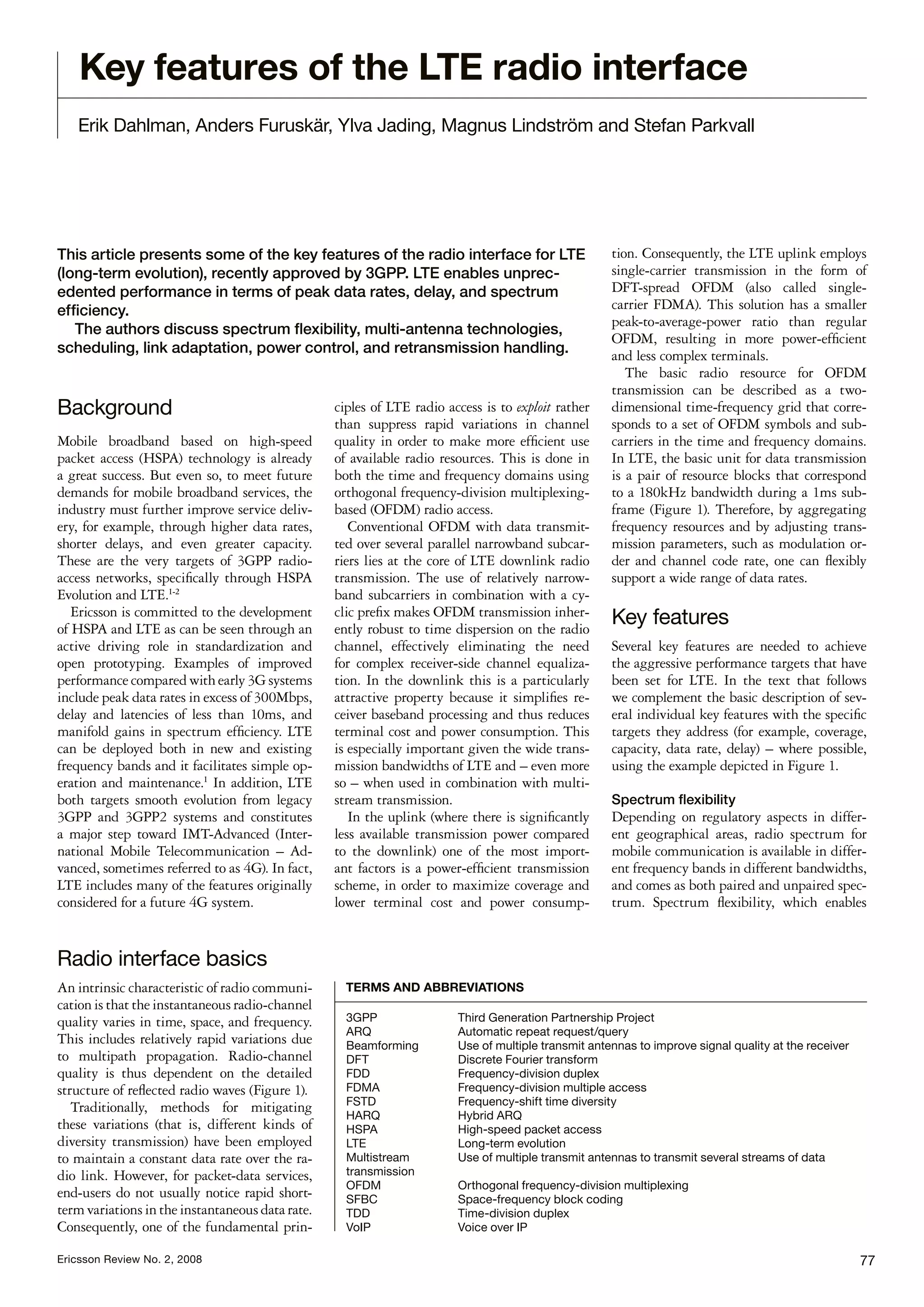
structure of reflected radio waves (Figure 1).
Traditionally, methods for mitigating
these variations (that is, different kinds of
diversity transmission) have been employed
to maintain a constant data rate over the ra-
dio link. However, for packet-data services,
end-users do not usually notice rapid short-
termvariationsintheinstantaneousdatarate.
Consequently, one of the fundamental prin-
ciples of LTE radio access is to exploit rather
than suppress rapid variations in channel
quality in order to make more efficient use
of available radio resources. This is done in
both the time and frequency domains using
orthogonal frequency-division multiplexing-
based (OFDM) radio access.
Conventional OFDM with data transmit-
ted over several parallel narrowband subcar-
riers lies at the core of LTE downlink radio
transmission. The use of relatively narrow-
band subcarriers in combination with a cy-
clic prefix makes OFDM transmission inher-
ently robust to time dispersion on the radio
channel, effectively eliminating the need
for complex receiver-side channel equaliza-
tion. In the downlink this is a particularly
attractive property because it simplifies re-
ceiver baseband processing and thus reduces
terminal cost and power consumption. This
is especially important given the wide trans-
mission bandwidths of LTE and – even more
so – when used in combination with multi-
stream transmission.
In the uplink (where there is significantly
less available transmission power compared
to the downlink) one of the most import­
ant factors is a power-efficient transmission
scheme, in order to maximize coverage and
lower terminal cost and power consump-
tion. Consequently, the LTE uplink employs
single-carrier transmission in the form of
DFT-spread OFDM (also called single-
carrier FDMA). This solution has a smaller
peak-to-average-power ratio than regular
OFDM, resulting in more power-efficient
and less complex terminals.
The basic radio resource for OFDM
transmission can be described as a two-
dimensional time-frequency grid that corre-
sponds to a set of OFDM symbols and sub-
carriers in the time and frequency domains.
In LTE, the basic unit for data transmission
is a pair of resource blocks that correspond
to a 180kHz bandwidth during a 1ms sub-
frame (Figure 1). Therefore, by aggregating
frequency resources and by adjusting trans-
mission parameters, such as modulation or-
der and channel code rate, one can flexibly
support a wide range of data rates.
Key features
Several key features are needed to achieve
the aggressive performance targets that have
been set for LTE. In the text that follows
we complement the basic description of sev-
eral individual key features with the specific
targets they address (for example, coverage,
capacity, data rate, delay) – where possible,
using the example depicted in Figure 1.
Spectrum flexibility
Depending on regulatory aspects in differ-
ent geographical areas, radio spectrum for
mobile communication is available in differ-
ent frequency bands in different bandwidths,
and comes as both paired and unpaired spec-
trum. Spectrum flexibility, which enables
Key features of the LTE radio interface
Erik Dahlman, Anders Furuskär, Ylva Jading, Magnus Lindström and Stefan Parkvall
This article presents some of the key features of the radio interface for LTE
(long-term evolution), recently approved by 3GPP. LTE enables unprec-
edented performance in terms of peak data rates, delay, and spectrum
efficiency.
The authors discuss spectrum flexibility, multi-antenna technologies,
scheduling, link adaptation, power control, and retransmission handling.
TERMS AND ABBREVIATIONS
3GPP		 Third Generation Partnership Project
ARQ		 Automatic repeat request/query
Beamforming	 Use of multiple transmit antennas to improve signal quality at the receiver
DFT		 Discrete Fourier transform
FDD		 Frequency-division duplex
FDMA		 Frequency-division multiple access
FSTD		 Frequency-shift time diversity
HARQ		 Hybrid ARQ
HSPA		 High-speed packet access
LTE		 Long-term evolution
Multistream	 Use of multiple transmit antennas to transmit several streams of data
transmission	
OFDM		 Orthogonal frequency-division multiplexing
SFBC		 Space-frequency block coding
TDD		 Time-division duplex
VoIP		 Voice over IP
Ericsson Review No. 2, 200878
operation under all these conditions, is one of
the key features of LTE radio access.
Besides being able to operate in differ-
ent frequency bands, LTE can be deployed
with different bandwidths ranging from ap-
proximately 1.25MHz (suitable for the initial
migration of, for example, cdma2000/1xEV-
DO systems) up to approximately 20MHz.
Furthermore, LTE can operate in both paired
and unpaired spectrum by providing a sin-
gle radio-access technology that supports
frequency-division duplex (FDD) as well as
time-division duplex (TDD) operation.
Where terminals are concerned, FDD can
be operated in full- and half-duplex modes.
Half-duplex FDD, in which the terminal
separates transmission and reception in fre-
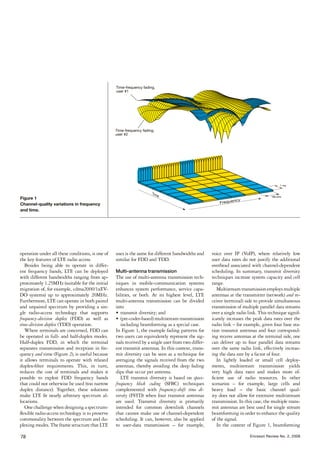
quency and time (Figure 2), is useful because
it allows terminals to operate with relaxed
duplex-filter requirements. This, in turn,
reduces the cost of terminals and makes it
possible to exploit FDD frequency bands
that could not otherwise be used (too narrow
duplex distance). Together, these solutions
make LTE fit nearly arbitrary spectrum al-
locations.
Onechallengewhendesigningaspectrum-
flexible radio-access technology is to preserve
commonality between the spectrum and du-
plexing modes. The frame structure that LTE
uses is the same for different bandwidths and
similar for FDD and TDD.
Multi-antenna transmission
The use of multi-antenna transmission tech-
niques in mobile-communication systems
enhances system performance, service capa-
bilities, or both. At its highest level, LTE
multi-antenna transmission can be divided
into
transmit diversity; and•	
(pre-coder-based) multistream transmission•	
including beamforming as a special case.
In Figure 1, the example fading patterns for
two users can equivalently represent the sig-
nals received by a single user from two differ-
ent transmit antennas. In this context, trans-
mit diversity can be seen as a technique for
averaging the signals received from the two
antennas, thereby avoiding the deep fading
dips that occur per antenna.
LTE transmit diversity is based on space-
frequency block coding (SFBC) techniques
complemented with frequency-shift time di-
versity (FSTD) when four transmit antennas
are used. Transmit diversity is primarily
intended for common downlink channels
that cannot make use of channel-dependent
scheduling. It can, however, also be applied
to user-data transmission – for example,
voice over IP (VoIP), where relatively low
user data rates do not justify the additional
overhead associated with channel-dependent
scheduling. In summary, transmit diversity
techniques increase system capacity and cell
range.
Multistream transmission employs multiple
antennas at the transmitter (network) and re-
ceiver (terminal) side to provide simultaneous
transmission of multiple parallel data streams
over a single radio link. This technique signif-
icantly increases the peak data rates over the
radio link – for example, given four base sta-
tion transmit antennas and four correspond-
ing receive antennas at the terminal side, one
can deliver up to four parallel data streams
over the same radio link, effectively increas-
ing the data rate by a factor of four.
In lightly loaded or small cell deploy-
ments, multistream transmission yields
very high data rates and makes more ef-
ficient use of radio resources. In other
scenarios – for example, large cells and
heavy load – the basic channel qual-
ity does not allow for extensive multistream
transmission. In this case, the multiple trans-
mit antennas are best used for single stream
beamforming in order to enhance the quality
of the signal.
In the context of Figure 1, beamforming
Figure 1
Channel-quality variations in frequency
and time.
Ericsson Review No. 2, 2008 79
can be seen as a means of controlling the fad-
ing pattern by pre-coding the transmitted
signals to adjust the phases so that fading
peaks appear at the receiver.
In summary, to yield good performance
over a broad range of scenarios, LTE provides
anadaptivemultistreamtransmissionscheme
in which the number of parallel streams can
be continuously adjusted to match the in-
stantaneous channel conditions.
When channel conditions are very good,•	
up to four streams can be transmitted in
parallel, yielding data rates up to 300Mbps
in a 20MHz bandwidth.
When channel conditions are less favor-•	
able, fewer parallel streams are used. The
multiple antennas are instead partly used
in a beamforming transmission scheme
that improves overall reception quality
and, as a consequence, system capacity and
coverage.
To achieve good coverage (for instance, in•	
large cells or to support higher data rates at
cell borders), one can employ single stream
beamforming transmission as well as trans-
mit diversity for common channels.
Scheduling and link adaptation
In general, scheduling refers to the process
of dividing and allocating resources between
users who have data to transfer. In LTE, dy-
namic scheduling (1ms) is applied both to
the uplink and downlink.
Scheduling should result in a balance be-
tween perceived end-user quality and overall
system performance. Channel-dependent sched-
uling is used to achieve high cell throughput.
Transmissions can be carried out with higher
data rates (the result of using higher-order
modulation, less channel coding, additional
streams, and fewer retransmissions) by trans-
mitting on time or frequency resources with
relatively good channel conditions. This way,
fewer radio resources (less time) are con-
sumed for any given amount of information
transferred, resulting in improved overall
system efficiency. Figure 1 illustrates how
radio channels with fast fading vary for two
users. The OFDM time-frequency grid fa-
cilitates the selection of resources in the time
and frequency domains.
Forserviceswithsmallpayloadsandregular
packet arrivals, the control signaling required
for dynamic scheduling might be dispropor-
tionately large relative to the amount of user
data transmitted. For this reason, LTE also
supports persistent scheduling (in addition to
dynamic scheduling). Persistent scheduling
implies that radio resources are allocated to a
user for a given set of subframes.
Link-adaptation techniques are employed
to make the most of instantaneous channel
quality. In essence, link adaptation adapts
the selection of modulation and channel-
coding schemes to current channel condi-
tions. This in turn determines the data rate
or error probabilities of each link.
Uplink power control
Power control is about setting transmit pow-
er levels, typically with the aim of
improving system capacity, coverage, and•	
user quality (data rate or voice quality);
and
reducing power consumption.•	
To reach these objectives, power-control
mechanisms typically attempt to maximize
the received power of desired signals while
limiting interference.
The LTE uplink is orthogonal, which is to
say there is, at least in the ideal case, no inter-
ference between users in the same cell. The
amount of interference to neighbor cells de-
pends, among other things, on the position
of the mobile terminal – more specifically,
on the path gain from the terminal to these
cells. In general, the closer a terminal is to a
neighboring cell the stronger the interference
to that cell. Accordingly, terminals that are
farther away from the neighboring cell may
transmit with higher power than terminals
that are near to the cell. In addition, there is
a correlation between proximity to the serv-
ing cell and distance from neighboring cells.
The LTE uplink power control takes all
these characteristics into consideration. The
orthogonal LTE uplink makes it possible to
multiplex signals from terminals with differ-
ent received uplink power in the same cell.
In the short term, this means that instead
of compensating for peaks in multipath fad-
ing by reducing power, one can exploit these
peaks to increase the data rates by means of
scheduling and link adaptation. In the long
term, one can set the received power target
based on the path gain to the serving cell,
giving terminals that generate little interfer-
ence a larger received power target. In the
Figure 2
LTE spectrum (bandwidth and duplex)
flexibility. Half-duplex FDD is seen from a
terminal perspective.
Ericsson Review No. 2, 200880
context of Figure 1, this corresponds to rais-
ing the average signal level.
Retransmission handling
In practically any communications system,
occasional data transfer errors arise from, for
example, noise, interference, and fading. Re-
transmission schemes are used to safeguard
against these errors and to guarantee the
quality of transferred data. The more effi-
cient the retransmission handling, the better
use one can make of the radio capabilities. To
make the most of its high-performance radio
interface, LTE supports a dynamic and effi-
cient two-layered retransmission scheme: A
fast hybrid automatic repeat request (HARQ)
protocol with low overhead feedback and re-
transmissions with incremental redundancy
is complemented by a highly reliable selec-
tive repeat ARQ protocol.
The HARQ protocol gives the receiver
redundancy information that enables it to
avoid a certain amount of errors. The HARQ
retransmissions also provide additional re-
dundancy, should the initial transmission
not be sufficient to avoid errors. In addi-
tion, the ARQ protocol provides a means of
completely retransmitting packets that the
HARQ protocol could not correct.
This design yields low latency and over-
head without sacrificing reliability. Most er-
rors are captured and corrected by the light-
weight HARQ protocol; therefore, the more
expensive (in terms of latency and overhead)
ARQ retransmissions are only rarely needed.
In LTE, the HARQ and ARQ protocols
are terminated in the base station, which
gives tighter coupling between the HARQ
and ARQ protocol layers. The benefits of
this architecture are manifold, including fast
handling of residual HARQ errors and vari-
able ARQ transmission size.
Conclusion
The building blocks of the LTE radio inter-
face are the key to its high performance.
Spectrum flexibility – in terms of variable
frequency bands, bandwidths, and FDD and
TDD operation – makes LTE suitable for
just about any available spectrum.
LTE supports several features that exploit
instantaneous radio conditions in a con-
structive way. Channel-dependent schedul-
ing allocates the very best resources to users;
multi-antenna technologies are employed to
make fading conditions on resources even
more favorable; and link-adaptation tech-
niques adapt the modulation and coding
scheme to the achieved signal quality. In
the uplink, a power-control mechanism is
employed to allow very high average signal
quality, and to control interference.
Aggressive use of these features is made
possible thanks to a combination of rapid
retransmission of data and soft-combining
of transmission, which yields incremental
redundancy.
REFERENCES
Bergman, J., Ericson, M., Gerstenberger,1.	
D., Göransson, B., Peisa, J. and Wager, S.:
HSPA Evolution – Boosting the performance
of mobile broadband access. Ericsson
Review, Vol. 85(2008):1, pp. 32-37
Beming, P., Frid, L, Hall, G., Malm, P.,2.	
Noren, T., Olsson, M. and Rune G.: LTE-SAE
architecture and performance. Ericsson
Review, Vol. 84(2007):3 pp. 98-104
Dahlman, E. et al: 3G Evolution: HSPA3.	
and LTE for Mobile Broadband. Academic
Press, Oxford, UK, 2007.

1018 key features-of-the-lte-radio-interface

  • 1.
    Ericsson Review No.2, 2008 77 Background Mobile broadband based on high-speed packet access (HSPA) technology is already a great success. But even so, to meet future demands for mobile broadband services, the industry must further improve service deliv- ery, for example, through higher data rates, shorter delays, and even greater capacity. These are the very targets of 3GPP radio- access networks, specifically through HSPA Evolution and LTE.1-2 Ericsson is committed to the development of HSPA and LTE as can be seen through an active driving role in standardization and open prototyping. Examples of improved performancecomparedwithearly3Gsystems include peak data rates in excess of 300Mbps, delay and latencies of less than 10ms, and manifold gains in spectrum efficiency. LTE can be deployed both in new and existing frequency bands and it facilitates simple op- eration and maintenance.1 In addition, LTE both targets smooth evolution from legacy 3GPP and 3GPP2 systems and constitutes a major step toward IMT-Advanced (Inter- national Mobile Telecommunication – Ad- vanced, sometimes referred to as 4G). In fact, LTE includes many of the features originally considered for a future 4G system. Radio interface basics An intrinsic characteristic of radio communi- cationisthattheinstantaneousradio-channel quality varies in time, space, and frequency. This includes relatively rapid variations due to multipath propagation. Radio-channel quality is thus dependent on the detailed structure of reflected radio waves (Figure 1). Traditionally, methods for mitigating these variations (that is, different kinds of diversity transmission) have been employed to maintain a constant data rate over the ra- dio link. However, for packet-data services, end-users do not usually notice rapid short- termvariationsintheinstantaneousdatarate. Consequently, one of the fundamental prin- ciples of LTE radio access is to exploit rather than suppress rapid variations in channel quality in order to make more efficient use of available radio resources. This is done in both the time and frequency domains using orthogonal frequency-division multiplexing- based (OFDM) radio access. Conventional OFDM with data transmit- ted over several parallel narrowband subcar- riers lies at the core of LTE downlink radio transmission. The use of relatively narrow- band subcarriers in combination with a cy- clic prefix makes OFDM transmission inher- ently robust to time dispersion on the radio channel, effectively eliminating the need for complex receiver-side channel equaliza- tion. In the downlink this is a particularly attractive property because it simplifies re- ceiver baseband processing and thus reduces terminal cost and power consumption. This is especially important given the wide trans- mission bandwidths of LTE and – even more so – when used in combination with multi- stream transmission. In the uplink (where there is significantly less available transmission power compared to the downlink) one of the most import­ ant factors is a power-efficient transmission scheme, in order to maximize coverage and lower terminal cost and power consump- tion. Consequently, the LTE uplink employs single-carrier transmission in the form of DFT-spread OFDM (also called single- carrier FDMA). This solution has a smaller peak-to-average-power ratio than regular OFDM, resulting in more power-efficient and less complex terminals. The basic radio resource for OFDM transmission can be described as a two- dimensional time-frequency grid that corre- sponds to a set of OFDM symbols and sub- carriers in the time and frequency domains. In LTE, the basic unit for data transmission is a pair of resource blocks that correspond to a 180kHz bandwidth during a 1ms sub- frame (Figure 1). Therefore, by aggregating frequency resources and by adjusting trans- mission parameters, such as modulation or- der and channel code rate, one can flexibly support a wide range of data rates. Key features Several key features are needed to achieve the aggressive performance targets that have been set for LTE. In the text that follows we complement the basic description of sev- eral individual key features with the specific targets they address (for example, coverage, capacity, data rate, delay) – where possible, using the example depicted in Figure 1. Spectrum flexibility Depending on regulatory aspects in differ- ent geographical areas, radio spectrum for mobile communication is available in differ- ent frequency bands in different bandwidths, and comes as both paired and unpaired spec- trum. Spectrum flexibility, which enables Key features of the LTE radio interface Erik Dahlman, Anders Furuskär, Ylva Jading, Magnus Lindström and Stefan Parkvall This article presents some of the key features of the radio interface for LTE (long-term evolution), recently approved by 3GPP. LTE enables unprec- edented performance in terms of peak data rates, delay, and spectrum efficiency. The authors discuss spectrum flexibility, multi-antenna technologies, scheduling, link adaptation, power control, and retransmission handling. TERMS AND ABBREVIATIONS 3GPP Third Generation Partnership Project ARQ Automatic repeat request/query Beamforming Use of multiple transmit antennas to improve signal quality at the receiver DFT Discrete Fourier transform FDD Frequency-division duplex FDMA Frequency-division multiple access FSTD Frequency-shift time diversity HARQ Hybrid ARQ HSPA High-speed packet access LTE Long-term evolution Multistream Use of multiple transmit antennas to transmit several streams of data transmission OFDM Orthogonal frequency-division multiplexing SFBC Space-frequency block coding TDD Time-division duplex VoIP Voice over IP
  • 2.
    Ericsson Review No.2, 200878 operation under all these conditions, is one of the key features of LTE radio access. Besides being able to operate in differ- ent frequency bands, LTE can be deployed with different bandwidths ranging from ap- proximately 1.25MHz (suitable for the initial migration of, for example, cdma2000/1xEV- DO systems) up to approximately 20MHz. Furthermore, LTE can operate in both paired and unpaired spectrum by providing a sin- gle radio-access technology that supports frequency-division duplex (FDD) as well as time-division duplex (TDD) operation. Where terminals are concerned, FDD can be operated in full- and half-duplex modes. Half-duplex FDD, in which the terminal separates transmission and reception in fre- quency and time (Figure 2), is useful because it allows terminals to operate with relaxed duplex-filter requirements. This, in turn, reduces the cost of terminals and makes it possible to exploit FDD frequency bands that could not otherwise be used (too narrow duplex distance). Together, these solutions make LTE fit nearly arbitrary spectrum al- locations. Onechallengewhendesigningaspectrum- flexible radio-access technology is to preserve commonality between the spectrum and du- plexing modes. The frame structure that LTE uses is the same for different bandwidths and similar for FDD and TDD. Multi-antenna transmission The use of multi-antenna transmission tech- niques in mobile-communication systems enhances system performance, service capa- bilities, or both. At its highest level, LTE multi-antenna transmission can be divided into transmit diversity; and• (pre-coder-based) multistream transmission• including beamforming as a special case. In Figure 1, the example fading patterns for two users can equivalently represent the sig- nals received by a single user from two differ- ent transmit antennas. In this context, trans- mit diversity can be seen as a technique for averaging the signals received from the two antennas, thereby avoiding the deep fading dips that occur per antenna. LTE transmit diversity is based on space- frequency block coding (SFBC) techniques complemented with frequency-shift time di- versity (FSTD) when four transmit antennas are used. Transmit diversity is primarily intended for common downlink channels that cannot make use of channel-dependent scheduling. It can, however, also be applied to user-data transmission – for example, voice over IP (VoIP), where relatively low user data rates do not justify the additional overhead associated with channel-dependent scheduling. In summary, transmit diversity techniques increase system capacity and cell range. Multistream transmission employs multiple antennas at the transmitter (network) and re- ceiver (terminal) side to provide simultaneous transmission of multiple parallel data streams over a single radio link. This technique signif- icantly increases the peak data rates over the radio link – for example, given four base sta- tion transmit antennas and four correspond- ing receive antennas at the terminal side, one can deliver up to four parallel data streams over the same radio link, effectively increas- ing the data rate by a factor of four. In lightly loaded or small cell deploy- ments, multistream transmission yields very high data rates and makes more ef- ficient use of radio resources. In other scenarios – for example, large cells and heavy load – the basic channel qual- ity does not allow for extensive multistream transmission. In this case, the multiple trans- mit antennas are best used for single stream beamforming in order to enhance the quality of the signal. In the context of Figure 1, beamforming Figure 1 Channel-quality variations in frequency and time.
  • 3.
    Ericsson Review No.2, 2008 79 can be seen as a means of controlling the fad- ing pattern by pre-coding the transmitted signals to adjust the phases so that fading peaks appear at the receiver. In summary, to yield good performance over a broad range of scenarios, LTE provides anadaptivemultistreamtransmissionscheme in which the number of parallel streams can be continuously adjusted to match the in- stantaneous channel conditions. When channel conditions are very good,• up to four streams can be transmitted in parallel, yielding data rates up to 300Mbps in a 20MHz bandwidth. When channel conditions are less favor-• able, fewer parallel streams are used. The multiple antennas are instead partly used in a beamforming transmission scheme that improves overall reception quality and, as a consequence, system capacity and coverage. To achieve good coverage (for instance, in• large cells or to support higher data rates at cell borders), one can employ single stream beamforming transmission as well as trans- mit diversity for common channels. Scheduling and link adaptation In general, scheduling refers to the process of dividing and allocating resources between users who have data to transfer. In LTE, dy- namic scheduling (1ms) is applied both to the uplink and downlink. Scheduling should result in a balance be- tween perceived end-user quality and overall system performance. Channel-dependent sched- uling is used to achieve high cell throughput. Transmissions can be carried out with higher data rates (the result of using higher-order modulation, less channel coding, additional streams, and fewer retransmissions) by trans- mitting on time or frequency resources with relatively good channel conditions. This way, fewer radio resources (less time) are con- sumed for any given amount of information transferred, resulting in improved overall system efficiency. Figure 1 illustrates how radio channels with fast fading vary for two users. The OFDM time-frequency grid fa- cilitates the selection of resources in the time and frequency domains. Forserviceswithsmallpayloadsandregular packet arrivals, the control signaling required for dynamic scheduling might be dispropor- tionately large relative to the amount of user data transmitted. For this reason, LTE also supports persistent scheduling (in addition to dynamic scheduling). Persistent scheduling implies that radio resources are allocated to a user for a given set of subframes. Link-adaptation techniques are employed to make the most of instantaneous channel quality. In essence, link adaptation adapts the selection of modulation and channel- coding schemes to current channel condi- tions. This in turn determines the data rate or error probabilities of each link. Uplink power control Power control is about setting transmit pow- er levels, typically with the aim of improving system capacity, coverage, and• user quality (data rate or voice quality); and reducing power consumption.• To reach these objectives, power-control mechanisms typically attempt to maximize the received power of desired signals while limiting interference. The LTE uplink is orthogonal, which is to say there is, at least in the ideal case, no inter- ference between users in the same cell. The amount of interference to neighbor cells de- pends, among other things, on the position of the mobile terminal – more specifically, on the path gain from the terminal to these cells. In general, the closer a terminal is to a neighboring cell the stronger the interference to that cell. Accordingly, terminals that are farther away from the neighboring cell may transmit with higher power than terminals that are near to the cell. In addition, there is a correlation between proximity to the serv- ing cell and distance from neighboring cells. The LTE uplink power control takes all these characteristics into consideration. The orthogonal LTE uplink makes it possible to multiplex signals from terminals with differ- ent received uplink power in the same cell. In the short term, this means that instead of compensating for peaks in multipath fad- ing by reducing power, one can exploit these peaks to increase the data rates by means of scheduling and link adaptation. In the long term, one can set the received power target based on the path gain to the serving cell, giving terminals that generate little interfer- ence a larger received power target. In the Figure 2 LTE spectrum (bandwidth and duplex) flexibility. Half-duplex FDD is seen from a terminal perspective.
  • 4.
    Ericsson Review No.2, 200880 context of Figure 1, this corresponds to rais- ing the average signal level. Retransmission handling In practically any communications system, occasional data transfer errors arise from, for example, noise, interference, and fading. Re- transmission schemes are used to safeguard against these errors and to guarantee the quality of transferred data. The more effi- cient the retransmission handling, the better use one can make of the radio capabilities. To make the most of its high-performance radio interface, LTE supports a dynamic and effi- cient two-layered retransmission scheme: A fast hybrid automatic repeat request (HARQ) protocol with low overhead feedback and re- transmissions with incremental redundancy is complemented by a highly reliable selec- tive repeat ARQ protocol. The HARQ protocol gives the receiver redundancy information that enables it to avoid a certain amount of errors. The HARQ retransmissions also provide additional re- dundancy, should the initial transmission not be sufficient to avoid errors. In addi- tion, the ARQ protocol provides a means of completely retransmitting packets that the HARQ protocol could not correct. This design yields low latency and over- head without sacrificing reliability. Most er- rors are captured and corrected by the light- weight HARQ protocol; therefore, the more expensive (in terms of latency and overhead) ARQ retransmissions are only rarely needed. In LTE, the HARQ and ARQ protocols are terminated in the base station, which gives tighter coupling between the HARQ and ARQ protocol layers. The benefits of this architecture are manifold, including fast handling of residual HARQ errors and vari- able ARQ transmission size. Conclusion The building blocks of the LTE radio inter- face are the key to its high performance. Spectrum flexibility – in terms of variable frequency bands, bandwidths, and FDD and TDD operation – makes LTE suitable for just about any available spectrum. LTE supports several features that exploit instantaneous radio conditions in a con- structive way. Channel-dependent schedul- ing allocates the very best resources to users; multi-antenna technologies are employed to make fading conditions on resources even more favorable; and link-adaptation tech- niques adapt the modulation and coding scheme to the achieved signal quality. In the uplink, a power-control mechanism is employed to allow very high average signal quality, and to control interference. Aggressive use of these features is made possible thanks to a combination of rapid retransmission of data and soft-combining of transmission, which yields incremental redundancy. REFERENCES Bergman, J., Ericson, M., Gerstenberger,1. D., Göransson, B., Peisa, J. and Wager, S.: HSPA Evolution – Boosting the performance of mobile broadband access. Ericsson Review, Vol. 85(2008):1, pp. 32-37 Beming, P., Frid, L, Hall, G., Malm, P.,2. Noren, T., Olsson, M. and Rune G.: LTE-SAE architecture and performance. Ericsson Review, Vol. 84(2007):3 pp. 98-104 Dahlman, E. et al: 3G Evolution: HSPA3. and LTE for Mobile Broadband. Academic Press, Oxford, UK, 2007.