Björn Brembs
Universität Regensburg
  http://brembs.net
Institutions produce
publications, data and software
• Institutional email   • No archiving of
• Institutional           publications
  webspace              • No archiving of
• Institutional blog      software
• Library access card   • No archiving of
• Open access             data
  repository
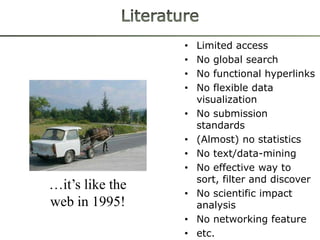
Dysfunctional scholarly
literature
•   Limited access
                 •   No global search
                 •   No functional hyperlinks
                 •   No flexible data
                     visualization
                 •   No submission
                     standards
                 •   (Almost) no statistics
                 •   No text/data-mining
                 •   No effective way to
                     sort, filter and discover
…it’s like the
                 •   No scientific impact
web in 1995!         analysis
                 •   No networking feature
                 •   etc.
Scientific data in peril
Non-existent software
archives
Technically feasible today (almost)

• No more corporate publishers – libraries
  archive everything and make it publicly
  accessible according to a world-wide
  standard

• Single semantic, decentralized database
  of literature, data and software
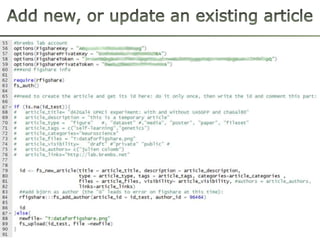
Software to control the experiment and save the data
Software to analyze and visualize the data
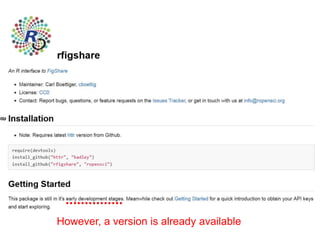
However, a version is already available
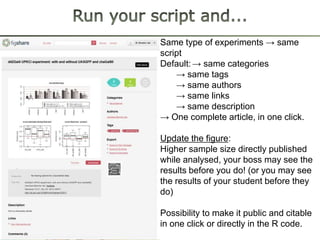
Same type of experiments → same
script
Default: → same categories
    → same tags
    → same authors
    → same links
    → same description
→ One complete article, in one click.

Update the figure:
Higher sample size directly published
while analysed, your boss may see the
results before you do! (or you may see
the results of your student before they
do)

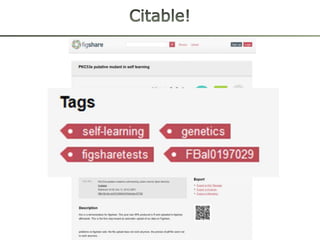
Possibility to make it public and citable
in one click or directly in the R code.
http://dx.doi.org/10.6084/m9.figshare.97792
One person is not an
institutional infrastructure!
Source Normalized Impact per Paper


      •   Thomson Reuters: Impact Factor
      •   Eigenfactor (now Thomson Reuters)
      •   ScImago JournalRank (SJR)
      •   Scopus: SNIP, SJR
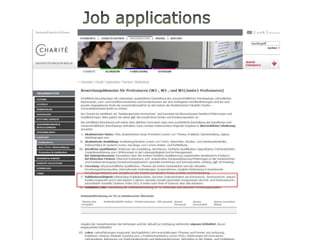
Publikationstätigkeit
(vollständige Publikationsliste, darunter Originalarbeiten als
Erstautor/in, Seniorautor/in, Impact-Punkte insgesamt und in den
letzten 5 Jahren, darunter jeweils gesondert ausgewiesen als Erst- und
Seniorautor/in, persönlicher Scientific Citations Index (SCI, h-Index
nach Web of Science) über alle Arbeiten)


Publications:
Complete list of publications, including original research papers as first
author, senior author, impact points total and in the last 5 years, with
marked first and last-authorships, personal Scientific Citations Index
(SCI, h-Index according to Web of Science) for all publications.
Lies, damn lies and
bibliometrics
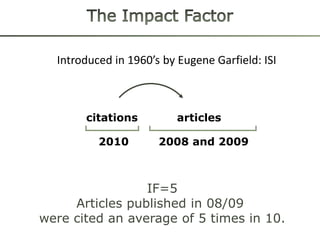
Introduced in 1960’s by Eugene Garfield: ISI


       citations          articles

          2010        2008 and 2009


                 IF=5
     Articles published in 08/09
were cited an average of 5 times in 10.
Journal X IF 2010=


 All citations from TR indexed journals in 2010 to papers in journal X


     Number of citable articles published in journal X in 2008/9


      €30,000-130,000/year subscription rates
  Covers ~11,500 journals (Scopus covers ~16,500)
• Negotiable


• Irreproducible


• Mathematically
  unsound
• PLoS Medicine, IF 2-11 (8.4)
 (The PLoS Medicine Editors (2006) The Impact Factor Game. PLoS Med 3(6): e291.
 http://www.plosmedicine.org/article/info:doi/10.1371%2Fjournal.pmed.0030291)


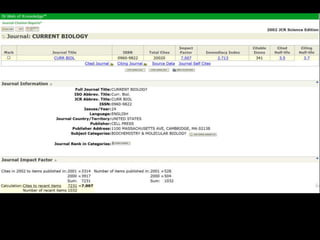
• Current Biology IF from 7 to 11 in
  2003
  – Bought by Cell Press (Elsevier) in 2001…
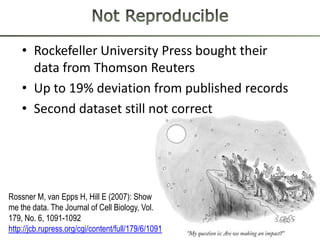
• Rockefeller University Press bought their
      data from Thomson Reuters
    • Up to 19% deviation from published records
    • Second dataset still not correct


Rossner M, van Epps H, Hill E (2007): Show
me the data. The Journal of Cell Biology, Vol.
179, No. 6, 1091-1092
http://jcb.rupress.org/cgi/content/full/179/6/1091
• Left-skewed distributions
      • Weak correlation of individual article citation
        rate with journal IF


Seglen PO (1997): Why the impact factor of journals should not be used for evaluating research. BMJ 1997;314(7079):497 (15 February)
http://www.bmj.com/cgi/content/full/314/7079/497
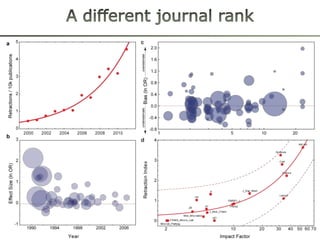
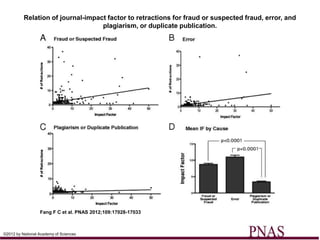
Relation of journal-impact factor to retractions for fraud or suspected fraud, error, and
                                   plagiarism, or duplicate publication.


                  Fang F C et al. PNAS 2012;109:17028-17033


©2012 by National Academy of Sciences
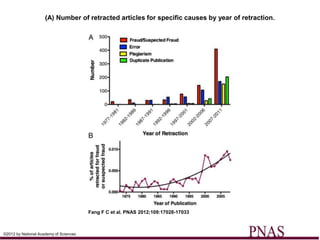
(A) Number of retracted articles for specific causes by year of retraction.


                                        Fang F C et al. PNAS 2012;109:17028-17033


©2012 by National Academy of Sciences

Fixing the infrastructure for open science

  • 1.
  • 2.
  • 3.
    • Institutional email • No archiving of • Institutional publications webspace • No archiving of • Institutional blog software • Library access card • No archiving of • Open access data repository
  • 4.
  • 5.
    Limited access • No global search • No functional hyperlinks • No flexible data visualization • No submission standards • (Almost) no statistics • No text/data-mining • No effective way to sort, filter and discover …it’s like the • No scientific impact web in 1995! analysis • No networking feature • etc.
  • 6.
  • 9.
  • 12.
    Technically feasible today(almost) • No more corporate publishers – libraries archive everything and make it publicly accessible according to a world-wide standard • Single semantic, decentralized database of literature, data and software
  • 18.
    Software to controlthe experiment and save the data
  • 19.
    Software to analyzeand visualize the data
  • 25.
    However, a versionis already available
  • 27.
    Same type ofexperiments → same script Default: → same categories → same tags → same authors → same links → same description → One complete article, in one click. Update the figure: Higher sample size directly published while analysed, your boss may see the results before you do! (or you may see the results of your student before they do) Possibility to make it public and citable in one click or directly in the R code.
  • 28.
  • 31.
    One person isnot an institutional infrastructure!
  • 32.
    Source Normalized Impactper Paper • Thomson Reuters: Impact Factor • Eigenfactor (now Thomson Reuters) • ScImago JournalRank (SJR) • Scopus: SNIP, SJR
  • 34.
    Publikationstätigkeit (vollständige Publikationsliste, darunterOriginalarbeiten als Erstautor/in, Seniorautor/in, Impact-Punkte insgesamt und in den letzten 5 Jahren, darunter jeweils gesondert ausgewiesen als Erst- und Seniorautor/in, persönlicher Scientific Citations Index (SCI, h-Index nach Web of Science) über alle Arbeiten) Publications: Complete list of publications, including original research papers as first author, senior author, impact points total and in the last 5 years, with marked first and last-authorships, personal Scientific Citations Index (SCI, h-Index according to Web of Science) for all publications.
  • 35.
    Lies, damn liesand bibliometrics
  • 36.
    Introduced in 1960’sby Eugene Garfield: ISI citations articles 2010 2008 and 2009 IF=5 Articles published in 08/09 were cited an average of 5 times in 10.
  • 37.
    Journal X IF2010= All citations from TR indexed journals in 2010 to papers in journal X Number of citable articles published in journal X in 2008/9 €30,000-130,000/year subscription rates Covers ~11,500 journals (Scopus covers ~16,500)
  • 38.
  • 39.
    • PLoS Medicine,IF 2-11 (8.4) (The PLoS Medicine Editors (2006) The Impact Factor Game. PLoS Med 3(6): e291. http://www.plosmedicine.org/article/info:doi/10.1371%2Fjournal.pmed.0030291) • Current Biology IF from 7 to 11 in 2003 – Bought by Cell Press (Elsevier) in 2001…
  • 42.
    • Rockefeller UniversityPress bought their data from Thomson Reuters • Up to 19% deviation from published records • Second dataset still not correct Rossner M, van Epps H, Hill E (2007): Show me the data. The Journal of Cell Biology, Vol. 179, No. 6, 1091-1092 http://jcb.rupress.org/cgi/content/full/179/6/1091
  • 43.
    • Left-skewed distributions • Weak correlation of individual article citation rate with journal IF Seglen PO (1997): Why the impact factor of journals should not be used for evaluating research. BMJ 1997;314(7079):497 (15 February) http://www.bmj.com/cgi/content/full/314/7079/497
  • 45.
    Relation of journal-impactfactor to retractions for fraud or suspected fraud, error, and plagiarism, or duplicate publication. Fang F C et al. PNAS 2012;109:17028-17033 ©2012 by National Academy of Sciences
  • 46.
    (A) Number ofretracted articles for specific causes by year of retraction. Fang F C et al. PNAS 2012;109:17028-17033 ©2012 by National Academy of Sciences