Tools for Engagement: Using social media to achieve research impact 
Prof. Jonathan P. Bowen 
Birmingham City University Museophile Limited 
www.bcu.ac.uk/jonathan-bowen www.jpbowen.com @jpbowen
Background 
•Mathematics, art, engineering, computer science, software engineering, museum informatics 
•Academia: Imperial, Oxford, Reading, LSBU, BCU 
•Visitor: UNU-IIST, KCL, Brunel, Westminster, Waikato (New Zealand, 2011), Pratt Institute (New York, USA, 2012), East China Normal University (Shanghai, China, 2013) 
•Industry: Logica, Silicon Graphics, Altran Praxis 
•Electronic Visualisation and the Arts (EVA London conference, 7–9 July 2015)
Overview 
•Communities 
•Online resources 
–Google Scholar 
–Academia.edu 
–ResearchGate 
–Academic Search 
–ORCID 
–Etc.
Community of Practice 
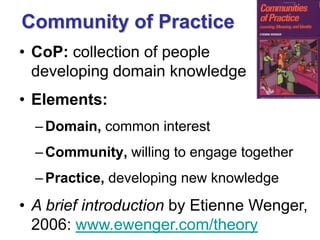
•CoP: collection of people developing domain knowledge 
•Elements: 
–Domain, common interest 
–Community, willing to engage together 
–Practice, developing new knowledge 
•A brief introduction by Etienne Wenger, 2006: www.ewenger.com/theory
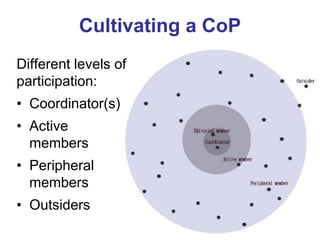
Cultivating a CoP 
Different levels of participation: 
•Coordinator(s) 
•Active members 
•Peripheral members 
•Outsiders
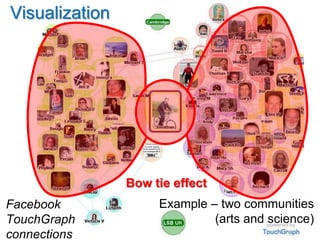
Bow tie effect 
Visualization 
Example – two communities (arts and science) 
Facebook TouchGraph connections
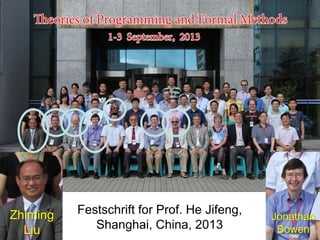
Theories of Programming and Formal Methods 
Shanghai, China, 1–3 September 2013 
Festschrift for Prof. He Jifeng, 
Shanghai, China, 2013 
Jonathan Bowen 
Zhiming Liu
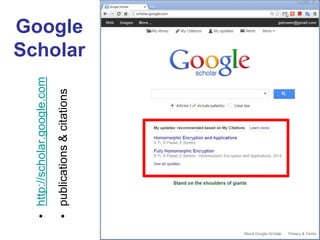
Google Scholar 
•http://scholar.google.com 
•publications & citations
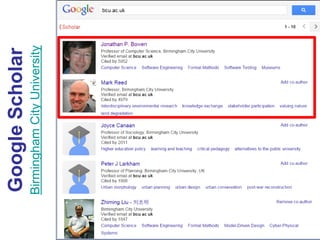
Google Scholar 
Birmingham City University
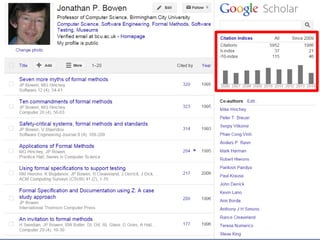
Google Scholar – home page 
•h-index (top h publications with h or more citations) 
•i10-index (at least 10 citations)
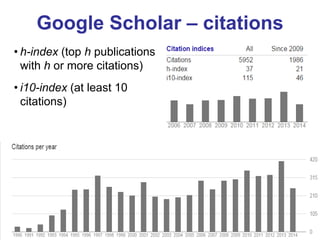
Google Scholar – citations 
•h-index (top h publications with h or more citations) 
•i10-index (at least 10 citations)
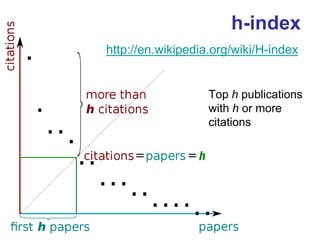
h-index 
Top h publications with h or more citations 
http://en.wikipedia.org/wiki/H-index
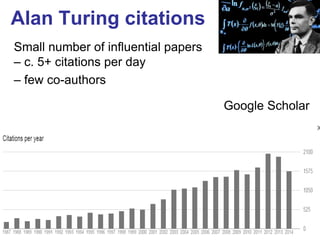
Alan Turing citations 
Google Scholar 
Small number of influential papers – c. 5+ citations per day 
– few co-authors
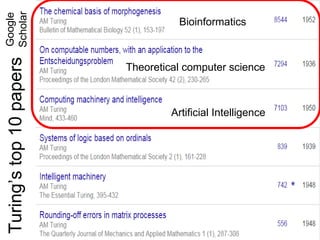
Turing’s top 10 papers 
Google Scholar 
Theoretical computer science 
Artificial Intelligence 
Bioinformatics
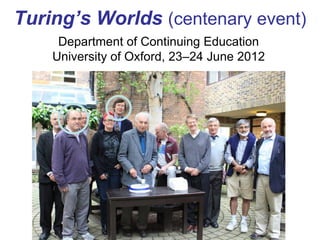
Turing’s Worlds (centenary event) 
Department of Continuing Education University of Oxford, 23–24 June 2012
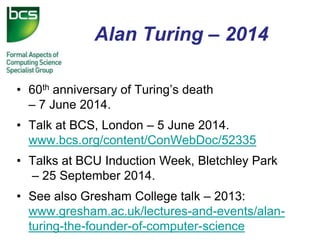
Alan Turing – 2014 
•60th anniversary of Turing’s death – 7 June 2014. 
•Talk at BCS, London – 5 June 2014. www.bcs.org/content/ConWebDoc/52335 
•Talks at BCU Induction Week, Bletchley Park – 25 September 2014. 
•See also Gresham College talk – 2013: www.gresham.ac.uk/lectures-and-events/alan- turing-the-founder-of-computer-science
The Turing Guide 
•Book due in 2015 
•To be published by Oxford University Press 
•Edited by Jonathan Bowen, Jack Copeland, Mark Sprevak, and Robin Wilson 
•c.40 chapters by contributors largely from Oxford, Cambridge, Bletchley Park meetings
Academia.edu 
•Academic networking website 
•Cf. LinkedIn (professional networking) 
•Includes affiliation to university and department 
•Allows easy addition of books, papers, answers, talks, teaching documents, research interests, CV, status updates, websites, etc. 
•Add keywords for publication searching 
•Monitoring of access statistics
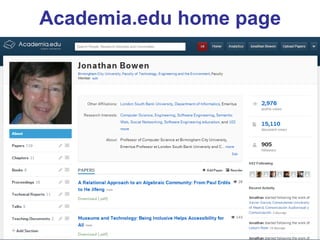
Academia.edu home page 
E.g., bcu.academia.edu/JonathanBowen
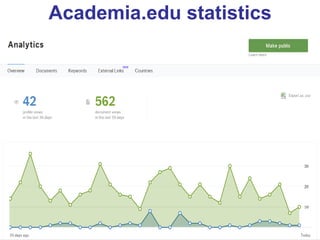
Academia.edu statistics 
E.g., lsbu.academia.edu/JonathanBowen
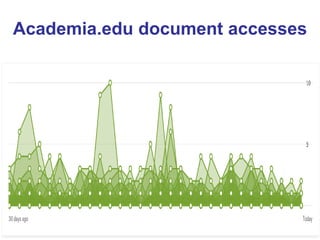
Academia.edu document accesses 
Last 30 days
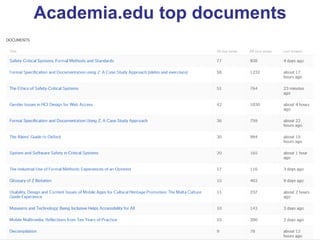
Academia.edu top documents 
Last 30 days
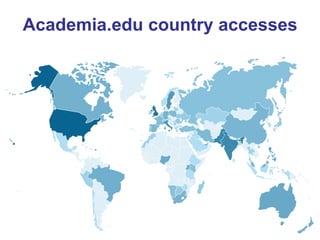
Academia.edu country accesses 
Last 30 days
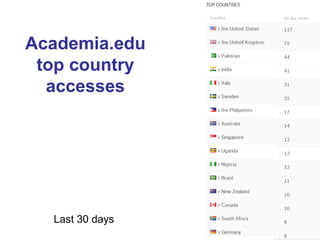
Academia.edu top country accesses 
Last 30 days
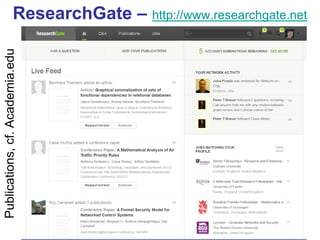
ResearchGate – http://www.researchgate.net 
Publications, cf. Academia.edu
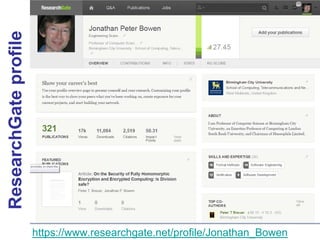
ResearchGate profile 
https://www.researchgate.net/profile/Jonathan_Bowen
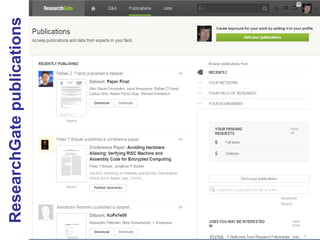
ResearchGate publications 
•Personal publications page
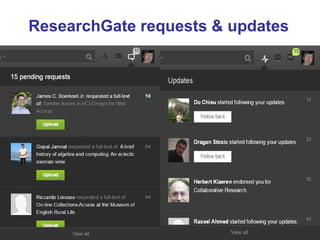
ResearchGate requests & updates 
•Personal publications page
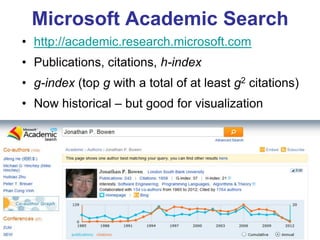
Microsoft Academic Search 
•http://academic.research.microsoft.com 
•Publications, citations, h-index 
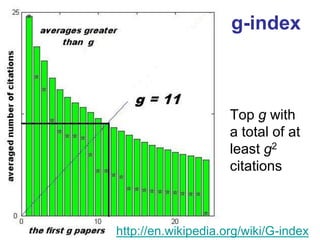
•g-index (top g with a total of at least g2 citations) 
•Now historical – but good for visualization
g-index 
Top g with a total of at least g2 citations 
http://en.wikipedia.org/wiki/G-index
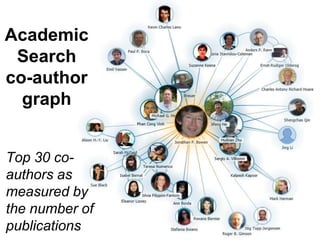
Top 30 co- authors as measured by the number of publications 
Academic Search co-author graph
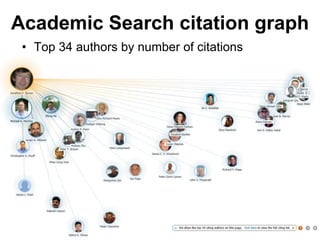
Academic Search citation graph 
•Top 34 authors by number of citations
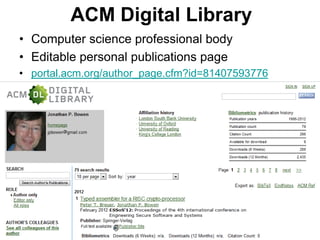
ACM Digital Library 
•Computer science professional body 
•Editable personal publications page 
•portal.acm.org/author_page.cfm?id=81407593776
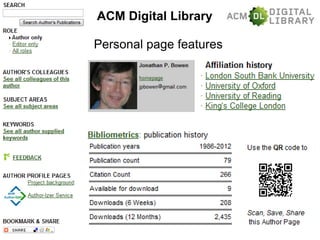
ACM Digital Library 
Personal page features
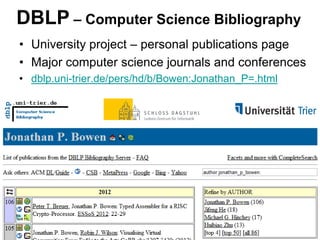
DBLP – Computer Science Bibliography 
•University project – personal publications page 
•Major computer science journals and conferences 
•dblp.uni-trier.de/pers/hd/b/Bowen:Jonathan_P=.html
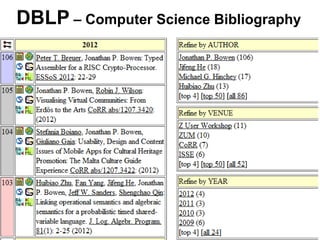
DBLP – Computer Science Bibliography 
•University project – personal publications page 
•Major computer science journals and conferences 
•dblp.uni-trier.de/pers/hd/b/Bowen:Jonathan_P=.html
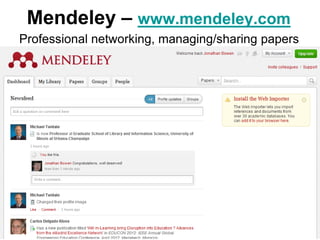
Mendeley – www.mendeley.com 
Professional networking, managing/sharing papers
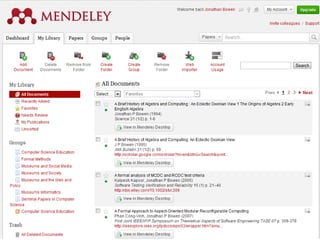
Mendeley – www.mendeley.com 
Professional networking, managing/sharing papers
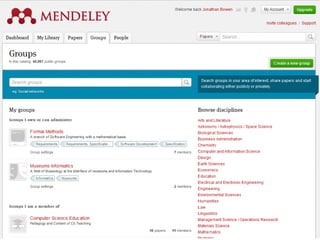
Mendeley – www.mendeley.com 
Professional networking, managing/sharing papers
Non-free citations websites 
•E.g., Web of Science 
–Thomson Reuters: http://wokinfo.com 
–UK: http://wok.mimas.ac.uk 
•OK if your university subscribes 
•But not all do ... 
•And no control for users
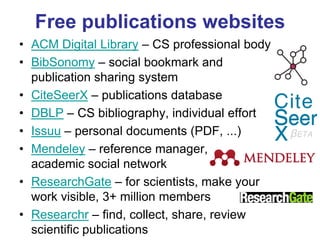
Free publications websites 
•ACM Digital Library – CS professional body 
•BibSonomy – social bookmark and publication sharing system 
•CiteSeerX – publications database 
•DBLP – CS bibliography, individual effort 
•Issuu – personal documents (PDF, ...) 
•Mendeley – reference manager, academic social network 
•ResearchGate – for scientists, make your work visible, 3+ million members 
•Researchr – find, collect, share, review scientific publications
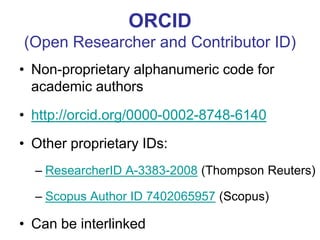
ORCID (Open Researcher and Contributor ID) 
•Non-proprietary alphanumeric code for academic authors 
•http://orcid.org/0000-0002-8748-6140 
•Other proprietary IDs: 
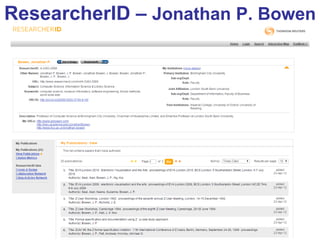
–ResearcherID A-3383-2008 (Thompson Reuters) 
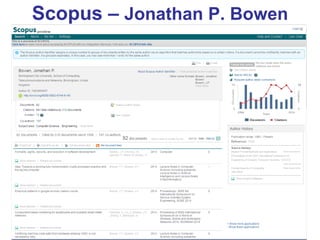
–Scopus Author ID 7402065957 (Scopus) 
•Can be interlinked
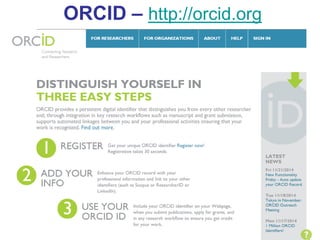
ORCID – http://orcid.org 
•Home page
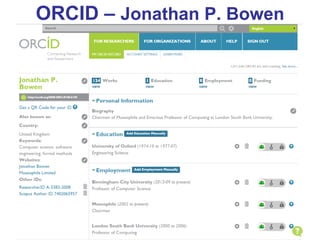
ORCID – Jonathan P. Bowen 
•Jonathan Bowen
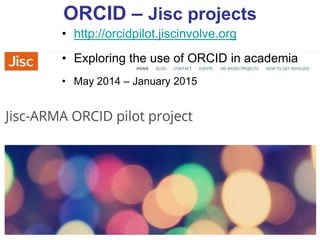
ORCID – Jisc projects 
•http://orcidpilot.jiscinvolve.org 
•Exploring the use of ORCID in academia 
•May 2014 – January 2015
ResearcherID – Jonathan P. Bowen 
•Jonathan Bowen
Scopus – Jonathan P. Bowen 
•Jonathan Bowen
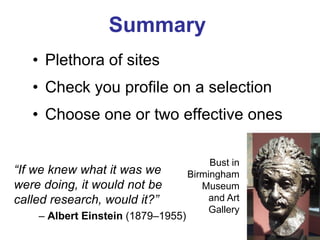
Summary 
“If we knew what it was we were doing, it would not be called research, would it?” 
– Albert Einstein (1879–1955) 
Bust in Birmingham Museum and Art Gallery 
•Plethora of sites 
•Check you profile on a selection 
•Choose one or two effective ones
Conclusion 
•Google Scholar – visibility 
•Academia.edu & ResearchGate – virtual communities 
•ORCID – virtual identify 
•Academic Search – visualization
Thank you! 
Prof. Jonathan P. Bowen (FBCS, FRSA) 
Birmingham City University Museophile Limited 
jonathan.bowen@bcu.ac.uk @jpbowen 
www.bcu.ac.uk/jonathan-bowen www.jpbowen.com

Online Academic Tools for Engagement

  • 1.
    Tools for Engagement:Using social media to achieve research impact Prof. Jonathan P. Bowen Birmingham City University Museophile Limited www.bcu.ac.uk/jonathan-bowen www.jpbowen.com @jpbowen
  • 2.
    Background •Mathematics, art,engineering, computer science, software engineering, museum informatics •Academia: Imperial, Oxford, Reading, LSBU, BCU •Visitor: UNU-IIST, KCL, Brunel, Westminster, Waikato (New Zealand, 2011), Pratt Institute (New York, USA, 2012), East China Normal University (Shanghai, China, 2013) •Industry: Logica, Silicon Graphics, Altran Praxis •Electronic Visualisation and the Arts (EVA London conference, 7–9 July 2015)
  • 3.
    Overview •Communities •Onlineresources –Google Scholar –Academia.edu –ResearchGate –Academic Search –ORCID –Etc.
  • 4.
    Community of Practice •CoP: collection of people developing domain knowledge •Elements: –Domain, common interest –Community, willing to engage together –Practice, developing new knowledge •A brief introduction by Etienne Wenger, 2006: www.ewenger.com/theory
  • 5.
    Cultivating a CoP Different levels of participation: •Coordinator(s) •Active members •Peripheral members •Outsiders
  • 6.
    Bow tie effect Visualization Example – two communities (arts and science) Facebook TouchGraph connections
  • 7.
    Theories of Programmingand Formal Methods Shanghai, China, 1–3 September 2013 Festschrift for Prof. He Jifeng, Shanghai, China, 2013 Jonathan Bowen Zhiming Liu
  • 8.
    Google Scholar •http://scholar.google.com •publications & citations
  • 9.
  • 10.
    Google Scholar –home page •h-index (top h publications with h or more citations) •i10-index (at least 10 citations)
  • 11.
    Google Scholar –citations •h-index (top h publications with h or more citations) •i10-index (at least 10 citations)
  • 12.
    h-index Top hpublications with h or more citations http://en.wikipedia.org/wiki/H-index
  • 13.
    Alan Turing citations Google Scholar Small number of influential papers – c. 5+ citations per day – few co-authors
  • 14.
    Turing’s top 10papers Google Scholar Theoretical computer science Artificial Intelligence Bioinformatics
  • 15.
    Turing’s Worlds (centenaryevent) Department of Continuing Education University of Oxford, 23–24 June 2012
  • 16.
    Alan Turing –2014 •60th anniversary of Turing’s death – 7 June 2014. •Talk at BCS, London – 5 June 2014. www.bcs.org/content/ConWebDoc/52335 •Talks at BCU Induction Week, Bletchley Park – 25 September 2014. •See also Gresham College talk – 2013: www.gresham.ac.uk/lectures-and-events/alan- turing-the-founder-of-computer-science
  • 17.
    The Turing Guide •Book due in 2015 •To be published by Oxford University Press •Edited by Jonathan Bowen, Jack Copeland, Mark Sprevak, and Robin Wilson •c.40 chapters by contributors largely from Oxford, Cambridge, Bletchley Park meetings
  • 18.
    Academia.edu •Academic networkingwebsite •Cf. LinkedIn (professional networking) •Includes affiliation to university and department •Allows easy addition of books, papers, answers, talks, teaching documents, research interests, CV, status updates, websites, etc. •Add keywords for publication searching •Monitoring of access statistics
  • 19.
    Academia.edu home page E.g., bcu.academia.edu/JonathanBowen
  • 20.
    Academia.edu statistics E.g.,lsbu.academia.edu/JonathanBowen
  • 21.
  • 22.
  • 23.
  • 24.
    Academia.edu top countryaccesses Last 30 days
  • 25.
    ResearchGate – http://www.researchgate.net Publications, cf. Academia.edu
  • 26.
  • 27.
  • 28.
    ResearchGate requests &updates •Personal publications page
  • 29.
    Microsoft Academic Search •http://academic.research.microsoft.com •Publications, citations, h-index •g-index (top g with a total of at least g2 citations) •Now historical – but good for visualization
  • 30.
    g-index Top gwith a total of at least g2 citations http://en.wikipedia.org/wiki/G-index
  • 31.
    Top 30 co-authors as measured by the number of publications Academic Search co-author graph
  • 32.
    Academic Search citationgraph •Top 34 authors by number of citations
  • 33.
    ACM Digital Library •Computer science professional body •Editable personal publications page •portal.acm.org/author_page.cfm?id=81407593776
  • 34.
    ACM Digital Library Personal page features
  • 35.
    DBLP – ComputerScience Bibliography •University project – personal publications page •Major computer science journals and conferences •dblp.uni-trier.de/pers/hd/b/Bowen:Jonathan_P=.html
  • 36.
    DBLP – ComputerScience Bibliography •University project – personal publications page •Major computer science journals and conferences •dblp.uni-trier.de/pers/hd/b/Bowen:Jonathan_P=.html
  • 37.
    Mendeley – www.mendeley.com Professional networking, managing/sharing papers
  • 38.
    Mendeley – www.mendeley.com Professional networking, managing/sharing papers
  • 39.
    Mendeley – www.mendeley.com Professional networking, managing/sharing papers
  • 40.
    Non-free citations websites •E.g., Web of Science –Thomson Reuters: http://wokinfo.com –UK: http://wok.mimas.ac.uk •OK if your university subscribes •But not all do ... •And no control for users
  • 41.
    Free publications websites •ACM Digital Library – CS professional body •BibSonomy – social bookmark and publication sharing system •CiteSeerX – publications database •DBLP – CS bibliography, individual effort •Issuu – personal documents (PDF, ...) •Mendeley – reference manager, academic social network •ResearchGate – for scientists, make your work visible, 3+ million members •Researchr – find, collect, share, review scientific publications
  • 42.
    ORCID (Open Researcherand Contributor ID) •Non-proprietary alphanumeric code for academic authors •http://orcid.org/0000-0002-8748-6140 •Other proprietary IDs: –ResearcherID A-3383-2008 (Thompson Reuters) –Scopus Author ID 7402065957 (Scopus) •Can be interlinked
  • 43.
  • 44.
    ORCID – JonathanP. Bowen •Jonathan Bowen
  • 45.
    ORCID – Jiscprojects •http://orcidpilot.jiscinvolve.org •Exploring the use of ORCID in academia •May 2014 – January 2015
  • 46.
    ResearcherID – JonathanP. Bowen •Jonathan Bowen
  • 47.
    Scopus – JonathanP. Bowen •Jonathan Bowen
  • 48.
    Summary “If weknew what it was we were doing, it would not be called research, would it?” – Albert Einstein (1879–1955) Bust in Birmingham Museum and Art Gallery •Plethora of sites •Check you profile on a selection •Choose one or two effective ones
  • 49.
    Conclusion •Google Scholar– visibility •Academia.edu & ResearchGate – virtual communities •ORCID – virtual identify •Academic Search – visualization
  • 50.
    Thank you! Prof.Jonathan P. Bowen (FBCS, FRSA) Birmingham City University Museophile Limited jonathan.bowen@bcu.ac.uk @jpbowen www.bcu.ac.uk/jonathan-bowen www.jpbowen.com