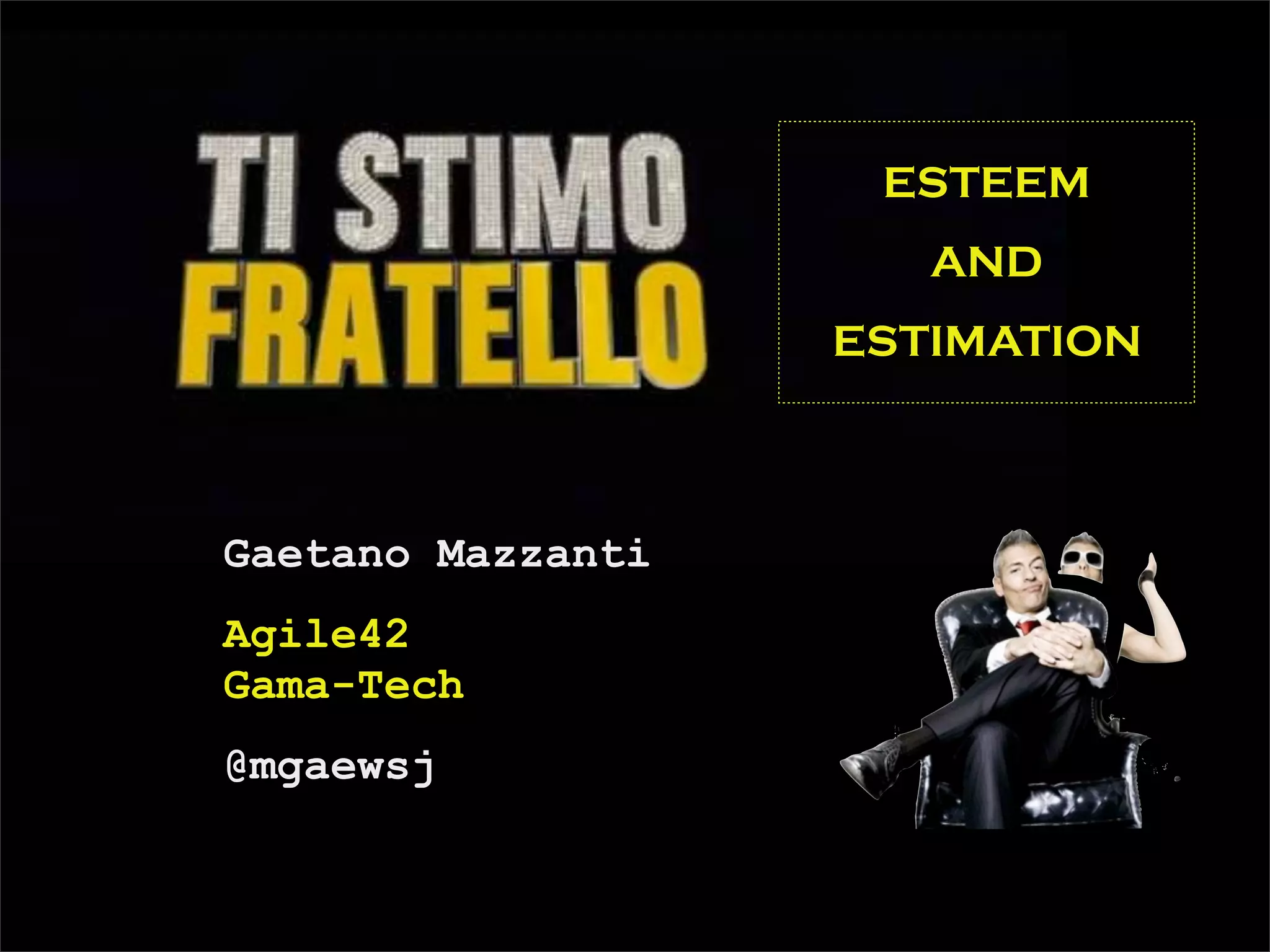
ESTEEM
                      AND
                   ESTIMATION


Gaetano Mazzanti
Agile42
Gama-Tech
@mgaewsj
Rumeli hisarı
estimates are not
   “the” problem
 the problem is in
how we use estimates
why do we estimate?
how do we estimate?
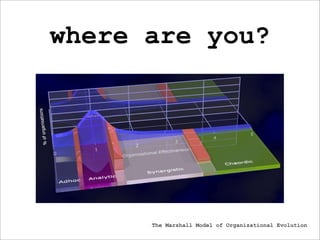
where are you?


      The Marshall Model of Organizational Evolution
classic
dysfunctions in
   estimates
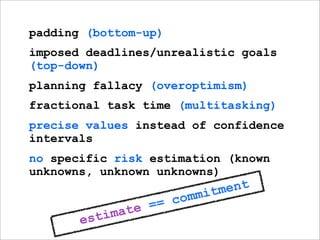
padding (bottom-up)
imposed deadlines/unrealistic goals
(top-down)
planning fallacy (overoptimism)
fractional task time (multitasking)
precise values instead of confidence
intervals
no specific risk estimation (known
unknowns, unknown unknowns)
                               itm ent
                     = c omm
             mat e =
       e sti
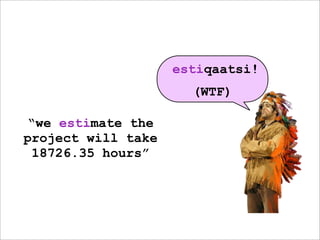
estiqaatsi!
                      (WTF)

“we estimate the
project will take
 18726.35 hours”
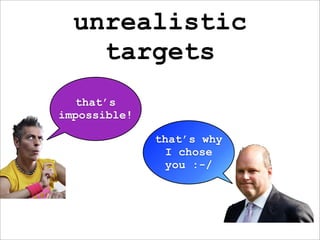
unrealistic
    targets
  that’s
impossible!

              that’s why
               I chose
               you :-/
fractional task time


 Task A   essiamonoi (50%)


 Task B   essiamonoi (30%)


 Task C        essiamonoi (20%)


            d
the myth of full capacity
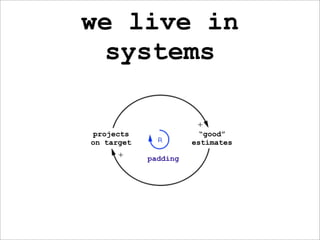
we live in
  systems

projects                “good”
on target             estimates

            padding
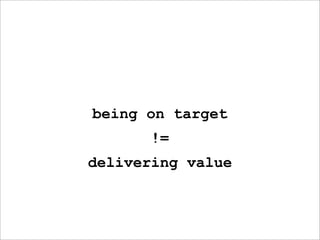
being on target
       !=
delivering value
being “good” at estimating
              !=
being good at delivering value
we live in
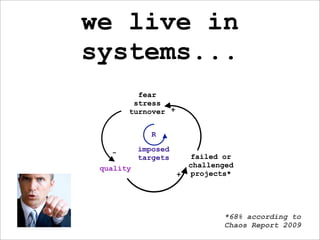
systems...
         fear
        stress
       turnover +


              R

   -       imposed
           targets     failed or
 quality               challenged
                     + projects*


                               *68% according to
                               Chaos Report 2009
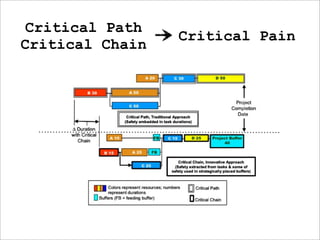
Critical Path
                 Critical Pain
Critical Chain
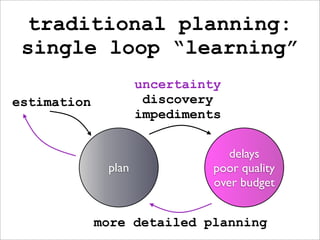
traditional planning:
 single loop “learning”
                     uncertainty
estimation            discovery
                     impediments


                                  delays
              plan             poor quality
                               over budget


             more detailed planning
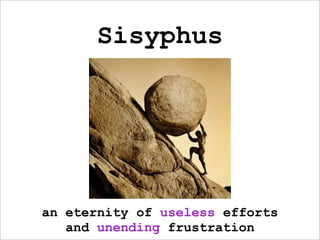
Sisyphus


an eternity of useless efforts
   and unending frustration
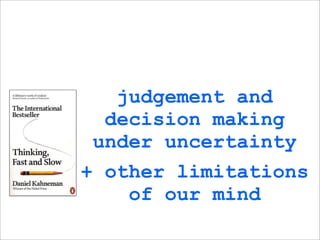
judgement and
  decision making
 under uncertainty
+ other limitations
    of our mind
the planning
        fallacy
humans systematically underestimate how
long it will take to do a task
they are over confident in their own
estimates
saying “estimate better” or “remember
how long previous tasks took” won’t work
deadlines are more significant in
determining when work will be
done than many of us realize,
or would like to admit
overconfidence
clinicians in a study were
completely certain of the
diagnosis antemortem: they were
wrong 40% of the time
appearing unsure is considered a
weakness
the admission that one is simply
guessing is unacceptable
estimating others
  and the past
people underestimate their own
but not others completion times
people focus on plan-based
scenarios rather than relevant
past experience when predicting
people undervalue past experience
(“this time is different”)
retrospective
    estimation
the fallacy holds also looking
back to the past:
reported time is typically less
than the actual time
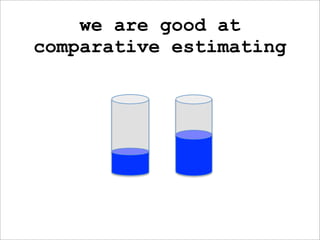
we are good at
comparative estimating
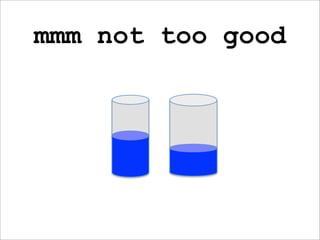
mmm not too good
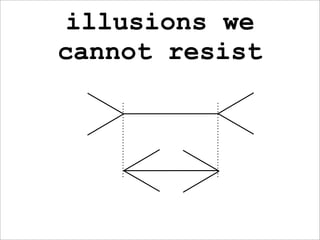
illusions we
cannot resist
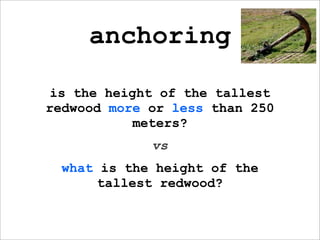
anchoring

is the height of the tallest
redwood more or less than 250
           meters?
             vs
  what is the height of the
       tallest redwood?
framing effect
odds of survival one month after
        surgery are 90%
               vs
 mortality within one month of
        surgery is 10%
               vs
 mortality within one month of
 surgery is 1 person out of 10
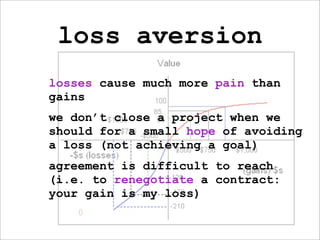
loss aversion
losses cause much more pain than
gains
we don’t close a project when we
should for a small hope of avoiding
a loss (not achieving a goal)
agreement is difficult to reach
(i.e. to renegotiate a contract:
your gain is my loss)
affect heuristic


 “he likes the project so much
that he thinks costs are low and
         benefits high”
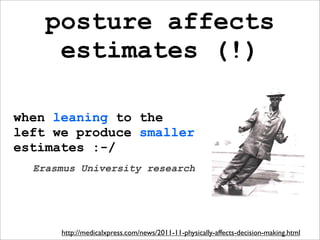
posture affects
     estimates (!)

when leaning to the
left we produce smaller
estimates :-/
  Erasmus University research


      http://medicalxpress.com/news/2011-11-physically-affects-decision-making.html
need for
        causality
we attribute causality to events in the
past when in fact no cause-effect
relationship exists (Retrospective
Coherence)

to estimate we need to assume that
causality exists

in a complex environment, this assumption
is not valid
we can’t stand
   uncertainty


we always look for causal
explanations
even when events are due just to
chance
we favor certainty over doubt
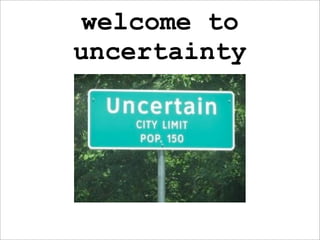
welcome to
uncertainty
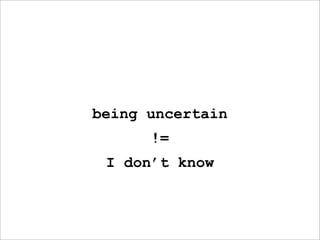
being uncertain
      !=
 I don’t know
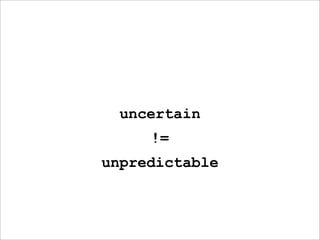
uncertain
     !=
unpredictable
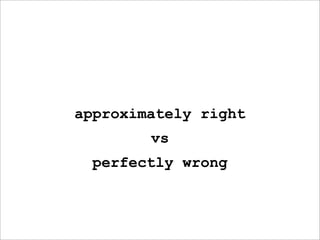
approximately right
        vs
  perfectly wrong
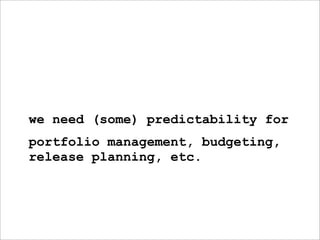
we need (some) predictability for
portfolio management, budgeting,
release planning, etc.
Agile to the rescue?
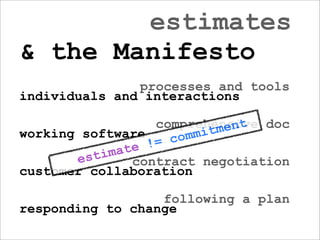
estimates
& the Manifesto
               processes and tools
individuals and interactions

                     comprehensive doc
                                 ent
working software         omm itm
                 e ! = c
         sti mat
       e         contract negotiation
customer collaboration

                  following a plan
responding to change
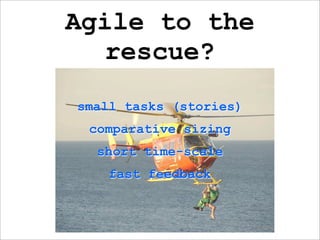
Agile to the
  rescue?
small tasks (stories)
 comparative sizing
  short time-scale
    fast feedback
“estimating and planning
can (and should) be
lightweight.
you should stop when
further planning is not
likely to lead to improved
decisions worth the extra
effort”
                  Mike Cohn
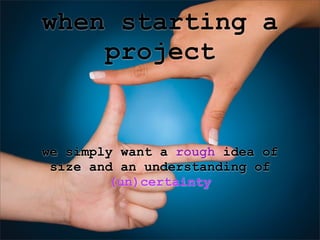
when starting a
    project


we simply want a rough idea of
 size and an understanding of
         (un)certainty
do a pre-mortem!
Agile has ritualized estimation
activities
there is some good
and some bad in this
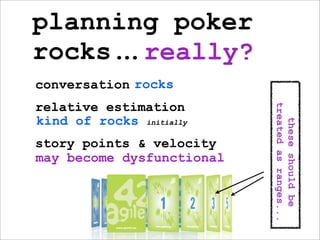
planning poker
rocks.. really?
      .
conversation rocks
relative estimation


                           treated as ranges...
kind of rocks initially


                             these should be
story points & velocity
may become dysfunctional
biggest value of the
estimation process is
     conversation
     (exploring,
    discovering)


   instead of sizing
we should call it just
     understanding
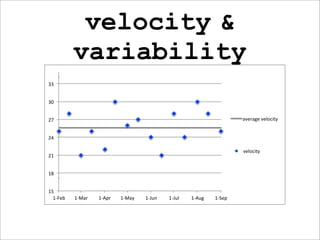
velocity &
           variability
33#


30#


27#                                                                       average#velocity#

                                                                          UCL#
24#                                                                       LCL#

                                                                          velocity#
21#


18#


15#
  1*Feb#   1*Mar#   1*Apr#   1*May#   1*Jun#   1*Jul#   1*Aug#   1*Sep#
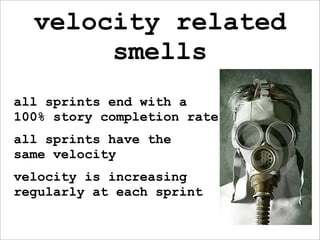
velocity related
       smells
all sprints end with a
100% story completion rate
all sprints have the
same velocity
velocity is increasing
regularly at each sprint
estimation == waste?

 “time spent estimating is
       time not spent doing
        value adding stuff”


    mmm, yes and no...
from
learning to estimates
an alternative to
  Story Points?


  just count the
number of Stories
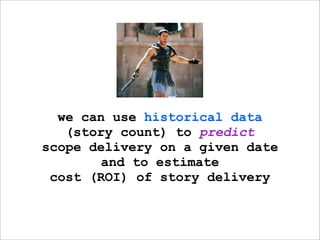
we can use historical data
   (story count) to predict
scope delivery on a given date
        and to estimate
 cost (ROI) of story delivery
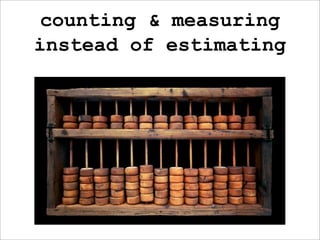
counting & measuring
instead of estimating
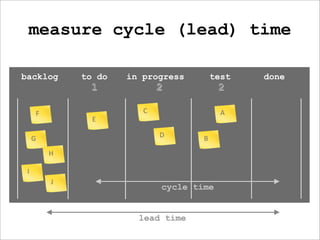
measure cycle (lead) time

backlog      to do   in progress        test   done
              1             2            2

     F                  C                 A
               E

     G                      D       B
         H

 I
         J
                            cycle time


                       lead time
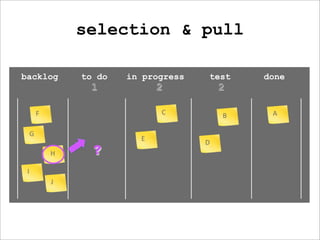
selection & pull

backlog              to do   in progress   test    done
                      1            2           2

         F                         C           B    A

     G
                               E
                                           D
             	
  H     ?
 I
              J
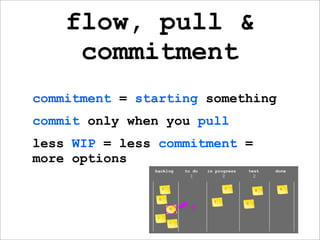
flow, pull &
     commitment
commitment = starting something
commit only when you pull
less WIP = less commitment =
more options
“ok, but I need to
  sign a contract!”
  contract: a piece of paper to
define consequences when there's
no trust and something goes wrong
use data from the past
acknowledge your ignorance
constantly monitor progress
cross your fingers
(optional) be transparent with
your client
esteem and respect
respect

 estimates
    !=
commitments
imposed
         deadlines
top-down deadlines force people to
compromise, motivation goes down
no control over the scope or schedule, only
one variable left: quality.

if bonus is tied to delivering on-time the
only way to achieve that goal is to
cut corners
                                                 C T!
                                          S PE
                                     RE
                               NO
rebooting teams
execs need to understand/respect
what makes a system work and what
makes it (un)predictable
you can’t reboot teams, project to
project, putting together different
people each time and expect to have
predictable outcomes
                                          C T!
                                   S PE
                              RE
                         NO
pretending decisions
     are shared


“shared” decisions (estimates)
      are often extorted


                                       C T!
                                S PE
                           RE
                      NO
bullying

“when will it be done?”
          ==
   I don't trust you
                                   C T!
                            S PE
                       RE
                 NO
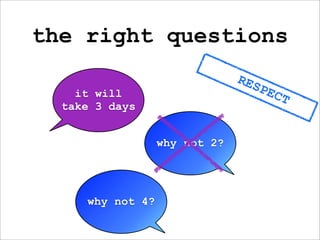
the right questions
                               RES
    it will                          PEC
                                           T
  take 3 days


                  why not 2?


     why not 4?
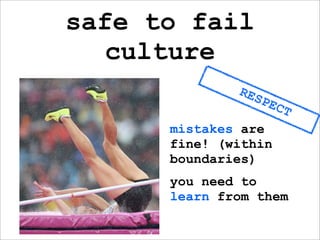
safe to fail
  culture
              RES
                    PEC
                          T
      mistakes are
      fine! (within
      boundaries)
      you need to
      learn from them
limit WIP
                             RES
                                   PEC
when you limit WIP you are               T
helping the team:
finishing stuff
making fewer commitments
giving them options
in closing

1.traditional approaches fail
(they ignore uncertainty and complexity)

2.our mind will anyway deceive us
3.Agile can help but beware of
falling into the same trap as 1.
4.respect is key
estimates can't be wrong
   they're estimates!
 "accurate estimates" or
"improving estimates" =>
   just a waste of time
estimates are not
   “the” problem
 the problem is in
how we use estimates
looking at our models and
assuming they might be wrong
   is the heart of respect
                      Liz Keogh
Gaetano Mazzanti
         @mgaewsj
gaetano.mazzanti@gmail.com

Esteem and Estimates (Ti Stimo Fratello)

  • 1.
    ESTEEM AND ESTIMATION Gaetano Mazzanti Agile42 Gama-Tech @mgaewsj
  • 2.
  • 3.
    estimates are not “the” problem the problem is in how we use estimates
  • 4.
    why do weestimate?
  • 5.
    how do weestimate?
  • 6.
    where are you? The Marshall Model of Organizational Evolution
  • 7.
  • 8.
    padding (bottom-up) imposed deadlines/unrealisticgoals (top-down) planning fallacy (overoptimism) fractional task time (multitasking) precise values instead of confidence intervals no specific risk estimation (known unknowns, unknown unknowns) itm ent = c omm mat e = e sti
  • 9.
    estiqaatsi! (WTF) “we estimate the project will take 18726.35 hours”
  • 10.
    unrealistic targets that’s impossible! that’s why I chose you :-/
  • 11.
    fractional task time Task A essiamonoi (50%) Task B essiamonoi (30%) Task C essiamonoi (20%) d the myth of full capacity
  • 12.
    we live in systems projects “good” on target estimates padding
  • 13.
    being on target != delivering value
  • 14.
    being “good” atestimating != being good at delivering value
  • 15.
    we live in systems... fear stress turnover + R - imposed targets failed or quality challenged + projects* *68% according to Chaos Report 2009
  • 16.
    Critical Path Critical Pain Critical Chain
  • 17.
    traditional planning: singleloop “learning” uncertainty estimation discovery impediments delays plan poor quality over budget more detailed planning
  • 18.
    Sisyphus an eternity ofuseless efforts and unending frustration
  • 19.
    judgement and decision making under uncertainty + other limitations of our mind
  • 20.
    the planning fallacy humans systematically underestimate how long it will take to do a task they are over confident in their own estimates saying “estimate better” or “remember how long previous tasks took” won’t work deadlines are more significant in determining when work will be done than many of us realize, or would like to admit
  • 21.
    overconfidence clinicians in astudy were completely certain of the diagnosis antemortem: they were wrong 40% of the time appearing unsure is considered a weakness the admission that one is simply guessing is unacceptable
  • 22.
    estimating others and the past people underestimate their own but not others completion times people focus on plan-based scenarios rather than relevant past experience when predicting people undervalue past experience (“this time is different”)
  • 23.
    retrospective estimation the fallacy holds also looking back to the past: reported time is typically less than the actual time
  • 24.
    we are goodat comparative estimating
  • 25.
  • 26.
  • 27.
    anchoring is the heightof the tallest redwood more or less than 250 meters? vs what is the height of the tallest redwood?
  • 28.
    framing effect odds ofsurvival one month after surgery are 90% vs mortality within one month of surgery is 10% vs mortality within one month of surgery is 1 person out of 10
  • 29.
    loss aversion losses causemuch more pain than gains we don’t close a project when we should for a small hope of avoiding a loss (not achieving a goal) agreement is difficult to reach (i.e. to renegotiate a contract: your gain is my loss)
  • 30.
    affect heuristic “helikes the project so much that he thinks costs are low and benefits high”
  • 31.
    posture affects estimates (!) when leaning to the left we produce smaller estimates :-/ Erasmus University research http://medicalxpress.com/news/2011-11-physically-affects-decision-making.html
  • 32.
    need for causality we attribute causality to events in the past when in fact no cause-effect relationship exists (Retrospective Coherence) to estimate we need to assume that causality exists in a complex environment, this assumption is not valid
  • 33.
    we can’t stand uncertainty we always look for causal explanations even when events are due just to chance we favor certainty over doubt
  • 34.
  • 35.
    being uncertain != I don’t know
  • 36.
    uncertain != unpredictable
  • 37.
    approximately right vs perfectly wrong
  • 38.
    we need (some)predictability for portfolio management, budgeting, release planning, etc.
  • 39.
    Agile to therescue?
  • 40.
    estimates & the Manifesto processes and tools individuals and interactions comprehensive doc ent working software omm itm e ! = c sti mat e contract negotiation customer collaboration following a plan responding to change
  • 41.
    Agile to the rescue? small tasks (stories) comparative sizing short time-scale fast feedback
  • 42.
    “estimating and planning can(and should) be lightweight. you should stop when further planning is not likely to lead to improved decisions worth the extra effort” Mike Cohn
  • 43.
    when starting a project we simply want a rough idea of size and an understanding of (un)certainty
  • 44.
  • 45.
    Agile has ritualizedestimation activities there is some good and some bad in this
  • 46.
    planning poker rocks.. really? . conversation rocks relative estimation treated as ranges... kind of rocks initially these should be story points & velocity may become dysfunctional
  • 47.
    biggest value ofthe estimation process is conversation (exploring, discovering) instead of sizing we should call it just understanding
  • 48.
    velocity & variability 33# 30# 27# average#velocity# UCL# 24# LCL# velocity# 21# 18# 15# 1*Feb# 1*Mar# 1*Apr# 1*May# 1*Jun# 1*Jul# 1*Aug# 1*Sep#
  • 49.
    velocity related smells all sprints end with a 100% story completion rate all sprints have the same velocity velocity is increasing regularly at each sprint
  • 50.
    estimation == waste? “time spent estimating is time not spent doing value adding stuff” mmm, yes and no...
  • 51.
  • 52.
    an alternative to Story Points? just count the number of Stories
  • 53.
    we can usehistorical data (story count) to predict scope delivery on a given date and to estimate cost (ROI) of story delivery
  • 54.
  • 55.
    measure cycle (lead)time backlog to do in progress test done 1 2 2 F C A E G D B H I J cycle time lead time
  • 56.
    selection & pull backlog to do in progress test done 1 2 2 F C B A G E D  H ? I J
  • 57.
    flow, pull & commitment commitment = starting something commit only when you pull less WIP = less commitment = more options
  • 58.
    “ok, but Ineed to sign a contract!” contract: a piece of paper to define consequences when there's no trust and something goes wrong use data from the past acknowledge your ignorance constantly monitor progress cross your fingers (optional) be transparent with your client
  • 59.
  • 60.
    respect estimates != commitments
  • 61.
    imposed deadlines top-down deadlines force people to compromise, motivation goes down no control over the scope or schedule, only one variable left: quality. if bonus is tied to delivering on-time the only way to achieve that goal is to cut corners C T! S PE RE NO
  • 62.
    rebooting teams execs needto understand/respect what makes a system work and what makes it (un)predictable you can’t reboot teams, project to project, putting together different people each time and expect to have predictable outcomes C T! S PE RE NO
  • 63.
    pretending decisions are shared “shared” decisions (estimates) are often extorted C T! S PE RE NO
  • 64.
    bullying “when will itbe done?” == I don't trust you C T! S PE RE NO
  • 65.
    the right questions RES it will PEC T take 3 days why not 2? why not 4?
  • 66.
    safe to fail culture RES PEC T mistakes are fine! (within boundaries) you need to learn from them
  • 67.
    limit WIP RES PEC when you limit WIP you are T helping the team: finishing stuff making fewer commitments giving them options
  • 68.
    in closing 1.traditional approachesfail (they ignore uncertainty and complexity) 2.our mind will anyway deceive us 3.Agile can help but beware of falling into the same trap as 1. 4.respect is key
  • 69.
    estimates can't bewrong they're estimates! "accurate estimates" or "improving estimates" => just a waste of time
  • 70.
    estimates are not “the” problem the problem is in how we use estimates
  • 71.
    looking at ourmodels and assuming they might be wrong is the heart of respect Liz Keogh
  • 72.
    Gaetano Mazzanti @mgaewsj gaetano.mazzanti@gmail.com