Balancing Technology Transfer


                              FITT
– Fostering Interregional Exchange in ICT Technology Transfer –


                                 www.FITT-for-Innovation.eu
Except where otherwise noted, this work is licensed under a Creative Commons Attribution 3.0 License.
Balancing Technology Transfer


        Balanced exploitation of results obtained in research collaboration with
         industry:
              covers the whole transfer chain
              is proportional in terms of investments and profits of each partner
              brings a product which perfectly answers market needs and gives
               a starting point for further developments


        An “ideal” transfer operation is not easy to reproduce
        The example of “ideal” collaboration between INRIA research centre and
         Texas Instruments helps to shed some light on the strong and weak points
         of such partnerships and on the success factors


2 | March 2010                        Balancing Technology Transfer
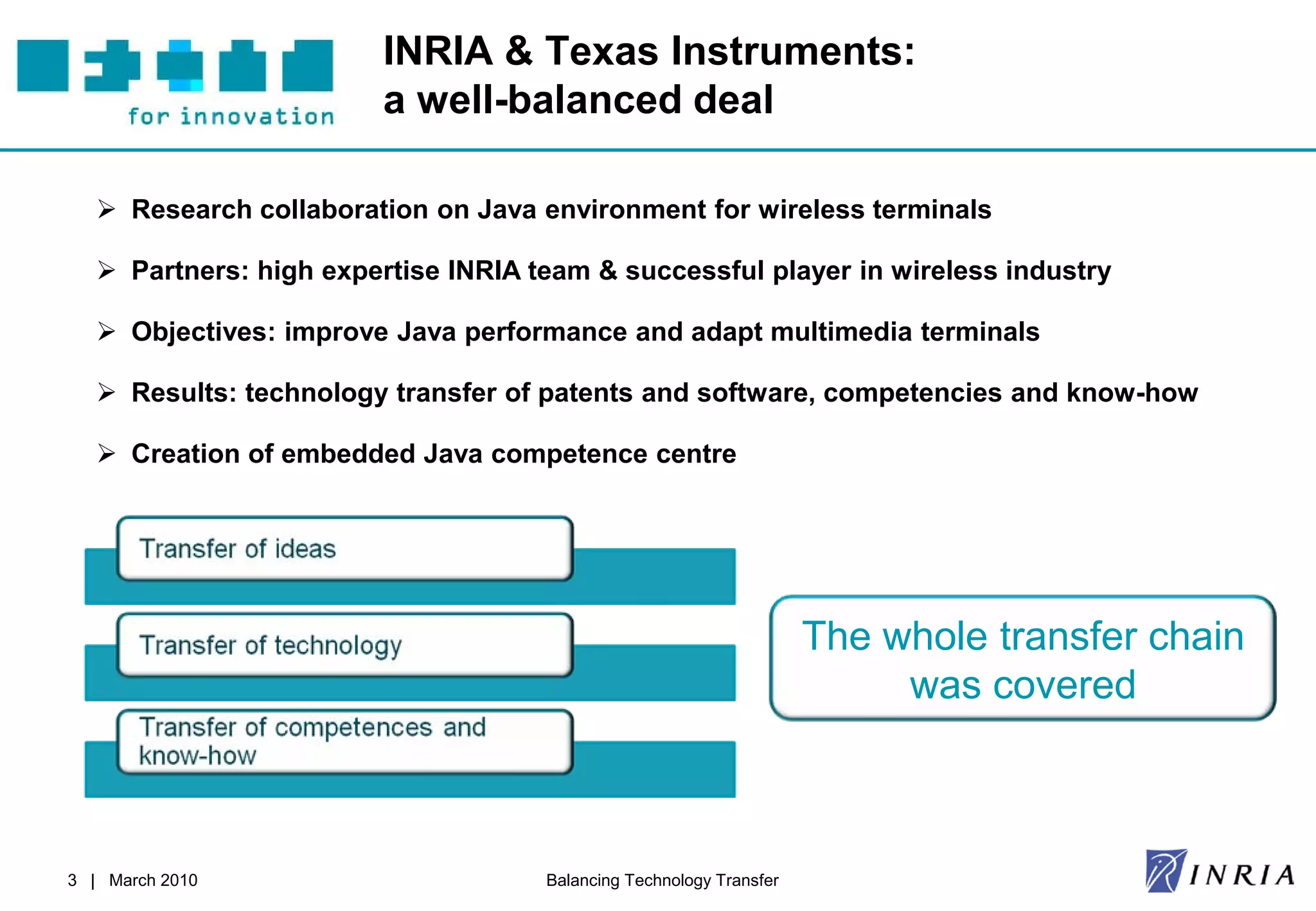
INRIA & Texas Instruments:
                         a well-balanced deal

    Research collaboration on Java environment for wireless terminals

    Partners: high expertise INRIA team & successful player in wireless industry

    Objectives: improve Java performance and adapt multimedia terminals

    Results: technology transfer of patents and software, competencies and know-how

    Creation of embedded Java competence centre


                                                                     The whole transfer chain
                                                                          was covered


3 | March 2010                       Balancing Technology Transfer
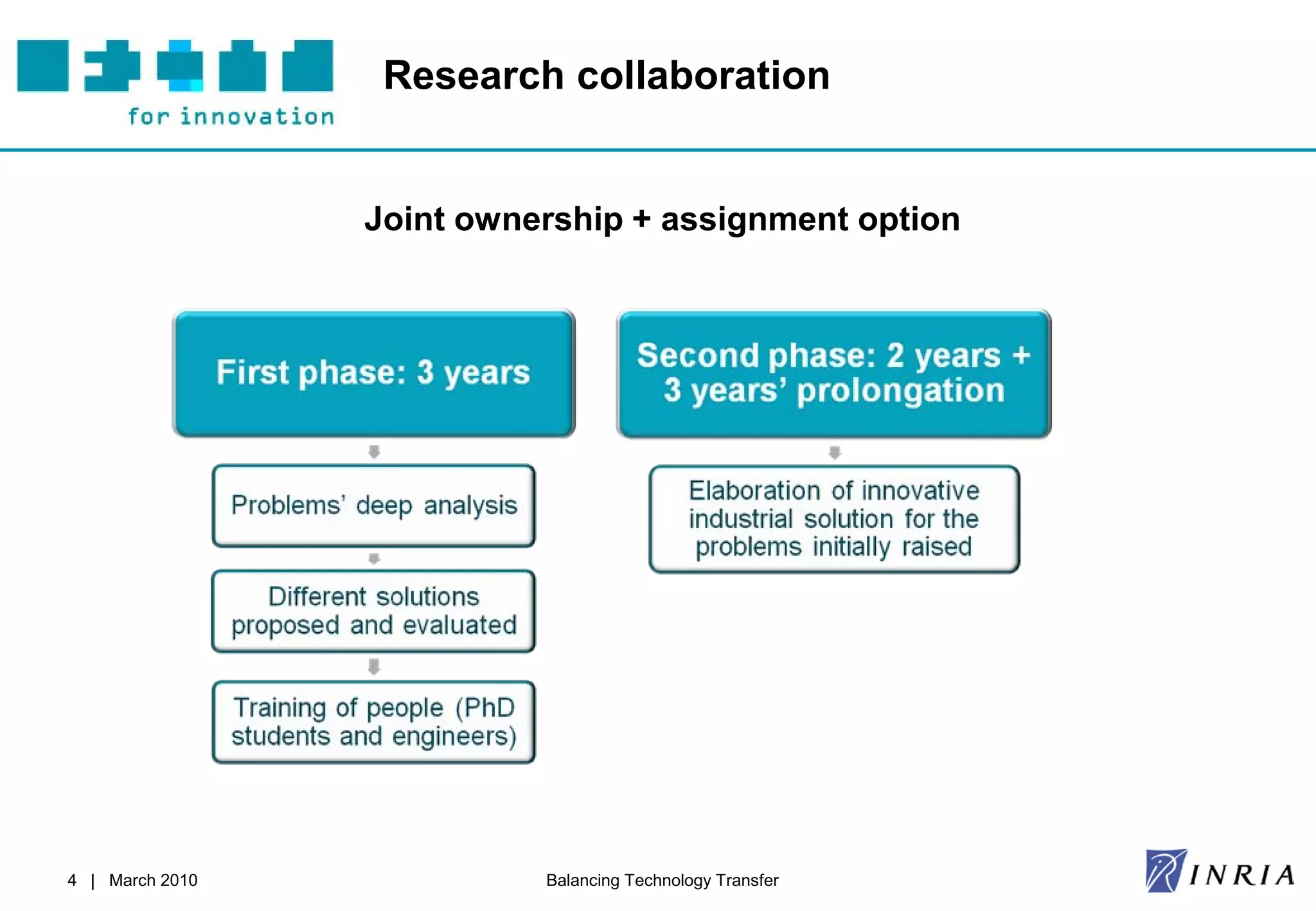
Research collaboration


                 Joint ownership + assignment option


4 | March 2010             Balancing Technology Transfer
Technology Transfer

   Texas Instruments has built a highly competitive commercial solution which
    complemented its wireless offer in semiconductors for manufacturers of mobile
    devices with embedded OS and for application developers

   Among the numerous results produced:

           9 patents were licensed on exclusive basis

           2 software products were assigned

           after the end of research collaboration all patents were bought by TI

   Without forgetting:

           Academic publication without divulgation of confidential data

           2 PhD thesis defences

           Transfer of competencies to temporary or permanent engineers


5 | March 2010                               Balancing Technology Transfer
TI competence centre creation


  Objective: to drive the transition of the research result into business reality

  Theme: “Embedded Java in mobile terminals”; focused on accelerating Java
   application on mobile multimedia devices

  Key interface for TI’s customers and partners in Java application area

  Close to the research team in Rennes INRIA centre

  Core team composed of a number of researchers / engineers who had worked in the
   initial research collaboration, hired by TI afterwards (optimal usage of knowledge and
   know-how accumulated)

  To continue in this technological domain in partnership with mobile phone industry,
   OS industry and the Java inventor, SUN


6 | March 2010                        Balancing Technology Transfer
When?


 Timing

       First research contract signed in 1998 for three years (1998-2001)

       The contract was prolonged twice, for the periods of 2001-2003 and 2003-2006

       Java competence centre established in December 2003 and closed in 2008 to
          be transformed into spin-off


7 | March 2010                           Balancing Technology Transfer
Who?


 Stakeholders

      INRIA team Aces:
       strong experience in operating systems and object languages, although “classical”
       results were not reusable in the new technological context and its constraints

      Texas Instruments:
       world leader in wireless /DSP providing components for Nokia, Motorola etc.;
       advanced research program on the next generation of mobile terminals, based on
       strong experience in hardware problems, with a branch in France

      INRIA TT office:
       good estimation of the transfer opportunity, negotiation skills


8 | March 2010                        Balancing Technology Transfer
Where?


 Location

      TI competence centre established in Rennes, close to INRIA research centre and
         collaborating team Aces

      Carried out in close connexion with TI’s European Wireless Centre in
         Villeneuve–Loubet, France (the driver of TI’s research programs over the past 15
         years)

      The TT officers both from INRIA Rennes centre and from INRIA headquarters
         (pilot role) were engaged in technology transfer around this collaboration


9 | March 2010                         Balancing Technology Transfer
Pros & Cons


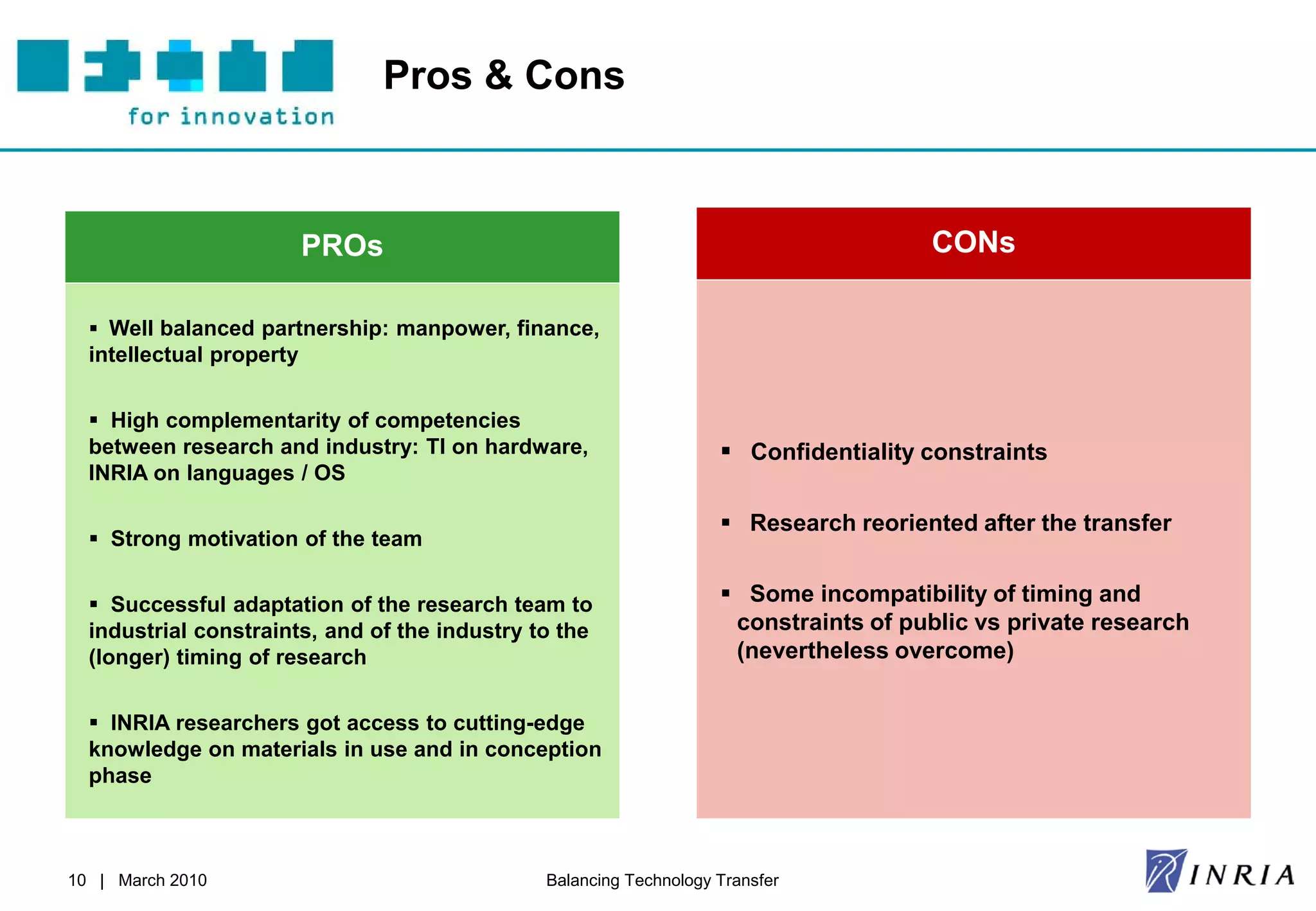
                          PROs                                                        CONs

   Well balanced partnership: manpower, finance,
  intellectual property


   High complementarity of competencies
  between research and industry: TI on hardware,                     Confidentiality constraints
  INRIA on languages / OS

                                                                     Research reoriented after the transfer
   Strong motivation of the team


   Successful adaptation of the research team to                    Some incompatibility of timing and
  industrial constraints, and of the industry to the                 constraints of public vs private research
  (longer) timing of research                                        (nevertheless overcome)


   INRIA researchers got access to cutting-edge
  knowledge on materials in use and in conception
  phase


10 | March 2010                                Balancing Technology Transfer
Why ? 1/2


 Rationale :

      TI was searching to provide new solutions for Java-based wireless applications
         compatible with its wireless communication chipsets and OMAP processors

      Aces team was able to provide necessary expertise in software
      The major challenges were:

            poor Java performance and its strong need in resources: processors, memory,
                  energy;

            poor compatibility of Java applications with real-time constraints while running on
                  mobile devices

      Those problems had to be overcome to go ahead with the telephony of 3rd and 4th
         generation


11 | March 2010                          Balancing Technology Transfer
Why? 2/2


  Evidence of success

        Initial research collaboration was continued through further contracts
        Development and commercialisation of the results proved its industrial
           application

        Both partners expressed a high level of satisfaction with the results and
           emphasised the quality of this collaboration

        All the results were transferred (rare case)

  Impact

        Evolution of the market offer for Java-enabled mobile devices and acceleration of
           the market growth

        Job creation in the TI competence centre in Rennes (employing many INRIA team
           members) and in TI site in Villeneuve-Loubet


12 | March 2010                         Balancing Technology Transfer
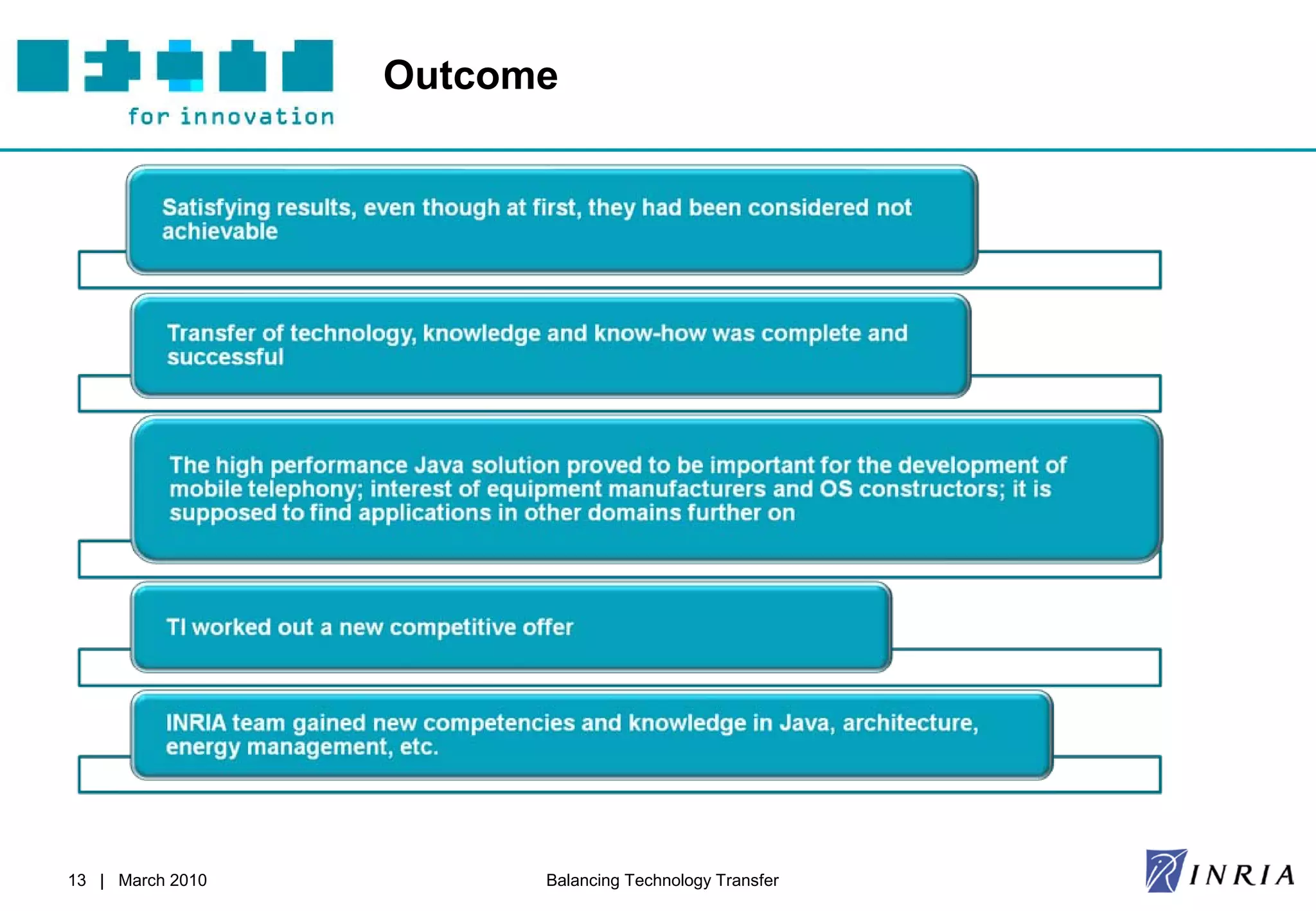
Outcome


13 | March 2010         Balancing Technology Transfer
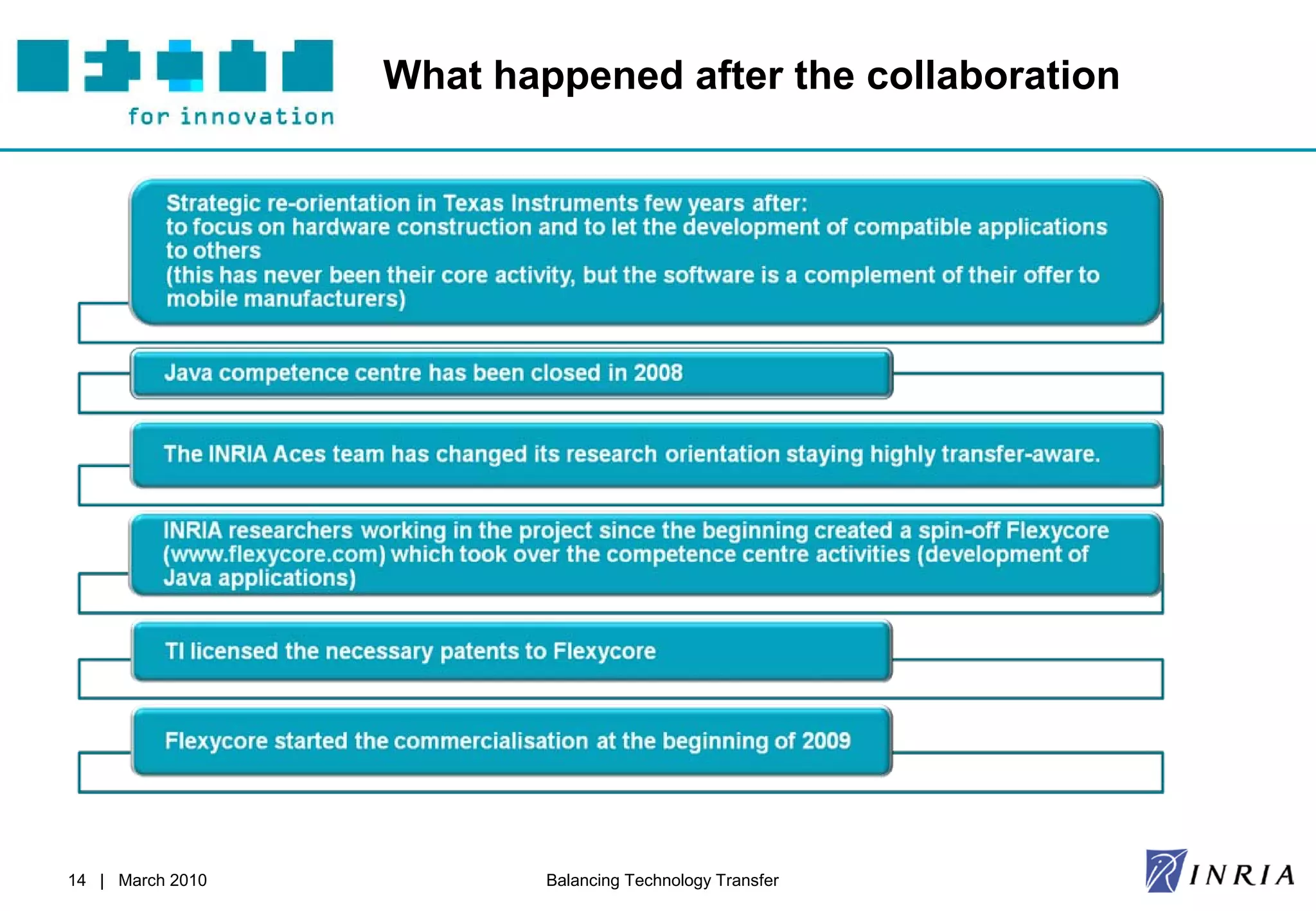
What happened after the collaboration


14 | March 2010           Balancing Technology Transfer
Lessons Learned


      Partners’ approach is of high importance for the success of
       collaboration: must be ready for efforts to understand and cope with
       constraints on each side


      Complementarity of partners is one of the success factors


      Time is needed to build trust relations and sometimes successful
       transfer takes place after a long collaboration


15 | March 2010                   Balancing Technology Transfer
Suggested Readings

    Link to bibliography

    Link to code book
    Industrial partnership

    Licensing

    Industry Attractiveness

    Research contract

    Technology transfer

    Competences transfer

    Link to relevant websites
    www.ti.com

    www.inria.fr

    http://www.inria.fr/valorisation/index.en.html


16 | March 2010                             Balancing Technology Transfer

FITT Toolbox: Balancing Technology Transfer

  • 1.
    Balancing Technology Transfer FITT – Fostering Interregional Exchange in ICT Technology Transfer – www.FITT-for-Innovation.eu Except where otherwise noted, this work is licensed under a Creative Commons Attribution 3.0 License.
  • 2.
    Balancing Technology Transfer  Balanced exploitation of results obtained in research collaboration with industry:  covers the whole transfer chain  is proportional in terms of investments and profits of each partner  brings a product which perfectly answers market needs and gives a starting point for further developments  An “ideal” transfer operation is not easy to reproduce  The example of “ideal” collaboration between INRIA research centre and Texas Instruments helps to shed some light on the strong and weak points of such partnerships and on the success factors 2 | March 2010 Balancing Technology Transfer
  • 3.
    INRIA & TexasInstruments: a well-balanced deal  Research collaboration on Java environment for wireless terminals  Partners: high expertise INRIA team & successful player in wireless industry  Objectives: improve Java performance and adapt multimedia terminals  Results: technology transfer of patents and software, competencies and know-how  Creation of embedded Java competence centre The whole transfer chain was covered 3 | March 2010 Balancing Technology Transfer
  • 4.
    Research collaboration Joint ownership + assignment option 4 | March 2010 Balancing Technology Transfer
  • 5.
    Technology Transfer  Texas Instruments has built a highly competitive commercial solution which complemented its wireless offer in semiconductors for manufacturers of mobile devices with embedded OS and for application developers  Among the numerous results produced:  9 patents were licensed on exclusive basis  2 software products were assigned  after the end of research collaboration all patents were bought by TI  Without forgetting:  Academic publication without divulgation of confidential data  2 PhD thesis defences  Transfer of competencies to temporary or permanent engineers 5 | March 2010 Balancing Technology Transfer
  • 6.
    TI competence centrecreation  Objective: to drive the transition of the research result into business reality  Theme: “Embedded Java in mobile terminals”; focused on accelerating Java application on mobile multimedia devices  Key interface for TI’s customers and partners in Java application area  Close to the research team in Rennes INRIA centre  Core team composed of a number of researchers / engineers who had worked in the initial research collaboration, hired by TI afterwards (optimal usage of knowledge and know-how accumulated)  To continue in this technological domain in partnership with mobile phone industry, OS industry and the Java inventor, SUN 6 | March 2010 Balancing Technology Transfer
  • 7.
    When?  Timing  First research contract signed in 1998 for three years (1998-2001)  The contract was prolonged twice, for the periods of 2001-2003 and 2003-2006  Java competence centre established in December 2003 and closed in 2008 to be transformed into spin-off 7 | March 2010 Balancing Technology Transfer
  • 8.
    Who?  Stakeholders  INRIA team Aces: strong experience in operating systems and object languages, although “classical” results were not reusable in the new technological context and its constraints  Texas Instruments: world leader in wireless /DSP providing components for Nokia, Motorola etc.; advanced research program on the next generation of mobile terminals, based on strong experience in hardware problems, with a branch in France  INRIA TT office: good estimation of the transfer opportunity, negotiation skills 8 | March 2010 Balancing Technology Transfer
  • 9.
    Where?  Location  TI competence centre established in Rennes, close to INRIA research centre and collaborating team Aces  Carried out in close connexion with TI’s European Wireless Centre in Villeneuve–Loubet, France (the driver of TI’s research programs over the past 15 years)  The TT officers both from INRIA Rennes centre and from INRIA headquarters (pilot role) were engaged in technology transfer around this collaboration 9 | March 2010 Balancing Technology Transfer
  • 10.
    Pros & Cons PROs CONs  Well balanced partnership: manpower, finance, intellectual property  High complementarity of competencies between research and industry: TI on hardware,  Confidentiality constraints INRIA on languages / OS  Research reoriented after the transfer  Strong motivation of the team  Successful adaptation of the research team to  Some incompatibility of timing and industrial constraints, and of the industry to the constraints of public vs private research (longer) timing of research (nevertheless overcome)  INRIA researchers got access to cutting-edge knowledge on materials in use and in conception phase 10 | March 2010 Balancing Technology Transfer
  • 11.
    Why ? 1/2 Rationale :  TI was searching to provide new solutions for Java-based wireless applications compatible with its wireless communication chipsets and OMAP processors  Aces team was able to provide necessary expertise in software  The major challenges were:  poor Java performance and its strong need in resources: processors, memory, energy;  poor compatibility of Java applications with real-time constraints while running on mobile devices  Those problems had to be overcome to go ahead with the telephony of 3rd and 4th generation 11 | March 2010 Balancing Technology Transfer
  • 12.
    Why? 2/2 Evidence of success  Initial research collaboration was continued through further contracts  Development and commercialisation of the results proved its industrial application  Both partners expressed a high level of satisfaction with the results and emphasised the quality of this collaboration  All the results were transferred (rare case)  Impact  Evolution of the market offer for Java-enabled mobile devices and acceleration of the market growth  Job creation in the TI competence centre in Rennes (employing many INRIA team members) and in TI site in Villeneuve-Loubet 12 | March 2010 Balancing Technology Transfer
  • 13.
    Outcome 13 | March2010 Balancing Technology Transfer
  • 14.
    What happened afterthe collaboration 14 | March 2010 Balancing Technology Transfer
  • 15.
    Lessons Learned  Partners’ approach is of high importance for the success of collaboration: must be ready for efforts to understand and cope with constraints on each side  Complementarity of partners is one of the success factors  Time is needed to build trust relations and sometimes successful transfer takes place after a long collaboration 15 | March 2010 Balancing Technology Transfer
  • 16.
    Suggested Readings Link to bibliography Link to code book Industrial partnership Licensing Industry Attractiveness Research contract Technology transfer Competences transfer Link to relevant websites www.ti.com www.inria.fr http://www.inria.fr/valorisation/index.en.html 16 | March 2010 Balancing Technology Transfer