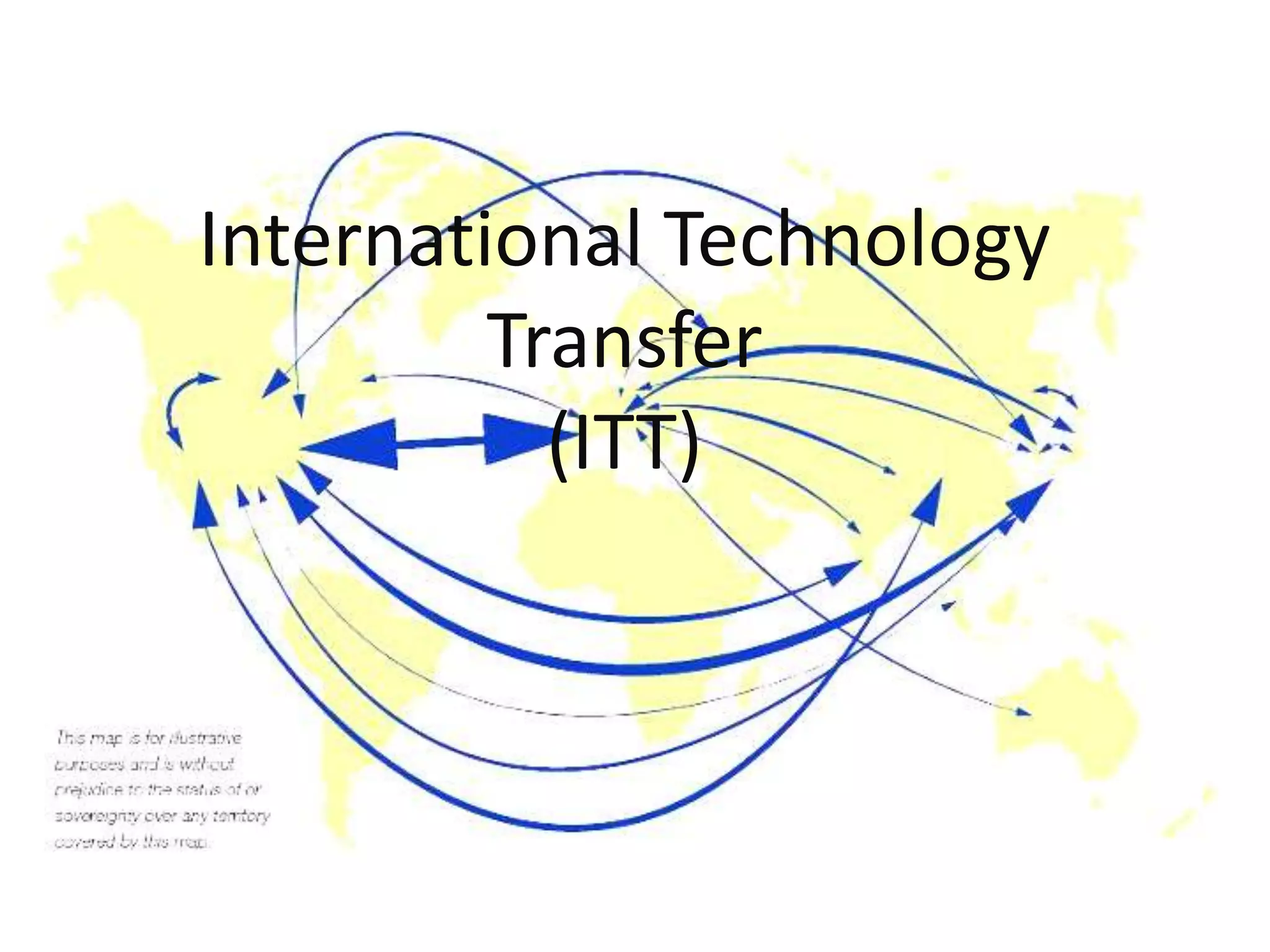
International Technology
Transfer
(ITT)
“New technologies from universities and
research institutions to parties capable of
commercialization”
Or in the sense of “Transfer of technologies across
international borders, generally from developed to
developing countries”.
• skills, knowledge, technologies, methods of manufacturing.
Reasons for Technology Transfer:
Many reasons exist that why company would like to
transfer its technology;
1) Due to lack of manufacturing capacity: A
production of similar products are producing with
minimum quantity so they need to transfer for
larger manufacturing.
2) Due to lack of resources: Transfer of technology
because there need of such resources which are
not available to him/her.
3) Due to lack of marketing distribution and distribution
capability: May have fully developed technology and
even has approvals for launching the products but it
may not have marketing and distribution channels so,
must collaborate with another organization to that has
capability.
4) Forming alliances with partners: that leads technology
to take it to market. It forms marketing and distribution
with partners and increases distribution capability.
5) Exploitation in field of transferring technology:
If the inventing organization is a government laboratory, that
laboratory is forbidden in general by law or policy (in the
United States) from competing with the private sector by
selling products or processes. Therefore, the technology
can only be brought to market by a private firm.
Licensing and Franchising
Franchising: is the practice of the right to use a firm's
successful business model and brand for a
prescribed period of time.
Is a huge business worldwide.
However, to be in a position to franchise your
business, product or service, you must be
successful.
Franchising and Licensing
Types of franchising:
1) Distribution franchise: Product distribution franchises simply sell
the franchisor’s products and are supplier-dealer relationships.
2) Manufacturing franchise: A franchiser grants a manufacturer the
right to produce and sell goods using its name and trademark.
3) Service franchise: That serves customer services, it means giving
the ownership of similar product for only Customer satisfaction.
4) Business format franchise: not only use a franchisor’s product,
service and trademark, but also the complete method to conduct
the business itself, such as the marketing plan and operations
manuals.
Franchising and Licensing
Licensing: Licensing simply means give
Permission for a business entity.
A license may be granted by a party ("licensor")
to another party ("licensee") as an element of
an agreement between those parties. A
shorthand definition of a license is "an
authorization (by the licensor) to use the
licensed material (by the licensee)."
Franchising and Licensing
Licensing steps:
1) Identify and define technology:
2) Evaluate potential:
3) Negotiate the agreement:
4) Transfer the technology:
5) Monitor the license:
6) Terminate the deal:
Legal aspects of Franchising
A franchise is a particular form of licensing
agreement indicating an agreement between the
franchiser and franchisee.
Franchiser provides certain legal aspects relating
franchising;
Copyrights - original works of authorship fixed in any
tangible expression form
Patents - inventions
Trademarks - words, names or symbols identifying
goods made or sold, distinguishing them from
others…
Patent Violations
Patent: No one allowed for violating the rights of
inventor by making same product by other
company.
Patent infringement may vary by jurisdiction
(Court of law).
(Patent infringement is a very large and
complicated topic).
Patent Violations
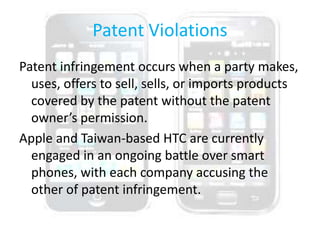
Patent infringement occurs when a party makes,
uses, offers to sell, sells, or imports products
covered by the patent without the patent
owner’s permission.
Apple and Taiwan-based HTC are currently
engaged in an ongoing battle over smart
phones, with each company accusing the
other of patent infringement.
What will happen if someone sues me
for patent infringement?
A patent owner can sue you in federal court for
patent infringement.
If the patent owner is able to prove
infringement, the court may order you to pay
monetary damages and/or stop infringing one
or more patent claims.
Protection of Trademark
A trademark, trade mark, or trade-mark is a
recognizable sign, design or expression which
identifies products or services of a particular
source from those of others
Also, they can assure them about the quality of
the products and therefore, play an important
role in the market place.
Trademarks are registered in Developed
countries where they serve its Right.
Protection of Trademark
Protection of well-known marks;
Many countries protect unregistered well-
known marks in accordance with their
international obligations under the Agreement
on Trade-Related Aspects of Intellectual
Property Rights (the TRIPS Agreement).
Protection of Trademark
How to protect trademark?
you need both a good offense and a good defense.
The offense starts with choosing the business name, slogan, or
logo that you want to, and will be able to, protect (Hard for
competitors to steal).
The defense comes once you have begun using your
trademark—and involves three strategies:
• Using your mark correctly
• Monitoring for potential infringements, and
• Cracking down on those who trespass on your trademark turf.
Well! Nothing is free, for protection you will have to pay your tax
in shape of insurance. 
International Agreements Concerning
Intellectual Property
There are few agreements which are
internationally performed as follows;
The Agreement of Trade Related Aspects of
Intellectual Property (TRIPS) is an
international agreement administered by
World Trade Organization (WTO) that sets
down minimum standards for many forms of
intellectual property regulation as applied to
nationals of other WTO members.
International Agreements Concerning
Intellectual Property
International intellectual property law is governed by multilateral
agreements;
1) Paris convention
2) Madrid agreement concerning the international registration of
trademark
3) Madrid protocol
4) World trade Organization Agreement Trade-Related aspects of
Intellectual Property (1995) and this agreement replaced General
Agreement of Tariff and Trade (GATT) (1947-1994)
&
5) World Intellectual Property Organization resolves International
intellectual property disputes.
All these Agreements are followed by 158 Countries.
International Technology Transfer (ITT)

International Technology Transfer (ITT)

  • 1.
  • 2.
    “New technologies fromuniversities and research institutions to parties capable of commercialization” Or in the sense of “Transfer of technologies across international borders, generally from developed to developing countries”. • skills, knowledge, technologies, methods of manufacturing.
  • 3.
    Reasons for TechnologyTransfer: Many reasons exist that why company would like to transfer its technology; 1) Due to lack of manufacturing capacity: A production of similar products are producing with minimum quantity so they need to transfer for larger manufacturing. 2) Due to lack of resources: Transfer of technology because there need of such resources which are not available to him/her.
  • 4.
    3) Due tolack of marketing distribution and distribution capability: May have fully developed technology and even has approvals for launching the products but it may not have marketing and distribution channels so, must collaborate with another organization to that has capability. 4) Forming alliances with partners: that leads technology to take it to market. It forms marketing and distribution with partners and increases distribution capability. 5) Exploitation in field of transferring technology: If the inventing organization is a government laboratory, that laboratory is forbidden in general by law or policy (in the United States) from competing with the private sector by selling products or processes. Therefore, the technology can only be brought to market by a private firm.
  • 5.
    Licensing and Franchising Franchising:is the practice of the right to use a firm's successful business model and brand for a prescribed period of time. Is a huge business worldwide. However, to be in a position to franchise your business, product or service, you must be successful.
  • 6.
    Franchising and Licensing Typesof franchising: 1) Distribution franchise: Product distribution franchises simply sell the franchisor’s products and are supplier-dealer relationships. 2) Manufacturing franchise: A franchiser grants a manufacturer the right to produce and sell goods using its name and trademark. 3) Service franchise: That serves customer services, it means giving the ownership of similar product for only Customer satisfaction. 4) Business format franchise: not only use a franchisor’s product, service and trademark, but also the complete method to conduct the business itself, such as the marketing plan and operations manuals.
  • 7.
    Franchising and Licensing Licensing:Licensing simply means give Permission for a business entity. A license may be granted by a party ("licensor") to another party ("licensee") as an element of an agreement between those parties. A shorthand definition of a license is "an authorization (by the licensor) to use the licensed material (by the licensee)."
  • 8.
    Franchising and Licensing Licensingsteps: 1) Identify and define technology: 2) Evaluate potential: 3) Negotiate the agreement: 4) Transfer the technology: 5) Monitor the license: 6) Terminate the deal:
  • 9.
    Legal aspects ofFranchising A franchise is a particular form of licensing agreement indicating an agreement between the franchiser and franchisee. Franchiser provides certain legal aspects relating franchising; Copyrights - original works of authorship fixed in any tangible expression form Patents - inventions Trademarks - words, names or symbols identifying goods made or sold, distinguishing them from others…
  • 10.
    Patent Violations Patent: Noone allowed for violating the rights of inventor by making same product by other company. Patent infringement may vary by jurisdiction (Court of law). (Patent infringement is a very large and complicated topic).
  • 11.
    Patent Violations Patent infringementoccurs when a party makes, uses, offers to sell, sells, or imports products covered by the patent without the patent owner’s permission. Apple and Taiwan-based HTC are currently engaged in an ongoing battle over smart phones, with each company accusing the other of patent infringement.
  • 12.
    What will happenif someone sues me for patent infringement? A patent owner can sue you in federal court for patent infringement. If the patent owner is able to prove infringement, the court may order you to pay monetary damages and/or stop infringing one or more patent claims.
  • 13.
    Protection of Trademark Atrademark, trade mark, or trade-mark is a recognizable sign, design or expression which identifies products or services of a particular source from those of others Also, they can assure them about the quality of the products and therefore, play an important role in the market place. Trademarks are registered in Developed countries where they serve its Right.
  • 14.
    Protection of Trademark Protectionof well-known marks; Many countries protect unregistered well- known marks in accordance with their international obligations under the Agreement on Trade-Related Aspects of Intellectual Property Rights (the TRIPS Agreement).
  • 15.
    Protection of Trademark Howto protect trademark? you need both a good offense and a good defense. The offense starts with choosing the business name, slogan, or logo that you want to, and will be able to, protect (Hard for competitors to steal). The defense comes once you have begun using your trademark—and involves three strategies: • Using your mark correctly • Monitoring for potential infringements, and • Cracking down on those who trespass on your trademark turf. Well! Nothing is free, for protection you will have to pay your tax in shape of insurance. 
  • 16.
    International Agreements Concerning IntellectualProperty There are few agreements which are internationally performed as follows; The Agreement of Trade Related Aspects of Intellectual Property (TRIPS) is an international agreement administered by World Trade Organization (WTO) that sets down minimum standards for many forms of intellectual property regulation as applied to nationals of other WTO members.
  • 17.
    International Agreements Concerning IntellectualProperty International intellectual property law is governed by multilateral agreements; 1) Paris convention 2) Madrid agreement concerning the international registration of trademark 3) Madrid protocol 4) World trade Organization Agreement Trade-Related aspects of Intellectual Property (1995) and this agreement replaced General Agreement of Tariff and Trade (GATT) (1947-1994) & 5) World Intellectual Property Organization resolves International intellectual property disputes. All these Agreements are followed by 158 Countries.