
Profiting from
Technological Innovation
Jalal Khan
Email: mailtojalal786@gmail.com
David J. Teece
June, 1986
Q.1 Overall Idea of the Research
Article?
• Innovating companies aren’t always the profit reapers
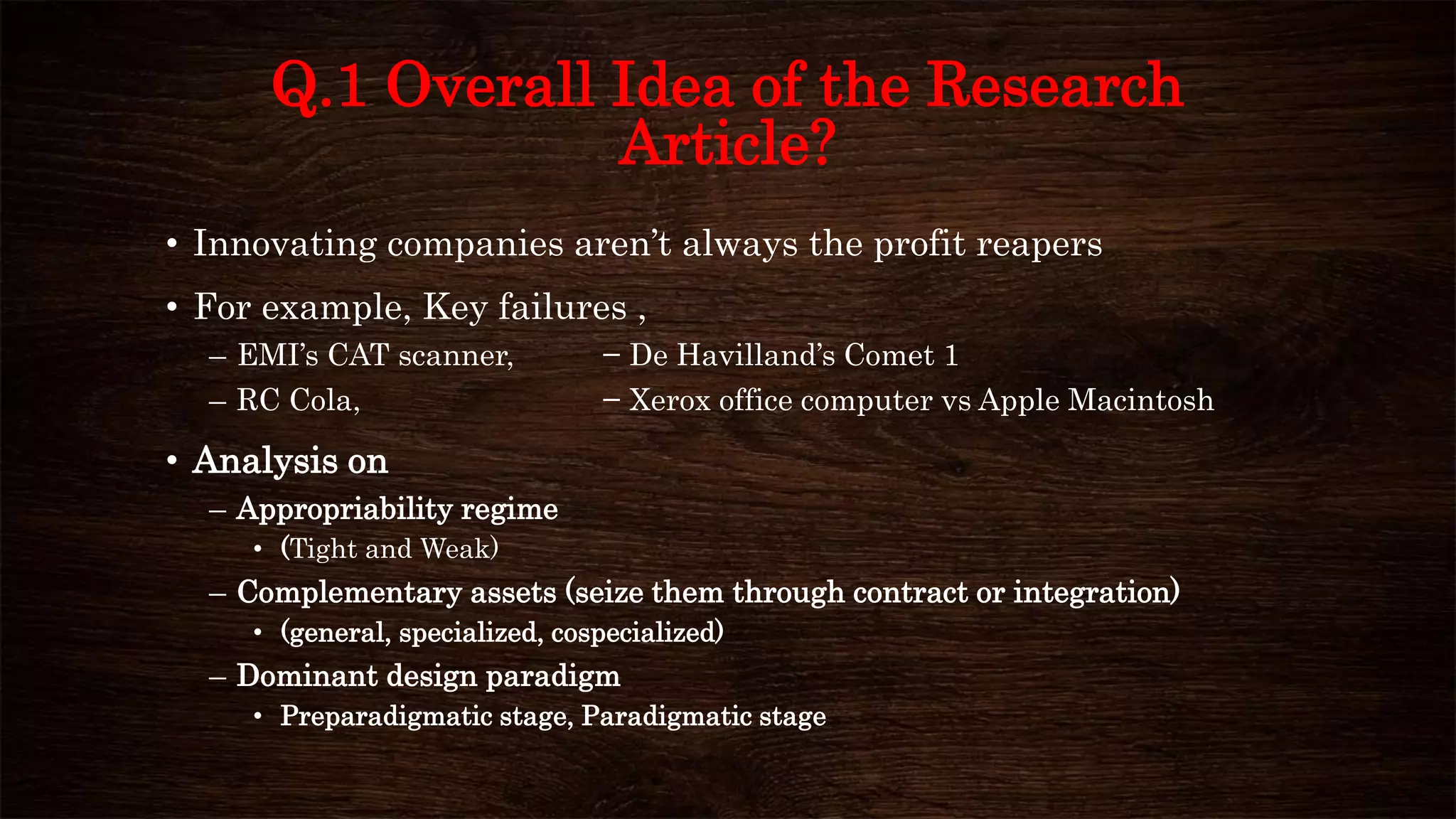
• For example, Key failures ,
– EMI’s CAT scanner, − De Havilland’s Comet 1
– RC Cola, − Xerox office computer vs Apple Macintosh
• Analysis on
– Appropriability regime
• (Tight and Weak)
– Complementary assets (seize them through contract or integration)
• (general, specialized, cospecialized)
– Dominant design paradigm
• Preparadigmatic stage, Paradigmatic stage
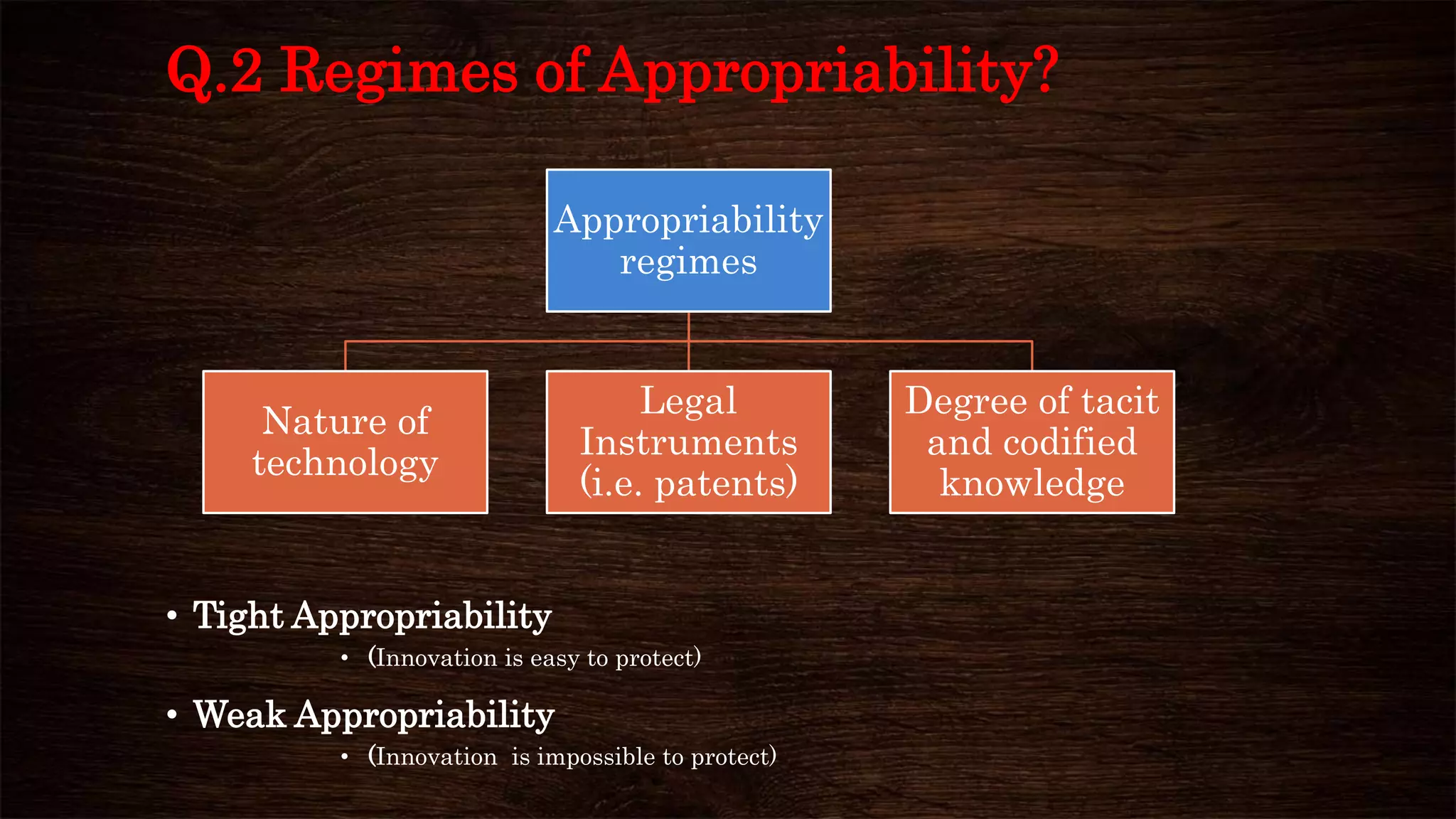
Q.2 Regimes of Appropriability?
• Tight Appropriability
• (Innovation is easy to protect)
• Weak Appropriability
• (Innovation is impossible to protect)
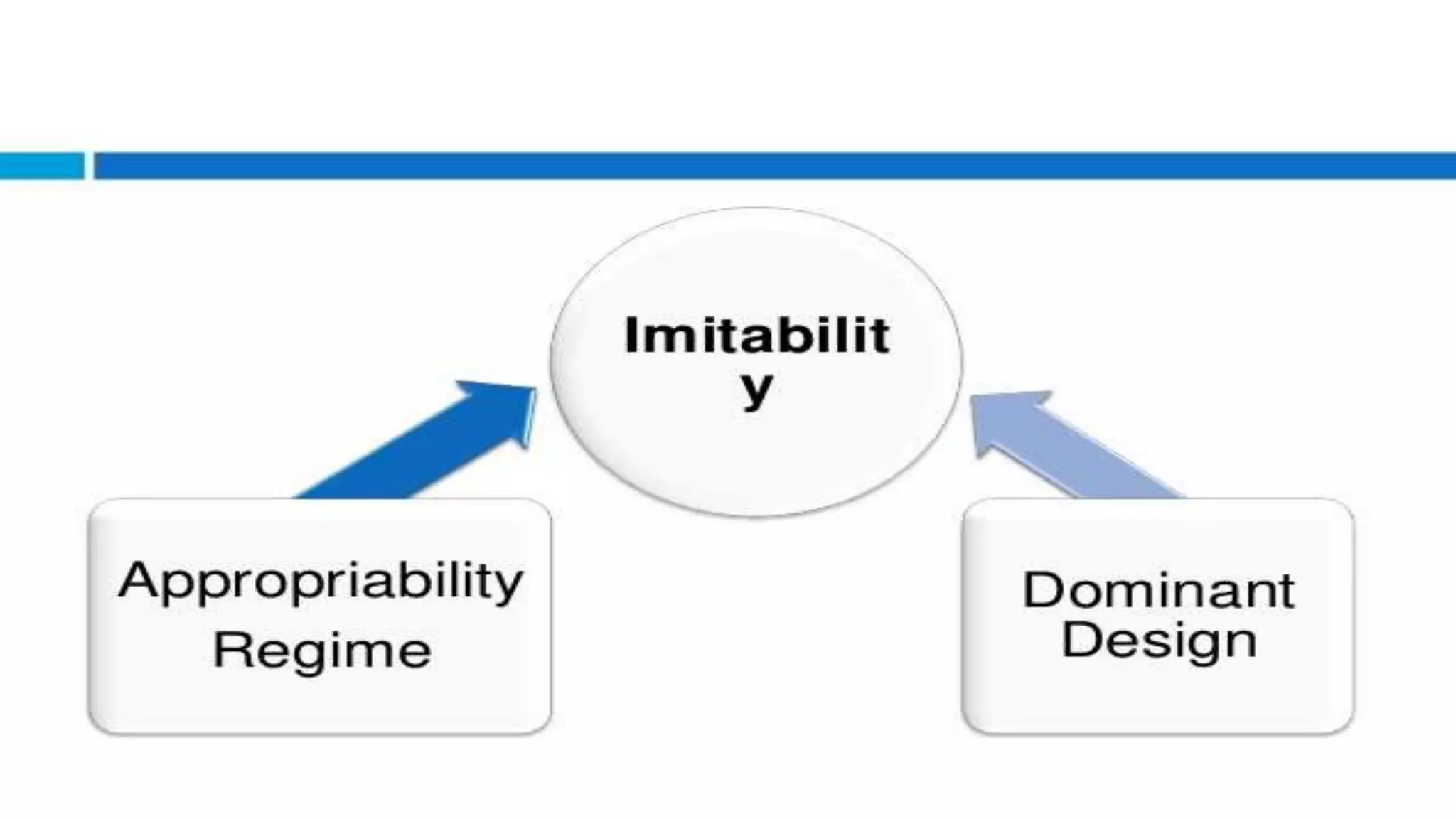
Appropriability
regimes
Nature of
technology
Legal
Instruments
(i.e. patents)
Degree of tacit
and codified
knowledge
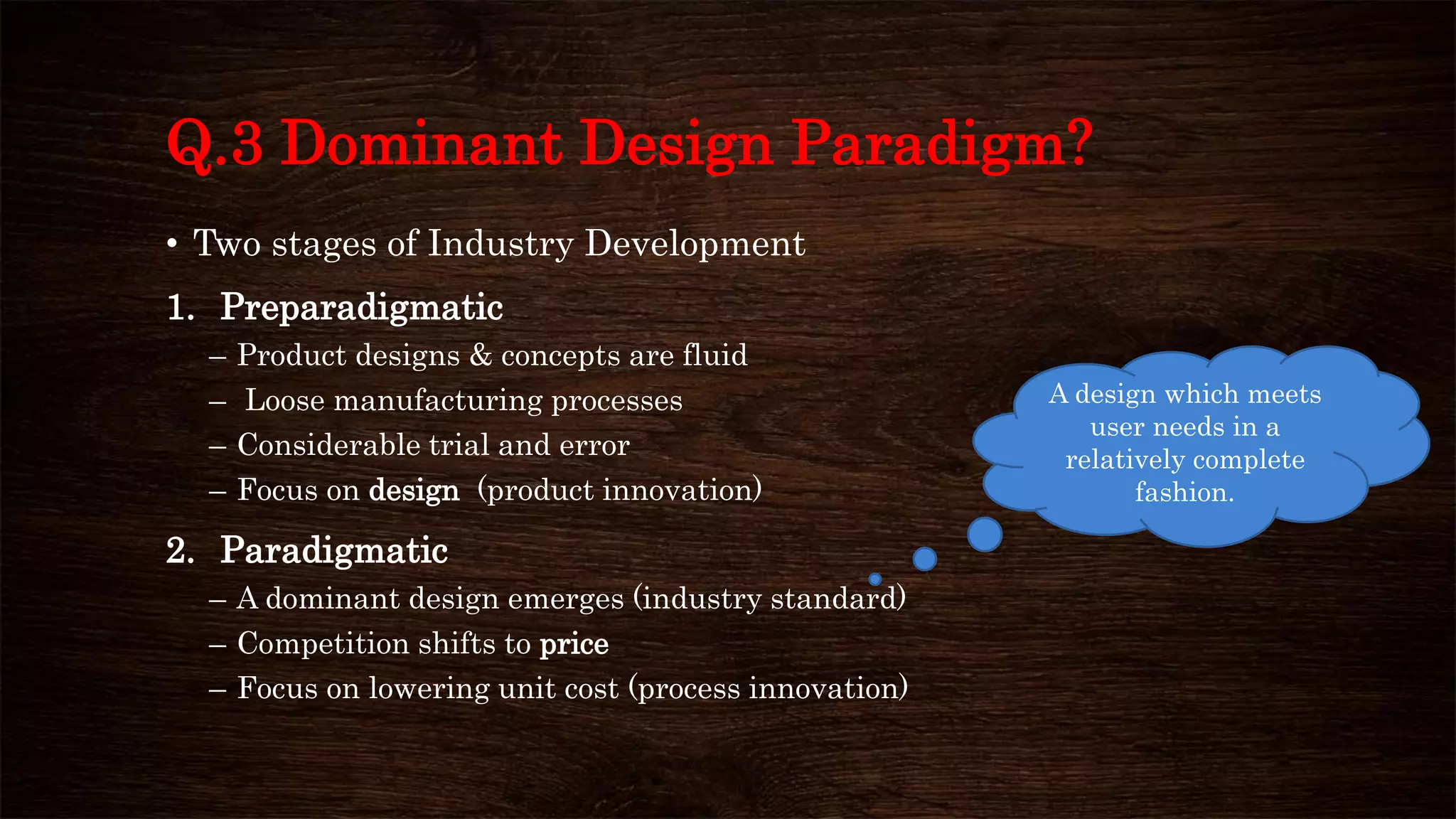
Q.3 Dominant Design Paradigm?
• Two stages of Industry Development
1. Preparadigmatic
– Product designs & concepts are fluid
– Loose manufacturing processes
– Considerable trial and error
– Focus on design (product innovation)
2. Paradigmatic
– A dominant design emerges (industry standard)
– Competition shifts to price
– Focus on lowering unit cost (process innovation)
A design which meets
user needs in a
relatively complete
fashion.
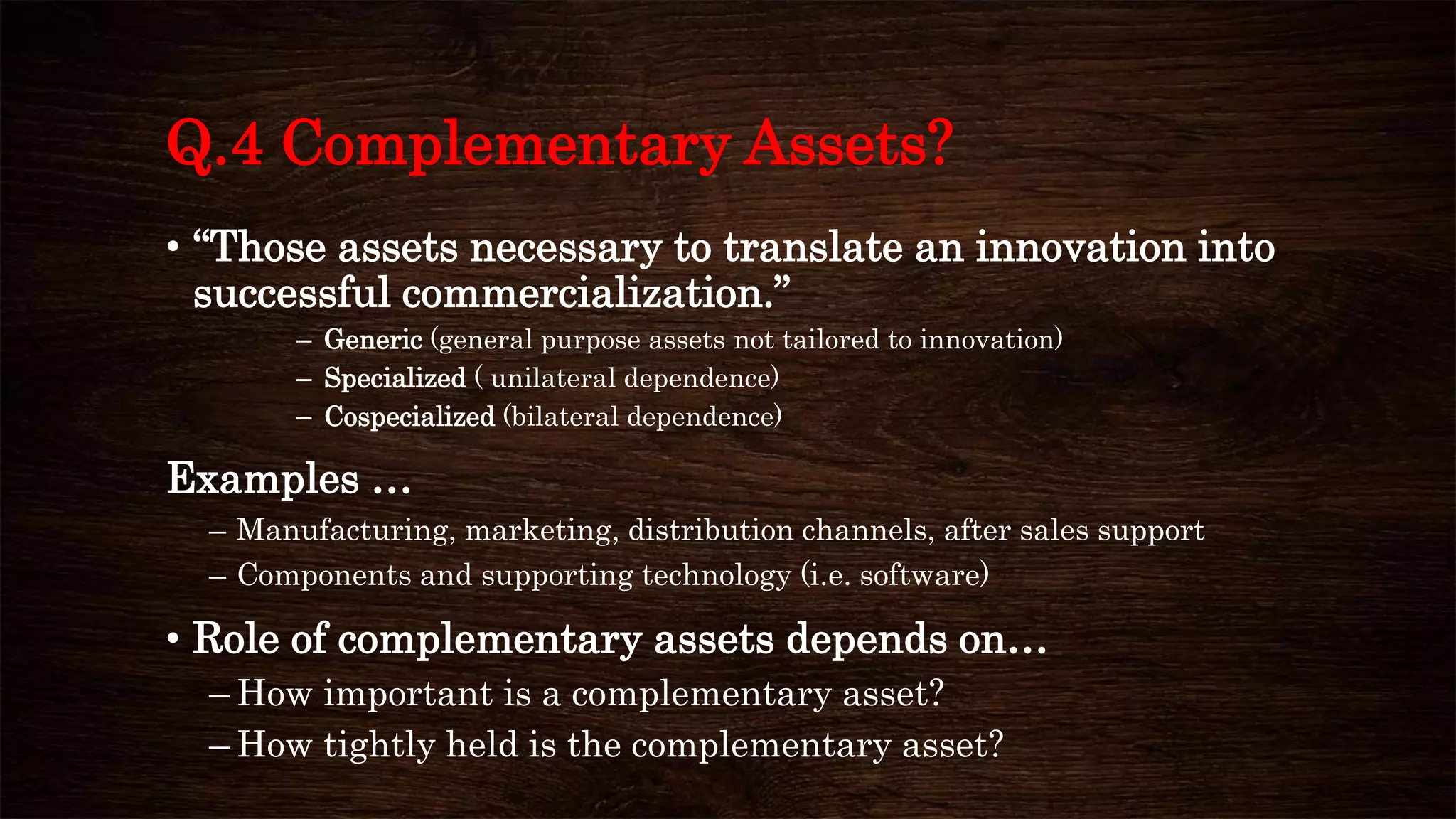
Q.4 Complementary Assets?
• “Those assets necessary to translate an innovation into
successful commercialization.”
– Generic (general purpose assets not tailored to innovation)
– Specialized ( unilateral dependence)
– Cospecialized (bilateral dependence)
Examples …
– Manufacturing, marketing, distribution channels, after sales support
– Components and supporting technology (i.e. software)
• Role of complementary assets depends on…
– How important is a complementary asset?
– How tightly held is the complementary asset?
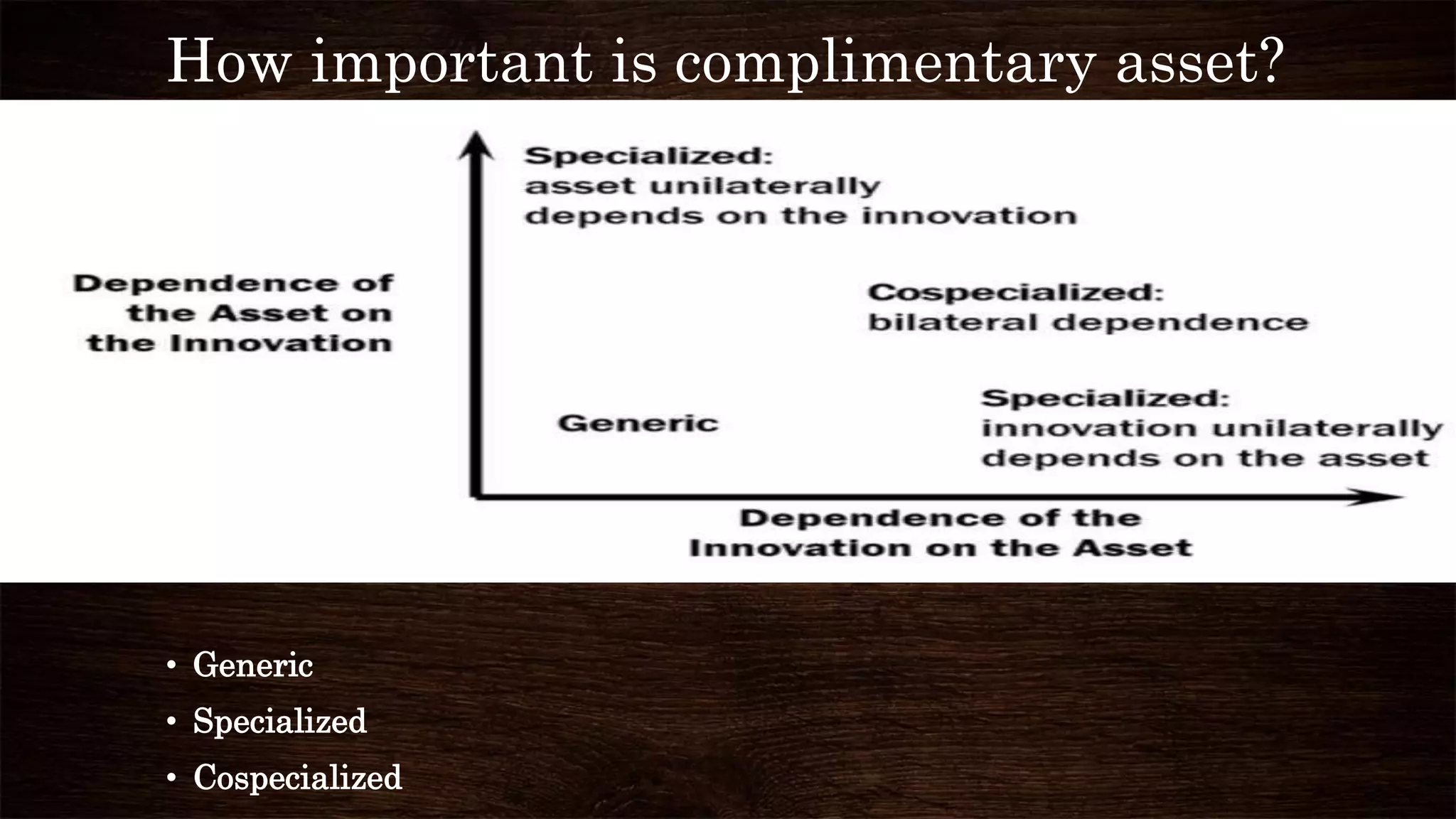
How important is complimentary asset?
• Generic
• Specialized
• Cospecialized
How tightly held is complimentary
asset?
• Tightly held
–Asset is rare (not widely possessed)
–Asset is hard to imitate or substitute
• Freely available
–Available with many
–Easy to build or develop
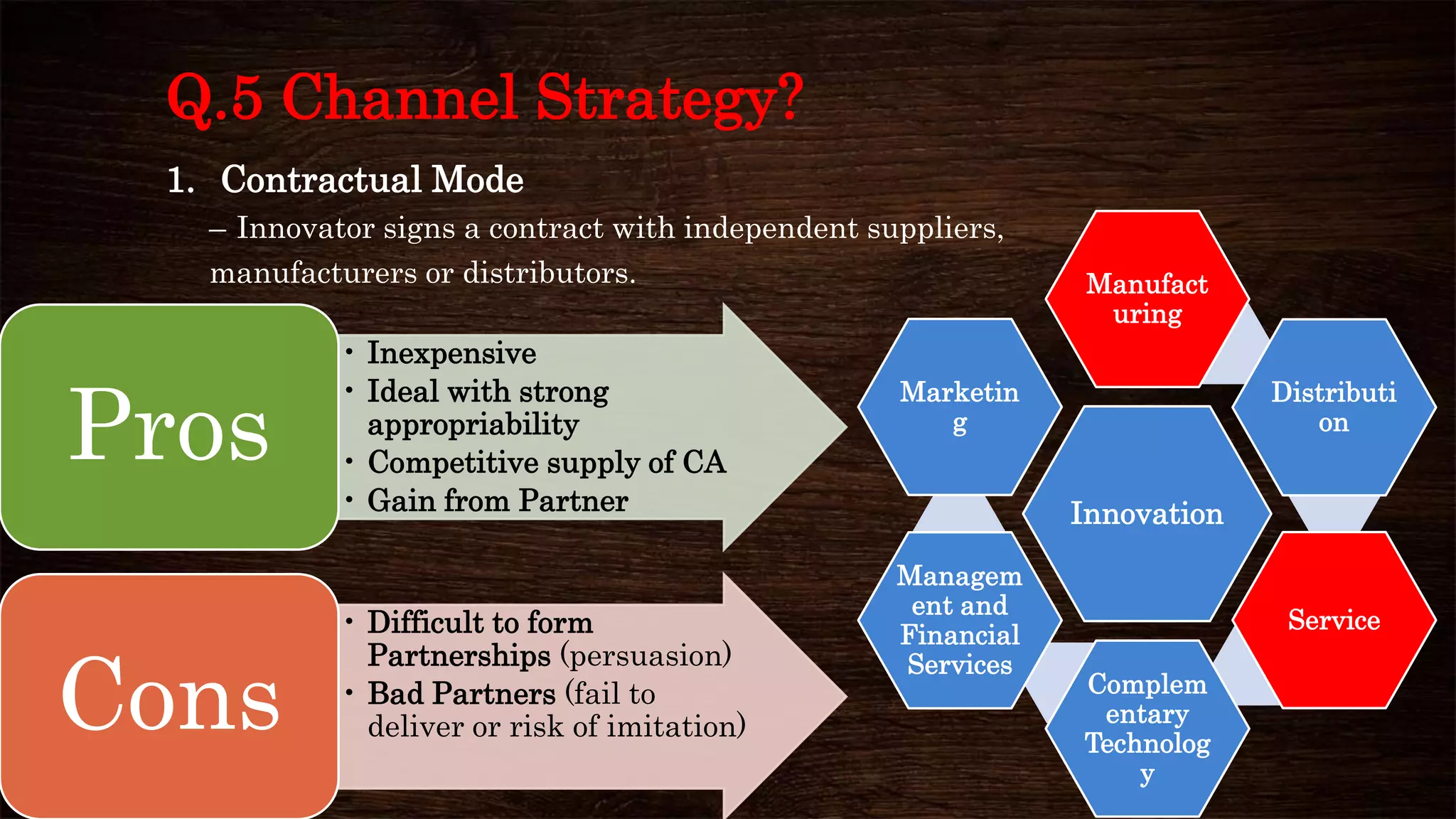
Q.5 Channel Strategy?
Innovation
Manufact
uring
Distributi
on
Service
Complem
entary
Technolog
y
Managem
ent and
Financial
Services
Marketin
g
1. Contractual Mode
– Innovator signs a contract with independent suppliers,
manufacturers or distributors.
• Inexpensive
• Ideal with strong
appropriability
• Competitive supply of CA
• Gain from Partner
Pros
• Difficult to form
Partnerships (persuasion)
• Bad Partners (fail to
deliver or risk of imitation)Cons
Continue…
Innovation
Manufact
uring
Distributi
on
Service
Complem
entary
Technolog
y
Managem
ent and
Financial
Services
Marketin
g
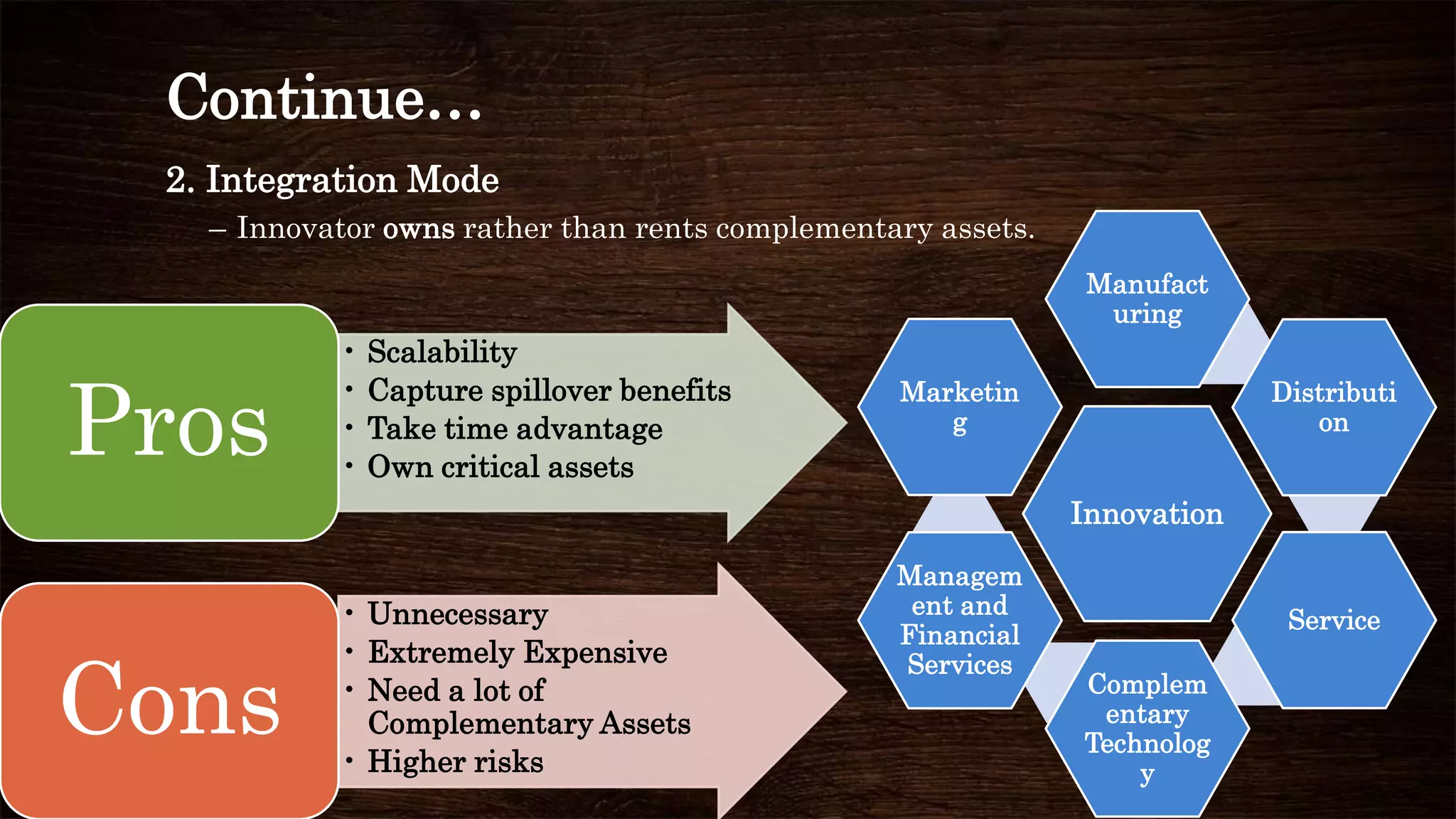
2. Integration Mode
– Innovator owns rather than rents complementary assets.
• Scalability
• Capture spillover benefits
• Take time advantage
• Own critical assets
Pros
• Unnecessary
• Extremely Expensive
• Need a lot of
Complementary Assets
• Higher risks
Cons
Continue…
Innovation
Manufact
uring
Distributi
on
Service
Complem
entary
Technolog
y
Managem
ent and
Financial
Services
Marketin
g
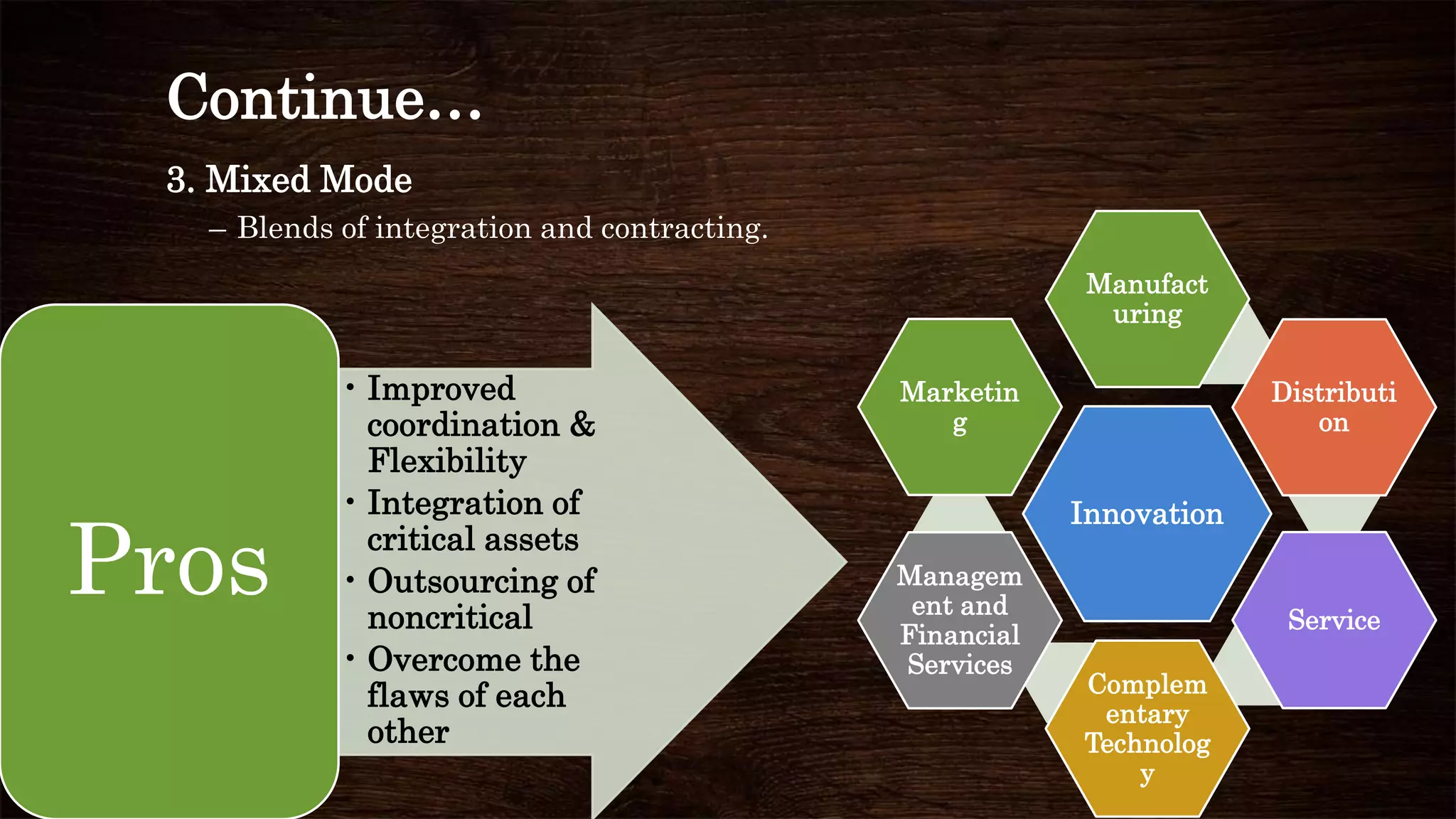
3. Mixed Mode
– Blends of integration and contracting.
• Improved
coordination &
Flexibility
• Integration of
critical assets
• Outsourcing of
noncritical
• Overcome the
flaws of each
other
Pros
Q.6 Main Conclusion of Research Article?
• Not all inventions make it to market successfully
• Imitators can outperform innovators
• Focus not only on R&D, but also complementary assets
• Complementary assets will reign supreme in the end
not only innovation (e.g. US)
• Be careful with strategic partnering decisions
(integration, contracting, mixed strategies)
Thank You
Thank
you

Profiting from technological innovation ppt

  • 1.
    Profiting from Technological Innovation JalalKhan Email: mailtojalal786@gmail.com David J. Teece June, 1986
  • 2.
    Q.1 Overall Ideaof the Research Article? • Innovating companies aren’t always the profit reapers • For example, Key failures , – EMI’s CAT scanner, − De Havilland’s Comet 1 – RC Cola, − Xerox office computer vs Apple Macintosh • Analysis on – Appropriability regime • (Tight and Weak) – Complementary assets (seize them through contract or integration) • (general, specialized, cospecialized) – Dominant design paradigm • Preparadigmatic stage, Paradigmatic stage
  • 4.
    Q.2 Regimes ofAppropriability? • Tight Appropriability • (Innovation is easy to protect) • Weak Appropriability • (Innovation is impossible to protect) Appropriability regimes Nature of technology Legal Instruments (i.e. patents) Degree of tacit and codified knowledge
  • 5.
    Q.3 Dominant DesignParadigm? • Two stages of Industry Development 1. Preparadigmatic – Product designs & concepts are fluid – Loose manufacturing processes – Considerable trial and error – Focus on design (product innovation) 2. Paradigmatic – A dominant design emerges (industry standard) – Competition shifts to price – Focus on lowering unit cost (process innovation) A design which meets user needs in a relatively complete fashion.
  • 7.
    Q.4 Complementary Assets? •“Those assets necessary to translate an innovation into successful commercialization.” – Generic (general purpose assets not tailored to innovation) – Specialized ( unilateral dependence) – Cospecialized (bilateral dependence) Examples … – Manufacturing, marketing, distribution channels, after sales support – Components and supporting technology (i.e. software) • Role of complementary assets depends on… – How important is a complementary asset? – How tightly held is the complementary asset?
  • 8.
    How important iscomplimentary asset? • Generic • Specialized • Cospecialized
  • 9.
    How tightly heldis complimentary asset? • Tightly held –Asset is rare (not widely possessed) –Asset is hard to imitate or substitute • Freely available –Available with many –Easy to build or develop
  • 10.
    Q.5 Channel Strategy? Innovation Manufact uring Distributi on Service Complem entary Technolog y Managem entand Financial Services Marketin g 1. Contractual Mode – Innovator signs a contract with independent suppliers, manufacturers or distributors. • Inexpensive • Ideal with strong appropriability • Competitive supply of CA • Gain from Partner Pros • Difficult to form Partnerships (persuasion) • Bad Partners (fail to deliver or risk of imitation)Cons
  • 11.
    Continue… Innovation Manufact uring Distributi on Service Complem entary Technolog y Managem ent and Financial Services Marketin g 2. IntegrationMode – Innovator owns rather than rents complementary assets. • Scalability • Capture spillover benefits • Take time advantage • Own critical assets Pros • Unnecessary • Extremely Expensive • Need a lot of Complementary Assets • Higher risks Cons
  • 12.
    Continue… Innovation Manufact uring Distributi on Service Complem entary Technolog y Managem ent and Financial Services Marketin g 3. MixedMode – Blends of integration and contracting. • Improved coordination & Flexibility • Integration of critical assets • Outsourcing of noncritical • Overcome the flaws of each other Pros
  • 13.
    Q.6 Main Conclusionof Research Article? • Not all inventions make it to market successfully • Imitators can outperform innovators • Focus not only on R&D, but also complementary assets • Complementary assets will reign supreme in the end not only innovation (e.g. US) • Be careful with strategic partnering decisions (integration, contracting, mixed strategies)
  • 14.

Editor's Notes

  • #2 How to design your business strategy so that you can profit from your innovation. Joint Ventures Coproduction Agreements Cross distribution Arrangements Technology Licensing
  • #3 Innovators, are those firms which are first to commercialize a new product or process in the market. Being First = Strategic Advantage Mistaken Illusion, “developing new products which meet customer needs will ensure fabulous success for product nor for innovator.” EMI Electrical Musical Industries Ltd High Resolution TVs in 1930s. UK’s first solid state computer in 1952 First to introduce EMI CAT (computerized axial tomograph) Scanner 1970s. When introduced into US market, within 6 years lost market leadership, in 8th year went out of CT scanner business GE/Technicare
  • #5 Appropriability Regimes: It refers to the environmental factors that govern an innovator’s ability to capture the profits of an innovation. Legal Instruments: Proving infringements costs are very high. Little legal protection (weak IP Protection) Prone to failure Countries have no system/mechanism as such Tacit Knowledge: (Informal Knowledge) by Michael Polanyi in 1966 book, ‘The Tacit Dimension.’: Tacit knowledge is unwritten, unspoken, and hidden body of knowledge held in mind. Difficult to articulate unless you demonstrate it Less exposed to industrial espionage/insider trading Codified Knowledge: It is written, spoken body of knowledge easy to transmit, and receive. Prone to industrial espionage/insider trading
  • #6 For example: RC Cola, Boeing 707, Apple Macintosh, Model T Ford, IBM 360 etc became industry standards Note: Followers have a good chance to anoint their modified product as the industry standard in the preparadigmatic stage.
  • #8 Generic assets are general purpose assets which do not need to be tailored to the innovation in question e.g., manufacturing facilities needed to make running shoes. Specialized assets: Unilateral dependence, e.g. Wal-mart, or a new drug requires the dissemination of information over a specialized information channel. Cospecialized assets: Bilateral dependence, e.g. Rotary engine and rotary engine repair facility/ IBM PC & MS DOS
  • #9 Dependence of Innovation on the Asset: e.g. a new drug requires the dissemination of information over a specialized information channel. e.g. a new product needs Wal-Mart’s distribution channel Dependence of Asset on the Innovation: e.g. Wal-Mart requires so many products for its distribution channel and profit earning. Bilateral Dependence: e.g. Rotary engine and rotary engine repair facility/ IBM PC & MS DOS
  • #10 Tightly Held: Bargaining power of supplier 2. Freely Available: Bargaining power of innovator
  • #11 For example: Furniture Manufacturing Gain from Partner, e.g. IBM PC and Microsoft MSDOS Difficult to form partnerships (inducing), e.g. Apple persuaded Canon to participate in the development of the LaserWriter by providing subsystems from its copiers. Bad Partners (fail to deliver or risk of imitation), e.g. Business Week call them “Hollow Corporation/Virtual Corporation” =  the organization keeping its core business to itself and outsourcing the rest of the processes. 
  • #12 For example: Furniture Manufacturing Scalability: the capacity to be changed in size or scale. Need a lot of complementary assets: To produce a personal computer, for instance, a company needs access to expertise in semiconductor technology, display technology, disk drive technology, networking technology, keyboard technology, and several others. No company can keep pace in all of these areas by itself.
  • #13 For example: EMI CAT Scanner could be a success if they had formed a partnership with SIEMENS to access the requisite capabilities. (strategic error/low IP Protection) GE and Technicare snatched it from EMI.