By: ASaminew H.( BSc, MSc in EMCCN)
First aid & accident prevention
For-4th Year pharmacy-students
2/18/2024
first aid.
1
2
Outlines
 Principles of first aid and accident prevention
 Cardio-Respiratory Emergencies and BLS
 Specific injuries
 Bone and joint injuries
 Shock and sudden illness
 Burn
 Lifting and moving emergency patients.
 Disaster prevention and mgt
2
3
CASE
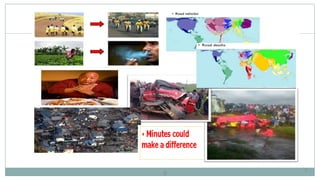
Just imagine:
 A co-worker is hurt in an accident and blood is gushing from the wound.
 One of your friends chokes on a piece of food and can’t breathe.
 Someone goes into cardiac arrest right at his workstation.
 Any one of these things is possible, and it could happen any time. A few
critical minutes one way or the other could make the difference between
life and death.
3
4
WHAT IS FIRST AID?
 It is a temporary and immediate care given to an
injured or suddenly ill person before the arrival of
emergency medical care
 Doesn't replace definitive care by professionals
 Only given for life-and-death situations
4
5
First Aid………….
 It can be performed by a bystander or by victim
 First aid -can brings a difference between life & death.
 A first aider – is someone with a formal training or
first people on an emergency scene
5
6
FIRST AID.
 It is immediate care a sick or injured person gets.
 In some cases, it may be the only care a person needs.
 In others, first aid is a way to prevent a person's condition from
worsening and keep them alive until paramedics arrive or they
are taken to the hospital
6
7
7
8
FIRST AID
 Bystanders : are other people who are present at the scene/incident.
 They may be with or without any formal training to provide emergency
life saving interventions.
 Call and dispatch Centre: refers to the organization responsible for
receiving emergency calls and notifying the appropriate emergency
medical service providers of such calls for help, and assigning them to
respond to such calls.
8
9
9
FIRSTAIDPOWERPOINT.ORG
The Aims of First Aid
Broadly, there are three main aims when
administering first aid:
Preserve life
Prevent worsening of the condition (if possible)
Promote recovery
For example, applying a plaster is preventing
the condition (a cut) from worsening by
stopping infection.
2/18/2024 first aid. 10
11
Preserving life
 Control of bleeding
 Treating possible cause of shock
 Maintain airway in correct position
 Perform CPR when required ( no pulse and breathing)
11
12
Preventing complication
 Dressing wound to prevent infection
 Place the casualty in comfortable position
 Provide comfort to casualty
12
13
Promote recovery
 Relief casualty from anxiety
 Encourage confidence and trust
 Attempt to relief pain and discomfort
 Protect the casualty from cold and wet
13
14
First aid principles.
 Keep victim warm &
comfortable.
 Do not touch open
wounds or burns with
fingers
 Keep NPO, for
unconscious victims
 Be calm and confident (safety first)
 Seek medical attention immediately
 Examine the victim gently and treat
the most urgent injuries 1st
 Do not move injured victim.
 Keep the victim lying down
14
15
General directions to provide first aid
Basic plan of action are:
 Assure Safety - Keep yourself & others at scene safe.
 Assess the victim - Gain access to the victim, and determine
immediate threats to life.
 Activate the EMS system/ CALL for help.
 Provide basic life support to those whose lives are threatened
 Move the victims only if necessary
 Arrange for the transfer or transport of the casualty
15
Roles and Responsibilities of a First Aider
A first aider has various roles and responsibilities. They should:
• Manage the incident and ensure the continuing safety of themselves, bystanders and the patient
• Assess victims and find out the nature & cause of their injuries
• Arrange for further medical help or other emergency services to attend
• If trained, prioritise casualties based upon medical need
• Provide appropriate first aid treatment as trained
• If able, make notes/observations of casualties
• Fill out any paperwork as required
• Provide a handover when further medical help arrives
2/18/2024
first aid. 16
Calling for Emergency Help
In many first aid situations, help from the emergency services will be
required.
Ensure you know the best emergency service number to use.
– United Kingdom: 999
– United States: 911
– European Union: 112
– ETHIOPIA 939
– JIMMA 6238
– Other countries:
https://en.wikipedia.org/wiki/List_of_emergency_telephone_nu
mbers
2/18/2024
first aid. 17
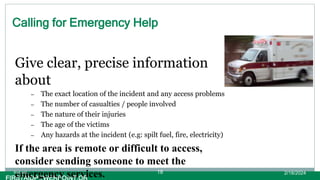
Calling for Emergency Help
Give clear, precise information
about
– The exact location of the incident and any access problems
– The number of casualties / people involved
– The nature of their injuries
– The age of the victims
– Any hazards at the incident (e.g: spilt fuel, fire, electricity)
If the area is remote or difficult to access,
consider sending someone to meet the
emergency services. 2/18/2024
first aid. 18
Incident Management
Always conduct a risk assessment before
rushing into any situation. Look for any
potential hazards to yourself, bystanders
or the patient (e.g: moving traffic, fire &
smoke, electricity). Never put yourself or
2/18/2024
first aid. 19
20
Injury prevention strategies
Strategies cover a variety of approaches, many of which
are classified as falling under the “3 E’s” of injury
prevention
“3 E’s” of injury prevention
Education,
Engineering modifications, and
Enforcement/enactment
20
21
Level of consciousness
Recognition of any change of level of consciousness is important.
Full consciousness- the casualty is able to speak and answer questions
normally
Drowsiness- the casualty is easily aroused but lapses in to unconscious
state
Stupor –the casualty can be roused with difficulty, aware of painful
stimuli. E.g. pin prick, but not of other external elements like being
spoken to.
21
22
CONT.
Coma - cannot be roused by any stimuli.
In general make full use of your senses to obtain maximum
information (Look, smell, listen and touch).
Action:-If the cause of the condition is still active, remove the cause.
E.g. -a lodging of wood on the causalities leg, contaminated clothing
or remove the causality from the cause, such as traffic, fire, water,
poisonous fumes
22
23
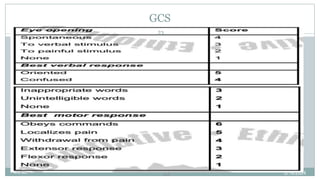
GCS
2/18/2024
first aid.
23
24
QUIZ
1. Define first aid? (2mark)
2. Describe at least three reason why first aid is given? (3mark)
3. What are the general direction to be followed while giving first aid at
least three?(3mark)
4. In the case of occurrence of an injury to a victim if the condition is still
active, remove the cause or the victim from the cause?
A/true b/false
24
25
5. In stupor, the casualty can be aroused with difficulty without aware of
painful stimuli? A/true b/false
6. The client opens his eyes when he hears the nurse walks into the room,
however is confused and disoriented when talking with the nurse. He is
unable to localize pain but withdraws from painful stimuli.
Total score________
25
26
CARDIO-PULMONARY EMERGENCIES AND BASIC LIFE
SUPPORT.
26
27
Cardio-pulmonary Emergencies and BLS
• Respiratory arrest: Respiratory arrest is a condition where the
lungs cutting off the ability to breathe(cessation of normal
breathing)
• Mostly, this occurs after cardiac arrest, b/c blood fails to reach
the lungs
27
28
Cont.
• However, can occur even when the heart is still functioning.
• This can occur due to nerve or neuromuscular disorders,
• drugs that inhibit respiratory drive (e.g., Opioids)
• crush injury to chest or cause upper or lower airway obstruction
28
29
Cardiac Arrest
 Occurs when the heart stops beating or beats too ineffectively to
circulate blood to the brain and other vital organs
 The first organ to become affected by the lack of oxygen supply
is the brain, and as a result, the patient loses consciousness.
 In cardiac arrest, the electrical impulses become abnormal and
chaotic.
 This causes the heart to lose the ability to beat rhythmically, or
to stop beating altogether
29
30
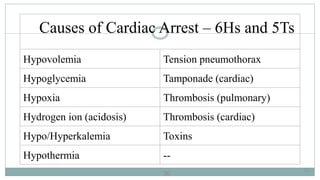
Causes of Cardiac Arrest – 6Hs and 5Ts
Hypovolemia Tension pneumothorax
Hypoglycemia Tamponade (cardiac)
Hypoxia Thrombosis (pulmonary)
Hydrogen ion (acidosis) Thrombosis (cardiac)
Hypo/Hyperkalemia Toxins
Hypothermia --
30
31
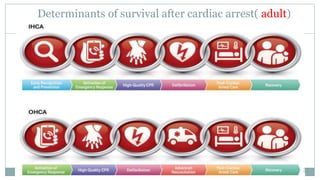
Determinants of survival after cardiac arrest( adult)
31
32
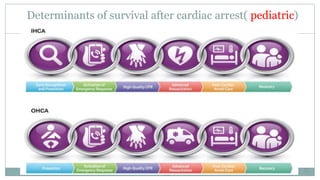
Determinants of survival after cardiac arrest( pediatric)
32
33
Management of cardiopulmonary arrest
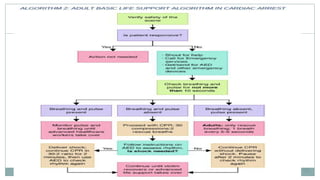
Basic Life Support /BLS
 is a sequences of procedures performed to restore the circulation
of oxygenated blood after a sudden pulmonary and/or cardiac
arrest
 Can be performed by anyone who knows how to do it, anywhere,
immediately, without any other equipment except using of
protective devices
33
34
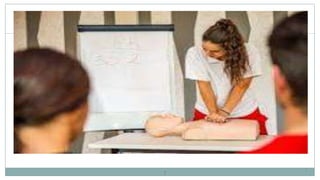
Cardio-pulmonary resuscitation /CPR
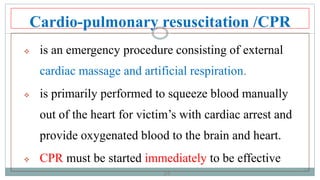
 is an emergency procedure consisting of external
cardiac massage and artificial respiration.
 is primarily performed to squeeze blood manually
out of the heart for victim’s with cardiac arrest and
provide oxygenated blood to the brain and heart.
 CPR must be started immediately to be effective
34
35
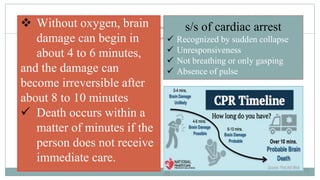
 Without oxygen, brain
damage can begin in
about 4 to 6 minutes,
and the damage can
become irreversible after
about 8 to 10 minutes
 Death occurs within a
matter of minutes if the
person does not receive
immediate care.
s/s of cardiac arrest
 Recognized by sudden collapse
 Unresponsiveness
 Not breathing or only gasping
 Absence of pulse
35
BLS Sequence
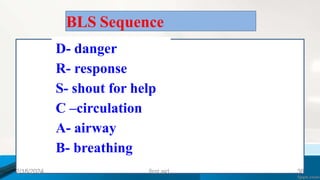
D- danger
R- response
S- shout for help
C –circulation
A- airway
B- breathing
2/18/2024 first aid. 36
BLS Sequence
D – Danger - safety first ( assess
the scene safety)
R
S
C
A
B
2/18/2024 first aid. 37
38
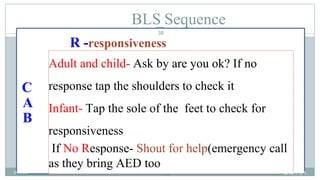
BLS Sequence
R -responsiveness
C
A
B
Adult and child- Ask by are you ok? If no
response tap the shoulders to check it
Infant- Tap the sole of the feet to check for
responsiveness
If No Response- Shout for help(emergency call
as they bring AED too
2/18/2024
first aid.
38
39
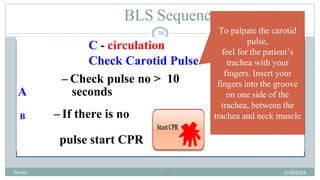
BLS Sequence
C - circulation
Check Carotid Pulse
– Check pulse no > 10
A seconds
B – If there is no
pulse start CPR
To palpate the carotid
pulse,
feel for the patient’s
trachea with your
fingers. Insert your
fingers into the groove
on one side of the
trachea, between the
trachea and neck muscle
2/18/2024
first aid.
39
40
Chest Compressions
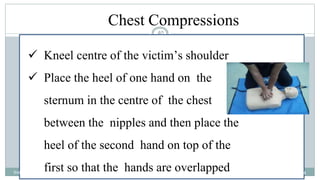
 Kneel centre of the victim’s shoulder
 Place the heel of one hand on the
sternum in the centre of the chest
between the nipples and then place the
heel of the second hand on top of the
first so that the hands are overlapped 2/18/2024
first aid.
40
41
Chest Compressions……….
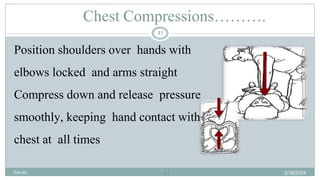
Position shoulders over hands with
elbows locked and arms straight
Compress down and release pressure
smoothly, keeping hand contact with
chest at all times
2/18/2024
first aid.
41
42
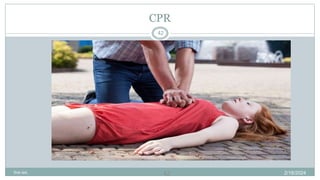
CPR
2/18/2024
first aid.
42
43
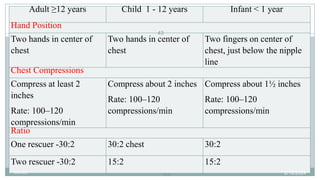
Adult ≥12 years Child 1 - 12 years Infant < 1 year
Hand Position
Two hands in center of
chest
Two hands in center of
chest
Two fingers on center of
chest, just below the nipple
line
Chest Compressions
Compress at least 2
inches
Rate: 100–120
compressions/min
Compress about 2 inches
Rate: 100–120
compressions/min
Compress about 1½ inches
Rate: 100–120
compressions/min
Ratio
One rescuer -30:2 30:2 chest 30:2
Two rescuer -30:2 15:2 15:2
2/18/2024
first aid.
43
44
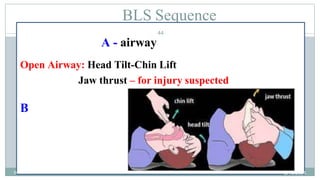
BLS Sequence
A - airway
Open Airway: Head Tilt-Chin Lift
Jaw thrust – for injury suspected
B
2/18/2024
first aid.
44
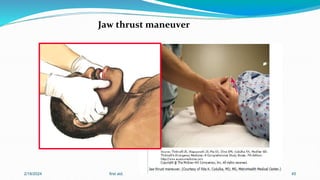
Jaw thrust maneuver
2/18/2024 first aid. 45
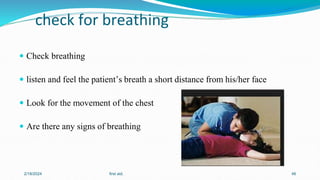
check for breathing
 Check breathing
 listen and feel the patient’s breath a short distance from his/her face
 Look for the movement of the chest
 Are there any signs of breathing
2/18/2024 first aid. 46
47
BLS Sequence
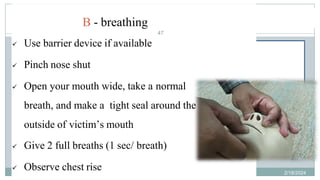
B - breathing
 Use barrier device if available
 Pinch nose shut
 Open your mouth wide, take a normal
breath, and make a tight seal around the
outside of victim’s mouth
 Give 2 full breaths (1 sec/ breath)
 Observe chest rise 2/18/2024
first aid.
47
48
BLS Sequence………
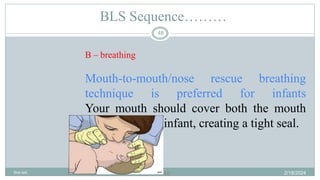
B – breathing
Mouth-to-mouth/nose rescue breathing
technique is preferred for infants
Your mouth should cover both the mouth
and nose of the infant, creating a tight seal.
2/18/2024
first aid.
48
49
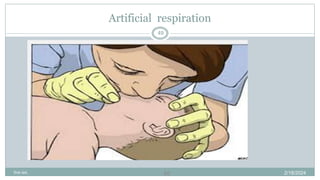
Artificial respiration
2/18/2024
first aid.
49
50
B-breathing ……..
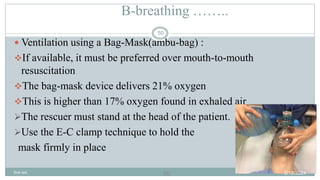
 Ventilation using a Bag-Mask(ambu-bag) :
If available, it must be preferred over mouth-to-mouth
resuscitation
The bag-mask device delivers 21% oxygen
This is higher than 17% oxygen found in exhaled air
The rescuer must stand at the head of the patient.
Use the E-C clamp technique to hold the
mask firmly in place
2/18/2024
first aid.
50
51
B-breathing ……..
The thumb and index fingers of your dominant hand form a ‘C’,
which is placed on the side of the mask, to press it into place and
create a tight seal.
The remaining three fingers form an ‘E’, which is used to lift the
chin and open up the airway
Once the mask is firmly in place, squeezed the bag over one
second, using non-dominant hand
with each squeeze, watch for the patient’s chest to rise
2/18/2024
first aid.
51
52
BLS Sequence….
Compression-only CPR:
 Outcome is better than outcome of No CPR
 Lay rescuers should do compression-only if they
are unwilling or unable to provide rescue breaths
2/18/2024
first aid.
52
53
BLS Sequence
Important Points to Remember
 Ratio - 30 compressions:2 breaths
 Rate - Approx. 100-120 compressions/min
 Depth – 2-2.4 inches for adult, 1.5 inches for infants
 1 cycle = 30 compressions and 2 breaths
 Five cycles should take no more than 2 minutes
 Reassess the victim every two minutes
2/18/2024
first aid.
53
54
High quality CPR
Compression rate of 100-120/min
Compression depth of at least 2 inches
Allow chest recoil
Minimize interruption
Avoid excessive ventilation
2/18/2024
first aid.
54
55
2/18/2024 first aid.
55
56
56
57
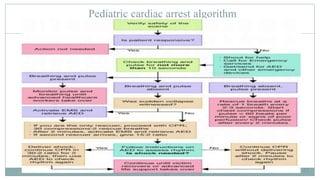
Pediatric cardiac arrest algorithm
57
58
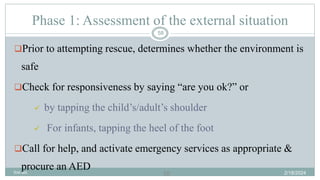
Phase 1: Assessment of the external situation
Prior to attempting rescue, determines whether the environment is
safe
Check for responsiveness by saying “are you ok?” or
 by tapping the child’s/adult’s shoulder
 For infants, tapping the heel of the foot
Call for help, and activate emergency services as appropriate &
procure an AED 2/18/2024
first aid.
58
59
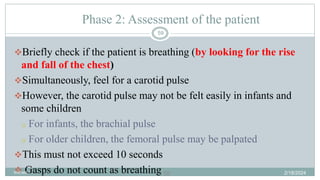
Phase 2: Assessment of the patient
Briefly check if the patient is breathing (by looking for the rise
and fall of the chest)
Simultaneously, feel for a carotid pulse
However, the carotid pulse may not be felt easily in infants and
some children
o For infants, the brachial pulse
o For older children, the femoral pulse may be palpated
This must not exceed 10 seconds
 Gasps do not count as breathing 2/18/2024
first aid.
59
60
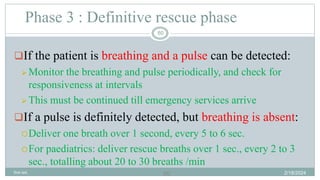
If the patient is breathing and a pulse can be detected:
 Monitor the breathing and pulse periodically, and check for
responsiveness at intervals
 This must be continued till emergency services arrive
If a pulse is definitely detected, but breathing is absent:
Deliver one breath over 1 second, every 5 to 6 sec.
For paediatrics: deliver rescue breaths over 1 sec., every 2 to 3
sec., totalling about 20 to 30 breaths /min
Phase 3 : Definitive rescue phase
2/18/2024
first aid.
60
61
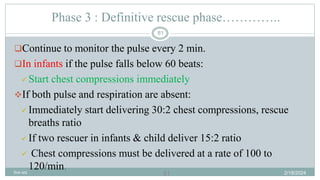
Phase 3 : Definitive rescue phase…………..
Continue to monitor the pulse every 2 min.
In infants if the pulse falls below 60 beats:
 Start chest compressions immediately
If both pulse and respiration are absent:
 Immediately start delivering 30:2 chest compressions, rescue
breaths ratio
 If two rescuer in infants & child deliver 15:2 ratio
 Chest compressions must be delivered at a rate of 100 to
120/min. 2/18/2024
first aid.
61
62
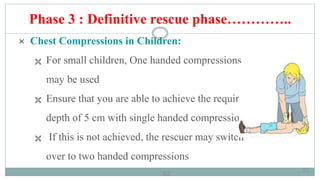
Phase 3 : Definitive rescue phase…………..
 Chest Compressions in Children:
 For small children, One handed compressions
may be used
 Ensure that you are able to achieve the required
depth of 5 cm with single handed compressions
 If this is not achieved, the rescuer may switch
over to two handed compressions
62
63
Phase 3 : Definitive rescue phase…………..
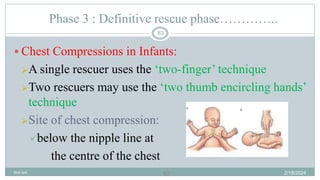
 Chest Compressions in Infants:
A single rescuer uses the ‘two-finger’ technique
Two rescuers may use the ‘two thumb encircling hands’
technique
Site of chest compression:
below the nipple line at
the centre of the chest
2/18/2024
first aid.
63
64
Phase 3 : Definitive rescue phase…………..
Once the AED is available, the second rescuer can allow the AED to
analyse the rhythm
Resume CPR immediately after shock (or after rhythm assessment if no
shock is needed)
Rescuers can switch roles while the rhythm is being analyzed
Reassess rhythm every 2 min until the patient recovers, or ALS
providers take over care of the patient
2/18/2024
first aid.
64
65
When to Stop CPR
S- Spontaneous breathing
T -Trained personnel arrived
O-Operator exhausted
P-Physician assumes responsibility
S-Scene become unsafe 2/18/2024
first aid.
65
66
Foreign body airway obstruction( choking)
 Is physical obstruction in their upper respiratory tract
 Is a serious medical emergency
 Children are more likely to swallow objects other than food, and
foreign objects such as coins or small toys
 Adoption of appropriate techniques can relieve choking in 70 to
80% of all cases.
66
67
S/S of FBAO
 Universal signal for choking:
 patient has both hands wrapped around the base of their
throat
 With complete airway obstruction, the child is unable
to speak, cry, or provide any sounds of respiration.
 The patient may be confused, weak, or cyanotic
67
68
68
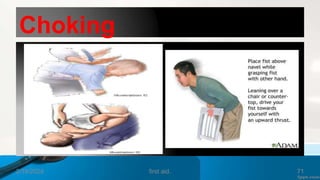
Choking
2/18/2024 first aid. 69
70
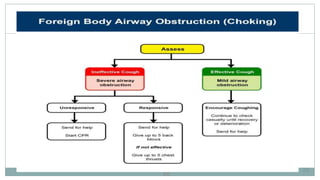
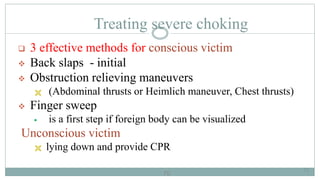
Treating severe choking
 3 effective methods for conscious victim
 Back slaps - initial
 Obstruction relieving maneuvers
 (Abdominal thrusts or Heimlich maneuver, Chest thrusts)
 Finger sweep
 is a first step if foreign body can be visualized
Unconscious victim
 lying down and provide CPR
70
Choking
Infant
2/18/2024 first aid. 71
72
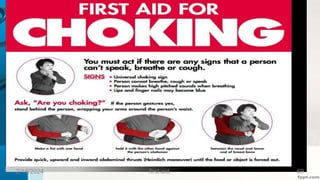
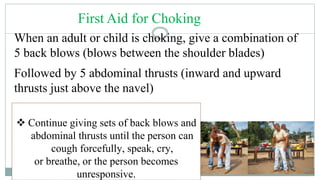
First Aid for Choking
When an adult or child is choking, give a combination of
5 back blows (blows between the shoulder blades)
Followed by 5 abdominal thrusts (inward and upward
thrusts just above the navel)
 Continue giving sets of back blows and
abdominal thrusts until the person can
cough forcefully, speak, cry,
or breathe, or the person becomes
unresponsive. 72
73
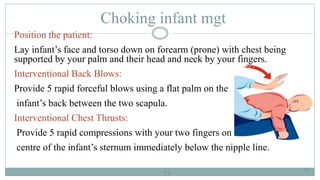
Choking infant mgt
Position the patient:
Lay infant’s face and torso down on forearm (prone) with chest being
supported by your palm and their head and neck by your fingers.
Interventional Back Blows:
Provide 5 rapid forceful blows using a flat palm on the
infant’s back between the two scapula.
Interventional Chest Thrusts:
Provide 5 rapid compressions with your two fingers on the
centre of the infant’s sternum immediately below the nipple line.
73
SUMMARY
 First aid is the immediate care given to
a person who has been injured or
suddenly taken ill.
 Advantages of first aid
 To preserve life.
 To prevent complications
 To promote healing and recovery
• Responsibility of a first –
aider(Assessment, diagnosis and
treatment process) first aid.
2/18/2024 74
summary cont..
First line treatment for life threatening
conditions involves
◦ Maintain clear air way (A)
◦ Correct the breathing (B)
◦ Control circulation (c)
 Stop bleeding
 Treat shock
◦ Check the disability (D)
◦ Expose the patient (E)
◦ Reassure the patient and make him in
conformable position
first aid.
2/18/2024 75
CHAPTER THREE
WOUNDS AND BLEEDING
first aid.
2/18/2024 76
Wound
Definition:
A wound is a break in the continuity of the tissue of the body
either internal or external
Common Causes:
Accidental falls
Handling of Sharp objects
Machinery
Weapons
first aid.
2/18/2024 77
Classifications of Wound
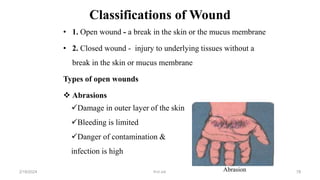
• 1. Open wound - a break in the skin or the mucus membrane
• 2. Closed wound - injury to underlying tissues without a
break in the skin or mucus membrane
Types of open wounds
 Abrasions
Damage in outer layer of the skin
Bleeding is limited
Danger of contamination &
infection is high
Abrasion
first aid.
2/18/2024 78
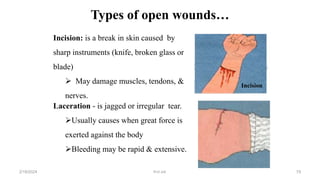
Types of open wounds…
Incision: is a break in skin caused by
sharp instruments (knife, broken glass or
blade)
 May damage muscles, tendons, &
nerves.
Laceration - is jagged or irregular tear.
Usually causes when great force is
exerted against the body
Bleeding may be rapid & extensive.
Incision
first aid.
2/18/2024 79
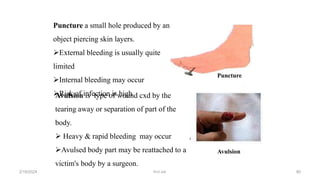
Puncture a small hole produced by an
object piercing skin layers.
External bleeding is usually quite
limited
Internal bleeding may occur
Risk of infection is high
Avulsion is type of wound cxd by the
tearing away or separation of part of the
body.
 Heavy & rapid bleeding may occur
Avulsed body part may be reattached to a
victim's body by a surgeon.
Puncture
Avulsion
first aid.
2/18/2024 80
Closed wound
 Closed wounds have fewer categories, but are just as
dangerous as open wounds. The types of closed wounds are:
• Hematomas, also called a blood tumor, caused by damage to
a blood vessel that in turn causes blood to collect under
the skin.
– Hematomas that originate from internal blood vessel
pathology are purpura petechiae, and ecchymosis. The
different classifications are based on size.
– Hematomas that originate from an external source of
trauma are contusions, also commonly called bruises.
first aid.
2/18/2024 81
Bleeding
• Bleeding: is loss of blood, usually through disease, injury, or other
physical conditions.
• Three Main Types of Bleeding
 Capillary Bleeding
– Capillaries are the smallest blood vessels in your body; they are about as
thin as the hairs on your head.
– Capillary bleeding usually occurs in superficial wounds, such
as abrasions, the bleeding is almost always very slow and small in
quantity.
– Your body's natural clotting mechanism is able to stop most cases of
capillary bleeding within seconds to minutes.
first aid.
2/18/2024 82
• Venous Bleeding
– Deep cuts have the potential to cut veins. A cut vein
typically results in a steady but relatively slow flow of
dark red blood.
– The best way to stop most cases of venous bleeding is to
put direct pressure on the wound.
• Arterial Bleeding
– This is the least common and most dangerous type of
bleeding.
– It involves bright red blood that comes out in large
volume, and in spurts that correspond with each beat of
your heart.
– In most cases of arterial bleeding, direct and extremely
firm pressure on the wound is the best way of stopping it
first aid.
2/18/2024 83
 Internal bleeding
– is bleeding inside body cavity.
– Bleeding inside body cavity may follow an injury, such as
a fracture or a penetrating wounds, but can also occur
spontaneously for example, bleeding from a stomach ulcer.
– The main risk from internal bleeding is shock. In addition,
blood can build up around organs such as the lungs or
brain and exert damaging pressure on them.
– You should suspect internal bleeding if a casualty develops
signs of shock without obvious blood loss. Check for any
bleeding from body openings (orifices) such as the ear,
mouth, urethra, or anus.
first aid.
2/18/2024 84
• How to recognize internal bleeding
– Initially, pale, cold skin. If bleeding continues, skin may
turn blue (cyanosis).
– Rapid, weak pulse
– Thirst
– Rapid , shallow breathing
– Confusion, restlessness, and irritability.
– unconsciousness
– Bleeding from body openings (orifices)
– Pain
first aid.
2/18/2024 85
First Aid Treatment for Open Wounds
• Open wounds can compromise the health of a person.
• It can lead to health problems such as infection and loss of
blood due to bleeding.
• Therefore, it is important that you are able to provide
immediate, proper first aid treatment to avoid potential health
problems.
first aid.
2/18/2024 86
. Control bleeding
– Apply direct pressure over the wound and elevate
affected part.
– Use a sterile dressing or clean sheet to cover the wound
then apply pressure. Tourniquet is not recommended for
controlling bleeding but may be used in cases of severe
bleeding.
first aid.
2/18/2024 87
Techniques to stop sever bleeding
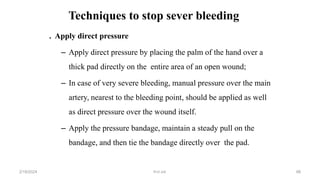
. Apply direct pressure
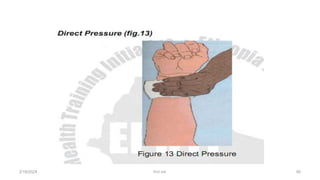
– Apply direct pressure by placing the palm of the hand over a
thick pad directly on the entire area of an open wound;
– In case of very severe bleeding, manual pressure over the main
artery, nearest to the bleeding point, should be applied as well
as direct pressure over the wound itself.
– Apply the pressure bandage, maintain a steady pull on the
bandage, and then tie the bandage directly over the pad.
first aid.
2/18/2024 88
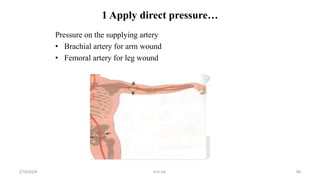
1 Apply direct pressure…
Pressure on the supplying artery
• Brachial artery for arm wound
• Femoral artery for leg wound
first aid.
2/18/2024 89
first aid.
2/18/2024 90
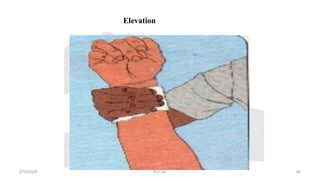
. Elevation
– Elevate the hand, neck, or leg above the victim's heart
unless there is evidence of a fracture, a severely bleeding
open wound of the hand, neck, arm or leg
– Should be elevated above the level of the victim’s heart.
– Elevation uses the force of gravity to help reduce blood
pressure in the injured area and slows down the loss of
blood through the wound, however, it should be aided by
direct pressure.
Techniques to stop sever bleeding…
first aid.
2/18/2024 91
Elevation
first aid.
2/18/2024 92
Techniques to stop sever bleeding…
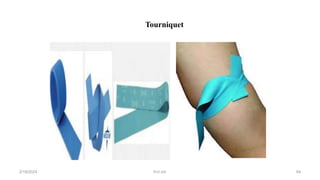
3.3. Tourniquet
– Another method of achieving constriction of the supplying
artery is the use of a tourniquet .
– a tightly tied band which goes around a limb to restrict blood
flow
– Pressure is applied circumferentially upon the skin and
underlying tissues of a limb
– Use of a tourniquet is dangerous and the tourniquet should be
used only for a severe life threatening hemorrhage that can not
be controlled by other means.
– Precaution: release the tourniquet every 15 minutes
first aid.
2/18/2024 93
Tourniquet
first aid.
2/18/2024 94
. Clotting agents
– Some protocols call for the use of clotting accelerating
agents, which can be either externally applied as a powder
or gel, or pre-dosed in a dressing or as an intravenous
injection.
– These may be particularly useful in situations where the
wound is not clotting, which can be due to external factors,
such as size of wound,
Techniques to stop sever bleeding…
first aid.
2/18/2024 95
. Cleaning an Open Wound
• Once bleeding has been controlled, the open wound should be
cleaned with mild soap and water .
• Saline solution is better for cleaning wounds and eyes.
• Cleaning an open wound can sometimes cause bleeding to
return. The bleeding will be minor and should be easily
stopped with direct pressure using a sterile - or at least clean -
dressing.
first aid.
2/18/2024 96
. Cleaning an Open …
– Wash your hands with soap & water
– Wash the wound from inside to outer side to remove
bacteria and other foreign materials .
– Rinse the wound thoroughly by flushing with clean
water
– Dry with sterile gauze/clean cloth
– Apply a dry clean dressing and secure it firmly in place.
– Inform the victim to seek health care if evidence of
infection appears
first aid.
2/18/2024 97
Prevention of contamination & infection while dealing with
the wound
• Open wounds are subject to contamination and infection.
This danger can be prevented or minimized by appropriate
first aid measures,
• Contamination is the act or process of making something
impure by touching it or by adding something to it
• Infection is introduction and proliferation of
microorganisms within the body
first aid.
2/18/2024 98
. Keep patient lying still
• Unnecessary, forceful movements can increase
blood circulation potentially restarting
bleeding
first aid.
2/18/2024 99
Chapter Four
Dressing and Bandages
first aid.
2/18/2024 100
DRESSING & BANDAGES
Definition of Dressing
– is a sterile pad applied to a wound to promote healing and/or
prevent further harm. A dressing is designed to be in direct
contact with the wound, as distinguished from a bandage,
which is most often used to hold a dressing in place.
– Sterile dressings are those which are free from germs are
preferable to use.
first aid.
2/18/2024 101
Purpose of Dressings
• To assist in the control of bleeding
• To absorb the blood & wound secretions
• To prevent contamination
• To relieve pain
first aid.
2/18/2024 102
Types of dressing
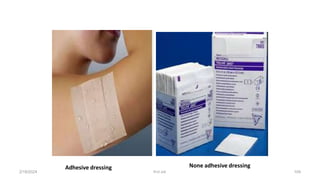
1. Adhesive dressing
– Is sticky dressing used for cover small cuts and grazes.
They consist of a gauze and an adhesive backing.
2. Non adhesive dressing
– is a type of dressing used to dress large size area wound
unlike that of adhesive dressing.
first aid.
2/18/2024 103
Adhesive dressing None adhesive dressing
first aid.
2/18/2024 104
Dressing procedure
To apply clean dressing materials at home,
Wash your hand
 Boil the dressing materials for 15 minutes
 Dry the dressing materials with out contamination
Apply the dressing
first aid.
2/18/2024 105
CONT.
• If clean dressing is available, the inner surface of a folded cloth
can be used for immediate use. Do not touch or breathe or
cough on the surface of a dressing that is to be placed next to
wound.
first aid.
2/18/2024 106
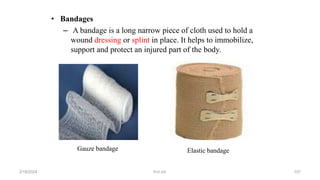
• Bandages
– A bandage is a long narrow piece of cloth used to hold a
wound dressing or splint in place. It helps to immobilize,
support and protect an injured part of the body.
Gauze bandage Elastic bandage
first aid.
2/18/2024 107
• Functions of bandages
– To assist in the control of bleeding
– To absorb blood and wound secretion
– To prevent additional contamination
– To ease pain
– Control or reduce swelling
– Lift and transport casualty
– Secure dressing and splint in position
– Assist in immobilization
first aid.
2/18/2024 108
Bandages cont…
• Kinds of Bandages
– Gauze bandages
– Elastic bandages
– Triangular bandages
– Combinations of dressing and bandages
first aid.
2/18/2024 109
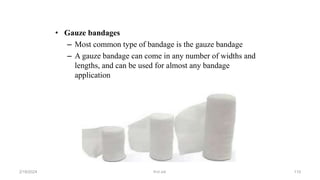
• Gauze bandages
– Most common type of bandage is the gauze bandage
– A gauze bandage can come in any number of widths and
lengths, and can be used for almost any bandage
application
first aid.
2/18/2024 110
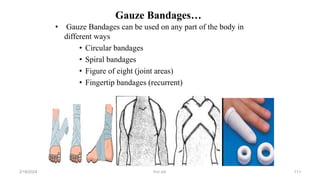
Gauze Bandages…
• Gauze Bandages can be used on any part of the body in
different ways
• Circular bandages
• Spiral bandages
• Figure of eight (joint areas)
• Fingertip bandages (recurrent)
first aid.
2/18/2024 111
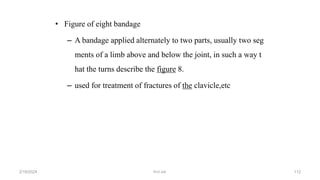
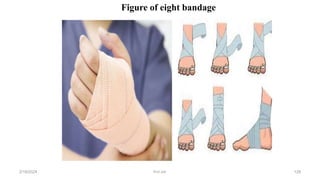
• Figure of eight bandage
– A bandage applied alternately to two parts, usually two seg
ments of a limb above and below the joint, in such a way t
hat the turns describe the figure 8.
– used for treatment of fractures of the clavicle,etc
first aid.
2/18/2024 112
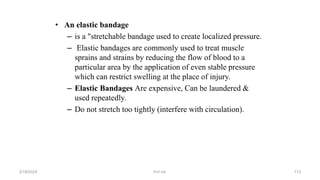
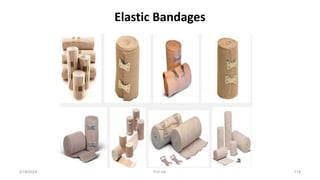
• An elastic bandage
– is a "stretchable bandage used to create localized pressure.
– Elastic bandages are commonly used to treat muscle
sprains and strains by reducing the flow of blood to a
particular area by the application of even stable pressure
which can restrict swelling at the place of injury.
– Elastic Bandages Are expensive, Can be laundered &
used repeatedly.
– Do not stretch too tightly (interfere with circulation).
first aid.
2/18/2024 113
Elastic Bandages
first aid.
2/18/2024 114
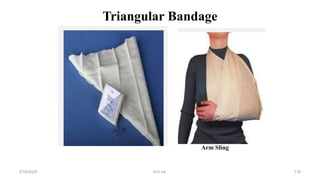
Triangular Bandage
• Is a right-angled triangle bandage
• Used as an emergency cover for large areas. Such a bandage
also is used as a sling for fracture or other injury of the arm or
hand
• It can be used to cover
– The entire scalp
– Foot or any large areas.
– Used as a sling for fracture of the arm.
– Folded as a normal bandage,
• The triangular bandage can be used as a circular, spiral or
figure of eight bandage
first aid.
2/18/2024 115
Triangular Bandage
Arm Sling
first aid.
2/18/2024 116
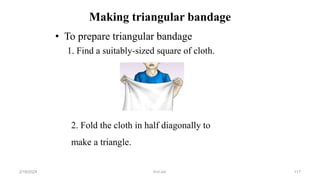
Making triangular bandage
• To prepare triangular bandage
1. Find a suitably-sized square of cloth.
2. Fold the cloth in half diagonally to
make a triangle.
first aid.
2/18/2024 117
Application of Bandages
• for Injury of
– Arm
– hand and wrist
– forehead
– Ear
– Eyes
– Cheek
– Ear
– Etc…
first aid.
2/18/2024 118
General principles:
– A bandage should be snug (not too loose and not too tight)
– Leave the fingertips or toes exposed.
– Watch for swelling, changes of color & temperature of the
tips of fingers or toes indicating interference with
circulation.
– If the victim complains of numbness or tingling sensation,
loosen the bandages immediately
– Never apply a tight circular bandage about a neck.
first aid.
2/18/2024 119
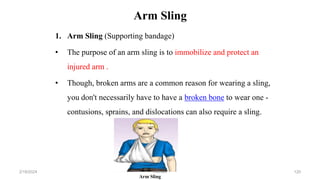
Arm Sling
1. Arm Sling (Supporting bandage)
• The purpose of an arm sling is to immobilize and protect an
injured arm .
• Though, broken arms are a common reason for wearing a sling,
you don't necessarily have to have a broken bone to wear one -
contusions, sprains, and dislocations can also require a sling.
Arm Sling
first aid.
2/18/2024 120
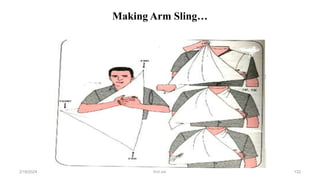
Making an Arm Sling
– Prepare triangular bandage or get a triangular bandage
– Place one end of the bandage over the shoulder of un
injured arm and let the other end hang down in front of the
chest
– Carry the point behind the elbow of the injured arm
– Carry the second end of the bandage up over the shoulder
and tie the two ends together at the side of the neck.
– Make sure the end of the fingers extend just beyond the
base for observation
– Adjust the sling so that the hand elevated 10 - 12 cm
above the level of the elbow
first aid.
2/18/2024 121
Making Arm Sling…
first aid.
2/18/2024 122
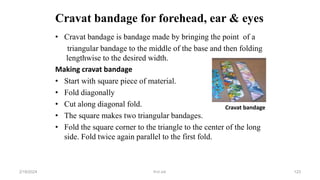
Cravat bandage for forehead, ear & eyes
• Cravat bandage is bandage made by bringing the point of a
triangular bandage to the middle of the base and then folding
lengthwise to the desired width.
Making cravat bandage
• Start with square piece of material.
• Fold diagonally
• Cut along diagonal fold.
• The square makes two triangular bandages.
• Fold the square corner to the triangle to the center of the long
side. Fold twice again parallel to the first fold.
Cravat bandage
first aid.
2/18/2024 123
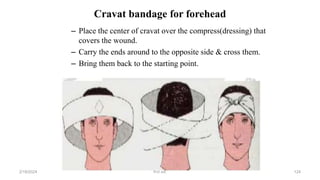
Cravat bandage for forehead
– Place the center of cravat over the compress(dressing) that
covers the wound.
– Carry the ends around to the opposite side & cross them.
– Bring them back to the starting point.
first aid.
2/18/2024 124
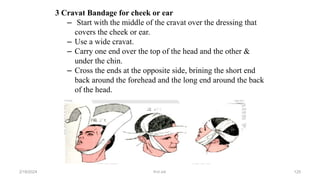
3 Cravat Bandage for cheek or ear
– Start with the middle of the cravat over the dressing that
covers the cheek or ear.
– Use a wide cravat.
– Carry one end over the top of the head and the other &
under the chin.
– Cross the ends at the opposite side, brining the short end
back around the forehead and the long end around the back
of the head.
first aid.
2/18/2024 125
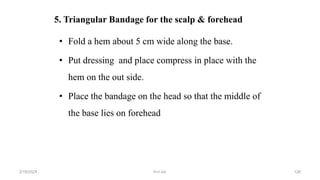
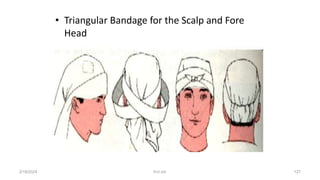
5. Triangular Bandage for the scalp & forehead
• Fold a hem about 5 cm wide along the base.
• Put dressing and place compress in place with the
hem on the out side.
• Place the bandage on the head so that the middle of
the base lies on forehead
first aid.
2/18/2024 126
• Triangular Bandage for the Scalp and Fore
Head
first aid.
2/18/2024 127
Figure of eight bandage
first aid.
2/18/2024 128
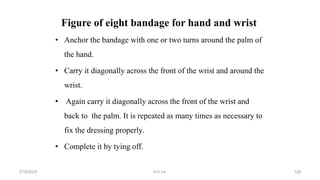
Figure of eight bandage for hand and wrist
• Anchor the bandage with one or two turns around the palm of
the hand.
• Carry it diagonally across the front of the wrist and around the
wrist.
• Again carry it diagonally across the front of the wrist and
back to the palm. It is repeated as many times as necessary to
fix the dressing properly.
• Complete it by tying off.
first aid.
2/18/2024 129
First Aid kits & Supplies
• The International Organization for standardization (ISO) sets a
standard for first aid kits of being green, with a white cross, in
order to make them easily recognizable to anyone requiring
first aid.
first aid.
2/18/2024 130
First Aid kits & Supplies…
• The common kits mostly found in the homes may contain:
Alcohol, Cotton Balls, Cotton Swabs, Iodine,
Bandage, Hydrogen Peroxide.
• Trauma injuries, such as bleeding, bone fractures or burns, are
usually the main focus of most first aid kits, kit should
includes
– Bandages
– Dressings (sterile, applied directly to the wound)
– Saline-used for cleaning wounds or washing out foreign
bodies from eyes
– Soap - used with water to clean superficial wounds once
bleeding is stopped
first aid.
2/18/2024 131
– Antiseptic wipes or sprays for reducing the risk of
infection in abrasions or around wounds. Dirty wounds
must be cleaned for antiseptics to be effective.
– Burn dressing, which is usually a sterile pad soaked in a
cooling gel
– Adhesive tape
– Haemostatic agents may be included in first aid kits,
especially military or tactical kits, to promote clotting for
severe bleeding.
Continued
first aid.
2/18/2024 132
133
End
2/18/2024
first aid.
133

FISRT AID for pharmacy students PPT.pptx

  • 1.
    By: ASaminew H.(BSc, MSc in EMCCN) First aid & accident prevention For-4th Year pharmacy-students 2/18/2024 first aid. 1
  • 2.
    2 Outlines  Principles offirst aid and accident prevention  Cardio-Respiratory Emergencies and BLS  Specific injuries  Bone and joint injuries  Shock and sudden illness  Burn  Lifting and moving emergency patients.  Disaster prevention and mgt 2
  • 3.
    3 CASE Just imagine:  Aco-worker is hurt in an accident and blood is gushing from the wound.  One of your friends chokes on a piece of food and can’t breathe.  Someone goes into cardiac arrest right at his workstation.  Any one of these things is possible, and it could happen any time. A few critical minutes one way or the other could make the difference between life and death. 3
  • 4.
    4 WHAT IS FIRSTAID?  It is a temporary and immediate care given to an injured or suddenly ill person before the arrival of emergency medical care  Doesn't replace definitive care by professionals  Only given for life-and-death situations 4
  • 5.
    5 First Aid………….  Itcan be performed by a bystander or by victim  First aid -can brings a difference between life & death.  A first aider – is someone with a formal training or first people on an emergency scene 5
  • 6.
    6 FIRST AID.  Itis immediate care a sick or injured person gets.  In some cases, it may be the only care a person needs.  In others, first aid is a way to prevent a person's condition from worsening and keep them alive until paramedics arrive or they are taken to the hospital 6
  • 7.
  • 8.
    8 FIRST AID  Bystanders: are other people who are present at the scene/incident.  They may be with or without any formal training to provide emergency life saving interventions.  Call and dispatch Centre: refers to the organization responsible for receiving emergency calls and notifying the appropriate emergency medical service providers of such calls for help, and assigning them to respond to such calls. 8
  • 9.
  • 10.
    FIRSTAIDPOWERPOINT.ORG The Aims ofFirst Aid Broadly, there are three main aims when administering first aid: Preserve life Prevent worsening of the condition (if possible) Promote recovery For example, applying a plaster is preventing the condition (a cut) from worsening by stopping infection. 2/18/2024 first aid. 10
  • 11.
    11 Preserving life  Controlof bleeding  Treating possible cause of shock  Maintain airway in correct position  Perform CPR when required ( no pulse and breathing) 11
  • 12.
    12 Preventing complication  Dressingwound to prevent infection  Place the casualty in comfortable position  Provide comfort to casualty 12
  • 13.
    13 Promote recovery  Reliefcasualty from anxiety  Encourage confidence and trust  Attempt to relief pain and discomfort  Protect the casualty from cold and wet 13
  • 14.
    14 First aid principles. Keep victim warm & comfortable.  Do not touch open wounds or burns with fingers  Keep NPO, for unconscious victims  Be calm and confident (safety first)  Seek medical attention immediately  Examine the victim gently and treat the most urgent injuries 1st  Do not move injured victim.  Keep the victim lying down 14
  • 15.
    15 General directions toprovide first aid Basic plan of action are:  Assure Safety - Keep yourself & others at scene safe.  Assess the victim - Gain access to the victim, and determine immediate threats to life.  Activate the EMS system/ CALL for help.  Provide basic life support to those whose lives are threatened  Move the victims only if necessary  Arrange for the transfer or transport of the casualty 15
  • 16.
    Roles and Responsibilitiesof a First Aider A first aider has various roles and responsibilities. They should: • Manage the incident and ensure the continuing safety of themselves, bystanders and the patient • Assess victims and find out the nature & cause of their injuries • Arrange for further medical help or other emergency services to attend • If trained, prioritise casualties based upon medical need • Provide appropriate first aid treatment as trained • If able, make notes/observations of casualties • Fill out any paperwork as required • Provide a handover when further medical help arrives 2/18/2024 first aid. 16
  • 17.
    Calling for EmergencyHelp In many first aid situations, help from the emergency services will be required. Ensure you know the best emergency service number to use. – United Kingdom: 999 – United States: 911 – European Union: 112 – ETHIOPIA 939 – JIMMA 6238 – Other countries: https://en.wikipedia.org/wiki/List_of_emergency_telephone_nu mbers 2/18/2024 first aid. 17
  • 18.
    Calling for EmergencyHelp Give clear, precise information about – The exact location of the incident and any access problems – The number of casualties / people involved – The nature of their injuries – The age of the victims – Any hazards at the incident (e.g: spilt fuel, fire, electricity) If the area is remote or difficult to access, consider sending someone to meet the emergency services. 2/18/2024 first aid. 18
  • 19.
    Incident Management Always conducta risk assessment before rushing into any situation. Look for any potential hazards to yourself, bystanders or the patient (e.g: moving traffic, fire & smoke, electricity). Never put yourself or 2/18/2024 first aid. 19
  • 20.
    20 Injury prevention strategies Strategiescover a variety of approaches, many of which are classified as falling under the “3 E’s” of injury prevention “3 E’s” of injury prevention Education, Engineering modifications, and Enforcement/enactment 20
  • 21.
    21 Level of consciousness Recognitionof any change of level of consciousness is important. Full consciousness- the casualty is able to speak and answer questions normally Drowsiness- the casualty is easily aroused but lapses in to unconscious state Stupor –the casualty can be roused with difficulty, aware of painful stimuli. E.g. pin prick, but not of other external elements like being spoken to. 21
  • 22.
    22 CONT. Coma - cannotbe roused by any stimuli. In general make full use of your senses to obtain maximum information (Look, smell, listen and touch). Action:-If the cause of the condition is still active, remove the cause. E.g. -a lodging of wood on the causalities leg, contaminated clothing or remove the causality from the cause, such as traffic, fire, water, poisonous fumes 22
  • 23.
  • 24.
    24 QUIZ 1. Define firstaid? (2mark) 2. Describe at least three reason why first aid is given? (3mark) 3. What are the general direction to be followed while giving first aid at least three?(3mark) 4. In the case of occurrence of an injury to a victim if the condition is still active, remove the cause or the victim from the cause? A/true b/false 24
  • 25.
    25 5. In stupor,the casualty can be aroused with difficulty without aware of painful stimuli? A/true b/false 6. The client opens his eyes when he hears the nurse walks into the room, however is confused and disoriented when talking with the nurse. He is unable to localize pain but withdraws from painful stimuli. Total score________ 25
  • 26.
  • 27.
    27 Cardio-pulmonary Emergencies andBLS • Respiratory arrest: Respiratory arrest is a condition where the lungs cutting off the ability to breathe(cessation of normal breathing) • Mostly, this occurs after cardiac arrest, b/c blood fails to reach the lungs 27
  • 28.
    28 Cont. • However, canoccur even when the heart is still functioning. • This can occur due to nerve or neuromuscular disorders, • drugs that inhibit respiratory drive (e.g., Opioids) • crush injury to chest or cause upper or lower airway obstruction 28
  • 29.
    29 Cardiac Arrest  Occurswhen the heart stops beating or beats too ineffectively to circulate blood to the brain and other vital organs  The first organ to become affected by the lack of oxygen supply is the brain, and as a result, the patient loses consciousness.  In cardiac arrest, the electrical impulses become abnormal and chaotic.  This causes the heart to lose the ability to beat rhythmically, or to stop beating altogether 29
  • 30.
    30 Causes of CardiacArrest – 6Hs and 5Ts Hypovolemia Tension pneumothorax Hypoglycemia Tamponade (cardiac) Hypoxia Thrombosis (pulmonary) Hydrogen ion (acidosis) Thrombosis (cardiac) Hypo/Hyperkalemia Toxins Hypothermia -- 30
  • 31.
    31 Determinants of survivalafter cardiac arrest( adult) 31
  • 32.
    32 Determinants of survivalafter cardiac arrest( pediatric) 32
  • 33.
    33 Management of cardiopulmonaryarrest Basic Life Support /BLS  is a sequences of procedures performed to restore the circulation of oxygenated blood after a sudden pulmonary and/or cardiac arrest  Can be performed by anyone who knows how to do it, anywhere, immediately, without any other equipment except using of protective devices 33
  • 34.
    34 Cardio-pulmonary resuscitation /CPR is an emergency procedure consisting of external cardiac massage and artificial respiration.  is primarily performed to squeeze blood manually out of the heart for victim’s with cardiac arrest and provide oxygenated blood to the brain and heart.  CPR must be started immediately to be effective 34
  • 35.
    35  Without oxygen,brain damage can begin in about 4 to 6 minutes, and the damage can become irreversible after about 8 to 10 minutes  Death occurs within a matter of minutes if the person does not receive immediate care. s/s of cardiac arrest  Recognized by sudden collapse  Unresponsiveness  Not breathing or only gasping  Absence of pulse 35
  • 36.
    BLS Sequence D- danger R-response S- shout for help C –circulation A- airway B- breathing 2/18/2024 first aid. 36
  • 37.
    BLS Sequence D –Danger - safety first ( assess the scene safety) R S C A B 2/18/2024 first aid. 37
  • 38.
    38 BLS Sequence R -responsiveness C A B Adultand child- Ask by are you ok? If no response tap the shoulders to check it Infant- Tap the sole of the feet to check for responsiveness If No Response- Shout for help(emergency call as they bring AED too 2/18/2024 first aid. 38
  • 39.
    39 BLS Sequence C -circulation Check Carotid Pulse – Check pulse no > 10 A seconds B – If there is no pulse start CPR To palpate the carotid pulse, feel for the patient’s trachea with your fingers. Insert your fingers into the groove on one side of the trachea, between the trachea and neck muscle 2/18/2024 first aid. 39
  • 40.
    40 Chest Compressions  Kneelcentre of the victim’s shoulder  Place the heel of one hand on the sternum in the centre of the chest between the nipples and then place the heel of the second hand on top of the first so that the hands are overlapped 2/18/2024 first aid. 40
  • 41.
    41 Chest Compressions………. Position shouldersover hands with elbows locked and arms straight Compress down and release pressure smoothly, keeping hand contact with chest at all times 2/18/2024 first aid. 41
  • 42.
  • 43.
    43 Adult ≥12 yearsChild 1 - 12 years Infant < 1 year Hand Position Two hands in center of chest Two hands in center of chest Two fingers on center of chest, just below the nipple line Chest Compressions Compress at least 2 inches Rate: 100–120 compressions/min Compress about 2 inches Rate: 100–120 compressions/min Compress about 1½ inches Rate: 100–120 compressions/min Ratio One rescuer -30:2 30:2 chest 30:2 Two rescuer -30:2 15:2 15:2 2/18/2024 first aid. 43
  • 44.
    44 BLS Sequence A -airway Open Airway: Head Tilt-Chin Lift Jaw thrust – for injury suspected B 2/18/2024 first aid. 44
  • 45.
  • 46.
    check for breathing Check breathing  listen and feel the patient’s breath a short distance from his/her face  Look for the movement of the chest  Are there any signs of breathing 2/18/2024 first aid. 46
  • 47.
    47 BLS Sequence B -breathing  Use barrier device if available  Pinch nose shut  Open your mouth wide, take a normal breath, and make a tight seal around the outside of victim’s mouth  Give 2 full breaths (1 sec/ breath)  Observe chest rise 2/18/2024 first aid. 47
  • 48.
    48 BLS Sequence……… B –breathing Mouth-to-mouth/nose rescue breathing technique is preferred for infants Your mouth should cover both the mouth and nose of the infant, creating a tight seal. 2/18/2024 first aid. 48
  • 49.
  • 50.
    50 B-breathing ……..  Ventilationusing a Bag-Mask(ambu-bag) : If available, it must be preferred over mouth-to-mouth resuscitation The bag-mask device delivers 21% oxygen This is higher than 17% oxygen found in exhaled air The rescuer must stand at the head of the patient. Use the E-C clamp technique to hold the mask firmly in place 2/18/2024 first aid. 50
  • 51.
    51 B-breathing …….. The thumband index fingers of your dominant hand form a ‘C’, which is placed on the side of the mask, to press it into place and create a tight seal. The remaining three fingers form an ‘E’, which is used to lift the chin and open up the airway Once the mask is firmly in place, squeezed the bag over one second, using non-dominant hand with each squeeze, watch for the patient’s chest to rise 2/18/2024 first aid. 51
  • 52.
    52 BLS Sequence…. Compression-only CPR: Outcome is better than outcome of No CPR  Lay rescuers should do compression-only if they are unwilling or unable to provide rescue breaths 2/18/2024 first aid. 52
  • 53.
    53 BLS Sequence Important Pointsto Remember  Ratio - 30 compressions:2 breaths  Rate - Approx. 100-120 compressions/min  Depth – 2-2.4 inches for adult, 1.5 inches for infants  1 cycle = 30 compressions and 2 breaths  Five cycles should take no more than 2 minutes  Reassess the victim every two minutes 2/18/2024 first aid. 53
  • 54.
    54 High quality CPR Compressionrate of 100-120/min Compression depth of at least 2 inches Allow chest recoil Minimize interruption Avoid excessive ventilation 2/18/2024 first aid. 54
  • 55.
  • 56.
  • 57.
  • 58.
    58 Phase 1: Assessmentof the external situation Prior to attempting rescue, determines whether the environment is safe Check for responsiveness by saying “are you ok?” or  by tapping the child’s/adult’s shoulder  For infants, tapping the heel of the foot Call for help, and activate emergency services as appropriate & procure an AED 2/18/2024 first aid. 58
  • 59.
    59 Phase 2: Assessmentof the patient Briefly check if the patient is breathing (by looking for the rise and fall of the chest) Simultaneously, feel for a carotid pulse However, the carotid pulse may not be felt easily in infants and some children o For infants, the brachial pulse o For older children, the femoral pulse may be palpated This must not exceed 10 seconds  Gasps do not count as breathing 2/18/2024 first aid. 59
  • 60.
    60 If the patientis breathing and a pulse can be detected:  Monitor the breathing and pulse periodically, and check for responsiveness at intervals  This must be continued till emergency services arrive If a pulse is definitely detected, but breathing is absent: Deliver one breath over 1 second, every 5 to 6 sec. For paediatrics: deliver rescue breaths over 1 sec., every 2 to 3 sec., totalling about 20 to 30 breaths /min Phase 3 : Definitive rescue phase 2/18/2024 first aid. 60
  • 61.
    61 Phase 3 :Definitive rescue phase………….. Continue to monitor the pulse every 2 min. In infants if the pulse falls below 60 beats:  Start chest compressions immediately If both pulse and respiration are absent:  Immediately start delivering 30:2 chest compressions, rescue breaths ratio  If two rescuer in infants & child deliver 15:2 ratio  Chest compressions must be delivered at a rate of 100 to 120/min. 2/18/2024 first aid. 61
  • 62.
    62 Phase 3 :Definitive rescue phase…………..  Chest Compressions in Children:  For small children, One handed compressions may be used  Ensure that you are able to achieve the required depth of 5 cm with single handed compressions  If this is not achieved, the rescuer may switch over to two handed compressions 62
  • 63.
    63 Phase 3 :Definitive rescue phase…………..  Chest Compressions in Infants: A single rescuer uses the ‘two-finger’ technique Two rescuers may use the ‘two thumb encircling hands’ technique Site of chest compression: below the nipple line at the centre of the chest 2/18/2024 first aid. 63
  • 64.
    64 Phase 3 :Definitive rescue phase………….. Once the AED is available, the second rescuer can allow the AED to analyse the rhythm Resume CPR immediately after shock (or after rhythm assessment if no shock is needed) Rescuers can switch roles while the rhythm is being analyzed Reassess rhythm every 2 min until the patient recovers, or ALS providers take over care of the patient 2/18/2024 first aid. 64
  • 65.
    65 When to StopCPR S- Spontaneous breathing T -Trained personnel arrived O-Operator exhausted P-Physician assumes responsibility S-Scene become unsafe 2/18/2024 first aid. 65
  • 66.
    66 Foreign body airwayobstruction( choking)  Is physical obstruction in their upper respiratory tract  Is a serious medical emergency  Children are more likely to swallow objects other than food, and foreign objects such as coins or small toys  Adoption of appropriate techniques can relieve choking in 70 to 80% of all cases. 66
  • 67.
    67 S/S of FBAO Universal signal for choking:  patient has both hands wrapped around the base of their throat  With complete airway obstruction, the child is unable to speak, cry, or provide any sounds of respiration.  The patient may be confused, weak, or cyanotic 67
  • 68.
  • 69.
  • 70.
    70 Treating severe choking 3 effective methods for conscious victim  Back slaps - initial  Obstruction relieving maneuvers  (Abdominal thrusts or Heimlich maneuver, Chest thrusts)  Finger sweep  is a first step if foreign body can be visualized Unconscious victim  lying down and provide CPR 70
  • 71.
  • 72.
    72 First Aid forChoking When an adult or child is choking, give a combination of 5 back blows (blows between the shoulder blades) Followed by 5 abdominal thrusts (inward and upward thrusts just above the navel)  Continue giving sets of back blows and abdominal thrusts until the person can cough forcefully, speak, cry, or breathe, or the person becomes unresponsive. 72
  • 73.
    73 Choking infant mgt Positionthe patient: Lay infant’s face and torso down on forearm (prone) with chest being supported by your palm and their head and neck by your fingers. Interventional Back Blows: Provide 5 rapid forceful blows using a flat palm on the infant’s back between the two scapula. Interventional Chest Thrusts: Provide 5 rapid compressions with your two fingers on the centre of the infant’s sternum immediately below the nipple line. 73
  • 74.
    SUMMARY  First aidis the immediate care given to a person who has been injured or suddenly taken ill.  Advantages of first aid  To preserve life.  To prevent complications  To promote healing and recovery • Responsibility of a first – aider(Assessment, diagnosis and treatment process) first aid. 2/18/2024 74
  • 75.
    summary cont.. First linetreatment for life threatening conditions involves ◦ Maintain clear air way (A) ◦ Correct the breathing (B) ◦ Control circulation (c)  Stop bleeding  Treat shock ◦ Check the disability (D) ◦ Expose the patient (E) ◦ Reassure the patient and make him in conformable position first aid. 2/18/2024 75
  • 76.
    CHAPTER THREE WOUNDS ANDBLEEDING first aid. 2/18/2024 76
  • 77.
    Wound Definition: A wound isa break in the continuity of the tissue of the body either internal or external Common Causes: Accidental falls Handling of Sharp objects Machinery Weapons first aid. 2/18/2024 77
  • 78.
    Classifications of Wound •1. Open wound - a break in the skin or the mucus membrane • 2. Closed wound - injury to underlying tissues without a break in the skin or mucus membrane Types of open wounds  Abrasions Damage in outer layer of the skin Bleeding is limited Danger of contamination & infection is high Abrasion first aid. 2/18/2024 78
  • 79.
    Types of openwounds… Incision: is a break in skin caused by sharp instruments (knife, broken glass or blade)  May damage muscles, tendons, & nerves. Laceration - is jagged or irregular tear. Usually causes when great force is exerted against the body Bleeding may be rapid & extensive. Incision first aid. 2/18/2024 79
  • 80.
    Puncture a smallhole produced by an object piercing skin layers. External bleeding is usually quite limited Internal bleeding may occur Risk of infection is high Avulsion is type of wound cxd by the tearing away or separation of part of the body.  Heavy & rapid bleeding may occur Avulsed body part may be reattached to a victim's body by a surgeon. Puncture Avulsion first aid. 2/18/2024 80
  • 81.
    Closed wound  Closedwounds have fewer categories, but are just as dangerous as open wounds. The types of closed wounds are: • Hematomas, also called a blood tumor, caused by damage to a blood vessel that in turn causes blood to collect under the skin. – Hematomas that originate from internal blood vessel pathology are purpura petechiae, and ecchymosis. The different classifications are based on size. – Hematomas that originate from an external source of trauma are contusions, also commonly called bruises. first aid. 2/18/2024 81
  • 82.
    Bleeding • Bleeding: isloss of blood, usually through disease, injury, or other physical conditions. • Three Main Types of Bleeding  Capillary Bleeding – Capillaries are the smallest blood vessels in your body; they are about as thin as the hairs on your head. – Capillary bleeding usually occurs in superficial wounds, such as abrasions, the bleeding is almost always very slow and small in quantity. – Your body's natural clotting mechanism is able to stop most cases of capillary bleeding within seconds to minutes. first aid. 2/18/2024 82
  • 83.
    • Venous Bleeding –Deep cuts have the potential to cut veins. A cut vein typically results in a steady but relatively slow flow of dark red blood. – The best way to stop most cases of venous bleeding is to put direct pressure on the wound. • Arterial Bleeding – This is the least common and most dangerous type of bleeding. – It involves bright red blood that comes out in large volume, and in spurts that correspond with each beat of your heart. – In most cases of arterial bleeding, direct and extremely firm pressure on the wound is the best way of stopping it first aid. 2/18/2024 83
  • 84.
     Internal bleeding –is bleeding inside body cavity. – Bleeding inside body cavity may follow an injury, such as a fracture or a penetrating wounds, but can also occur spontaneously for example, bleeding from a stomach ulcer. – The main risk from internal bleeding is shock. In addition, blood can build up around organs such as the lungs or brain and exert damaging pressure on them. – You should suspect internal bleeding if a casualty develops signs of shock without obvious blood loss. Check for any bleeding from body openings (orifices) such as the ear, mouth, urethra, or anus. first aid. 2/18/2024 84
  • 85.
    • How torecognize internal bleeding – Initially, pale, cold skin. If bleeding continues, skin may turn blue (cyanosis). – Rapid, weak pulse – Thirst – Rapid , shallow breathing – Confusion, restlessness, and irritability. – unconsciousness – Bleeding from body openings (orifices) – Pain first aid. 2/18/2024 85
  • 86.
    First Aid Treatmentfor Open Wounds • Open wounds can compromise the health of a person. • It can lead to health problems such as infection and loss of blood due to bleeding. • Therefore, it is important that you are able to provide immediate, proper first aid treatment to avoid potential health problems. first aid. 2/18/2024 86
  • 87.
    . Control bleeding –Apply direct pressure over the wound and elevate affected part. – Use a sterile dressing or clean sheet to cover the wound then apply pressure. Tourniquet is not recommended for controlling bleeding but may be used in cases of severe bleeding. first aid. 2/18/2024 87
  • 88.
    Techniques to stopsever bleeding . Apply direct pressure – Apply direct pressure by placing the palm of the hand over a thick pad directly on the entire area of an open wound; – In case of very severe bleeding, manual pressure over the main artery, nearest to the bleeding point, should be applied as well as direct pressure over the wound itself. – Apply the pressure bandage, maintain a steady pull on the bandage, and then tie the bandage directly over the pad. first aid. 2/18/2024 88
  • 89.
    1 Apply directpressure… Pressure on the supplying artery • Brachial artery for arm wound • Femoral artery for leg wound first aid. 2/18/2024 89
  • 90.
  • 91.
    . Elevation – Elevatethe hand, neck, or leg above the victim's heart unless there is evidence of a fracture, a severely bleeding open wound of the hand, neck, arm or leg – Should be elevated above the level of the victim’s heart. – Elevation uses the force of gravity to help reduce blood pressure in the injured area and slows down the loss of blood through the wound, however, it should be aided by direct pressure. Techniques to stop sever bleeding… first aid. 2/18/2024 91
  • 92.
  • 93.
    Techniques to stopsever bleeding… 3.3. Tourniquet – Another method of achieving constriction of the supplying artery is the use of a tourniquet . – a tightly tied band which goes around a limb to restrict blood flow – Pressure is applied circumferentially upon the skin and underlying tissues of a limb – Use of a tourniquet is dangerous and the tourniquet should be used only for a severe life threatening hemorrhage that can not be controlled by other means. – Precaution: release the tourniquet every 15 minutes first aid. 2/18/2024 93
  • 94.
  • 95.
    . Clotting agents –Some protocols call for the use of clotting accelerating agents, which can be either externally applied as a powder or gel, or pre-dosed in a dressing or as an intravenous injection. – These may be particularly useful in situations where the wound is not clotting, which can be due to external factors, such as size of wound, Techniques to stop sever bleeding… first aid. 2/18/2024 95
  • 96.
    . Cleaning anOpen Wound • Once bleeding has been controlled, the open wound should be cleaned with mild soap and water . • Saline solution is better for cleaning wounds and eyes. • Cleaning an open wound can sometimes cause bleeding to return. The bleeding will be minor and should be easily stopped with direct pressure using a sterile - or at least clean - dressing. first aid. 2/18/2024 96
  • 97.
    . Cleaning anOpen … – Wash your hands with soap & water – Wash the wound from inside to outer side to remove bacteria and other foreign materials . – Rinse the wound thoroughly by flushing with clean water – Dry with sterile gauze/clean cloth – Apply a dry clean dressing and secure it firmly in place. – Inform the victim to seek health care if evidence of infection appears first aid. 2/18/2024 97
  • 98.
    Prevention of contamination& infection while dealing with the wound • Open wounds are subject to contamination and infection. This danger can be prevented or minimized by appropriate first aid measures, • Contamination is the act or process of making something impure by touching it or by adding something to it • Infection is introduction and proliferation of microorganisms within the body first aid. 2/18/2024 98
  • 99.
    . Keep patientlying still • Unnecessary, forceful movements can increase blood circulation potentially restarting bleeding first aid. 2/18/2024 99
  • 100.
    Chapter Four Dressing andBandages first aid. 2/18/2024 100
  • 101.
    DRESSING & BANDAGES Definitionof Dressing – is a sterile pad applied to a wound to promote healing and/or prevent further harm. A dressing is designed to be in direct contact with the wound, as distinguished from a bandage, which is most often used to hold a dressing in place. – Sterile dressings are those which are free from germs are preferable to use. first aid. 2/18/2024 101
  • 102.
    Purpose of Dressings •To assist in the control of bleeding • To absorb the blood & wound secretions • To prevent contamination • To relieve pain first aid. 2/18/2024 102
  • 103.
    Types of dressing 1.Adhesive dressing – Is sticky dressing used for cover small cuts and grazes. They consist of a gauze and an adhesive backing. 2. Non adhesive dressing – is a type of dressing used to dress large size area wound unlike that of adhesive dressing. first aid. 2/18/2024 103
  • 104.
    Adhesive dressing Noneadhesive dressing first aid. 2/18/2024 104
  • 105.
    Dressing procedure To applyclean dressing materials at home, Wash your hand  Boil the dressing materials for 15 minutes  Dry the dressing materials with out contamination Apply the dressing first aid. 2/18/2024 105
  • 106.
    CONT. • If cleandressing is available, the inner surface of a folded cloth can be used for immediate use. Do not touch or breathe or cough on the surface of a dressing that is to be placed next to wound. first aid. 2/18/2024 106
  • 107.
    • Bandages – Abandage is a long narrow piece of cloth used to hold a wound dressing or splint in place. It helps to immobilize, support and protect an injured part of the body. Gauze bandage Elastic bandage first aid. 2/18/2024 107
  • 108.
    • Functions ofbandages – To assist in the control of bleeding – To absorb blood and wound secretion – To prevent additional contamination – To ease pain – Control or reduce swelling – Lift and transport casualty – Secure dressing and splint in position – Assist in immobilization first aid. 2/18/2024 108
  • 109.
    Bandages cont… • Kindsof Bandages – Gauze bandages – Elastic bandages – Triangular bandages – Combinations of dressing and bandages first aid. 2/18/2024 109
  • 110.
    • Gauze bandages –Most common type of bandage is the gauze bandage – A gauze bandage can come in any number of widths and lengths, and can be used for almost any bandage application first aid. 2/18/2024 110
  • 111.
    Gauze Bandages… • GauzeBandages can be used on any part of the body in different ways • Circular bandages • Spiral bandages • Figure of eight (joint areas) • Fingertip bandages (recurrent) first aid. 2/18/2024 111
  • 112.
    • Figure ofeight bandage – A bandage applied alternately to two parts, usually two seg ments of a limb above and below the joint, in such a way t hat the turns describe the figure 8. – used for treatment of fractures of the clavicle,etc first aid. 2/18/2024 112
  • 113.
    • An elasticbandage – is a "stretchable bandage used to create localized pressure. – Elastic bandages are commonly used to treat muscle sprains and strains by reducing the flow of blood to a particular area by the application of even stable pressure which can restrict swelling at the place of injury. – Elastic Bandages Are expensive, Can be laundered & used repeatedly. – Do not stretch too tightly (interfere with circulation). first aid. 2/18/2024 113
  • 114.
  • 115.
    Triangular Bandage • Isa right-angled triangle bandage • Used as an emergency cover for large areas. Such a bandage also is used as a sling for fracture or other injury of the arm or hand • It can be used to cover – The entire scalp – Foot or any large areas. – Used as a sling for fracture of the arm. – Folded as a normal bandage, • The triangular bandage can be used as a circular, spiral or figure of eight bandage first aid. 2/18/2024 115
  • 116.
  • 117.
    Making triangular bandage •To prepare triangular bandage 1. Find a suitably-sized square of cloth. 2. Fold the cloth in half diagonally to make a triangle. first aid. 2/18/2024 117
  • 118.
    Application of Bandages •for Injury of – Arm – hand and wrist – forehead – Ear – Eyes – Cheek – Ear – Etc… first aid. 2/18/2024 118
  • 119.
    General principles: – Abandage should be snug (not too loose and not too tight) – Leave the fingertips or toes exposed. – Watch for swelling, changes of color & temperature of the tips of fingers or toes indicating interference with circulation. – If the victim complains of numbness or tingling sensation, loosen the bandages immediately – Never apply a tight circular bandage about a neck. first aid. 2/18/2024 119
  • 120.
    Arm Sling 1. ArmSling (Supporting bandage) • The purpose of an arm sling is to immobilize and protect an injured arm . • Though, broken arms are a common reason for wearing a sling, you don't necessarily have to have a broken bone to wear one - contusions, sprains, and dislocations can also require a sling. Arm Sling first aid. 2/18/2024 120
  • 121.
    Making an ArmSling – Prepare triangular bandage or get a triangular bandage – Place one end of the bandage over the shoulder of un injured arm and let the other end hang down in front of the chest – Carry the point behind the elbow of the injured arm – Carry the second end of the bandage up over the shoulder and tie the two ends together at the side of the neck. – Make sure the end of the fingers extend just beyond the base for observation – Adjust the sling so that the hand elevated 10 - 12 cm above the level of the elbow first aid. 2/18/2024 121
  • 122.
    Making Arm Sling… firstaid. 2/18/2024 122
  • 123.
    Cravat bandage forforehead, ear & eyes • Cravat bandage is bandage made by bringing the point of a triangular bandage to the middle of the base and then folding lengthwise to the desired width. Making cravat bandage • Start with square piece of material. • Fold diagonally • Cut along diagonal fold. • The square makes two triangular bandages. • Fold the square corner to the triangle to the center of the long side. Fold twice again parallel to the first fold. Cravat bandage first aid. 2/18/2024 123
  • 124.
    Cravat bandage forforehead – Place the center of cravat over the compress(dressing) that covers the wound. – Carry the ends around to the opposite side & cross them. – Bring them back to the starting point. first aid. 2/18/2024 124
  • 125.
    3 Cravat Bandagefor cheek or ear – Start with the middle of the cravat over the dressing that covers the cheek or ear. – Use a wide cravat. – Carry one end over the top of the head and the other & under the chin. – Cross the ends at the opposite side, brining the short end back around the forehead and the long end around the back of the head. first aid. 2/18/2024 125
  • 126.
    5. Triangular Bandagefor the scalp & forehead • Fold a hem about 5 cm wide along the base. • Put dressing and place compress in place with the hem on the out side. • Place the bandage on the head so that the middle of the base lies on forehead first aid. 2/18/2024 126
  • 127.
    • Triangular Bandagefor the Scalp and Fore Head first aid. 2/18/2024 127
  • 128.
    Figure of eightbandage first aid. 2/18/2024 128
  • 129.
    Figure of eightbandage for hand and wrist • Anchor the bandage with one or two turns around the palm of the hand. • Carry it diagonally across the front of the wrist and around the wrist. • Again carry it diagonally across the front of the wrist and back to the palm. It is repeated as many times as necessary to fix the dressing properly. • Complete it by tying off. first aid. 2/18/2024 129
  • 130.
    First Aid kits& Supplies • The International Organization for standardization (ISO) sets a standard for first aid kits of being green, with a white cross, in order to make them easily recognizable to anyone requiring first aid. first aid. 2/18/2024 130
  • 131.
    First Aid kits& Supplies… • The common kits mostly found in the homes may contain: Alcohol, Cotton Balls, Cotton Swabs, Iodine, Bandage, Hydrogen Peroxide. • Trauma injuries, such as bleeding, bone fractures or burns, are usually the main focus of most first aid kits, kit should includes – Bandages – Dressings (sterile, applied directly to the wound) – Saline-used for cleaning wounds or washing out foreign bodies from eyes – Soap - used with water to clean superficial wounds once bleeding is stopped first aid. 2/18/2024 131
  • 132.
    – Antiseptic wipesor sprays for reducing the risk of infection in abrasions or around wounds. Dirty wounds must be cleaned for antiseptics to be effective. – Burn dressing, which is usually a sterile pad soaked in a cooling gel – Adhesive tape – Haemostatic agents may be included in first aid kits, especially military or tactical kits, to promote clotting for severe bleeding. Continued first aid. 2/18/2024 132
  • 133.

Editor's Notes

  • #36 For each minute that CPR and use of an AED are delayed, the person’s chance for survival is reduced by about 10%
  • #59 Reading Assignment 1: AED( automatic external device) How AED works Time of using AED Technique of Using an AED Factors to Consider while Using an AED
  • #74 Chest Thrusts primarily used in morbidly obese, infants late stages of pregnancy, or if rescuer cannot reach around the victim's abdomen to perform Heimlich maneuver