Ambulance Module   Operations Reporting Record Keeping
EMT Roles - Driver Responsible for mechanical check Tires Gas level Oil brakes, etc..
EMT Roles - Attendant Responsible for medical supplies Back boards Oxygen Splints Bandages, etc..
EMT Roles - other Paperwork Radio reporting Verbal to ER staff
EMT Roles - on-scene Patient Contact Scene Manager THESE ARE 2 DISTINCT ROLES
Driving CODE 2   Non Emergency (normal driving) CODE 3 Emergency (operating as an emergency vehicle)
Code 3 driving   MUST BE ABLE TO JUSTIFY! Valid reasons  =  ABC problems Airway Obstruction Respiratory Distress Shock
Code 3 driving   Decision to Operate CODE 3 Dispatch decides initially You decide how to transport to Hospital (ABC problem?)
Code 3 driving   Operating Code 3  - EMERGENCY Exempt from most traffic regulations 10 MPH over the posted speed limit Beware intersections
You are NEVER exempt from operating safely You can be charged with a crime if you operate unsafely
Responding Always use maps - BEFORE you begin to move! The attendant should help with the response. Make eye contact with other drivers and STILL DON”T TRUST THEM
Freeway Response  No Light bar Forward steady red and Rear flashers only (think CHP) Can use all lights once parked (safety)
Scene Approach VIOLENT?  Approach slow and silent Consider Staging 1-2 blocks away Beware dead ends and long alleys Park as a TACTIC, not as if you were shopping
Radio requests Composed Brief Be specific what you want State purpose of request
Radio reports Be composed Be prepared before you start Be structured - same format every time
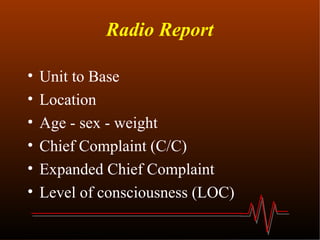
Radio Report Unit to Base Location Age - sex - weight Chief Complaint (C/C) Expanded Chief Complaint Level of consciousness (LOC)
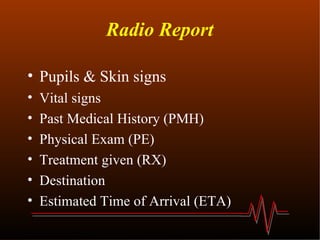
Radio Report Pupils & Skin signs Vital signs Past Medical History (PMH) Physical Exam (PE) Treatment given (RX) Destination Estimated Time of Arrival (ETA)
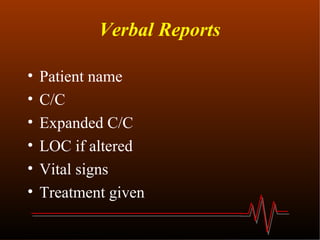
Verbal Reports Patient name C/C Expanded C/C LOC if altered Vital signs Treatment given
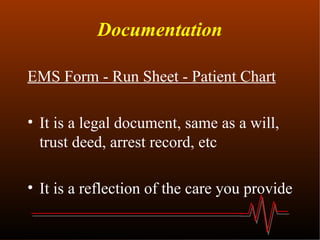
Documentation EMS Form - Run Sheet - Patient Chart It is a legal document, same as a will, trust deed, arrest record, etc It is a reflection of the care you provide
Documentation rules If you did not write it down, you did not do it. Incomplete paperwork equals incomplete care. Sloppy paperwork equals sloppy care.
Scene Safety and Personal Protection   Prepare yourself when dispatched  Inspect surroundings  Mark the scene  Check vehicle stability Take proper night time precautions
Communicable Diseases Transmitted from one person to another Minimize risk with proper protection Immunizations
Routes of Transmission Direct Vector-borne Vehicle (indirect) Airborne
Common Terms Exposure Universal precautions Body Substance Isolation (BSI) Exposure Control Plan
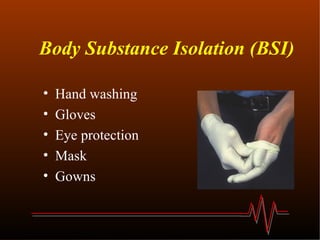
Body Substance Isolation (BSI) Hand washing Gloves  Eye protection Mask Gowns
Immunizations Recommended: Tetanus-diphtheria boosters (every 10 years) Measles, mumps, rubella (MMR) Influenza vaccine (yearly) Hepatitis B vaccine
Duty to Act Cannot deny care to a patient with a suspected communicable disease Abandonment / breach of duty / negligence
Diseases of Special Concern  HIV infection Hepatitis Meningitis Tuberculosis
General Post Exposure Management See a doctor immediately Ryan White law
Clinical & Ride-a-longs Arrive in proper uniform Arrive a few minutes early Ask questions Remember your scope of practice Patient information is confidential
Sign Ups If you sign up for a clinical or schedule a ride-a-long you are expected to be there. If you have to reschedule you will lose your priority
Sign ups If you fail to show up for a field experience the will be a penalty (50 points) Bring lunch money or a sack lunch
Paperwork Field Evaluation Form Patient Summary Sheet Notebook to take notes (when  appropriate)
Thank You for Coming The END

Ambulance

  • 1.
    Ambulance Module Operations Reporting Record Keeping
  • 2.
    EMT Roles -Driver Responsible for mechanical check Tires Gas level Oil brakes, etc..
  • 3.
    EMT Roles -Attendant Responsible for medical supplies Back boards Oxygen Splints Bandages, etc..
  • 4.
    EMT Roles -other Paperwork Radio reporting Verbal to ER staff
  • 5.
    EMT Roles -on-scene Patient Contact Scene Manager THESE ARE 2 DISTINCT ROLES
  • 6.
    Driving CODE 2 Non Emergency (normal driving) CODE 3 Emergency (operating as an emergency vehicle)
  • 7.
    Code 3 driving MUST BE ABLE TO JUSTIFY! Valid reasons = ABC problems Airway Obstruction Respiratory Distress Shock
  • 8.
    Code 3 driving Decision to Operate CODE 3 Dispatch decides initially You decide how to transport to Hospital (ABC problem?)
  • 9.
    Code 3 driving Operating Code 3 - EMERGENCY Exempt from most traffic regulations 10 MPH over the posted speed limit Beware intersections
  • 10.
    You are NEVERexempt from operating safely You can be charged with a crime if you operate unsafely
  • 11.
    Responding Always usemaps - BEFORE you begin to move! The attendant should help with the response. Make eye contact with other drivers and STILL DON”T TRUST THEM
  • 12.
    Freeway Response No Light bar Forward steady red and Rear flashers only (think CHP) Can use all lights once parked (safety)
  • 13.
    Scene Approach VIOLENT? Approach slow and silent Consider Staging 1-2 blocks away Beware dead ends and long alleys Park as a TACTIC, not as if you were shopping
  • 14.
    Radio requests ComposedBrief Be specific what you want State purpose of request
  • 15.
    Radio reports Becomposed Be prepared before you start Be structured - same format every time
  • 16.
    Radio Report Unitto Base Location Age - sex - weight Chief Complaint (C/C) Expanded Chief Complaint Level of consciousness (LOC)
  • 17.
    Radio Report Pupils& Skin signs Vital signs Past Medical History (PMH) Physical Exam (PE) Treatment given (RX) Destination Estimated Time of Arrival (ETA)
  • 18.
    Verbal Reports Patientname C/C Expanded C/C LOC if altered Vital signs Treatment given
  • 19.
    Documentation EMS Form- Run Sheet - Patient Chart It is a legal document, same as a will, trust deed, arrest record, etc It is a reflection of the care you provide
  • 20.
    Documentation rules Ifyou did not write it down, you did not do it. Incomplete paperwork equals incomplete care. Sloppy paperwork equals sloppy care.
  • 21.
    Scene Safety andPersonal Protection Prepare yourself when dispatched Inspect surroundings Mark the scene Check vehicle stability Take proper night time precautions
  • 22.
    Communicable Diseases Transmittedfrom one person to another Minimize risk with proper protection Immunizations
  • 23.
    Routes of TransmissionDirect Vector-borne Vehicle (indirect) Airborne
  • 24.
    Common Terms ExposureUniversal precautions Body Substance Isolation (BSI) Exposure Control Plan
  • 25.
    Body Substance Isolation(BSI) Hand washing Gloves Eye protection Mask Gowns
  • 26.
    Immunizations Recommended: Tetanus-diphtheriaboosters (every 10 years) Measles, mumps, rubella (MMR) Influenza vaccine (yearly) Hepatitis B vaccine
  • 27.
    Duty to ActCannot deny care to a patient with a suspected communicable disease Abandonment / breach of duty / negligence
  • 28.
    Diseases of SpecialConcern HIV infection Hepatitis Meningitis Tuberculosis
  • 29.
    General Post ExposureManagement See a doctor immediately Ryan White law
  • 30.
    Clinical & Ride-a-longsArrive in proper uniform Arrive a few minutes early Ask questions Remember your scope of practice Patient information is confidential
  • 31.
    Sign Ups Ifyou sign up for a clinical or schedule a ride-a-long you are expected to be there. If you have to reschedule you will lose your priority
  • 32.
    Sign ups Ifyou fail to show up for a field experience the will be a penalty (50 points) Bring lunch money or a sack lunch
  • 33.
    Paperwork Field EvaluationForm Patient Summary Sheet Notebook to take notes (when appropriate)
  • 34.
    Thank You forComing The END