PRESENTATION
ON
FISCAL POLICY
Submitted to: Submitted by:
Ms. Ginny Sayal Kirti Sharma
Ass. Professor MBA-1ST SEM.
Department of Management Class Roll No- 202123
Fiscal Policies Disastrous for Indian Economy - TheLeaflet
CONTENTS:-
• Introduction.
• Definition.
• Objectives.
• Methods or tools or instruments.
• Fiscal policy and stabilisation.
• Economic development.
• Conclusion.
INTRODUCTION:-
 Fiscal policy is a part of macro economics.
 This policy is also known as budgetary policy.
 The word fisc in English language means ‘state treasury’.
 One major function of the government is to stabilize the
economy.
 Fiscal policy is an economic policy under which govt. uses its
public revenue & expenditure to produce desirable effect on
economy in terms of macroeconomic variables like national
income, production and employment.
DEFINITION:-
1. According to D.C. Rowan, “Fiscal Policy is defined as the
discretionary action by the government to change (i) the level of
government expenditure on goods and services and transfer
payments and (ii) the yield of taxation at any given level of output.”
2. According to Musgrave, “Fiscal Policy is concerned with those
aspects of economic policy which arise in the operation of the
public budget.”
OBJECTIVES:-
 To raise the level of Investments.
 To check the fluctuations in the market.
 To earn revenue.
 Rapid Economic Development.
 For proper allocation of the resources.
 To increase capital formation.
 Control on Inflation.
 Price and economic stability.
 Increase the rate of employment.
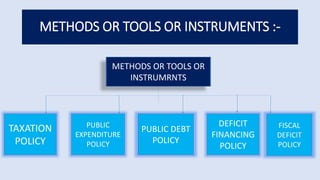
METHODS OR TOOLS OR INSTRUMENTS :-
METHODS OR TOOLS OR
INSTRUMRNTS
TAXATION
POLICY
PUBLIC
EXPENDITURE
POLICY
PUBLIC DEBT
POLICY
DEFICIT
FINANCING
POLICY
FISCAL
DEFICIT
POLICY
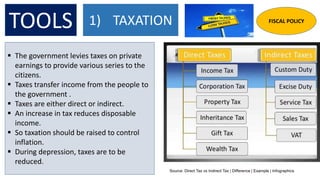
TOOLS 1) TAXATION
 The government levies taxes on private
earnings to provide various series to the
citizens.
 Taxes transfer income from the people to
the government .
 Taxes are either direct or indirect.
 An increase in tax reduces disposable
income.
 So taxation should be raised to control
inflation.
 During depression, taxes are to be
reduced.
Source: Direct Tax vs Indirect Tax | Difference | Example | Infographics
FISCAL POLICY
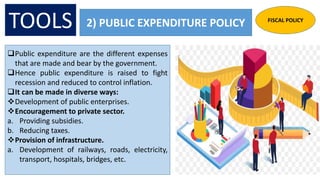
2) PUBLIC EXPENDITURE POLICY
Public expenditure are the different expenses
that are made and bear by the government.
Hence public expenditure is raised to fight
recession and reduced to control inflation.
It can be made in diverse ways:
Development of public enterprises.
Encouragement to private sector.
a. Providing subsidies.
b. Reducing taxes.
Provision of infrastructure.
a. Development of railways, roads, electricity,
transport, hospitals, bridges, etc.
TOOLS FISCAL POLICY
TOOLS 3) PUBLIC DEBT POLICY
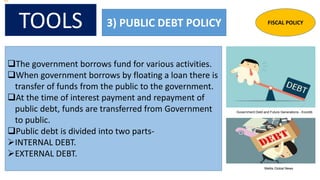
The government borrows fund for various activities.
When government borrows by floating a loan there is
transfer of funds from the public to the government.
At the time of interest payment and repayment of
public debt, funds are transferred from Government
to public.
Public debt is divided into two parts-
INTERNAL DEBT.
EXTERNAL DEBT.
FISCAL POLICY
Government Debt and Future Generations - Econlib
Mettis Global News
TOOLS 4) DEFICIT FINANCING POLICY FISCAL POLICY
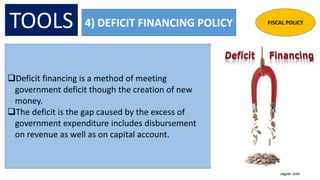
Deficit financing is a method of meeting
government deficit though the creation of new
money.
The deficit is the gap caused by the excess of
government expenditure includes disbursement
on revenue as well as on capital account.
Jagran Josh
TOOLS 5) FISCAL DEFICIT POLICY FISCAL POLICY
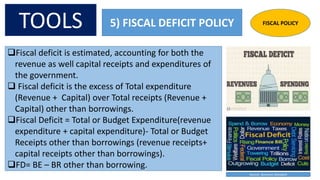
Fiscal deficit is estimated, accounting for both the
revenue as well capital receipts and expenditures of
the government.
 Fiscal deficit is the excess of Total expenditure
(Revenue + Capital) over Total receipts (Revenue +
Capital) other than borrowings.
Fiscal Deficit = Total or Budget Expenditure(revenue
expenditure + capital expenditure)- Total or Budget
Receipts other than borrowings (revenue receipts+
capital receipts other than borrowings).
FD= BE – BR other than borrowing.
Source: Business Standard
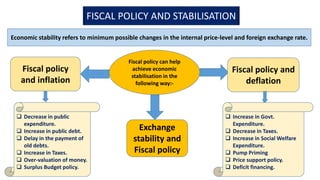
FISCAL POLICY AND STABILISATION
Economic stability refers to minimum possible changes in the internal price-level and foreign exchange rate.
Fiscal policy can help
achieve economic
stabilisation in the
following way:-
Fiscal policy
and inflation
Fiscal policy and
deflation
Exchange
stability and
Fiscal policy
 Decrease in public
expenditure.
 Increase in public debt.
 Delay in the payment of
old debts.
 Increase in Taxes.
 Over-valuation of money.
 Surplus Budget policy.
 Increase in Govt.
Expenditure.
 Decrease in Taxes.
 Increase in Social Welfare
Expenditure.
 Pump Priming
 Price support policy.
 Deficit financing.
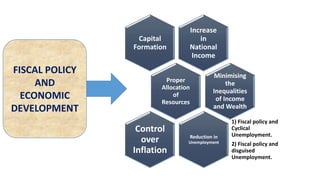
FISCAL POLICY
AND
ECONOMIC
DEVELOPMENT
Increase
in
National
Income
Capital
Formation
Proper
Allocation
of
Resources
Minimising
the
Inequalities
of Income
and Wealth
Reduction in
Unemployment
1) Fiscal policy and
Cyclical
Unemployment.
2) Fiscal policy and
disguised
Unemployment.
Control
over
Inflation
Fiscal Policy PPT.pptx

Fiscal Policy PPT.pptx

  • 1.
    PRESENTATION ON FISCAL POLICY Submitted to:Submitted by: Ms. Ginny Sayal Kirti Sharma Ass. Professor MBA-1ST SEM. Department of Management Class Roll No- 202123 Fiscal Policies Disastrous for Indian Economy - TheLeaflet
  • 2.
    CONTENTS:- • Introduction. • Definition. •Objectives. • Methods or tools or instruments. • Fiscal policy and stabilisation. • Economic development. • Conclusion.
  • 3.
    INTRODUCTION:-  Fiscal policyis a part of macro economics.  This policy is also known as budgetary policy.  The word fisc in English language means ‘state treasury’.  One major function of the government is to stabilize the economy.  Fiscal policy is an economic policy under which govt. uses its public revenue & expenditure to produce desirable effect on economy in terms of macroeconomic variables like national income, production and employment.
  • 4.
    DEFINITION:- 1. According toD.C. Rowan, “Fiscal Policy is defined as the discretionary action by the government to change (i) the level of government expenditure on goods and services and transfer payments and (ii) the yield of taxation at any given level of output.” 2. According to Musgrave, “Fiscal Policy is concerned with those aspects of economic policy which arise in the operation of the public budget.”
  • 5.
    OBJECTIVES:-  To raisethe level of Investments.  To check the fluctuations in the market.  To earn revenue.  Rapid Economic Development.  For proper allocation of the resources.  To increase capital formation.  Control on Inflation.  Price and economic stability.  Increase the rate of employment.
  • 6.
    METHODS OR TOOLSOR INSTRUMENTS :- METHODS OR TOOLS OR INSTRUMRNTS TAXATION POLICY PUBLIC EXPENDITURE POLICY PUBLIC DEBT POLICY DEFICIT FINANCING POLICY FISCAL DEFICIT POLICY
  • 7.
    TOOLS 1) TAXATION The government levies taxes on private earnings to provide various series to the citizens.  Taxes transfer income from the people to the government .  Taxes are either direct or indirect.  An increase in tax reduces disposable income.  So taxation should be raised to control inflation.  During depression, taxes are to be reduced. Source: Direct Tax vs Indirect Tax | Difference | Example | Infographics FISCAL POLICY
  • 8.
    2) PUBLIC EXPENDITUREPOLICY Public expenditure are the different expenses that are made and bear by the government. Hence public expenditure is raised to fight recession and reduced to control inflation. It can be made in diverse ways: Development of public enterprises. Encouragement to private sector. a. Providing subsidies. b. Reducing taxes. Provision of infrastructure. a. Development of railways, roads, electricity, transport, hospitals, bridges, etc. TOOLS FISCAL POLICY
  • 9.
    TOOLS 3) PUBLICDEBT POLICY The government borrows fund for various activities. When government borrows by floating a loan there is transfer of funds from the public to the government. At the time of interest payment and repayment of public debt, funds are transferred from Government to public. Public debt is divided into two parts- INTERNAL DEBT. EXTERNAL DEBT. FISCAL POLICY Government Debt and Future Generations - Econlib Mettis Global News
  • 10.
    TOOLS 4) DEFICITFINANCING POLICY FISCAL POLICY Deficit financing is a method of meeting government deficit though the creation of new money. The deficit is the gap caused by the excess of government expenditure includes disbursement on revenue as well as on capital account. Jagran Josh
  • 11.
    TOOLS 5) FISCALDEFICIT POLICY FISCAL POLICY Fiscal deficit is estimated, accounting for both the revenue as well capital receipts and expenditures of the government.  Fiscal deficit is the excess of Total expenditure (Revenue + Capital) over Total receipts (Revenue + Capital) other than borrowings. Fiscal Deficit = Total or Budget Expenditure(revenue expenditure + capital expenditure)- Total or Budget Receipts other than borrowings (revenue receipts+ capital receipts other than borrowings). FD= BE – BR other than borrowing. Source: Business Standard
  • 12.
    FISCAL POLICY ANDSTABILISATION Economic stability refers to minimum possible changes in the internal price-level and foreign exchange rate. Fiscal policy can help achieve economic stabilisation in the following way:- Fiscal policy and inflation Fiscal policy and deflation Exchange stability and Fiscal policy  Decrease in public expenditure.  Increase in public debt.  Delay in the payment of old debts.  Increase in Taxes.  Over-valuation of money.  Surplus Budget policy.  Increase in Govt. Expenditure.  Decrease in Taxes.  Increase in Social Welfare Expenditure.  Pump Priming  Price support policy.  Deficit financing.
  • 13.
    FISCAL POLICY AND ECONOMIC DEVELOPMENT Increase in National Income Capital Formation Proper Allocation of Resources Minimising the Inequalities of Income andWealth Reduction in Unemployment 1) Fiscal policy and Cyclical Unemployment. 2) Fiscal policy and disguised Unemployment. Control over Inflation