DEMAND SIDE POLICIES
FISCAL POLICIES MONETARY POLICIES
1. FISCAL POLICY 1.1 Fiscal Tools: Government Expenditure (G) Taxes (T) Government’s Fiscal Stance:  Expansionary v/s Contractionary
1.2 Purpose of Fiscal Policy To correct disequilibrium in the economy To reduce fluctuations during business cycles. Hence, fiscal policies are also called  stabilisation policies.
Existing fiscal tools can act as  automatic fiscal stabilisers. OR  Government can adopt  discretionary fiscal policies NOTE: Government Expenditure multiplier  effect > Tax multiplier effect How do Fiscal Tools work?
1.3 Effectiveness of Automatic Fiscal Stabilisers  Main Benefit: It acts instantly Main Problems:  It does not eliminate fluctuations High taxes offer stability but discourages workers and investors Adverse effect of high unemployment benefits
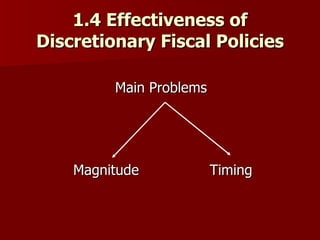
Main Problems   Magnitude  Timing 1.4 Effectiveness of Discretionary Fiscal Policies
Magnitude Problem Difficult to predict the effect of a change in G An increase in G by x% can lead to increase in injections  by less than x%.  Why? Difficult to predict the effect of a change in T An increase in T affects consumers’ ability to spend and  save.    Outcome depends on whether consumers expect  this change to be temporary or permanent.
Difficult to predict the size of the multiplier  The effect on consumption or savings will depend on  future expectations. It is also difficult to predict the increase in investment  through the accelerator. Random shocks Unpredictable events can undermine effectiveness of fiscal  policy.
Timing Problem Time lags are involved with fiscal policies.  Why?? Government takes time to recognise the problem.  Government takes time to take the appropriate action. It takes time for the change in policy to take effect.
The multiplier effect takes time to happen. Consumption adjusts slowly to change in T Note: If these time lags are long then fiscal  policies can destabilise the economy.  Example??
Undesirable Effects of Discretionary Fiscal Policy Cost Inflation Distributive Justice Disincentive Effects
2. MONETARY POLICY   2.1 Monetary Tools Interest Rates The Monetary Policy Committee sets the  interest rate in UK. Rationing of Credit This tool is not used now
Growth of money supply Central Bank can influence the money  supply through: Open Market Operations (OMO) Discount Rate  Reserve Ratio
2.2 Effectiveness of  Monetary Policy A) Effectiveness of credit rationing Benefit: It can direct loans towards productive purposes. Problems: Banks may resist Dampens growth of banks SMEs can be adversely affected Open world financial market reduces effectiveness of domestic policies
B) Effectiveness of changing interest rates Benefit: No implementation time lag Problems arise if: Demand for Loans is fairly inelastic Money demand is unstable
C) Effectiveness of controlling money supply: OMO may not reduce liquidity. Why?? Increase in reserve ratio may not slow down credit creation process. Why?? Increase in discount rate may not affect amount of loans created.  Why??
POLICY MIX If fiscal and monetary policies are used  together, they are more likely to be  successful.

Demand side policies

  • 1.
  • 2.
  • 3.
    1. FISCAL POLICY1.1 Fiscal Tools: Government Expenditure (G) Taxes (T) Government’s Fiscal Stance: Expansionary v/s Contractionary
  • 4.
    1.2 Purpose ofFiscal Policy To correct disequilibrium in the economy To reduce fluctuations during business cycles. Hence, fiscal policies are also called stabilisation policies.
  • 5.
    Existing fiscal toolscan act as automatic fiscal stabilisers. OR Government can adopt discretionary fiscal policies NOTE: Government Expenditure multiplier effect > Tax multiplier effect How do Fiscal Tools work?
  • 6.
    1.3 Effectiveness ofAutomatic Fiscal Stabilisers Main Benefit: It acts instantly Main Problems: It does not eliminate fluctuations High taxes offer stability but discourages workers and investors Adverse effect of high unemployment benefits
  • 7.
    Main Problems Magnitude Timing 1.4 Effectiveness of Discretionary Fiscal Policies
  • 8.
    Magnitude Problem Difficultto predict the effect of a change in G An increase in G by x% can lead to increase in injections by less than x%. Why? Difficult to predict the effect of a change in T An increase in T affects consumers’ ability to spend and save. Outcome depends on whether consumers expect this change to be temporary or permanent.
  • 9.
    Difficult to predictthe size of the multiplier The effect on consumption or savings will depend on future expectations. It is also difficult to predict the increase in investment through the accelerator. Random shocks Unpredictable events can undermine effectiveness of fiscal policy.
  • 10.
    Timing Problem Timelags are involved with fiscal policies. Why?? Government takes time to recognise the problem. Government takes time to take the appropriate action. It takes time for the change in policy to take effect.
  • 11.
    The multiplier effecttakes time to happen. Consumption adjusts slowly to change in T Note: If these time lags are long then fiscal policies can destabilise the economy. Example??
  • 12.
    Undesirable Effects ofDiscretionary Fiscal Policy Cost Inflation Distributive Justice Disincentive Effects
  • 13.
    2. MONETARY POLICY 2.1 Monetary Tools Interest Rates The Monetary Policy Committee sets the interest rate in UK. Rationing of Credit This tool is not used now
  • 14.
    Growth of moneysupply Central Bank can influence the money supply through: Open Market Operations (OMO) Discount Rate Reserve Ratio
  • 15.
    2.2 Effectiveness of Monetary Policy A) Effectiveness of credit rationing Benefit: It can direct loans towards productive purposes. Problems: Banks may resist Dampens growth of banks SMEs can be adversely affected Open world financial market reduces effectiveness of domestic policies
  • 16.
    B) Effectiveness ofchanging interest rates Benefit: No implementation time lag Problems arise if: Demand for Loans is fairly inelastic Money demand is unstable
  • 17.
    C) Effectiveness ofcontrolling money supply: OMO may not reduce liquidity. Why?? Increase in reserve ratio may not slow down credit creation process. Why?? Increase in discount rate may not affect amount of loans created. Why??
  • 18.
    POLICY MIX Iffiscal and monetary policies are used together, they are more likely to be successful.