Harmonization vs.
Competition: Fiscal Union
vs. Decentralization
           Free Market Road Show,
           April 27, 2012
Defining the Problem
   There is no “European” problem.
   There is no “Eurozone” problem.
   There is no “Euro” problem.
   There is a problem of many nations taxing
   too much and spending too much.
   This is leading to anemic economic
   performance.
   International investors don’t trust some
   nations to pay thir bills.
Making Bad Policy Even Worse
   Proposals for tax harmonization and/or a
   fiscal union will exacerbate the problems in
   Europe.
   No economic rationale for identical/similar tax
   rates.
   No economic rationale for fiscal transfers.
   Look at the U.S., particularly in the past.
   Look at Switzerland today.
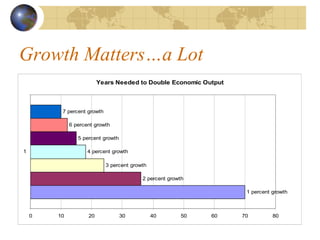
Growth Matters…a Lot
                         Years Needed to Double Economic Output


         7 percent growth

             6 percent growth

                5 percent growth

1                   4 percent growth

                            3 percent growth

                                          2 percent growth

                                                                   1 percent growth


    0   10          20             30          40       50   60   70         80
Definition of Good Fiscal Policy
  Government spending should grow slower
  than nominal GDP.
  Over time, this reduces burden of public
  sector.
  Eliminates risk of higher taxes.
  Deficits eventually disappear.
  Debt shrinks as share of GDP.
  Politicians don’t like this approach since they
  can’t buy votes with other people’s money.
Size of Government Matters…a Lot
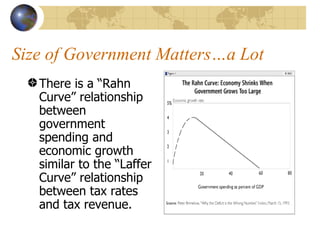
   There is a “Rahn
   Curve” relationship
   between
   government
   spending and
   economic growth
   similar to the “Laffer
   Curve” relationship
   between tax rates
   and tax revenue.
Big Government Inevitably…
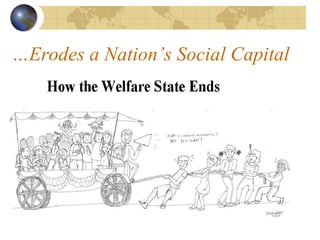
…Erodes a Nation’s Social Capital
Demographics Is Fiscal Destiny
   Ageing populations and welfare states are an
   unstable combination.
   Pay-as-you-go systems are Ponzi schemes.
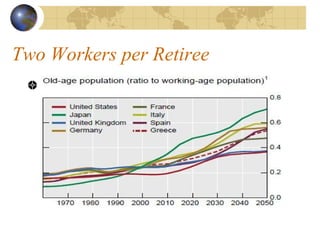
   Not enough future workers to support
   redistribution programs.
   Without reform, massive debt or massive tax
   increases.
   Probably both
Two Workers per Retiree
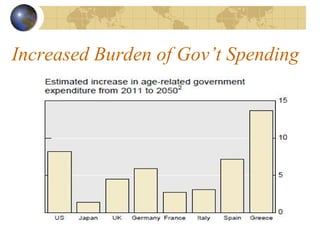
Increased Burden of Gov’t Spending
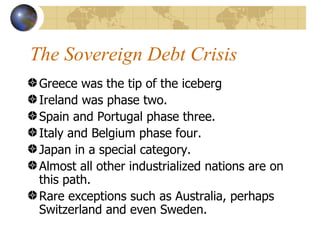
The Sovereign Debt Crisis
 Greece was the tip of the iceberg
 Ireland was phase two.
 Spain and Portugal phase three.
 Italy and Belgium phase four.
 Japan in a special category.
 Almost all other industrialized nations are on
 this path.
 Rare exceptions such as Australia, perhaps
 Switzerland and even Sweden.
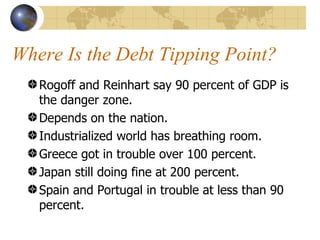
Where Is the Debt Tipping Point?
   Rogoff and Reinhart say 90 percent of GDP is
   the danger zone.
   Depends on the nation.
   Industrialized world has breathing room.
   Greece got in trouble over 100 percent.
   Japan still doing fine at 200 percent.
   Spain and Portugal in trouble at less than 90
   percent.
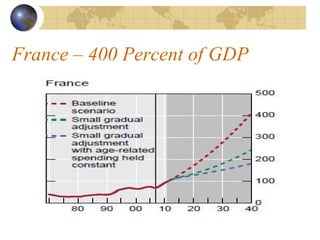
France – 400 Percent of GDP
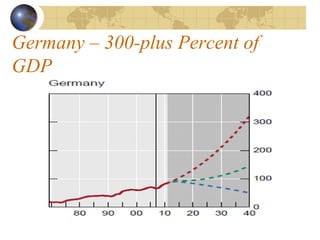
Germany – 300-plus Percent of
GDP
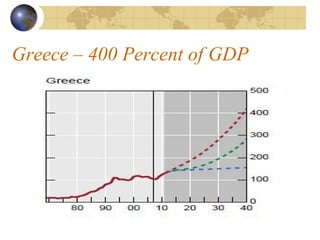
Greece – 400 Percent of GDP
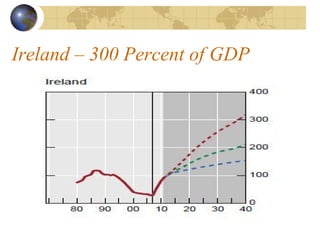
Ireland – 300 Percent of GDP
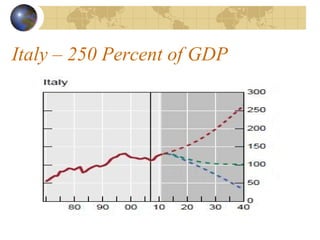
Italy – 250 Percent of GDP
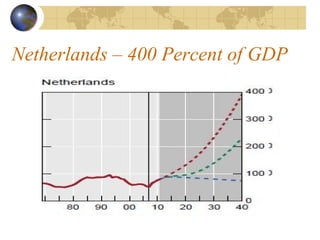
Netherlands – 400 Percent of GDP
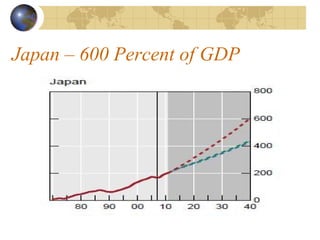
Japan – 600 Percent of GDP
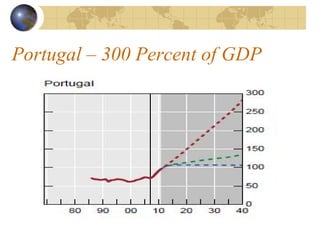
Portugal – 300 Percent of GDP
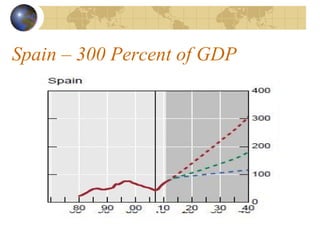
Spain – 300 Percent of GDP
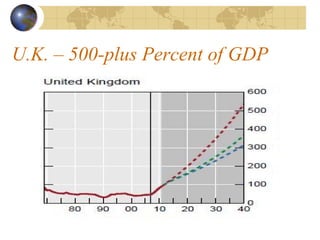
U.K. – 500-plus Percent of GDP
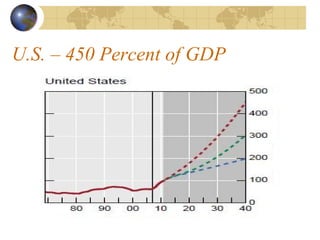
U.S. – 450 Percent of GDP
Implications for Tax Policy
   Burden of government spending will increase
   by at least 10 percentage points of GDP.
   BIS model shows worse results, driven by
   interest assumptions.
   That won’t happen because it means an end
   to Western civilization.
   But what will happen?
   In Europe, some nations will default and
   leave the euro (so they can inflate).
Can Europe Tax to Prosperity?
   Taxes on personal income averaged 9 percent
   of GDP as of 2008.
   VAT rates already average more than 20
   percent.
   Payroll tax rates also very high in most
   European nations.
   A reverse of trend of lower corporate rates is
   almost certain.
   But…
Revenge of the Laffer Curve?
   Politicians can increase tax rates, but that
   does not necessarily mean they collect more
   tax revenue.
   If economic growth slows, taxable income
   also slows.
   If incentives to avoid and evade rise, taxable
   income slows even more.
   America conducted a Laffer Curve experiment
   in the 1980s.
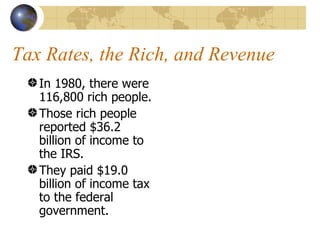
Tax Rates, the Rich, and Revenue
   In 1980, there were
   116,800 rich people.
   Those rich people
   reported $36.2
   billion of income to
   the IRS.
   They paid $19.0
   billion of income tax
   to the federal
   government.
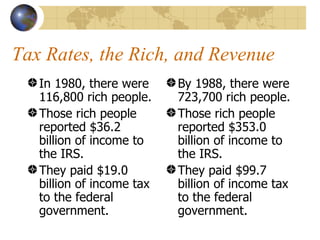
Tax Rates, the Rich, and Revenue
   In 1980, there were     By 1988, there were
   116,800 rich people.    723,700 rich people.
   Those rich people       Those rich people
   reported $36.2          reported $353.0
   billion of income to    billion of income to
   the IRS.                the IRS.
   They paid $19.0         They paid $99.7
   billion of income tax   billion of income tax
   to the federal          to the federal
   government.             government.
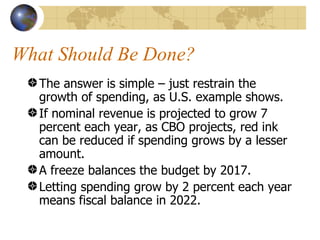
What Should Be Done?
  The answer is simple – just restrain the
  growth of spending, as U.S. example shows.
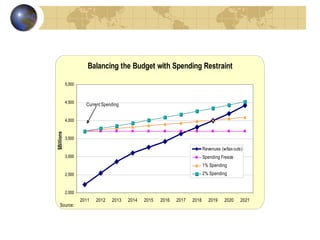
  If nominal revenue is projected to grow 7
  percent each year, as CBO projects, red ink
  can be reduced if spending grows by a lesser
  amount.
  A freeze balances the budget by 2017.
  Letting spending grow by 2 percent each year
  means fiscal balance in 2022.
Balancing the Budget with Spending Restraint

            5,000


            4,500
                      Current Spending


            4,000
$Billions


            3,500

                                                                            Revenues (w/tax cuts)
            3,000                                                           Spending Freeze
                                                                            1% Spending
            2,500                                                           2% Spending


            2,000
                    2011   2012   2013   2014   2015   2016   2017   2018      2019    2020    2021
    Source:
Other Nations Have Reformed
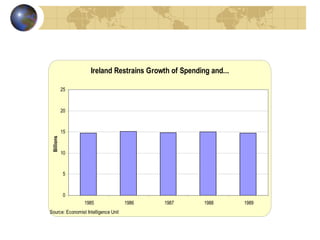
   Good fiscal policy does not require miracles,
   just spending restraint.
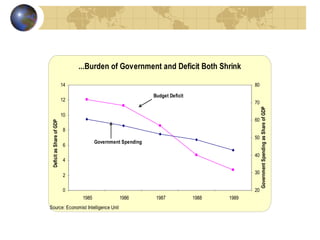
   If spending grows slower than nominal GDP,
   good things happen.
   Greater levels of fiscal restraint mean quicker
   progress.
   If spending grows faster than nominal GDP,
   sooner or later a nation becomes Greece.
   But sometimes nations do the right thing.
Ireland Restrains Growth of Spending and...

            25


            20


            15
 Billions


            10


            5


            0
                 1985                 1986   1987      1988       1989
Source: Economist Intelligence Unit
...Burden of Government and Deficit Both Shrink

                           14                                                                80

                                                              Budget Deficit
                           12
                                                                                             70


                                                                                                  Government Spending as Share of GDP
                           10
                                                                                             60
 Deficit as Share of GDP


                           8
                                                                                             50
                                        Government Spending
                           6
                                                                                             40
                           4

                                                                                             30
                           2

                           0                                                                 20
                                 1985             1986         1987            1988   1989
Source: Economist Intelligence Unit
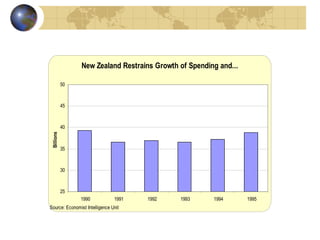
New Zealand Restrains Growth of Spending and...

            50


            45


            40
 Billions


            35


            30


            25
                 1990           1991   1992   1993      1994       1995
Source: Economist Intelligence Unit
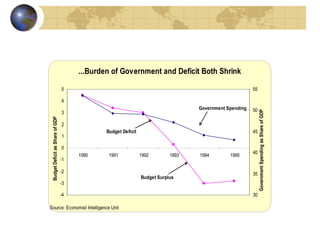
...Burden of Government and Deficit Both Shrink

                                  5                                                                      55

                                  4
                                                                                   Government Spending   50


                                                                                                              Government Spending as Share of GDP
                                  3
 Budget Deficit as Share of GDP


                                  2
                                               Budget Deficit                                            45
                                  1

                                  0
                                                                                                         40
                                       1990     1991            1992        1993   1994        1995
                                  -1

                                  -2                                                                     35
                                                                Budget Surplus
                                  -3

                                  -4                                                                     30

Source: Economist Intelligence Unit
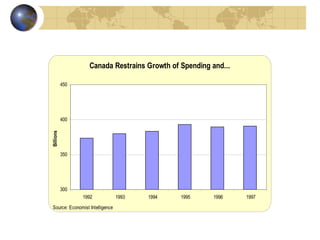
Canada Restrains Growth of Spending and...

           450


           400
Billions


           350


           300
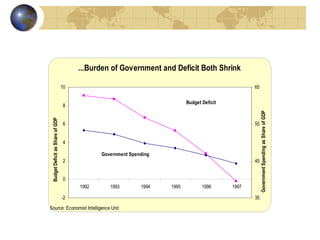
                 1992             1993   1994   1995    1996    1997
 Source: Economist Intelligence
...Burden of Government and Deficit Both Shrink

                                  10                                                               65

                                                                           Budget Deficit
                                  8


                                                                                                        Government Spending as Share of GDP
 Budget Deficit as Share of GDP


                                  6                                                                55


                                  4

                                              Government Spending
                                  2                                                                45


                                  0
                                       1992      1993        1994   1995          1996      1997

                                  -2                                                               35
Source: Economist Intelligence Unit
Conclusion
   Three challenges for Europe
     Correctly identifying the problem – big
     government is the disease. Deficits and
     debt are symptoms.
     Figuring out ways to “bend the cost curve”
     of government spending.
     Convincing voters that liberty is better than
     dependency – particularly when
     dependency means fiscal disaster.

Daniel Mitchell: Free Market Road Show 2012

  • 1.
    Harmonization vs. Competition: FiscalUnion vs. Decentralization Free Market Road Show, April 27, 2012
  • 2.
    Defining the Problem There is no “European” problem. There is no “Eurozone” problem. There is no “Euro” problem. There is a problem of many nations taxing too much and spending too much. This is leading to anemic economic performance. International investors don’t trust some nations to pay thir bills.
  • 3.
    Making Bad PolicyEven Worse Proposals for tax harmonization and/or a fiscal union will exacerbate the problems in Europe. No economic rationale for identical/similar tax rates. No economic rationale for fiscal transfers. Look at the U.S., particularly in the past. Look at Switzerland today.
  • 4.
    Growth Matters…a Lot Years Needed to Double Economic Output 7 percent growth 6 percent growth 5 percent growth 1 4 percent growth 3 percent growth 2 percent growth 1 percent growth 0 10 20 30 40 50 60 70 80
  • 5.
    Definition of GoodFiscal Policy Government spending should grow slower than nominal GDP. Over time, this reduces burden of public sector. Eliminates risk of higher taxes. Deficits eventually disappear. Debt shrinks as share of GDP. Politicians don’t like this approach since they can’t buy votes with other people’s money.
  • 6.
    Size of GovernmentMatters…a Lot There is a “Rahn Curve” relationship between government spending and economic growth similar to the “Laffer Curve” relationship between tax rates and tax revenue.
  • 7.
  • 8.
    …Erodes a Nation’sSocial Capital
  • 9.
    Demographics Is FiscalDestiny Ageing populations and welfare states are an unstable combination. Pay-as-you-go systems are Ponzi schemes. Not enough future workers to support redistribution programs. Without reform, massive debt or massive tax increases. Probably both
  • 10.
  • 11.
    Increased Burden ofGov’t Spending
  • 12.
    The Sovereign DebtCrisis Greece was the tip of the iceberg Ireland was phase two. Spain and Portugal phase three. Italy and Belgium phase four. Japan in a special category. Almost all other industrialized nations are on this path. Rare exceptions such as Australia, perhaps Switzerland and even Sweden.
  • 13.
    Where Is theDebt Tipping Point? Rogoff and Reinhart say 90 percent of GDP is the danger zone. Depends on the nation. Industrialized world has breathing room. Greece got in trouble over 100 percent. Japan still doing fine at 200 percent. Spain and Portugal in trouble at less than 90 percent.
  • 14.
    France – 400Percent of GDP
  • 15.
    Germany – 300-plusPercent of GDP
  • 16.
    Greece – 400Percent of GDP
  • 17.
    Ireland – 300Percent of GDP
  • 18.
    Italy – 250Percent of GDP
  • 19.
    Netherlands – 400Percent of GDP
  • 20.
    Japan – 600Percent of GDP
  • 21.
    Portugal – 300Percent of GDP
  • 22.
    Spain – 300Percent of GDP
  • 23.
    U.K. – 500-plusPercent of GDP
  • 24.
    U.S. – 450Percent of GDP
  • 25.
    Implications for TaxPolicy Burden of government spending will increase by at least 10 percentage points of GDP. BIS model shows worse results, driven by interest assumptions. That won’t happen because it means an end to Western civilization. But what will happen? In Europe, some nations will default and leave the euro (so they can inflate).
  • 26.
    Can Europe Taxto Prosperity? Taxes on personal income averaged 9 percent of GDP as of 2008. VAT rates already average more than 20 percent. Payroll tax rates also very high in most European nations. A reverse of trend of lower corporate rates is almost certain. But…
  • 27.
    Revenge of theLaffer Curve? Politicians can increase tax rates, but that does not necessarily mean they collect more tax revenue. If economic growth slows, taxable income also slows. If incentives to avoid and evade rise, taxable income slows even more. America conducted a Laffer Curve experiment in the 1980s.
  • 28.
    Tax Rates, theRich, and Revenue In 1980, there were 116,800 rich people. Those rich people reported $36.2 billion of income to the IRS. They paid $19.0 billion of income tax to the federal government.
  • 29.
    Tax Rates, theRich, and Revenue In 1980, there were By 1988, there were 116,800 rich people. 723,700 rich people. Those rich people Those rich people reported $36.2 reported $353.0 billion of income to billion of income to the IRS. the IRS. They paid $19.0 They paid $99.7 billion of income tax billion of income tax to the federal to the federal government. government.
  • 30.
    What Should BeDone? The answer is simple – just restrain the growth of spending, as U.S. example shows. If nominal revenue is projected to grow 7 percent each year, as CBO projects, red ink can be reduced if spending grows by a lesser amount. A freeze balances the budget by 2017. Letting spending grow by 2 percent each year means fiscal balance in 2022.
  • 31.
    Balancing the Budgetwith Spending Restraint 5,000 4,500 Current Spending 4,000 $Billions 3,500 Revenues (w/tax cuts) 3,000 Spending Freeze 1% Spending 2,500 2% Spending 2,000 2011 2012 2013 2014 2015 2016 2017 2018 2019 2020 2021 Source:
  • 32.
    Other Nations HaveReformed Good fiscal policy does not require miracles, just spending restraint. If spending grows slower than nominal GDP, good things happen. Greater levels of fiscal restraint mean quicker progress. If spending grows faster than nominal GDP, sooner or later a nation becomes Greece. But sometimes nations do the right thing.
  • 33.
    Ireland Restrains Growthof Spending and... 25 20 15 Billions 10 5 0 1985 1986 1987 1988 1989 Source: Economist Intelligence Unit
  • 34.
    ...Burden of Governmentand Deficit Both Shrink 14 80 Budget Deficit 12 70 Government Spending as Share of GDP 10 60 Deficit as Share of GDP 8 50 Government Spending 6 40 4 30 2 0 20 1985 1986 1987 1988 1989 Source: Economist Intelligence Unit
  • 35.
    New Zealand RestrainsGrowth of Spending and... 50 45 40 Billions 35 30 25 1990 1991 1992 1993 1994 1995 Source: Economist Intelligence Unit
  • 36.
    ...Burden of Governmentand Deficit Both Shrink 5 55 4 Government Spending 50 Government Spending as Share of GDP 3 Budget Deficit as Share of GDP 2 Budget Deficit 45 1 0 40 1990 1991 1992 1993 1994 1995 -1 -2 35 Budget Surplus -3 -4 30 Source: Economist Intelligence Unit
  • 37.
    Canada Restrains Growthof Spending and... 450 400 Billions 350 300 1992 1993 1994 1995 1996 1997 Source: Economist Intelligence
  • 38.
    ...Burden of Governmentand Deficit Both Shrink 10 65 Budget Deficit 8 Government Spending as Share of GDP Budget Deficit as Share of GDP 6 55 4 Government Spending 2 45 0 1992 1993 1994 1995 1996 1997 -2 35 Source: Economist Intelligence Unit
  • 39.
    Conclusion Three challenges for Europe Correctly identifying the problem – big government is the disease. Deficits and debt are symptoms. Figuring out ways to “bend the cost curve” of government spending. Convincing voters that liberty is better than dependency – particularly when dependency means fiscal disaster.