-First aid can be define as it is the simple medical
treatment given as soon as possible to someone who is
injured or who suddenly becomes ill is called as first
aid.
Or
Immediately treatment give to the patient Accidental
victim or sudden illness.
Objective of First Aid
1. To prevent the life of human.
2. To prevent the worsening of injury.
3. To promote recovery.
 The most accident happen at homes,
schools and public places and the first
Aider can be treat condition better than
a stranger.
e.g. if someone’s get snack bite that
condition first aid very important because
it may be change ambulance will be
delay that time patient may death.
 The principle of first aid are based on the
principle of practice of medicine and
surgery. The aim of of first aid is to
preserve life, promote recovery and
prevent injury or illness until medicine aid
is obtained.
 Shocks is the term which is often used
loosely, resulting in confusion. In medical
terms, shocks is condition which occurs
due to loss of circulating blood volume.
 Causes
1. Loss of circulation volume.
2. Increase circulatory capacity.
3. Lack of normal circulation.
1. Nausea and vomiting.
2. Fast and weak pulse.
3. Anxious.
4. Low blood pressure.
5. Excessive sweating.
6. Poor urine output.
 Heart failure.
 Heart attack.
 Electrocution.
 Dehydration.
 Severe bleeding.
 Severe burns.
 Head and Spinal injury.
 Severe allergy reaction.
 Lay the person down and elevate the legs and feet
slightly, unless you think this may cause pain or further
injury.
 Keep the person still and don't move him or her unless
necessary.
 Begin CPR if the person shows no signs of life, such as
not breathing, coughing or moving.
 Loosen tight clothing and, if needed, cover the
person with a blanket to prevent chilling.
 Don't let the person eat or drink anything.
 If the person vomits or begins bleeding from the
mouth, and no spinal injury is suspected, turn him or
her onto a side to prevent choking.
Or call 199 for emergency ambulance.
 There are more than 3500 species of snaks.
But only 250 are venomous. The common
poisonous snakes are cobra, king cobra,
common Krait, banded Krait and Russel’s
viper. Also some 20 types of sea snake are
poisonous.
 Examination of bitten person.
1. Puncture wound.
2. Pain.
3. Sweeping.
4. Other symptoms.
1. Torniquet.
2. Cleaning.
3. Local incision.
4. Assurance.
5. No sleep.
 Medical treatment-
It consist of given specific antivenous or
polyvalent antivenin.
 Poison –
A poison is any substance which has a
harmful effect on the body, injuries health or
producing death.
 Poisoning
Poisoning may be accidental or
intentionally.
The poisoning may be occurs by-
1. Inhalation- when poisoning gases or fumes
are breathed
2. Ingestion-
when the poison is swallowed.
3. Injection-
Into the skin by means of a syringe or when
a poisonous animal or insect bites.
1. For corrosive.
2. Unconscious patients.
3. Conscious patient.
1. Corrosive acids.
2. Corrosive alkalies.
3. Insecticides.
4. Narcotics.
5. Sleeping tablets.
6. Aspirin.
7. Food poisoning.
8. Carbon monoxide.
 Burns is certain type of injuries.
1. Dry heat such as fire, a piece of hot
metel or sun.
2. Electric current when an electric
conductor is contacted.
3. Lightening.
4. Corrosive chemical such as acids or
alkalies.
1. Put out the fire.
2. Shocks.
3. Maintenance of airways.
4. Prevention of infection.
5. Dressing the Burns.
 The heart disease which required first aid
are angina pectoris and heart attack.
1. Angina pectoris
it means pain in cheat. Now it is taken to
mean pain of cardiac origin without
coronary thrombosis. It occurs due to spam
or narrowing of coronary arteries, so they
cannot supply enough blood to the
heart.the pain is of short duration and it is
relieved by rest.
 Sign and symptoms
1. Chest pain.
2. Rapid and slow respiration.
3. Clouding of consciousness.
4. Nausea or vomiting.
 First aid
1. Reassurance of the patient.
2. The patient must sit or lie down. If there is
vomating he should be placed in
recovery position.
3. Cloths must be loosened.
4. If the patient has tablets (glyceryl
trinitrite) he may be asked to take it.
5. Immediate medical advice is required.
Hearth attack (Myocardial
infraction, coronary thrombosis)
 Sign and symptoms
1. and vomating.
2. Sweating.
3. Rapid and slow respiration.
4. Irregular pulse.
5. Hearth may be stop with sudden
collapse of the patient (cardiac arrest).
6. Pain in chest.
 First aid
1. If there is no pulse, cardiacpulmonary
resuscitation must be commenced
immediately.
2. Nothing should given by mouth.
3. Unconscious patients with pulse and
breathing should be placed in recovery
position. Airway must be maintained.
4. Unconscious patients must be placed
sitting at 45 degree and should not be laid
flat. Leg should not be raised since it may
increase venous return and thus strain the
heart.
5. Clothes must be loosened and the patient
reassured.
6. Movement must be limited as much as
possible.
7. Medical help must be summoned
immediately.
 Stroke
it occurs due to cerebral hemorrhage or
due to thrombosis of cerebral blood
vessels. It occurs due to impaired blood
supply to brain or due to increase pressure.
There is loss of function of the affected
area. Sign and symptoms depends on the
area of which damage.
 Sign and symptoms.
1. Disorientation.
2. Difficulty with speech.
3. Weakness or paralysis.
4. Loss of balance.
5. Headache.
6. Coma.
 First aid
if pulse or respiration stops, rescucitation is
started immediately. Nothing should be given
by mouth.
1. Reassurance of the patient. If unconscious,
he is placed in recovery position.
2. Clear airway is ensured.
3. Clothes are loosened.
4. Medical aid is summoned.
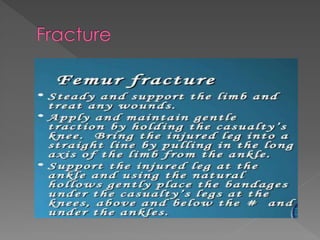
 Fracture-
A fracture is a break in continuity of a
bone. It may very from a crack to a
complete break.
 Causes of fracture-
. Fractures occurs due to application of
force to the skeleton. The force may be
direct or indirect.
 Direct force-
The bone breaks at the spot where force
is applied.
 Indirect force-
The bone breaks at some distance from
the spot where force is applied. E.g.
Fracture of collar bone due to fall on the
outstretched hand.
1. N. Murugesh, Health education and
community pharmacy, 4th edition,
Sathya publishers, page no. 66-99.
2. https://www.slideshare.net/mobile/prati
maninama/first-aid-for-fracture.
First health

First health

  • 3.
    -First aid canbe define as it is the simple medical treatment given as soon as possible to someone who is injured or who suddenly becomes ill is called as first aid. Or Immediately treatment give to the patient Accidental victim or sudden illness. Objective of First Aid 1. To prevent the life of human. 2. To prevent the worsening of injury. 3. To promote recovery.
  • 4.
     The mostaccident happen at homes, schools and public places and the first Aider can be treat condition better than a stranger. e.g. if someone’s get snack bite that condition first aid very important because it may be change ambulance will be delay that time patient may death.
  • 5.
     The principleof first aid are based on the principle of practice of medicine and surgery. The aim of of first aid is to preserve life, promote recovery and prevent injury or illness until medicine aid is obtained.
  • 7.
     Shocks isthe term which is often used loosely, resulting in confusion. In medical terms, shocks is condition which occurs due to loss of circulating blood volume.  Causes 1. Loss of circulation volume. 2. Increase circulatory capacity. 3. Lack of normal circulation.
  • 8.
    1. Nausea andvomiting. 2. Fast and weak pulse. 3. Anxious. 4. Low blood pressure. 5. Excessive sweating. 6. Poor urine output.
  • 9.
     Heart failure. Heart attack.  Electrocution.  Dehydration.  Severe bleeding.  Severe burns.  Head and Spinal injury.  Severe allergy reaction.
  • 11.
     Lay theperson down and elevate the legs and feet slightly, unless you think this may cause pain or further injury.  Keep the person still and don't move him or her unless necessary.  Begin CPR if the person shows no signs of life, such as not breathing, coughing or moving.  Loosen tight clothing and, if needed, cover the person with a blanket to prevent chilling.  Don't let the person eat or drink anything.  If the person vomits or begins bleeding from the mouth, and no spinal injury is suspected, turn him or her onto a side to prevent choking. Or call 199 for emergency ambulance.
  • 12.
     There aremore than 3500 species of snaks. But only 250 are venomous. The common poisonous snakes are cobra, king cobra, common Krait, banded Krait and Russel’s viper. Also some 20 types of sea snake are poisonous.  Examination of bitten person. 1. Puncture wound. 2. Pain. 3. Sweeping. 4. Other symptoms.
  • 13.
    1. Torniquet. 2. Cleaning. 3.Local incision. 4. Assurance. 5. No sleep.  Medical treatment- It consist of given specific antivenous or polyvalent antivenin.
  • 14.
     Poison – Apoison is any substance which has a harmful effect on the body, injuries health or producing death.  Poisoning Poisoning may be accidental or intentionally. The poisoning may be occurs by- 1. Inhalation- when poisoning gases or fumes are breathed
  • 15.
    2. Ingestion- when thepoison is swallowed. 3. Injection- Into the skin by means of a syringe or when a poisonous animal or insect bites.
  • 16.
    1. For corrosive. 2.Unconscious patients. 3. Conscious patient.
  • 17.
    1. Corrosive acids. 2.Corrosive alkalies. 3. Insecticides. 4. Narcotics. 5. Sleeping tablets. 6. Aspirin. 7. Food poisoning. 8. Carbon monoxide.
  • 18.
     Burns iscertain type of injuries. 1. Dry heat such as fire, a piece of hot metel or sun. 2. Electric current when an electric conductor is contacted. 3. Lightening. 4. Corrosive chemical such as acids or alkalies.
  • 19.
    1. Put outthe fire. 2. Shocks. 3. Maintenance of airways. 4. Prevention of infection. 5. Dressing the Burns.
  • 20.
     The heartdisease which required first aid are angina pectoris and heart attack. 1. Angina pectoris it means pain in cheat. Now it is taken to mean pain of cardiac origin without coronary thrombosis. It occurs due to spam or narrowing of coronary arteries, so they cannot supply enough blood to the heart.the pain is of short duration and it is relieved by rest.
  • 21.
     Sign andsymptoms 1. Chest pain. 2. Rapid and slow respiration. 3. Clouding of consciousness. 4. Nausea or vomiting.
  • 22.
     First aid 1.Reassurance of the patient. 2. The patient must sit or lie down. If there is vomating he should be placed in recovery position. 3. Cloths must be loosened. 4. If the patient has tablets (glyceryl trinitrite) he may be asked to take it. 5. Immediate medical advice is required.
  • 24.
    Hearth attack (Myocardial infraction,coronary thrombosis)  Sign and symptoms 1. and vomating. 2. Sweating. 3. Rapid and slow respiration. 4. Irregular pulse. 5. Hearth may be stop with sudden collapse of the patient (cardiac arrest). 6. Pain in chest.
  • 25.
     First aid 1.If there is no pulse, cardiacpulmonary resuscitation must be commenced immediately. 2. Nothing should given by mouth. 3. Unconscious patients with pulse and breathing should be placed in recovery position. Airway must be maintained.
  • 26.
    4. Unconscious patientsmust be placed sitting at 45 degree and should not be laid flat. Leg should not be raised since it may increase venous return and thus strain the heart. 5. Clothes must be loosened and the patient reassured. 6. Movement must be limited as much as possible. 7. Medical help must be summoned immediately.
  • 27.
     Stroke it occursdue to cerebral hemorrhage or due to thrombosis of cerebral blood vessels. It occurs due to impaired blood supply to brain or due to increase pressure. There is loss of function of the affected area. Sign and symptoms depends on the area of which damage.
  • 28.
     Sign andsymptoms. 1. Disorientation. 2. Difficulty with speech. 3. Weakness or paralysis. 4. Loss of balance. 5. Headache. 6. Coma.
  • 29.
     First aid ifpulse or respiration stops, rescucitation is started immediately. Nothing should be given by mouth. 1. Reassurance of the patient. If unconscious, he is placed in recovery position. 2. Clear airway is ensured. 3. Clothes are loosened. 4. Medical aid is summoned.
  • 30.
     Fracture- A fractureis a break in continuity of a bone. It may very from a crack to a complete break.  Causes of fracture- . Fractures occurs due to application of force to the skeleton. The force may be direct or indirect.
  • 31.
     Direct force- Thebone breaks at the spot where force is applied.  Indirect force- The bone breaks at some distance from the spot where force is applied. E.g. Fracture of collar bone due to fall on the outstretched hand.
  • 55.
    1. N. Murugesh,Health education and community pharmacy, 4th edition, Sathya publishers, page no. 66-99. 2. https://www.slideshare.net/mobile/prati maninama/first-aid-for-fracture.