FIREWALL SECURITY
IN COMPUTER
NETWORK
SUBMITTED
BY:
POORVA VYAS
SUBMITTED TO :
MR. SANJAY DIDDEE
SIR
TO BE DISCUSSED
 WHAT IS FIREWALL?
 WHY DO YOU NEED A FIREWALL?
 TYPES OF FIREWALL.
 METHODS OF DELIEVERING FIREWALL.
What is a Firewall?
 A firewall is a type of cyber security tool that is used to filter
traffic on a network .
 Firewalls can be used to separate network nodes from
external traffic sources, internal traffic sources, or even
specific applications.
 Firewalls can be software, hardware, or cloud-based, with
each type of firewall having its own unique pros and cons.
Why Do You Need
a Firewall?
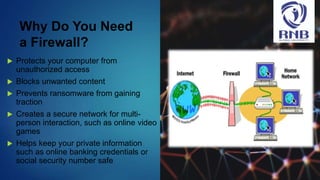
 Protects your computer from
unauthorized access
 Blocks unwanted content
 Prevents ransomware from gaining
traction
 Creates a secure network for multi-
person interaction, such as online video
games
 Helps keep your private information
such as online banking credentials or
social security number safe
TYPES OF FIREWALLS
 Packet-filtering firewalls
 Circuit-level gateways
 Stateful inspection firewalls
 Application-level gateways (a.k.a. proxy firewalls)
 Next-gen firewalls
Packet-Filtering Firewalls
As the most “basic” and oldest type of
firewall architecture, packet-filtering
firewalls basically create a checkpoint at
a traffic router or switch.
The firewall performs a simple check of
the data packets coming through the
router—inspecting information such as
the destination and origination IP
address, packet type, port number, and
other surface-level information without
opening up the packet to inspect its
contents.
Circuit-Level Gateways
 As another simplistic firewall type that is meant to
quickly and easily approve or deny traffic without
consuming significant computing resources, circuit-
level gateways work by verifying the transmission
control protocol (TCP) handshake. This TCP
handshake check is designed to make sure that the
session the packet is from is legitimate.
Stateful Inspection Firewalls
 These firewalls combine both packet inspection technology
and TCP handshake verification to create a level of protection
greater than either of the previous two architectures could
provide alone.
 However, these firewalls do put more of a strain on computing
resources as well. This may slow down the transfer of
legitimate packets compared to the other solutions.
Proxy Firewalls (Application-Level
Gateways/Cloud Firewalls)
 Proxy firewalls operate at the application layer to filter
incoming traffic between your network and the traffic source—
hence, the name “application-level gateway.” These firewalls
are delivered via a cloud-based solution or another proxy
device. Rather than letting traffic connect directly, the proxy
firewall first establishes a connection to the source of the
traffic and inspects the incoming data packet.
Next-Generation Firewalls
 firewall architectures include deep-packet inspection
(checking the actual contents of the data packet), TCP
handshake checks, and surface-level packet inspection. Next-
generation firewalls may include other technologies as well,
such as intrusion prevention systems (IPSs) that work to
automatically stop attacks against your network.
METHODS OF DELIVERING
FIREWALL
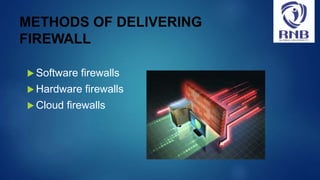
 Software firewalls
 Hardware firewalls
 Cloud firewalls
Software firewalls
 Software firewalls include any type of firewall that is installed
on a local device rather than a separate piece of hardware (or
a cloud server)
 However, maintaining individual software firewalls on different
devices can be difficult and time-consuming. Furthermore, not
every device on a network may be compatible with a single
software firewall, which may mean having to use several
different software firewalls to cover every asset.
HARDWARE FIREWALLS
 Hardware firewalls use a physical appliance that acts in a
manner similar to a traffic router to intercept data packets and
traffic requests before they're connected to the network's
servers.
 The actual capabilities of a hardware firewall may vary
depending on the manufacturer—some may have a more
limited capacity to handle simultaneous connections than
others.
Cloud Firewalls
 Whenever a cloud solution is used to deliver a firewall, it can
be called a cloud firewall, or firewall-as-a-service (FaaS).
Cloud firewalls are considered synonymous with proxy
firewalls by many, since a cloud server is often used in a proxy
firewall setup (though the proxy doesn't necessarily have to be
on the cloud, it frequently is).
WHICH FIREWALL IS RIGHT FOR
MY COMPANY
 The simple packet filtering or circuit-level gateway, which
provides basic protection that has minimal performance
impact.
 The stateful inspection architecture that combines the
capabilities of both of the previous two options, but has a
larger performance impact.
 A proxy or next-gen firewall that offers far more robust
protection in exchange for additional expenses and an even
higher performance impact.
Thank You!
SOMEONE@EXAMPLE.COM