Submitted By
Pawan Suresh Nishad
Department of computer studies & research
Sardar patel mahavidyalaya, chandrapur
Session
2022-2023
To be discuss
 What is firewall
 Why do we need a firewall
 Types of firewall
 Methods of delivering firewall
 A firewall is a type of a cyber security tool that is used
to filter traffic on a network
 Firewall can be used to separate network nodes from
external traffic source, internal traffic source, or even
in specific applications.
 Firewall can be software, hardware, or cloud based,
either each type of firewall having its own unique pros
and cons.
Why do we needa firewall
 Protects yours computer from unauthorized access.
 Blocks unwanted content
 Prevents ransom ware from gaining traction
 Creates a secure network for multi-person interaction,
such as online video games
 Helps keep your private information such as online
banking credentials or social security number safe.
Types of firewall
 Packet filtering firewall
 Circuit level gateway
 State full inspection firewall
 Application level gateway(a.k.a. proxy firewall)
 Next gen firewall
Packet-filteringfirewall
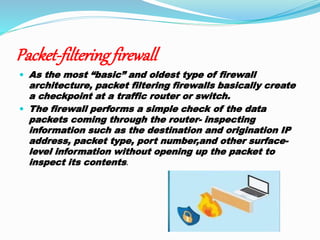
 As the most “basic” and oldest type of firewall
architecture, packet filtering firewalls basically create
a checkpoint at a traffic router or switch.
 The firewall performs a simple check of the data
packets coming through the router- inspecting
information such as the destination and origination IP
address, packet type, port number,and other surface-
level information without opening up the packet to
inspect its contents.
Circuit-level gateway
 As another simplistic firewall type that is meant to
quickly and easily approve or deny traffic without
consuming significant computing resources, circuit-
level gateway work by verifying the transmission
control protocol(TCP) handshake. This TCP handshake
check is designed to make sure that the session the
packet is from is legitimate.
StatefulL inspectionfirewalls
 These firewalls combine both packet inspection
technology and TCP handshake verification to create a
level of protection greater than either of the previous
two architectures could provide alone.
 However, these firewalls do put more of a strain on
computing resources as well. This may slow down the
transfer of legitimate packets compared to the other
solutions.
Proxyfirewalls
 Proxy firewalls operate at the application layer to filter
incoming traffic between your network and the traffic
source hence, the name “application-level gateway.”
these firewalls are delivered via a cloud-based solution
or another proxy device. Rather than letting traffic
connect directly, the proxy firewall first establishes a
connection to the source of the traffic and inspect the
incoming data packet.
Next generationfirewalls
 Firewall architectures include deep-packet inspection,
TCP handshake checks, and surface-level packet
inspection. Next-generation firewalls may include other
technologies as well, such as intrusion prevention
systems(IPSs) that work to automatically stop attacks
against your network.
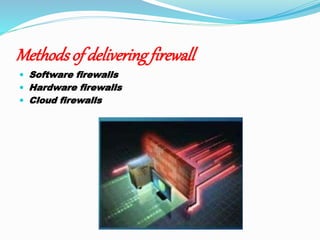
Methodsof deliveringfirewall
 Software firewalls
 Hardware firewalls
 Cloud firewalls
Software firewalls
 Software firewalls include any type of firewall that is
installed on a local device rather than a separate piece
of hardware
 However, maintaining individual software firewall on
different devices can be difficult and time-consuming.
Furthermore, not every device on the network may
mean having to use several different software firewalls
to cover every asset.
Hardware firewalls
 Hardware firewalls use a physical appliance that acts
in a manner similar to a traffic router to intercept data
packets and traffic requests before they’re connected
to the network’s servers.
 The actual capabilities of a hardware firewall may vary
depending on the manufacturer- some may have a more
limited capacity to handle simultaneous connections
than others.
Cloudfirewalls
 Whenever a cloud solution used to delivered a firewall
it can be called as cloud firewall or firewall as a
service(FaaS) cloud firewall are considered
synonymous with proxy firewalls by many, since a
cloud server is often used in a proxy firewall setup.
Whichfirewallis right for my company
 The simple packet filtering or circuit-level
gateway, which provides basic protection
that has minimal performance impact.
 The state full inspection architecture that
combines the capabilities of both of the
previous two options, but has a larger
performance impact.
 A proxy or next-gen firewall that offers far
more robust protection in exchange for
additional expenses and an even higher
performance impact.
Firewall security in computer security

Firewall security in computer security

  • 1.
    Submitted By Pawan SureshNishad Department of computer studies & research Sardar patel mahavidyalaya, chandrapur Session 2022-2023
  • 3.
    To be discuss What is firewall  Why do we need a firewall  Types of firewall  Methods of delivering firewall
  • 4.
     A firewallis a type of a cyber security tool that is used to filter traffic on a network  Firewall can be used to separate network nodes from external traffic source, internal traffic source, or even in specific applications.  Firewall can be software, hardware, or cloud based, either each type of firewall having its own unique pros and cons.
  • 5.
    Why do weneeda firewall  Protects yours computer from unauthorized access.  Blocks unwanted content  Prevents ransom ware from gaining traction  Creates a secure network for multi-person interaction, such as online video games  Helps keep your private information such as online banking credentials or social security number safe.
  • 6.
    Types of firewall Packet filtering firewall  Circuit level gateway  State full inspection firewall  Application level gateway(a.k.a. proxy firewall)  Next gen firewall
  • 7.
    Packet-filteringfirewall  As themost “basic” and oldest type of firewall architecture, packet filtering firewalls basically create a checkpoint at a traffic router or switch.  The firewall performs a simple check of the data packets coming through the router- inspecting information such as the destination and origination IP address, packet type, port number,and other surface- level information without opening up the packet to inspect its contents.
  • 8.
    Circuit-level gateway  Asanother simplistic firewall type that is meant to quickly and easily approve or deny traffic without consuming significant computing resources, circuit- level gateway work by verifying the transmission control protocol(TCP) handshake. This TCP handshake check is designed to make sure that the session the packet is from is legitimate.
  • 9.
    StatefulL inspectionfirewalls  Thesefirewalls combine both packet inspection technology and TCP handshake verification to create a level of protection greater than either of the previous two architectures could provide alone.  However, these firewalls do put more of a strain on computing resources as well. This may slow down the transfer of legitimate packets compared to the other solutions.
  • 10.
    Proxyfirewalls  Proxy firewallsoperate at the application layer to filter incoming traffic between your network and the traffic source hence, the name “application-level gateway.” these firewalls are delivered via a cloud-based solution or another proxy device. Rather than letting traffic connect directly, the proxy firewall first establishes a connection to the source of the traffic and inspect the incoming data packet.
  • 11.
    Next generationfirewalls  Firewallarchitectures include deep-packet inspection, TCP handshake checks, and surface-level packet inspection. Next-generation firewalls may include other technologies as well, such as intrusion prevention systems(IPSs) that work to automatically stop attacks against your network.
  • 12.
    Methodsof deliveringfirewall  Softwarefirewalls  Hardware firewalls  Cloud firewalls
  • 13.
    Software firewalls  Softwarefirewalls include any type of firewall that is installed on a local device rather than a separate piece of hardware  However, maintaining individual software firewall on different devices can be difficult and time-consuming. Furthermore, not every device on the network may mean having to use several different software firewalls to cover every asset.
  • 14.
    Hardware firewalls  Hardwarefirewalls use a physical appliance that acts in a manner similar to a traffic router to intercept data packets and traffic requests before they’re connected to the network’s servers.  The actual capabilities of a hardware firewall may vary depending on the manufacturer- some may have a more limited capacity to handle simultaneous connections than others.
  • 15.
    Cloudfirewalls  Whenever acloud solution used to delivered a firewall it can be called as cloud firewall or firewall as a service(FaaS) cloud firewall are considered synonymous with proxy firewalls by many, since a cloud server is often used in a proxy firewall setup.
  • 16.
    Whichfirewallis right formy company  The simple packet filtering or circuit-level gateway, which provides basic protection that has minimal performance impact.  The state full inspection architecture that combines the capabilities of both of the previous two options, but has a larger performance impact.  A proxy or next-gen firewall that offers far more robust protection in exchange for additional expenses and an even higher performance impact.