CHAPTER 6
Safety and Security
Objectives: Examining how to ensure safety &
security in the hotel through efficient
housekeeping operations
Safety and Security
• Safety: Refers to the actual conditions in the work
environment.
• Security: Refers to the prevention of theft, fire, and
other emergencies.
Safety
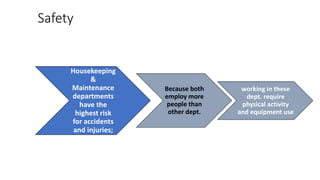
Housekeeping
&
Maintenance
departments
have the
highest risk
for accidents
and injuries;
Because both
employ more
people than
other dept.
working in these
dept. require
physical activity
and equipment use
Safety
•Housekeeping and Maintenance department
experiences more accidents than other departments
for two reasons:
➢Labor Intensity
➢Physical Activity and Equipment Use
Safety
To reduce safety risks, the executive housekeeper must
be,
• Aware of potential safety hazards.
• Develop procedures to prevent accidents.
• Develop ongoing safety training programs.
• Aware of the laws that regulate the work environment.
Safety
Some management and legal concerns:
• Insurance and liability concerns
➢ Expensive medical costs
➢ Legal problems e.G. Fines or legal action
➢ Decreased productivity
• Employee moral and management concerns
➢Negative employee morale
➢Low performance
Potentially Hazardous Conditions
Mangers and workers must work together to remove all types of
potential hazardous objects.
Remove hazardous conditions before it threatens guests,
employees and the property.
Managers must train employees to recognize potentially
hazardous conditions and take corrective actions.
❖ wet floors and slippery walkways
❖ messy floors
❖ equipment left out in the way
❖ improper lifting techniques
Potentially Hazardous Conditions
By following three simple rules, employees can
contribute to a safe, accident free work
environment.
1. Take acceptable amount of time
2. Correct unsafe conditions
immediately
3. Do it safely the first time
Potentially hazardous conditions
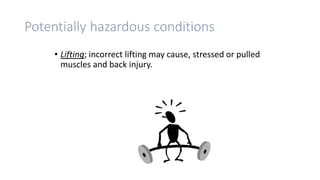
• Lifting; incorrect lifting may cause, stressed or pulled
muscles and back injury.
• Do not use broken or flawed ladder
• Do not use aluminum or metal ladder
when working near or on electrical
equipment
• Use rubber footing on tile floors and in
kitchen
• Floor must be dry and clean
• Should be high enough
• Never stand on the top step
• Never place a ladder against a window
or uneven surfaces
• Should be well-balanced
Ladders;
when
selecting
a ladder,
inspect its
condition,
height
and
footing.
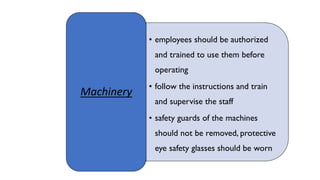
• employees should be authorized
and trained to use them before
operating
• follow the instructions and train
and supervise the staff
• safety guards of the machines
should not be removed, protective
eye safety glasses should be worn
Machinery
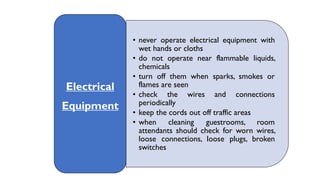
• never operate electrical equipment with
wet hands or cloths
• do not operate near flammable liquids,
chemicals
• turn off them when sparks, smokes or
flames are seen
• check the wires and connections
periodically
• keep the cords out off traffic areas
• when cleaning guestrooms, room
attendants should check for worn wires,
loose connections, loose plugs, broken
switches
Electrical
Equipment
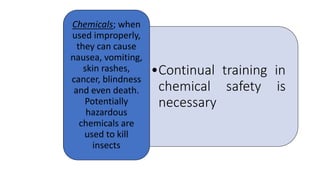
•Continual training in
chemical safety is
necessary
Chemicals; when
used improperly,
they can cause
nausea, vomiting,
skin rashes,
cancer, blindness
and even death.
Potentially
hazardous
chemicals are
used to kill
insects
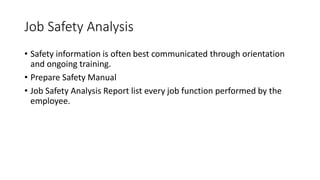
Job Safety Analysis
• Safety information is often best communicated through orientation
and ongoing training.
• Prepare Safety Manual
• Job Safety Analysis Report list every job function performed by the
employee.
Job Safety Analysis
Job Safety Analysis is a detailed report that lists every job function
performed by all employees in a housekeeping department with safety
tips and potential hazards being cited.
The analysis should be produced in booklet form and used in training.
Housekeeping managers should demonstrate and explain each task
when training.
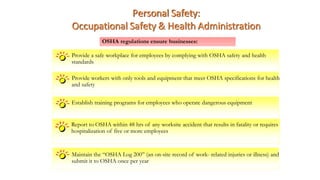
Provide a safe workplace for employees by complying with OSHA safety and health
standards
Personal Safety:
Occupational Safety & Health Administration
OSHA regulations ensure businesses:
Provide workers with only tools and equipment that meet OSHA specifications for health
and safety
Establish training programs for employees who operate dangerous equipment
Report to OSHA within 48 hrs of any worksite accident that results in fatality or requires
hospitalization of five or more employees
Maintain the “OSHA Log 200” (an on-site record of work- related injuries or illness) and
submit it to OSHA once per year
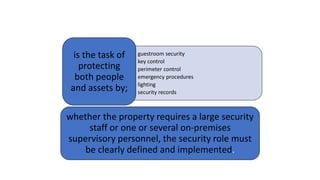
• guestroom security
• key control
• perimeter control
• emergency procedures
• lighting
• security records
is the task of
protecting
both people
and assets by;
whether the property requires a large security
staff or one or several on-premises
supervisory personnel, the security role must
be clearly defined and implemented.
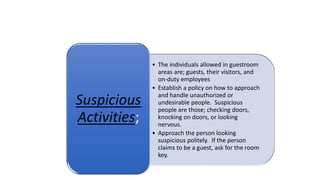
• The individuals allowed in guestroom
areas are; guests, their visitors, and
on-duty employees
• Establish a policy on how to approach
and handle unauthorized or
undesirable people. Suspicious
people are those; checking doors,
knocking on doors, or looking
nervous.
• Approach the person looking
suspicious politely. If the person
claims to be a guest, ask for the room
key.
Suspicious
Activities;
explain the hotel policy and direct the guest to the front desk.
employees who are not in their designated area should be asked if
they need help. Depending on the person’s response and manner,
report to security.
friends and relatives of employees should not be allowed in
guestroom areas or employee locker rooms
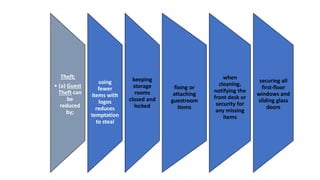
Theft;
• (a) Guest
Theft can
be
reduced
by;
using
fewer
items with
logos
reduces
temptation
to steal
keeping
storage
rooms
closed and
locked
fixing or
attaching
guestroom
items
when
cleaning,
notifying the
front desk or
security for
any missing
items
securing all
first-floor
windows and
sliding glass
doors
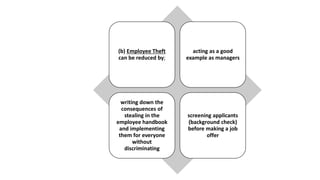
(b) Employee Theft
can be reduced by;
acting as a good
example as managers
writing down the
consequences of
stealing in the
employee handbook
and implementing
them for everyone
without
discriminating
screening applicants
(background check)
before making a job
offer
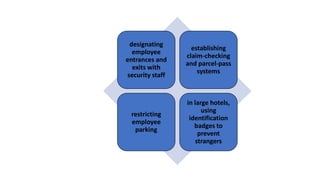
designating
employee
entrances and
exits with
security staff
establishing
claim-checking
and parcel-pass
systems
restricting
employee
parking
in large hotels,
using
identification
badges to
prevent
strangers
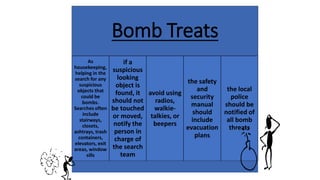
Bomb Treats
As
housekeeping,
helping in the
search for any
suspicious
objects that
could be
bombs.
Searches often
include
stairways,
closets,
ashtrays, trash
containers,
elevators, exit
areas, window
sills
if a
suspicious
looking
object is
found, it
should not
be touched
or moved,
notify the
person in
charge of
the search
team
avoid using
radios,
walkie-
talkies, or
beepers
the safety
and
security
manual
should
include
evacuation
plans
the local
police
should be
notified of
all bomb
threats
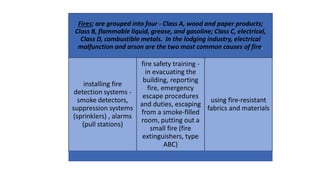
Fires; are grouped into four - Class A, wood and paper products;
Class B, flammable liquid, grease, and gasoline; Class C, electrical,
Class D, combustible metals. In the lodging industry, electrical
malfunction and arson are the two most common causes of fire.
installing fire
detection systems -
smoke detectors,
suppression systems
(sprinklers) , alarms
(pull stations)
fire safety training -
in evacuating the
building, reporting
fire, emergency
escape procedures
and duties, escaping
from a smoke-filled
room, putting out a
small fire (fire
extinguishers, type
ABC)
using fire-resistant
fabrics and materials
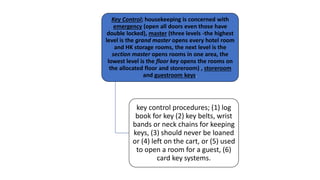
Key Control; housekeeping is concerned with
emergency (open all doors even those have
double locked), master (three levels -the highest
level is the grand master opens every hotel room
and HK storage rooms, the next level is the
section master opens rooms in one area, the
lowest level is the floor key opens the rooms on
the allocated floor and storeroom) , storeroom
and guestroom keys.
key control procedures; (1) log
book for key (2) key belts, wrist
bands or neck chains for keeping
keys, (3) should never be loaned
or (4) left on the cart, or (5) used
to open a room for a guest, (6)
card key systems.
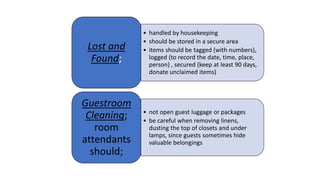
• handled by housekeeping
• should be stored in a secure area
• items should be tagged (with numbers),
logged (to record the date, time, place,
person) , secured (keep at least 90 days,
donate unclaimed items)
Lost and
Found;
• not open guest luggage or packages
• be careful when removing linens,
dusting the top of closets and under
lamps, since guests sometimes hide
valuable belongings
Guestroom
Cleaning;
room
attendants
should;

Safety and Security (HOUSEKEEPING)

  • 1.
    CHAPTER 6 Safety andSecurity Objectives: Examining how to ensure safety & security in the hotel through efficient housekeeping operations
  • 2.
    Safety and Security •Safety: Refers to the actual conditions in the work environment. • Security: Refers to the prevention of theft, fire, and other emergencies.
  • 5.
    Safety Housekeeping & Maintenance departments have the highest risk foraccidents and injuries; Because both employ more people than other dept. working in these dept. require physical activity and equipment use
  • 6.
    Safety •Housekeeping and Maintenancedepartment experiences more accidents than other departments for two reasons: ➢Labor Intensity ➢Physical Activity and Equipment Use
  • 7.
    Safety To reduce safetyrisks, the executive housekeeper must be, • Aware of potential safety hazards. • Develop procedures to prevent accidents. • Develop ongoing safety training programs. • Aware of the laws that regulate the work environment.
  • 8.
    Safety Some management andlegal concerns: • Insurance and liability concerns ➢ Expensive medical costs ➢ Legal problems e.G. Fines or legal action ➢ Decreased productivity • Employee moral and management concerns ➢Negative employee morale ➢Low performance
  • 9.
    Potentially Hazardous Conditions Mangersand workers must work together to remove all types of potential hazardous objects. Remove hazardous conditions before it threatens guests, employees and the property. Managers must train employees to recognize potentially hazardous conditions and take corrective actions. ❖ wet floors and slippery walkways ❖ messy floors ❖ equipment left out in the way ❖ improper lifting techniques
  • 10.
    Potentially Hazardous Conditions Byfollowing three simple rules, employees can contribute to a safe, accident free work environment. 1. Take acceptable amount of time 2. Correct unsafe conditions immediately 3. Do it safely the first time
  • 11.
    Potentially hazardous conditions •Lifting; incorrect lifting may cause, stressed or pulled muscles and back injury.
  • 12.
    • Do notuse broken or flawed ladder • Do not use aluminum or metal ladder when working near or on electrical equipment • Use rubber footing on tile floors and in kitchen • Floor must be dry and clean • Should be high enough • Never stand on the top step • Never place a ladder against a window or uneven surfaces • Should be well-balanced Ladders; when selecting a ladder, inspect its condition, height and footing.
  • 13.
    • employees shouldbe authorized and trained to use them before operating • follow the instructions and train and supervise the staff • safety guards of the machines should not be removed, protective eye safety glasses should be worn Machinery
  • 14.
    • never operateelectrical equipment with wet hands or cloths • do not operate near flammable liquids, chemicals • turn off them when sparks, smokes or flames are seen • check the wires and connections periodically • keep the cords out off traffic areas • when cleaning guestrooms, room attendants should check for worn wires, loose connections, loose plugs, broken switches Electrical Equipment
  • 15.
    •Continual training in chemicalsafety is necessary Chemicals; when used improperly, they can cause nausea, vomiting, skin rashes, cancer, blindness and even death. Potentially hazardous chemicals are used to kill insects
  • 16.
    Job Safety Analysis •Safety information is often best communicated through orientation and ongoing training. • Prepare Safety Manual • Job Safety Analysis Report list every job function performed by the employee.
  • 17.
    Job Safety Analysis JobSafety Analysis is a detailed report that lists every job function performed by all employees in a housekeeping department with safety tips and potential hazards being cited. The analysis should be produced in booklet form and used in training. Housekeeping managers should demonstrate and explain each task when training.
  • 18.
    Provide a safeworkplace for employees by complying with OSHA safety and health standards Personal Safety: Occupational Safety & Health Administration OSHA regulations ensure businesses: Provide workers with only tools and equipment that meet OSHA specifications for health and safety Establish training programs for employees who operate dangerous equipment Report to OSHA within 48 hrs of any worksite accident that results in fatality or requires hospitalization of five or more employees Maintain the “OSHA Log 200” (an on-site record of work- related injuries or illness) and submit it to OSHA once per year
  • 19.
    • guestroom security •key control • perimeter control • emergency procedures • lighting • security records is the task of protecting both people and assets by; whether the property requires a large security staff or one or several on-premises supervisory personnel, the security role must be clearly defined and implemented.
  • 20.
    • The individualsallowed in guestroom areas are; guests, their visitors, and on-duty employees • Establish a policy on how to approach and handle unauthorized or undesirable people. Suspicious people are those; checking doors, knocking on doors, or looking nervous. • Approach the person looking suspicious politely. If the person claims to be a guest, ask for the room key. Suspicious Activities;
  • 21.
    explain the hotelpolicy and direct the guest to the front desk. employees who are not in their designated area should be asked if they need help. Depending on the person’s response and manner, report to security. friends and relatives of employees should not be allowed in guestroom areas or employee locker rooms
  • 22.
    Theft; • (a) Guest Theftcan be reduced by; using fewer items with logos reduces temptation to steal keeping storage rooms closed and locked fixing or attaching guestroom items when cleaning, notifying the front desk or security for any missing items securing all first-floor windows and sliding glass doors
  • 23.
    (b) Employee Theft canbe reduced by; acting as a good example as managers writing down the consequences of stealing in the employee handbook and implementing them for everyone without discriminating screening applicants (background check) before making a job offer
  • 24.
    designating employee entrances and exits with securitystaff establishing claim-checking and parcel-pass systems restricting employee parking in large hotels, using identification badges to prevent strangers
  • 25.
    Bomb Treats As housekeeping, helping inthe search for any suspicious objects that could be bombs. Searches often include stairways, closets, ashtrays, trash containers, elevators, exit areas, window sills if a suspicious looking object is found, it should not be touched or moved, notify the person in charge of the search team avoid using radios, walkie- talkies, or beepers the safety and security manual should include evacuation plans the local police should be notified of all bomb threats
  • 26.
    Fires; are groupedinto four - Class A, wood and paper products; Class B, flammable liquid, grease, and gasoline; Class C, electrical, Class D, combustible metals. In the lodging industry, electrical malfunction and arson are the two most common causes of fire. installing fire detection systems - smoke detectors, suppression systems (sprinklers) , alarms (pull stations) fire safety training - in evacuating the building, reporting fire, emergency escape procedures and duties, escaping from a smoke-filled room, putting out a small fire (fire extinguishers, type ABC) using fire-resistant fabrics and materials
  • 27.
    Key Control; housekeepingis concerned with emergency (open all doors even those have double locked), master (three levels -the highest level is the grand master opens every hotel room and HK storage rooms, the next level is the section master opens rooms in one area, the lowest level is the floor key opens the rooms on the allocated floor and storeroom) , storeroom and guestroom keys. key control procedures; (1) log book for key (2) key belts, wrist bands or neck chains for keeping keys, (3) should never be loaned or (4) left on the cart, or (5) used to open a room for a guest, (6) card key systems.
  • 28.
    • handled byhousekeeping • should be stored in a secure area • items should be tagged (with numbers), logged (to record the date, time, place, person) , secured (keep at least 90 days, donate unclaimed items) Lost and Found; • not open guest luggage or packages • be careful when removing linens, dusting the top of closets and under lamps, since guests sometimes hide valuable belongings Guestroom Cleaning; room attendants should;