DEFINITON
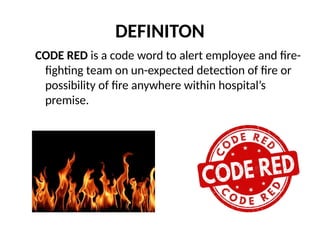
CODE RED isa code word to alert employee and fire-
fighting team on un-expected detection of fire or
possibility of fire anywhere within hospital’s
premise.
3.
LEVELS OF FIRE
LevelOne:
• This is when the fire is in early stages (Smoke only) and can be handled by the
first responders.
Level Two:
• This is when the fire is small and controlled and can be handled by the QRT
team, Fire officer and Security officer.
Level Three:
• This is when the fire is beyond local control and requires support from the Fire
Department.
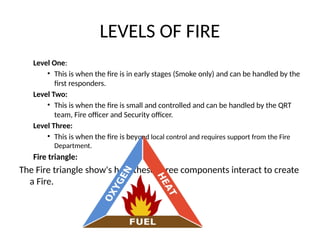
Fire triangle:
The Fire triangle show's how these three components interact to create
a Fire.
4.
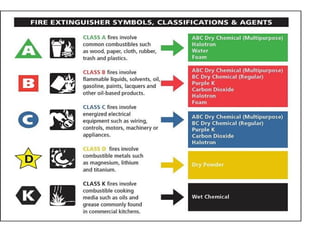
CLASSIFICATION OF FIRE
•Fire is divided into five classes (A, B, C, D, and K)
that are primarily based on the fuel that is burning.
• This classification system helps to assess hazards
and determine the most effective type of
extinguishing agent.
• Note: In - order to avoid confusion and at act
swiftly during fire accident, at all working place of
PIMS campus, ABC type and CO2 type
extinguishers is placed which can be used for
majority type of fire.
6.
PROCEDURE
1.Code Red shouldbe immediately initiated
whenever any one of the following indications are
observed:
• Seeing smoke, sparks or a fire.
• Smelling smoke or other burning material.
• Feeling unusual heat on a wall, door or other surface.
• In response to any fire safety system alarm
7.
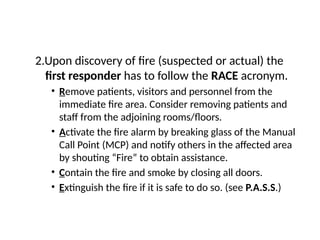
2.Upon discovery offire (suspected or actual) the
first responder has to follow the RACE acronym.
• Remove patients, visitors and personnel from the
immediate fire area. Consider removing patients and
staff from the adjoining rooms/floors.
• Activate the fire alarm by breaking glass of the Manual
Call Point (MCP) and notify others in the affected area
by shouting “Fire” to obtain assistance.
• Contain the fire and smoke by closing all doors.
• Extinguish the fire if it is safe to do so. (see P.A.S.S.)
8.
FIRE EXTINGUISHER
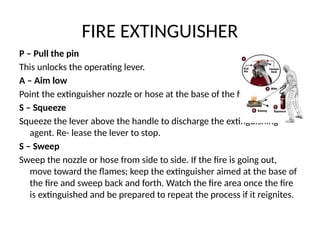
P –Pull the pin
This unlocks the operating lever.
A – Aim low
Point the extinguisher nozzle or hose at the base of the fire.
S – Squeeze
Squeeze the lever above the handle to discharge the extinguishing
agent. Re- lease the lever to stop.
S – Sweep
Sweep the nozzle or hose from side to side. If the fire is going out,
move toward the flames; keep the extinguisher aimed at the base of
the fire and sweep back and forth. Watch the fire area once the fire
is extinguished and be prepared to repeat the process if it reignites.
9.
3.The second responderimmediately calls the
emergency code number “1009” from the nearest
intercom or “04132651009” from his / her cell
phone.
The second responder tells the OPD reception
staff to activate the CODE RED alert on the PA
system specifying the location in which the fire is
suspected.
10.
4.The OPD receptionstaff announces the CODE RED alert three
times on the PA system which is repeated after 30 seconds for
2 minutes.
5.Mean while the second responder assist the first responder in
extinguishing the fire with fire extinguisher, if possible. P.A.S.S
acronym is used when using the fire extinguisher to put off
the fire.
6. On hearing the CODE RED alert on the PA system, all staffs of
the hospital prepare to assist, in the fire incident area.
7. Fire Safety Officer or Security Officer on duty will assume the
role of the team leader and will coordinate with a senior
member of the department where the alarm is occurring.
11.
8.The team leaderwill consider the need for evacuation.
• Evacuation and relocation of staff, patients, and/or visitors should be
undertaken at the direction of the Team leader.
• In fire level 1, evacuation is not required, but information of the fire has
to be given to the Fire Safety Officer immediately.
• In fire level 2, type of evacuation has to be decided based on the
individual incident.
• In fire level 3, evacuation has to be done.
• Horizontal evacuation of patients and staff to adjacent building is
preferred in most cases. Vertical evacuation of patients and staff is
completed if necessary.
• After evacuation the people assemble in the nearest assembly point.
• Ensure patient records and medications are transferred with the patient
upon evacuation or transfer.
12.
– Evacuation ofthe ward or service area is guided by the evacuation matrix
prepared by the individual departments. During the Evacuation process staff will
follow the specific assignments.
– A staff of the ward where the fire incident is happening or a staff of the adjoining
ward takes the role of Patient Tracking Supervisor. He / she is responsible for
tracking and assessing patients at the assembly point and relay
information/supplies/medications between assembly point and the hospital.
– Considerations for the shut off the oxygen supply should be made by the nurse
immediately or the Biomedical Engineer on duty, as oxygen can promote the
spread of fire and is found in most patient care areas. The Bio medical Engineer
should ensure proper coordination with engineering, nursing, on-duty doctors of
the concerned departments before shutting off medical gases to the affected
area(s).
– The on duty staff of engineering should shut off the electrical supply to the area of
fire if an electrical short circuit is suspected after informing Duty Doctor and Duty
Nurse.
13.
– The NursingSupervisor recalls additional staff if
necessary.
– The housekeeping supervisor helps in getting
additional man power for transport of evacuations.
– The CMO gets prepared to receive any person who
has been injured due to the fire.
– The CMO follows the protocol for mass casualty to
alert all on duty doctor of the respective
departments taking care of trauma patients.
14.
9.All clear:
• Theteam leader – after consultation with the fire department, if
applicable –issues an “all clear” notification to the OPD reception staff
to indicate the termination of response operations.
• The OPD reception staff announces “Code Red, all clear” three (3) times
via the PA system.
• All employees return to normal operations after hearing “CODE RED all
clear” notification.
10.Documentation and Reporting:
• Documentation containing information about the activation should be
reviewed at the time of debriefing by the team leader.
• Reporting of the incident by the team leader and sent to the Safety
officer.
• Regular Inspections to be done by Fire Safety Officer
15.
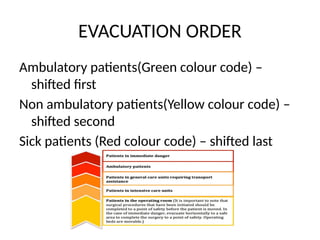
EVACUATION ORDER
Ambulatory patients(Greencolour code) –
shifted first
Non ambulatory patients(Yellow colour code) –
shifted second
Sick patients (Red colour code) – shifted last
16.
FIRE SAFETY CHECKLIST
1.MEANS OF ESCAPE
• Are fire signages appropriate and placed at the right locations?
• Are the exits routes route free from any material that would cause hindrance in
evacuations?
• Are fire doors remaining open at all times?
2. (MANUAL) FIRE ALARM SYSTEM
• Is the system regularly serviced?
• Are operation points safely located?
• Are smoke/heat detectors appropriately located?
• Is any smoke/heat detector head obstructed?
• Is the alarm clearly audible in all areas?
• Do the manual call points have means to break the glass ?
• Have the Fire alarm systems properly tested and maintained and is a record of the
same present ?
17.
3. FIRE EQUIPMENT
•Are appropriate type and number or fire extinguishers being installed
according to the type of fire that could occur in the respective areas?
• Is it properly located?
• Do hose reels operate satisfactorily?
• Date of last service:
• Are fire hoses properly maintained?
• Date of last service:
• Do hydrants operate satisfactorily?
• Are water supplies adequate?
• Is the fire pump house maintained properly and whether appropriate
pressures are maintained in the fire hydrant and sprinkler lines ?
18.
4. TRAINING
Is propertraining program for handling fire emergencies being conducted ?
Are proper training records being maintained ?
Are fire orders displayed?
Is there a fire evacuation matrix present for the respective area ?
Date of last fire drill:
5. FIRE PREVENTION STANDARDS
Are the protocols for storing, dispensing and use of flammable material being followed ?
Is preventive maintenance and testing of all electrical points being done at regular
intervals ?
Is the earthing system are checked regulary ?
Are the UPS batteries check regulary to check any heating ?
Is proper ventilation present in electrical panels, UPS and equipment rooms to avoid
over heating ?
19.
HAZARDOUS MATERIALS
• Areprocured as per the area’s requirement
• Are labeled appropriately(Name, dilution, expiry date)
• Are stocked as per the quantity needed for the area
• Are segregated as flammable and nonflammable
• Are stored safely as per manufacturer’s instruction(cool/dry)
• Are stored in lower rack
• Are kept under lock and not reachable to patients
• Hazardous material used as per the instruction
• Spill managed as per HAZMAT guidelines
• Are disposed as per PPCB guidelines
• Spill kits available and regularly maintained
• Eyewash bottle available and regularly maintained
• Staff are aware of the handling of hazardous materials
• Incident report maintained
• Is MSDS available
• Are SOP available for hazardous materials(storage, handling, spillage and disposal)
• Hazardous material register maintained



![ONFH[AVN HIP] -TRIPLE REGIME -A NOVAL SURGICAL CONCEPT .pptx](https://cdn.slidesharecdn.com/ss_thumbnails/onfhavnhip2026koaconcalicutdrgokuldevdrmashraf-260210064517-213ec005-thumbnail.jpg?width=640&height=640&fit=bounds)
![CTEV [ clubfoot] DR ARUN LAL ,DR MOHAMED ASHRAF travancore medical college k...](https://cdn.slidesharecdn.com/ss_thumbnails/ctevclubfootdrarunlaldrmohamedashraftravancoremedicalcollegekollamkeralaindia-260208063247-18fc466c-thumbnail.jpg?width=640&height=640&fit=bounds)


