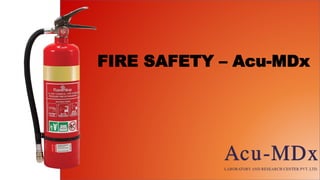
FIRE SAFETY – Acu-MDx
“fires must be prevented”
• ‘National Building Code of India – 2005’ on ‘Fire & Life Safety’
covers the requirements for fire prevention & life safety in relation
to fire and fire pro
• The Code specifies construction, occupancy and protection
features that are necessary to minimize danger to life and property
from fire.
• Laboratory have been classified as Business Buildings
Minimum Requirements for Fire Fighting Installations (NBC)
EXIT FACILILTIES
• facilities shall be provided to move clients/patients to the other side
of a smoke barrier.
• Two exits of one or more of the following types shall be provided for
every floor, including basement
a. Doors leading directly outside the building;
b. Stairways;
c. Horizontal exits; and
d. Fire tower.
• All required exits shall be not less than 2 m in clear width.
• width of corridor shall be 2400 mm
Additional Requirements
• No combustible material of any kind shall be stored.
• Bare minimum quantities of flammable material such as chloroform,
ethyl alcohol, spirit, etc shall be allowed to be stored and handled.
Bulk storage of these items, will be governed by relevant rules and
safe practices.
Obtain No Objection Certificate from the concerned
Fire Department
Requirements
The minimum requirements for fire safety are:
1. No Objection Certificate
2. Drawing related to Fire escape Routes
3. Fire exit signage's
4. Fire exit plan for each floor displayed & in each Room
5. Exit Door should remain open on all the time
6. Emergency illumination system
7. Adequate Fire detection system across lab i.e. smoke
8. Adequate Fire Fighting system across alab i.e. extinguishers, hydrant.
Requirements
• Designated place for assembly of patients/staff.
• Operational & Maintenance plan of Fire equipment including
refilling of extinguisher
• Up-to-date fire drawing
• Adequate training plans for all the staff.
• conduct mock fire drills
• Maintain mock fire drills records
CODE RED
Purpose: The response to any fire inside the premises or outside
Basic Fire Response Plan
A. Response in a Patient Occupied Area
Remember R-A-C-E Guidelines:
R - Rescue/ Remove persons from danger
A - Activate the nearest alarm. Call 300 and report the exact location of
the fire.
C - Contain the fire. Close all windows and doors.
E - Extinguish and evacuate as needed. Do not use elevators. Always
exit the laboratory premises by the stairways.
CODE RED
B. What to do When CODE RED is Announced Over the PA System ?
 If you see anyone in corridor/hall, ask them to return to waiting areas or patient
rooms until the emergency is over.
 If people are coming in the laboratory from the lobby ask them to remain in
those areas until the emergency is over.
 Clients, patients, visitors, or vendors evacuate the building as directed by proper
authorities.
CODE RED
C. Response in a Unoccupied Area
 Isolate the fire as much a possible by closing doors, windows, etc.
leading to the area
 Sound the alarm from the nearest pull station and have any other
person present call and state the specific location of the fire
CODE RED
D. When the Fire is Small
• Without taking unnecessary chances, the employee discovering the fire
should now try to extinguish the fire if it is small with water, a blanket, or a
fire extinguisher.
• When using a fire extinguisher, remember P-A-S-S:
• P - Pull the Pin
• A - Aim the nozzle or spout at the base of the fire
• S - Squeeze the handle to release extinguishing agent
• S - Sweep back and forth at the base of the fire until extinguisher is empty
• Never Put a Used Fire Extinguisher Back Up on the Wall. Give the used
extinguishers to maintenance to be refilled.
CODE RED
Level 2 Response
• If the department experiencing the Code Red needs additional assistance
after the initial response from other staff on the same floor, a staff member
should call the switchboard operator and request additional assistance.
• The switchboard will announce, “All available personnel to ______ to assist
with Code Red.”
• This request for help should be made to assist with removing patients and
charts to a safe area, or other assistance deemed necessary by the office in
charge. (Horizontal or Vertical Evacuation)
• When this announcement is made, all personnel not immediately involved
in critical patient care are to move without delay to the Location as
directed by Supervisory personnel.
CODE RED
Evacuation Information
• Only evacuate patients when specific direction is given from
maintenance, Shift Administrator, or fire chief.
• Emergency and evacuation maps that clearly mark and identify
entry/exit points are located near the elevator lobbies and
throughout the hospital. Know Your Evacuation Route.
• During an emergency, initial evacuation of persons in immediate
danger must take precedence over all other actions.
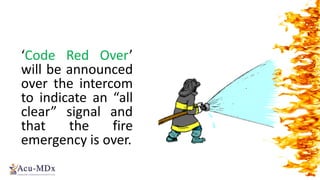
‘Code Red Over’
will be announced
over the intercom
to indicate an “all
clear” signal and
that the fire
emergency is over.

Fire Safety.pptx

  • 1.
  • 2.
    “fires must beprevented” • ‘National Building Code of India – 2005’ on ‘Fire & Life Safety’ covers the requirements for fire prevention & life safety in relation to fire and fire pro • The Code specifies construction, occupancy and protection features that are necessary to minimize danger to life and property from fire. • Laboratory have been classified as Business Buildings Minimum Requirements for Fire Fighting Installations (NBC)
  • 3.
    EXIT FACILILTIES • facilitiesshall be provided to move clients/patients to the other side of a smoke barrier. • Two exits of one or more of the following types shall be provided for every floor, including basement a. Doors leading directly outside the building; b. Stairways; c. Horizontal exits; and d. Fire tower. • All required exits shall be not less than 2 m in clear width. • width of corridor shall be 2400 mm
  • 4.
    Additional Requirements • Nocombustible material of any kind shall be stored. • Bare minimum quantities of flammable material such as chloroform, ethyl alcohol, spirit, etc shall be allowed to be stored and handled. Bulk storage of these items, will be governed by relevant rules and safe practices. Obtain No Objection Certificate from the concerned Fire Department
  • 5.
    Requirements The minimum requirementsfor fire safety are: 1. No Objection Certificate 2. Drawing related to Fire escape Routes 3. Fire exit signage's 4. Fire exit plan for each floor displayed & in each Room 5. Exit Door should remain open on all the time 6. Emergency illumination system 7. Adequate Fire detection system across lab i.e. smoke 8. Adequate Fire Fighting system across alab i.e. extinguishers, hydrant.
  • 6.
    Requirements • Designated placefor assembly of patients/staff. • Operational & Maintenance plan of Fire equipment including refilling of extinguisher • Up-to-date fire drawing • Adequate training plans for all the staff. • conduct mock fire drills • Maintain mock fire drills records
  • 7.
    CODE RED Purpose: Theresponse to any fire inside the premises or outside Basic Fire Response Plan A. Response in a Patient Occupied Area Remember R-A-C-E Guidelines: R - Rescue/ Remove persons from danger A - Activate the nearest alarm. Call 300 and report the exact location of the fire. C - Contain the fire. Close all windows and doors. E - Extinguish and evacuate as needed. Do not use elevators. Always exit the laboratory premises by the stairways.
  • 8.
    CODE RED B. Whatto do When CODE RED is Announced Over the PA System ?  If you see anyone in corridor/hall, ask them to return to waiting areas or patient rooms until the emergency is over.  If people are coming in the laboratory from the lobby ask them to remain in those areas until the emergency is over.  Clients, patients, visitors, or vendors evacuate the building as directed by proper authorities.
  • 9.
    CODE RED C. Responsein a Unoccupied Area  Isolate the fire as much a possible by closing doors, windows, etc. leading to the area  Sound the alarm from the nearest pull station and have any other person present call and state the specific location of the fire
  • 10.
    CODE RED D. Whenthe Fire is Small • Without taking unnecessary chances, the employee discovering the fire should now try to extinguish the fire if it is small with water, a blanket, or a fire extinguisher. • When using a fire extinguisher, remember P-A-S-S: • P - Pull the Pin • A - Aim the nozzle or spout at the base of the fire • S - Squeeze the handle to release extinguishing agent • S - Sweep back and forth at the base of the fire until extinguisher is empty • Never Put a Used Fire Extinguisher Back Up on the Wall. Give the used extinguishers to maintenance to be refilled.
  • 11.
    CODE RED Level 2Response • If the department experiencing the Code Red needs additional assistance after the initial response from other staff on the same floor, a staff member should call the switchboard operator and request additional assistance. • The switchboard will announce, “All available personnel to ______ to assist with Code Red.” • This request for help should be made to assist with removing patients and charts to a safe area, or other assistance deemed necessary by the office in charge. (Horizontal or Vertical Evacuation) • When this announcement is made, all personnel not immediately involved in critical patient care are to move without delay to the Location as directed by Supervisory personnel.
  • 12.
    CODE RED Evacuation Information •Only evacuate patients when specific direction is given from maintenance, Shift Administrator, or fire chief. • Emergency and evacuation maps that clearly mark and identify entry/exit points are located near the elevator lobbies and throughout the hospital. Know Your Evacuation Route. • During an emergency, initial evacuation of persons in immediate danger must take precedence over all other actions.
  • 13.
    ‘Code Red Over’ willbe announced over the intercom to indicate an “all clear” signal and that the fire emergency is over.