BUILDING SAFETY
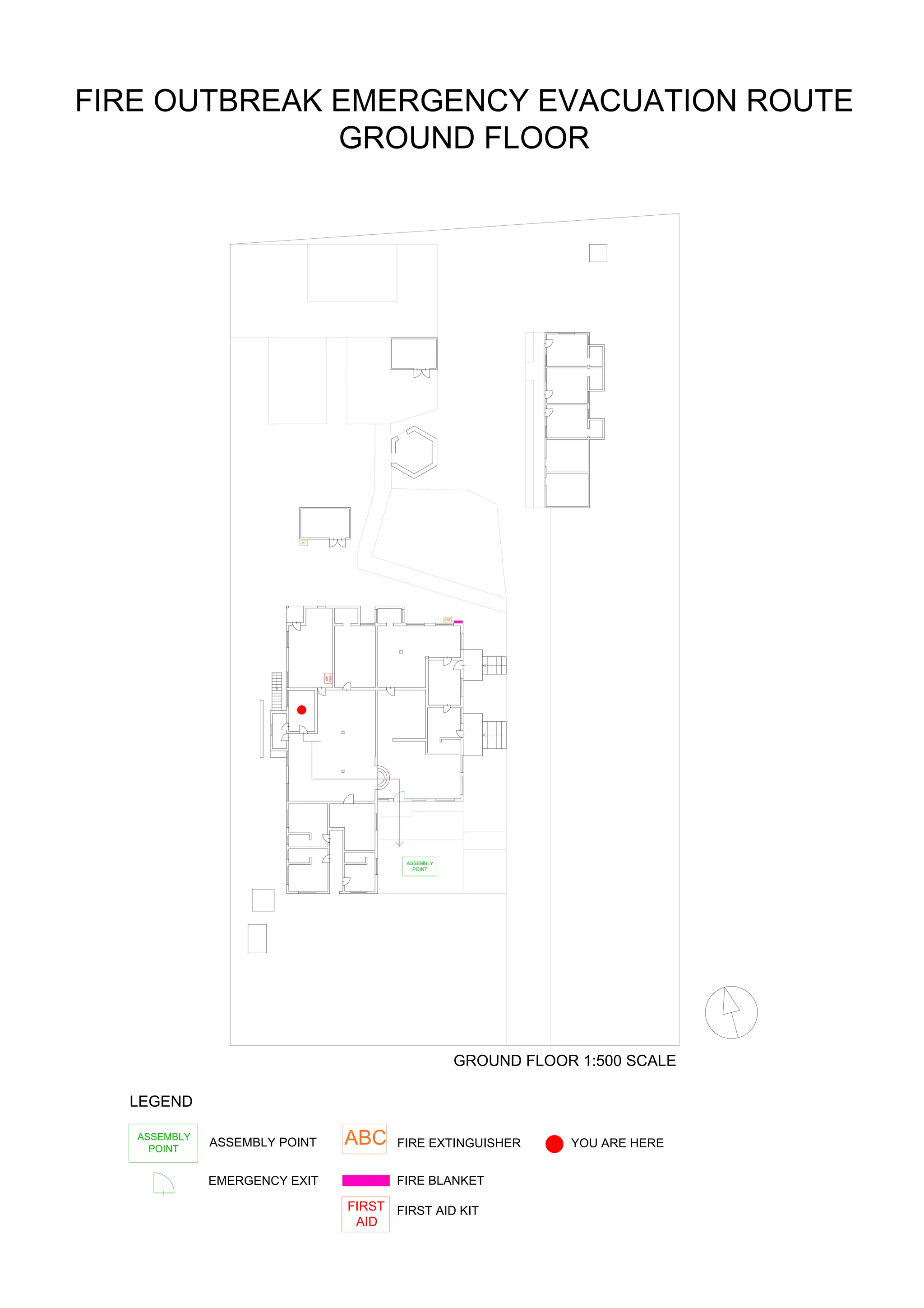
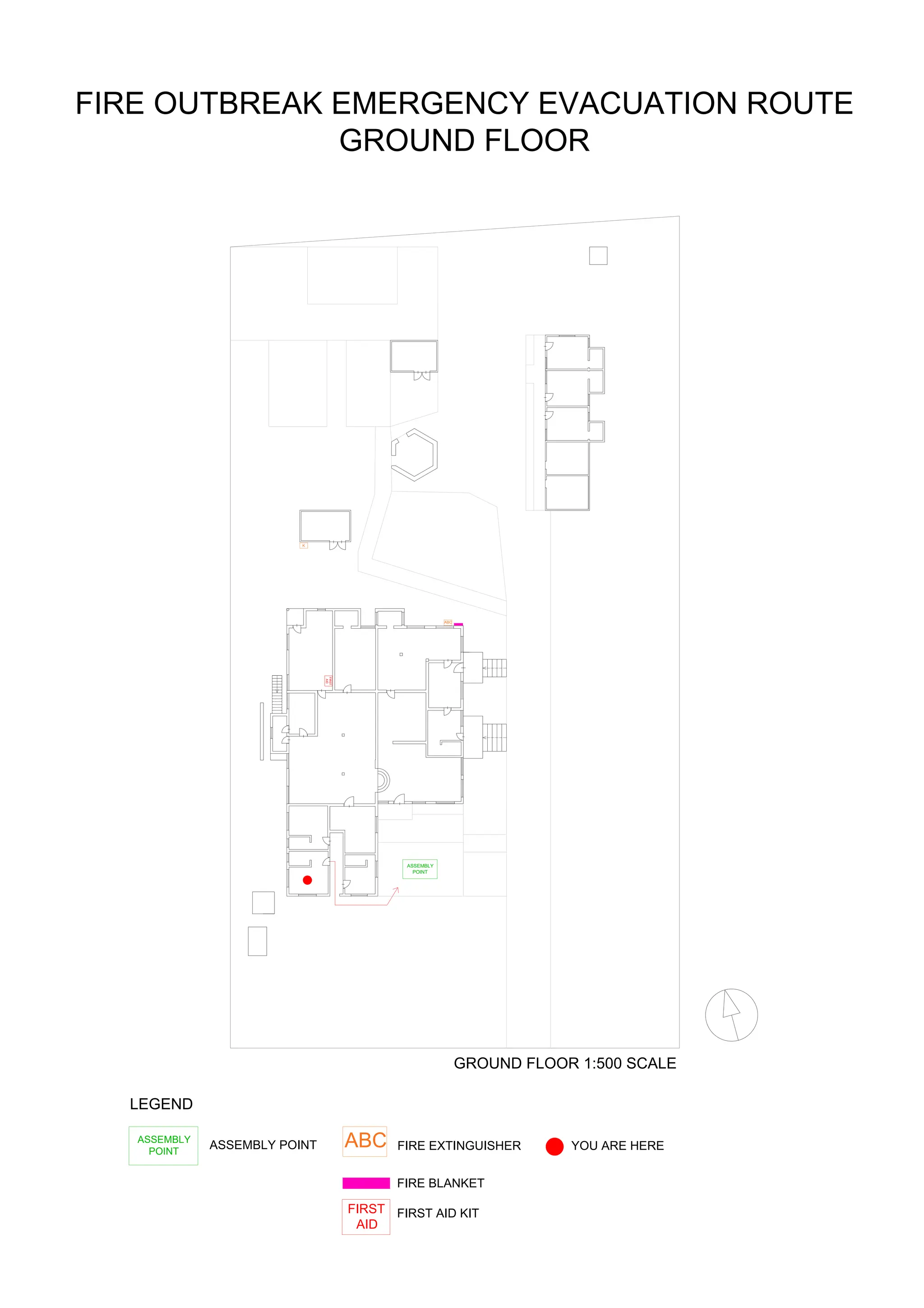
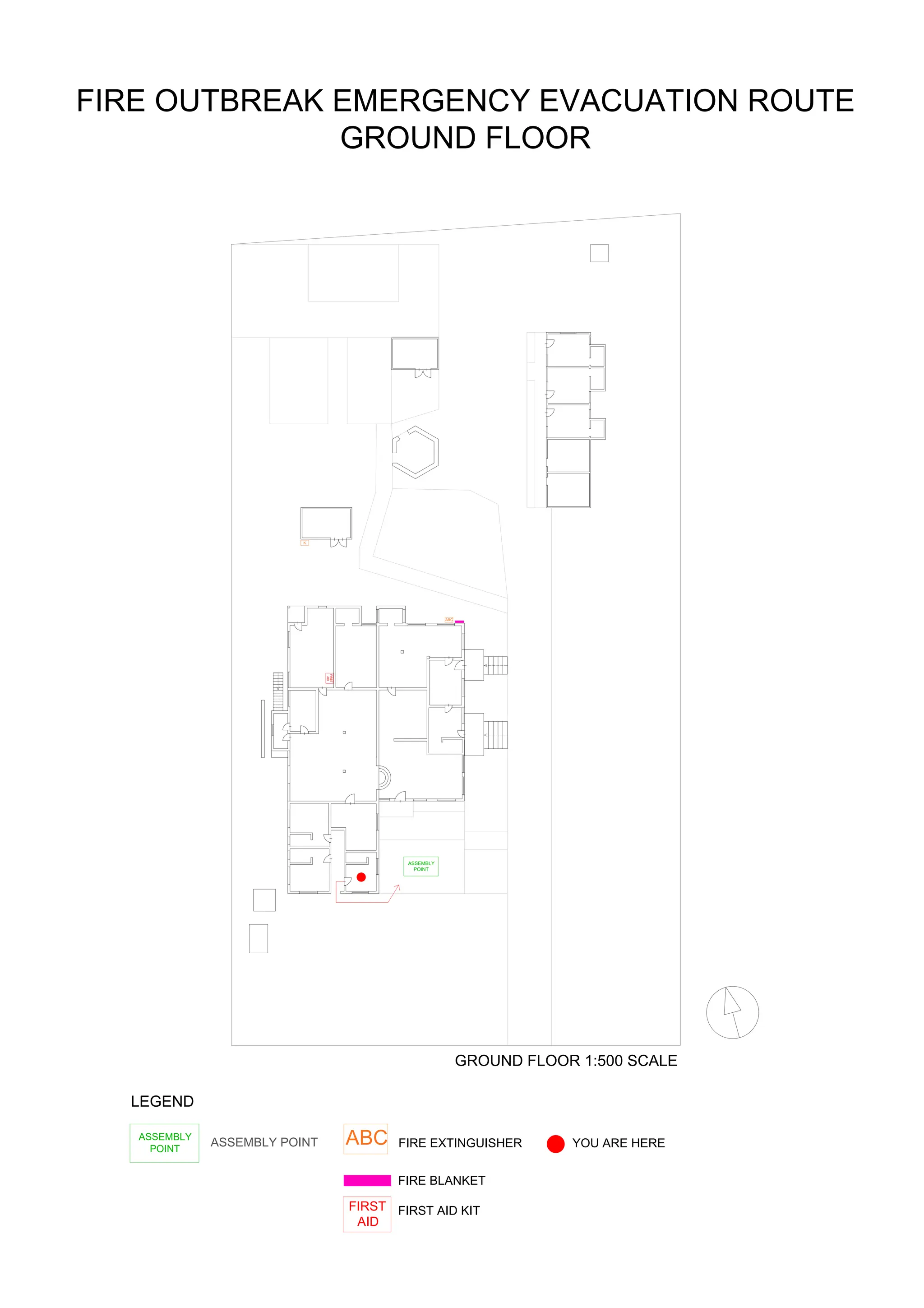
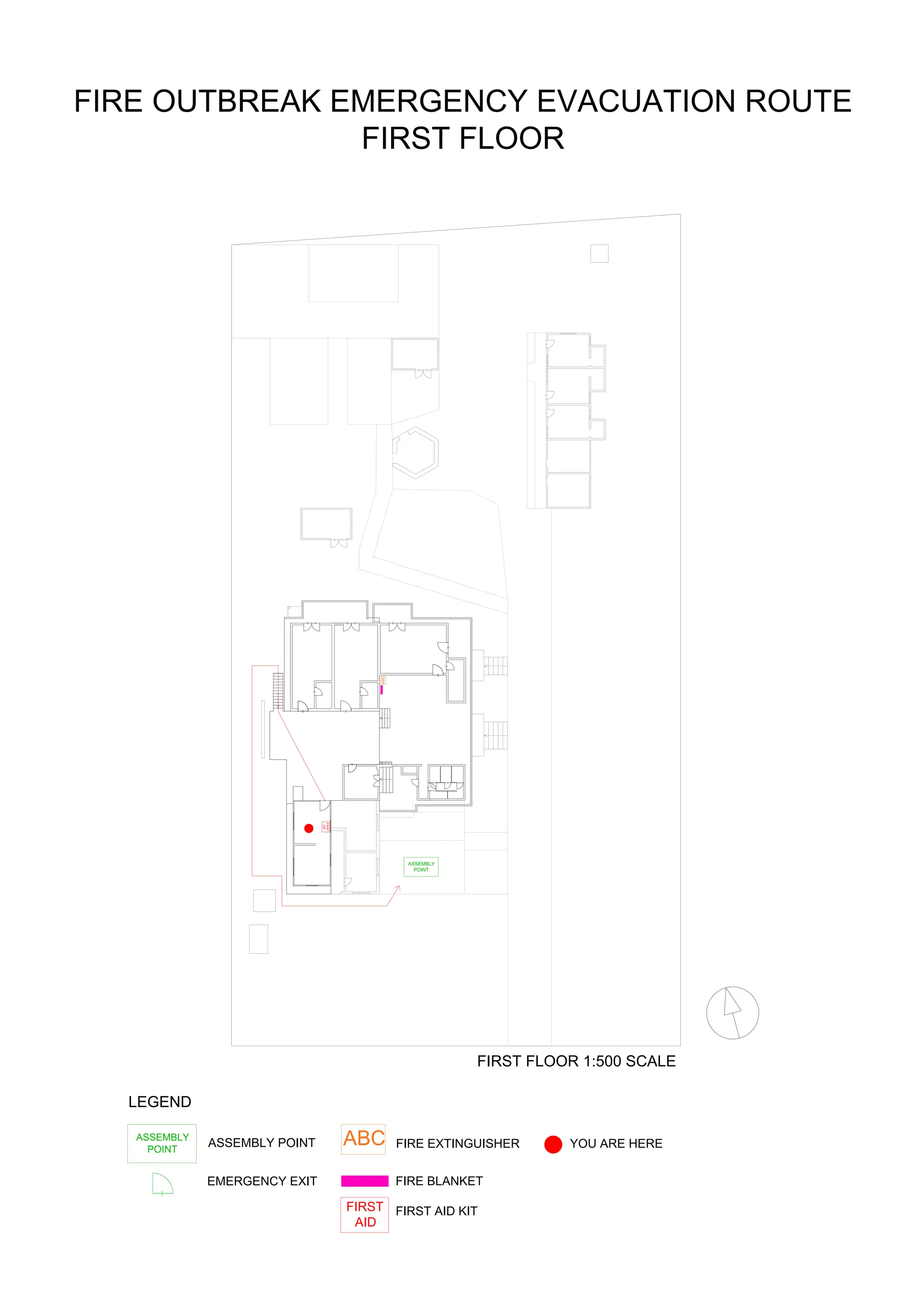
FIRE OUTBREAK EMERGENCY
FIRE RISK ASSESSMENT AND EMERGENCY PLAN FOR ART IN
TANZANIA COMPOUND IN MADALE VILLAGE
Dorota Anna Smalec
Politecnico di Torino Bachelor of Architecture Student
Intern in Art In Tanzania August-September 2022
Report completed on 23/09/2022
Art In Tanzania
Umoja Road
Madale Village
23333 Dar es Salaam
Tanzania
2
INDEX
part 1 Fire Outbreak Emergency Comprehensive Collection of Information 5
1. Fire risk assessment and its importance 5
2. Fire Prevention 5
I. Fire extinguishers 5
I.a. Portable Fire extinguisher use 5
I.b. Portable Fire extinguisher location 5
I.c. Fire types 5
I.d. Extinguisher types 6
II. Fire blankets 6
II.a. Fire blanket application 6
II.b. Fire blanket use instruction 6
III. Emergency exits 7
III.a. Indications 7
III.b. “Exit choice” 7
III.c. Escape behaviour 7
III.d. Familiarity with escape routes 7
IV. Critical control points 7
IV.a. Critical points 7
IV.b. High fire risk 7
IV.c. Occupant load 8
V. Risky electrical connections 8
V.a. Control importance 8
V.b. Solutions to ensure safety 8
VI. Emergency numbers 8
3. Fire Detection Early Alarm Program 8
I. Initiating devices 8
II. Smoke detectors 8
II.a. Smoke detectors’ importance 8
II.b. Two fire stages 9
II.c. Smoke detectors 9
III. Fire sprinklers 9
III.a. Fire sprinklers system explanation 9
III.b. Fire sprinklers’ importance 9
III.c. Fire prinklers 9
III.d. Installation 9
4. Emergency escape procedures – action plan 10
I. Fire reporting 10
I.a. Fire reporting instruction 10
II. Extinguish or evacuate? 10
III. Evacuation 10
III.a. Evacuation plan accessibility statement 10
III.b. Evacuation procedures 10
III.c. Remember during the evacuation 11
III.d. If evacuation not possible 11
IV. Rescue and First Aid procedures 11
IV.a. What is first aid? 11
3
IV.b. First aid and law – consent 11
IV.c. Personal safety 12
IV.d. Help at the emergency scene – bystander 12
V. Final statement 12
part 2 Fire Assessment for Art In Tanzania Compound in Madale Village 13
1. Introduction 13
2. Safety Issues 13
I. Previously defined issues 13
I.a. Consequences in case of fire 13
3. Fire assessment 13
I. Previously defined fire assessment 13
II. Comparison with the current situation 13
III. Fire hazards present within the premises 14
IV. People at risk 14
IV.a. Occupant load ground floor 14
IV.b. Occupant load first floor 14
4. Intern Health and Safety Policy – Art in Tanzania 14
I. Inaccuracies 14
II. Accessibility 15
5. Current situation illustrative report 15
I. First aid kit 15
II. Fire extinguishers 15
6. Conclusions 16
part 3 Fire Prevention and Early Alarm Program for Art In Tanzania Compound in
Madale Village 17
1. Actions that need to be taken 17
2. Equipment at the compound 17
3. Equipment needed 17
4. Costs estimation and final invoice 17
part 4 Fire Outbreak Emergency Escape Plan for Art In Tanzania Compound in
Madale Village 19
1. IN CASE OF FIRE 19
I. Fire reporting 19
II. Extinguish or evacuate 19
III. Evacuation 19
4
part 5 List of Sources and Attachments 20
1. Sources 20
I. Documents 20
II. Books 20
III. Articles 20
IV. Websites 20
2. Attachments 20
5
FIRE OUTBREAK EMERGENCY
COMPREHENSIVE COLLECTION OF INFORMATION
1. Fire risk assessment and its importance
Fire risk assessment identifies the fire hazards present within the premises and the people who may
be at risk in case of emergency. It includes sources of ignition, heaters, cooking equipment, sources of
fuel and sources of, oxygen. Its role is to define the risks, evaluate and reduce them, which means
proposing solutions of actions ensuring safety on the premises (installing the early alarm system and
fire extinguishers, making sure the combustible materials are stored away from the ignition source and
that escape route are free from obstructions, ensuring that people present within the premises are
familiar with the emergency plan and know how to behave in case of an emergency).
2. Fire Prevention
This part defines all the safety measures and steps that need to be undertaken to ensure safety on the
campus and to enable quick and effective abatement of the fire hazard in case of an emergency:
I. Fire extinguishers
II. Fire blankets
III. Emergency exits
IV. Critical control points
V. Risky electrical connections
VI. Emergency numbers
I. Fire extinguishers
I.a. Portable Fire extinguisher use
When to use the portable fire extinguisher:
a) you know that the fire department was or is being called
b) you are trained in using the extinguisher and you feel confident about it (do not undertake any
steps while panicking)
c) the proper type of extinguisher is available, as the use of the wrong extinguisher type may
cause the spread of fire and injury to the user
d) your way of escape is clear and you can fight the fire having the escape behind your back (do
not let the fire cut your way of escape off)
e) you are not blocking the escape way for other people
I.b. Portable Fire extinguisher location
Fire extinguishers should be located next to the main room exit or the emergency exit, never on the
opposite side of the room nor away from the escape way.
I.c. Fire types
The A B C D and K classifications describe the fire fuel, i.e. what material is burning. It is also used for
rating fire extinguishers to indicate in which case they can be used.
A – ordinary combustibles producing ash while burning such as paper, wood, clothes, rubbish, and
many plastics
B – flammable materials such as gasoline, oil, oil-based paints, flammable gases, and some plastics
C – electrical plugs and outlets, energized electrical equipment if plugged; if unplugged then it belongs
to category A or B
6
D – combustible materials such as magnesium, titanium, zirconium, sodium, lithium, and potassium
K – burning kitchen grasses and fat, this extinguisher can is adapted to put down high-temperature
fats and oils
I.d. Extinguisher types
ABC – considered as “universal”; dry chemical extinguisher
A – pressurized water extinguisher
B and C – carbon dioxide (CO2) extinguisher; usually they are grouped together as type BC
D – sodium chlorine dry powder extinguishers
K – contains a special extinguishing agent designed to put down kitchen fires
I.e. Portable extinguisher operation instruction
Firstly check the type of the extinguisher, if it is right for the fire involved; all the extinguishers have a
nameplate with the instruction for use and the type class. A portable fire extinguisher can be easily
operated in 4 steps, that together can be memorized as the “PASS” method.
PULL THE PIN – hold the extinguisher with the nozzle directed away from yourself and release the
locking mechanism, which means pulling out the pin located under the trigger
AIM LOW – stand 2 to 3 meters distant from the fire source and aim the extinguisher at the base of
the fire; ATTENTION: always use the extinguisher vertically, moving from left to right or vice versa,
never up and down
SQUEEZE THE TRIGGER – slowly pulling the trigger will release the extinguishing agent and expel it
through the nozzle
SWEEP – side to side or directly at the firebase depending on the fire type; if the fire closest to you is
extinguished you can continue moving forward; ATTENTION: put your personal safety first and
immediately leave the building if the fire does not diminish, do not turn your back to the fire, even if
you think it is out!
II. Fire blankets
Fire blankets are sheets made of fire-resistant material that are used to cover a fire source/burning
object/person. Fire abates due to the cut of oxygen supply.
II.a. Fire blanket application
Advantages:
a) easy to maintain and quick to use
b) cheaper than fire extinguisher
c) most useful in the kitchen
Disadvantages:
a) necessity to get close to the fire, risk of burning hands
b) usage restricted to small and maintained fire
c) only one go at putting the fire down
II.b. Fire blanket use instruction:
1. remove the blanket from a bag
2. turn off the heat source if generated by electrical component/kitchen supply
3. grab the blanket with the backs of your hands and turn it in, protect yourself by holding the
blanket against yourself
4. in one quick swift motion place the blanket over the fire, do not attempt to throw it
7
5. leave the blanket for around 30 minutes, taking it off too quickly creates a chance of
re-ignition
6. call the fire department and evacuate the building
In case your clothes catch on fire and you cannot use a fire blanket or you are too far away from the
closest available one, follow these steps:
Stop moving
Drop to the ground
Roll several times to put down the flames
Do not run – it only fans the flames
III. Emergency exits
III.a. Indications
An emergency exit is permanent, unobstructed, and must lead to a street, walkway, or other open
space outside the building. According to Fire and Rescue Force Act from 2015 emergency exit “is a
means of escape from the interior of the building to an exterior space which is provided by the use of
the following either singly or in combination: exterior door openings, exit staircases, exit ramps or exit
passageways. In the case of an exit leading to a separate building, it includes link ways, walkways,
bridges and balconies, but exit excludes access stairs, aisles, corridor doors or corridors and access
doors to rooms or spaces in occupancy areas”.
III.b. “Exit choice”
“Exit choice” is a situation in which more than 1 emergency exit is provided to allow a population of a
specified number of people, defined as ‘occupant capacity’ in relation to floor/room space, multiple
escape routes. This gives people the possibility of safe escape in case one exits is being obstructed by
fire and smoke.
III.c. Escape behaviour
In the event of a fire outbreak people’s escape behaviour is defined as their direction of escape, ability
to undertake actions aimed to put down the fire using a fire extinguisher, and ability to keep calm and
follow the procedures. Escape behaviour depends on several factors: the role of a person (staff
member or regular users), location and distance from the emergency exit, being alone or in a group,
relations with the other group members, guidance to exits, familiarity with escape routes.
III.d. Familiarity with escape routes
User and public awareness of the availability and use of the means such as exit doors, escape routes
and fire emergency equipment is fundamental for safe and effective management of fire outbreak
emergency. However, apart from raising awareness on the location of the escape routes, another issue
is easy access through the ways: doors should remain unobstructed and not closed with the key.
IV. Critical control points
IV.a. Critical points
Critical points are places/rooms with increased fire risk and therefore they require more attention,
especially when it comes to establishing the occupant load, and/or specifically adapted equipment.
IV.b. High fire risk
Some buildings/rooms/spaces may be in higher risk of fire outbreak than others, or/and may be in
bigger difficulty of the fire hazard abatement. Reasons of a high fire risk may derive from the function
involving open flames or storage of easily combustible materials, accessibility to the fire emergency
equipment or/and the structure itself, with the focus on used materials. Difficulty in the fire hazard
abatement depends on the space’s size, number of its occupants and complexity, as these are factors
influencing evacuation.
8
IV.c. Occupant load
According to Fire and Rescue Force Act from 2015 occupant load means the total number of persons
that may occupy such building or part thereof at any one time and it can be estimated in two ways: by
applying to the floor areas available for occupation based on the appropriate areas per person and by
the number of fixed seating, if applicable, for Assembly Occupancies.
V. Risky electrical connections
V.a. Control importance
Due to the building construction process that was not overlooked by the authorities, it is essential to
control all the electrical outlets to ensure their safe functioning and use.
V.b. Solutions to ensure safety
a) keep the electrical components away from the water, never plug in the tool if its charger had
contact with water
b) use the right power tools for the adequate voltage – 230V in Tanzania, same as in Europe
c) use the right socket adapter, attempting to force a wrong plug into the socket may cause
damage of the plug or/and the socket
d) any new sockets/outlets/installations on the site must be installed only by a licensed
electrician
VI. Emergency numbers
Ambulance (022) 112
Fire Department (022) 114
Police work phone (022) 112
Fire and Rescue Force in Tanzania
headquarters Ushirika Building Dar Es Salaam, 5821 (floor n.5 and 10)
3. Fire Detection Early Alarm Program
I. Initiating devices
Fire alarm initiating devices detect signs of a fire and activate an alarm. There are two types of
initiating devices: manual and automatic.
Manual initiating devices - manual pull-down stations that can be activated only by hand, they are
required in commercial buildings, offices, and multi-storey buildings;
Automatic initiating devices – trigger automatically in presence of fire; include smoke detectors, fire
sprinklers, and heat detectors.
II. Smoke detectors
II.a. Smoke detectors’ importance
Smoke detectors/smoke alarms automatically sense the presence of smoke and issue an audible
and/or visual warning signal. Depending on their type they react 15 – 50 minutes early in the fire
smouldering phase before the flames outburst. NOTE: cigarette smoke/e-cigarette vapour/burning
food may also trigger a smoke detector.
9
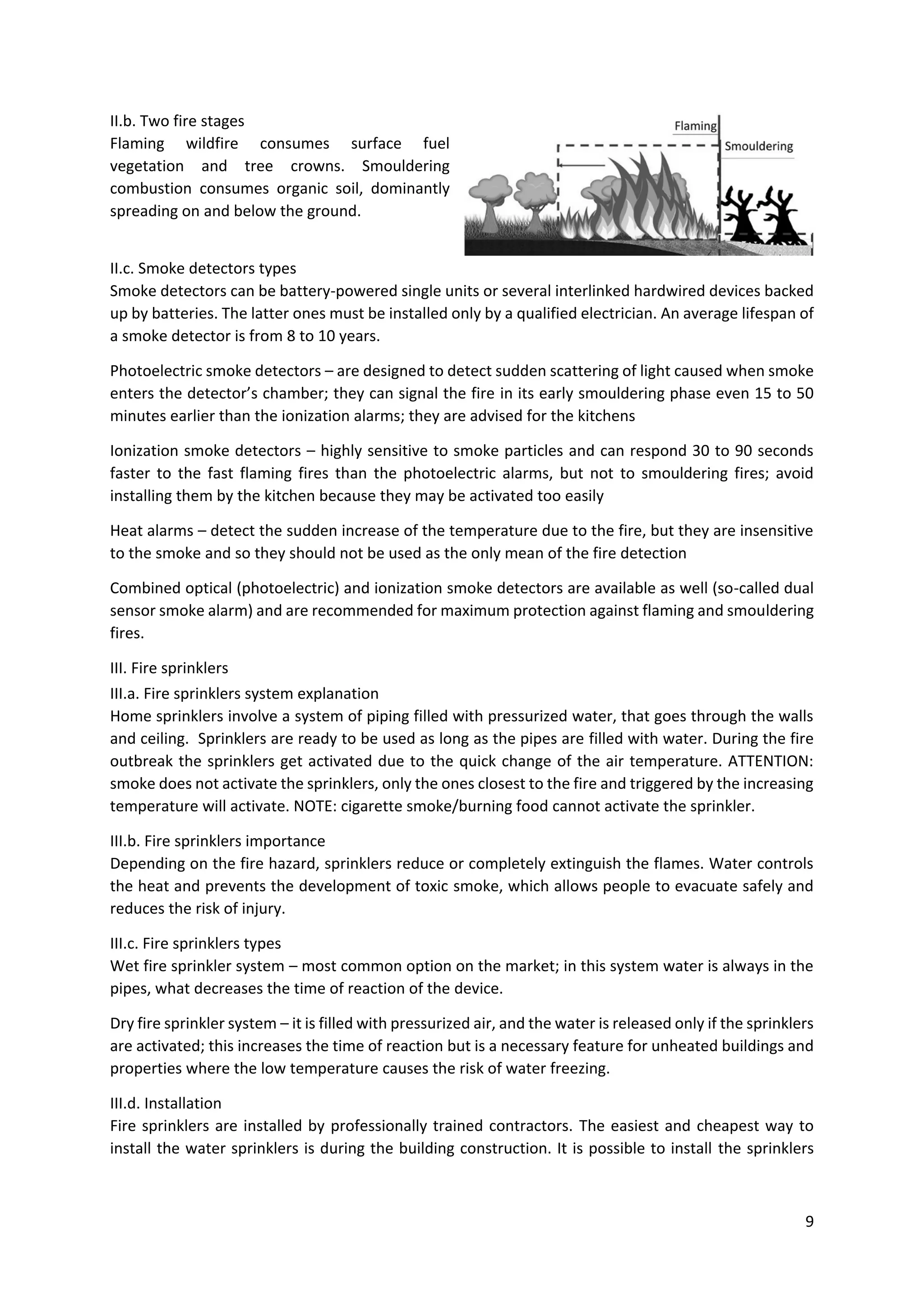
II.b. Two fire stages
Flaming wildfire consumes surface fuel
vegetation and tree crowns. Smouldering
combustion consumes organic soil, dominantly
spreading on and below the ground.
II.c. Smoke detectors types
Smoke detectors can be battery-powered single units or several interlinked hardwired devices backed
up by batteries. The latter ones must be installed only by a qualified electrician. An average lifespan of
a smoke detector is from 8 to 10 years.
Photoelectric smoke detectors – are designed to detect sudden scattering of light caused when smoke
enters the detector’s chamber; they can signal the fire in its early smouldering phase even 15 to 50
minutes earlier than the ionization alarms; they are advised for the kitchens
Ionization smoke detectors – highly sensitive to smoke particles and can respond 30 to 90 seconds
faster to the fast flaming fires than the photoelectric alarms, but not to smouldering fires; avoid
installing them by the kitchen because they may be activated too easily
Heat alarms – detect the sudden increase of the temperature due to the fire, but they are insensitive
to the smoke and so they should not be used as the only mean of the fire detection
Combined optical (photoelectric) and ionization smoke detectors are available as well (so-called dual
sensor smoke alarm) and are recommended for maximum protection against flaming and smouldering
fires.
III. Fire sprinklers
III.a. Fire sprinklers system explanation
Home sprinklers involve a system of piping filled with pressurized water, that goes through the walls
and ceiling. Sprinklers are ready to be used as long as the pipes are filled with water. During the fire
outbreak the sprinklers get activated due to the quick change of the air temperature. ATTENTION:
smoke does not activate the sprinklers, only the ones closest to the fire and triggered by the increasing
temperature will activate. NOTE: cigarette smoke/burning food cannot activate the sprinkler.
III.b. Fire sprinklers importance
Depending on the fire hazard, sprinklers reduce or completely extinguish the flames. Water controls
the heat and prevents the development of toxic smoke, which allows people to evacuate safely and
reduces the risk of injury.
III.c. Fire sprinklers types
Wet fire sprinkler system – most common option on the market; in this system water is always in the
pipes, what decreases the time of reaction of the device.
Dry fire sprinkler system – it is filled with pressurized air, and the water is released only if the sprinklers
are activated; this increases the time of reaction but is a necessary feature for unheated buildings and
properties where the low temperature causes the risk of water freezing.
III.d. Installation
Fire sprinklers are installed by professionally trained contractors. The easiest and cheapest way to
install the water sprinklers is during the building construction. It is possible to install the sprinklers
10
system also during remodeling process – retrofitting- but here the costs depend on the existing
structure and the difficulty of its adaptation for the whole new piping system.
4. Emergency escape procedures – action plan
I. Fire reporting
II. Extinguish or evacuate
III. Evacuation
IV. Rescue and First Aid procedures
I. Fire reporting
If you notice a fire outbreak in a room immediately close it to stop the fire hazard from spreading. No
matter how big the fire is, a person that discovers a fire outbreak should in first place contact
immediately local Fire Brigade. If the early alarm system is not activated already activate manually the
closest pull-down station.
I.a. Fire reporting instruction
1. use your private phone or a telephone accessible in a building if you are close to it, do not use
a public pay phone
2. provide location: city, street, building, floor, room
3. if you know say what caused the fire, what is on fire and how big the fire is
4. if you have such information tell the dispatcher if there is anyone else in the building
5. if you have such information tell the dispatcher if anyone is hurt
6. be prepared to answer any other questions the dispatcher may ask
Meanwhile you are talking with the dispatcher they are alerting appropriate fire station and getting
help on the way, that is why it is important to mention your locations as soon as possible.
Evacuate as soon as the call ends or even during the call, if you are able to focus on both activities and
take care of your safety.
II. Extinguish or evacuate?
If the fire is estimated as manageable and there is present a person trained in using a portable fire
extinguisher they may attempt to put the fire out on their own. Fire can be considered “manageable”
if it is confined to a small area (for example a trash bin) and it is not spreading. The rest of the building
should follow the evacuation procedures as the volunteer firefighter may not be treated and trusted
as a professionally trained Fire Rescue Force. If the fire is spreading fast and it’s too difficult to manage,
or there is no one able to use the fire extinguisher, the first thing to do is to call the fire department
and evacuate the building immediately.
III. Evacuation
III.a. Evacuation plan accessibility statement
The emergency procedures must be presented to the volunteers and interns during the orientation
day and the evacuation plan must be present in each room, secured from water and placed in a visible
spot easily accessible to everyone, for example on the doors.
III.b. Evacuation procedures
1) Go to the closest exit and proceed directly to the designated meeting area
2) On your way notify others about the fire
3) Do not use open stairs and elevators, if possible use closed stairways that lead directly outside
4) Before opening any door feel it with the back of your hand, do not open it if it is hot
11
5) If you encounter smoke during evacuation stay low to the floor, breathe through a material
like your t-shirt
6) When you arrive to the designated meeting area wait for the police and/or fire department to
arrive
III.c. Remember during the evacuation
a) Primarily take care of your own safety, do not wait for other people to evacuate.
b) If possible do not turn your back to the fire while evacuating
c) If you find yourself in a smoke-filled room cover your mouth and nose with if possible, wet
material and crawl under the smoke (hot smoke rises, keep your head low, and do not
stand up until you are away from the danger)
d) Do not come back to the room to collect your personal belongings, what counts the most
while evacuating is the time and freedom of movement
e) Do not re-enter the building until the fire alarm has been silenced and the authorities
(police or fire department) announced that the emergency was staved off.
III.d. If evacuation not possible
Evacuation from the building may not be possible because of the smoke or fire directly blocking the
passage. In such case:
1) Remain calm
2) Close the door to the room you are in
3) Call the fire Department and report your location so that you can be rescued
4) Stuff a material, preferably wet if possible (blanket/towel/t-shirt) under the door if the smoke
starts to come in
5) Do not break the window if not necessary for oxygen as the broken glass may cause the injury,
and the air flow may cause the smoke to enter through the window and make it more difficult
to breathe
6) If you opened the window try to attract attention but shouting should be considered as
ultimatum, as it may waste your breath and cause breathing in loads of smoke
7) Do not try to escape through the window until you have no other chances to survive, but try
to resist and wait for the Fire Department to arrive and rescue you safely
IV. Rescue and First Aid procedures
IV.a. What is first aid?
According to the “First Aid Reference Guide” (St. John Ambulance, second edition July 2007) first aid is
emergency help given to an injured or suddenly ill person using readily available materials. The three
priorities of first aid, in order of importance, are to:
1) Preserve life
2) Prevent the illness or/and injury from becoming worse
3) Promote recovery
IV.b. First aid and law – consent
Before attempting to help someone always ask for the permission to help them before you touch them.
If the injured/ill person cannot answer you, you have so called implied consent that allows you to help.
A person has the right to refuse your intervention, and in this case you cannot force first aid. Things
you can do without consent of a person is controlling the scene and calling for medical help. In case
you are forced to transport the injured/ill person to the hospital yourself you are protected by law in
case it results in further injury.
12
IV.c. Personal safety
Although it is not always possible, it is highly required to use a face mask or shield and gloves to protect
the first aider and to minimize the health and safety risks when in contact with an injured/ill person.
Let take over the situation to the more qualified person as soon as they arrive to the scene of the
emergency.
IV.d. Help at the emergency scene – bystander
1. Make the area safe
2. Find all the injured/ill people
3. Find a first aid kit
4. Control the crowd
5. Call for medical help
6. Gather and protect the injured/ill person belongings
7. Reassure the injured/ill person relatives
8. Lead the paramedics to the scene of emergency
If you are locked in or arrived to the emergency meeting point with a person that is injured or in need
of assistance:
1) Call an ambulance and remain on call until its arrival, transport the injured/ill person to the
hospital only if there is no other way of getting medical help
2) Stay with the person until the arrival of ambulance/trained medical personnel
3) Do not move the victim or provide help unless you are trained to do so and the victim is at risk
4) Obtain or ask someone to bring the necessary personal protective equipment (PPE) and First
Aid kit
5) Talk to the person, recognize it they can hear you or not
6) Check if the person is breathing
7) Do not undertake any action before consulting with medical dispatcher
8) Follow the instructions of medical dispatcher
If you are alone you must decide whether to stay with the injured/ill person or leave to get help.
If there is no possibility of calling an ambulance the most qualified and trained person present should
proceed with the first aid until arrival of fire department.
V. Final statement
This document together with the following Fire Assessment, Fire Detection Early alarm Program and
Fire Outbreak Emergency Escape Plan for Art In Tanzania Compound in Madale Village must be
available to all people living/employed/temporarily staying at the Compound, by any possible means:
publication on the Art In Tanzania website, at least one printed copy available at the Compound, safety
presentation included in the orientation for the students and volunteers.
13
FIRE ASSESSMENT FOR ART IN TANZANIA COMPOUND
IN MADALE VILLAGE
1. Introduction
The reference point for this document is a Report written by Francesco Loretucci (further mentioned
as Intern) on the 25th
of June 2022. He was my predecessor in the field of Disaster Management of Art
In Tanzania NGO, responsible for initiating the safety analysis and process of implementation of the
emergency plan for the Art In Tanzania Compound in Madale Village.
2. Safety Issues
I. Previously defined issues
In the Report Intern describes a flooding accident that happened overnight due to a failure of a roof
piece activating the water tap and the dysfunction of a draining system. While analysing the problem
he highlights four main safety issues as follows:
1. The Intern did not know if there was a person in charge of the emergency and, if there was, he
did not know where to find them. The person that was helping him to mitigate the situation,
did not have such information neither knew what to do.
2. There was not a way to raise the alarm, the Intern had to knock on different doors to find
someone.
3. The Intern did not know what number to call (fire brigade or an ambulance if someone had an
accident that caused the flooding).
I.a. Consequences in case of fire
As reported by the Intern, the Compound represents lack of preparedness and mitigation in case of
emergency. He estimates the time in which he found help as 25minutes, which in case of fire could
result in serious consequences and would put lives of the people at the Compound in danger.
3. Fire assessment
I. Previously defined fire assessment
a) There are no fire extinguishers at the ground level (compound, kitchen, rooms). There are 2 fire
extinguishers on the first level (both CO2 type). One is empty. One is operative (there is no
sticker with the date of the last check and no info about the level of CO2 still available).
b) There are no fire alarms or smoke detectors.
c) There is no general alarm to be used in case of emergency.
d) There is no information about emergency procedures to be followed.
e) There are no pre-designed assembly points in case of evacuation.
f) There is not a Fire Marshall or an Emergency Manager that we know we can approach or call in
case of need and that could provide training and info to the staff members and the interns
g) Nobody is keeping track of the safety and equipment check at the compound.
II. Comparison with the current situation
There are still no fire extinguishers, fire alarms, smoke detectors and any kind of fire equipment.
Emergency procedures by now were not defined and given to the public information. There is still no
pre-designed assembly point at the Compound. Emergency numbers are not known to the staff
members and interns. The first aid training was provided at the Compound by Francesco Loretucci but
currently there is not a designated person responsible to provide such training. The most critical point
at the Compound is the kitchen.
14
III. Fire hazards present within the premises
a) Kitchen
problem: fire to prepare meals is a non-controlled construction which may risk the bamboo
structure to catch on fire
solution: installing a fire extinguisher designed to put down high-temperature fat and oils
b) Bonfire
problem: the current bonfire place is located really close to the bar, which is a bamboo
construction
solution: for safety reasons it is reasonable to move the bonfire place further away from the
bar or any wooden construction
c) Cigarettes
problem: there is not designated ashtray to throw the cigarettes away, a cigarette butt that is
not put down correctly in critical situation may ignite a fire
solution: providing the Compound with ashtrays and disposal bin
IV. People at risk
At the Art in Tanzania compound in Madale Village the number of people present is constantly
changing. They can be divided into 3 groups:
a) Stuff (4 to 5 people + 1 security guard during the night)
b) Interns and volunteers (usually between 10 and 20 people)
c) Visitors / children
IV.a. Occupant load ground floor
1. Boys’ room 1 – 3 people
2. Boys’ room 2 – 3 people
3. Boys’ room 3 – 2 people
4. Double room 1 – 2 people
5. Double room 2 – 2 people
6. Double room 3 – 2 people
7. Double room 4 – 2 people
8. Staff’s room 1 – 2 people
9. Staff’s room 2 – 2 people
10. Staff’s room 3 – 2 people
Maximum capacity: 22 people
IV.b. Occupant load first floor
1. Girls’ dormitory 1 – 6 people
2. Girls’ dormitory 2 – 8 people
3. Double room 5 – 2 people
4. Boys’ dormitory 2 – 8 people
Maximum capacity: 24 people
Total maximum capacity: 46 people
4. Intern Health and Safety Policy – Art in Tanzania
I. Inaccuracies
As the Intern previously pointed out in the Report, there are inaccuracies in the Health and Safety
Policy published by Art in Tanzania NGO.
15
“First AID packages are available in the office, at the dormitories and in the office.”
There are no first aid packages on the Compound.
“Names and contacts of dispensaries and hospitals are available at office and dormitories.”
There is no such information in the rooms.
“Health policy and action chain is part of the program orientation at the start of the program.”
Safety issues and emergency plan are not explained during the orientation program.
“Fire distinguishers are located at all key areas at the compound and there are regularly checked every
six months.”
There are three fire extinguishers within the premises, there is no information about the quantity of
the contents, we assume they are empty. This points out that the 6 months checks are not provided.
II. Accessibility
Health and Safety Policy is accessible on the official website of the NGO https://artintanzania.org/ on
the bottom of the page, under the INFORMATION tab. It should be visible right away on the top tabs
with other crucial information.
5. Current situation illustrative report
I. First aid kit
II. Fire extinguishers
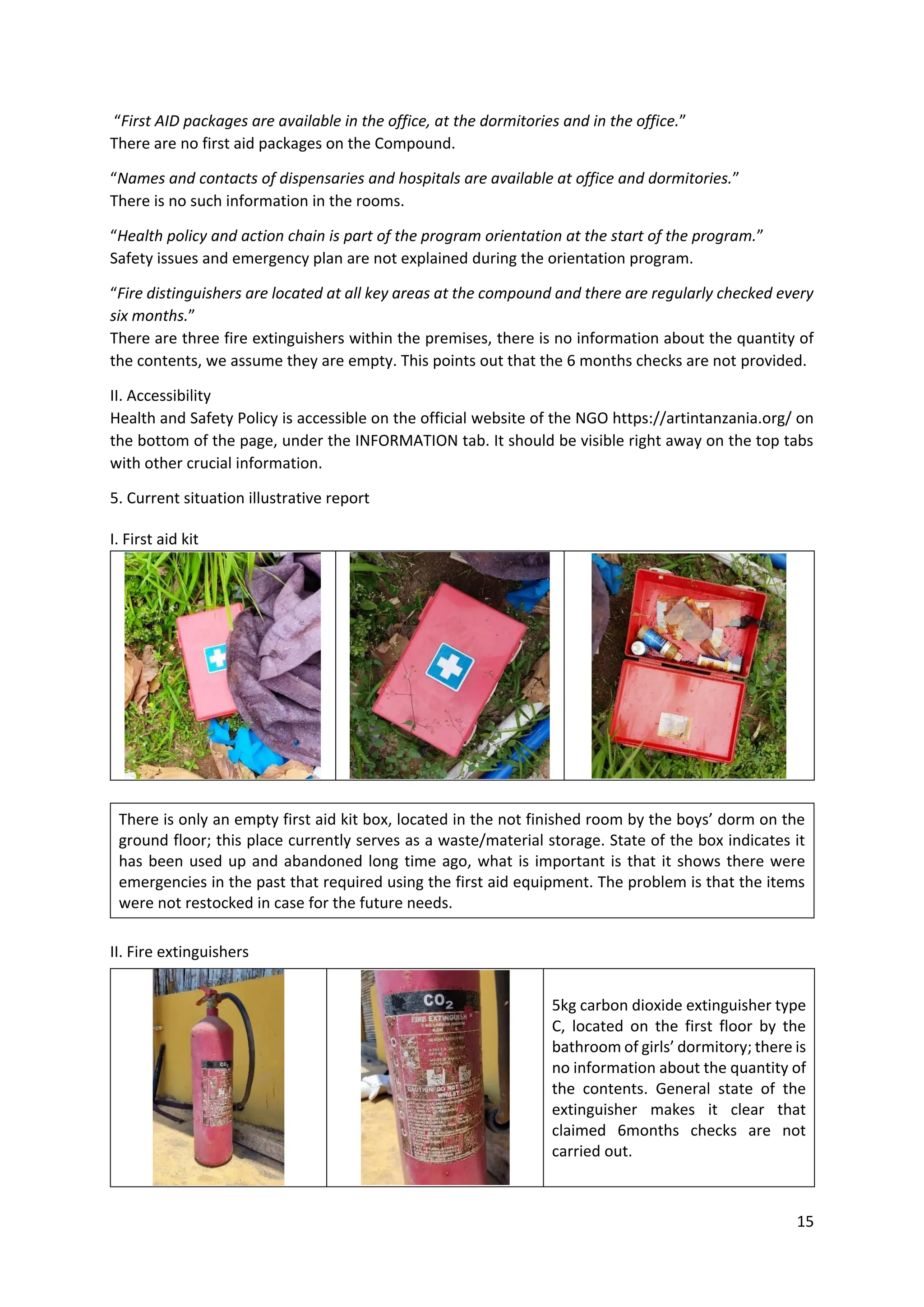
There is only an empty first aid kit box, located in the not finished room by the boys’ dorm on the
ground floor; this place currently serves as a waste/material storage. State of the box indicates it
has been used up and abandoned long time ago, what is important is that it shows there were
emergencies in the past that required using the first aid equipment. The problem is that the items
were not restocked in case for the future needs.
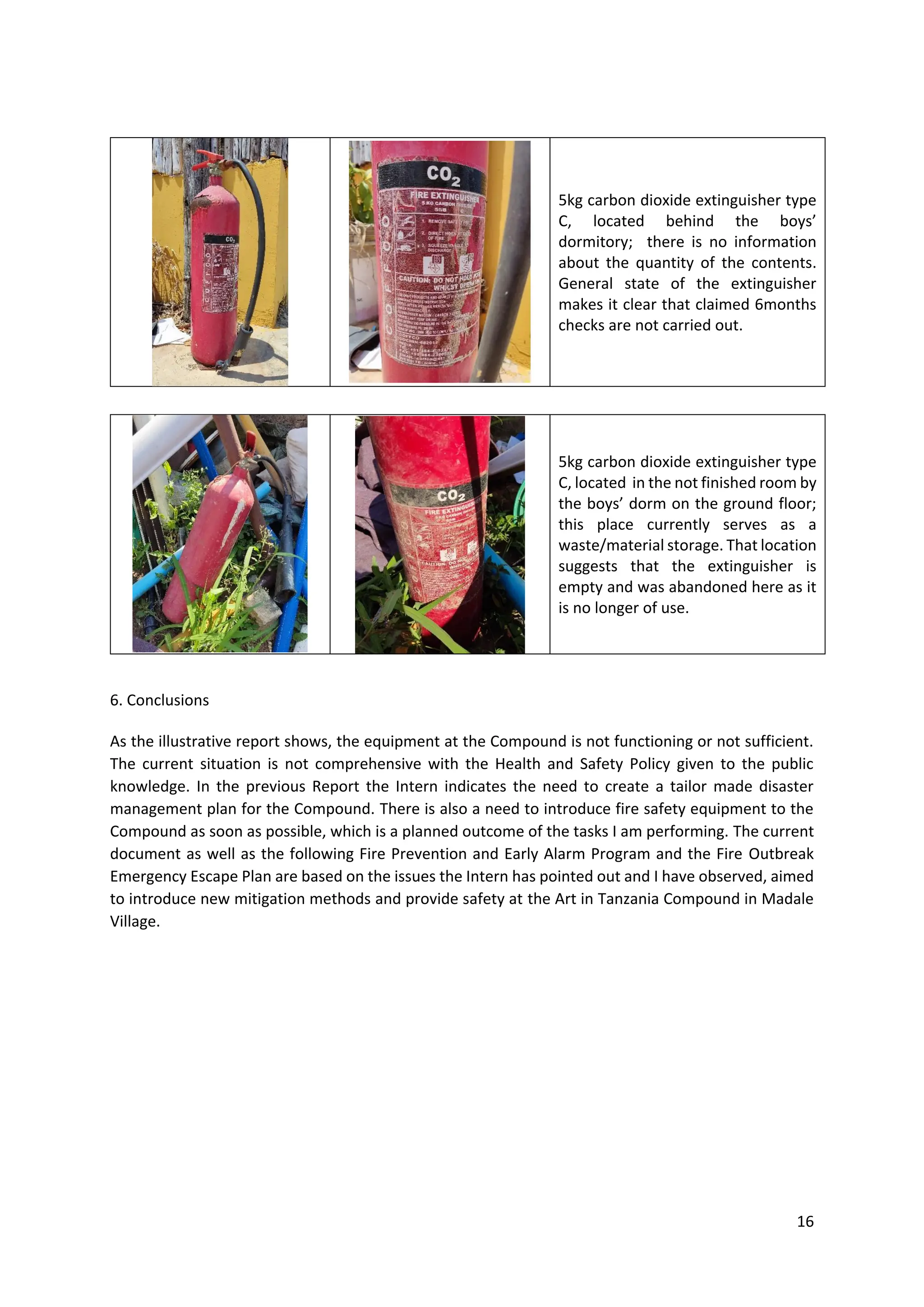
5kg carbon dioxide extinguisher type
C, located on the first floor by the
bathroom of girls’ dormitory; there is
no information about the quantity of
the contents. General state of the
extinguisher makes it clear that
claimed 6months checks are not
carried out.
16
6. Conclusions
As the illustrative report shows, the equipment at the Compound is not functioning or not sufficient.
The current situation is not comprehensive with the Health and Safety Policy given to the public
knowledge. In the previous Report the Intern indicates the need to create a tailor made disaster
management plan for the Compound. There is also a need to introduce fire safety equipment to the
Compound as soon as possible, which is a planned outcome of the tasks I am performing. The current
document as well as the following Fire Prevention and Early Alarm Program and the Fire Outbreak
Emergency Escape Plan are based on the issues the Intern has pointed out and I have observed, aimed
to introduce new mitigation methods and provide safety at the Art in Tanzania Compound in Madale
Village.
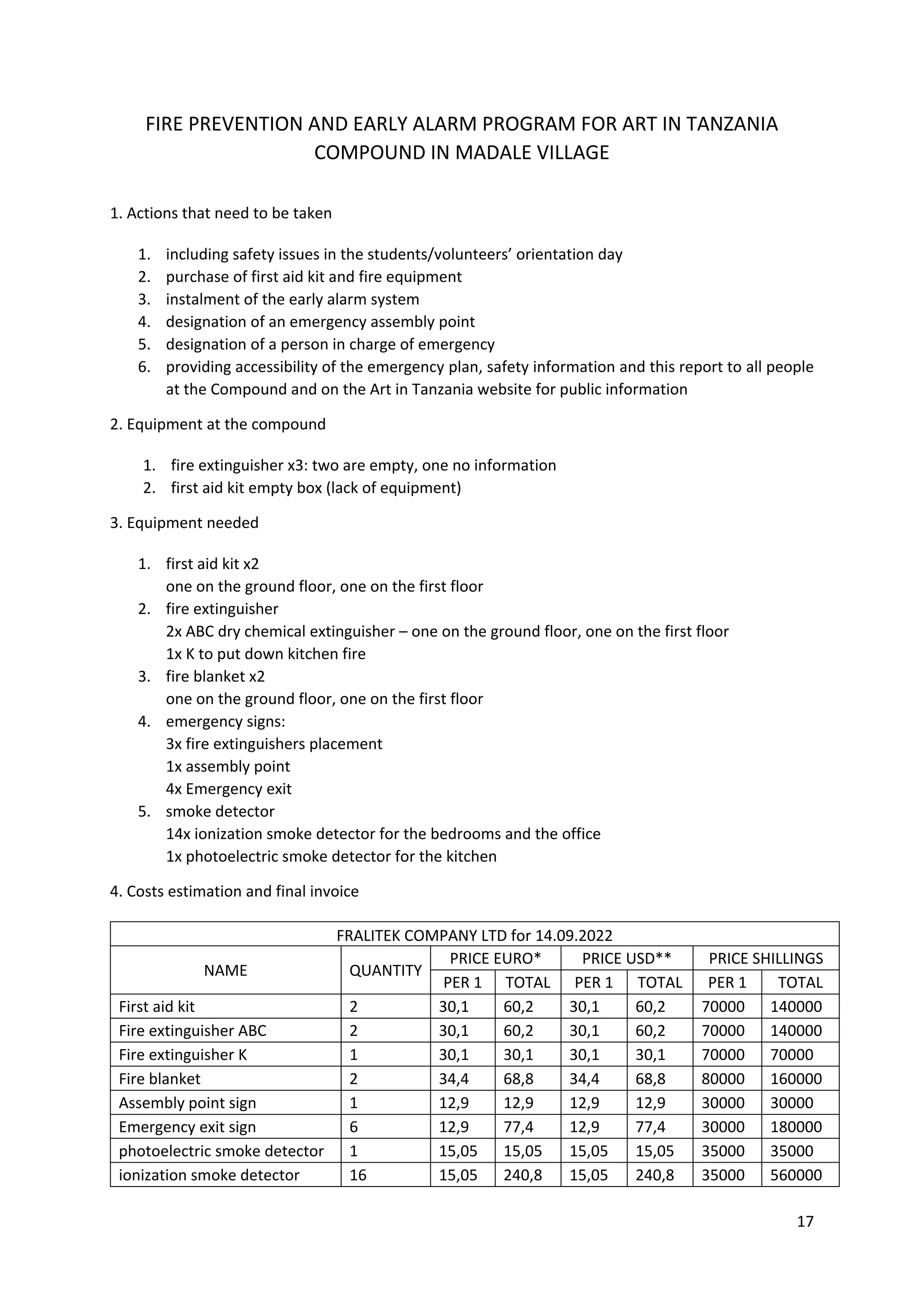
5kg carbon dioxide extinguisher type
C, located behind the boys’
dormitory; there is no information
about the quantity of the contents.
General state of the extinguisher
makes it clear that claimed 6months
checks are not carried out.
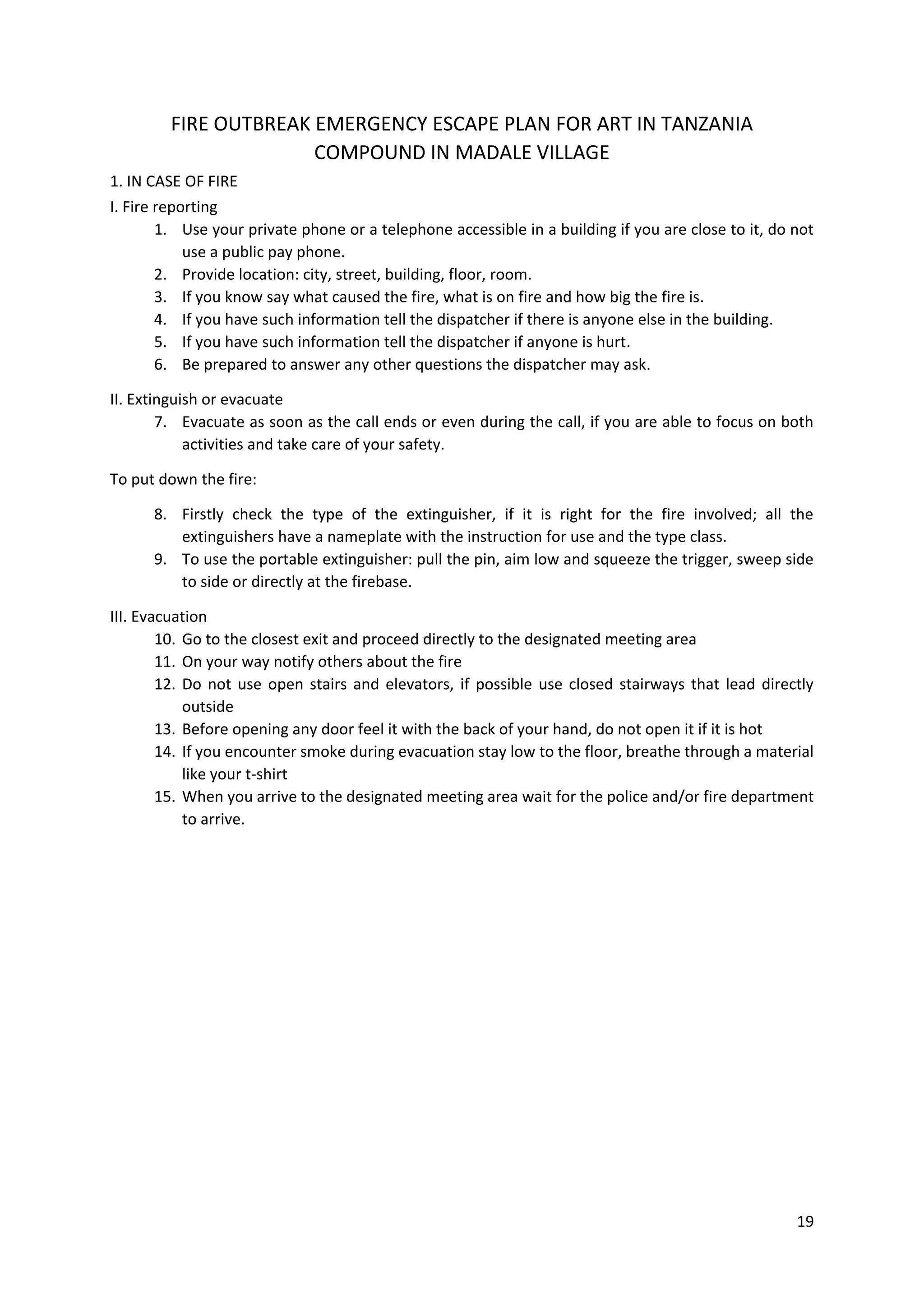
5kg carbon dioxide extinguisher type
C, located in the not finished room by
the boys’ dorm on the ground floor;
this place currently serves as a
waste/material storage. That location
suggests that the extinguisher is
empty and was abandoned here as it
is no longer of use.
17
FIRE PREVENTION AND EARLY ALARM PROGRAM FOR ART IN TANZANIA
COMPOUND IN MADALE VILLAGE
1. Actions that need to be taken
1. including safety issues in the students/volunteers’ orientation day
2. purchase of first aid kit and fire equipment
3. instalment of the early alarm system
4. designation of an emergency assembly point
5. designation of a person in charge of emergency
6. providing accessibility of the emergency plan, safety information and this report to all people
at the Compound and on the Art in Tanzania website for public information
2. Equipment at the compound
1. fire extinguisher x3: two are empty, one no information
2. first aid kit empty box (lack of equipment)
3. Equipment needed
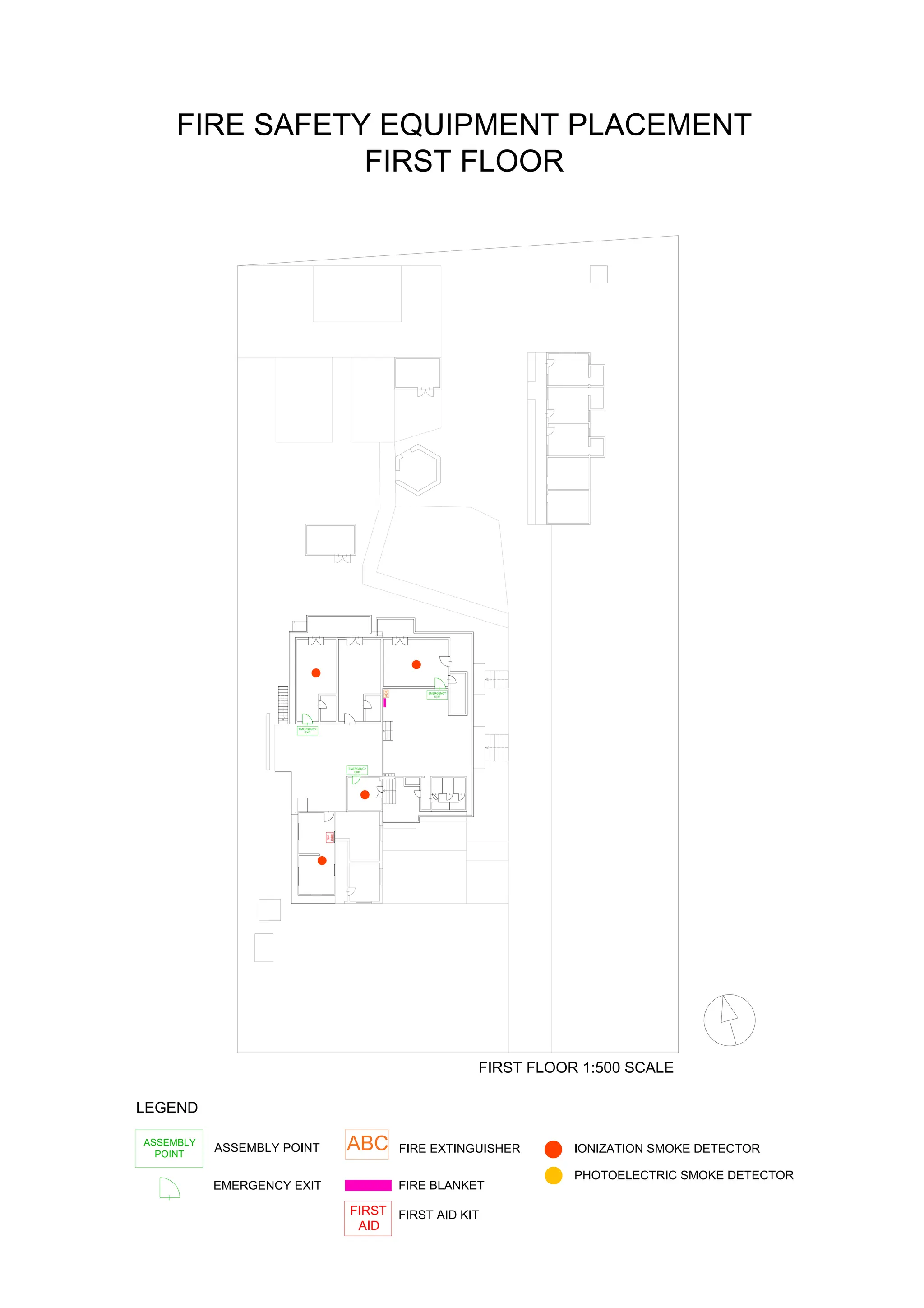
1. first aid kit x2
one on the ground floor, one on the first floor
2. fire extinguisher
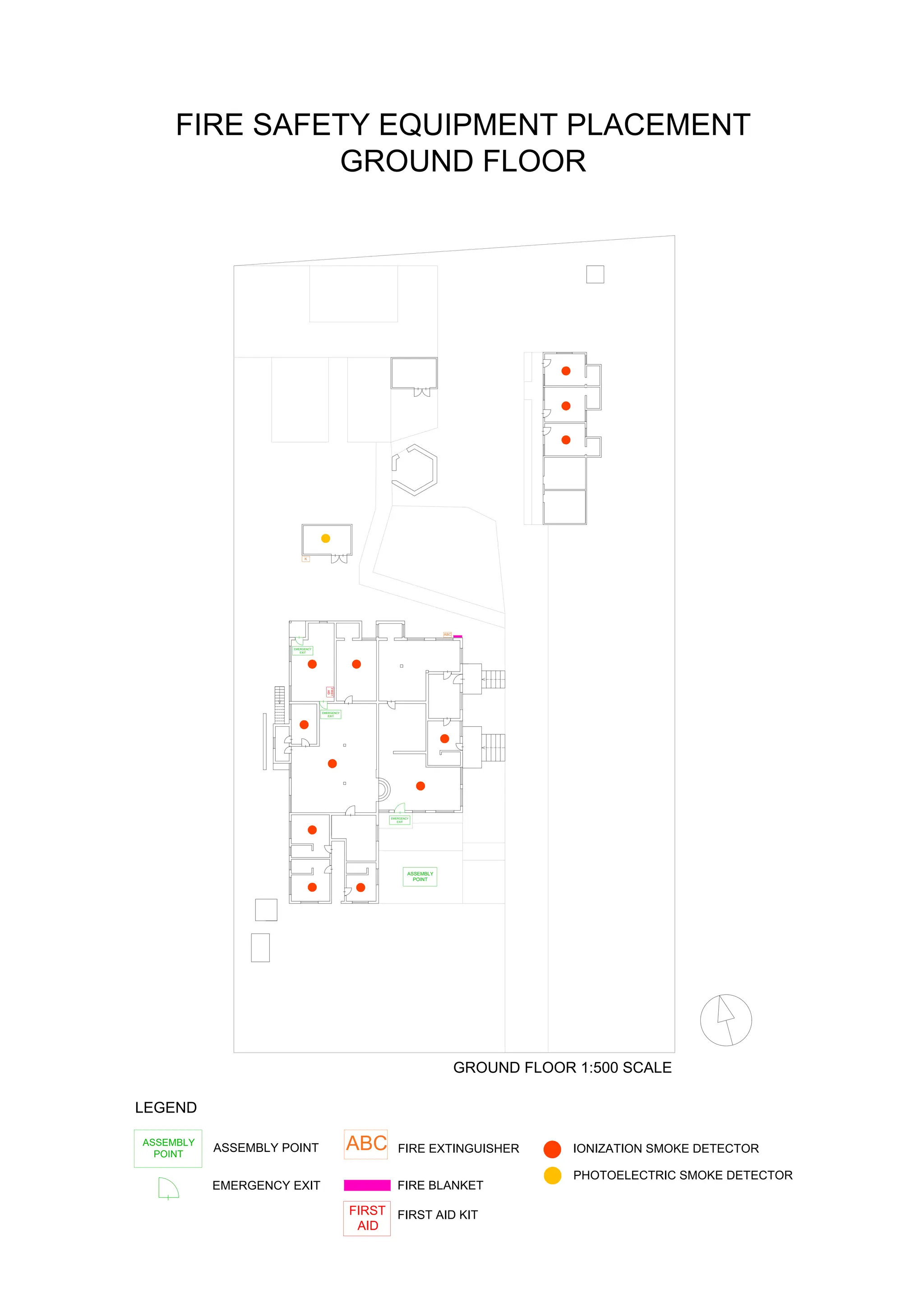
2x ABC dry chemical extinguisher – one on the ground floor, one on the first floor
1x K to put down kitchen fire
3. fire blanket x2
one on the ground floor, one on the first floor
4. emergency signs:
3x fire extinguishers placement
1x assembly point
4x Emergency exit
5. smoke detector
14x ionization smoke detector for the bedrooms and the office
1x photoelectric smoke detector for the kitchen
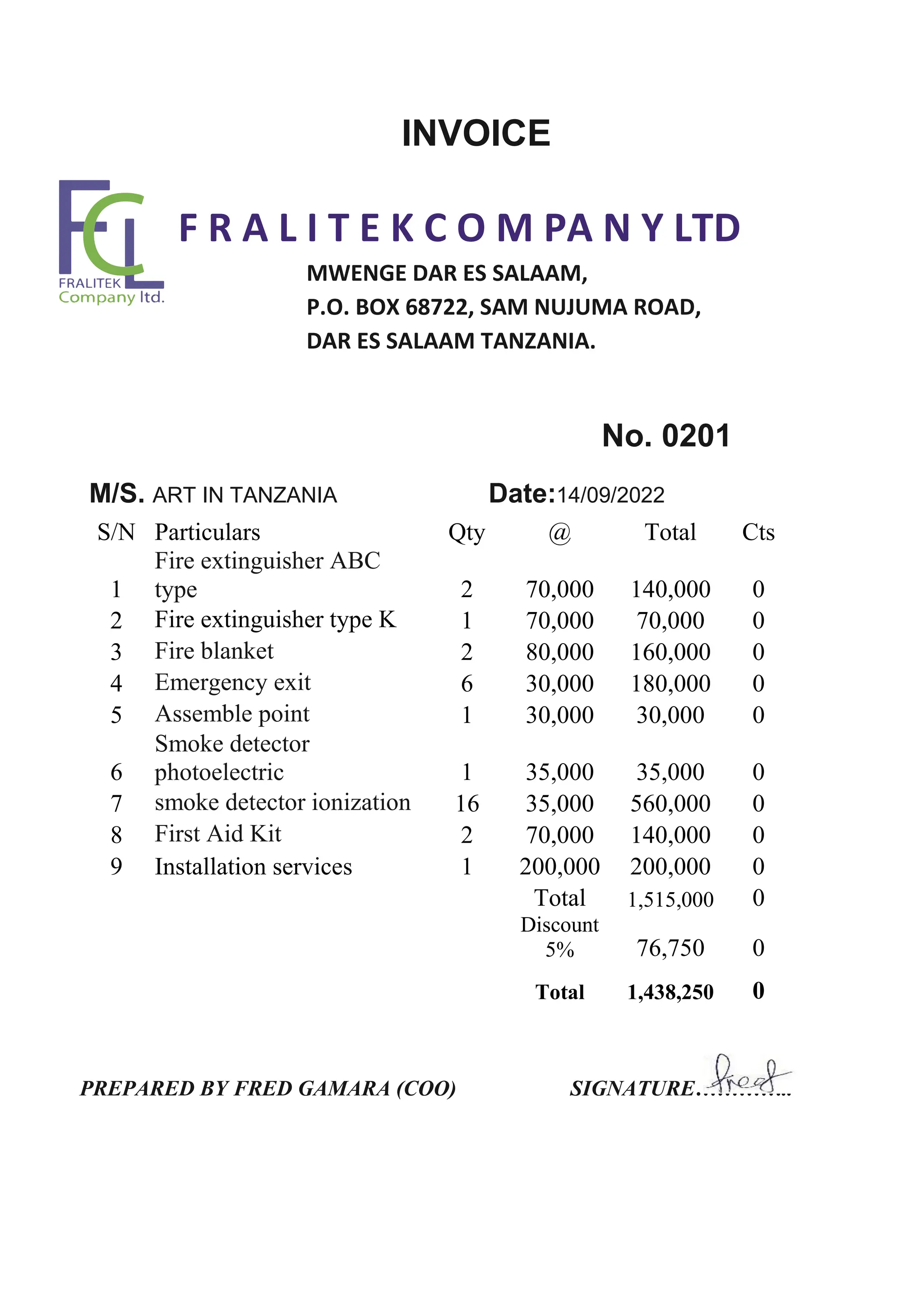
4. Costs estimation and final invoice
FRALITEK COMPANY LTD for 14.09.2022
NAME QUANTITY
PRICE EURO* PRICE USD** PRICE SHILLINGS
PER 1 TOTAL PER 1 TOTAL PER 1 TOTAL
First aid kit 2 30,1 60,2 30,1 60,2 70000 140000
Fire extinguisher ABC 2 30,1 60,2 30,1 60,2 70000 140000
Fire extinguisher K 1 30,1 30,1 30,1 30,1 70000 70000
Fire blanket 2 34,4 68,8 34,4 68,8 80000 160000
Assembly point sign 1 12,9 12,9 12,9 12,9 30000 30000
Emergency exit sign 6 12,9 77,4 12,9 77,4 30000 180000
photoelectric smoke detector 1 15,05 15,05 15,05 15,05 35000 35000
ionization smoke detector 16 15,05 240,8 15,05 240,8 35000 560000
18
installation services 1 86 86 200000 200000
TOTAL COSTS 651,45 651,45 1515000
discount 5% 618,88 618,88 1439250
*exchange rate EURO to tanzanian shilling 1TZS= 0,00043 EURO as for 14.09.2022
** exchange rate USD to tanzanian shilling 1TZS = 0,00043 USD as for 14.09.2022
19
FIRE OUTBREAK EMERGENCY ESCAPE PLAN FOR ART IN TANZANIA
COMPOUND IN MADALE VILLAGE
1. IN CASE OF FIRE
I. Fire reporting
1. Use your private phone or a telephone accessible in a building if you are close to it, do not
use a public pay phone.
2. Provide location: city, street, building, floor, room.
3. If you know say what caused the fire, what is on fire and how big the fire is.
4. If you have such information tell the dispatcher if there is anyone else in the building.
5. If you have such information tell the dispatcher if anyone is hurt.
6. Be prepared to answer any other questions the dispatcher may ask.
II. Extinguish or evacuate
7. Evacuate as soon as the call ends or even during the call, if you are able to focus on both
activities and take care of your safety.
To put down the fire:
8. Firstly check the type of the extinguisher, if it is right for the fire involved; all the
extinguishers have a nameplate with the instruction for use and the type class.
9. To use the portable extinguisher: pull the pin, aim low and squeeze the trigger, sweep side
to side or directly at the firebase.
III. Evacuation
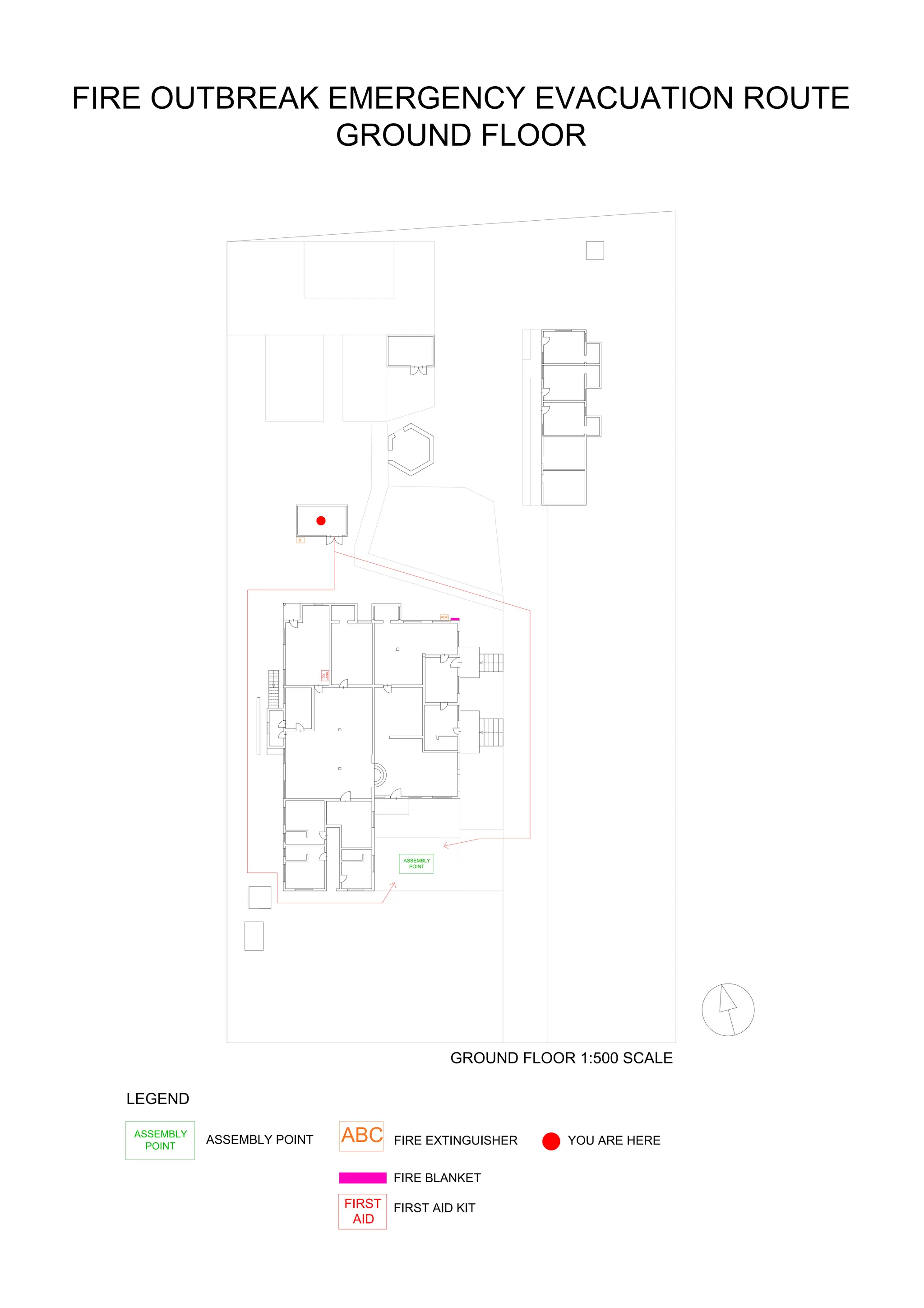
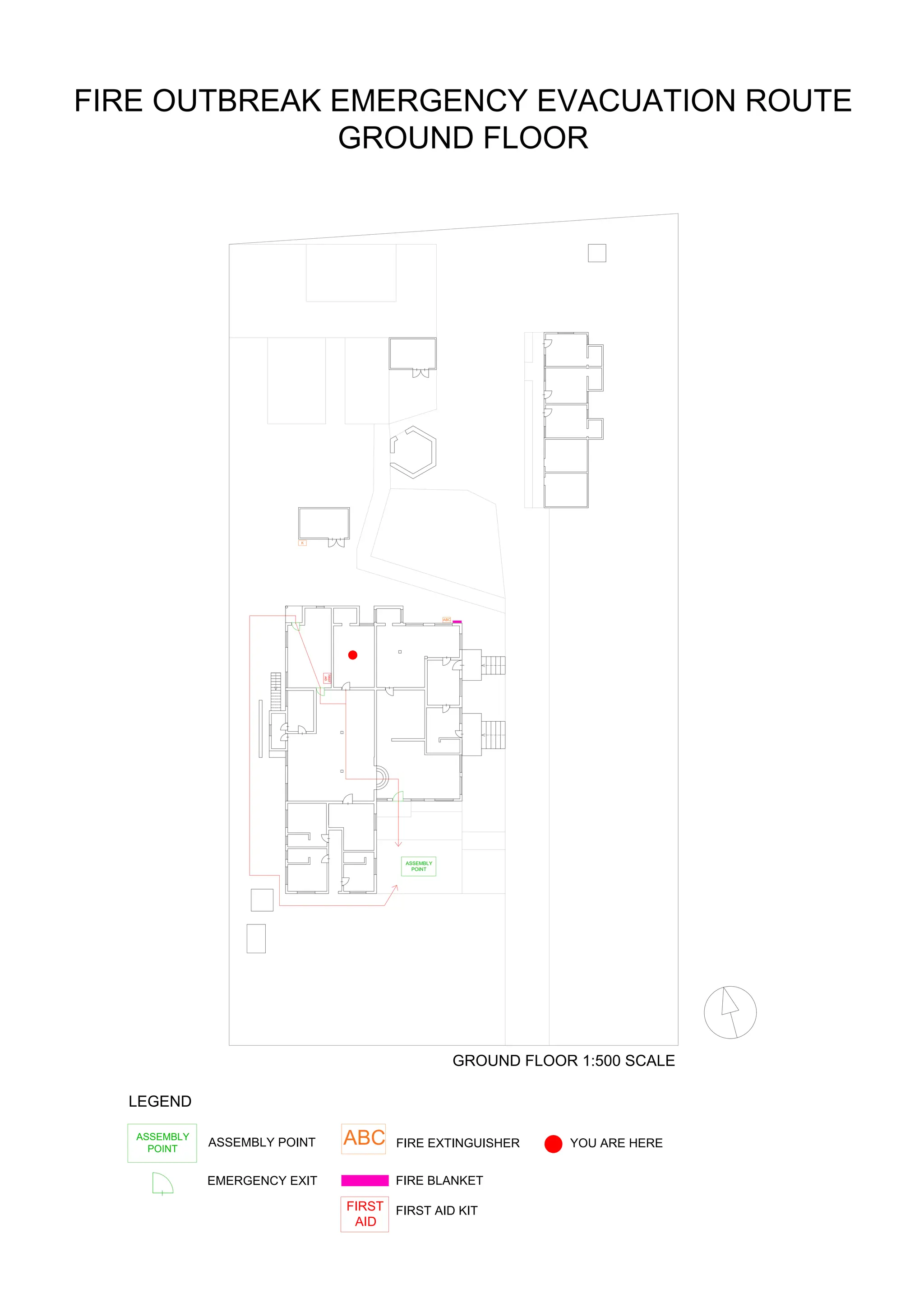
10. Go to the closest exit and proceed directly to the designated meeting area
11. On your way notify others about the fire
12. Do not use open stairs and elevators, if possible use closed stairways that lead directly
outside
13. Before opening any door feel it with the back of your hand, do not open it if it is hot
14. If you encounter smoke during evacuation stay low to the floor, breathe through a material
like your t-shirt
15. When you arrive to the designated meeting area wait for the police and/or fire department
to arrive.
20
LIST OF SOURCES AND ATTACHMENTS
1. Sources
I. Documents
“The Fire and Rescue Act” chapter 427, 20th
June 2008, Act No. 14 of 2007
“Tanzania Emergency Preparedness and Response Plan (TERP) draft” January 2012, The United
Republic of Tanzania Prime Minister’s Office Disaster Management Department
“Emergency Plan Art in Tanzania Compound” report written by Intern Francesco Loretucci at the end
of June 2022
“Intern Health and Safety policy” issued by Kari Korhonen, the Program Director 1st
of January 2019
II. Books
“First Aid Reference Guide” St .John Ambulance, second edition July 2007
III. Articles
“Assessing urban fire risk in the central business district of Dar es Salaa, Tanzania” article in Jamba:
Journal of Disaster Risk Studies, April 2010, Yohannes Kachenje, Huba Mary Nguluma and Jacob Kihila
https://www.frontiersin.org/articles/10.3389/fmech.2019.00049/full Front. Mech. Eng., 18
September 2019, Review of the Transition From Smouldering to Flaming combustion in Wildfires
IV. Websites
https://www.umb.edu/ehs/fire_safety/fire_extinguishers
https://www.amherst.edu/offices/enviro_health_safety/fire/fire-emergency/emergency_actionplan
https://www.ifsecglobal.com/smoke-detectors/
https://www.ifsecglobal.com/fire-news/guide-fire-risk-assessment-get-one/
https://www.bayalarm.com/commercial/fire-alarms-smoke-detectors/types-of-fire-alarm-systems-
explained/#
https://www.dfliq.net/blog/unsafe-electrical-installations-causes-and-solutions/
https://www.nfpa.org/Public-Education/Staying-safe/Safety-equipment/Home-fire-sprinklers/Fire-
Sprinkler-Initiative/Take-action/Free-downloads/How-sprinklers-work
https://vanguard-fire.com/3-types-of-fire-sprinkler-systems/
https://www.bu.edu/ehs/ehs-topics/fire-safety/fire-safety-dos-and-donts/
https://monaghan.ie/firebuildingcontrol/what-are-fire-blankets/
https://stafffiretraining.co.uk/how-to-use-a-fire-blanket/
2. Attachments
Architectural drawings for the AiT premises in Madale Village:
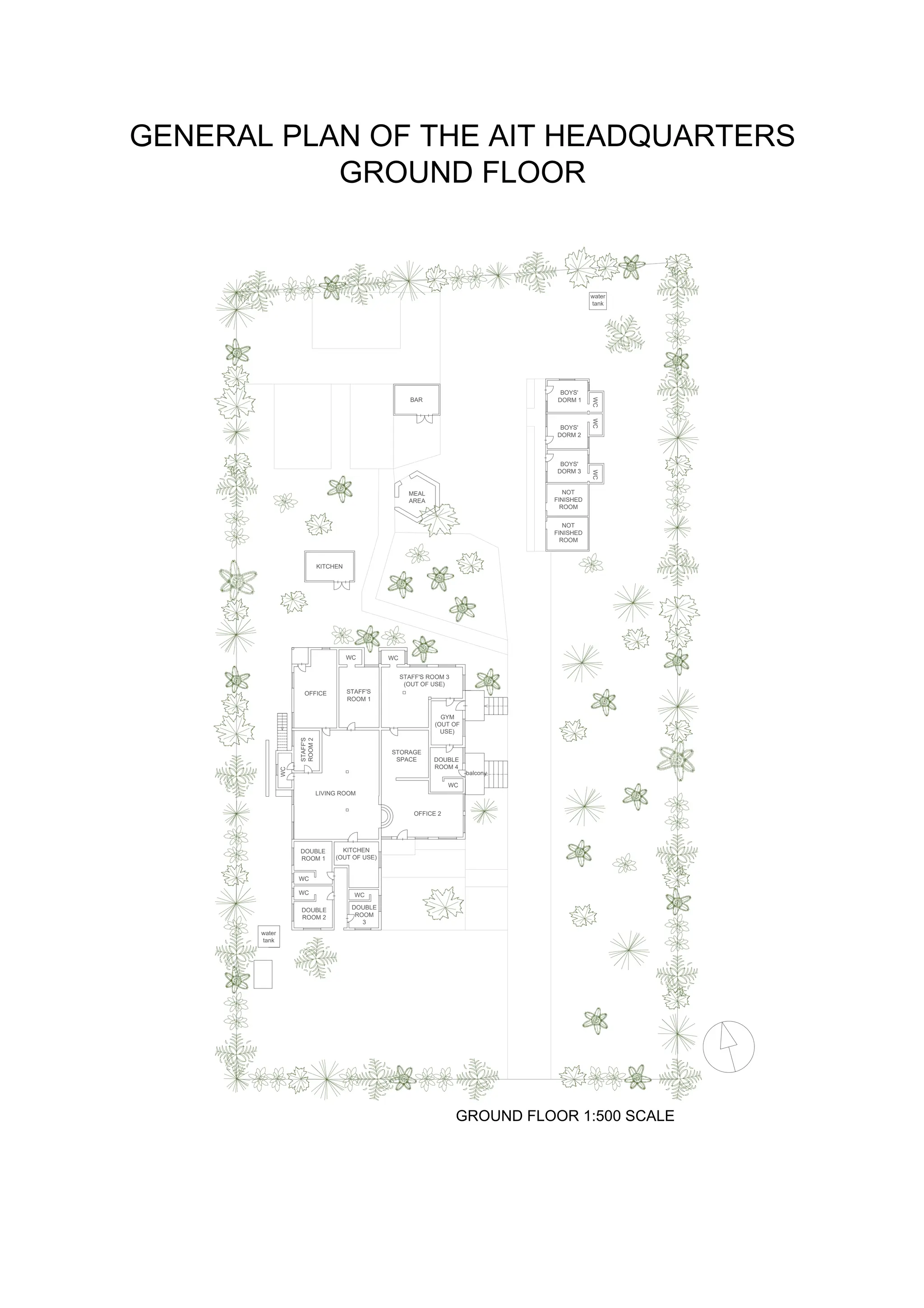
1. General plans of the premises (ground floor + first floor)
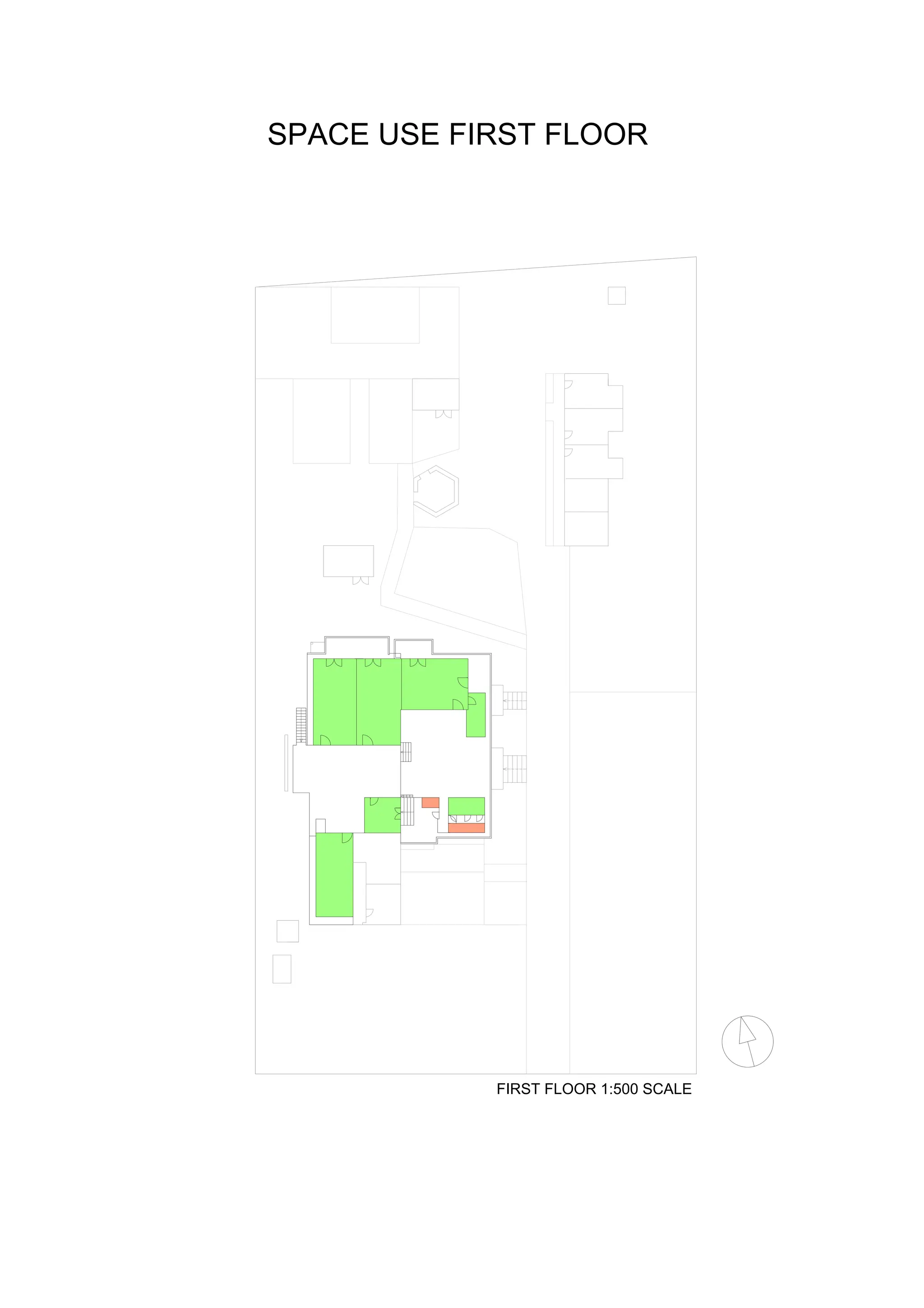
2. Space use (ground floor + first floor)
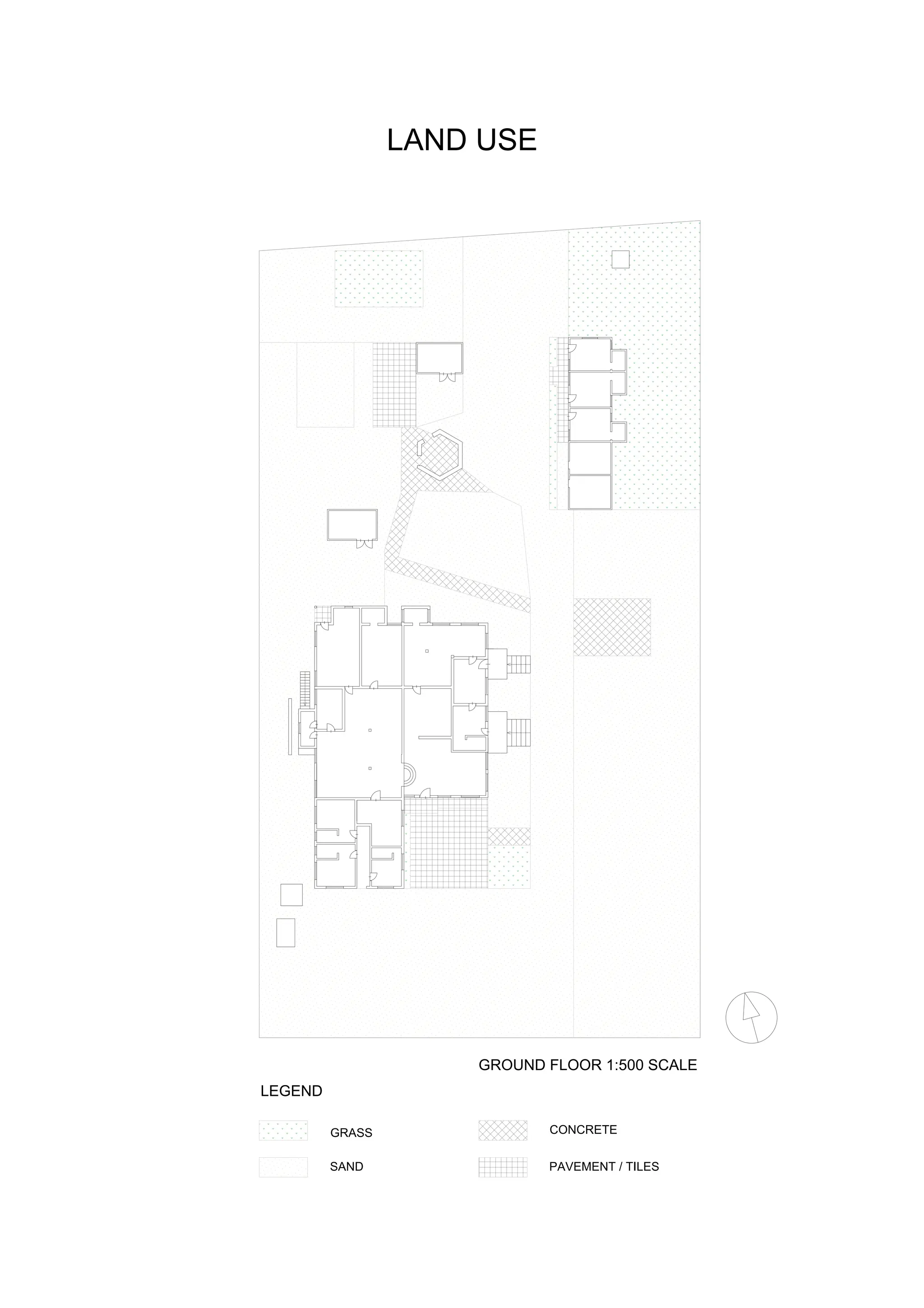
3. Land use
4. Fire equipment placement (ground floor + first floor)
5. Fire outbreak emergency routes (ground floor + first floor for each room)
21
Documents:
6. “Intern Health and Safety policy” issued by Kari Korhonen, the Program Director 1st
of
January 2019
7. Fire safety equipment invoice from FRALITEK COMPANY LTD issued for Art in Tanzania on the
14/09/2022
8. “Emergency Plan Art in Tanzania Compound” report written by Intern Francesco Loretucci at
the end of June 2022
GROUND FLOOR 1:500 SCALE
BAR
MEAL
AREA
KITCHEN
BOYS'
DORM 1
WC
NOT
FINISHED
ROOM
WC
WC
BOYS'
DORM 2
BOYS'
DORM 3
NOT
FINISHED
ROOM
WC WC
WC
WC
WC WC
WC
OFFICE
LIVING ROOM
OFFICE 2
STAFF'S
ROOM 1
GYM
(OUT OF
USE)
STORAGE
SPACE
KITCHEN
(OUT OF USE)
DOUBLE
ROOM 2
DOUBLE
ROOM 1
DOUBLE
ROOM
3
DOUBLE
ROOM 4
STAFF'S
ROOM
2
STAFF'S ROOM 3
(OUT OF USE)
balcony
water
tank
water
tank
GENERAL PLAN OF THE AIT HEADQUARTERS
GROUND FLOOR
FIRST FLOOR 1:500 SCALE
WC
WC
WC
WC
BOYS'
DORM 4
GIRLS'
DORM 1
GIRLS'
DORM 2
DOUBLE
ROOM 5
balcony
balcony balcony
balcony
passage
open terrace
open terrace
water
tank
GENERAL PLAN OF THE AIT HEADQUARTERS
FIRST FLOOR
LAND USE
GROUND FLOOR 1:500 SCALE
LEGEND
GRASS
SAND
CONCRETE
PAVEMENT / TILES
LEGEND
ROOMS CURRENTLY IN USE
ROOMS OUT OF USE
GROUND FLOOR 1:500 SCALE
SPACE USE GROUND FLOOR
FIRST FLOOR 1:500 SCALE
SPACE USE FIRST FLOOR
ABC
K
ASSEMBLY
POINT
EMERGENCY
EXIT
EMERGENCY
EXIT
EMERGENCY
EXIT
FIRST
AID
ASSEMBLY
POINT
ABC
FIRST
AID
LEGEND
ASSEMBLY POINT
EMERGENCY EXIT
FIRE EXTINGUISHER
FIRE BLANKET
FIRST AID KIT
IONIZATION SMOKE DETECTOR
PHOTOELECTRIC SMOKE DETECTOR
GROUND FLOOR 1:500 SCALE
FIRE SAFETY EQUIPMENT PLACEMENT
GROUND FLOOR
ASSEMBLY
POINT
ABC
FIRST
AID
LEGEND
ASSEMBLY POINT
EMERGENCY EXIT
FIRE EXTINGUISHER
FIRE BLANKET
FIRST AID KIT
IONIZATION SMOKE DETECTOR
PHOTOELECTRIC SMOKE DETECTOR
ABC
EMERGENCY
EXIT
EMERGENCY
EXIT
EMERGENCY
EXIT
FIRST
AID
FIRST FLOOR 1:500 SCALE
FIRE SAFETY EQUIPMENT PLACEMENT
FIRST FLOOR
ABC
K
ASSEMBLY
POINT
FIRST
AID
ASSEMBLY
POINT
ABC
FIRST
AID
LEGEND
ASSEMBLY POINT FIRE EXTINGUISHER
FIRE BLANKET
FIRST AID KIT
GROUND FLOOR 1:500 SCALE
YOU ARE HERE
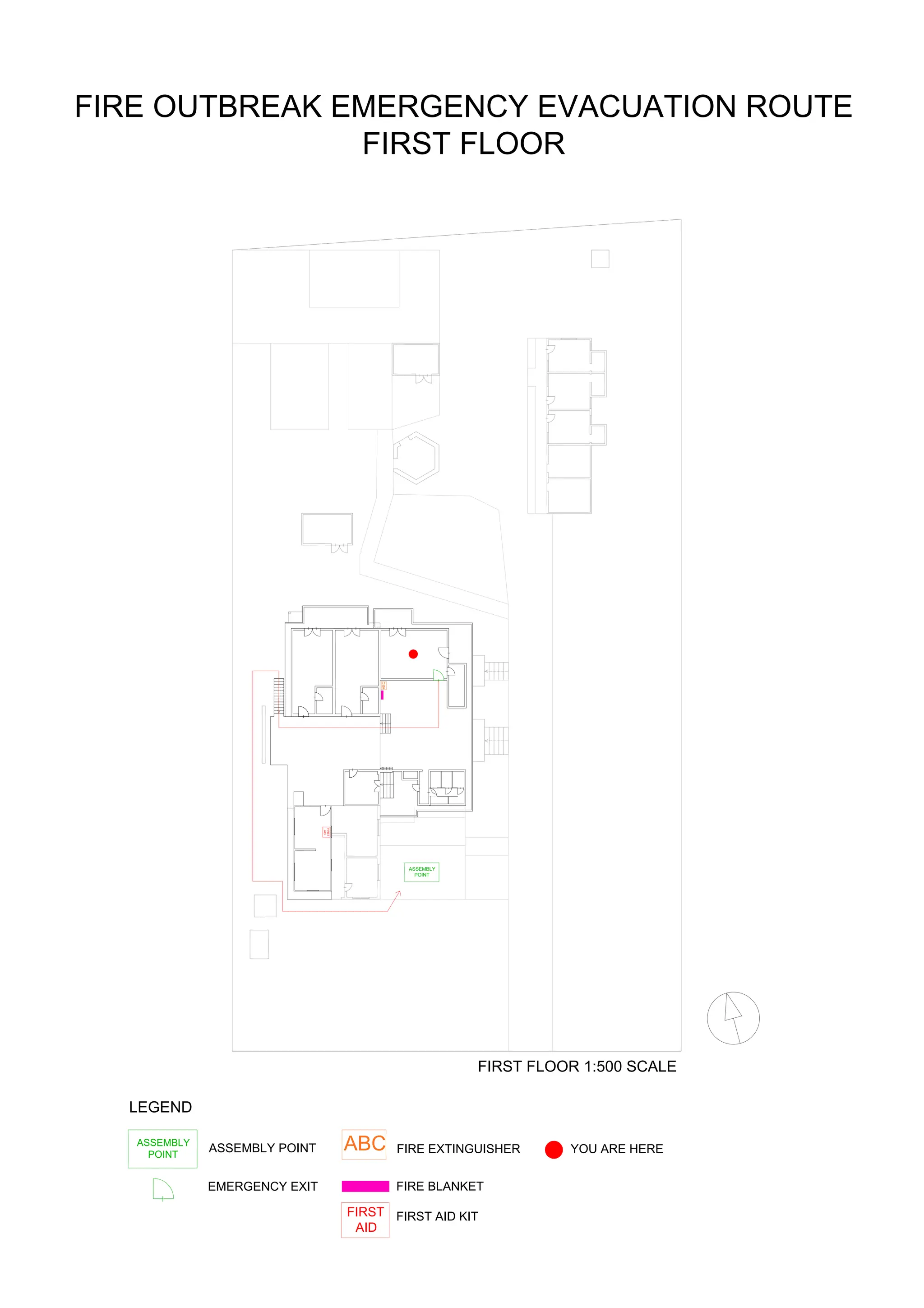
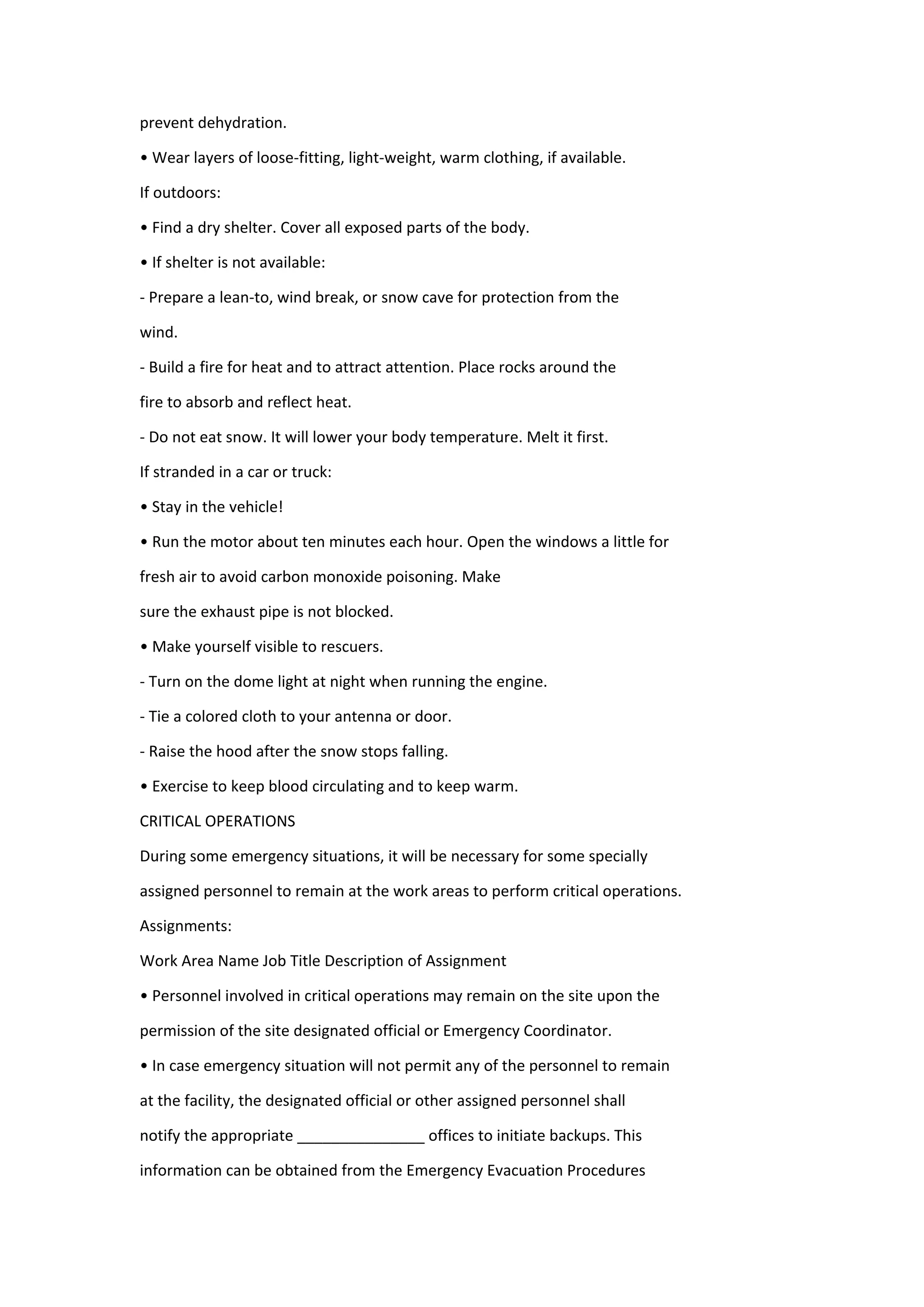
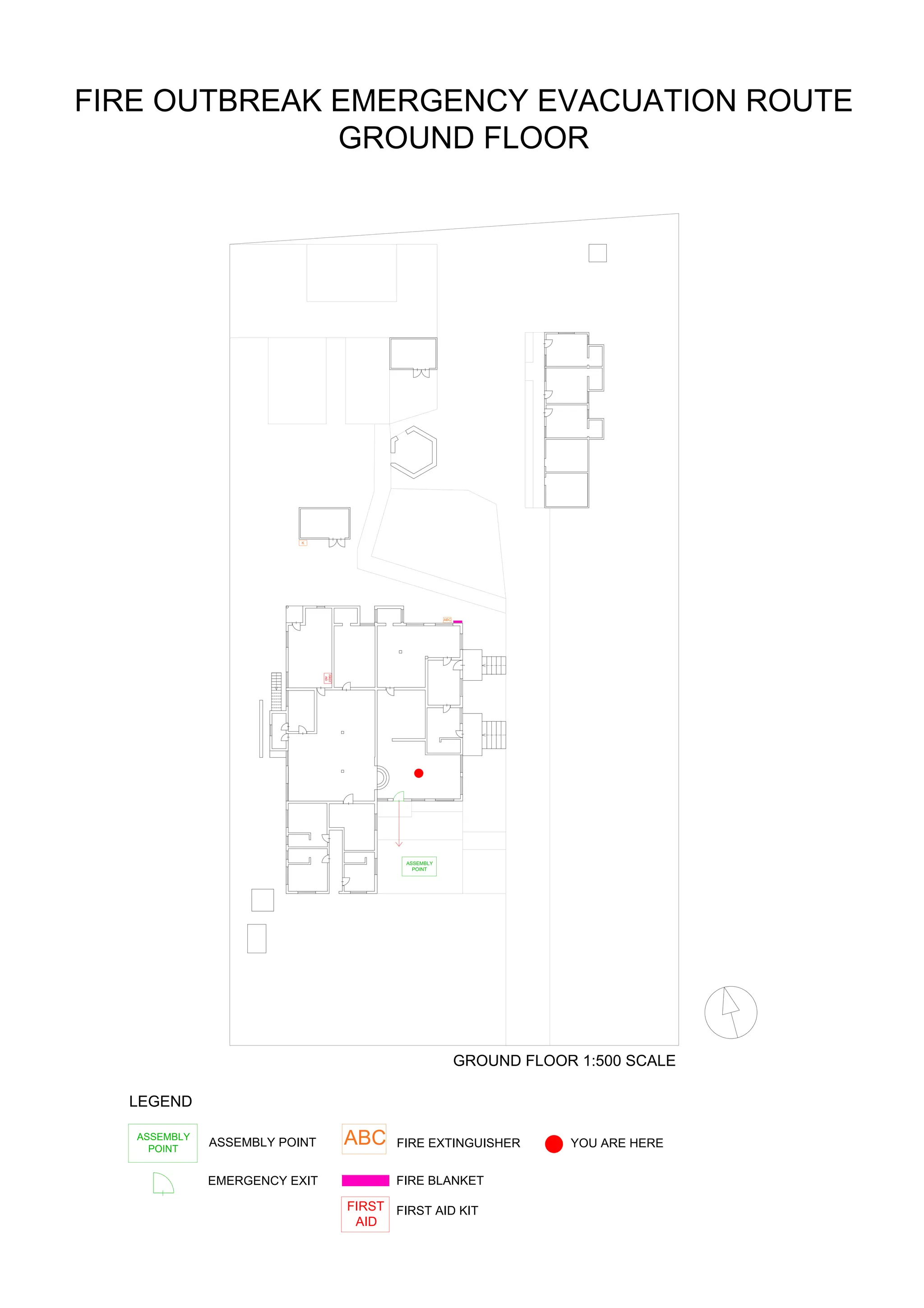
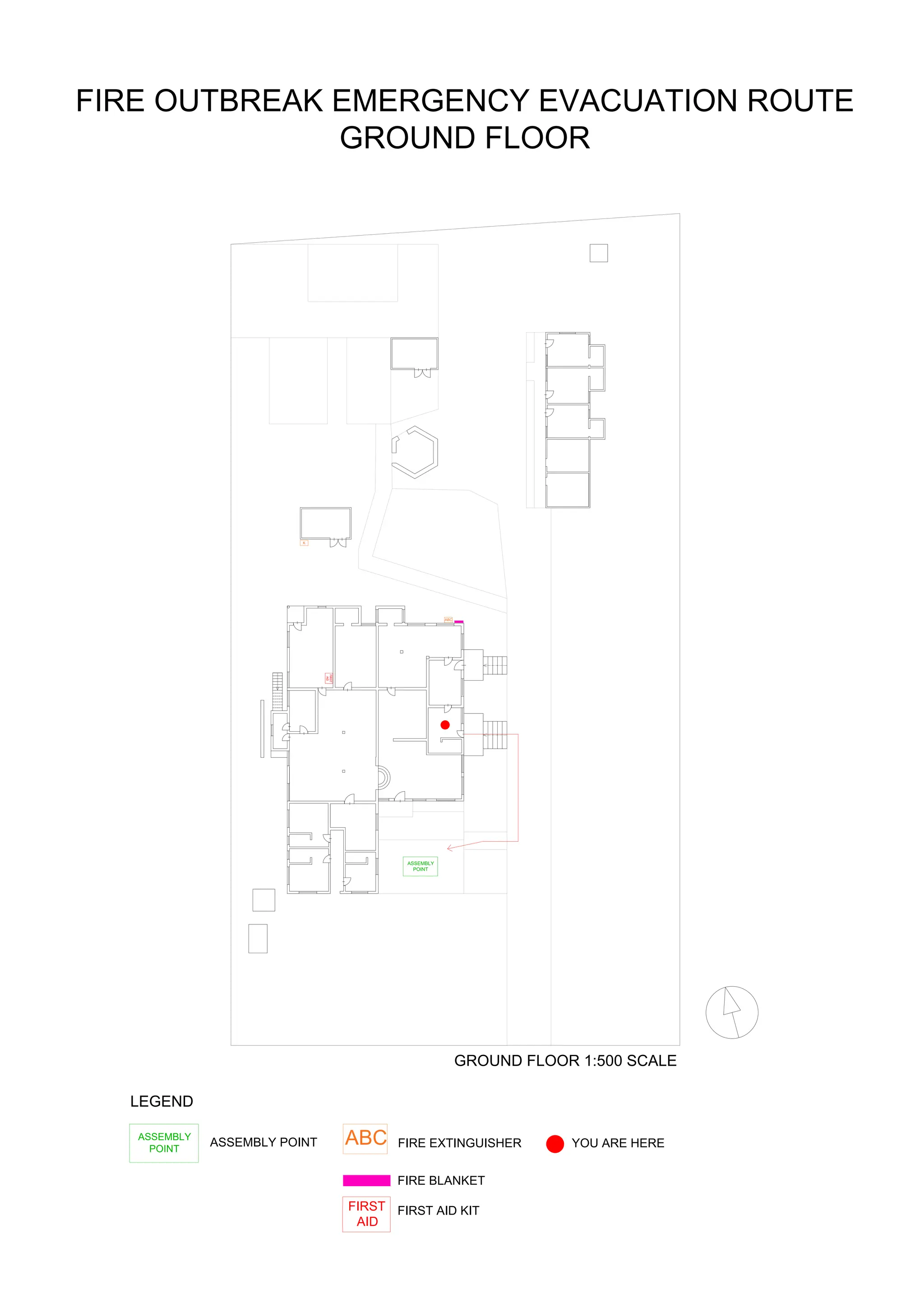
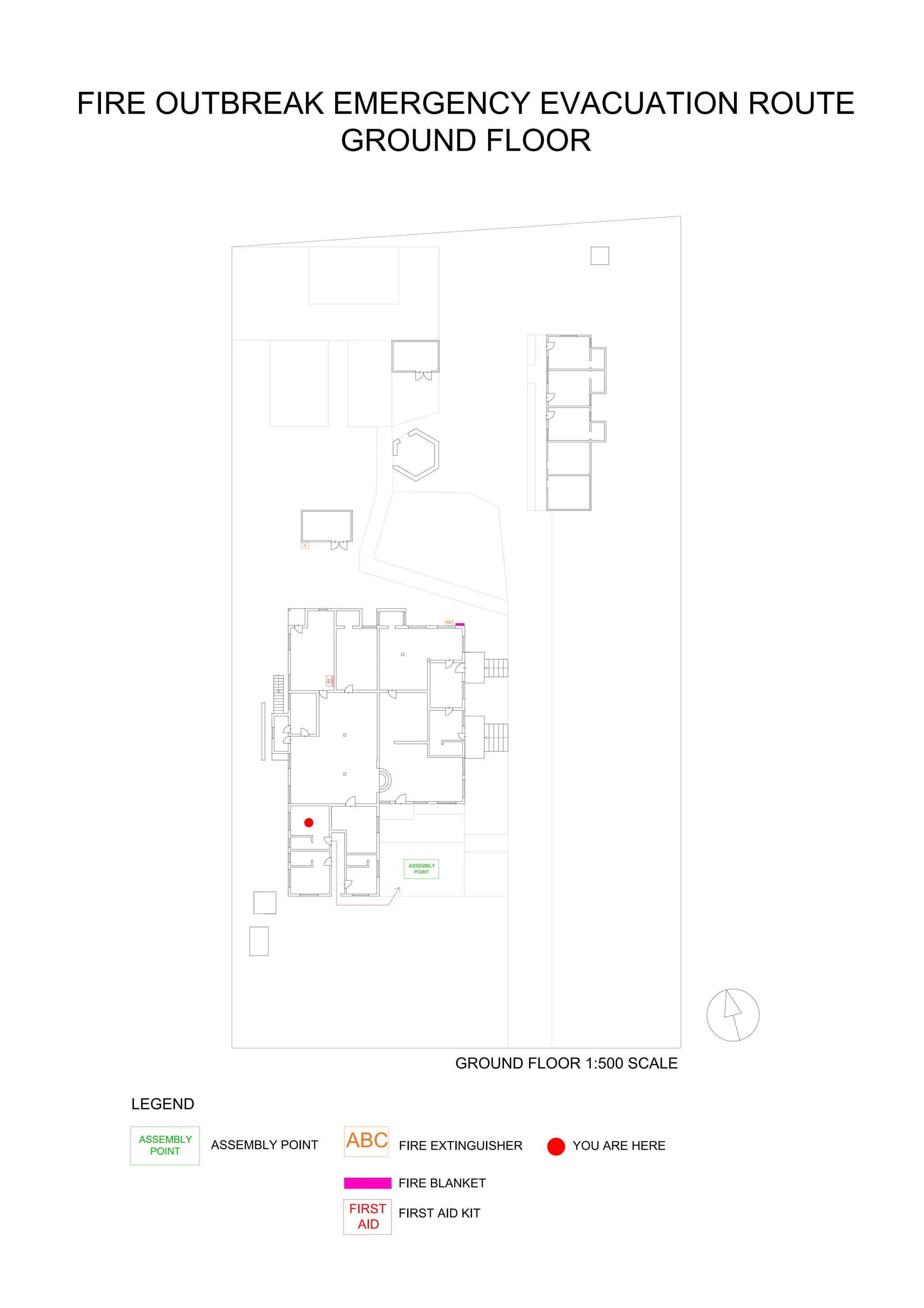
FIRE OUTBREAK EMERGENCY EVACUATION ROUTE
GROUND FLOOR
ABC
K
ASSEMBLY
POINT
FIRST
AID
ASSEMBLY
POINT
ABC
FIRST
AID
LEGEND
ASSEMBLY POINT FIRE EXTINGUISHER
FIRE BLANKET
FIRST AID KIT
GROUND FLOOR 1:500 SCALE
YOU ARE HERE
FIRE OUTBREAK EMERGENCY EVACUATION ROUTE
GROUND FLOOR
ABC
K
ASSEMBLY
POINT
FIRST
AID
ASSEMBLY
POINT
ABC
FIRST
AID
LEGEND
ASSEMBLY POINT FIRE EXTINGUISHER
FIRE BLANKET
FIRST AID KIT
GROUND FLOOR 1:500 SCALE
YOU ARE HERE
FIRE OUTBREAK EMERGENCY EVACUATION ROUTE
GROUND FLOOR
ABC
K
ASSEMBLY
POINT
FIRST
AID
ASSEMBLY
POINT
ABC
FIRST
AID
LEGEND
ASSEMBLY POINT FIRE EXTINGUISHER
FIRE BLANKET
FIRST AID KIT
GROUND FLOOR 1:500 SCALE
YOU ARE HERE
FIRE OUTBREAK EMERGENCY EVACUATION ROUTE
GROUND FLOOR
ABC
K
ASSEMBLY
POINT
FIRST
AID
ASSEMBLY
POINT
ABC
FIRST
AID
LEGEND
ASSEMBLY POINT FIRE EXTINGUISHER
FIRE BLANKET
FIRST AID KIT
GROUND FLOOR 1:500 SCALE
YOU ARE HERE
EMERGENCY EXIT
FIRE OUTBREAK EMERGENCY EVACUATION ROUTE
GROUND FLOOR
ABC
K
ASSEMBLY
POINT
FIRST
AID
ASSEMBLY
POINT
ABC
FIRST
AID
LEGEND
ASSEMBLY POINT FIRE EXTINGUISHER
FIRE BLANKET
FIRST AID KIT
GROUND FLOOR 1:500 SCALE
YOU ARE HERE
EMERGENCY EXIT
FIRE OUTBREAK EMERGENCY EVACUATION ROUTE
GROUND FLOOR
ABC
K
ASSEMBLY
POINT
FIRST
AID
ASSEMBLY
POINT
ABC
FIRST
AID
LEGEND
ASSEMBLY POINT FIRE EXTINGUISHER
FIRE BLANKET
FIRST AID KIT
GROUND FLOOR 1:500 SCALE
YOU ARE HERE
EMERGENCY EXIT
FIRE OUTBREAK EMERGENCY EVACUATION ROUTE
GROUND FLOOR
ABC
K
ASSEMBLY
POINT
FIRST
AID
ASSEMBLY
POINT
ABC
FIRST
AID
LEGEND
ASSEMBLY POINT FIRE EXTINGUISHER
FIRE BLANKET
FIRST AID KIT
GROUND FLOOR 1:500 SCALE
YOU ARE HERE
EMERGENCY EXIT
FIRE OUTBREAK EMERGENCY EVACUATION ROUTE
GROUND FLOOR
ABC
K
ASSEMBLY
POINT
FIRST
AID
ASSEMBLY
POINT
ABC
FIRST
AID
LEGEND
ASSEMBLY POINT FIRE EXTINGUISHER
FIRE BLANKET
FIRST AID KIT
GROUND FLOOR 1:500 SCALE
YOU ARE HERE
EMERGENCY EXIT
FIRE OUTBREAK EMERGENCY EVACUATION ROUTE
GROUND FLOOR
ABC
K
ASSEMBLY
POINT
FIRST
AID
ASSEMBLY
POINT
ABC
FIRST
AID
LEGEND
ASSEMBLY POINT FIRE EXTINGUISHER
FIRE BLANKET
FIRST AID KIT
GROUND FLOOR 1:500 SCALE
YOU ARE HERE
FIRE OUTBREAK EMERGENCY EVACUATION ROUTE
GROUND FLOOR
ABC
K
ASSEMBLY
POINT
FIRST
AID
ASSEMBLY
POINT
ABC
FIRST
AID
LEGEND
ASSEMBLY POINT FIRE EXTINGUISHER
FIRE BLANKET
FIRST AID KIT
GROUND FLOOR 1:500 SCALE
YOU ARE HERE
FIRE OUTBREAK EMERGENCY EVACUATION ROUTE
GROUND FLOOR
ABC
K
ASSEMBLY
POINT
FIRST
AID
ASSEMBLY
POINT
ABC
FIRST
AID
LEGEND
ASSEMBLY POINT FIRE EXTINGUISHER
FIRE BLANKET
FIRST AID KIT
GROUND FLOOR 1:500 SCALE
YOU ARE HERE
FIRE OUTBREAK EMERGENCY EVACUATION ROUTE
GROUND FLOOR
ABC
K
ASSEMBLY
POINT
FIRST
AID
ASSEMBLY
POINT
ABC
FIRST
AID
LEGEND
ASSEMBLY POINT FIRE EXTINGUISHER
FIRE BLANKET
FIRST AID KIT
GROUND FLOOR 1:500 SCALE
YOU ARE HERE
FIRE OUTBREAK EMERGENCY EVACUATION ROUTE
GROUND FLOOR
ASSEMBLY
POINT
ABC
FIRST
AID
LEGEND
ASSEMBLY POINT
EMERGENCY EXIT
FIRE EXTINGUISHER
FIRE BLANKET
FIRST AID KIT
ABC
FIRST
AID
FIRST FLOOR 1:500 SCALE
YOU ARE HERE
ASSEMBLY
POINT
FIRE OUTBREAK EMERGENCY EVACUATION ROUTE
FIRST FLOOR
ASSEMBLY
POINT
ABC
FIRST
AID
LEGEND
ASSEMBLY POINT
EMERGENCY EXIT
FIRE EXTINGUISHER
FIRE BLANKET
FIRST AID KIT
ABC
FIRST
AID
FIRST FLOOR 1:500 SCALE
YOU ARE HERE
ASSEMBLY
POINT
FIRE OUTBREAK EMERGENCY EVACUATION ROUTE
FIRST FLOOR
ASSEMBLY
POINT
ABC
FIRST
AID
LEGEND
ASSEMBLY POINT
EMERGENCY EXIT
FIRE EXTINGUISHER
FIRE BLANKET
FIRST AID KIT
ABC
FIRST
AID
FIRST FLOOR 1:500 SCALE
YOU ARE HERE
ASSEMBLY
POINT
FIRE OUTBREAK EMERGENCY EVACUATION ROUTE
FIRST FLOOR
ASSEMBLY
POINT
ABC
FIRST
AID
LEGEND
ASSEMBLY POINT
EMERGENCY EXIT
FIRE EXTINGUISHER
FIRE BLANKET
FIRST AID KIT
ABC
FIRST
AID
FIRST FLOOR 1:500 SCALE
YOU ARE HERE
ASSEMBLY
POINT
FIRE OUTBREAK EMERGENCY EVACUATION ROUTE
FIRST FLOOR
Art in Tanzania
Web page - Blog - Facebook - Twitter - LinkedIn - YouTube - Pinterest - Instagram
1
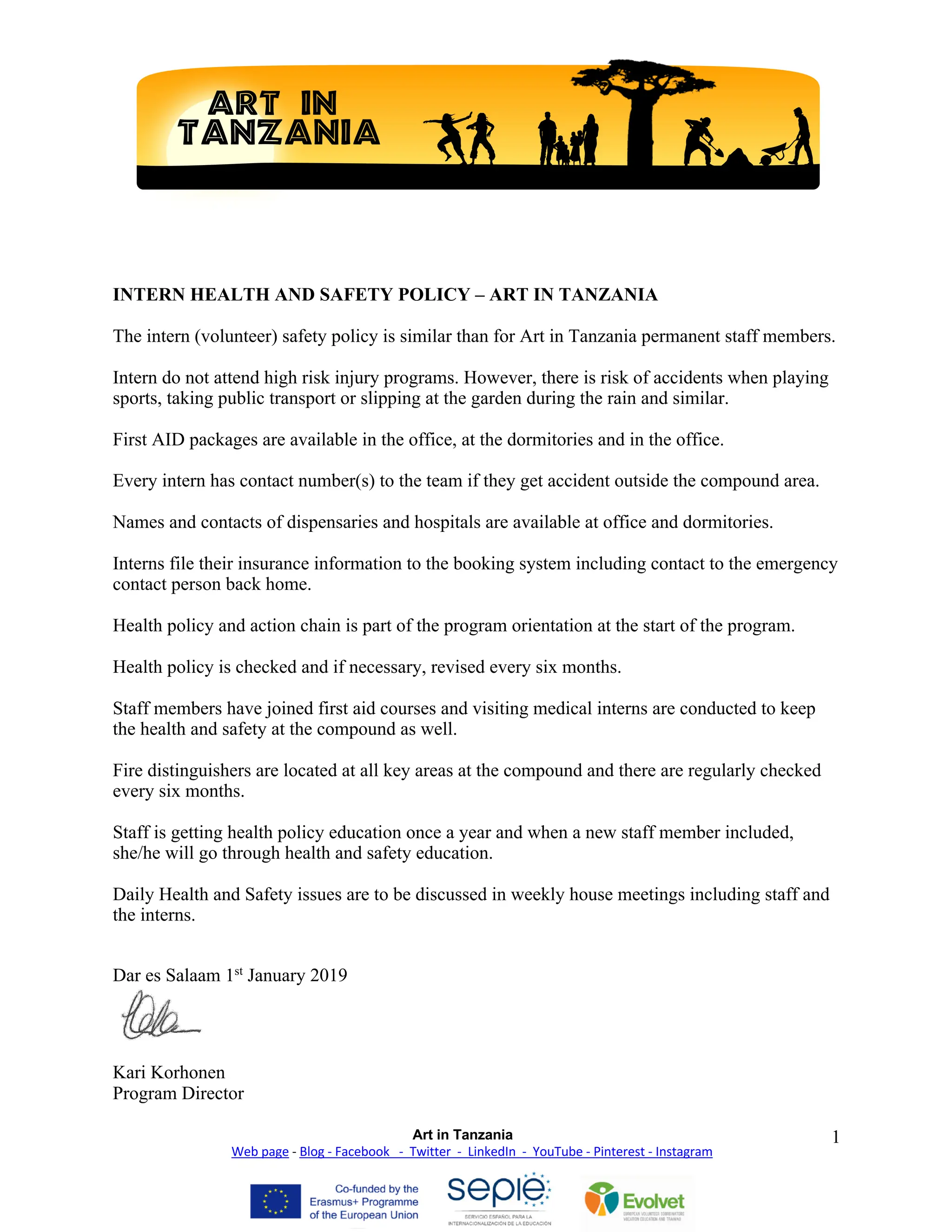
INTERN HEALTH AND SAFETY POLICY – ART IN TANZANIA
The intern (volunteer) safety policy is similar than for Art in Tanzania permanent staff members.
Intern do not attend high risk injury programs. However, there is risk of accidents when playing
sports, taking public transport or slipping at the garden during the rain and similar.
First AID packages are available in the office, at the dormitories and in the office.
Every intern has contact number(s) to the team if they get accident outside the compound area.
Names and contacts of dispensaries and hospitals are available at office and dormitories.
Interns file their insurance information to the booking system including contact to the emergency
contact person back home.
Health policy and action chain is part of the program orientation at the start of the program.
Health policy is checked and if necessary, revised every six months.
Staff members have joined first aid courses and visiting medical interns are conducted to keep
the health and safety at the compound as well.
Fire distinguishers are located at all key areas at the compound and there are regularly checked
every six months.
Staff is getting health policy education once a year and when a new staff member included,
she/he will go through health and safety education.
Daily Health and Safety issues are to be discussed in weekly house meetings including staff and
the interns.
Dar es Salaam 1st
January 2019
Kari Korhonen
Program Director
INVOICE
F R A L I T E K C O M PA N Y LTD
MWENGE DAR ES SALAAM,
P.O. BOX 68722, SAM NUJUMA ROAD,
DAR ES SALAAM TANZANIA.
No. 0201
M/S. ART IN TANZANIA Date:14/09/2022
PREPARED BY FRED GAMARA (COO) SIGNATURE…………..
S/N Particulars Qty @ Total Cts
1
Fire extinguisher ABC
type 2 70,000 140,000 0
2 Fire extinguisher type K 1 70,000 70,000 0
3 Fire blanket 2 80,000 160,000 0
4 Emergency exit 6 30,000 180,000 0
5 Assemble point 1 30,000 30,000 0
6
Smoke detector
photoelectric 1 35,000 35,000 0
7 smoke detector ionization 16 35,000 560,000 0
8 First Aid Kit 2 70,000 140,000 0
9 Installation services 1 200,000 200,000 0
Total 1,515,000 0
Discount
5% 76,750 0
Total 1,438,250 0
Emergency Plan
Art in Tanzania Compound
Francesco Loretucci – Intern
Introduction
Disaster Management is a process of effectively preparing for and responding to disasters. It involves
strategically organizing resources to lessen the harm that disasters cause. It also involves a systematic
approach to managing the responsibilities of disaster prevention, preparedness, response, and
recovery.
This intern has investigated the processes, the operations, and the structures at the Art in Tanzania
compound in Madale, to help the NGO to develop a proper disaster management plan in case of need.
This report, specifically, will describe the actions and the decisions that Art in Tanzania Management
should consider in case of fire (being flooding not an event that affects the Madale village at the
present time.
However, the theory behind Disaster Management described in this document could be used for
different situations and at different level.
This document, furthermore, will use a real accident happened at the compound on Saturday, the 25th
of June 2022, to highlight the critical issues already found during the “fire scenario” investigation.
The end of this report will contain advice and ideas on how to develop a correct management plan for
the compound.
1.0 Disaster Management Cycle
The Disaster management cycle illustrates the ongoing process by which governments, businesses,
and civil society plan for and reduce the impact of disasters, react during and immediately following a
disaster, and take steps to recover after a disaster has occurred.
One of the main goals of disaster management, and one of its strongest links with development, is the
promotion of sustainable livelihoods and their protection and recovery during disasters and
emergencies. Where this goal is achieved, people have a greater capacity to deal with disasters and
their recovery is more rapid and long lasting. In a development-oriented disaster management
approach, the objectives are to reduce hazards, prevent disasters, and prepare for emergencies.
Therefore, developmental considerations are strongly represented in the mitigation and preparedness
phases of the disaster management cycle. Inappropriate development processes can lead to increased
vulnerability to disasters and loss of preparedness for emergency situations.
The Disaster Management Cycle can be resumed, and explained, with the following diagram.
1.1 Preparedness
This is usually the first step for any Disaster Management. With the Preparedness phase, the
organisation plans and prepares itself to cope with a disaster scenario. Usually this step includes:
a. Training: the staff is prepared to cope with a disaster, which means that the staff knows, for
example
 how to use a fire extinguisher
 the right procedures to escape the compound
 how to provide information to the people living and working at the compound
 First Aid techniques and other Health and Safety trainings
 How to raise the alarm / how to establish a warning system
 The numbers to call in case of emergency
 How to continue the operation in case of emergency
 How to protect the people living and working at the compound
 Who is in charge in case of disaster (Health and Safety Manager)
This points should be shared with the newcomers so they are aware of the “home rules” and how they
can be part of the health and safety system of the compound.
b. The NGO should establish and develop a Business Continuity Plan, which means that the NGO,
in case the compound cannot be used for damages or other reasons, have an emergency plan
to continue their activities (alternative shelters for the interns, another office to manage the
situation and so on...)
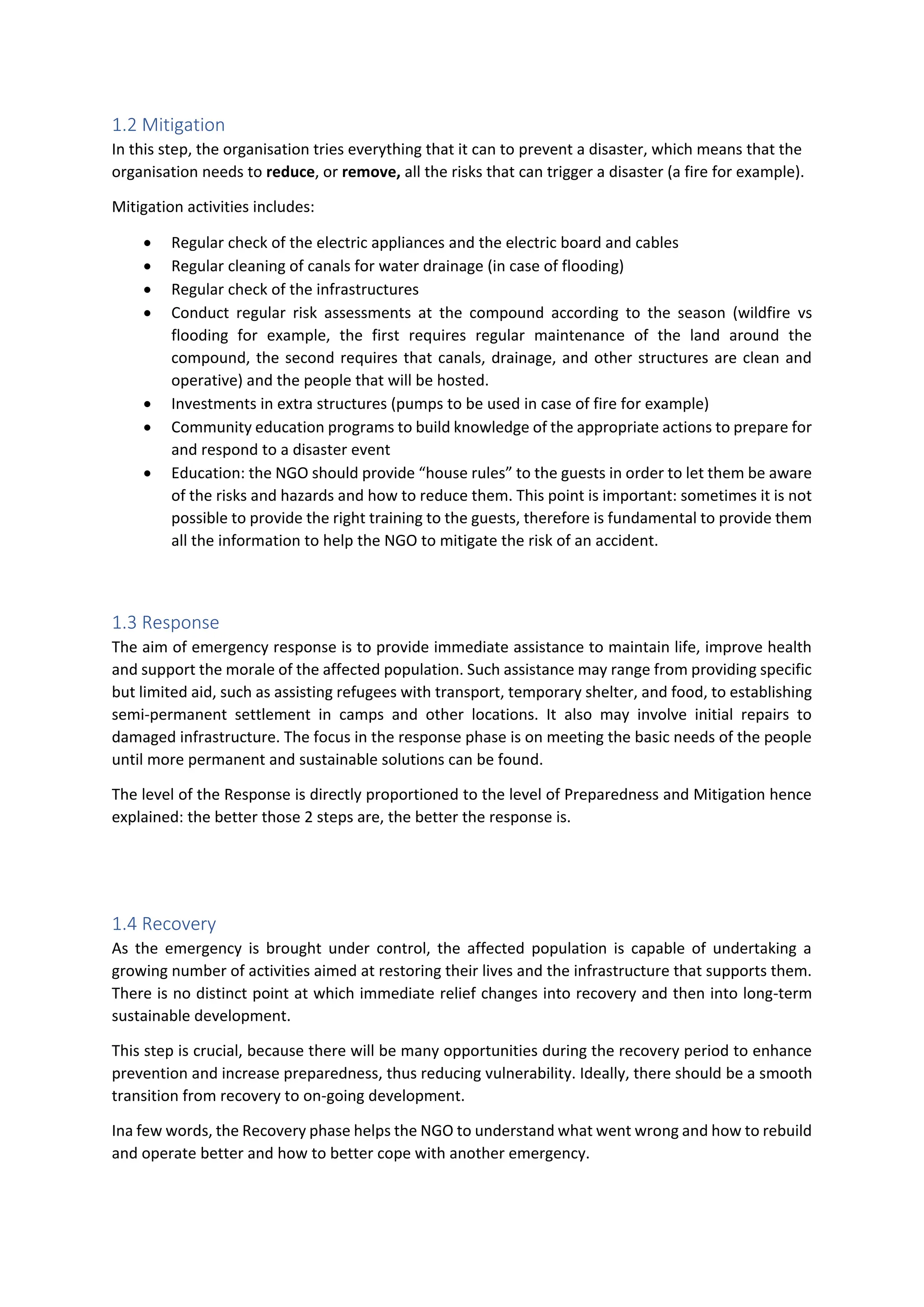
1.2 Mitigation
In this step, the organisation tries everything that it can to prevent a disaster, which means that the
organisation needs to reduce, or remove, all the risks that can trigger a disaster (a fire for example).
Mitigation activities includes:
 Regular check of the electric appliances and the electric board and cables
 Regular cleaning of canals for water drainage (in case of flooding)
 Regular check of the infrastructures
 Conduct regular risk assessments at the compound according to the season (wildfire vs
flooding for example, the first requires regular maintenance of the land around the
compound, the second requires that canals, drainage, and other structures are clean and
operative) and the people that will be hosted.
 Investments in extra structures (pumps to be used in case of fire for example)
 Community education programs to build knowledge of the appropriate actions to prepare for
and respond to a disaster event
 Education: the NGO should provide “house rules” to the guests in order to let them be aware
of the risks and hazards and how to reduce them. This point is important: sometimes it is not
possible to provide the right training to the guests, therefore is fundamental to provide them
all the information to help the NGO to mitigate the risk of an accident.
1.3 Response
The aim of emergency response is to provide immediate assistance to maintain life, improve health
and support the morale of the affected population. Such assistance may range from providing specific
but limited aid, such as assisting refugees with transport, temporary shelter, and food, to establishing
semi-permanent settlement in camps and other locations. It also may involve initial repairs to
damaged infrastructure. The focus in the response phase is on meeting the basic needs of the people
until more permanent and sustainable solutions can be found.
The level of the Response is directly proportioned to the level of Preparedness and Mitigation hence
explained: the better those 2 steps are, the better the response is.
1.4 Recovery
As the emergency is brought under control, the affected population is capable of undertaking a
growing number of activities aimed at restoring their lives and the infrastructure that supports them.
There is no distinct point at which immediate relief changes into recovery and then into long-term
sustainable development.
This step is crucial, because there will be many opportunities during the recovery period to enhance
prevention and increase preparedness, thus reducing vulnerability. Ideally, there should be a smooth
transition from recovery to on-going development.
Ina few words, the Recovery phase helps the NGO to understand what went wrong and how to rebuild
and operate better and how to better cope with another emergency.
2.0 Accident Report
On the 25th
of June, 2022, there was an accident that highlighted the unpreparedness of the
compound to deal with some unforeseen or unexpected situations.
During that night, at 2am, I woke up hearing a strong noise of running water. When I got up from the
bed, roughly 1cm of water was flooding half of my room. Going outside, I found that the water was
coming from one of the interns’ room. In the corridor there already was more or less 2cm of water.
Despite I loudly banged on their door, I had no response. I banged on another door, but no results as
well. My colleagues were in a very deep sleep.
At 2.07am I looked for help, which I luckily found in Emmanuel. We went back to the corridor, and we
tried again to bang on the door. It was 2.15am.
At 2.20 the guys were finally awake. At 2.25 we started to clean and remove the water.
The cause of the flooding was identified on a piece of the ceiling that collapsed, hitting the water tap
that start releasing a lot of water. The drainage of their bathroom was not working and that was the
reason of the flood.
2.1. Analysis
The accident highlighted four main critical issues:
1. I did not know if there was a person in charge of the emergency and, if there was, I did not
know where to find him/her. The person that was with me and was providing help, was not
sure about what to do
2. There was not a way for me to raise the alarm, I had to knock different doors to find
someone
3. I did not know, in case, what number to call (fire brigade for example, or an ambulance if my
colleagues inside the room had an accident that caused the flooding) and I did not know
what member of the staff was in charge of an emergency
4. I had no safety information/orientation when I arrived
These 4 points highlight the lack of preparedness and mitigation in case of a general emergency. To
find some help it took almost 25mins. The emergency was kind of simple because taken in time (the
water could reach electric plugs or eventual appliances in charge if I did not wake up in time), but it if
was a fire, the consequences of these 25mins of unpreparedness could have been serious.
2.2 Fire scenario
If we consider what has been mentioned so far, and the analysis of the accident hence described,
during my investigation of the compound I found the following critical issues in case of fire.
a. There are no fire extinguishers at the ground level (compound, kitchen, rooms). There are 2
fire extinguishers on the first level (both CO2 type). One is empty. One is operative (there is
no sticker with the date of the last check and no info about the level of CO2 still available).
b. There are no fire alarms, of any kind (smoke detector for example)
c. There is no general alarm to be used in case of emergency (like the accident hence analysed)
d. There is no info about emergency procedures to be followed, nor meetings or inductions with
the staff in relation to emergency information.
e. There are no “assembly points” in case of evacuation
f. There is not a Fire Marshall, or an Emergency Manager that we know we can approach or call
in case of need; that can provide training and info to both the rest of the staff and the interns;
that can keep track of the safety check at the compound (fire extinguishers check for
example).
These points must be taken into consideration not only for a house fire (that can be triggered by an
electric appliance, a cigarette bud and such), but also in case of wildfire due to the consequences of
climate change or an accident. Considering that the vegetation at the moment is very dry, if there are
pumps, hoses, or other tools that can be used in case of fire (house fire or wildfire), they are not visible
nor mentioned.
There is something more to add to this report. The Art in Tanzania website, within the Health and
Safety information, declare:
- First Aid packages are available in the office and at the dormitories
There are no first aid packages, and my colleagues do not know anything about them
- Health Policy and Action Chain is part of the programme orientation at the start of the
programme
This part was not mentioned during the orientation
- Fire extinguishers are in key areas at the compound, and they are regularly checked every
six months
- As hence mentioned, there are only 2 fire extinguishers (first floor). One out of order, the
other is working but no info about the last check and the level of CO2 still available
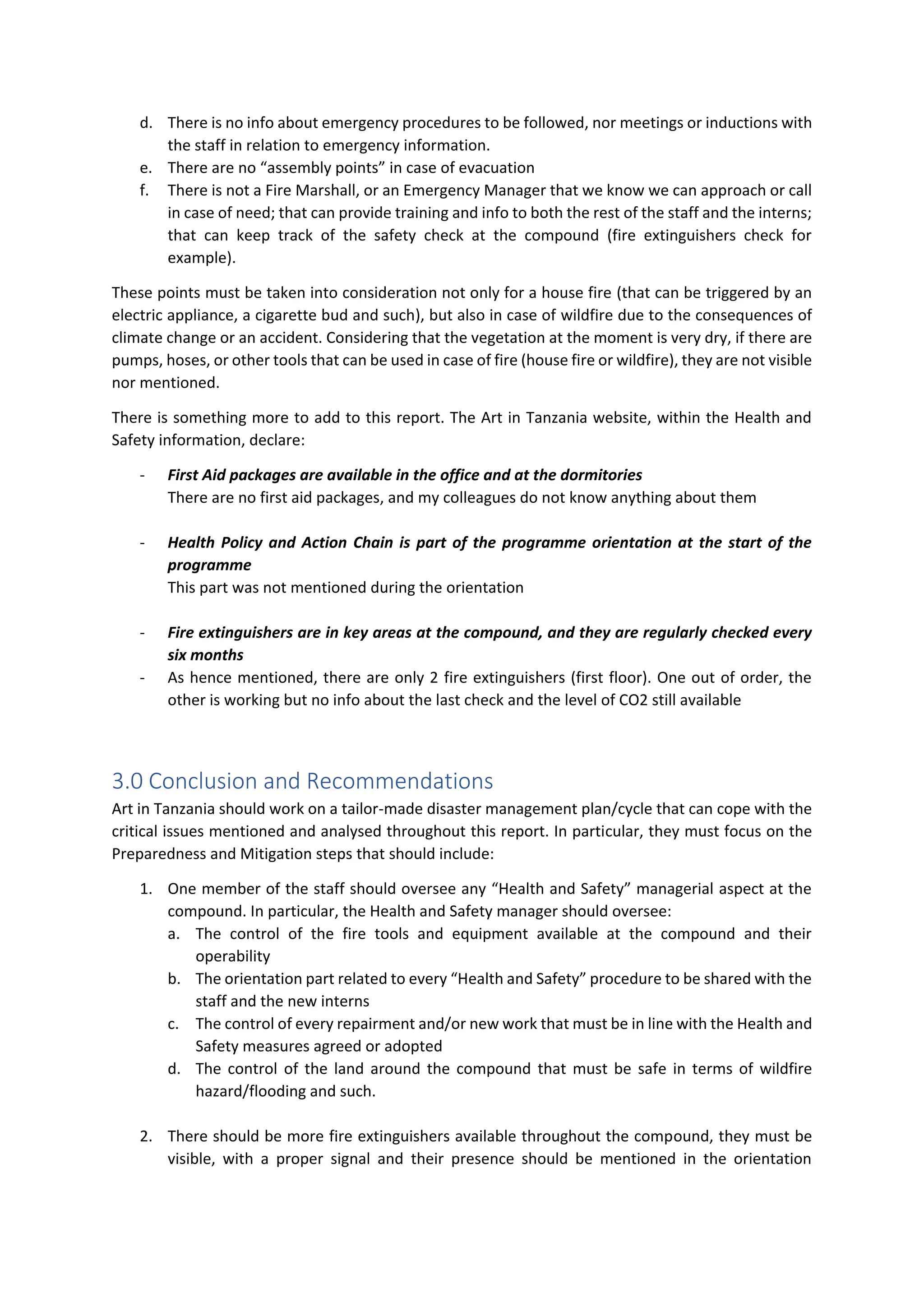
3.0 Conclusion and Recommendations
Art in Tanzania should work on a tailor-made disaster management plan/cycle that can cope with the
critical issues mentioned and analysed throughout this report. In particular, they must focus on the
Preparedness and Mitigation steps that should include:
1. One member of the staff should oversee any “Health and Safety” managerial aspect at the
compound. In particular, the Health and Safety manager should oversee:
a. The control of the fire tools and equipment available at the compound and their
operability
b. The orientation part related to every “Health and Safety” procedure to be shared with the
staff and the new interns
c. The control of every repairment and/or new work that must be in line with the Health and
Safety measures agreed or adopted
d. The control of the land around the compound that must be safe in terms of wildfire
hazard/flooding and such.
2. There should be more fire extinguishers available throughout the compound, they must be
visible, with a proper signal and their presence should be mentioned in the orientation
meeting. In the meantime, bucket of sand/soil available in the rooms and main common areas
can help in case of need.
3. There should be an assembly point in case of evacuation and should be mentioned during the
orientation as part of the house rules for the newcomers.
4. There should be first aid kits available throughout the compounds and must be mentioned
during the orientation as stated on the website). First Aid basic training should be offered to
the newcomers and the new stuff as an option.
Very important: the first aid kits should be available in areas that are accessible 24/7
5. Ther should be smoke detectors or similar fire alarms that can be automatic or manually used
6. There should be an alarm system to be used in case of general emergency (a big bell for
example) so to raise the attention for SPECIFIC problems that should be established by the
staff and shared with the interns.
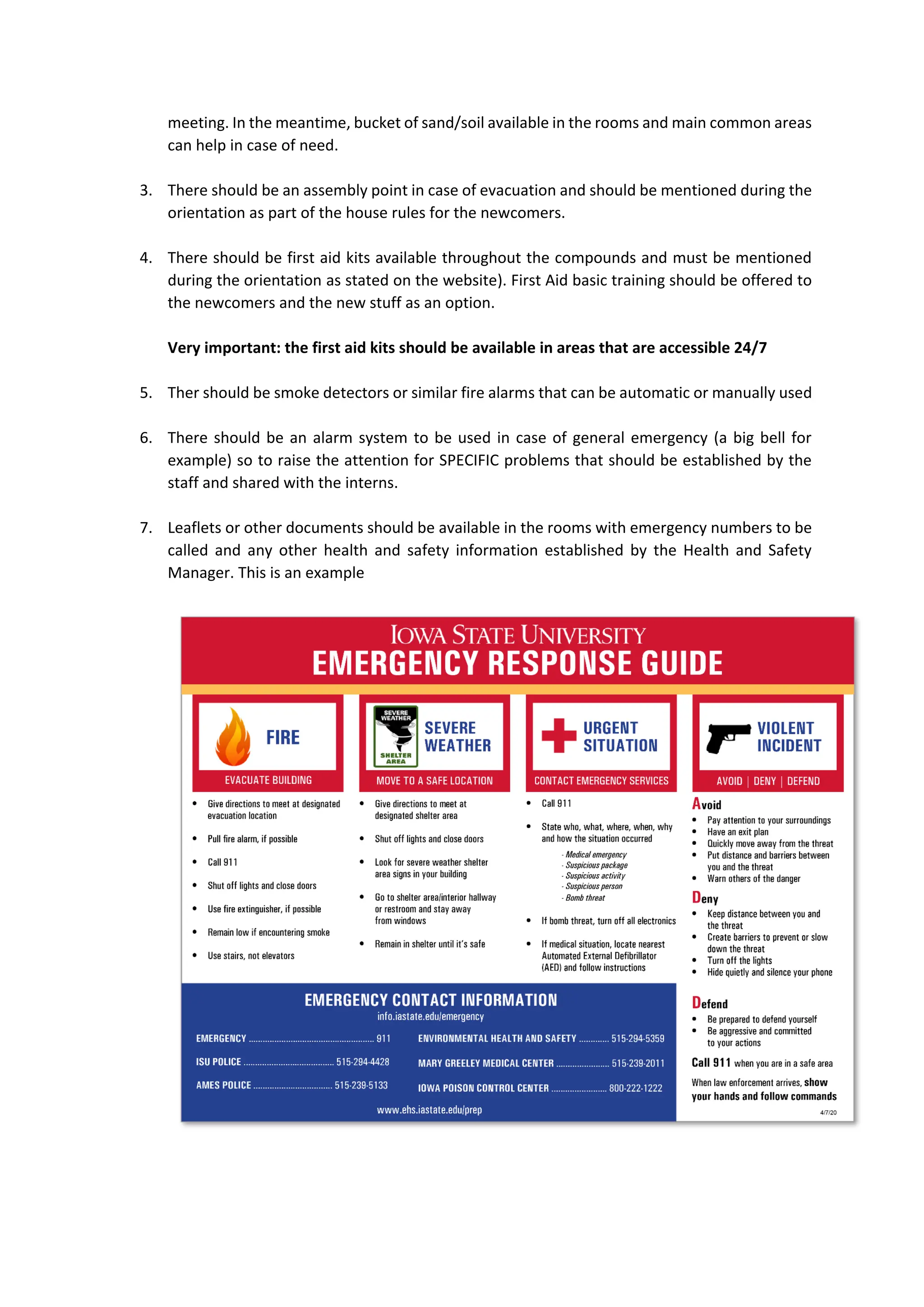
7. Leaflets or other documents should be available in the rooms with emergency numbers to be
called and any other health and safety information established by the Health and Safety
Manager. This is an example
8. During the general meeting, Health and Safety issues should be mentioned/discussed with the
staff so to cope with any concern or hazard (the draining system within the room that was
flooded for example) immediately.
9. The Health and Safety Manager should have access to any health condition that every intern
mentions in their form during the application, to be aware of any health emergency he/she
could cope with
10. To consider a safer way to let the interns to escape from their rooms in case of emergency
evacuation. At the moment, the window metal frame cannot be opened and there is a door
lock that, in case of panic, might be hard to unlock. Anti-panic handles probably are too
expensive and require certain kind of doors and mechanisms, but something that can be used
to lock the room and open the door in an easier way is strongly recommended.
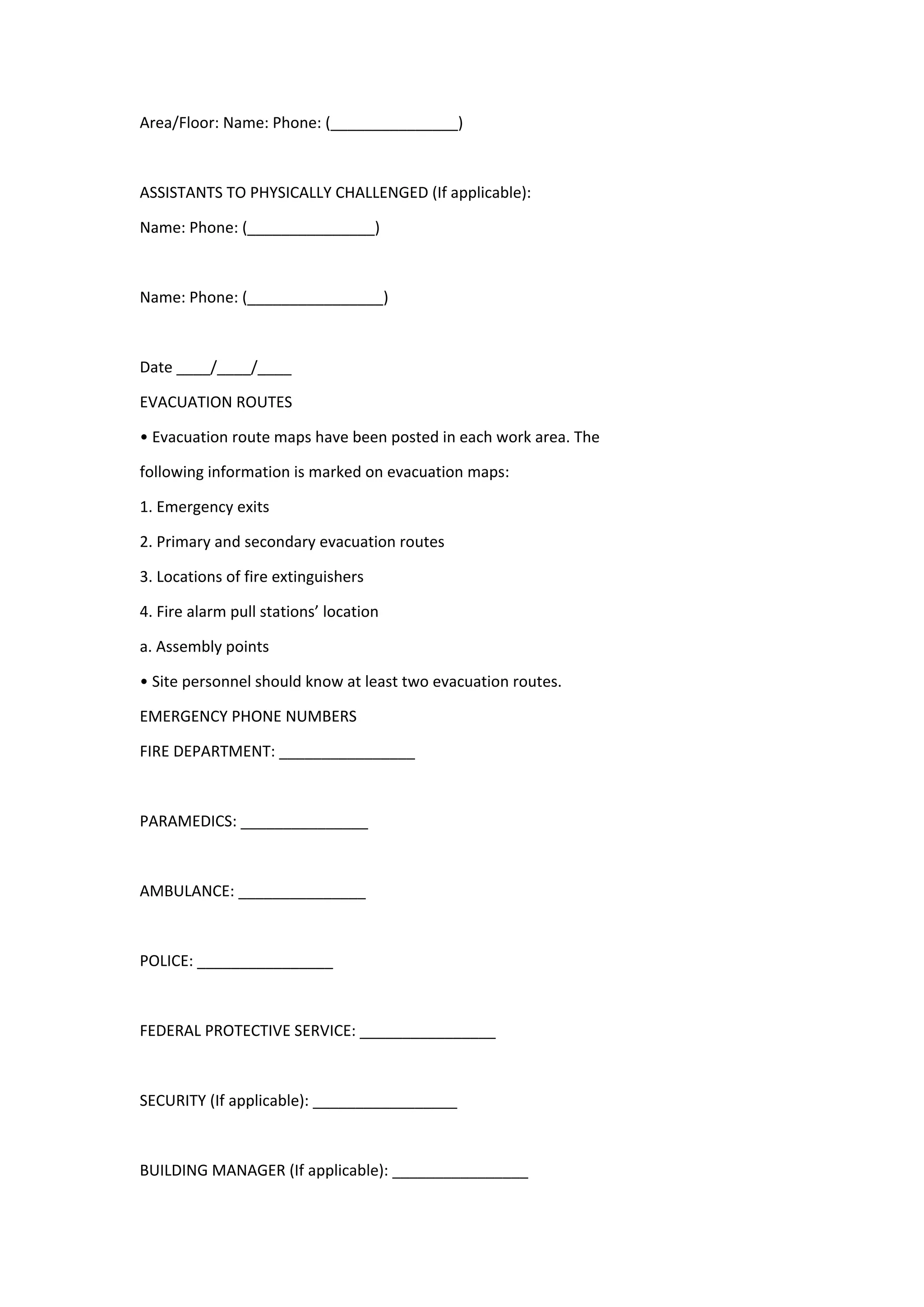
4.0 Example of Emergency Plan Template
Emergency Action Plan (Template)
EMERGENCY ACTION PLAN
for
Facility Name: ____________________
Facility Address: ___________________
DATE PREPARED: ___/_____/______
EMERGENCY PERSONNEL NAMES AND PHONE NUMBERS
DESIGNATED RESPONSIBLE OFFICIAL (Highest Ranking Manager at
_____________site, such as __________, ___________, or ____________):
Name: Phone: (________________)
EMERGENCY COORDINATOR:
Name: Phone: (______________)
AREA/FLOOR MONITORS (If applicable):
Area/Floor: Name: Phone: (_______________)
ASSISTANTS TO PHYSICALLY CHALLENGED (If applicable):
Name: Phone: (_______________)
Name: Phone: (________________)
Date ____/____/____
EVACUATION ROUTES
• Evacuation route maps have been posted in each work area. The
following information is marked on evacuation maps:
1. Emergency exits
2. Primary and secondary evacuation routes
3. Locations of fire extinguishers
4. Fire alarm pull stations’ location
a. Assembly points
• Site personnel should know at least two evacuation routes.
EMERGENCY PHONE NUMBERS
FIRE DEPARTMENT: ________________
PARAMEDICS: _______________
AMBULANCE: _______________
POLICE: ________________
FEDERAL PROTECTIVE SERVICE: ________________
SECURITY (If applicable): _________________
BUILDING MANAGER (If applicable): ________________
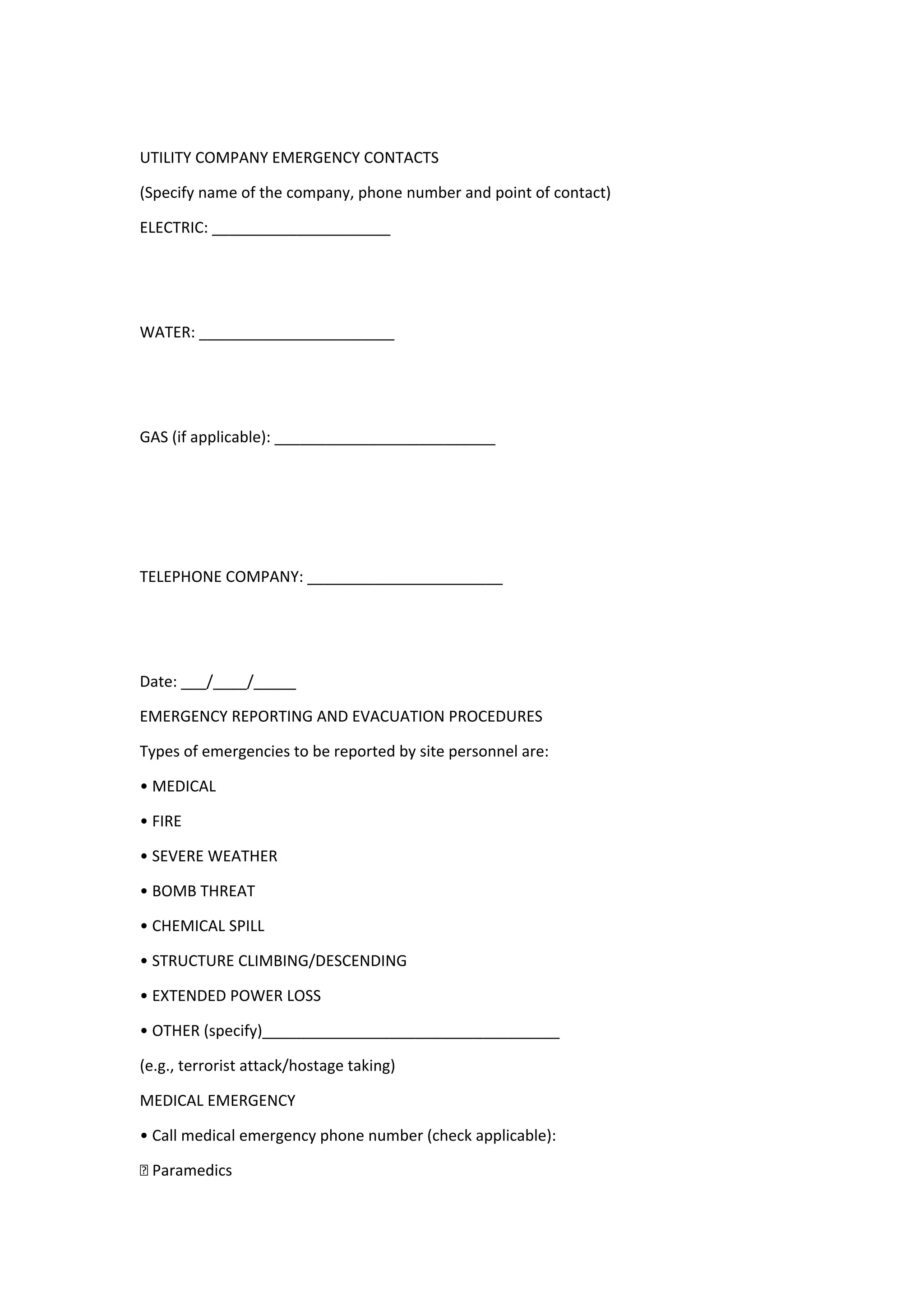
UTILITY COMPANY EMERGENCY CONTACTS
(Specify name of the company, phone number and point of contact)
ELECTRIC: _____________________
WATER: _______________________
GAS (if applicable): __________________________
TELEPHONE COMPANY: _______________________
Date: ___/____/_____
EMERGENCY REPORTING AND EVACUATION PROCEDURES
Types of emergencies to be reported by site personnel are:
• MEDICAL
• FIRE
• SEVERE WEATHER
• BOMB THREAT
• CHEMICAL SPILL
• STRUCTURE CLIMBING/DESCENDING
• EXTENDED POWER LOSS
• OTHER (specify)___________________________________
(e.g., terrorist attack/hostage taking)
MEDICAL EMERGENCY
• Call medical emergency phone number (check applicable):
† Paramedics
† Ambulance
† Fire Department
† Other
Provide the following information:
a. Nature of medical emergency,
b. Location of the emergency (address, building, room number),
and
c. Your name and phone number from which you are calling.
• Do not move victim unless absolutely necessary.
• Call the following personnel trained in CPR and First Aid to provide the
required assistance prior to the arrival of the professional medical help:
Name: Phone:_______________________
Name: Phone: ________________________
• If personnel trained in First Aid are not available, as a minimum, attempt to
provide the following assistance:
1. Stop the bleeding with firm pressure on the wounds (note: avoid
contact with blood or other bodily fluids).
2. Clear the air passages using the Heimlich Maneuver in case of
choking.
• In case of rendering assistance to personnel exposed to hazardous materials,
consult the Material Safety Data Sheet (MSDS) and wear the appropriate personal
protective equipment. Attempt first aid ONLY if trained and qualified.
Date___/___/___
FIRE EMERGENCY
When fire is discovered:
• Activate the nearest fire alarm (if installed)
• Notify the local Fire Department by calling .
• If the fire alarm is not available, notify the site personnel about the fire
emergency by the following means (check applicable):
† Voice
Communication
† Phone Paging
† Radio
† Other (specify)
Fight the fire ONLY if:
• The Fire Department has been notified.
• The fire is small and is not spreading to other areas.
• Escaping the area is possible by backing up to the nearest exit.
• The fire extinguisher is in working condition and personnel are trained to
use it.
Upon being notified about the fire emergency, occupants must:
• Leave the building using the designated escape routes.
• Assemble in the designated area (specify location):
• Remain outside until the competent authority (Designated Official or
designee) announces that it is safe to reenter.
Designated Official, Emergency Coordinator or supervisors must (underline one):
• Disconnect utilities and equipment unless doing so jeopardizes his/her
safety.
• Coordinate an orderly evacuation of personnel.
• Perform an accurate head count of personnel reported to the designated
area.
• Determine a rescue method to locate missing personnel.
• Provide the Fire Department personnel with the necessary information
about the facility.
• Perform assessment and coordinate weather forecast office emergency
closing procedures
Area/Floor Monitors must:
• Ensure that all employees have evacuated the area/floor.
• Report any problems to the Emergency Coordinator at the assembly area.
Assistants to Physically Challenged should:
• Assist all physically challenged employees in emergency evacuation.
Date___/___/___
EXTENDED POWER LOSS
In the event of extended power loss to a facility certain precautionary measures should
be taken depending on the geographical location and environment of the facility:
• Unnecessary electrical equipment and appliances should be turned off in
the event that power restoration would surge causing damage to
electronics and effecting sensitive equipment.
• Facilities with freezing temperatures should turn off and drain the following
lines in the event of a long term power loss.
· Fire sprinkler system
· Standpipes
· Potable water lines
· Toilets
• Add propylene-glycol to drains to prevent traps from freezing
• Equipment that contain fluids that may freeze due to long term exposure
to freezing temperatures should be moved to heated areas, drained of
liquids, or provided with auxiliary heat sources.
Upon Restoration of heat and power:
• Electronic equipment should be brought up to ambient temperatures
before energizing to prevent condensate from forming on circuitry.
• Fire and potable water piping should be checked for leaks from freeze
damage after the heat has been restored to the facility and water turned
back on.
CHEMICAL SPILL
The following are the locations of:
Spill Containment and Security Equipment: ___________________________
Personal Protective Equipment (PPE):
MSDS:_____________________________________________________
When a Large Chemical Spill has occurred:
• Immediately notify the designated official and Emergency Coordinator.
• Contain the spill with available equipment (e.g., pads, booms, absorbent
powder, etc.).
• Secure the area and alert other site personnel.
• Do not attempt to clean the spill unless trained to do so.
• Attend to injured personnel and call the medical emergency number, if
required.
• Call a local spill cleanup company or the Fire Department (if arrangement
has been made) to perform a large chemical (e.g., mercury) spill cleanup.
Name of Spill Cleanup Company:_______________________________
Phone Number:_____________________________________________
• Evacuate building as necessary
When a Small Chemical Spill has occurred:
• Notify the Emergency Coordinator and/or supervisor (select one).
• If toxic fumes are present, secure the area (with caution tapes or cones) to
prevent other personnel from entering.
• Deal with the spill in accordance with the instructions described in the
MSDS.
• Small spills must be handled in a safe manner, while wearing the proper
PPE.
• Review the general spill cleanup procedures.
Date___/___/___
STRUCTURE CLIMBING/DESCENDING EMERGENCIES
List structures maintained by site personnel (tower, river gauge, etc.):
No. Structure Type Location (address, if
applicable)
Emergency Response
Organization* (if available
within 30-minute response
time)
Emergency Response Organization(s):
Name Phone Number______________________
(Attach Emergency Response Agreement if available)
* - N/A. If no Emergency Response Organization available within 30-minute
response time additional personnel trained in rescue operations and equipped
with rescue kit must accompany the climber(s).
TELEPHONE BOMB THREAT CHECKLIST
INSTRUCTIONS: BE CALM, BE COURTEOUS. LISTEN. DO NOT INTERRUPT THE CALLER.
YOUR NAME: __________________________ TIME: _____________ DATE: ________________
CALLER'S IDENTITY SEX: Male _____ Female ____ Adult ____ Juvenile ____ APPROXIMATE AGE:
_____
ORIGIN OF CALL: Local __________ Long Distance ___________ Telephone Booth __________
VOICE CHARACTERISTICS SPEECH LANGUAGE
___ Loud
___ High Pitch
___ Raspy
___ Intoxicated
___ Soft
___ Deep
___ Pleasant
____________
Other
___ Fast
___ Distinct
___ Stutter
___ Slurred
___ Slow
___ Distorted
___ Nasal
____________
Other
___ Excellent
___ Fair
___ Foul
___ Good
___ Poor
__________
Other
ACCENT MANNER BACKGROUND NOISES
___ Local
___ Foreign
___ Race
___ Not Local
___ Region
___ Calm
___ Rational
___ Coherent
___ Deliberate
___ Righteous
___ Angry
___ Irrational
___ Incoherent
___ Emotional
___ Laughing
___ Factory
___ Machines
___ Music
___ Office
___ Machines
___ Street
___ Traffic
___ Trains
___ Animals
___ Quiet
___ Voices
___ Airplanes
___ Party
___ Atmosphere
BOMB FACTS
PRETEND DIFFICULTY HEARING - KEEP CALLER TALKING - IF CALLER SEEMS
AGREEABLE TO FURTHER CONVERSATION, ASK QUESTIONS LIKE:
When will it go off? Certain Hour ____ Time Remaining
Where is it located? Building Area
What kind of bomb? ___________________
What kind of package?______________
How do you know so much about the bomb?___
What is your name and address?
If building is occupied, inform caller that detonation could cause injury or death.
Activate malicious call trace: Hang up phone and do not answer another line. Choose same
line and dial *57 (if your phone system has this capability). Listen for the confirmation
announcement and hang up.
Call Security at __________ and relay information about call.
Did the caller appear familiar with plant or building (by his/her description of the bomb
location)?
Write out the message in its entirety and any other comments on a separate sheet of paper and
attach to this checklist.
Notify your supervisor immediately.
SEVERE WEATHER AND NATURAL DISASTERS
Tornado:
• When a warning is issued by sirens or other means, seek inside shelter.
Consider the following:
- Small interior rooms on the lowest floor and without windows,
- Hallways on the lowest floor away from doors and windows, and
- Rooms constructed with reinforced concrete, brick, or block with no
windows.
• Stay away from outside walls and windows.
• Use arms to protect head and neck.
• Remain sheltered until the tornado threat is announced to be over.
Earthquake:
• Stay calm and await instructions from the Emergency Coordinator or the
designated official.
• Keep away from overhead fixtures, windows, filing cabinets, and electrical
power.
• Assist people with disabilities in finding a safe place.
• Evacuate as instructed by the Emergency Coordinator and/or the
designated official.
Flood:
If indoors:
• Be ready to evacuate as directed by the Emergency Coordinator and/or
the designated official.
• Follow the recommended primary or secondary evacuation routes.
If outdoors:
• Climb to high ground and stay there.
• Avoid walking or driving through flood water.
• If car stalls, abandon it immediately and climb to a higher ground.
Hurricane:
• The nature of a hurricane provides for more warning than other natural
and weather disasters. A hurricane watch issued when a hurricane
becomes a threat to a coastal area. A hurricane warning is issued when
hurricane winds of 74 mph or higher, or a combination of dangerously high
water and rough seas, are expected in the area within 24 hours.
Once a hurricane watch has been issued:
• Stay calm and await instructions from the Emergency Coordinator or the
designated official.
• Moor any boats securely, or move to a safe place if time allows.
• Continue to monitor local TV and radio stations for instructions.
• Move early out of low-lying areas or from the coast, at the request of
officials.
• If you are on high ground, away from the coast and plan to stay, secure
the building, moving all loose items indoors and boarding up windows and
openings.
• Collect drinking water in appropriate containers.
Once a hurricane warning has been issued:
• Be ready to evacuate as directed by the Emergency Coordinator and/or
the designated official.
• Leave areas that might be affected by storm tide or stream flooding.
During a hurricane:
• Remain indoors and consider the following:
- Small interior rooms on the lowest floor and without windows,
- Hallways on the lowest floor away from doors and windows, and
- Rooms constructed with reinforced concrete, brick, or block with no
windows.
Blizzard:
If indoors:
• Stay calm and await instructions from the Emergency Coordinator or the
designated official.
• Stay indoors!
• If there is no heat:
- Close off unneeded rooms or areas.
- Stuff towels or rags in cracks under doors.
- Cover windows at night.
• Eat and drink. Food provides the body with energy and heat. Fluids
prevent dehydration.
• Wear layers of loose-fitting, light-weight, warm clothing, if available.
If outdoors:
• Find a dry shelter. Cover all exposed parts of the body.
• If shelter is not available:
- Prepare a lean-to, wind break, or snow cave for protection from the
wind.
- Build a fire for heat and to attract attention. Place rocks around the
fire to absorb and reflect heat.
- Do not eat snow. It will lower your body temperature. Melt it first.
If stranded in a car or truck:
• Stay in the vehicle!
• Run the motor about ten minutes each hour. Open the windows a little for
fresh air to avoid carbon monoxide poisoning. Make
sure the exhaust pipe is not blocked.
• Make yourself visible to rescuers.
- Turn on the dome light at night when running the engine.
- Tie a colored cloth to your antenna or door.
- Raise the hood after the snow stops falling.
• Exercise to keep blood circulating and to keep warm.
CRITICAL OPERATIONS
During some emergency situations, it will be necessary for some specially
assigned personnel to remain at the work areas to perform critical operations.
Assignments:
Work Area Name Job Title Description of Assignment
• Personnel involved in critical operations may remain on the site upon the
permission of the site designated official or Emergency Coordinator.
• In case emergency situation will not permit any of the personnel to remain
at the facility, the designated official or other assigned personnel shall
notify the appropriate _______________ offices to initiate backups. This
information can be obtained from the Emergency Evacuation Procedures
included in the ___________________ Manual.
The following offices should be contacted:
Name/Location:________________________________
Telephone Number:_____________________________
Name/Location:________________________________
Telephone Number:_____________________________
Name/Location:________________________________
Telephone Number:_____________________________
TRAINING
The following personnel have been trained to ensure a safe and orderly
emergency evacuation of other employees:
Facility:
Name Title Responsibility Date

FIRE OUTBREAK EMERGENCY FINAL REPORT.pdf

  • 1.
    BUILDING SAFETY FIRE OUTBREAKEMERGENCY FIRE RISK ASSESSMENT AND EMERGENCY PLAN FOR ART IN TANZANIA COMPOUND IN MADALE VILLAGE Dorota Anna Smalec Politecnico di Torino Bachelor of Architecture Student Intern in Art In Tanzania August-September 2022 Report completed on 23/09/2022 Art In Tanzania Umoja Road Madale Village 23333 Dar es Salaam Tanzania
  • 2.
    2 INDEX part 1 FireOutbreak Emergency Comprehensive Collection of Information 5 1. Fire risk assessment and its importance 5 2. Fire Prevention 5 I. Fire extinguishers 5 I.a. Portable Fire extinguisher use 5 I.b. Portable Fire extinguisher location 5 I.c. Fire types 5 I.d. Extinguisher types 6 II. Fire blankets 6 II.a. Fire blanket application 6 II.b. Fire blanket use instruction 6 III. Emergency exits 7 III.a. Indications 7 III.b. “Exit choice” 7 III.c. Escape behaviour 7 III.d. Familiarity with escape routes 7 IV. Critical control points 7 IV.a. Critical points 7 IV.b. High fire risk 7 IV.c. Occupant load 8 V. Risky electrical connections 8 V.a. Control importance 8 V.b. Solutions to ensure safety 8 VI. Emergency numbers 8 3. Fire Detection Early Alarm Program 8 I. Initiating devices 8 II. Smoke detectors 8 II.a. Smoke detectors’ importance 8 II.b. Two fire stages 9 II.c. Smoke detectors 9 III. Fire sprinklers 9 III.a. Fire sprinklers system explanation 9 III.b. Fire sprinklers’ importance 9 III.c. Fire prinklers 9 III.d. Installation 9 4. Emergency escape procedures – action plan 10 I. Fire reporting 10 I.a. Fire reporting instruction 10 II. Extinguish or evacuate? 10 III. Evacuation 10 III.a. Evacuation plan accessibility statement 10 III.b. Evacuation procedures 10 III.c. Remember during the evacuation 11 III.d. If evacuation not possible 11 IV. Rescue and First Aid procedures 11 IV.a. What is first aid? 11
  • 3.
    3 IV.b. First aidand law – consent 11 IV.c. Personal safety 12 IV.d. Help at the emergency scene – bystander 12 V. Final statement 12 part 2 Fire Assessment for Art In Tanzania Compound in Madale Village 13 1. Introduction 13 2. Safety Issues 13 I. Previously defined issues 13 I.a. Consequences in case of fire 13 3. Fire assessment 13 I. Previously defined fire assessment 13 II. Comparison with the current situation 13 III. Fire hazards present within the premises 14 IV. People at risk 14 IV.a. Occupant load ground floor 14 IV.b. Occupant load first floor 14 4. Intern Health and Safety Policy – Art in Tanzania 14 I. Inaccuracies 14 II. Accessibility 15 5. Current situation illustrative report 15 I. First aid kit 15 II. Fire extinguishers 15 6. Conclusions 16 part 3 Fire Prevention and Early Alarm Program for Art In Tanzania Compound in Madale Village 17 1. Actions that need to be taken 17 2. Equipment at the compound 17 3. Equipment needed 17 4. Costs estimation and final invoice 17 part 4 Fire Outbreak Emergency Escape Plan for Art In Tanzania Compound in Madale Village 19 1. IN CASE OF FIRE 19 I. Fire reporting 19 II. Extinguish or evacuate 19 III. Evacuation 19
  • 4.
    4 part 5 Listof Sources and Attachments 20 1. Sources 20 I. Documents 20 II. Books 20 III. Articles 20 IV. Websites 20 2. Attachments 20
  • 5.
    5 FIRE OUTBREAK EMERGENCY COMPREHENSIVECOLLECTION OF INFORMATION 1. Fire risk assessment and its importance Fire risk assessment identifies the fire hazards present within the premises and the people who may be at risk in case of emergency. It includes sources of ignition, heaters, cooking equipment, sources of fuel and sources of, oxygen. Its role is to define the risks, evaluate and reduce them, which means proposing solutions of actions ensuring safety on the premises (installing the early alarm system and fire extinguishers, making sure the combustible materials are stored away from the ignition source and that escape route are free from obstructions, ensuring that people present within the premises are familiar with the emergency plan and know how to behave in case of an emergency). 2. Fire Prevention This part defines all the safety measures and steps that need to be undertaken to ensure safety on the campus and to enable quick and effective abatement of the fire hazard in case of an emergency: I. Fire extinguishers II. Fire blankets III. Emergency exits IV. Critical control points V. Risky electrical connections VI. Emergency numbers I. Fire extinguishers I.a. Portable Fire extinguisher use When to use the portable fire extinguisher: a) you know that the fire department was or is being called b) you are trained in using the extinguisher and you feel confident about it (do not undertake any steps while panicking) c) the proper type of extinguisher is available, as the use of the wrong extinguisher type may cause the spread of fire and injury to the user d) your way of escape is clear and you can fight the fire having the escape behind your back (do not let the fire cut your way of escape off) e) you are not blocking the escape way for other people I.b. Portable Fire extinguisher location Fire extinguishers should be located next to the main room exit or the emergency exit, never on the opposite side of the room nor away from the escape way. I.c. Fire types The A B C D and K classifications describe the fire fuel, i.e. what material is burning. It is also used for rating fire extinguishers to indicate in which case they can be used. A – ordinary combustibles producing ash while burning such as paper, wood, clothes, rubbish, and many plastics B – flammable materials such as gasoline, oil, oil-based paints, flammable gases, and some plastics C – electrical plugs and outlets, energized electrical equipment if plugged; if unplugged then it belongs to category A or B
  • 6.
    6 D – combustiblematerials such as magnesium, titanium, zirconium, sodium, lithium, and potassium K – burning kitchen grasses and fat, this extinguisher can is adapted to put down high-temperature fats and oils I.d. Extinguisher types ABC – considered as “universal”; dry chemical extinguisher A – pressurized water extinguisher B and C – carbon dioxide (CO2) extinguisher; usually they are grouped together as type BC D – sodium chlorine dry powder extinguishers K – contains a special extinguishing agent designed to put down kitchen fires I.e. Portable extinguisher operation instruction Firstly check the type of the extinguisher, if it is right for the fire involved; all the extinguishers have a nameplate with the instruction for use and the type class. A portable fire extinguisher can be easily operated in 4 steps, that together can be memorized as the “PASS” method. PULL THE PIN – hold the extinguisher with the nozzle directed away from yourself and release the locking mechanism, which means pulling out the pin located under the trigger AIM LOW – stand 2 to 3 meters distant from the fire source and aim the extinguisher at the base of the fire; ATTENTION: always use the extinguisher vertically, moving from left to right or vice versa, never up and down SQUEEZE THE TRIGGER – slowly pulling the trigger will release the extinguishing agent and expel it through the nozzle SWEEP – side to side or directly at the firebase depending on the fire type; if the fire closest to you is extinguished you can continue moving forward; ATTENTION: put your personal safety first and immediately leave the building if the fire does not diminish, do not turn your back to the fire, even if you think it is out! II. Fire blankets Fire blankets are sheets made of fire-resistant material that are used to cover a fire source/burning object/person. Fire abates due to the cut of oxygen supply. II.a. Fire blanket application Advantages: a) easy to maintain and quick to use b) cheaper than fire extinguisher c) most useful in the kitchen Disadvantages: a) necessity to get close to the fire, risk of burning hands b) usage restricted to small and maintained fire c) only one go at putting the fire down II.b. Fire blanket use instruction: 1. remove the blanket from a bag 2. turn off the heat source if generated by electrical component/kitchen supply 3. grab the blanket with the backs of your hands and turn it in, protect yourself by holding the blanket against yourself 4. in one quick swift motion place the blanket over the fire, do not attempt to throw it
  • 7.
    7 5. leave theblanket for around 30 minutes, taking it off too quickly creates a chance of re-ignition 6. call the fire department and evacuate the building In case your clothes catch on fire and you cannot use a fire blanket or you are too far away from the closest available one, follow these steps: Stop moving Drop to the ground Roll several times to put down the flames Do not run – it only fans the flames III. Emergency exits III.a. Indications An emergency exit is permanent, unobstructed, and must lead to a street, walkway, or other open space outside the building. According to Fire and Rescue Force Act from 2015 emergency exit “is a means of escape from the interior of the building to an exterior space which is provided by the use of the following either singly or in combination: exterior door openings, exit staircases, exit ramps or exit passageways. In the case of an exit leading to a separate building, it includes link ways, walkways, bridges and balconies, but exit excludes access stairs, aisles, corridor doors or corridors and access doors to rooms or spaces in occupancy areas”. III.b. “Exit choice” “Exit choice” is a situation in which more than 1 emergency exit is provided to allow a population of a specified number of people, defined as ‘occupant capacity’ in relation to floor/room space, multiple escape routes. This gives people the possibility of safe escape in case one exits is being obstructed by fire and smoke. III.c. Escape behaviour In the event of a fire outbreak people’s escape behaviour is defined as their direction of escape, ability to undertake actions aimed to put down the fire using a fire extinguisher, and ability to keep calm and follow the procedures. Escape behaviour depends on several factors: the role of a person (staff member or regular users), location and distance from the emergency exit, being alone or in a group, relations with the other group members, guidance to exits, familiarity with escape routes. III.d. Familiarity with escape routes User and public awareness of the availability and use of the means such as exit doors, escape routes and fire emergency equipment is fundamental for safe and effective management of fire outbreak emergency. However, apart from raising awareness on the location of the escape routes, another issue is easy access through the ways: doors should remain unobstructed and not closed with the key. IV. Critical control points IV.a. Critical points Critical points are places/rooms with increased fire risk and therefore they require more attention, especially when it comes to establishing the occupant load, and/or specifically adapted equipment. IV.b. High fire risk Some buildings/rooms/spaces may be in higher risk of fire outbreak than others, or/and may be in bigger difficulty of the fire hazard abatement. Reasons of a high fire risk may derive from the function involving open flames or storage of easily combustible materials, accessibility to the fire emergency equipment or/and the structure itself, with the focus on used materials. Difficulty in the fire hazard abatement depends on the space’s size, number of its occupants and complexity, as these are factors influencing evacuation.
  • 8.
    8 IV.c. Occupant load Accordingto Fire and Rescue Force Act from 2015 occupant load means the total number of persons that may occupy such building or part thereof at any one time and it can be estimated in two ways: by applying to the floor areas available for occupation based on the appropriate areas per person and by the number of fixed seating, if applicable, for Assembly Occupancies. V. Risky electrical connections V.a. Control importance Due to the building construction process that was not overlooked by the authorities, it is essential to control all the electrical outlets to ensure their safe functioning and use. V.b. Solutions to ensure safety a) keep the electrical components away from the water, never plug in the tool if its charger had contact with water b) use the right power tools for the adequate voltage – 230V in Tanzania, same as in Europe c) use the right socket adapter, attempting to force a wrong plug into the socket may cause damage of the plug or/and the socket d) any new sockets/outlets/installations on the site must be installed only by a licensed electrician VI. Emergency numbers Ambulance (022) 112 Fire Department (022) 114 Police work phone (022) 112 Fire and Rescue Force in Tanzania headquarters Ushirika Building Dar Es Salaam, 5821 (floor n.5 and 10) 3. Fire Detection Early Alarm Program I. Initiating devices Fire alarm initiating devices detect signs of a fire and activate an alarm. There are two types of initiating devices: manual and automatic. Manual initiating devices - manual pull-down stations that can be activated only by hand, they are required in commercial buildings, offices, and multi-storey buildings; Automatic initiating devices – trigger automatically in presence of fire; include smoke detectors, fire sprinklers, and heat detectors. II. Smoke detectors II.a. Smoke detectors’ importance Smoke detectors/smoke alarms automatically sense the presence of smoke and issue an audible and/or visual warning signal. Depending on their type they react 15 – 50 minutes early in the fire smouldering phase before the flames outburst. NOTE: cigarette smoke/e-cigarette vapour/burning food may also trigger a smoke detector.
  • 9.
    9 II.b. Two firestages Flaming wildfire consumes surface fuel vegetation and tree crowns. Smouldering combustion consumes organic soil, dominantly spreading on and below the ground. II.c. Smoke detectors types Smoke detectors can be battery-powered single units or several interlinked hardwired devices backed up by batteries. The latter ones must be installed only by a qualified electrician. An average lifespan of a smoke detector is from 8 to 10 years. Photoelectric smoke detectors – are designed to detect sudden scattering of light caused when smoke enters the detector’s chamber; they can signal the fire in its early smouldering phase even 15 to 50 minutes earlier than the ionization alarms; they are advised for the kitchens Ionization smoke detectors – highly sensitive to smoke particles and can respond 30 to 90 seconds faster to the fast flaming fires than the photoelectric alarms, but not to smouldering fires; avoid installing them by the kitchen because they may be activated too easily Heat alarms – detect the sudden increase of the temperature due to the fire, but they are insensitive to the smoke and so they should not be used as the only mean of the fire detection Combined optical (photoelectric) and ionization smoke detectors are available as well (so-called dual sensor smoke alarm) and are recommended for maximum protection against flaming and smouldering fires. III. Fire sprinklers III.a. Fire sprinklers system explanation Home sprinklers involve a system of piping filled with pressurized water, that goes through the walls and ceiling. Sprinklers are ready to be used as long as the pipes are filled with water. During the fire outbreak the sprinklers get activated due to the quick change of the air temperature. ATTENTION: smoke does not activate the sprinklers, only the ones closest to the fire and triggered by the increasing temperature will activate. NOTE: cigarette smoke/burning food cannot activate the sprinkler. III.b. Fire sprinklers importance Depending on the fire hazard, sprinklers reduce or completely extinguish the flames. Water controls the heat and prevents the development of toxic smoke, which allows people to evacuate safely and reduces the risk of injury. III.c. Fire sprinklers types Wet fire sprinkler system – most common option on the market; in this system water is always in the pipes, what decreases the time of reaction of the device. Dry fire sprinkler system – it is filled with pressurized air, and the water is released only if the sprinklers are activated; this increases the time of reaction but is a necessary feature for unheated buildings and properties where the low temperature causes the risk of water freezing. III.d. Installation Fire sprinklers are installed by professionally trained contractors. The easiest and cheapest way to install the water sprinklers is during the building construction. It is possible to install the sprinklers
  • 10.
    10 system also duringremodeling process – retrofitting- but here the costs depend on the existing structure and the difficulty of its adaptation for the whole new piping system. 4. Emergency escape procedures – action plan I. Fire reporting II. Extinguish or evacuate III. Evacuation IV. Rescue and First Aid procedures I. Fire reporting If you notice a fire outbreak in a room immediately close it to stop the fire hazard from spreading. No matter how big the fire is, a person that discovers a fire outbreak should in first place contact immediately local Fire Brigade. If the early alarm system is not activated already activate manually the closest pull-down station. I.a. Fire reporting instruction 1. use your private phone or a telephone accessible in a building if you are close to it, do not use a public pay phone 2. provide location: city, street, building, floor, room 3. if you know say what caused the fire, what is on fire and how big the fire is 4. if you have such information tell the dispatcher if there is anyone else in the building 5. if you have such information tell the dispatcher if anyone is hurt 6. be prepared to answer any other questions the dispatcher may ask Meanwhile you are talking with the dispatcher they are alerting appropriate fire station and getting help on the way, that is why it is important to mention your locations as soon as possible. Evacuate as soon as the call ends or even during the call, if you are able to focus on both activities and take care of your safety. II. Extinguish or evacuate? If the fire is estimated as manageable and there is present a person trained in using a portable fire extinguisher they may attempt to put the fire out on their own. Fire can be considered “manageable” if it is confined to a small area (for example a trash bin) and it is not spreading. The rest of the building should follow the evacuation procedures as the volunteer firefighter may not be treated and trusted as a professionally trained Fire Rescue Force. If the fire is spreading fast and it’s too difficult to manage, or there is no one able to use the fire extinguisher, the first thing to do is to call the fire department and evacuate the building immediately. III. Evacuation III.a. Evacuation plan accessibility statement The emergency procedures must be presented to the volunteers and interns during the orientation day and the evacuation plan must be present in each room, secured from water and placed in a visible spot easily accessible to everyone, for example on the doors. III.b. Evacuation procedures 1) Go to the closest exit and proceed directly to the designated meeting area 2) On your way notify others about the fire 3) Do not use open stairs and elevators, if possible use closed stairways that lead directly outside 4) Before opening any door feel it with the back of your hand, do not open it if it is hot
  • 11.
    11 5) If youencounter smoke during evacuation stay low to the floor, breathe through a material like your t-shirt 6) When you arrive to the designated meeting area wait for the police and/or fire department to arrive III.c. Remember during the evacuation a) Primarily take care of your own safety, do not wait for other people to evacuate. b) If possible do not turn your back to the fire while evacuating c) If you find yourself in a smoke-filled room cover your mouth and nose with if possible, wet material and crawl under the smoke (hot smoke rises, keep your head low, and do not stand up until you are away from the danger) d) Do not come back to the room to collect your personal belongings, what counts the most while evacuating is the time and freedom of movement e) Do not re-enter the building until the fire alarm has been silenced and the authorities (police or fire department) announced that the emergency was staved off. III.d. If evacuation not possible Evacuation from the building may not be possible because of the smoke or fire directly blocking the passage. In such case: 1) Remain calm 2) Close the door to the room you are in 3) Call the fire Department and report your location so that you can be rescued 4) Stuff a material, preferably wet if possible (blanket/towel/t-shirt) under the door if the smoke starts to come in 5) Do not break the window if not necessary for oxygen as the broken glass may cause the injury, and the air flow may cause the smoke to enter through the window and make it more difficult to breathe 6) If you opened the window try to attract attention but shouting should be considered as ultimatum, as it may waste your breath and cause breathing in loads of smoke 7) Do not try to escape through the window until you have no other chances to survive, but try to resist and wait for the Fire Department to arrive and rescue you safely IV. Rescue and First Aid procedures IV.a. What is first aid? According to the “First Aid Reference Guide” (St. John Ambulance, second edition July 2007) first aid is emergency help given to an injured or suddenly ill person using readily available materials. The three priorities of first aid, in order of importance, are to: 1) Preserve life 2) Prevent the illness or/and injury from becoming worse 3) Promote recovery IV.b. First aid and law – consent Before attempting to help someone always ask for the permission to help them before you touch them. If the injured/ill person cannot answer you, you have so called implied consent that allows you to help. A person has the right to refuse your intervention, and in this case you cannot force first aid. Things you can do without consent of a person is controlling the scene and calling for medical help. In case you are forced to transport the injured/ill person to the hospital yourself you are protected by law in case it results in further injury.
  • 12.
    12 IV.c. Personal safety Althoughit is not always possible, it is highly required to use a face mask or shield and gloves to protect the first aider and to minimize the health and safety risks when in contact with an injured/ill person. Let take over the situation to the more qualified person as soon as they arrive to the scene of the emergency. IV.d. Help at the emergency scene – bystander 1. Make the area safe 2. Find all the injured/ill people 3. Find a first aid kit 4. Control the crowd 5. Call for medical help 6. Gather and protect the injured/ill person belongings 7. Reassure the injured/ill person relatives 8. Lead the paramedics to the scene of emergency If you are locked in or arrived to the emergency meeting point with a person that is injured or in need of assistance: 1) Call an ambulance and remain on call until its arrival, transport the injured/ill person to the hospital only if there is no other way of getting medical help 2) Stay with the person until the arrival of ambulance/trained medical personnel 3) Do not move the victim or provide help unless you are trained to do so and the victim is at risk 4) Obtain or ask someone to bring the necessary personal protective equipment (PPE) and First Aid kit 5) Talk to the person, recognize it they can hear you or not 6) Check if the person is breathing 7) Do not undertake any action before consulting with medical dispatcher 8) Follow the instructions of medical dispatcher If you are alone you must decide whether to stay with the injured/ill person or leave to get help. If there is no possibility of calling an ambulance the most qualified and trained person present should proceed with the first aid until arrival of fire department. V. Final statement This document together with the following Fire Assessment, Fire Detection Early alarm Program and Fire Outbreak Emergency Escape Plan for Art In Tanzania Compound in Madale Village must be available to all people living/employed/temporarily staying at the Compound, by any possible means: publication on the Art In Tanzania website, at least one printed copy available at the Compound, safety presentation included in the orientation for the students and volunteers.
  • 13.
    13 FIRE ASSESSMENT FORART IN TANZANIA COMPOUND IN MADALE VILLAGE 1. Introduction The reference point for this document is a Report written by Francesco Loretucci (further mentioned as Intern) on the 25th of June 2022. He was my predecessor in the field of Disaster Management of Art In Tanzania NGO, responsible for initiating the safety analysis and process of implementation of the emergency plan for the Art In Tanzania Compound in Madale Village. 2. Safety Issues I. Previously defined issues In the Report Intern describes a flooding accident that happened overnight due to a failure of a roof piece activating the water tap and the dysfunction of a draining system. While analysing the problem he highlights four main safety issues as follows: 1. The Intern did not know if there was a person in charge of the emergency and, if there was, he did not know where to find them. The person that was helping him to mitigate the situation, did not have such information neither knew what to do. 2. There was not a way to raise the alarm, the Intern had to knock on different doors to find someone. 3. The Intern did not know what number to call (fire brigade or an ambulance if someone had an accident that caused the flooding). I.a. Consequences in case of fire As reported by the Intern, the Compound represents lack of preparedness and mitigation in case of emergency. He estimates the time in which he found help as 25minutes, which in case of fire could result in serious consequences and would put lives of the people at the Compound in danger. 3. Fire assessment I. Previously defined fire assessment a) There are no fire extinguishers at the ground level (compound, kitchen, rooms). There are 2 fire extinguishers on the first level (both CO2 type). One is empty. One is operative (there is no sticker with the date of the last check and no info about the level of CO2 still available). b) There are no fire alarms or smoke detectors. c) There is no general alarm to be used in case of emergency. d) There is no information about emergency procedures to be followed. e) There are no pre-designed assembly points in case of evacuation. f) There is not a Fire Marshall or an Emergency Manager that we know we can approach or call in case of need and that could provide training and info to the staff members and the interns g) Nobody is keeping track of the safety and equipment check at the compound. II. Comparison with the current situation There are still no fire extinguishers, fire alarms, smoke detectors and any kind of fire equipment. Emergency procedures by now were not defined and given to the public information. There is still no pre-designed assembly point at the Compound. Emergency numbers are not known to the staff members and interns. The first aid training was provided at the Compound by Francesco Loretucci but currently there is not a designated person responsible to provide such training. The most critical point at the Compound is the kitchen.
  • 14.
    14 III. Fire hazardspresent within the premises a) Kitchen problem: fire to prepare meals is a non-controlled construction which may risk the bamboo structure to catch on fire solution: installing a fire extinguisher designed to put down high-temperature fat and oils b) Bonfire problem: the current bonfire place is located really close to the bar, which is a bamboo construction solution: for safety reasons it is reasonable to move the bonfire place further away from the bar or any wooden construction c) Cigarettes problem: there is not designated ashtray to throw the cigarettes away, a cigarette butt that is not put down correctly in critical situation may ignite a fire solution: providing the Compound with ashtrays and disposal bin IV. People at risk At the Art in Tanzania compound in Madale Village the number of people present is constantly changing. They can be divided into 3 groups: a) Stuff (4 to 5 people + 1 security guard during the night) b) Interns and volunteers (usually between 10 and 20 people) c) Visitors / children IV.a. Occupant load ground floor 1. Boys’ room 1 – 3 people 2. Boys’ room 2 – 3 people 3. Boys’ room 3 – 2 people 4. Double room 1 – 2 people 5. Double room 2 – 2 people 6. Double room 3 – 2 people 7. Double room 4 – 2 people 8. Staff’s room 1 – 2 people 9. Staff’s room 2 – 2 people 10. Staff’s room 3 – 2 people Maximum capacity: 22 people IV.b. Occupant load first floor 1. Girls’ dormitory 1 – 6 people 2. Girls’ dormitory 2 – 8 people 3. Double room 5 – 2 people 4. Boys’ dormitory 2 – 8 people Maximum capacity: 24 people Total maximum capacity: 46 people 4. Intern Health and Safety Policy – Art in Tanzania I. Inaccuracies As the Intern previously pointed out in the Report, there are inaccuracies in the Health and Safety Policy published by Art in Tanzania NGO.
  • 15.
    15 “First AID packagesare available in the office, at the dormitories and in the office.” There are no first aid packages on the Compound. “Names and contacts of dispensaries and hospitals are available at office and dormitories.” There is no such information in the rooms. “Health policy and action chain is part of the program orientation at the start of the program.” Safety issues and emergency plan are not explained during the orientation program. “Fire distinguishers are located at all key areas at the compound and there are regularly checked every six months.” There are three fire extinguishers within the premises, there is no information about the quantity of the contents, we assume they are empty. This points out that the 6 months checks are not provided. II. Accessibility Health and Safety Policy is accessible on the official website of the NGO https://artintanzania.org/ on the bottom of the page, under the INFORMATION tab. It should be visible right away on the top tabs with other crucial information. 5. Current situation illustrative report I. First aid kit II. Fire extinguishers There is only an empty first aid kit box, located in the not finished room by the boys’ dorm on the ground floor; this place currently serves as a waste/material storage. State of the box indicates it has been used up and abandoned long time ago, what is important is that it shows there were emergencies in the past that required using the first aid equipment. The problem is that the items were not restocked in case for the future needs. 5kg carbon dioxide extinguisher type C, located on the first floor by the bathroom of girls’ dormitory; there is no information about the quantity of the contents. General state of the extinguisher makes it clear that claimed 6months checks are not carried out.
  • 16.
    16 6. Conclusions As theillustrative report shows, the equipment at the Compound is not functioning or not sufficient. The current situation is not comprehensive with the Health and Safety Policy given to the public knowledge. In the previous Report the Intern indicates the need to create a tailor made disaster management plan for the Compound. There is also a need to introduce fire safety equipment to the Compound as soon as possible, which is a planned outcome of the tasks I am performing. The current document as well as the following Fire Prevention and Early Alarm Program and the Fire Outbreak Emergency Escape Plan are based on the issues the Intern has pointed out and I have observed, aimed to introduce new mitigation methods and provide safety at the Art in Tanzania Compound in Madale Village. 5kg carbon dioxide extinguisher type C, located behind the boys’ dormitory; there is no information about the quantity of the contents. General state of the extinguisher makes it clear that claimed 6months checks are not carried out. 5kg carbon dioxide extinguisher type C, located in the not finished room by the boys’ dorm on the ground floor; this place currently serves as a waste/material storage. That location suggests that the extinguisher is empty and was abandoned here as it is no longer of use.
  • 17.
    17 FIRE PREVENTION ANDEARLY ALARM PROGRAM FOR ART IN TANZANIA COMPOUND IN MADALE VILLAGE 1. Actions that need to be taken 1. including safety issues in the students/volunteers’ orientation day 2. purchase of first aid kit and fire equipment 3. instalment of the early alarm system 4. designation of an emergency assembly point 5. designation of a person in charge of emergency 6. providing accessibility of the emergency plan, safety information and this report to all people at the Compound and on the Art in Tanzania website for public information 2. Equipment at the compound 1. fire extinguisher x3: two are empty, one no information 2. first aid kit empty box (lack of equipment) 3. Equipment needed 1. first aid kit x2 one on the ground floor, one on the first floor 2. fire extinguisher 2x ABC dry chemical extinguisher – one on the ground floor, one on the first floor 1x K to put down kitchen fire 3. fire blanket x2 one on the ground floor, one on the first floor 4. emergency signs: 3x fire extinguishers placement 1x assembly point 4x Emergency exit 5. smoke detector 14x ionization smoke detector for the bedrooms and the office 1x photoelectric smoke detector for the kitchen 4. Costs estimation and final invoice FRALITEK COMPANY LTD for 14.09.2022 NAME QUANTITY PRICE EURO* PRICE USD** PRICE SHILLINGS PER 1 TOTAL PER 1 TOTAL PER 1 TOTAL First aid kit 2 30,1 60,2 30,1 60,2 70000 140000 Fire extinguisher ABC 2 30,1 60,2 30,1 60,2 70000 140000 Fire extinguisher K 1 30,1 30,1 30,1 30,1 70000 70000 Fire blanket 2 34,4 68,8 34,4 68,8 80000 160000 Assembly point sign 1 12,9 12,9 12,9 12,9 30000 30000 Emergency exit sign 6 12,9 77,4 12,9 77,4 30000 180000 photoelectric smoke detector 1 15,05 15,05 15,05 15,05 35000 35000 ionization smoke detector 16 15,05 240,8 15,05 240,8 35000 560000
  • 18.
    18 installation services 186 86 200000 200000 TOTAL COSTS 651,45 651,45 1515000 discount 5% 618,88 618,88 1439250 *exchange rate EURO to tanzanian shilling 1TZS= 0,00043 EURO as for 14.09.2022 ** exchange rate USD to tanzanian shilling 1TZS = 0,00043 USD as for 14.09.2022
  • 19.
    19 FIRE OUTBREAK EMERGENCYESCAPE PLAN FOR ART IN TANZANIA COMPOUND IN MADALE VILLAGE 1. IN CASE OF FIRE I. Fire reporting 1. Use your private phone or a telephone accessible in a building if you are close to it, do not use a public pay phone. 2. Provide location: city, street, building, floor, room. 3. If you know say what caused the fire, what is on fire and how big the fire is. 4. If you have such information tell the dispatcher if there is anyone else in the building. 5. If you have such information tell the dispatcher if anyone is hurt. 6. Be prepared to answer any other questions the dispatcher may ask. II. Extinguish or evacuate 7. Evacuate as soon as the call ends or even during the call, if you are able to focus on both activities and take care of your safety. To put down the fire: 8. Firstly check the type of the extinguisher, if it is right for the fire involved; all the extinguishers have a nameplate with the instruction for use and the type class. 9. To use the portable extinguisher: pull the pin, aim low and squeeze the trigger, sweep side to side or directly at the firebase. III. Evacuation 10. Go to the closest exit and proceed directly to the designated meeting area 11. On your way notify others about the fire 12. Do not use open stairs and elevators, if possible use closed stairways that lead directly outside 13. Before opening any door feel it with the back of your hand, do not open it if it is hot 14. If you encounter smoke during evacuation stay low to the floor, breathe through a material like your t-shirt 15. When you arrive to the designated meeting area wait for the police and/or fire department to arrive.
  • 20.
    20 LIST OF SOURCESAND ATTACHMENTS 1. Sources I. Documents “The Fire and Rescue Act” chapter 427, 20th June 2008, Act No. 14 of 2007 “Tanzania Emergency Preparedness and Response Plan (TERP) draft” January 2012, The United Republic of Tanzania Prime Minister’s Office Disaster Management Department “Emergency Plan Art in Tanzania Compound” report written by Intern Francesco Loretucci at the end of June 2022 “Intern Health and Safety policy” issued by Kari Korhonen, the Program Director 1st of January 2019 II. Books “First Aid Reference Guide” St .John Ambulance, second edition July 2007 III. Articles “Assessing urban fire risk in the central business district of Dar es Salaa, Tanzania” article in Jamba: Journal of Disaster Risk Studies, April 2010, Yohannes Kachenje, Huba Mary Nguluma and Jacob Kihila https://www.frontiersin.org/articles/10.3389/fmech.2019.00049/full Front. Mech. Eng., 18 September 2019, Review of the Transition From Smouldering to Flaming combustion in Wildfires IV. Websites https://www.umb.edu/ehs/fire_safety/fire_extinguishers https://www.amherst.edu/offices/enviro_health_safety/fire/fire-emergency/emergency_actionplan https://www.ifsecglobal.com/smoke-detectors/ https://www.ifsecglobal.com/fire-news/guide-fire-risk-assessment-get-one/ https://www.bayalarm.com/commercial/fire-alarms-smoke-detectors/types-of-fire-alarm-systems- explained/# https://www.dfliq.net/blog/unsafe-electrical-installations-causes-and-solutions/ https://www.nfpa.org/Public-Education/Staying-safe/Safety-equipment/Home-fire-sprinklers/Fire- Sprinkler-Initiative/Take-action/Free-downloads/How-sprinklers-work https://vanguard-fire.com/3-types-of-fire-sprinkler-systems/ https://www.bu.edu/ehs/ehs-topics/fire-safety/fire-safety-dos-and-donts/ https://monaghan.ie/firebuildingcontrol/what-are-fire-blankets/ https://stafffiretraining.co.uk/how-to-use-a-fire-blanket/ 2. Attachments Architectural drawings for the AiT premises in Madale Village: 1. General plans of the premises (ground floor + first floor) 2. Space use (ground floor + first floor) 3. Land use 4. Fire equipment placement (ground floor + first floor) 5. Fire outbreak emergency routes (ground floor + first floor for each room)
  • 21.
    21 Documents: 6. “Intern Healthand Safety policy” issued by Kari Korhonen, the Program Director 1st of January 2019 7. Fire safety equipment invoice from FRALITEK COMPANY LTD issued for Art in Tanzania on the 14/09/2022 8. “Emergency Plan Art in Tanzania Compound” report written by Intern Francesco Loretucci at the end of June 2022
  • 22.
    GROUND FLOOR 1:500SCALE BAR MEAL AREA KITCHEN BOYS' DORM 1 WC NOT FINISHED ROOM WC WC BOYS' DORM 2 BOYS' DORM 3 NOT FINISHED ROOM WC WC WC WC WC WC WC OFFICE LIVING ROOM OFFICE 2 STAFF'S ROOM 1 GYM (OUT OF USE) STORAGE SPACE KITCHEN (OUT OF USE) DOUBLE ROOM 2 DOUBLE ROOM 1 DOUBLE ROOM 3 DOUBLE ROOM 4 STAFF'S ROOM 2 STAFF'S ROOM 3 (OUT OF USE) balcony water tank water tank GENERAL PLAN OF THE AIT HEADQUARTERS GROUND FLOOR
  • 23.
    FIRST FLOOR 1:500SCALE WC WC WC WC BOYS' DORM 4 GIRLS' DORM 1 GIRLS' DORM 2 DOUBLE ROOM 5 balcony balcony balcony balcony passage open terrace open terrace water tank GENERAL PLAN OF THE AIT HEADQUARTERS FIRST FLOOR
  • 24.
    LAND USE GROUND FLOOR1:500 SCALE LEGEND GRASS SAND CONCRETE PAVEMENT / TILES
  • 25.
    LEGEND ROOMS CURRENTLY INUSE ROOMS OUT OF USE GROUND FLOOR 1:500 SCALE SPACE USE GROUND FLOOR
  • 26.
    FIRST FLOOR 1:500SCALE SPACE USE FIRST FLOOR
  • 27.
    ABC K ASSEMBLY POINT EMERGENCY EXIT EMERGENCY EXIT EMERGENCY EXIT FIRST AID ASSEMBLY POINT ABC FIRST AID LEGEND ASSEMBLY POINT EMERGENCY EXIT FIREEXTINGUISHER FIRE BLANKET FIRST AID KIT IONIZATION SMOKE DETECTOR PHOTOELECTRIC SMOKE DETECTOR GROUND FLOOR 1:500 SCALE FIRE SAFETY EQUIPMENT PLACEMENT GROUND FLOOR
  • 28.
    ASSEMBLY POINT ABC FIRST AID LEGEND ASSEMBLY POINT EMERGENCY EXIT FIREEXTINGUISHER FIRE BLANKET FIRST AID KIT IONIZATION SMOKE DETECTOR PHOTOELECTRIC SMOKE DETECTOR ABC EMERGENCY EXIT EMERGENCY EXIT EMERGENCY EXIT FIRST AID FIRST FLOOR 1:500 SCALE FIRE SAFETY EQUIPMENT PLACEMENT FIRST FLOOR
  • 29.
    ABC K ASSEMBLY POINT FIRST AID ASSEMBLY POINT ABC FIRST AID LEGEND ASSEMBLY POINT FIREEXTINGUISHER FIRE BLANKET FIRST AID KIT GROUND FLOOR 1:500 SCALE YOU ARE HERE FIRE OUTBREAK EMERGENCY EVACUATION ROUTE GROUND FLOOR
  • 30.
    ABC K ASSEMBLY POINT FIRST AID ASSEMBLY POINT ABC FIRST AID LEGEND ASSEMBLY POINT FIREEXTINGUISHER FIRE BLANKET FIRST AID KIT GROUND FLOOR 1:500 SCALE YOU ARE HERE FIRE OUTBREAK EMERGENCY EVACUATION ROUTE GROUND FLOOR
  • 31.
    ABC K ASSEMBLY POINT FIRST AID ASSEMBLY POINT ABC FIRST AID LEGEND ASSEMBLY POINT FIREEXTINGUISHER FIRE BLANKET FIRST AID KIT GROUND FLOOR 1:500 SCALE YOU ARE HERE FIRE OUTBREAK EMERGENCY EVACUATION ROUTE GROUND FLOOR
  • 32.
    ABC K ASSEMBLY POINT FIRST AID ASSEMBLY POINT ABC FIRST AID LEGEND ASSEMBLY POINT FIREEXTINGUISHER FIRE BLANKET FIRST AID KIT GROUND FLOOR 1:500 SCALE YOU ARE HERE FIRE OUTBREAK EMERGENCY EVACUATION ROUTE GROUND FLOOR
  • 33.
    ABC K ASSEMBLY POINT FIRST AID ASSEMBLY POINT ABC FIRST AID LEGEND ASSEMBLY POINT FIREEXTINGUISHER FIRE BLANKET FIRST AID KIT GROUND FLOOR 1:500 SCALE YOU ARE HERE EMERGENCY EXIT FIRE OUTBREAK EMERGENCY EVACUATION ROUTE GROUND FLOOR
  • 34.
    ABC K ASSEMBLY POINT FIRST AID ASSEMBLY POINT ABC FIRST AID LEGEND ASSEMBLY POINT FIREEXTINGUISHER FIRE BLANKET FIRST AID KIT GROUND FLOOR 1:500 SCALE YOU ARE HERE EMERGENCY EXIT FIRE OUTBREAK EMERGENCY EVACUATION ROUTE GROUND FLOOR
  • 35.
    ABC K ASSEMBLY POINT FIRST AID ASSEMBLY POINT ABC FIRST AID LEGEND ASSEMBLY POINT FIREEXTINGUISHER FIRE BLANKET FIRST AID KIT GROUND FLOOR 1:500 SCALE YOU ARE HERE EMERGENCY EXIT FIRE OUTBREAK EMERGENCY EVACUATION ROUTE GROUND FLOOR
  • 36.
    ABC K ASSEMBLY POINT FIRST AID ASSEMBLY POINT ABC FIRST AID LEGEND ASSEMBLY POINT FIREEXTINGUISHER FIRE BLANKET FIRST AID KIT GROUND FLOOR 1:500 SCALE YOU ARE HERE EMERGENCY EXIT FIRE OUTBREAK EMERGENCY EVACUATION ROUTE GROUND FLOOR
  • 37.
    ABC K ASSEMBLY POINT FIRST AID ASSEMBLY POINT ABC FIRST AID LEGEND ASSEMBLY POINT FIREEXTINGUISHER FIRE BLANKET FIRST AID KIT GROUND FLOOR 1:500 SCALE YOU ARE HERE EMERGENCY EXIT FIRE OUTBREAK EMERGENCY EVACUATION ROUTE GROUND FLOOR
  • 38.
    ABC K ASSEMBLY POINT FIRST AID ASSEMBLY POINT ABC FIRST AID LEGEND ASSEMBLY POINT FIREEXTINGUISHER FIRE BLANKET FIRST AID KIT GROUND FLOOR 1:500 SCALE YOU ARE HERE FIRE OUTBREAK EMERGENCY EVACUATION ROUTE GROUND FLOOR
  • 39.
    ABC K ASSEMBLY POINT FIRST AID ASSEMBLY POINT ABC FIRST AID LEGEND ASSEMBLY POINT FIREEXTINGUISHER FIRE BLANKET FIRST AID KIT GROUND FLOOR 1:500 SCALE YOU ARE HERE FIRE OUTBREAK EMERGENCY EVACUATION ROUTE GROUND FLOOR
  • 40.
    ABC K ASSEMBLY POINT FIRST AID ASSEMBLY POINT ABC FIRST AID LEGEND ASSEMBLY POINT FIREEXTINGUISHER FIRE BLANKET FIRST AID KIT GROUND FLOOR 1:500 SCALE YOU ARE HERE FIRE OUTBREAK EMERGENCY EVACUATION ROUTE GROUND FLOOR
  • 41.
    ABC K ASSEMBLY POINT FIRST AID ASSEMBLY POINT ABC FIRST AID LEGEND ASSEMBLY POINT FIREEXTINGUISHER FIRE BLANKET FIRST AID KIT GROUND FLOOR 1:500 SCALE YOU ARE HERE FIRE OUTBREAK EMERGENCY EVACUATION ROUTE GROUND FLOOR
  • 42.
    ASSEMBLY POINT ABC FIRST AID LEGEND ASSEMBLY POINT EMERGENCY EXIT FIREEXTINGUISHER FIRE BLANKET FIRST AID KIT ABC FIRST AID FIRST FLOOR 1:500 SCALE YOU ARE HERE ASSEMBLY POINT FIRE OUTBREAK EMERGENCY EVACUATION ROUTE FIRST FLOOR
  • 43.
    ASSEMBLY POINT ABC FIRST AID LEGEND ASSEMBLY POINT EMERGENCY EXIT FIREEXTINGUISHER FIRE BLANKET FIRST AID KIT ABC FIRST AID FIRST FLOOR 1:500 SCALE YOU ARE HERE ASSEMBLY POINT FIRE OUTBREAK EMERGENCY EVACUATION ROUTE FIRST FLOOR
  • 44.
    ASSEMBLY POINT ABC FIRST AID LEGEND ASSEMBLY POINT EMERGENCY EXIT FIREEXTINGUISHER FIRE BLANKET FIRST AID KIT ABC FIRST AID FIRST FLOOR 1:500 SCALE YOU ARE HERE ASSEMBLY POINT FIRE OUTBREAK EMERGENCY EVACUATION ROUTE FIRST FLOOR
  • 45.
    ASSEMBLY POINT ABC FIRST AID LEGEND ASSEMBLY POINT EMERGENCY EXIT FIREEXTINGUISHER FIRE BLANKET FIRST AID KIT ABC FIRST AID FIRST FLOOR 1:500 SCALE YOU ARE HERE ASSEMBLY POINT FIRE OUTBREAK EMERGENCY EVACUATION ROUTE FIRST FLOOR
  • 46.
    Art in Tanzania Webpage - Blog - Facebook - Twitter - LinkedIn - YouTube - Pinterest - Instagram 1 INTERN HEALTH AND SAFETY POLICY – ART IN TANZANIA The intern (volunteer) safety policy is similar than for Art in Tanzania permanent staff members. Intern do not attend high risk injury programs. However, there is risk of accidents when playing sports, taking public transport or slipping at the garden during the rain and similar. First AID packages are available in the office, at the dormitories and in the office. Every intern has contact number(s) to the team if they get accident outside the compound area. Names and contacts of dispensaries and hospitals are available at office and dormitories. Interns file their insurance information to the booking system including contact to the emergency contact person back home. Health policy and action chain is part of the program orientation at the start of the program. Health policy is checked and if necessary, revised every six months. Staff members have joined first aid courses and visiting medical interns are conducted to keep the health and safety at the compound as well. Fire distinguishers are located at all key areas at the compound and there are regularly checked every six months. Staff is getting health policy education once a year and when a new staff member included, she/he will go through health and safety education. Daily Health and Safety issues are to be discussed in weekly house meetings including staff and the interns. Dar es Salaam 1st January 2019 Kari Korhonen Program Director
  • 47.
    INVOICE F R AL I T E K C O M PA N Y LTD MWENGE DAR ES SALAAM, P.O. BOX 68722, SAM NUJUMA ROAD, DAR ES SALAAM TANZANIA. No. 0201 M/S. ART IN TANZANIA Date:14/09/2022 PREPARED BY FRED GAMARA (COO) SIGNATURE………….. S/N Particulars Qty @ Total Cts 1 Fire extinguisher ABC type 2 70,000 140,000 0 2 Fire extinguisher type K 1 70,000 70,000 0 3 Fire blanket 2 80,000 160,000 0 4 Emergency exit 6 30,000 180,000 0 5 Assemble point 1 30,000 30,000 0 6 Smoke detector photoelectric 1 35,000 35,000 0 7 smoke detector ionization 16 35,000 560,000 0 8 First Aid Kit 2 70,000 140,000 0 9 Installation services 1 200,000 200,000 0 Total 1,515,000 0 Discount 5% 76,750 0 Total 1,438,250 0
  • 48.
    Emergency Plan Art inTanzania Compound Francesco Loretucci – Intern
  • 49.
    Introduction Disaster Management isa process of effectively preparing for and responding to disasters. It involves strategically organizing resources to lessen the harm that disasters cause. It also involves a systematic approach to managing the responsibilities of disaster prevention, preparedness, response, and recovery. This intern has investigated the processes, the operations, and the structures at the Art in Tanzania compound in Madale, to help the NGO to develop a proper disaster management plan in case of need. This report, specifically, will describe the actions and the decisions that Art in Tanzania Management should consider in case of fire (being flooding not an event that affects the Madale village at the present time. However, the theory behind Disaster Management described in this document could be used for different situations and at different level. This document, furthermore, will use a real accident happened at the compound on Saturday, the 25th of June 2022, to highlight the critical issues already found during the “fire scenario” investigation. The end of this report will contain advice and ideas on how to develop a correct management plan for the compound. 1.0 Disaster Management Cycle The Disaster management cycle illustrates the ongoing process by which governments, businesses, and civil society plan for and reduce the impact of disasters, react during and immediately following a disaster, and take steps to recover after a disaster has occurred. One of the main goals of disaster management, and one of its strongest links with development, is the promotion of sustainable livelihoods and their protection and recovery during disasters and emergencies. Where this goal is achieved, people have a greater capacity to deal with disasters and their recovery is more rapid and long lasting. In a development-oriented disaster management approach, the objectives are to reduce hazards, prevent disasters, and prepare for emergencies. Therefore, developmental considerations are strongly represented in the mitigation and preparedness phases of the disaster management cycle. Inappropriate development processes can lead to increased vulnerability to disasters and loss of preparedness for emergency situations. The Disaster Management Cycle can be resumed, and explained, with the following diagram.
  • 50.
    1.1 Preparedness This isusually the first step for any Disaster Management. With the Preparedness phase, the organisation plans and prepares itself to cope with a disaster scenario. Usually this step includes: a. Training: the staff is prepared to cope with a disaster, which means that the staff knows, for example  how to use a fire extinguisher  the right procedures to escape the compound  how to provide information to the people living and working at the compound  First Aid techniques and other Health and Safety trainings  How to raise the alarm / how to establish a warning system  The numbers to call in case of emergency  How to continue the operation in case of emergency  How to protect the people living and working at the compound  Who is in charge in case of disaster (Health and Safety Manager) This points should be shared with the newcomers so they are aware of the “home rules” and how they can be part of the health and safety system of the compound. b. The NGO should establish and develop a Business Continuity Plan, which means that the NGO, in case the compound cannot be used for damages or other reasons, have an emergency plan to continue their activities (alternative shelters for the interns, another office to manage the situation and so on...)
  • 51.
    1.2 Mitigation In thisstep, the organisation tries everything that it can to prevent a disaster, which means that the organisation needs to reduce, or remove, all the risks that can trigger a disaster (a fire for example). Mitigation activities includes:  Regular check of the electric appliances and the electric board and cables  Regular cleaning of canals for water drainage (in case of flooding)  Regular check of the infrastructures  Conduct regular risk assessments at the compound according to the season (wildfire vs flooding for example, the first requires regular maintenance of the land around the compound, the second requires that canals, drainage, and other structures are clean and operative) and the people that will be hosted.  Investments in extra structures (pumps to be used in case of fire for example)  Community education programs to build knowledge of the appropriate actions to prepare for and respond to a disaster event  Education: the NGO should provide “house rules” to the guests in order to let them be aware of the risks and hazards and how to reduce them. This point is important: sometimes it is not possible to provide the right training to the guests, therefore is fundamental to provide them all the information to help the NGO to mitigate the risk of an accident. 1.3 Response The aim of emergency response is to provide immediate assistance to maintain life, improve health and support the morale of the affected population. Such assistance may range from providing specific but limited aid, such as assisting refugees with transport, temporary shelter, and food, to establishing semi-permanent settlement in camps and other locations. It also may involve initial repairs to damaged infrastructure. The focus in the response phase is on meeting the basic needs of the people until more permanent and sustainable solutions can be found. The level of the Response is directly proportioned to the level of Preparedness and Mitigation hence explained: the better those 2 steps are, the better the response is. 1.4 Recovery As the emergency is brought under control, the affected population is capable of undertaking a growing number of activities aimed at restoring their lives and the infrastructure that supports them. There is no distinct point at which immediate relief changes into recovery and then into long-term sustainable development. This step is crucial, because there will be many opportunities during the recovery period to enhance prevention and increase preparedness, thus reducing vulnerability. Ideally, there should be a smooth transition from recovery to on-going development. Ina few words, the Recovery phase helps the NGO to understand what went wrong and how to rebuild and operate better and how to better cope with another emergency.
  • 52.
    2.0 Accident Report Onthe 25th of June, 2022, there was an accident that highlighted the unpreparedness of the compound to deal with some unforeseen or unexpected situations. During that night, at 2am, I woke up hearing a strong noise of running water. When I got up from the bed, roughly 1cm of water was flooding half of my room. Going outside, I found that the water was coming from one of the interns’ room. In the corridor there already was more or less 2cm of water. Despite I loudly banged on their door, I had no response. I banged on another door, but no results as well. My colleagues were in a very deep sleep. At 2.07am I looked for help, which I luckily found in Emmanuel. We went back to the corridor, and we tried again to bang on the door. It was 2.15am. At 2.20 the guys were finally awake. At 2.25 we started to clean and remove the water. The cause of the flooding was identified on a piece of the ceiling that collapsed, hitting the water tap that start releasing a lot of water. The drainage of their bathroom was not working and that was the reason of the flood. 2.1. Analysis The accident highlighted four main critical issues: 1. I did not know if there was a person in charge of the emergency and, if there was, I did not know where to find him/her. The person that was with me and was providing help, was not sure about what to do 2. There was not a way for me to raise the alarm, I had to knock different doors to find someone 3. I did not know, in case, what number to call (fire brigade for example, or an ambulance if my colleagues inside the room had an accident that caused the flooding) and I did not know what member of the staff was in charge of an emergency 4. I had no safety information/orientation when I arrived These 4 points highlight the lack of preparedness and mitigation in case of a general emergency. To find some help it took almost 25mins. The emergency was kind of simple because taken in time (the water could reach electric plugs or eventual appliances in charge if I did not wake up in time), but it if was a fire, the consequences of these 25mins of unpreparedness could have been serious. 2.2 Fire scenario If we consider what has been mentioned so far, and the analysis of the accident hence described, during my investigation of the compound I found the following critical issues in case of fire. a. There are no fire extinguishers at the ground level (compound, kitchen, rooms). There are 2 fire extinguishers on the first level (both CO2 type). One is empty. One is operative (there is no sticker with the date of the last check and no info about the level of CO2 still available). b. There are no fire alarms, of any kind (smoke detector for example) c. There is no general alarm to be used in case of emergency (like the accident hence analysed)
  • 53.
    d. There isno info about emergency procedures to be followed, nor meetings or inductions with the staff in relation to emergency information. e. There are no “assembly points” in case of evacuation f. There is not a Fire Marshall, or an Emergency Manager that we know we can approach or call in case of need; that can provide training and info to both the rest of the staff and the interns; that can keep track of the safety check at the compound (fire extinguishers check for example). These points must be taken into consideration not only for a house fire (that can be triggered by an electric appliance, a cigarette bud and such), but also in case of wildfire due to the consequences of climate change or an accident. Considering that the vegetation at the moment is very dry, if there are pumps, hoses, or other tools that can be used in case of fire (house fire or wildfire), they are not visible nor mentioned. There is something more to add to this report. The Art in Tanzania website, within the Health and Safety information, declare: - First Aid packages are available in the office and at the dormitories There are no first aid packages, and my colleagues do not know anything about them - Health Policy and Action Chain is part of the programme orientation at the start of the programme This part was not mentioned during the orientation - Fire extinguishers are in key areas at the compound, and they are regularly checked every six months - As hence mentioned, there are only 2 fire extinguishers (first floor). One out of order, the other is working but no info about the last check and the level of CO2 still available 3.0 Conclusion and Recommendations Art in Tanzania should work on a tailor-made disaster management plan/cycle that can cope with the critical issues mentioned and analysed throughout this report. In particular, they must focus on the Preparedness and Mitigation steps that should include: 1. One member of the staff should oversee any “Health and Safety” managerial aspect at the compound. In particular, the Health and Safety manager should oversee: a. The control of the fire tools and equipment available at the compound and their operability b. The orientation part related to every “Health and Safety” procedure to be shared with the staff and the new interns c. The control of every repairment and/or new work that must be in line with the Health and Safety measures agreed or adopted d. The control of the land around the compound that must be safe in terms of wildfire hazard/flooding and such. 2. There should be more fire extinguishers available throughout the compound, they must be visible, with a proper signal and their presence should be mentioned in the orientation
  • 54.
    meeting. In themeantime, bucket of sand/soil available in the rooms and main common areas can help in case of need. 3. There should be an assembly point in case of evacuation and should be mentioned during the orientation as part of the house rules for the newcomers. 4. There should be first aid kits available throughout the compounds and must be mentioned during the orientation as stated on the website). First Aid basic training should be offered to the newcomers and the new stuff as an option. Very important: the first aid kits should be available in areas that are accessible 24/7 5. Ther should be smoke detectors or similar fire alarms that can be automatic or manually used 6. There should be an alarm system to be used in case of general emergency (a big bell for example) so to raise the attention for SPECIFIC problems that should be established by the staff and shared with the interns. 7. Leaflets or other documents should be available in the rooms with emergency numbers to be called and any other health and safety information established by the Health and Safety Manager. This is an example
  • 55.
    8. During thegeneral meeting, Health and Safety issues should be mentioned/discussed with the staff so to cope with any concern or hazard (the draining system within the room that was flooded for example) immediately. 9. The Health and Safety Manager should have access to any health condition that every intern mentions in their form during the application, to be aware of any health emergency he/she could cope with 10. To consider a safer way to let the interns to escape from their rooms in case of emergency evacuation. At the moment, the window metal frame cannot be opened and there is a door lock that, in case of panic, might be hard to unlock. Anti-panic handles probably are too expensive and require certain kind of doors and mechanisms, but something that can be used to lock the room and open the door in an easier way is strongly recommended. 4.0 Example of Emergency Plan Template Emergency Action Plan (Template) EMERGENCY ACTION PLAN for Facility Name: ____________________ Facility Address: ___________________ DATE PREPARED: ___/_____/______ EMERGENCY PERSONNEL NAMES AND PHONE NUMBERS DESIGNATED RESPONSIBLE OFFICIAL (Highest Ranking Manager at _____________site, such as __________, ___________, or ____________): Name: Phone: (________________) EMERGENCY COORDINATOR: Name: Phone: (______________) AREA/FLOOR MONITORS (If applicable): Area/Floor: Name: Phone: (_______________)
  • 56.
    Area/Floor: Name: Phone:(_______________) ASSISTANTS TO PHYSICALLY CHALLENGED (If applicable): Name: Phone: (_______________) Name: Phone: (________________) Date ____/____/____ EVACUATION ROUTES • Evacuation route maps have been posted in each work area. The following information is marked on evacuation maps: 1. Emergency exits 2. Primary and secondary evacuation routes 3. Locations of fire extinguishers 4. Fire alarm pull stations’ location a. Assembly points • Site personnel should know at least two evacuation routes. EMERGENCY PHONE NUMBERS FIRE DEPARTMENT: ________________ PARAMEDICS: _______________ AMBULANCE: _______________ POLICE: ________________ FEDERAL PROTECTIVE SERVICE: ________________ SECURITY (If applicable): _________________ BUILDING MANAGER (If applicable): ________________
  • 57.
    UTILITY COMPANY EMERGENCYCONTACTS (Specify name of the company, phone number and point of contact) ELECTRIC: _____________________ WATER: _______________________ GAS (if applicable): __________________________ TELEPHONE COMPANY: _______________________ Date: ___/____/_____ EMERGENCY REPORTING AND EVACUATION PROCEDURES Types of emergencies to be reported by site personnel are: • MEDICAL • FIRE • SEVERE WEATHER • BOMB THREAT • CHEMICAL SPILL • STRUCTURE CLIMBING/DESCENDING • EXTENDED POWER LOSS • OTHER (specify)___________________________________ (e.g., terrorist attack/hostage taking) MEDICAL EMERGENCY • Call medical emergency phone number (check applicable): † Paramedics
  • 58.
    † Ambulance † FireDepartment † Other Provide the following information: a. Nature of medical emergency, b. Location of the emergency (address, building, room number), and c. Your name and phone number from which you are calling. • Do not move victim unless absolutely necessary. • Call the following personnel trained in CPR and First Aid to provide the required assistance prior to the arrival of the professional medical help: Name: Phone:_______________________ Name: Phone: ________________________ • If personnel trained in First Aid are not available, as a minimum, attempt to provide the following assistance: 1. Stop the bleeding with firm pressure on the wounds (note: avoid contact with blood or other bodily fluids). 2. Clear the air passages using the Heimlich Maneuver in case of choking. • In case of rendering assistance to personnel exposed to hazardous materials, consult the Material Safety Data Sheet (MSDS) and wear the appropriate personal protective equipment. Attempt first aid ONLY if trained and qualified. Date___/___/___ FIRE EMERGENCY When fire is discovered: • Activate the nearest fire alarm (if installed) • Notify the local Fire Department by calling . • If the fire alarm is not available, notify the site personnel about the fire emergency by the following means (check applicable):
  • 59.
    † Voice Communication † PhonePaging † Radio † Other (specify) Fight the fire ONLY if: • The Fire Department has been notified. • The fire is small and is not spreading to other areas. • Escaping the area is possible by backing up to the nearest exit. • The fire extinguisher is in working condition and personnel are trained to use it. Upon being notified about the fire emergency, occupants must: • Leave the building using the designated escape routes. • Assemble in the designated area (specify location): • Remain outside until the competent authority (Designated Official or designee) announces that it is safe to reenter. Designated Official, Emergency Coordinator or supervisors must (underline one): • Disconnect utilities and equipment unless doing so jeopardizes his/her safety. • Coordinate an orderly evacuation of personnel. • Perform an accurate head count of personnel reported to the designated area. • Determine a rescue method to locate missing personnel. • Provide the Fire Department personnel with the necessary information about the facility. • Perform assessment and coordinate weather forecast office emergency closing procedures Area/Floor Monitors must: • Ensure that all employees have evacuated the area/floor. • Report any problems to the Emergency Coordinator at the assembly area.
  • 60.
    Assistants to PhysicallyChallenged should: • Assist all physically challenged employees in emergency evacuation. Date___/___/___ EXTENDED POWER LOSS In the event of extended power loss to a facility certain precautionary measures should be taken depending on the geographical location and environment of the facility: • Unnecessary electrical equipment and appliances should be turned off in the event that power restoration would surge causing damage to electronics and effecting sensitive equipment. • Facilities with freezing temperatures should turn off and drain the following lines in the event of a long term power loss. · Fire sprinkler system · Standpipes · Potable water lines · Toilets • Add propylene-glycol to drains to prevent traps from freezing • Equipment that contain fluids that may freeze due to long term exposure to freezing temperatures should be moved to heated areas, drained of liquids, or provided with auxiliary heat sources. Upon Restoration of heat and power: • Electronic equipment should be brought up to ambient temperatures before energizing to prevent condensate from forming on circuitry. • Fire and potable water piping should be checked for leaks from freeze damage after the heat has been restored to the facility and water turned back on. CHEMICAL SPILL The following are the locations of: Spill Containment and Security Equipment: ___________________________ Personal Protective Equipment (PPE): MSDS:_____________________________________________________ When a Large Chemical Spill has occurred:
  • 61.
    • Immediately notifythe designated official and Emergency Coordinator. • Contain the spill with available equipment (e.g., pads, booms, absorbent powder, etc.). • Secure the area and alert other site personnel. • Do not attempt to clean the spill unless trained to do so. • Attend to injured personnel and call the medical emergency number, if required. • Call a local spill cleanup company or the Fire Department (if arrangement has been made) to perform a large chemical (e.g., mercury) spill cleanup. Name of Spill Cleanup Company:_______________________________ Phone Number:_____________________________________________ • Evacuate building as necessary When a Small Chemical Spill has occurred: • Notify the Emergency Coordinator and/or supervisor (select one). • If toxic fumes are present, secure the area (with caution tapes or cones) to prevent other personnel from entering. • Deal with the spill in accordance with the instructions described in the MSDS. • Small spills must be handled in a safe manner, while wearing the proper PPE. • Review the general spill cleanup procedures. Date___/___/___ STRUCTURE CLIMBING/DESCENDING EMERGENCIES List structures maintained by site personnel (tower, river gauge, etc.): No. Structure Type Location (address, if applicable) Emergency Response Organization* (if available within 30-minute response time) Emergency Response Organization(s):
  • 62.
    Name Phone Number______________________ NamePhone Number______________________ (Attach Emergency Response Agreement if available) * - N/A. If no Emergency Response Organization available within 30-minute response time additional personnel trained in rescue operations and equipped with rescue kit must accompany the climber(s). TELEPHONE BOMB THREAT CHECKLIST INSTRUCTIONS: BE CALM, BE COURTEOUS. LISTEN. DO NOT INTERRUPT THE CALLER. YOUR NAME: __________________________ TIME: _____________ DATE: ________________ CALLER'S IDENTITY SEX: Male _____ Female ____ Adult ____ Juvenile ____ APPROXIMATE AGE: _____ ORIGIN OF CALL: Local __________ Long Distance ___________ Telephone Booth __________ VOICE CHARACTERISTICS SPEECH LANGUAGE ___ Loud ___ High Pitch ___ Raspy ___ Intoxicated ___ Soft ___ Deep ___ Pleasant ____________ Other ___ Fast ___ Distinct ___ Stutter ___ Slurred ___ Slow ___ Distorted ___ Nasal
  • 63.
    ____________ Other ___ Excellent ___ Fair ___Foul ___ Good ___ Poor __________ Other ACCENT MANNER BACKGROUND NOISES ___ Local ___ Foreign ___ Race ___ Not Local ___ Region ___ Calm ___ Rational ___ Coherent ___ Deliberate ___ Righteous ___ Angry ___ Irrational ___ Incoherent ___ Emotional ___ Laughing ___ Factory ___ Machines ___ Music ___ Office ___ Machines ___ Street
  • 64.
    ___ Traffic ___ Trains ___Animals ___ Quiet ___ Voices ___ Airplanes ___ Party ___ Atmosphere BOMB FACTS PRETEND DIFFICULTY HEARING - KEEP CALLER TALKING - IF CALLER SEEMS AGREEABLE TO FURTHER CONVERSATION, ASK QUESTIONS LIKE: When will it go off? Certain Hour ____ Time Remaining Where is it located? Building Area What kind of bomb? ___________________ What kind of package?______________ How do you know so much about the bomb?___ What is your name and address? If building is occupied, inform caller that detonation could cause injury or death. Activate malicious call trace: Hang up phone and do not answer another line. Choose same line and dial *57 (if your phone system has this capability). Listen for the confirmation announcement and hang up. Call Security at __________ and relay information about call. Did the caller appear familiar with plant or building (by his/her description of the bomb location)? Write out the message in its entirety and any other comments on a separate sheet of paper and attach to this checklist. Notify your supervisor immediately. SEVERE WEATHER AND NATURAL DISASTERS Tornado: • When a warning is issued by sirens or other means, seek inside shelter.
  • 65.
    Consider the following: -Small interior rooms on the lowest floor and without windows, - Hallways on the lowest floor away from doors and windows, and - Rooms constructed with reinforced concrete, brick, or block with no windows. • Stay away from outside walls and windows. • Use arms to protect head and neck. • Remain sheltered until the tornado threat is announced to be over. Earthquake: • Stay calm and await instructions from the Emergency Coordinator or the designated official. • Keep away from overhead fixtures, windows, filing cabinets, and electrical power. • Assist people with disabilities in finding a safe place. • Evacuate as instructed by the Emergency Coordinator and/or the designated official. Flood: If indoors: • Be ready to evacuate as directed by the Emergency Coordinator and/or the designated official. • Follow the recommended primary or secondary evacuation routes. If outdoors: • Climb to high ground and stay there. • Avoid walking or driving through flood water. • If car stalls, abandon it immediately and climb to a higher ground. Hurricane: • The nature of a hurricane provides for more warning than other natural and weather disasters. A hurricane watch issued when a hurricane becomes a threat to a coastal area. A hurricane warning is issued when hurricane winds of 74 mph or higher, or a combination of dangerously high water and rough seas, are expected in the area within 24 hours.
  • 66.
    Once a hurricanewatch has been issued: • Stay calm and await instructions from the Emergency Coordinator or the designated official. • Moor any boats securely, or move to a safe place if time allows. • Continue to monitor local TV and radio stations for instructions. • Move early out of low-lying areas or from the coast, at the request of officials. • If you are on high ground, away from the coast and plan to stay, secure the building, moving all loose items indoors and boarding up windows and openings. • Collect drinking water in appropriate containers. Once a hurricane warning has been issued: • Be ready to evacuate as directed by the Emergency Coordinator and/or the designated official. • Leave areas that might be affected by storm tide or stream flooding. During a hurricane: • Remain indoors and consider the following: - Small interior rooms on the lowest floor and without windows, - Hallways on the lowest floor away from doors and windows, and - Rooms constructed with reinforced concrete, brick, or block with no windows. Blizzard: If indoors: • Stay calm and await instructions from the Emergency Coordinator or the designated official. • Stay indoors! • If there is no heat: - Close off unneeded rooms or areas. - Stuff towels or rags in cracks under doors. - Cover windows at night. • Eat and drink. Food provides the body with energy and heat. Fluids
  • 67.
    prevent dehydration. • Wearlayers of loose-fitting, light-weight, warm clothing, if available. If outdoors: • Find a dry shelter. Cover all exposed parts of the body. • If shelter is not available: - Prepare a lean-to, wind break, or snow cave for protection from the wind. - Build a fire for heat and to attract attention. Place rocks around the fire to absorb and reflect heat. - Do not eat snow. It will lower your body temperature. Melt it first. If stranded in a car or truck: • Stay in the vehicle! • Run the motor about ten minutes each hour. Open the windows a little for fresh air to avoid carbon monoxide poisoning. Make sure the exhaust pipe is not blocked. • Make yourself visible to rescuers. - Turn on the dome light at night when running the engine. - Tie a colored cloth to your antenna or door. - Raise the hood after the snow stops falling. • Exercise to keep blood circulating and to keep warm. CRITICAL OPERATIONS During some emergency situations, it will be necessary for some specially assigned personnel to remain at the work areas to perform critical operations. Assignments: Work Area Name Job Title Description of Assignment • Personnel involved in critical operations may remain on the site upon the permission of the site designated official or Emergency Coordinator. • In case emergency situation will not permit any of the personnel to remain at the facility, the designated official or other assigned personnel shall notify the appropriate _______________ offices to initiate backups. This information can be obtained from the Emergency Evacuation Procedures
  • 68.
    included in the___________________ Manual. The following offices should be contacted: Name/Location:________________________________ Telephone Number:_____________________________ Name/Location:________________________________ Telephone Number:_____________________________ Name/Location:________________________________ Telephone Number:_____________________________ TRAINING The following personnel have been trained to ensure a safe and orderly emergency evacuation of other employees: Facility: Name Title Responsibility Date