FIRE FIGHTING
FIRE:It is a chemical reaction between a combustible
material (fuel) and air (oxygen) in the presence of heat.
COMPOSITION OF FIRE: It is very important to the
safety of a ship that every sailor should know the
causes of fire and how to prevent and control them. For
a fire to burn the following element must be present:
i. Flammable material (fuel). (gasoline, paper, wood) etc.
ii. Heat.
iii. Oxygen. (which ignites the fuel in the presence of heat)
3.
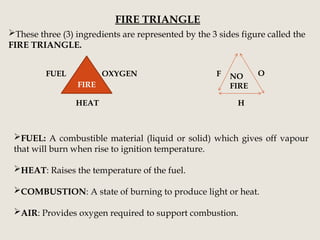
FIRE TRIANGLE
OXYGEN
FIRE
FUEL
HEAT H
F
O
NO
FIRE
Thesethree (3) ingredients are represented by the 3 sides figure called the
FIRE TRIANGLE.
FUEL: A combustible material (liquid or solid) which gives off vapour
that will burn when rise to ignition temperature.
HEAT: Raises the temperature of the fuel.
COMBUSTION: A state of burning to produce light or heat.
AIR: Provides oxygen required to support combustion.
4.
PREVENTION OF FIRE
Fire can be prevented by keeping these three (3) elements separated by
paying careful attention to the stowage of flammable materials and
their protection from sparks and by observing the precautions for the
disposal of cigarette ends, matches etc. With the exception of those fires
caused by enemy action, most fires onboard ship can be prevented by
keeping things in their proper places, and by cleanliness, tidiness and
obeying relevant instructions.
CAUSES OF FIRE
NEGLEGENCE OR CARELESSNESS:
a. Smoking and throwing of cigarette ends carelessly over fuel (wood,
paper, cloth) etc.
b. Cooking oil allowed to overheat and unattended or to spill over heated
electric cookers.
c. Use of naked light over flammable materials.
d. Leaving pressing iron on unattended.
e. Use of faulty electrical appliances.
f. Leaving oil soaked rags over hot surfaces.
5.
IGNORANCE :
a.Accidental explosion. i.e, from overheat machineries, ammo, welding
work etc.
b. By enemy action.
SABOTAGE : With the intention to destroy.
SPONTANEOUS FIRE : This is not caused by man but comes as a
result of reaction between flammable material and air under high
temperature. eg, public refuge dump
PRECAUTION AGAINST FIRE.
a. Ash tray must be provided for keeping cigarette end.
b. Fire fighting equipments must be well preserved and readily available.
c. Avoid used of naked lights.
d. Oil must be well protected.
e. Use of faulty electrical appliances must be avoided.
f. Do not smoke near or around highly inflammable material.
6.
FIRE HARZARDS ONBOARDSHIP
IN THE ENGINEROOM:
a. Combustion liquids (gasoline, lubrication oil, etc).
b. Oil leaks and soaked insulation materials (rags, card, etc).
c. Hot surfaces (exhaust pipes, overheated engine parts etc).
d. Defects in laggings of hot machineries.
e. Hot work (welding and cutting by oxyacetylene touch).
f. Auto ignition ( oil dripping on hot surface).
IN GALLEY:
a. Combustion liquids (cooking oil, hot fats, etc).
b. Hot surfaces ( ovens, frying pan, flues, etc).
NB: Flues – Tube or pipe i.e, chimney that smoke from fire pass or
flow through to outside a building or compartment.
c. Defectives and improper electrical connections.
7.
IN ACCOMMADATIONAREA:
a. Combustion materials (furnishings, personal effects, waste bin
contents, bed cloths etc).
b. Matches and cigarette smoking.
c. Defective and improper electrical connections etc.
FROM CARGOES:
a. Self heating cargoes (that may give spontaneous combustion).
b. Explosives.
SAFETY PRACTICES (GENERAL)
a. Do not smoke in hazardous areas.
b. Raised alarm as quickly as possible in the event of fire.
c. Develop the ability to use portable fire extinguishers and other
methods.
d. Develop the necessary actions to be taken to prevent them.
8.
METHOD OF EXTINGUISHINGFIRE
FIRE FIGHTING: It is the elimination of one or more of the
ingredients required for a fire to burn.
A fire fighter must attempt to:
1. Starve the fire - by removing the flammable material and
preventing more from igniting.
2. Cool the fire - by cooling the material and the air round it to
below ignition point.
3. Smother the fire - by preventing oxygen from reaching the fire
by smothering it or shutting off the ventilation in the vicinity.
STARVING: It is removal of the flammable material from the
vicinity of the fire. If the fire is being fed by liquid fuel, closing of
the appropriate valve of the fuel supplier is necessary.
9.
COOLING: Bycooling the burning material and air around it to
below ignition point. The cooling agent is water but must be used by
discretion onboard ship. The fire fighter must ensure that the smallest
quantity of water is used to achieve the greatest cooling effect.
Note that excessive use of water to fight the fire may:
a. Cause the ship to heel or capsize.
b. Entail much more pumping than necessary.
c. Cause damage to non-watertight electrical equipments.
d. Cause electric shock if played on live electrical apparatus.
SMOTHERING: Done by preventing oxygen from reaching the fire.
It can also be done by the use of CO on the fire. Foam is used such
₂
that the foam will float over the liquid fire, closing all ventilations to
the compartment involved or blanketing the surface of the fire,
(applicable to small fires)
10.
TYPES AND CLASSIFICATIONOF FIRE AND ITS
EXTINGUISHING METHOD
1. CLASS A (SOLID FIRE): Fire that will leave ash after burning. Solid
are as follows: wood, paper, textiles etc.
EXTINGUISHERS : Water (H O), CO and Dry chemical powder.
₂ ₂
2. CLASS B (LIQUID FIRE): Any liquid that can burn. Ie, petrol, gasoline,
oil, kerosene etc.
EXTINGUISHERS : Foam and CO .
₂
3. CLASS C (GASEOUS FIRE): LPG, Acetylene etc.
EXTINGUISHERS : CO , H O (Water).
₂ ₂
4. CLASS D (METALLIC FIRE): These normally occur in the industries
working with metals.
EXTIMGUISHERS: H O (Water), CO .
₂ ₂
11.
5. CLASS E(ELECTRICAL FIRE): The first step to extinguish this fire is
to secure the power supply to the equipments involved and then use
CO and H O extinguishers.
₂ ₂
NB- Electrical fire sometimes leave ash after burning, hence can be
classified as solid.
PORTABLE FIRE EXTINGUIHERS
1. WATER FIRE EXTINGUISHER (2 GALLONS) RED: This consists
of a container holding fresh water H O into which is placed in a steel
₂
cylinder container CO .
₂
OPERATION: Strike down the knob at the top and direct the H O
₂
from nozzle to the fire as required. The nozzle can be switched from
jet to spray or spray to jet by means of the two knob on its end.
12.
2. FOAM FIREEXTINGUISHER (2 GALLONS) CREAM: This consists of the
inner and outer cylinder each of which is contains a chemical substance. eg,
sodium carbonate (NA CO ) – Outer cylinder and aluminum sulphate
₂ ₂
(AL SO ) – Inner cylinder. When mixed together these substance produce
₂ ₄
foam. They are kept apart by a seal of two rubber valves coupled together.
OPERATION: Turn the T- handle at the top anticlockwise and allow it to
spring up. Place thumb firmly over the nozzle, turn extinguisher upside down,
shake it to mix the chemicals, release thumb and direct the foam against some
suitable obstruction so that the foam will runs or glide down and over the
surface of the burning fuel. The extinguisher can be used as a partial shield for
the face against heat whilst in use.
3. CO EXTINGUISHER (BLACK):
₂ It is a gas container filled with under
pressure.
OPERATION: Remove the safety pin from the trigger mechanism at the top of
the CO extinguisher, turn the hose towards the base of the fire, holding by the
₂
trigger mechanism only. Squeeze trigger to release CO to smother the fire.
₂
NOTE: Do not touch the hose when apparatus is in use to avoid cold burn.
13.
4. DRY CHEMICALPOWDER EXTINGUISHER (BLUE): This
consists of a container holding chemical powder which is
discharged by the use of CO cylinder fitted into it.
₂
OPERATION: Remove the safety pin, strike knob on top, hold
nozzle and point it to the base of the fire, squeeze trigger to
discharge the powder. They are used against aircraft and
helicopter fires. Some have the CO cylinder fitted internally to it.
₂
FIRE FIGHTING INSTALLATIONS ONBOARD SHIP
1. The salt water mains.
2. Hydrants.
3. Hose.
4. CO system.
₂
5. Sprinkler system.
14.
CARE OFHOSES:
a. Do not paint hoses and couplings.
b. Do not wash hoses with strong soda.
c. Do not leave hoses faked down for too long without opening them
for inspection.
d. Do not spill oil or grease on hoses.
e. Do not use fire hoses for washing decks, special washing hoses are
provided for this purpose.
f. Do not expel (H O) water from by walking on them, under run
₂
them at shoulder height.
g. Dry out hoses before stowage to avoid rotting.
h. Fake them down in their correct stowage.
MOBILE FIRE FIGHTING APPLIANCES: These are equipments
that have capacities between fixed systems and the portables. They
are heavier and larger than can carried by hand and therefore
mounted on wheels for easy movement. They may be of CO type
₂
or dry chemical powder type etc. eg portable emergency pump.
15.
AUXILIARY FIREFIGHTING EQUIPMENT
1. HAND TOUCHES: Are provided in the fire fighting and damage
control lockers for use in emergency. They must not be used for other
purposes and must be maintained in good order.
2. HEAD LAMPS: Are battery operated and are fitted to the head in
order to leave both hands free for use. The batteries must be
recharged frequently.
3. FLOOD LIGHT: Are supplied for emergency lighting and be
connected to any suitable power source by a long flexible cod. They
should be connected by a qualified personnel.
4. BREATHING APPARATUS (BA): In any fire situation, the area soon
becomes smoky which is often spread by the ventilation fans. This
smoke is normally unpleasant and in many cases contains toxic gases.
Example : smoke from mattresses used onboard. To protect and
enable fire fighter to carry out his duty effectively, the breathing
apparatus is worn to supply clean air. Example : of the breathing
apparatus is ICABA.
16.
ICABA: InternationalCompressed Air Breathing Apparatus. This is a light
weight self contained twin cylinder compressed air breathing apparatus
which enable the wearer to operate independently approximately 20-30
minutes duration in hard working condition. Whenever breathing apparatus
is in use a second person must be detailed as the control number (sentry) and
is responsible for :
i. Keeping a sharp listening watch for any distress signal.
ii. Inform the officer in charge if the operator has not returned at a reasonable
time after is time of returning has elapsed.
iii. Recalling the operator at the proper time when the extension equipment is
used.
iv. Tend the operator’s guideline when one is being used.
v. Tending the apparatus when the extension equipment is used.
SMOKE MASK: They are mainly use for entering foul compartment, confine
space, cold room etc.
17.
DAMAGE CONTROL ANDITS ORGANISATION ONBOARD
SHIP
DAMAGE CONTROL: It is the precaution taken to guard against and
minimize the effect caused to the ship by the following: collision, action
damage, grounding, fire, flooding etc.
AIM: To enable the ship to float, move and fight effectively after damage as
well as before, however everyone onboard the ship must have knowledge and
understanding of the following:
i. Layout of the ship.
ii. Position of the fire fighting equipments and how to use them.
iii. The function of the NBCD positions.
iv. The method of passing quick and accurate reports.
v. The need for watertight and gastight integrity and the need of risk control
markings.
vi. First aid.
18.
ORGANIZATION: Everyship has one officer responsible for directing the
ship’s NBCD organization and for co-ordinate NBCD training. The
organization has a smaller team of officers and men from each department as
its nucleus. The NBCD organization will vary according to the size of the ship.
The NBCD HQ situated in the ship near the main switchboard. Effective
damage control and repair works can be achieved under a control
organization. It must be maintained at all times.
AIMS OF ORGANIZATION:
a. Efficient use of manpower.
b. To give complete coverage to the whole ship to effect emergency repairs,
control damage etc, with maximum speed and efficiency.
THE NBCD CONTROL TEAM
1. Fire and Repair Party.
2. Pumping and Flooding.
3. First Aid Party.
4. Electrical Repair Party.
5. Watertight and Gastight Integrity Party.
19.
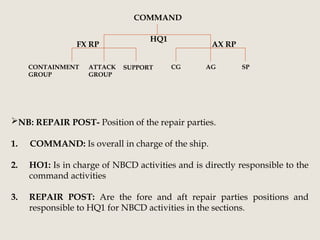
COMMAND
HQ1
AX RP
FX RP
CONTAINMENT
GROUP
ATTACK
GROUP
SUPPORTCG AG SP
NB: REPAIR POST- Position of the repair parties.
1. COMMAND: Is overall in charge of the ship.
2. HO1: Is in charge of NBCD activities and is directly responsible to the
command activities
3. REPAIR POST: Are the fore and aft repair parties positions and
responsible to HQ1 for NBCD activities in the sections.
20.
The HQ1being the main center of the NBCD organization contains the specialist
officers in the NBCD ie:
1. Marine engineering officer (MEO).
2. Weapon electrical officer (WLO).
3. Shipwright etc.
The repair parties have a senior rate in charge, normally marine engineering
artificer (MEA) who controls special team of men to deal with incident of
damage eg, floods, power failure etc.
RISK AND CONTROL MARKINGS: Openings are controlled by material
conditions of readiness. These refer to the different stages of watertight and
gastight integrities, which are formed by the closure of damage control fittings
within the confines of the ship. Watertight and gastight integrities are
maintained by the use of risk and control markings.
WATERTIGHT INTEGRITY: Ships are divided by watertight decks and
bulkheads, so that if flooding occurs it can be confined within the watertight
unit, ie the compartment affected only.
21.
GASTIGHT INTEGRITY:A ship must be gastight as well as watertight:
radioactive material, chemical and biological agents known as collectively as
“gases” must be kept out or from being admitted into the ship.
RISK MARKING: These are coloured markings or paintings on doors,
scuttles, hatches, and any other openings which denote risk to the watertight
and gastight integrity of the ship if they are left opened.
RED ZONE: When a ship is damage at or below waterline, compartments in
the vicinity will flood immediately. Because of heel and trim after damage, the
zone in which this can happen may extend above the waterline, especially at
the end of a ship and of a big ship. Openings to all compartments within this
zone are deemed to be, when open, an immediate risk to watertight integrity.
All such openings are marked with red disc or flash and are known as RED
OPENINGS.
22.
BLUE ZONE:Openings in the citadel and gas free space boundaries
constitute a risk to the gastight integrity and are not as emergency as
RED MARKINGS.
ORANGE OPENINGS: Openings in the citadel and gas free space
boundaries constitute a risk to the gastight integrity and are marked
ORANGE.
NBCD ORGANIZATION
1. Nuclear
2. Biological
3. Chemical
4. Defence and Damage Control.
5. CONTROL MARKINGS: These are black capital letters on doors
and other openings which refer to different stages of watertight and
gastight integrities. This depends on the following circumstances
while allowing maintenance and access to traffic flow (Human
movement).
23.
WATERTIGHT CONDITIONS(X,Y,Z)
1. The following watertight conditions are used in the ship:
a. CONDITION X-RAY (X) LOWEST: When this condition is reached
all openings marked with control letter (X) are shut. In peace time,
it is used when in harbour and cruising at sea.
b. CONDITION YANKEY (Y): When reached all openings marked by
the letters X and Y are shut. In peace time this condition is used in
dangerous circumstances. Eg, navigation hazard and in war time
used both in harbour and when cruising at sea.
c. CONDITION ZULU (Z) HIGHEST: When reached all openings
marked with control letter X,Y and Z are shut. In wartime, this
condition is used in NBCD state 1.
24.
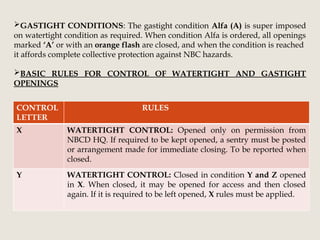
GASTIGHT CONDITIONS: Thegastight condition Alfa (A) is super imposed
on watertight condition as required. When condition Alfa is ordered, all openings
marked ‘A’ or with an orange flash are closed, and when the condition is reached
it affords complete collective protection against NBC hazards.
BASIC RULES FOR CONTROL OF WATERTIGHT AND GASTIGHT
OPENINGS
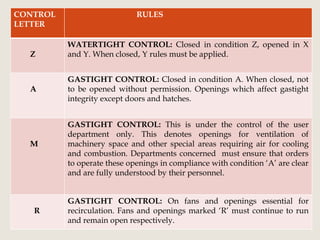
CONTROL
LETTER
RULES
X WATERTIGHT CONTROL: Opened only on permission from
NBCD HQ. If required to be kept opened, a sentry must be posted
or arrangement made for immediate closing. To be reported when
closed.
Y WATERTIGHT CONTROL: Closed in condition Y and Z opened
in X. When closed, it may be opened for access and then closed
again. If it is required to be left opened, X rules must be applied.
25.
CONTROL
LETTER
RULES
Z
WATERTIGHT CONTROL: Closedin condition Z, opened in X
and Y. When closed, Y rules must be applied.
A
GASTIGHT CONTROL: Closed in condition A. When closed, not
to be opened without permission. Openings which affect gastight
integrity except doors and hatches.
M
GASTIGHT CONTROL: This is under the control of the user
department only. This denotes openings for ventilation of
machinery space and other special areas requiring air for cooling
and combustion. Departments concerned must ensure that orders
to operate these openings in compliance with condition ‘A’ are clear
and are fully understood by their personnel.
R
GASTIGHT CONTROL: On fans and openings essential for
recirculation. Fans and openings marked ‘R’ must continue to run
and remain open respectively.
26.
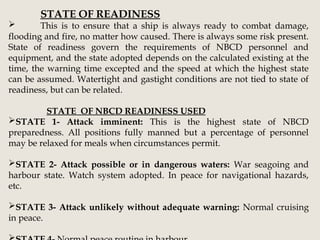
STATE OF READINESS
This is to ensure that a ship is always ready to combat damage,
flooding and fire, no matter how caused. There is always some risk present.
State of readiness govern the requirements of NBCD personnel and
equipment, and the state adopted depends on the calculated existing at the
time, the warning time excepted and the speed at which the highest state
can be assumed. Watertight and gastight conditions are not tied to state of
readiness, but can be related.
STATE OF NBCD READINESS USED
STATE 1- Attack imminent: This is the highest state of NBCD
preparedness. All positions fully manned but a percentage of personnel
may be relaxed for meals when circumstances permit.
STATE 2- Attack possible or in dangerous waters: War seagoing and
harbour state. Watch system adopted. In peace for navigational hazards,
etc.
STATE 3- Attack unlikely without adequate warning: Normal cruising
in peace.
27.
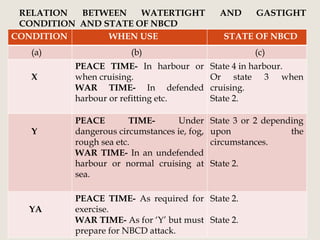
RELATION BETWEEN WATERTIGHTAND GASTIGHT
CONDITION AND STATE OF NBCD
CONDITION WHEN USE STATE OF NBCD
(a) (b) (c)
X
PEACE TIME- In harbour or
when cruising.
WAR TIME- In defended
harbour or refitting etc.
State 4 in harbour.
Or state 3 when
cruising.
State 2.
Y
PEACE TIME- Under
dangerous circumstances ie, fog,
rough sea etc.
WAR TIME- In an undefended
harbour or normal cruising at
sea.
State 3 or 2 depending
upon the
circumstances.
State 2.
YA
PEACE TIME- As required for
exercise.
WAR TIME- As for ‘Y’ but must
prepare for NBCD attack.
State 2.
State 2.
28.
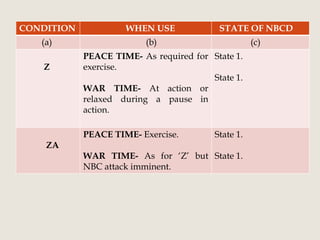
CONDITION WHEN USESTATE OF NBCD
(a) (b) (c)
Z
PEACE TIME- As required for
exercise.
WAR TIME- At action or
relaxed during a pause in
action.
State 1.
State 1.
ZA
PEACE TIME- Exercise.
WAR TIME- As for ‘Z’ but
NBC attack imminent.
State 1.
State 1.
29.
COMMUNITIONS
LARGE SHIPS:The fire and repair party positions within a section
are connected to the section base by telephone. Certain other
positions are connected directly to the NBCD Headquarters, e.g. the
principal electrical control positions and rapid flooding positions.
SMALL SHIPS: The NBCD telephone is centred on NBCD
Headquarters, with connections to all important positions in the
ship.
There are three types of telephone system in use:
1. Red, for fire and general damage.
2. Green, for electrical equipment and circuits.
3. Yellow, for pumping and flooding.
Other communications used in NBCD are main broadcast system,
intercom system, ‘walkie-talkie’ system and messengers.