Welcome
KOLHAPUR INSTITUTE OF TECHNOLOGY’S COLLEGE OF ENGINEERING KOLHAPUR 1
KOLHAPURINSTITUTEOFTECHNOLOGY’SCOLLEGEOF
ENGINEERINGKOLHAPUR
Presented By:
1. Vrishal Chandawarkar (B03)
2. Ritesh Dolare (B12)
3. Abhishek Gaikwad (B14)
4. Shubham Gaikwad (B15)
Name of Guide : Ms. Sonal Lad
KOLHAPUR INSTITUTE OF TECHNOLOGY’S COLLEGE OF ENGINEERING KOLHAPUR 2
CONTENTS
• Introduction
• Block Diagram
• Circuit Diagram
• Component
• Result
• Advantages
• Disadvantages
• Application
• Future Scope
• Conclusion
• Sample Video
KOLHAPUR INSTITUTE OF TECHNOLOGY’S COLLEGE OF ENGINEERING KOLHAPUR 3
Fire Fighting Robot
PROBLEM STATEMENT
Recently, it has sometimes been impossible for fire-fighting personnel to access the site
of a fire, even as the fire causes tremendous property damage and loss of human life,
due to high temperatures or the presence of explosive materials. In such environments,
fire-fighting robots can be useful for extinguishing a fire. Thus, Fire-fighting robots are
operated in places where fire fighters are unable to work .Besides that, firefighting
robot can be use for protecting fire fighters from extreme danger in petrochemical,
chemical dangerous product, toxicity or exploder fire accidents. Therefore, it also can
reduce the human injury from a fire burning. Therefore we are going to build a fire
fighting robot using Arduino, which automatically sense the fire and start water pump.
KOLHAPUR INSTITUTE OF TECHNOLOGY’S COLLEGE OF ENGINEERING KOLHAPUR
Fire Fighting Robot
4
LITERATURE SURVEY
Tawfiqur Rakib, M. A. Rashid Sarkar proposed a fire fighting robot model which consists of a
base platform made up of ‘Kerosene wood’, LM35 sensor for temperature detection, flame
sensors to detect the fire and a water container of 1 litre capacity which is made up of a strong
cardboard that makes it water resistant. The robot has two wheels for its movement. Advanced
firefighting automated framework autonomously distinguishes and douses fire. In the time of
development, the world is progressively turning towards the robotized structure and self-
journeying vehicles, fire fighters are persistently at a peril of losing their life. Fire spreads rapidly
if it isn't controlled. In the event of a gas spillage there even might be an effect.
KOLHAPUR INSTITUTE OF TECHNOLOGY’S COLLEGE OF ENGINEERING KOLHAPUR
Fire Fighting Robot
5
PROPOSED METHODOLOGIES
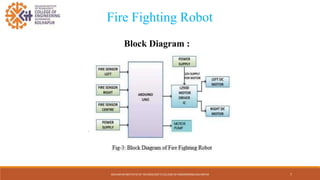
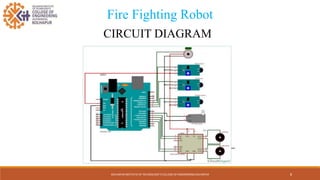
Giving the connections as per circuit diagram and upload the code to Arduino.
Check the water in container and giving supply.
Place the fire in front flame sensors and moving fire left, straight, right for
proper working of sensor.
Use submersible pump like as fire extinguisher.
KOLHAPUR INSTITUTE OF TECHNOLOGY’S COLLEGE OF ENGINEERING KOLHAPUR
Fire Fighting Robot
6
KOLHAPUR INSTITUTE OF TECHNOLOGY’S COLLEGE OF ENGINEERING KOLHAPUR
Block Diagram :
Fire Fighting Robot
7
CIRCUIT DIAGRAM
KOLHAPUR INSTITUTE OF TECHNOLOGY’S COLLEGE OF ENGINEERING KOLHAPUR
Fire Fighting Robot
8
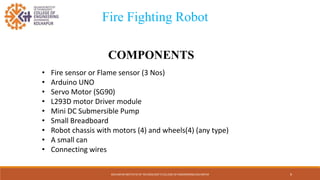
COMPONENTS
• Fire sensor or Flame sensor (3 Nos)
• Arduino UNO
• Servo Motor (SG90)
• L293D motor Driver module
• Mini DC Submersible Pump
• Small Breadboard
• Robot chassis with motors (4) and wheels(4) (any type)
• A small can
• Connecting wires
KOLHAPUR INSTITUTE OF TECHNOLOGY’S COLLEGE OF ENGINEERING KOLHAPUR 9
Fire Fighting Robot
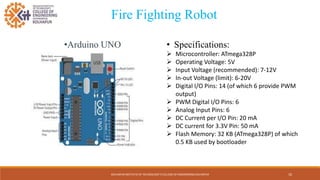
• Specifications:
 Microcontroller: ATmega328P
 Operating Voltage: 5V
 Input Voltage (recommended): 7-12V
 In-out Voltage (limit): 6-20V
 Digital I/O Pins: 14 (of which 6 provide PWM
output)
 PWM Digital I/O Pins: 6
 Analog Input Pins: 6
 DC Current per I/O Pin: 20 mA
 DC current for 3.3V Pin: 50 mA
 Flash Memory: 32 KB (ATmega328P) of which
0.5 KB used by bootloader
KOLHAPUR INSTITUTE OF TECHNOLOGY’S COLLEGE OF ENGINEERING KOLHAPUR
•Arduino UNO
Fire Fighting Robot
10
KOLHAPUR INSTITUTE OF TECHNOLOGY’S COLLEGE OF ENGINEERING KOLHAPUR
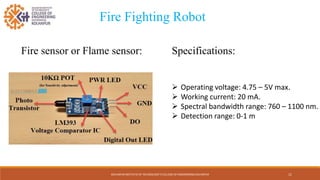
Fire sensor or Flame sensor:
Fire Fighting Robot
11
Specifications:
 Operating voltage: 4.75 – 5V max.
 Working current: 20 mA.
 Spectral bandwidth range: 760 – 1100 nm.
 Detection range: 0-1 m
KOLHAPUR INSTITUTE OF TECHNOLOGY’S COLLEGE OF ENGINEERING KOLHAPUR
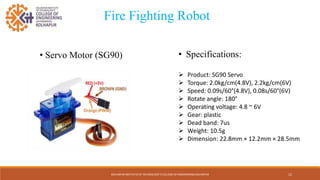
• Specifications:
 Product: SG90 Servo
 Torque: 2.0kg/cm(4.8V), 2.2kg/cm(6V)
 Speed: 0.09s/60°(4.8V), 0.08s/60°(6V)
 Rotate angle: 180°
 Operating voltage: 4.8 ~ 6V
 Gear: plastic
 Dead band: 7us
 Weight: 10.5g
 Dimension: 22.8mm × 12.2mm × 28.5mm
• Servo Motor (SG90)
Fire Fighting Robot
12
KOLHAPUR INSTITUTE OF TECHNOLOGY’S COLLEGE OF ENGINEERING KOLHAPUR 13
Fire Fighting Robot
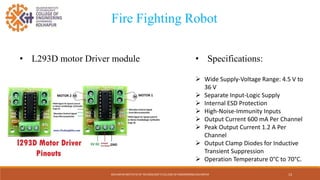
• L293D motor Driver module • Specifications:
 Wide Supply-Voltage Range: 4.5 V to
36 V
 Separate Input-Logic Supply
 Internal ESD Protection
 High-Noise-Immunity Inputs
 Output Current 600 mA Per Channel
 Peak Output Current 1.2 A Per
Channel
 Output Clamp Diodes for Inductive
Transient Suppression
 Operation Temperature 0°C to 70°C.
KOLHAPUR INSTITUTE OF TECHNOLOGY’S COLLEGE OF ENGINEERING KOLHAPUR 14
Fire Fighting Robot
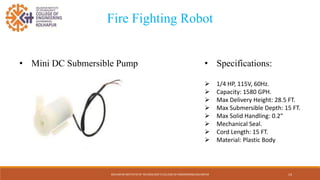
• Mini DC Submersible Pump • Specifications:
 1/4 HP, 115V, 60Hz.
 Capacity: 1580 GPH.
 Max Delivery Height: 28.5 FT.
 Max Submersible Depth: 15 FT.
 Max Solid Handling: 0.2"
 Mechanical Seal.
 Cord Length: 15 FT.
 Material: Plastic Body
KOLHAPUR INSTITUTE OF TECHNOLOGY’S COLLEGE OF ENGINEERING KOLHAPUR
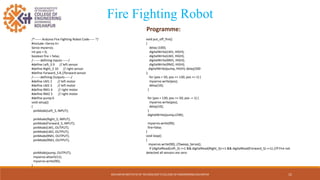
Programme:
/*------ Arduino Fire Fighting Robot Code----- */
#include <Servo.h>
Servo myservo;
int pos = 0;
boolean fire = false;
/-------defining Inputs------/
#define Left_S 9 // left sensor
#define Right_S 10 // right sensor
#define Forward_S 8 //forward sensor
/-------defining Outputs------/
#define LM1 2 // left motor
#define LM2 3 // left motor
#define RM1 4 // right motor
#define RM2 5 // right motor
#define pump 6
void setup()
{
pinMode(Left_S, INPUT);
pinMode(Right_S, INPUT);
pinMode(Forward_S, INPUT);
pinMode(LM1, OUTPUT);
pinMode(LM2, OUTPUT);
pinMode(RM1, OUTPUT);
pinMode(RM2, OUTPUT);
pinMode(pump, OUTPUT);
myservo.attach(11);
myservo.write(90);
}
15
Fire Fighting Robot
void put_off_fire()
{
delay (100);
digitalWrite(LM1, HIGH);
digitalWrite(LM2, HIGH);
digitalWrite(RM1, HIGH);
digitalWrite(RM2, HIGH);
digitalWrite(pump, HIGH); delay(500
);
for (pos = 50; pos <= 130; pos += 1) {
myservo.write(pos);
delay(10);
}
for (pos = 130; pos >= 50; pos -= 1) {
myservo.write(pos);
delay(10);
}
digitalWrite(pump,LOW);
myservo.write(90);
fire=false;
}
void loop()
{
myservo.write(90); //Sweep_Servo();
if (digitalRead(Left_S) ==1 && digitalRead(Right_S)==1 && digitalRead(Forward_S) ==1) //If Fire not
detected all sensors are zero
KOLHAPUR INSTITUTE OF TECHNOLOGY’S COLLEGE OF ENGINEERING KOLHAPUR 16
Fire Fighting Robot
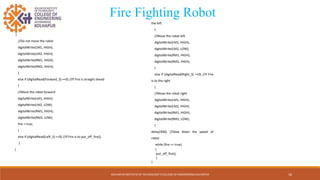
{
//Do not move the robot
digitalWrite(LM1, HIGH);
digitalWrite(LM2, HIGH);
digitalWrite(RM1, HIGH);
digitalWrite(RM2, HIGH);
}
else if (digitalRead(Forward_S) ==0) //If Fire is straight ahead
{
//Move the robot forward
digitalWrite(LM1, HIGH);
digitalWrite(LM2, LOW);
digitalWrite(RM1, HIGH);
digitalWrite(RM2, LOW);
fire = true;
}
else if (digitalRead(Left_S) ==0) //If Fire is to put_off_fire();
}
}
the left
{
//Move the robot left
digitalWrite(LM1, HIGH);
digitalWrite(LM2, LOW);
digitalWrite(RM1, HIGH);
digitalWrite(RM2, HIGH);
}
else if (digitalRead(Right_S) ==0) //If Fire
is to the right
{
//Move the robot right
digitalWrite(LM1, HIGH);
digitalWrite(LM2, HIGH);
digitalWrite(RM1, HIGH);
digitalWrite(RM2, LOW);
}
delay(300); //Slow down the speed of
robot
while (fire == true)
{
put_off_fire();
}
}
KOLHAPUR INSTITUTE OF TECHNOLOGY’S COLLEGE OF ENGINEERING KOLHAPUR 17
Fire Fighting Robot
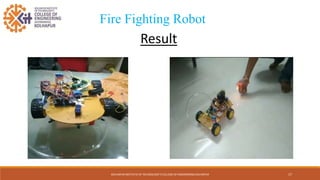
Result
• Advantages
KOLHAPUR INSTITUTE OF TECHNOLOGY’S COLLEGE OF ENGINEERING KOLHAPUR
 Completely replaces the human effort of putting of the fire.
 Enables live streaming of the fire place to the remote user.
 Sends an email alert once the obstacle is detected.
 The Robot performs well in manual and automatic mode
 Reduce the direct exposure of fireman and his effort.
 Reduce human efforts.
 Capability of sensing accurately with increased flexibility.
Fire Fighting Robot
18
• Disadvantages
KOLHAPUR INSTITUTE OF TECHNOLOGY’S COLLEGE OF ENGINEERING KOLHAPUR
 When the robot is superintended by means of web page
 The robot depends upon the network signal and its quality.
 Need self-protection method.
 To and fro motion to a same point is not possible.
 No remote control for the robotic movement.
 No monitoring system for vehicle.
Fire Fighting Robot
19
• Application
 The main purpose of robot is to rescue the people by extinguishing fire in a building.
 Firefighter robot to detect fire and extinguish it if possible.
 In places where risk of explosion is high such as gas plants.
 The Firefighting Robot is a compact and portable emergency responder robot that
assists firemen in fighting high-rise fires, especially in highly dangerous environments
where it is not safe for people to enter
KOLHAPUR INSTITUTE OF TECHNOLOGY’S COLLEGE OF ENGINEERING KOLHAPUR 20
Fire Fighting Robot
KOLHAPUR INSTITUTE OF TECHNOLOGY’S COLLEGE OF ENGINEERING KOLHAPUR 21
Fire Fighting Robot
• Future Scope
 Improve weight capacity of the robot.
 Camera and Video transmission can be added.
 Military mission can be possible.
 Humans are replaced with robots in life-threatening situations.
 project has been motivated by the desire to design a system that can detect
fires and take appropriate action, without any human intervention.
 This provides us the opportunity to pass on to robots tasks that traditionally
humans had to do but were inherently life threatening.
 Fire-fighting is an obvious candidate for such automation.
 It can be enhanced by interfacing it with a wireless camera so that the
person controlling it can view the operation of the robot remotely on a
screen.
• Conclusion
KOLHAPUR INSTITUTE OF TECHNOLOGY’S COLLEGE OF ENGINEERING KOLHAPUR 22
Fire Fighting Robot
Here we are simply designing a fire fighting robot, fire can cause heavy
damage to life and property. Our main objective of making this project
is to detect fire and extinguish it automatically to protect the people
and their property . Because of our project highly dangerous
environments where it is not safe for people to enter our robo .Here
we are simply using flame sensor to detect fire and extinguish the fire
with the help of water pump.
KOLHAPUR INSTITUTE OF TECHNOLOGY’S COLLEGE OF ENGINEERING KOLHAPUR 23
Fire Fighting Robot
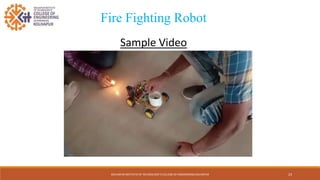
Sample Video
KOLHAPUR INSTITUTE OF TECHNOLOGY’S COLLEGE OF ENGINEERING KOLHAPUR 24

Fire Fighting Robot.pptx

  • 1.
    Welcome KOLHAPUR INSTITUTE OFTECHNOLOGY’S COLLEGE OF ENGINEERING KOLHAPUR 1
  • 2.
    KOLHAPURINSTITUTEOFTECHNOLOGY’SCOLLEGEOF ENGINEERINGKOLHAPUR Presented By: 1. VrishalChandawarkar (B03) 2. Ritesh Dolare (B12) 3. Abhishek Gaikwad (B14) 4. Shubham Gaikwad (B15) Name of Guide : Ms. Sonal Lad KOLHAPUR INSTITUTE OF TECHNOLOGY’S COLLEGE OF ENGINEERING KOLHAPUR 2
  • 3.
    CONTENTS • Introduction • BlockDiagram • Circuit Diagram • Component • Result • Advantages • Disadvantages • Application • Future Scope • Conclusion • Sample Video KOLHAPUR INSTITUTE OF TECHNOLOGY’S COLLEGE OF ENGINEERING KOLHAPUR 3 Fire Fighting Robot
  • 4.
    PROBLEM STATEMENT Recently, ithas sometimes been impossible for fire-fighting personnel to access the site of a fire, even as the fire causes tremendous property damage and loss of human life, due to high temperatures or the presence of explosive materials. In such environments, fire-fighting robots can be useful for extinguishing a fire. Thus, Fire-fighting robots are operated in places where fire fighters are unable to work .Besides that, firefighting robot can be use for protecting fire fighters from extreme danger in petrochemical, chemical dangerous product, toxicity or exploder fire accidents. Therefore, it also can reduce the human injury from a fire burning. Therefore we are going to build a fire fighting robot using Arduino, which automatically sense the fire and start water pump. KOLHAPUR INSTITUTE OF TECHNOLOGY’S COLLEGE OF ENGINEERING KOLHAPUR Fire Fighting Robot 4
  • 5.
    LITERATURE SURVEY Tawfiqur Rakib,M. A. Rashid Sarkar proposed a fire fighting robot model which consists of a base platform made up of ‘Kerosene wood’, LM35 sensor for temperature detection, flame sensors to detect the fire and a water container of 1 litre capacity which is made up of a strong cardboard that makes it water resistant. The robot has two wheels for its movement. Advanced firefighting automated framework autonomously distinguishes and douses fire. In the time of development, the world is progressively turning towards the robotized structure and self- journeying vehicles, fire fighters are persistently at a peril of losing their life. Fire spreads rapidly if it isn't controlled. In the event of a gas spillage there even might be an effect. KOLHAPUR INSTITUTE OF TECHNOLOGY’S COLLEGE OF ENGINEERING KOLHAPUR Fire Fighting Robot 5
  • 6.
    PROPOSED METHODOLOGIES Giving theconnections as per circuit diagram and upload the code to Arduino. Check the water in container and giving supply. Place the fire in front flame sensors and moving fire left, straight, right for proper working of sensor. Use submersible pump like as fire extinguisher. KOLHAPUR INSTITUTE OF TECHNOLOGY’S COLLEGE OF ENGINEERING KOLHAPUR Fire Fighting Robot 6
  • 7.
    KOLHAPUR INSTITUTE OFTECHNOLOGY’S COLLEGE OF ENGINEERING KOLHAPUR Block Diagram : Fire Fighting Robot 7
  • 8.
    CIRCUIT DIAGRAM KOLHAPUR INSTITUTEOF TECHNOLOGY’S COLLEGE OF ENGINEERING KOLHAPUR Fire Fighting Robot 8
  • 9.
    COMPONENTS • Fire sensoror Flame sensor (3 Nos) • Arduino UNO • Servo Motor (SG90) • L293D motor Driver module • Mini DC Submersible Pump • Small Breadboard • Robot chassis with motors (4) and wheels(4) (any type) • A small can • Connecting wires KOLHAPUR INSTITUTE OF TECHNOLOGY’S COLLEGE OF ENGINEERING KOLHAPUR 9 Fire Fighting Robot
  • 10.
    • Specifications:  Microcontroller:ATmega328P  Operating Voltage: 5V  Input Voltage (recommended): 7-12V  In-out Voltage (limit): 6-20V  Digital I/O Pins: 14 (of which 6 provide PWM output)  PWM Digital I/O Pins: 6  Analog Input Pins: 6  DC Current per I/O Pin: 20 mA  DC current for 3.3V Pin: 50 mA  Flash Memory: 32 KB (ATmega328P) of which 0.5 KB used by bootloader KOLHAPUR INSTITUTE OF TECHNOLOGY’S COLLEGE OF ENGINEERING KOLHAPUR •Arduino UNO Fire Fighting Robot 10
  • 11.
    KOLHAPUR INSTITUTE OFTECHNOLOGY’S COLLEGE OF ENGINEERING KOLHAPUR Fire sensor or Flame sensor: Fire Fighting Robot 11 Specifications:  Operating voltage: 4.75 – 5V max.  Working current: 20 mA.  Spectral bandwidth range: 760 – 1100 nm.  Detection range: 0-1 m
  • 12.
    KOLHAPUR INSTITUTE OFTECHNOLOGY’S COLLEGE OF ENGINEERING KOLHAPUR • Specifications:  Product: SG90 Servo  Torque: 2.0kg/cm(4.8V), 2.2kg/cm(6V)  Speed: 0.09s/60°(4.8V), 0.08s/60°(6V)  Rotate angle: 180°  Operating voltage: 4.8 ~ 6V  Gear: plastic  Dead band: 7us  Weight: 10.5g  Dimension: 22.8mm × 12.2mm × 28.5mm • Servo Motor (SG90) Fire Fighting Robot 12
  • 13.
    KOLHAPUR INSTITUTE OFTECHNOLOGY’S COLLEGE OF ENGINEERING KOLHAPUR 13 Fire Fighting Robot • L293D motor Driver module • Specifications:  Wide Supply-Voltage Range: 4.5 V to 36 V  Separate Input-Logic Supply  Internal ESD Protection  High-Noise-Immunity Inputs  Output Current 600 mA Per Channel  Peak Output Current 1.2 A Per Channel  Output Clamp Diodes for Inductive Transient Suppression  Operation Temperature 0°C to 70°C.
  • 14.
    KOLHAPUR INSTITUTE OFTECHNOLOGY’S COLLEGE OF ENGINEERING KOLHAPUR 14 Fire Fighting Robot • Mini DC Submersible Pump • Specifications:  1/4 HP, 115V, 60Hz.  Capacity: 1580 GPH.  Max Delivery Height: 28.5 FT.  Max Submersible Depth: 15 FT.  Max Solid Handling: 0.2"  Mechanical Seal.  Cord Length: 15 FT.  Material: Plastic Body
  • 15.
    KOLHAPUR INSTITUTE OFTECHNOLOGY’S COLLEGE OF ENGINEERING KOLHAPUR Programme: /*------ Arduino Fire Fighting Robot Code----- */ #include <Servo.h> Servo myservo; int pos = 0; boolean fire = false; /-------defining Inputs------/ #define Left_S 9 // left sensor #define Right_S 10 // right sensor #define Forward_S 8 //forward sensor /-------defining Outputs------/ #define LM1 2 // left motor #define LM2 3 // left motor #define RM1 4 // right motor #define RM2 5 // right motor #define pump 6 void setup() { pinMode(Left_S, INPUT); pinMode(Right_S, INPUT); pinMode(Forward_S, INPUT); pinMode(LM1, OUTPUT); pinMode(LM2, OUTPUT); pinMode(RM1, OUTPUT); pinMode(RM2, OUTPUT); pinMode(pump, OUTPUT); myservo.attach(11); myservo.write(90); } 15 Fire Fighting Robot void put_off_fire() { delay (100); digitalWrite(LM1, HIGH); digitalWrite(LM2, HIGH); digitalWrite(RM1, HIGH); digitalWrite(RM2, HIGH); digitalWrite(pump, HIGH); delay(500 ); for (pos = 50; pos <= 130; pos += 1) { myservo.write(pos); delay(10); } for (pos = 130; pos >= 50; pos -= 1) { myservo.write(pos); delay(10); } digitalWrite(pump,LOW); myservo.write(90); fire=false; } void loop() { myservo.write(90); //Sweep_Servo(); if (digitalRead(Left_S) ==1 && digitalRead(Right_S)==1 && digitalRead(Forward_S) ==1) //If Fire not detected all sensors are zero
  • 16.
    KOLHAPUR INSTITUTE OFTECHNOLOGY’S COLLEGE OF ENGINEERING KOLHAPUR 16 Fire Fighting Robot { //Do not move the robot digitalWrite(LM1, HIGH); digitalWrite(LM2, HIGH); digitalWrite(RM1, HIGH); digitalWrite(RM2, HIGH); } else if (digitalRead(Forward_S) ==0) //If Fire is straight ahead { //Move the robot forward digitalWrite(LM1, HIGH); digitalWrite(LM2, LOW); digitalWrite(RM1, HIGH); digitalWrite(RM2, LOW); fire = true; } else if (digitalRead(Left_S) ==0) //If Fire is to put_off_fire(); } } the left { //Move the robot left digitalWrite(LM1, HIGH); digitalWrite(LM2, LOW); digitalWrite(RM1, HIGH); digitalWrite(RM2, HIGH); } else if (digitalRead(Right_S) ==0) //If Fire is to the right { //Move the robot right digitalWrite(LM1, HIGH); digitalWrite(LM2, HIGH); digitalWrite(RM1, HIGH); digitalWrite(RM2, LOW); } delay(300); //Slow down the speed of robot while (fire == true) { put_off_fire(); } }
  • 17.
    KOLHAPUR INSTITUTE OFTECHNOLOGY’S COLLEGE OF ENGINEERING KOLHAPUR 17 Fire Fighting Robot Result
  • 18.
    • Advantages KOLHAPUR INSTITUTEOF TECHNOLOGY’S COLLEGE OF ENGINEERING KOLHAPUR  Completely replaces the human effort of putting of the fire.  Enables live streaming of the fire place to the remote user.  Sends an email alert once the obstacle is detected.  The Robot performs well in manual and automatic mode  Reduce the direct exposure of fireman and his effort.  Reduce human efforts.  Capability of sensing accurately with increased flexibility. Fire Fighting Robot 18
  • 19.
    • Disadvantages KOLHAPUR INSTITUTEOF TECHNOLOGY’S COLLEGE OF ENGINEERING KOLHAPUR  When the robot is superintended by means of web page  The robot depends upon the network signal and its quality.  Need self-protection method.  To and fro motion to a same point is not possible.  No remote control for the robotic movement.  No monitoring system for vehicle. Fire Fighting Robot 19
  • 20.
    • Application  Themain purpose of robot is to rescue the people by extinguishing fire in a building.  Firefighter robot to detect fire and extinguish it if possible.  In places where risk of explosion is high such as gas plants.  The Firefighting Robot is a compact and portable emergency responder robot that assists firemen in fighting high-rise fires, especially in highly dangerous environments where it is not safe for people to enter KOLHAPUR INSTITUTE OF TECHNOLOGY’S COLLEGE OF ENGINEERING KOLHAPUR 20 Fire Fighting Robot
  • 21.
    KOLHAPUR INSTITUTE OFTECHNOLOGY’S COLLEGE OF ENGINEERING KOLHAPUR 21 Fire Fighting Robot • Future Scope  Improve weight capacity of the robot.  Camera and Video transmission can be added.  Military mission can be possible.  Humans are replaced with robots in life-threatening situations.  project has been motivated by the desire to design a system that can detect fires and take appropriate action, without any human intervention.  This provides us the opportunity to pass on to robots tasks that traditionally humans had to do but were inherently life threatening.  Fire-fighting is an obvious candidate for such automation.  It can be enhanced by interfacing it with a wireless camera so that the person controlling it can view the operation of the robot remotely on a screen.
  • 22.
    • Conclusion KOLHAPUR INSTITUTEOF TECHNOLOGY’S COLLEGE OF ENGINEERING KOLHAPUR 22 Fire Fighting Robot Here we are simply designing a fire fighting robot, fire can cause heavy damage to life and property. Our main objective of making this project is to detect fire and extinguish it automatically to protect the people and their property . Because of our project highly dangerous environments where it is not safe for people to enter our robo .Here we are simply using flame sensor to detect fire and extinguish the fire with the help of water pump.
  • 23.
    KOLHAPUR INSTITUTE OFTECHNOLOGY’S COLLEGE OF ENGINEERING KOLHAPUR 23 Fire Fighting Robot Sample Video
  • 24.
    KOLHAPUR INSTITUTE OFTECHNOLOGY’S COLLEGE OF ENGINEERING KOLHAPUR 24