International Research Journal of Engineering and Technology (IRJET) e-ISSN: 2395-0056
Volume: 06 Issue: 04 | Apr 2019 www.irjet.net p-ISSN: 2395-0072
© 2019, IRJET | Impact Factor value: 7.211 | ISO 9001:2008 Certified Journal | Page 512
An Analytic Study on Fire Fighting Robot
Abhyuday C Thorat1, Ashish A Khose2, Anjum Shikalgar3, Hemangi Dalvi4, P.V Bhosale5
1,2,3,4Student, Dept. of Instrumentation Engineering, B.V.C.O.E, Kharghar, Navi Mumbai
5Professor, Dept. of Instrumentation Engineering, B.V.C.O.E, Kharghar, Navi Mumbai.
---------------------------------------------------------------------***----------------------------------------------------------------------
Abstract - Expanding human population and growing
industrialization, has led to a manifold increaseinthenumber
of fire accidents. There are many possibilities that a fire can
start in an industry or in any remote area. For example, in
cotton mills, garments, fuel storages, etc., electricleakagescan
lead to huge damage. The physical limitations of humans to
deal with these kinds of destructive fires combined with the
adverse conditions, makes fire extinguishing an arduous task.
The research and development in the field of Artificial
Intelligence has given rise to Robotics. Robots are
implemented in various areas like Manufacturing, Industries
etc. Hence, Robotics can be used to assist fire fighters to
perform the task of firefighting and so reduces the risk oftheir
lives. The use of firefighting robots can reduce the errors and
the limitations that are faced by human fire fighters. This
paper will talk about each component of the robot from fire
monitoring to fire extinguishing.
Key Words: Fire Fighting, Fire Monitoring, Fire
Extinguish, NodeMCU, Robot, WiFi.
1. INTRODUCTION
Accidents that involve fire have been a cause of concern to
mankind for a long time now. Fires are known to cause
destruction on a small as well as a large scale. Fire requires
three basic components to get ignited; this is known as FIRE
TRIANGLE. The Fire Triangle also known as Combustion
Triangle is a simple model for understanding the necessary
ingredients for most fires. The triangle illustrates the three
elements a fire needs to ignite: heat, fuel, and an oxidizing
agent (Oxygen). Fig. i. illustrates the Fire Triangle and its
three basic components.
Fig- 1: Fire Triangle
In spite of the best attempts made by human fire in the
process of extinguishing fires, it is not always possible for
them to tackle fires in the most efficient manner.
Our task an Instrumentation Engineers was to design and
build a prototype systemthatcouldmonitorandextinguisha
fire. It is the Robot that can move through a structure, find a
lit candle, monitor the temperature and then extinguish it
with help of a water spraying technique.
Previously Fire Fighting Robots were controlled by using
different electronics devices but this reduces the scope of
control of fire fighting robot. However, with the advanced
techniques we can build the same robot by using android
application to control the actions of the robot. With the help
of such robots, a fire fighter’s work gets decreased and a
movement of robot is much effective. By using an android
app fireman man detect the fire andcanbeabletoextinguish
it.
Our research paper describes the design of a small Fire
Fighting Robot. We have worked on the same project at our
college presenting a synopsis showing its basic construction
and working. The Fire Fighting Robot is designed to search
for a fire in a small floor plan of a house, extinguish the fire
with the help of the water pump.
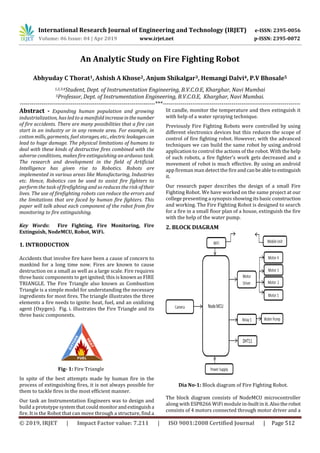
2. BLOCK DIAGRAM
Dia No-1: Block diagram of Fire Fighting Robot.
The block diagram consists of NodeMCU microcontroller
along with ESP8266 WiFi module in-builtinit.Alsotherobot
consists of 4 motors connected through motor driver and a
International Research Journal of Engineering and Technology (IRJET) e-ISSN: 2395-0056
Volume: 06 Issue: 04 | Apr 2019 www.irjet.net p-ISSN: 2395-0072
© 2019, IRJET | Impact Factor value: 7.211 | ISO 9001:2008 Certified Journal | Page 513
humidity and temperature sensor for monitoring the
environment. The robot also consists of third party Camera
for visually observing the surrounding.Forextinguishingthe
fire the robot consist of a water pump operated through
mobile commands.
3. CIRCUIT DIAGRAM AND SYSTEM WORKING.
The circuit implemented consists mainly of two different
sub-circuits.
Dia No-2: Circuit diagram of Fire Fighting Robot.
The first part comprises of making the robot to follow the
instruction that are given to it by the user using Android App
through WiFi. This was done using a WiFi module circuit.
This was based on the phenomenon that with the router
receiving information from the Internet, translating it into a
radio signal and sending it to the computer's wireless
adapter. In our case, the user watches the surrounding
through the robot’s eye and then through mobilewesendthe
command to the robot. Therefore,thevoltageacrossterminal
of the controller gets high aslong as the robot isreceivingthe
signal. As the pin gets high the motor corresponding to it
starts. Thesensoraheadkeepsonmeasuringthetemperature
and humidity and informs us continuously. As the command
stops, the voltage across pin gets low and the motor stops.
The second part comprises of detecting the fire, monitoring
the temperature and humidity and extinguishing the fire.
When the user handling and giving commands to the robot
monitoring the temperature and detects fire, the user
command s robot to start the water sprinkler.
3.1. Components
3.1.1. Microcontroller
A microcontroller is a computer on a single
integrated circuit containing memory, a processor core and
programmable input/output peripherals. It is designed for
embedded applications.
NodeMCU is an open source IoT platform. It includes
firmware which runs on the ESP8266 WiFi SoC
from Espressif Systems, and hardware whichisbasedonthe
ESP-12 module.[1][2] The term "NodeMCU" by default refers
to the firmware rather than the development kits. The
firmware uses the Lua scripting language. It is based on the
eLua project, and built on the Espressif Non-OS SDK for
ESP8266. Node MCU has 128kB internal RAM and 4MB
external flash. It works on 80-160MHz clock frequency.
Fig No-2: NodeMCU Front and Back Side
3.1.2. Mechanical Part
The robot is based on the four wheel drive system which
provides more stability to the robot. The chassis is made of
metal so that it can bear the weight of all the components.
3.1.3. Motors
Four 100 rpm motors have been used to run the robot. The
motors give high torque due to which robot is able to
maintain balance between speed and weight.
International Research Journal of Engineering and Technology (IRJET) e-ISSN: 2395-0056
Volume: 06 Issue: 04 | Apr 2019 www.irjet.net p-ISSN: 2395-0072
© 2019, IRJET | Impact Factor value: 7.211 | ISO 9001:2008 Certified Journal | Page 514
3.1.4. Power
A 12V battery is been used as power source.
3.1.5. Pumping System
The pumping system consists of a mini submersible type
water pump that works on 9 V D.C. and a water tank. It is
extremely simple and easy to use. A small pipe is used to
carry water from pump outlet.
4. MODULES
4.1. Fire Detection Module:
a) The user controlling the robot will move it into
the room and monitors the fire if there is any.
b) If the temperature at certain place is more than
the threshold set then the user start the water
sprinkler.
c) Else detect and monitor only the temperature
inside the room.
4.2. Temperature Monitoring Module:
a) When the user directs the robot into a room,
the robot analysis the room and monitors as
well as displays the temperature in the room.
4.3. Fireman Module:
a) When the robot will be moving inside the room
it can be controlled by the fireman using
android phone.
b) The camera on the robot will allow fireman to
analyze the situation and turn the pipeofwater
sprinkler.
4.4. Fire Monitoring Module:
a) The user controlling the robot will move it into
the room and monitors the fire if there is any.
b) If the temperature at certain place is more than
the threshold set then the user start the water
sprinkler.
When the fire is extinguished the temperature is monitored
and displayed as well the camera shows the after result of
the fire and can be used to control it.
5. RESULTS AND OBSERVATION
Whenever a flame gets detected, the robot’s motion is
stopped by the user and the pumping mechanism of the
robot gets turned on to extinguish the fire with the help of
water. Since a small amount of water can also decrease the
intensity of flames coming out of fire, therefore thepumping
mechanism will work for a definite amount oftimetoensure
that the fire is completely extinguished. There is no doubt
that different kind of fires need different type of fire
extinguishing material. Therefore every material should be
tested. But for now we will be considering water as our
major extinguishing material which can be later on replaced
by best suited extinguishing material for a particular type of
industry.
6. APPLICATION AND FUTURE DEVELOPMENT
Some of the advantages of industrial firefighting robot are:-
i. Can be used as a mobile surveillance system.
ii. Can be used as a fire extinguisher at places out
of human reach.
iii. Can be used in security system.
The present work can be extended in several waysandsome
of them are given below:
i. For detecting fire with 100% accuracy so that
the robot can differentiate between industrial
fire and an ordinary flame, we can add some
more type of sensors i.e. smoke sensor and
thermal sensor.
ii. To save people who get trapped in the fire, we
will again use transmission of wireless signals
to the firefighting person so that theycaneasily
locate the people and hence save a lot of
precious time.
iii. We can replace water in pumping system with
pressurized carbon dioxide to fight with fires
caused due to electric short circuits.
iv. For domestic use, we will try to implement
motion planning using neural networks so that
the errors can be minimized in mapping of the
house.
In this paper, the robot is limited to work in an environment
which allows it to move on aparticular pathinstructedbythe
user. This path can be laid only in industries which offer
other equipment’s which are non-mobile. But since every
industry doesn’t offer this typeof environment,thereforethe
robot cannot be used in every industry. Therefore to use the
robot in every industry, wecanupgradetherobotandusethe
SLAM (SimultaneousLocalizationandMapping)techniqueso
that the robot moves in directions having no obstacles and
thus explore each and every corner of an industry. Moreover
for obstacle detection we need to use a sonar sensor and an
infrared sensor.
7. CONCLUSION
This paper has presented a unique vision of the concepts
which are used in this particular field. It aims to promote
technology innovation to achieve a reliable and efficient
International Research Journal of Engineering and Technology (IRJET) e-ISSN: 2395-0056
Volume: 06 Issue: 04 | Apr 2019 www.irjet.net p-ISSN: 2395-0072
© 2019, IRJET | Impact Factor value: 7.211 | ISO 9001:2008 Certified Journal | Page 515
outcome from the various instruments. Experimental work
has been carried out carefully. With a common digitalized
platform, these latest instruments will enable increased
flexibility in control, operation, and expansion.
REFERENCES
[1] Systems, Espressif. "Espressif Systems". Espressif-
WikiDevi. Retrieved 3 June 2017.
[2] Brian Benchoff. "A DEV BOARD FOR THE ESP LUA
INTERPRETER". Hackaday. Retrieved 2 April 2015.
[3] www.ijettcs.org/Volume2Issue4/IJETTCS-2013-08-13-
084.pdf.
[4] www.ijerd.com/paper/vol10-
issue4/Version_2/G1044347.pdf
[5] https://www.robotshop.com/community/robots/show
/fire-fighting-robot
[6] electronicsprojs.blogspot.com/2013/05/fire-fighting-
robot.html

IRJET- An Analytic Study on Fire Fighting Robot

  • 1.
    International Research Journalof Engineering and Technology (IRJET) e-ISSN: 2395-0056 Volume: 06 Issue: 04 | Apr 2019 www.irjet.net p-ISSN: 2395-0072 © 2019, IRJET | Impact Factor value: 7.211 | ISO 9001:2008 Certified Journal | Page 512 An Analytic Study on Fire Fighting Robot Abhyuday C Thorat1, Ashish A Khose2, Anjum Shikalgar3, Hemangi Dalvi4, P.V Bhosale5 1,2,3,4Student, Dept. of Instrumentation Engineering, B.V.C.O.E, Kharghar, Navi Mumbai 5Professor, Dept. of Instrumentation Engineering, B.V.C.O.E, Kharghar, Navi Mumbai. ---------------------------------------------------------------------***---------------------------------------------------------------------- Abstract - Expanding human population and growing industrialization, has led to a manifold increaseinthenumber of fire accidents. There are many possibilities that a fire can start in an industry or in any remote area. For example, in cotton mills, garments, fuel storages, etc., electricleakagescan lead to huge damage. The physical limitations of humans to deal with these kinds of destructive fires combined with the adverse conditions, makes fire extinguishing an arduous task. The research and development in the field of Artificial Intelligence has given rise to Robotics. Robots are implemented in various areas like Manufacturing, Industries etc. Hence, Robotics can be used to assist fire fighters to perform the task of firefighting and so reduces the risk oftheir lives. The use of firefighting robots can reduce the errors and the limitations that are faced by human fire fighters. This paper will talk about each component of the robot from fire monitoring to fire extinguishing. Key Words: Fire Fighting, Fire Monitoring, Fire Extinguish, NodeMCU, Robot, WiFi. 1. INTRODUCTION Accidents that involve fire have been a cause of concern to mankind for a long time now. Fires are known to cause destruction on a small as well as a large scale. Fire requires three basic components to get ignited; this is known as FIRE TRIANGLE. The Fire Triangle also known as Combustion Triangle is a simple model for understanding the necessary ingredients for most fires. The triangle illustrates the three elements a fire needs to ignite: heat, fuel, and an oxidizing agent (Oxygen). Fig. i. illustrates the Fire Triangle and its three basic components. Fig- 1: Fire Triangle In spite of the best attempts made by human fire in the process of extinguishing fires, it is not always possible for them to tackle fires in the most efficient manner. Our task an Instrumentation Engineers was to design and build a prototype systemthatcouldmonitorandextinguisha fire. It is the Robot that can move through a structure, find a lit candle, monitor the temperature and then extinguish it with help of a water spraying technique. Previously Fire Fighting Robots were controlled by using different electronics devices but this reduces the scope of control of fire fighting robot. However, with the advanced techniques we can build the same robot by using android application to control the actions of the robot. With the help of such robots, a fire fighter’s work gets decreased and a movement of robot is much effective. By using an android app fireman man detect the fire andcanbeabletoextinguish it. Our research paper describes the design of a small Fire Fighting Robot. We have worked on the same project at our college presenting a synopsis showing its basic construction and working. The Fire Fighting Robot is designed to search for a fire in a small floor plan of a house, extinguish the fire with the help of the water pump. 2. BLOCK DIAGRAM Dia No-1: Block diagram of Fire Fighting Robot. The block diagram consists of NodeMCU microcontroller along with ESP8266 WiFi module in-builtinit.Alsotherobot consists of 4 motors connected through motor driver and a
  • 2.
    International Research Journalof Engineering and Technology (IRJET) e-ISSN: 2395-0056 Volume: 06 Issue: 04 | Apr 2019 www.irjet.net p-ISSN: 2395-0072 © 2019, IRJET | Impact Factor value: 7.211 | ISO 9001:2008 Certified Journal | Page 513 humidity and temperature sensor for monitoring the environment. The robot also consists of third party Camera for visually observing the surrounding.Forextinguishingthe fire the robot consist of a water pump operated through mobile commands. 3. CIRCUIT DIAGRAM AND SYSTEM WORKING. The circuit implemented consists mainly of two different sub-circuits. Dia No-2: Circuit diagram of Fire Fighting Robot. The first part comprises of making the robot to follow the instruction that are given to it by the user using Android App through WiFi. This was done using a WiFi module circuit. This was based on the phenomenon that with the router receiving information from the Internet, translating it into a radio signal and sending it to the computer's wireless adapter. In our case, the user watches the surrounding through the robot’s eye and then through mobilewesendthe command to the robot. Therefore,thevoltageacrossterminal of the controller gets high aslong as the robot isreceivingthe signal. As the pin gets high the motor corresponding to it starts. Thesensoraheadkeepsonmeasuringthetemperature and humidity and informs us continuously. As the command stops, the voltage across pin gets low and the motor stops. The second part comprises of detecting the fire, monitoring the temperature and humidity and extinguishing the fire. When the user handling and giving commands to the robot monitoring the temperature and detects fire, the user command s robot to start the water sprinkler. 3.1. Components 3.1.1. Microcontroller A microcontroller is a computer on a single integrated circuit containing memory, a processor core and programmable input/output peripherals. It is designed for embedded applications. NodeMCU is an open source IoT platform. It includes firmware which runs on the ESP8266 WiFi SoC from Espressif Systems, and hardware whichisbasedonthe ESP-12 module.[1][2] The term "NodeMCU" by default refers to the firmware rather than the development kits. The firmware uses the Lua scripting language. It is based on the eLua project, and built on the Espressif Non-OS SDK for ESP8266. Node MCU has 128kB internal RAM and 4MB external flash. It works on 80-160MHz clock frequency. Fig No-2: NodeMCU Front and Back Side 3.1.2. Mechanical Part The robot is based on the four wheel drive system which provides more stability to the robot. The chassis is made of metal so that it can bear the weight of all the components. 3.1.3. Motors Four 100 rpm motors have been used to run the robot. The motors give high torque due to which robot is able to maintain balance between speed and weight.
  • 3.
    International Research Journalof Engineering and Technology (IRJET) e-ISSN: 2395-0056 Volume: 06 Issue: 04 | Apr 2019 www.irjet.net p-ISSN: 2395-0072 © 2019, IRJET | Impact Factor value: 7.211 | ISO 9001:2008 Certified Journal | Page 514 3.1.4. Power A 12V battery is been used as power source. 3.1.5. Pumping System The pumping system consists of a mini submersible type water pump that works on 9 V D.C. and a water tank. It is extremely simple and easy to use. A small pipe is used to carry water from pump outlet. 4. MODULES 4.1. Fire Detection Module: a) The user controlling the robot will move it into the room and monitors the fire if there is any. b) If the temperature at certain place is more than the threshold set then the user start the water sprinkler. c) Else detect and monitor only the temperature inside the room. 4.2. Temperature Monitoring Module: a) When the user directs the robot into a room, the robot analysis the room and monitors as well as displays the temperature in the room. 4.3. Fireman Module: a) When the robot will be moving inside the room it can be controlled by the fireman using android phone. b) The camera on the robot will allow fireman to analyze the situation and turn the pipeofwater sprinkler. 4.4. Fire Monitoring Module: a) The user controlling the robot will move it into the room and monitors the fire if there is any. b) If the temperature at certain place is more than the threshold set then the user start the water sprinkler. When the fire is extinguished the temperature is monitored and displayed as well the camera shows the after result of the fire and can be used to control it. 5. RESULTS AND OBSERVATION Whenever a flame gets detected, the robot’s motion is stopped by the user and the pumping mechanism of the robot gets turned on to extinguish the fire with the help of water. Since a small amount of water can also decrease the intensity of flames coming out of fire, therefore thepumping mechanism will work for a definite amount oftimetoensure that the fire is completely extinguished. There is no doubt that different kind of fires need different type of fire extinguishing material. Therefore every material should be tested. But for now we will be considering water as our major extinguishing material which can be later on replaced by best suited extinguishing material for a particular type of industry. 6. APPLICATION AND FUTURE DEVELOPMENT Some of the advantages of industrial firefighting robot are:- i. Can be used as a mobile surveillance system. ii. Can be used as a fire extinguisher at places out of human reach. iii. Can be used in security system. The present work can be extended in several waysandsome of them are given below: i. For detecting fire with 100% accuracy so that the robot can differentiate between industrial fire and an ordinary flame, we can add some more type of sensors i.e. smoke sensor and thermal sensor. ii. To save people who get trapped in the fire, we will again use transmission of wireless signals to the firefighting person so that theycaneasily locate the people and hence save a lot of precious time. iii. We can replace water in pumping system with pressurized carbon dioxide to fight with fires caused due to electric short circuits. iv. For domestic use, we will try to implement motion planning using neural networks so that the errors can be minimized in mapping of the house. In this paper, the robot is limited to work in an environment which allows it to move on aparticular pathinstructedbythe user. This path can be laid only in industries which offer other equipment’s which are non-mobile. But since every industry doesn’t offer this typeof environment,thereforethe robot cannot be used in every industry. Therefore to use the robot in every industry, wecanupgradetherobotandusethe SLAM (SimultaneousLocalizationandMapping)techniqueso that the robot moves in directions having no obstacles and thus explore each and every corner of an industry. Moreover for obstacle detection we need to use a sonar sensor and an infrared sensor. 7. CONCLUSION This paper has presented a unique vision of the concepts which are used in this particular field. It aims to promote technology innovation to achieve a reliable and efficient
  • 4.
    International Research Journalof Engineering and Technology (IRJET) e-ISSN: 2395-0056 Volume: 06 Issue: 04 | Apr 2019 www.irjet.net p-ISSN: 2395-0072 © 2019, IRJET | Impact Factor value: 7.211 | ISO 9001:2008 Certified Journal | Page 515 outcome from the various instruments. Experimental work has been carried out carefully. With a common digitalized platform, these latest instruments will enable increased flexibility in control, operation, and expansion. REFERENCES [1] Systems, Espressif. "Espressif Systems". Espressif- WikiDevi. Retrieved 3 June 2017. [2] Brian Benchoff. "A DEV BOARD FOR THE ESP LUA INTERPRETER". Hackaday. Retrieved 2 April 2015. [3] www.ijettcs.org/Volume2Issue4/IJETTCS-2013-08-13- 084.pdf. [4] www.ijerd.com/paper/vol10- issue4/Version_2/G1044347.pdf [5] https://www.robotshop.com/community/robots/show /fire-fighting-robot [6] electronicsprojs.blogspot.com/2013/05/fire-fighting- robot.html