
The NKI Internet College Based on 40 Years of Research in Distance Education  – Relevance for the FIRB AM-Learning Project FIRB AM-Learning seminar April 16th 2010 Torstein Rekkedal Professor Norwegian School of Information Technology Director of Research and Development  at NKI, Norway
NKI research and AM-Learning????? AM-Learning: Automatization of individualisation of learning message according to automatic assessment of individual language and linguistic ability Research in this field is lacking within distance and online learning Assumption holds in general – relation to NKI research Assumption in line with e.g. Jim Taylor and the development of ”Fifth generation distance education - Cost-effiency combined with high quality requires automatization of tutoring services
NKI NKI Distance Education Established in Sweden in 1910 Established in Norway 1959 Non profit foundation from 1974 Company within the ABNU Educational corporation from 2007 Each year around 15,000 active students in 40 countries 100 programmes and 400 courses on the Internet One of few megaproviders of online distance education in Europe The only or one of very few private non research institutions with av continuous research agenda – specifically on own activities
NKI Distance Education : One of Europe’s largest providers of online distance education More than 110 000 enrolments in online courses since 1987 Broad range of subjects from secondary to master level About 400 distance education courses online (all in Norwegian) About 10 000 online students in about 40 countries About 70 % women Revenue of 14 M Euros in 2007,  9.5 M of them from online education Individual progress plans/individual follow-up Thousands of potential learning partners Global student catalogue with 1100 profiles Always room for more students Exams at local schools and embassies Online students get better grades
Research strategy Trustworthy knowledge of reality is necessary for development and quality development Research is the best basis for learning Research stimulates personnel and organisational development Research motivates Research supports network building Research market and profiles the institution in the gneneral public and to the authorities Research contributes to the bottom line
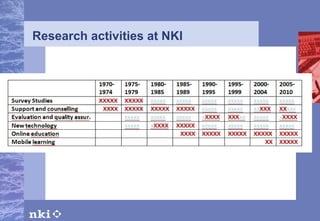
Research activities at NKI
Moore, 1985: “ Distance education is an applied professional field, and such fields - like medicine - need two kinds of research. Obviously it needs research which helps solve problems, but it also needs basic research - that is, research which tests and extends basic knowledge which is helpful to us all - and that is the theory. ”
Survey and drop out studies Survey and drop out studies  –  some results Drop out from distance study is larger in the initial phases of study than later  A considerable number of students do not submit one single assignment There is a positive correlation between the age and success  There is also a positive correlation between level of previous education and all measures of success in distance study, and a negative relationship between time since last school experience and success Reasons: External factors  –  Internal factors  –  Interactions Measures taken to improve teaching and support services do have effects
Moore, 1985: “ If we want to know the effect of a particular teaching technique, the researcher must control the effects of other conditions and manipulate the technique in question and see the effect on the learners. This is the only sure way of evaluating practice, yet it is very seriously neglected in distance education. ”
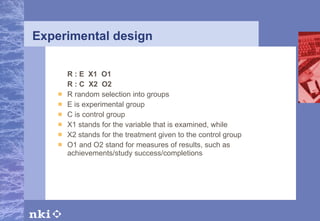
Experimental design R : E  X1  O1 R : C  X2  O2 R random selection into groups E is experimental group C is control group X1 stands for the variable that is examined, while X2 stands for the treatment given to the control group O1 and O2 stand for measures of results, such as achievements/study success/completions
Experimental studies – examples   Turn-around time Systematic follow-up and introduction to study techniques Pre-produced tutor comments Telephone tutoring The use of fax in two-way communication The personal tutor-counsellor in distance education
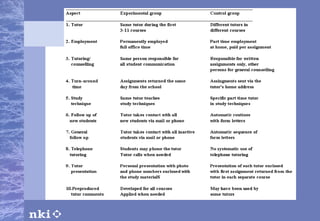
Personalizing teaching in a large- scale system Aspects included in the experiment:
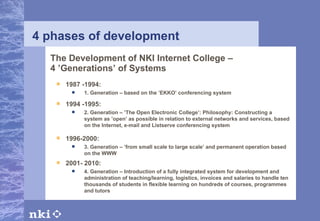
4 phases of development The Development of NKI Internet College –  4 ’Generations’ of Systems 1987 -1994: 1. Generation – based on the ’EKKO’ conferencing system 1994 -1995: 2. Generation – ’The Open Electronic College’: Philosophy: Constructing a system as ’open’ as possible in relation to external networks and services, based on the Internet, e-mail and Listserve conferencing system 1996-2000: 3. Generation – ’from small scale to large scale’ and permanent operation based on the WWW 2001- 2010: 4. Generation – Introduction of a fully integrated system for development and administration of teaching/learning, logistics, invoices and salaries to handle ten thousands of students in flexible learning on hundreds of courses, programmes and tutors
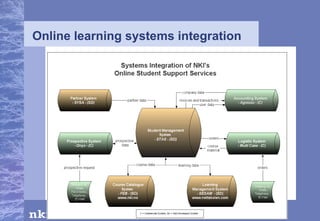
Online learning systems integration
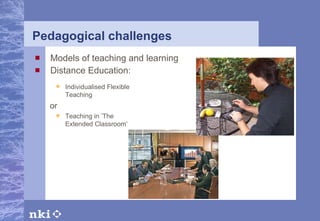
Pedagogical challenges Models of teaching and learning Distance Education: Individualised Flexible Teaching  or  Teaching in ’The Extended Classroom’
Student support John Bååth: ” We have four categories of students; there are students who need student support services but don’t want them students who need student support services and want them students who don’t need student support services but want them students who neither need nor want student support services.”   !Comparative studies at NKI shows that distance students differ more on most variables than do ordinary students!
Students’ attitudes Students’ attitudes towards online learning Why choose online study? Flexibility Some other aspects Very important: Less important: the quality of the study guide individual reading/study work on assignments the tutor’s comments individual communication with the tutor individual flexibility social and academic communication with fellow students social and academic conferences cooperative learning
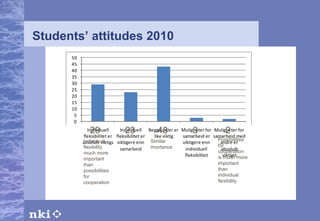
Students’ attitudes 2010 29  23  43  3  2 Individual flexibility much more important than possibilities for cooperation Similar imortance Possibilities for cooperation is much more important than individual flexibility
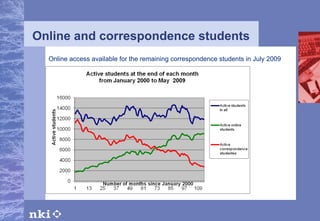
Online and correspondence students Online access available for the remaining correspondence students in July 2009
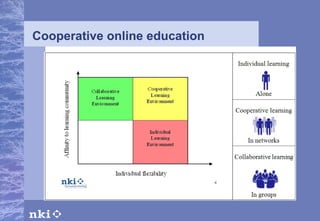
Cooperative online education
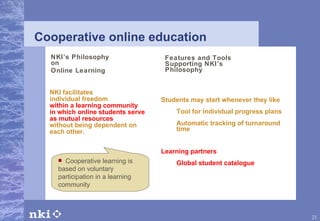
NKI’s Philosophy on  Online Learning NKI facilitates individual freedom within a learning community in which online students serve as mutual resources without being dependent on each other. Features and Tools Supporting NKI’s Philosophy Students may start whenever they like Tool for individual progress plans Automatic tracking of turnaround time Learning partners Global student catalogue Cooperative learning is  based on voluntary participation in a learning community Cooperative online education
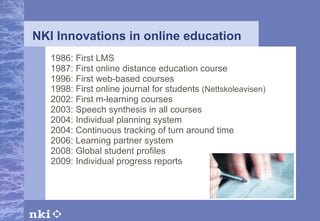
NKI Innovations in online education 1986: First LMS 1987: First online distance education course 1996: First web-based courses 1998: First online journal for students  (Nettskoleavisen) 2002: First m-learning courses 2003: Speech synthesis in all courses 2004: Individual planning system 2004: Continuous tracking of turn around time 2006: Learning partner system 2008: Global student profiles 2009: Individual progress reports
Individual adaption of learning materials Characteristica of online students at NKI: Large differences between students on ”all” variables Large number of students with reading and writing difficulties Specific market within vocational rehabilitation market Many second chance students
Individual adaption of learning materials Some solutions not related to content/message Emphasis on individual tutoring Emphasis on individual student support Emphasis on individual pace of study Emphasis on individual support systems
Individual adaption of learning materials Learning materials Universal adaptation and acessibility Speech synthesis of all web materials Easy language Built-in tutor Individual choice of routes through materials Individual choice of exercises and tests Voluntary submissions No real individualization of the pre-produced learning message The FIRB AM-Learning project represents an interesting innovation
Thank you!

Research in distance education at NKI

  • 1.
    The NKI InternetCollege Based on 40 Years of Research in Distance Education – Relevance for the FIRB AM-Learning Project FIRB AM-Learning seminar April 16th 2010 Torstein Rekkedal Professor Norwegian School of Information Technology Director of Research and Development at NKI, Norway
  • 2.
    NKI research andAM-Learning????? AM-Learning: Automatization of individualisation of learning message according to automatic assessment of individual language and linguistic ability Research in this field is lacking within distance and online learning Assumption holds in general – relation to NKI research Assumption in line with e.g. Jim Taylor and the development of ”Fifth generation distance education - Cost-effiency combined with high quality requires automatization of tutoring services
  • 3.
    NKI NKI DistanceEducation Established in Sweden in 1910 Established in Norway 1959 Non profit foundation from 1974 Company within the ABNU Educational corporation from 2007 Each year around 15,000 active students in 40 countries 100 programmes and 400 courses on the Internet One of few megaproviders of online distance education in Europe The only or one of very few private non research institutions with av continuous research agenda – specifically on own activities
  • 4.
    NKI Distance Education: One of Europe’s largest providers of online distance education More than 110 000 enrolments in online courses since 1987 Broad range of subjects from secondary to master level About 400 distance education courses online (all in Norwegian) About 10 000 online students in about 40 countries About 70 % women Revenue of 14 M Euros in 2007, 9.5 M of them from online education Individual progress plans/individual follow-up Thousands of potential learning partners Global student catalogue with 1100 profiles Always room for more students Exams at local schools and embassies Online students get better grades
  • 5.
    Research strategy Trustworthyknowledge of reality is necessary for development and quality development Research is the best basis for learning Research stimulates personnel and organisational development Research motivates Research supports network building Research market and profiles the institution in the gneneral public and to the authorities Research contributes to the bottom line
  • 6.
  • 7.
    Moore, 1985: “Distance education is an applied professional field, and such fields - like medicine - need two kinds of research. Obviously it needs research which helps solve problems, but it also needs basic research - that is, research which tests and extends basic knowledge which is helpful to us all - and that is the theory. ”
  • 8.
    Survey and dropout studies Survey and drop out studies – some results Drop out from distance study is larger in the initial phases of study than later A considerable number of students do not submit one single assignment There is a positive correlation between the age and success There is also a positive correlation between level of previous education and all measures of success in distance study, and a negative relationship between time since last school experience and success Reasons: External factors – Internal factors – Interactions Measures taken to improve teaching and support services do have effects
  • 9.
    Moore, 1985: “If we want to know the effect of a particular teaching technique, the researcher must control the effects of other conditions and manipulate the technique in question and see the effect on the learners. This is the only sure way of evaluating practice, yet it is very seriously neglected in distance education. ”
  • 10.
    Experimental design R: E X1 O1 R : C X2 O2 R random selection into groups E is experimental group C is control group X1 stands for the variable that is examined, while X2 stands for the treatment given to the control group O1 and O2 stand for measures of results, such as achievements/study success/completions
  • 11.
    Experimental studies –examples Turn-around time Systematic follow-up and introduction to study techniques Pre-produced tutor comments Telephone tutoring The use of fax in two-way communication The personal tutor-counsellor in distance education
  • 12.
    Personalizing teaching ina large- scale system Aspects included in the experiment:
  • 13.
    4 phases ofdevelopment The Development of NKI Internet College – 4 ’Generations’ of Systems 1987 -1994: 1. Generation – based on the ’EKKO’ conferencing system 1994 -1995: 2. Generation – ’The Open Electronic College’: Philosophy: Constructing a system as ’open’ as possible in relation to external networks and services, based on the Internet, e-mail and Listserve conferencing system 1996-2000: 3. Generation – ’from small scale to large scale’ and permanent operation based on the WWW 2001- 2010: 4. Generation – Introduction of a fully integrated system for development and administration of teaching/learning, logistics, invoices and salaries to handle ten thousands of students in flexible learning on hundreds of courses, programmes and tutors
  • 14.
  • 15.
    Pedagogical challenges Modelsof teaching and learning Distance Education: Individualised Flexible Teaching or Teaching in ’The Extended Classroom’
  • 16.
    Student support JohnBååth: ” We have four categories of students; there are students who need student support services but don’t want them students who need student support services and want them students who don’t need student support services but want them students who neither need nor want student support services.” !Comparative studies at NKI shows that distance students differ more on most variables than do ordinary students!
  • 17.
    Students’ attitudes Students’attitudes towards online learning Why choose online study? Flexibility Some other aspects Very important: Less important: the quality of the study guide individual reading/study work on assignments the tutor’s comments individual communication with the tutor individual flexibility social and academic communication with fellow students social and academic conferences cooperative learning
  • 18.
    Students’ attitudes 201029 23 43 3 2 Individual flexibility much more important than possibilities for cooperation Similar imortance Possibilities for cooperation is much more important than individual flexibility
  • 19.
    Online and correspondencestudents Online access available for the remaining correspondence students in July 2009
  • 20.
  • 21.
    NKI’s Philosophy on Online Learning NKI facilitates individual freedom within a learning community in which online students serve as mutual resources without being dependent on each other. Features and Tools Supporting NKI’s Philosophy Students may start whenever they like Tool for individual progress plans Automatic tracking of turnaround time Learning partners Global student catalogue Cooperative learning is based on voluntary participation in a learning community Cooperative online education
  • 22.
    NKI Innovations inonline education 1986: First LMS 1987: First online distance education course 1996: First web-based courses 1998: First online journal for students (Nettskoleavisen) 2002: First m-learning courses 2003: Speech synthesis in all courses 2004: Individual planning system 2004: Continuous tracking of turn around time 2006: Learning partner system 2008: Global student profiles 2009: Individual progress reports
  • 23.
    Individual adaption oflearning materials Characteristica of online students at NKI: Large differences between students on ”all” variables Large number of students with reading and writing difficulties Specific market within vocational rehabilitation market Many second chance students
  • 24.
    Individual adaption oflearning materials Some solutions not related to content/message Emphasis on individual tutoring Emphasis on individual student support Emphasis on individual pace of study Emphasis on individual support systems
  • 25.
    Individual adaption oflearning materials Learning materials Universal adaptation and acessibility Speech synthesis of all web materials Easy language Built-in tutor Individual choice of routes through materials Individual choice of exercises and tests Voluntary submissions No real individualization of the pre-produced learning message The FIRB AM-Learning project represents an interesting innovation
  • 26.