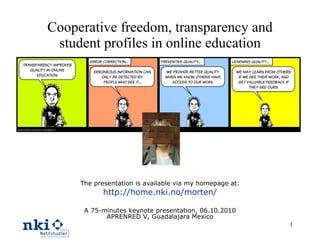
Cooperative freedom, transparency and student profiles in online education The presentation is available via my homepage at: http://home.nki.no/morten/ A 75-minutes keynote presentation, 06.10.2010 APRENRED V, Guadalajara Mexico
About me Thought my first online, distance education course in 1987 Director of Development and Innovation at NKI Distance Education Professor of Online Education President of EDEN Doctor of Education from the Pennsylvania State University Has been Adjunct Professor, at the Athabasca University in Canada and  professor associado  at Universidade Aberta in Portugal
NKI was established as a correspondence school in 1910 One of Europe’s largest providers of online distance education More than 130 000 enrolments in online courses since 1987 Broad range of subjects from secondary to master level About 400 distance education courses online (all in Norwegian) About 13 000 online students in about 40 countries About 70 % women Individual progress plans/individual follow-up Thousands of potential learning partners Global student catalogue with 1650 profiles Always room for more students Exams at local schools and embassies October 2010
Secondary school courses:  Tonje Kvalvik  18 courses completed  Vocational courses:  Thor Steinsland  24 and  Roger Skogberget  27 College courses:  Trude Helen Flak  13 and  Erma Bratic  14 Celebrating 100 000 online course enrolments During the first 20 years, NKI’s online students enrolled in hundred thousand courses and spent many million hours of studying to reach their goals. This was celebrated  August 22, 2008 with 5 students as guests of honour.
Online access available for the remaining correspondence students in July 2009
The most interesting pedagogical challenge in our lifetime is to provide online education that combines individual freedom with meaningful cooperation. I have struggled with this challenge since I first introduced my Theory of Cooperative Freedom in 1992. www.ednews.org/articles/10626/1/An-Interview-with-Morten-Flate-Paulsen-Focusing-on-His-Theory-of-Cooperative-Freedom-in-Online-Education/Page1.html
The book’s website: www.studymentor.com   The Theory of Cooperative Freedom is described in my book, which you can  download   from the Internet. Online Education and Learning Management Systems: Global E-learning in a Scandinavian Perspective .
Now… … the web2.0 and PLE services may help the theory suceed… The most interesting characteristics of Web 2.0 is the development of social networks that are hugely successful since the users produce, share and refine information of mutual interest and benefit for all the community members .
Six Dimensions of Freedom It is difficult to combine individual flexibility and cooperation
One may say that: Individual learning is conducted  alone Collaborative learning depends on  groups Cooperative learning takes place in  networks
NKI provides cooperative online education
NKI’s Philosophy on Online Learning NKI facilitates individual freedom within a learning community in which online students serve as mutual resources without being dependent on each other. Features and Tools Supporting NKI’s Philosophy Students may start whenever they like Tool for individual progress plans Automatic tracking of turnaround time Learning partners Global student catalogue Cooperative learning is based on voluntary participation in a learning community
NKI Innovations in Online Education 1986: First LMS 1987: First online distance education course 1996: First web-based courses 1998: First online journal for students  (Nettskoleavisen) 2002: First m-learning courses 2003: Speech synthesis in all courses 2004: Individual planning system 2004: Continuous tracking of turn around time 2006: Learning partner system 2008: Global student profiles 2009: Individual progress reports Rosing Competency Award  2003 Baldic Award 2006 Tisip E-learning Award 2007
NKI Developments 2006 Learning partner services 2004 Planning system and response barometer 1996 The first web courses –  1986 Correspondence school 1986 NKI developed the first LMS in Europe 2009 Online access + progress reports  2011 Quality barometer … 6
Continuous tracking of turn around time Introduced in May 2004 Resulted in much discussion in the teachers’ online forum A few teachers voiced strong criticism, doubts and reservations The average response time  dropped month by month during the Fall of 2004. In October it showed 3,97 days, in November 3,06 days and in December 2,76 days. Since then, the average response time has been less than 3 days except during summer holidays. In 2008 we introduced an automatic e-mail reminder to the tutors who had one ore more assignments waiting for 7 days or more.
NKI’s quality goal:  90 %  of students positive or neutrale My results last quarter/year:  93/84 %.  Average teacher results last quarter/year:  86/89 % A nonymous evaluation Automatic e-mail reminders if quality should be noticed Quality Barometer - coming 2011 22
NKI students have individual progress plans UA students have collective progress plans Copyright Atle Løkken
NKI introduced the individual planning system in 2004 assignments that are completed assignments that are delayed according to the plan assignments that are planned
In January 2009 we started to e-mail individual monthly progress reports to all students Includes personal: Contact information LMS settings Progress report Planed progress
Lists with information about next submission number and planned submission date makes cooperation easier
Boldic Award 2006 NKI’s Learning Partners Innovative service for voluntary cooperation between students in a large online learning community International award for the Baltic and Nordic countries. The jury stated that NKI’s Learning Partner Service: "Furthers and develops the Nordic tradition in ODL. The learning partner concept adds a new, innovative dimension of student support to flexible distance education.“ Learning partner - opportunities for cooperation in distance learning www.elearningeuropa.info/directory/index.php?page=doc&doc_id=8294&doclng=6
There is an online demo explaining in Norwegian how students may find learning partners www.nettskolen.com/multimedia/laringspartner1_viewlet_swf.html   Make your personal presentation Decide who may access it Search for potential learning partners Invite somebody to become your learning partner
Anders S., student at the  NKI  School of Project Management: I have three learning partners, whom I chose because the y  were about at the same stage in the course as I was. Luckily enough, one of my learning partners also lives not far from me. The communication vary, in general  I communicate with at least 2 of my LPs each week. I wish to increase my competence by seeing the subject matter content from different angles, and get healthy and inspiring discussions about the assignments. I feel like I have got some new friends, and a possibility to both learn and help others. I feel that I have benefited from the cooperation, I would very much like to recommend the Learning partner service to other online   students.
Presentations May 2009 All 10102 users of NKI’s LMS have personal presentations which automatically list relevant information about them and their courses as shown below. 5299 of them have added some personal information, typically a photo and a description of previous education, work experience and personal interests as shown below. www.nki.no/pp/fagerbergtr
Presentations May 2009 The default values are: Limited visibility and Don’t want LP Visibility Want LP Don’t want LP Sum Percent Closed 141 913 1054 10 Limited 2096 3469 5565 55 Open 745 1580 2325 23 Global 670 488 1158 12 Sum 3652 6450 10102 100 Percent 36 64 100  
Google translation of the Global Catalogue   at www.nki.no/pp
350 Senior students 70 Fellow students 55 Senior Fellow students courses Kurt Karlsen  www.nki.no/pp/KurtKarlsen  completed 56 courses from 1995 to 2005
NKI has 1600 global student presentations www.youtube.com/MortenFP#p/a/u/0/gyQ1u977iwk
The presentations show that online courses support individual needs and challenges Man, 42 years:  I chose online learning since  I need  flexibility to study . At the moment I work 50/50 in Norway and India, and it would be impossible for me to study without NKI’s flexibility. Online education makes it possible for me to study independent of time zones, geography and daily tasks .  52 of the 100 global students mention that they have children. 5 of them write that they are less than 23 years old and have children.  Woman, 18 years : I’m 18 years old…. I used to go to … secondary school, but  when I got pregnant, I found that it would be easier to finish school via online courses  and not take the baby with me to school. 10 of the 100 presentations disclose particular learning challenges. Woman 23:   I have dyslexia  …  Woman, 38:  I received the diagnosis  Multiple Sclerosis  two years ago, and to quit a busy job. With online courses, I can organize my days so that I have energy for my family, friends and physical exercises. NKI has many gifted immigrants who study online to get Norwegian certificates and competencies.
How to manage 28 self-paced courses, three kids and a job in the North Sea Thor Steinsland www.nki.no/pp/steinslandt presented his experiences at the EDEN Research Workshop in Paris, October 2008
There are NKI students who understand Norwegian in about 40 countries Translated by Google from www.nki.no/pp/ThereseSvihus
Presented with permission from  www.nki.no/pp/LexidhSolstad I now try to get a diploma showing that I can write. Have worked as a TV journalist … but now the Fibromyalgia pains restrains me so much that I have to work from bed in the future.
Translated by Google from www.nki.no/pp/ViviHurtley I was accepted as a psychology student at the university, but had no interpreter, so I chose to study online to combine family life and education. I need a sign language interpreter to follow  traditional lectures, since I am deaf. So it is ideal with NKI, since I do not need an interpreter.
Why the presentations are important to NKI Better service since we see the human behind the e-mail addresses and student IDs More cooperation since students know more about each others Improved information to prospective students
Global teacher presentations Courses thought are automatically listed Many teachers provide advice to students in their presentations The advice is valuable also for prospective students
Transparency or privacy ?
Risks!!! Inappropriate content Copyright issues Criticism from dissatisfied students Students who expose too much personal information NKI handles these issues by asking readers to report inappropriate content to an e-mail address. So far, we have not received any reports or complaints .
Transparency improves quality
Transparency promotes cooperation Dalsgaard, C. and Paulsen, M.F. (2009) Transparency in Cooperative Online Education.  IRRODL, Vol 10, No 3.
Some relevant resources E-viva em Portugal  http://nettstudier.blogspot.com/ Transparency in Cooperative Online Education  http://www.irrodl.org/index.php/irrodl/article/view/671/1267 Cooperative Online Education  http://seminar.net/index.php/volume-4-issue-2-2008-previousissuesmeny-124/100-cooperative-online-education   Cooperative Freedom and Transparency in Online Education http://www.slideshare.net/MortenFP/futuralia-3400339 Visualizing student profiles http://www.slideshare.net/MortenFP/visualizing-student-profiles-through-nkis-online-catalogue-and-student-network   Transparency for Cooperation http://toonlet.com/archive?m=s&i=11245
I demonstrated what I mean by cooperative freedom, and transparency through an online master course at Universidade Aberta in Portugal Some of the MPEL-students at Futuralia Read about my experiences at: http://nettstudier.blogspot.com/2010/04/online-teaching-techniques.html
Processos Pedagógicos em Elearning The Course had 4 Study Units The Theory of Cooperative Freedom Online Teaching Techniques Transparency in Online Education Final report, reflection and refinement
Each Study Unit had 4 Week-long Activities Find, study and share materials related to the theme and organizing it together with ideas and thoughts in an  annotated bibliography  in your blog Produce a  learning object  related to the theme, publish it somewhere Write  reviews  in the forum on one annotated bibliography and one learning object published by colleagues Take part in a  structured discussion  on issues related to the theme
The students’ course work and personal learning environments are available via  http://ppel4.pbworks.com/
Activity 2: Examples of Learning Objects my students published in various web2.0 services http://issuu.com/svalente/docs/learning_process_-_sv   http://issuu.com/eduardarondao/docs/ppel/16   http://toonlet.com/creator/monicavelosa   http://voicethread.com/#q.b700875.i3706622   http://animoto.com/play/mcWnwcwLlchUW7kikfjkDg?autostart=true http://lenita.edu.glogster.com/learning-partners-when-students-become-teachers/   http://content.yudu.com/Library/A1mvrs/TransparencyinOnline/resources/index.htm   http://goanimate.com/movie/0t_WqQCZr6m8 http://goanimate.com/movie/0tHSCTHKrJ8U   http://prezi.com/jtuypqux9uoe/cooperative-freedom/   http://prezi.com/vrphgc8096jy/cooperative-freedom/   http://www.xtranormal.com/watch/6292799/   http://www.scribd.com/doc/28688394/Cooperative-Freedom-in-NKI   http://www.youtube.com/MortenFP#p/f/3/g6Oo1-VXsWI   http://www.slideshare.net/nmso/learning-object-theory-cooperative-freedom   http://groups.diigo.com/group/uab-mpel3 http://www.facebook.com/profile.php?id=100000775922345#!/group.php?gid=206533992596   http://actividade2.wikispaces.com/
http://voicethread.com/#q.b700875.i3706651
GoAnimate.com :   Cooperative Freedom in Learning   by elearninghoje http://goanimate.com/movie/0tHSCTHKrJ8U
Activity 4: Structured discussion One-Question-Interviews Terry Anderson: About Cooperative Freedom Stephen Downes: Collaboration vs Cooperation Debate: Transparency vs Privacy Debate: self-paced versus group-paced progression Roleplay on workload
Mónica’s final report:  http://finalreport.ensinoinf.net/  Sónia’s final report: http://issuu.com/svalente/docs/learning_process_-_sv
Summary of experiences from Universidade Aberta The students  publish their work  in  blogs  (Blogspot, Wordpress etc.) They share it in Moodle,  Facebook  and  Diigo They make learning objects in Toonlet, Glogster, Slideshare, Youtube, Issuu, Voicetread etc. It’s much work to overview this distributed learning environment The “entire world” can see our work and give us feedback Many tutors and students may not be comfortable with this extreme openness.
Questions? I care, so I share: http://home.nki.no/morten https://twitter.com/MFPaulsen  http://www.slideshare.net/MortenFP http://www.facebook.com/mfpaulsen  http://www.eden-online.org/blog

Key Note Guadalajara

  • 1.
    Cooperative freedom, transparencyand student profiles in online education The presentation is available via my homepage at: http://home.nki.no/morten/ A 75-minutes keynote presentation, 06.10.2010 APRENRED V, Guadalajara Mexico
  • 2.
    About me Thoughtmy first online, distance education course in 1987 Director of Development and Innovation at NKI Distance Education Professor of Online Education President of EDEN Doctor of Education from the Pennsylvania State University Has been Adjunct Professor, at the Athabasca University in Canada and professor associado at Universidade Aberta in Portugal
  • 3.
    NKI was establishedas a correspondence school in 1910 One of Europe’s largest providers of online distance education More than 130 000 enrolments in online courses since 1987 Broad range of subjects from secondary to master level About 400 distance education courses online (all in Norwegian) About 13 000 online students in about 40 countries About 70 % women Individual progress plans/individual follow-up Thousands of potential learning partners Global student catalogue with 1650 profiles Always room for more students Exams at local schools and embassies October 2010
  • 4.
    Secondary school courses: Tonje Kvalvik 18 courses completed Vocational courses: Thor Steinsland 24 and Roger Skogberget 27 College courses: Trude Helen Flak 13 and Erma Bratic 14 Celebrating 100 000 online course enrolments During the first 20 years, NKI’s online students enrolled in hundred thousand courses and spent many million hours of studying to reach their goals. This was celebrated August 22, 2008 with 5 students as guests of honour.
  • 5.
    Online access availablefor the remaining correspondence students in July 2009
  • 6.
    The most interestingpedagogical challenge in our lifetime is to provide online education that combines individual freedom with meaningful cooperation. I have struggled with this challenge since I first introduced my Theory of Cooperative Freedom in 1992. www.ednews.org/articles/10626/1/An-Interview-with-Morten-Flate-Paulsen-Focusing-on-His-Theory-of-Cooperative-Freedom-in-Online-Education/Page1.html
  • 7.
    The book’s website:www.studymentor.com The Theory of Cooperative Freedom is described in my book, which you can download from the Internet. Online Education and Learning Management Systems: Global E-learning in a Scandinavian Perspective .
  • 8.
    Now… … theweb2.0 and PLE services may help the theory suceed… The most interesting characteristics of Web 2.0 is the development of social networks that are hugely successful since the users produce, share and refine information of mutual interest and benefit for all the community members .
  • 9.
    Six Dimensions ofFreedom It is difficult to combine individual flexibility and cooperation
  • 10.
    One may saythat: Individual learning is conducted alone Collaborative learning depends on groups Cooperative learning takes place in networks
  • 11.
    NKI provides cooperativeonline education
  • 12.
    NKI’s Philosophy onOnline Learning NKI facilitates individual freedom within a learning community in which online students serve as mutual resources without being dependent on each other. Features and Tools Supporting NKI’s Philosophy Students may start whenever they like Tool for individual progress plans Automatic tracking of turnaround time Learning partners Global student catalogue Cooperative learning is based on voluntary participation in a learning community
  • 13.
    NKI Innovations inOnline Education 1986: First LMS 1987: First online distance education course 1996: First web-based courses 1998: First online journal for students (Nettskoleavisen) 2002: First m-learning courses 2003: Speech synthesis in all courses 2004: Individual planning system 2004: Continuous tracking of turn around time 2006: Learning partner system 2008: Global student profiles 2009: Individual progress reports Rosing Competency Award 2003 Baldic Award 2006 Tisip E-learning Award 2007
  • 14.
    NKI Developments 2006Learning partner services 2004 Planning system and response barometer 1996 The first web courses – 1986 Correspondence school 1986 NKI developed the first LMS in Europe 2009 Online access + progress reports 2011 Quality barometer … 6
  • 15.
    Continuous tracking ofturn around time Introduced in May 2004 Resulted in much discussion in the teachers’ online forum A few teachers voiced strong criticism, doubts and reservations The average response time dropped month by month during the Fall of 2004. In October it showed 3,97 days, in November 3,06 days and in December 2,76 days. Since then, the average response time has been less than 3 days except during summer holidays. In 2008 we introduced an automatic e-mail reminder to the tutors who had one ore more assignments waiting for 7 days or more.
  • 16.
    NKI’s quality goal: 90 % of students positive or neutrale My results last quarter/year: 93/84 %. Average teacher results last quarter/year: 86/89 % A nonymous evaluation Automatic e-mail reminders if quality should be noticed Quality Barometer - coming 2011 22
  • 17.
    NKI students haveindividual progress plans UA students have collective progress plans Copyright Atle Løkken
  • 18.
    NKI introduced theindividual planning system in 2004 assignments that are completed assignments that are delayed according to the plan assignments that are planned
  • 20.
    In January 2009we started to e-mail individual monthly progress reports to all students Includes personal: Contact information LMS settings Progress report Planed progress
  • 21.
    Lists with informationabout next submission number and planned submission date makes cooperation easier
  • 22.
    Boldic Award 2006NKI’s Learning Partners Innovative service for voluntary cooperation between students in a large online learning community International award for the Baltic and Nordic countries. The jury stated that NKI’s Learning Partner Service: "Furthers and develops the Nordic tradition in ODL. The learning partner concept adds a new, innovative dimension of student support to flexible distance education.“ Learning partner - opportunities for cooperation in distance learning www.elearningeuropa.info/directory/index.php?page=doc&doc_id=8294&doclng=6
  • 23.
    There is anonline demo explaining in Norwegian how students may find learning partners www.nettskolen.com/multimedia/laringspartner1_viewlet_swf.html Make your personal presentation Decide who may access it Search for potential learning partners Invite somebody to become your learning partner
  • 24.
    Anders S., studentat the NKI School of Project Management: I have three learning partners, whom I chose because the y were about at the same stage in the course as I was. Luckily enough, one of my learning partners also lives not far from me. The communication vary, in general I communicate with at least 2 of my LPs each week. I wish to increase my competence by seeing the subject matter content from different angles, and get healthy and inspiring discussions about the assignments. I feel like I have got some new friends, and a possibility to both learn and help others. I feel that I have benefited from the cooperation, I would very much like to recommend the Learning partner service to other online students.
  • 25.
    Presentations May 2009All 10102 users of NKI’s LMS have personal presentations which automatically list relevant information about them and their courses as shown below. 5299 of them have added some personal information, typically a photo and a description of previous education, work experience and personal interests as shown below. www.nki.no/pp/fagerbergtr
  • 26.
    Presentations May 2009The default values are: Limited visibility and Don’t want LP Visibility Want LP Don’t want LP Sum Percent Closed 141 913 1054 10 Limited 2096 3469 5565 55 Open 745 1580 2325 23 Global 670 488 1158 12 Sum 3652 6450 10102 100 Percent 36 64 100  
  • 27.
    Google translation ofthe Global Catalogue at www.nki.no/pp
  • 28.
    350 Senior students70 Fellow students 55 Senior Fellow students courses Kurt Karlsen www.nki.no/pp/KurtKarlsen completed 56 courses from 1995 to 2005
  • 29.
    NKI has 1600global student presentations www.youtube.com/MortenFP#p/a/u/0/gyQ1u977iwk
  • 30.
    The presentations showthat online courses support individual needs and challenges Man, 42 years: I chose online learning since I need flexibility to study . At the moment I work 50/50 in Norway and India, and it would be impossible for me to study without NKI’s flexibility. Online education makes it possible for me to study independent of time zones, geography and daily tasks . 52 of the 100 global students mention that they have children. 5 of them write that they are less than 23 years old and have children. Woman, 18 years : I’m 18 years old…. I used to go to … secondary school, but when I got pregnant, I found that it would be easier to finish school via online courses and not take the baby with me to school. 10 of the 100 presentations disclose particular learning challenges. Woman 23: I have dyslexia … Woman, 38: I received the diagnosis Multiple Sclerosis two years ago, and to quit a busy job. With online courses, I can organize my days so that I have energy for my family, friends and physical exercises. NKI has many gifted immigrants who study online to get Norwegian certificates and competencies.
  • 31.
    How to manage28 self-paced courses, three kids and a job in the North Sea Thor Steinsland www.nki.no/pp/steinslandt presented his experiences at the EDEN Research Workshop in Paris, October 2008
  • 32.
    There are NKIstudents who understand Norwegian in about 40 countries Translated by Google from www.nki.no/pp/ThereseSvihus
  • 33.
    Presented with permissionfrom www.nki.no/pp/LexidhSolstad I now try to get a diploma showing that I can write. Have worked as a TV journalist … but now the Fibromyalgia pains restrains me so much that I have to work from bed in the future.
  • 34.
    Translated by Googlefrom www.nki.no/pp/ViviHurtley I was accepted as a psychology student at the university, but had no interpreter, so I chose to study online to combine family life and education. I need a sign language interpreter to follow traditional lectures, since I am deaf. So it is ideal with NKI, since I do not need an interpreter.
  • 35.
    Why the presentationsare important to NKI Better service since we see the human behind the e-mail addresses and student IDs More cooperation since students know more about each others Improved information to prospective students
  • 36.
    Global teacher presentationsCourses thought are automatically listed Many teachers provide advice to students in their presentations The advice is valuable also for prospective students
  • 37.
  • 39.
    Risks!!! Inappropriate contentCopyright issues Criticism from dissatisfied students Students who expose too much personal information NKI handles these issues by asking readers to report inappropriate content to an e-mail address. So far, we have not received any reports or complaints .
  • 40.
  • 41.
    Transparency promotes cooperationDalsgaard, C. and Paulsen, M.F. (2009) Transparency in Cooperative Online Education. IRRODL, Vol 10, No 3.
  • 42.
    Some relevant resourcesE-viva em Portugal http://nettstudier.blogspot.com/ Transparency in Cooperative Online Education http://www.irrodl.org/index.php/irrodl/article/view/671/1267 Cooperative Online Education http://seminar.net/index.php/volume-4-issue-2-2008-previousissuesmeny-124/100-cooperative-online-education Cooperative Freedom and Transparency in Online Education http://www.slideshare.net/MortenFP/futuralia-3400339 Visualizing student profiles http://www.slideshare.net/MortenFP/visualizing-student-profiles-through-nkis-online-catalogue-and-student-network Transparency for Cooperation http://toonlet.com/archive?m=s&i=11245
  • 43.
    I demonstrated whatI mean by cooperative freedom, and transparency through an online master course at Universidade Aberta in Portugal Some of the MPEL-students at Futuralia Read about my experiences at: http://nettstudier.blogspot.com/2010/04/online-teaching-techniques.html
  • 44.
    Processos Pedagógicos emElearning The Course had 4 Study Units The Theory of Cooperative Freedom Online Teaching Techniques Transparency in Online Education Final report, reflection and refinement
  • 45.
    Each Study Unithad 4 Week-long Activities Find, study and share materials related to the theme and organizing it together with ideas and thoughts in an annotated bibliography in your blog Produce a learning object related to the theme, publish it somewhere Write reviews in the forum on one annotated bibliography and one learning object published by colleagues Take part in a structured discussion on issues related to the theme
  • 46.
    The students’ coursework and personal learning environments are available via http://ppel4.pbworks.com/
  • 47.
    Activity 2: Examplesof Learning Objects my students published in various web2.0 services http://issuu.com/svalente/docs/learning_process_-_sv http://issuu.com/eduardarondao/docs/ppel/16 http://toonlet.com/creator/monicavelosa http://voicethread.com/#q.b700875.i3706622 http://animoto.com/play/mcWnwcwLlchUW7kikfjkDg?autostart=true http://lenita.edu.glogster.com/learning-partners-when-students-become-teachers/ http://content.yudu.com/Library/A1mvrs/TransparencyinOnline/resources/index.htm http://goanimate.com/movie/0t_WqQCZr6m8 http://goanimate.com/movie/0tHSCTHKrJ8U http://prezi.com/jtuypqux9uoe/cooperative-freedom/ http://prezi.com/vrphgc8096jy/cooperative-freedom/ http://www.xtranormal.com/watch/6292799/ http://www.scribd.com/doc/28688394/Cooperative-Freedom-in-NKI http://www.youtube.com/MortenFP#p/f/3/g6Oo1-VXsWI http://www.slideshare.net/nmso/learning-object-theory-cooperative-freedom http://groups.diigo.com/group/uab-mpel3 http://www.facebook.com/profile.php?id=100000775922345#!/group.php?gid=206533992596 http://actividade2.wikispaces.com/
  • 48.
  • 49.
    GoAnimate.com :  Cooperative Freedom in Learning   by elearninghoje http://goanimate.com/movie/0tHSCTHKrJ8U
  • 50.
    Activity 4: Structureddiscussion One-Question-Interviews Terry Anderson: About Cooperative Freedom Stephen Downes: Collaboration vs Cooperation Debate: Transparency vs Privacy Debate: self-paced versus group-paced progression Roleplay on workload
  • 51.
    Mónica’s final report: http://finalreport.ensinoinf.net/ Sónia’s final report: http://issuu.com/svalente/docs/learning_process_-_sv
  • 52.
    Summary of experiencesfrom Universidade Aberta The students publish their work in blogs (Blogspot, Wordpress etc.) They share it in Moodle, Facebook and Diigo They make learning objects in Toonlet, Glogster, Slideshare, Youtube, Issuu, Voicetread etc. It’s much work to overview this distributed learning environment The “entire world” can see our work and give us feedback Many tutors and students may not be comfortable with this extreme openness.
  • 53.
    Questions? I care,so I share: http://home.nki.no/morten https://twitter.com/MFPaulsen http://www.slideshare.net/MortenFP http://www.facebook.com/mfpaulsen http://www.eden-online.org/blog

Editor's Notes

  • #6 Oppdater
  • #25 Summary of Anders – other examples of sucsessfull cooperation among the the students are f.eks. 5 ladies, 2 in Houston 1 in Singapore and two in norway – they all cooperate – and communicates trough SKYPE